Top Two Divisions Attendances and Table From Today in 1985

Here are the top two divisions of the Football League’s attendances together with the two League tables. Whenever details like attendances are posted in isolation people often ask for clarity on how the top tier figures compare to the second tier and whether League position played its part in affecting crowds. Firstly, here are the top flight attendances published on 17 November 1985:

And here’s those that correspond with today in 1985 (published 24 November 1985), together with the League table too.

Obviously, these are only snapshots from that season.

If you’d like to know more about Manchester City at this time, here’s a 2,500 word subscriber feature on the 1985-86 season. Enjoy!

Subscribe to get access – Monthly

Read more of this content when you subscribe today. It costs £3 per month (cancel anytime) to access everything posted since 1 October 2022 or there’s a special annual rate below which gives greater access and works out much cheaper.

Subscribe to get access – Annual

Read more of this content when you subscribe today. It costs £3 per month (above) or £20 a year (here) to access everything posted since the site was created in December 2020. This special rate works out about £1.67 a week and gives access to everything posted, including PDFs of 3 of my books.

If you’d like to know more about subscribing then see:

Manchester 1840-1919 (Part Eleven)

Here’s another subscriber post from my book ‘The Emergence of Footballing Cultures: Manchester 1840-1919’. It tells the story of men’s football in Manchester and today’s section is the tenth chapter of the book (a 7,400 word section). This is another topical one as it focuses on a Manchester footballing scandal, namely United’s match fixing scandal. Fans of both Manchester’s League teams should find something in it for them while those not familiar with the scandal at United will be able to read the facts, not the fiction.

Subscribing costs £3 per month (cancel anytime) or you could sign up for a year at the discounted price of £20 per year. Every subscriber gets access to everything posted on the site.

Subscribe to get access

Read more of this content when you subscribe today.

Manchester 1840-1919 (Part Ten)

I’ve missed a few weeks, but today we’re restarting the series of subscriber posts from my book ‘The Emergence of Footballing Cultures: Manchester 1840-1919’. It tells the story of men’s football in Manchester and today’s section is the ninth chapter of the book (a 9,000 word section). This may be quite topical in that it focuses on City’s illegal payments scandal (United’s match fixing scandal comes next week!) and on the building of Old Trafford. It also covers the shock departure of Ernest Mangnall from the Reds to the Blues. Fans of both Manchester’s League teams should find something in it for them while those not familiar with the scandal at City will be able to read the facts, not the fiction.

Subscribing costs £3 per month (cancel anytime) or you could sign up for a year at the discounted price of £20 per year. Every subscriber gets access to everything posted on the site.

Subscribe to get access

Read more of this content when you subscribe today.

The Appeal Of Manchester City

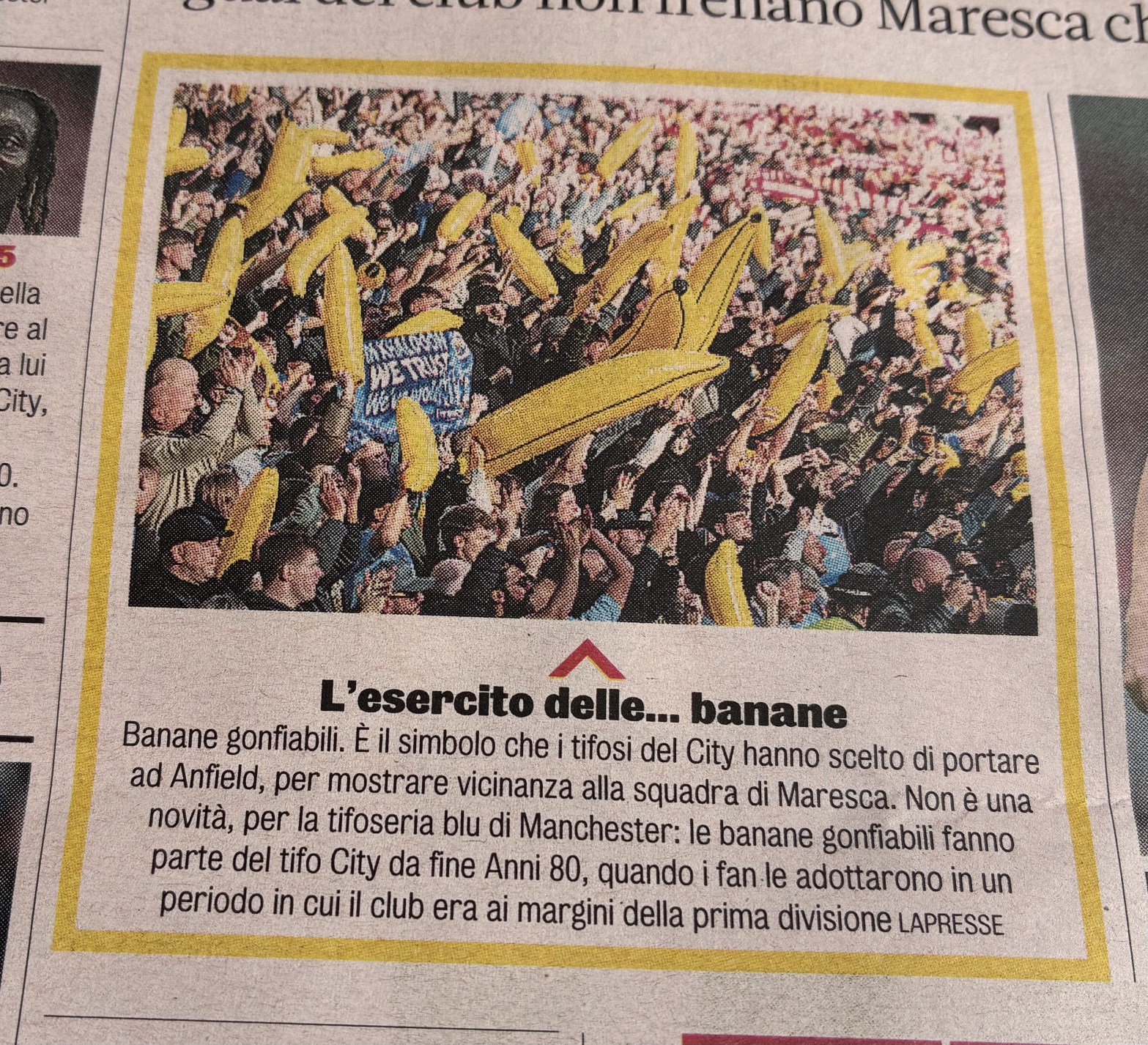
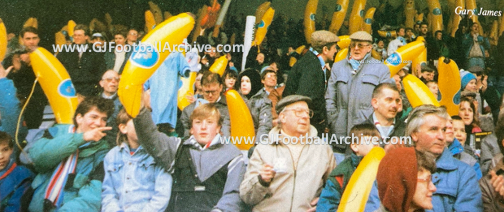
There has been a lot of criticism of City’s fanbase in recent weeks. Ridiculous stuff like celebrating a goal is seemingly wrong, according to some. Thankfully the banana craze and the general humour of fans is helping enormously and is a huge positive. Let’s face it, football is a game to enjoy and, as with the original banana craze, the idea of ‘putting the fun’ back into football is something all should support. The appeal of Manchester City has never simply been about finding success, it’s about community.

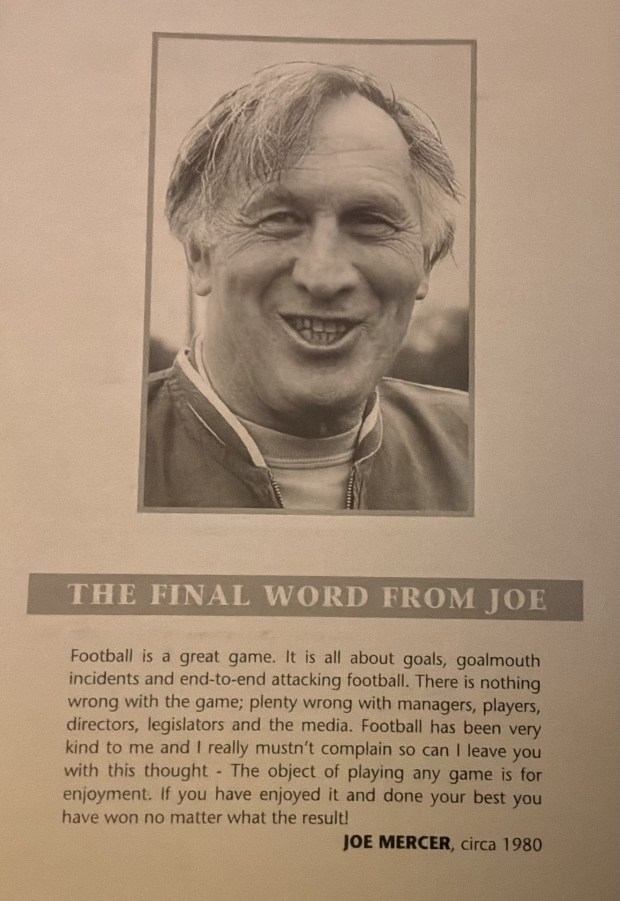
I’ve often posted this page from my biography of Joe Mercer which rightly points out that football is a great game (and highlights that there’s plenty wrong around the game, though he didn’t highlight fans which I think shows he knew what it was like for us).

Joe Mercer, quoted in Football With A Smile by Gary James

Football is all about camaraderie, connections, family and friends. It’s about shared experiences and the joy of life. Sometimes things don’t go so well, but the key thing is that football should always be about the joy of attending games and sharing experiences and, as with so many times in the past, the negativity of others shouldn’t detract from your own experience.

Leaving the Etihad the other night after City had lost to PSG there were plenty of smiling faces. Sure we’d lost but most there recognised the fightback and spirit exhibited in that second half, while also acknowledging that PSG played extremely well. I think we always knew it would be difficult to beat PSG, especially after Sunday’s pressures at Anfield, so it was wonderful to see the spirit of the Blues (both on the pitch and in the stands).

As I left the ground an excited boy was saying to his dad: ‘Did you see that penalty save, Dad?’ and he was clearly delighted with what he saw. I’m sure his dad will have seen better penalties – and saves for that matter – but for that boy it was a great moment. Maybe it was the first time he’d seen a penalty save? Maybe he wants to be a goalkeeper? Who knows, but what is true is that the game brought him joy. Ultimately, we should all have that joy.

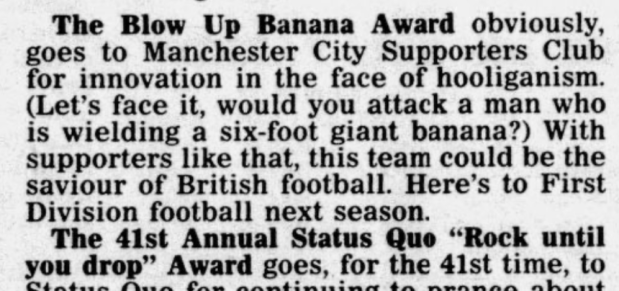
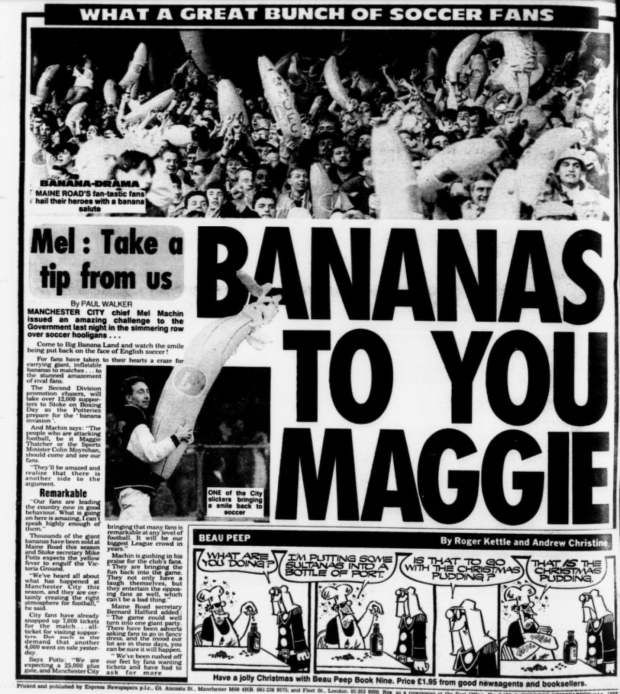
Back in 1987 when the banana craze started football fans were viewed negatively by politicians, the wider media and the general public who didn’t attend games but read what they saw in the ‘papers. We were all classed as hooligans because of several high profile stories (not least Heysel but also issues at a variety of grounds around the country), but of course not all fans looked for trouble. Not all fans were ‘hooligans’. However, the negativity towards us was intense. I remember being interviewed for, what I hoped would be my first job, and the interviewee (who knew nothing about football) was surprised I’d mentioned being a season ticket holder. It was as if I’d said I belonged to some outlawed political party.

In this environment many fans began to challenge the way we were perceived and organisations were established to represent fans’ feelings. Fanzines also started to appear. Then at City the banana craze began. It was a laugh, pure and simple, and several articles highlighted the positivity of it all. It brightened the mood.

This is a bit of a rambling piece but I just basically wanted to highlight that football is a fun game and it’s not all about match results, it’s about the community. City fans know better than most that football is never just about results. Only a small number of clubs can ever find trophy success each season and games are either won, drawn or lost – we can’t all win every game. So it’s so important to have fun no matter what the result. The banana craze gave us that in the 1980s (our big fancy dress day out at Stoke ended in defeat of course!) and today, in October 2026, thanks to the 1894 Group, the Supporters Club and those who attended Anfield, the 2026 version of the craze is doing it again. Enjoy!

Liverpool v Manchester City

Today’s the latest in a long line of meetings between Manchester’s Blues and Liverpool’s Reds. Don’t forget to take your inflatables and have some fun in an atmosphere that is likely to be ferocious today. The first competitive meeting was on 16/9/1893 (as Ardwick)) with the first meeting as Manchester City coming on New Year’s Day 1896.

There have been over 200 games between these clubs (more than Manchester derbies!) and many of these have been featured on this site over the years, such as this meeting at Anfield:

Here’s one from more recent times:

Here’s a link to every other post on this site tagged Liverpool. Enjoy!

https://gjfootballarchive.com/tag/liverpool

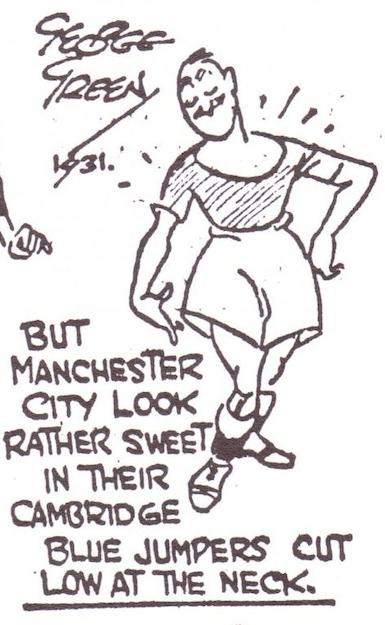
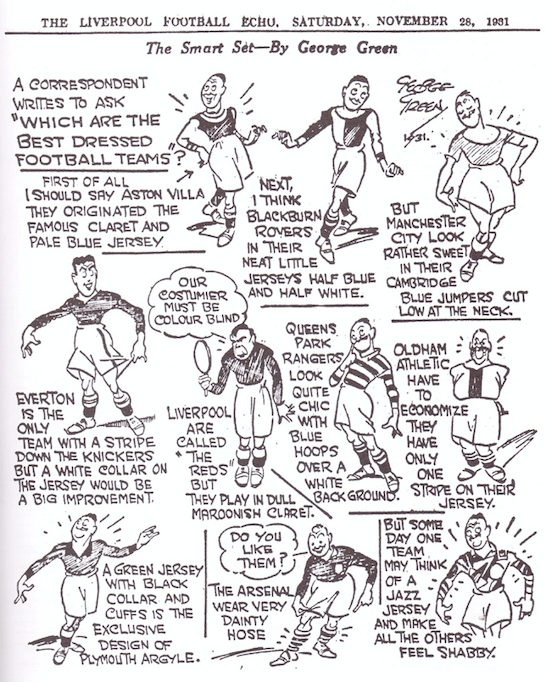
The Smart Set – Club Colours in the 1930s

On 28 November 1931 the Liverpool Echo published this George Green cartoon of the kits worn by several leading clubs of the period. I thought I’d post it here to show how these things were often portrayed in the newspapers of the day. Thanks.

While you’re here I’d like to thank you for taking the time and trouble to visit my website. I have been researching and writing about Manchester football for a long time (no wonder I’m going grey!) with my first book published in 1989. I am not employed by anyone and I do not have sponsorship either and so I’ve set up this website to help share my 32 years plus writing and research. The intention is to develop the archive and to provide access to as much of my material as possible over the coming weeks, months & years. Subscribers can already access hundreds of articles/posts including the entire Manchester A Football History book and various audio interviews (including John Bond, Malcolm Allison & George Graham). 

It costs £20 a year (it works out £1.67 a month) or £3 if you’d like to sign up a month at a time to get full access for as long as you subscribe. Thanks for the support, Gary.

Subscribe to get access to the entire site

Read the in-depth content when you subscribe today.

David White Scores Twice v Liverpool: A Rare Victory

35 years ago today (21 August 1991) a Wednesday night meeting with Liverpool ended in a 2-1 victory for Manchester City. You can see highlights of the game – a rare victory over Liverpool back then – and relive the days of night matches on the Kippax/at Maine Rd. David White scored both City’s goals: https://www.youtube.com/watch?v=RI62DKjsCmo

Record Average Crowds

I’ve not done one of these for a while but I know they always prompt a bit of debate, so here goes… a feature on Manchester City FC attendances. It is a fact that the Blues have, generation after generation, been one of the English game’s top attractions. Like all – and I do mean all – English clubs there have been some average attendance lows over the years, but when the entire history of Manchester City is reviewed and the club’s average figures are compared with the national average it is clear that the Blues have consistently been one of football’s most attractive draws.  Take a look at the following:

  • Since the beginning of the Football League in 1888 only nine sides have topped the table for average attendances.  In chronological order of their first appearance at the top of the average table they are: Everton (1888-9), Villa (1898-99), Newcastle (1904-05), Chelsea (1907-08), Tottenham (1909-10), City (1910-11), Liverpool (1922-23), Arsenal (1929-30), & Manchester United (1956-57) 
  • As early as 1895-96 City were the third best supported side in the entire League despite being a Second Division side.  Only First Division sides Everton & Aston Villa could better the Blues.  Modern day giants Arsenal were 10th; Liverpool were 19th; United were 21st and Chelsea had yet to exist.
  • In 1900-01 City were the 2nd best supported side in the entire League with only 400 people separating Villa (1st) and City 
  • The 1910-11 season saw Manchester’s Blues top the attendance charts for the first time.  City’s average was 26,000 and was the 8th highest average of all time at that point (all clubs, all seasons). 
  • Regularly amongst the best supported sides throughout the inter war period, City’s average exceeded 37,000 for the first time in 1927-28 when the Blues established a record average crowd for the Second Division.  This was also the entire League’s highest.
  • In 1947-48 City’s average crowd exceeded 42,000 for the first time.  Prior to that season only Chelsea (1919-20 & 1946-7), Arsenal (1934-5, 1936-7, 1937-8, & 1946-7) , Newcastle (1946-7), Liverpool (1946-7), United (1946-7), and Wolves (1946-7) had exceeded that figure.
  • From 1975 to relegation in 1983 City were always one of the top 4 best supported sides, usually third behind United and Liverpool.
  • Since the 1980s whenever City have played outside of the top division, they have tended to be the best supported side in that division.  
  • Since moving to their current home in 2003, the increased capacity has allowed City to re-establish itself as one of best supported clubs again. Maine Road’s capacity from 1994 onwards was extremely low compared to the club’s entire history and prevented the Blues from staging games in front of attendances of approximateley 35,000 upwards.

In general many people believe success increases support, and while that is undoubtedly true to some extent, for City it is often periods of adversity that prove the loyalty of the Club’s fans.  It is highly significant, for example, that the first time City were the best supported side in the entire League (1910-11) Manchester United (6th best supported side) won the League title for the second time in 3 seasons.

Similarly, in 1925-26 when City were the best supported side in Division One and had established a new record average, the Blues were actually relegated.  This coupled with significant poverty and hardship in Manchester at the time should have reduced support but loyalty increased!  In my book “Manchester A Football History” I explore the relationship between attendances and Manchester’s major sides and it is fair to say that City fans can feel immensely proud of their loyalty throughout the history of the game.  Something that cannot be said by all of the League’s biggest names.  

In fact, it is worth highlighting that City have never been the worst supported side in their division but, of today’s so-called giants, Arsenal (1912-13 – average = 9,100) and Manchester United (1930-31 – average = 11,685) have.  City’s worst average of the Twentieth Century came in the desperate 1964-65 season and was 14,753 (half the average of 1960-61 and a 3rd of the 1957-8 figure).  However it is significant that for every League season City’s average has always been above the divisional average and, apart from 17 seasons, has always been in the top 11 nationally.  Again, few of today’s giants can’t say that – United’s 20th Century low stands at 4,650 and Chelsea averaged 15,731 as recently as 1988-89. In fact City’s lowest League attendance is more than double United’s lowest League attendance at Old Trafford (United have several crowds of less than 4,000 at Old Trafford, including top flight games; City’s lowest in the League was a little over 8000 in the second tier).

For fans average attendances are often used as an indicator of size of club and so a number of people over the years have tried to produce a definitive ‘all-time’ attendance table.  Several years ago analysis by a member of the Association of Football Statisticians claimed that if stadium capacity was not an issue for any club City would be the fourth biggest side in terms of attendance.  That analysis compared postwar attendance detail with performance on the pitch.  

In 2002 writer Brian Tabner calculated an all-time attendance table based on each club’s average attendance position during seasons 1925-2002.  His top ten were:  Arsenal, Liverpool, United, Everton, Tottenham, Newcastle, City, Chelsea, Villa and Sunderland.  Since 2002 several clubs have increased their capacities of course and this will have a positive impact on each club’s standing in a more up to date analysis.   

Figures can be manipulated in many different ways, but City should feel proud that they have many attendance firsts that can never be matched by today’s perceived biggest clubs.  

The Seasons City Have Topped the Divisional Charts

The following figures show the seasons when City were the best supported side in their division and the Club’s highest individual crowd that season.  Those crowds marked in italics were also the highest individual crowds for the entire division that season (crowds pre-1925 are inconsistently recorded and so have not been highlighted).  It is fair to say that when an average crowd is within 4,000 of the highest then the stadium is likely to have been full for the majority of games with the size of away support varying.     

Average         Season          Highest Crowd                                  

10,000            1895-96         30,000 (Liverpool)                

10,000            1898-99         25,000 (N. Heath)    

16,000            1902-03         30,000 (United)        

18,275            1909-10         40,000 (Oldham)

26,000            1910-11         40,000 (Liverpool)    

21,000            1914-15         40,000 (Oldham)

32,000            1925-26         62,994 (United)

30,848            1926-27         49,384 (Bradford C)

37,468            1927-28         59,500 (Preston)

31,715            1928-29         61,007 (United)

35,016            1950-51         45,842 (Hull)

27,739            1965-66         47,171 (Huddersfield)

24,220            1984-85         47,285 (Charlton)

23,500            1988-89         40,070 (Chelsea)

26,753            1996-97         30,729 (Oldham)

28,273            1998-99         32,471 (York)

32,001            1999-00         33,027 (Blackburn)

33,059            2001-02         34,657 (Portsmouth)

With the increase in capacity at the Etihad coming this year it will be interesting to see how attendances develop. No doubt I’ll post more on this as the season progresses. Undoubtedly City will establish a new record average attendance in 2026-27.

European Span of Success 2025: Will Villa & Arsenal Move Up The Table?

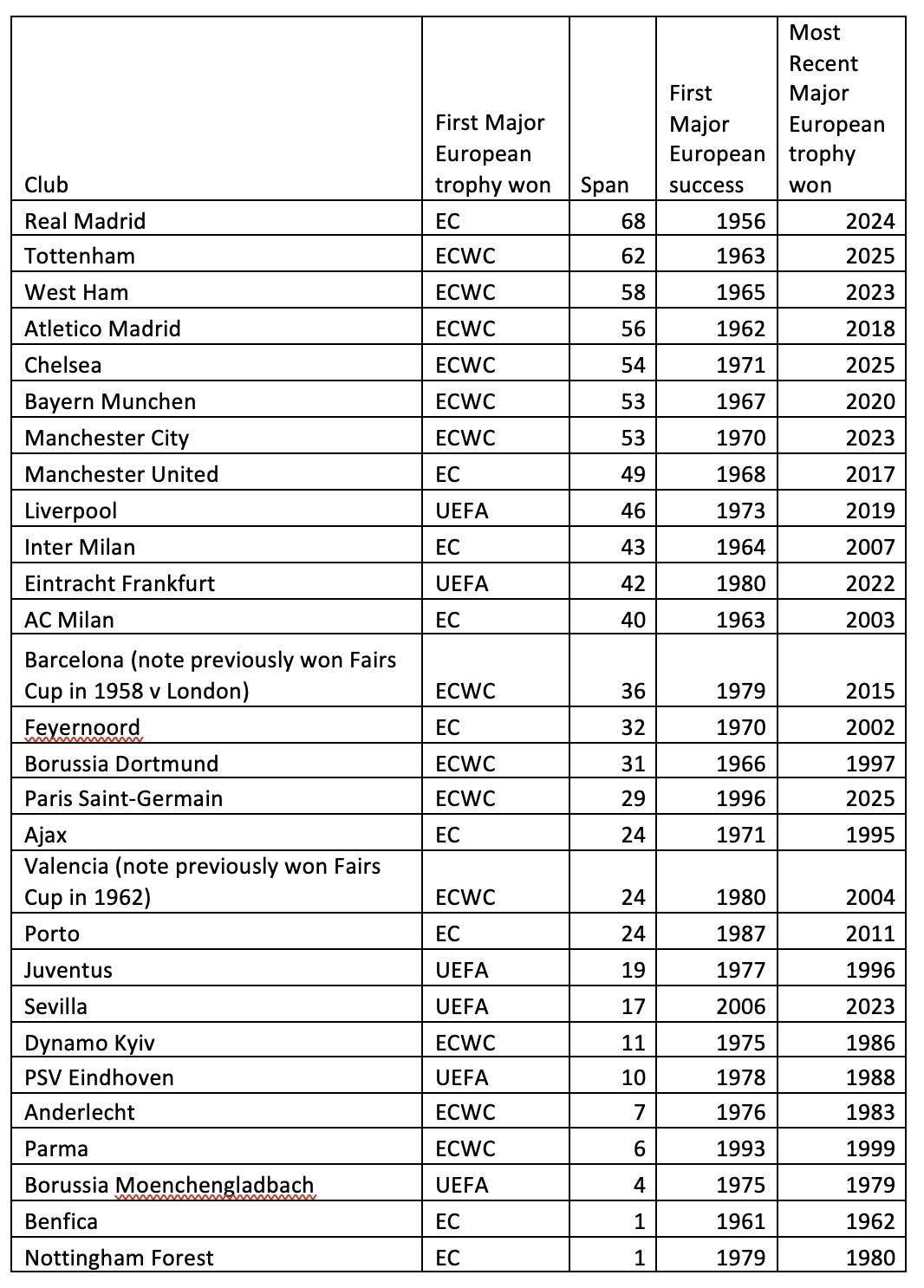
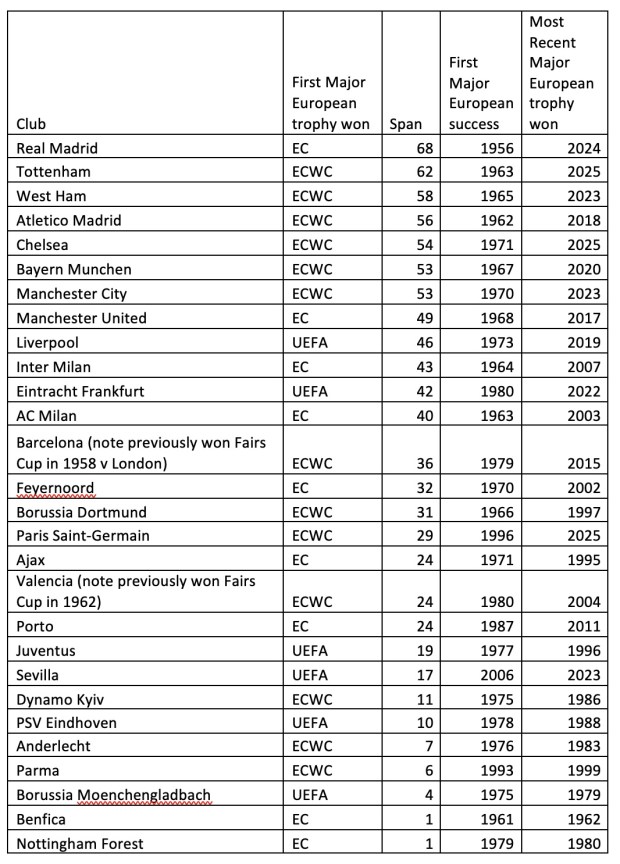
Each year, following the end of the UEFA football season I update the UEFA European Span of Success table. What is this? It’s a list of those clubs who have won two or more (sorry Palace) major UEFA tournaments showing the span between their first UEFA success and their most recent. The list may surprise some who think that football is all about those perceived as European giants with ‘history’. This is how the table stands today (19 May 2026). Chelsea and Tottenham have moved up the table in recent seasons.

UEFA European Major Trophy Span of Success 2025

I can imagine a few Arsenal fans looking at this and saying ‘Why aren’t we on there?’ They won the Fairs Cup in 1970 and the ECWC in 1994 BUT the Fairs Cup wasn’t a UEFA tournament and had some odd entry rules over the years! For your benefit here’s a table including the Fairs Cup lower down on this page. The above table includes the four major UEFA tournaments: European Cup/Champions League; European Cup Winner’s Cup; UEFA Cup/Europa League & the Europa Conference League. It does not include non-UEFA tournaments such as the Mitropa Cup and Fairs Cup. Nor does it include the Intertoto Cup or similar.

So why are they excluded… I recognise that the Mitropa Cup had some significant clubs competing in it. However, it was predominantly an East European competition and participants were not spread over the entire continent.

With the Fairs Cup… It is true that this was later transformed into the UEFA Cup and I have included all UEFA Cup finals in my analysis. But the Fairs Cup had an odd series of entry rules at times. Cities, rather than clubs, often entered with Barcelona beating London in one final for example. It was set up as a friendly type of competition with cities that had staged trade fairs playing each other. As time wore on entry came via the League Cup or League position in England, which added significance to it. But two teams from the same city were not allowed to participate, which meant that teams finishing way down the table could be (and were) included if those above them were multiple clubs from the same city.

In 1970 Manchester City’s Mike Doyle joked that by winning the League Cup he was satisfying his aim of ‘keeping United out of Europe’ (he joked about creating car stickers with that slogan!) because it appeared at that time that United’s only chance of Europe had gone with City’s qualification for the Fairs Cup.

City went on to win the ECWC that season, meaning that Fairs Cup place was opened up to League position, but United had finished lower down the table anyway and qualified for the Watney Cup instead. Actually, the Watney Cup is one worth talking about, but I’ll save that for another day. In 1970 Fourth placed Derby County qualified for the Watney Cup, while 5th to 7th (Liverpool, Coventry and Newcastle) all got a Fairs Cup place, alongside 12th placed Arsenal (Fairs Cup winners). I’ve not investigated this fully but it does seem odd that the Watney Cup took precedence over the Fairs Cup.

Arsenal’s 1970 Fairs Cup success was their first European trophy but is not included in the span, neither are those Fairs Cup wins of Barcelona. However, as quite a few Arsenal fans seemed to get a bit upset when the table was posted the other year I’ve decided to include the Fairs Cup in the following version of the table. So this table is the winners of the main UEFA competitions I mentioned earlier plus the Fairs Cup with its odd rules:

ClubFirst Major European trophy wonSpanFirst Major European successMost Recent Major European trophy won
Real MadridEC 6819562024
TottenhamECWC6219632025
RomaFairs6119612022
West HamECWC5819652023
BarcelonaFairs5719582015
Atletico MadridECWC5619622018
ChelseaECWC5419712025
Bayern MunchenECWC5319672020
Manchester CityECWC5319702023
Manchester UnitedEC4919682017
LiverpoolUEFA4619732019
Inter MilanEC 4319642007
ValenciaFairs4219622004
Eintracht FrankfurtUEFA4219802022
AC MilanEC 4019632003
FeyernoordEC 3219702002
Real Zaragoza Fairs3119641995
Borussia DortmundECWC3119661997
Paris Saint-GermainECWC2919962025
ArsenalFairs2419701994
AjaxEC 2419711995
Porto EC 2419872011
JuventusUEFA1919771996
SevillaUEFA1720062023
Dynamo KyivECWC1119751986
PSV EindhovenUEFA1019781988
AnderlechtECWC719761983
ParmaECWC619931999
Borussia MoenchengladbachUEFA419751979
Leeds United (BOTH FAIRS CUP)Fairs319681971
BenficaEC 119611962
Nottingham ForestEC119791980

Obviously, neither table shows the number of major trophies won, but it does indicate trophy-winning longevity for those who obsess over ‘my cup’s bigger than yours’ and similar debates. Personally, I think we should all be proud of our club’s achievements and not worry about what a rival has won.

Hopefully, those Arsenal fans who were somewhat upset last year will now be happy. Note that both Roma and Barcelona have moved up the table. Both ‘Rome’ and ‘Barcelona’ won the Fairs Cup when it was city based and not club based, adding to the questionable nature of including the Fairs Cup. ‘London’ once competed in it!

Arsenal are now 20th in this combined table, behind their fellow English clubs Tottenham, West Ham, City, Chelsea, United and Liverpool. But they could move up, as could Aston Villa.

As an example of the odd qualification rules in place for the Fairs Cup at times it’s worth looking at the 1969 qualification via the English League system.

In 1969 champions Leeds entered the European Cup. The ECWC place went to FA Cup winners Manchester City and the Fairs Cup places went to: Arsenal (4th), Southampton (7th) and Newcastle (9th). Swindon had won the League Cup, beating Arsenal in the final, but the Fairs Cup organisers wouldn’t allow them to participate as they were not a top flight club! This adds to the reason the competition is usually excluded. It is certainly not a UEFA competition in any case.

Similarly, Everton (3rd), Chelsea (5th), Spurs (6th) and West Ham (8th) who all finished above Newcastle were denied because of the rule that only one club from each city be allowed. So Liverpool and Arsenal’s inclusion meant their rivals stood less chance of winning the trophy than Newcastle simply because there were multiple clubs in their cities.

That rule does make me wonder what would have happened if both Manchester clubs had qualified for the competition as City are within the city of Manchester boundaries and United are not. Would the two clubs have challenged any decision not to include one of them based on the age old argument of Manchester’s boundaries?

Maybe I’ll post more on the odd rules of football competitions and tell the story of some of those long forgotten competitions.

If you’re interested in the wider span of success for English clubs (listing those who have the longest span between their first trophy and most recent, not simply European trophies) then take a look at this I posted Sunday:

You can find out the benefits of subscribing here:

The Span of Success: Will This Change This Month?

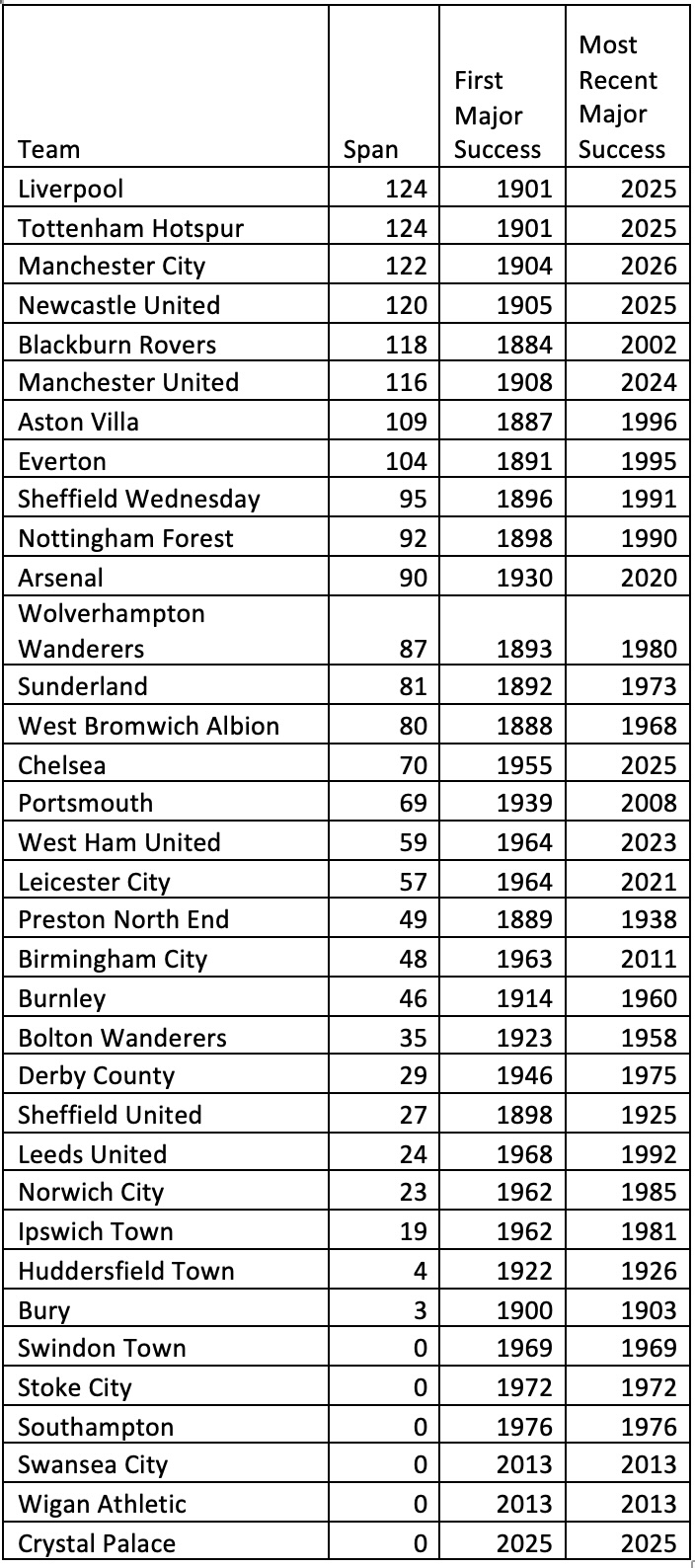
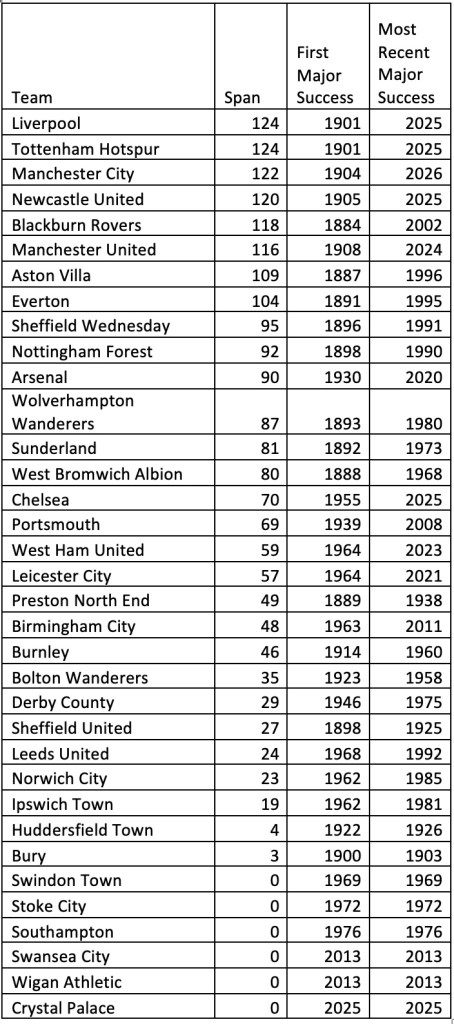
Every year, once the domestic season ends I update the table showing the English clubs’ span of success – i.e. the number of years between a club’s first major success (FA Cup, League, League Cup, major European trophy) and their most recent. Here’s the table as it stands today (17 May 2026) after Manchester City’s success in the FA Cup. Obviously, there’s a chance for Arsenal (currently 11th), Aston Villa (7th but could be top if they win their European final) and Crystal Palace (just on the table following last year’s FAC success but could rise above those other ‘one major trophy’ clubs) to move up the table this month.

2026 Span of Success (as of 17/5/26, after FAC final)

Even if Arsenal do win the League or Champions League this year they’ll only rise to ninth as they didn’t win a major trophy until the 1930s.

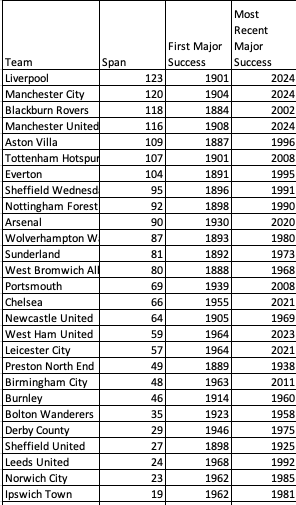
For comparison purposes here’s the table after the 2023-24 season ended (see below). Notice the moves up the table of Spurs and Newcastle in recent seasons:

As I always say, the span of success does not show how many trophies each club has won nor does it show how frequently that club has experienced great eras of success, but it does demonstrate how wrong those people are who believe certain clubs were unsuccessful until recent years, or those who think certain clubs have always been giants. The column on first major success helps to show when some clubs first became trophy-winning significant (often after transformational investment too!).

I know clubs focus on their financials but winning a trophy has longevity, gaining the odd Premier League place provides a bit of extra cash now but no long term kudos. Winning a trophy attracts new fans and brings money-spinning opportunities too. Look at how winning the FA Cup has helped Palace this last year or so.

If I was a supporter of any of the major clubs who have not found significant success in recent decades then I would absolutely want my team to go for whichever cup competition seems the most likely to win. That’s what I always wanted from Manchester City before they were able to compete for the League again. Winning the FA Cup in 2011 helped everything that followed happen – it gave confidence and a trophy winning mentality.

While you’re here why not take a look at the wide range of articles available on this site? Such as the 100 day series of features on Maine Road: