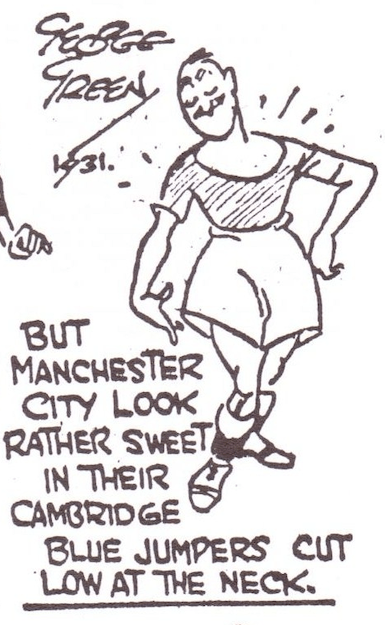
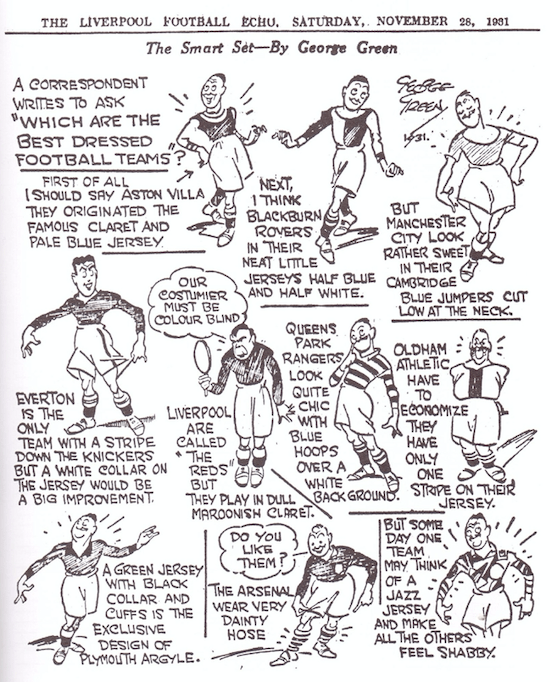
On 28 November 1931 the Liverpool Echo published this George Green cartoon of the kits worn by several leading clubs of the period. I thought I’d post it here to show how these things were often portrayed in the newspapers of the day. Thanks.
While you’re here I’d like to thank you for taking the time and trouble to visit my website. I have been researching and writing about Manchester football for a long time (no wonder I’m going grey!) with my first book published in 1989. I am not employed by anyone and I do not have sponsorship either and so I’ve set up this website to help share my 32 years plus writing and research. The intention is to develop the archive and to provide access to as much of my material as possible over the coming weeks, months & years. Subscribers can already access hundreds of articles/posts including the entire Manchester A Football History book and various audio interviews (including John Bond, Malcolm Allison & George Graham).
It costs £20 a year (it works out £1.67 a month) or £3 if you’d like to sign up a month at a time to get full access for as long as you subscribe. Thanks for the support, Gary.
Subscribe to get access to the entire site
Read the in-depth content when you subscribe today.
If you enjoy all the free material on my website and would like to support my research and keep this website going (but don’t want to subscribe) then why not make a one-time donation (or buy me a coffee). All support for my research is valued and welcome. It allows me to keep some free material available for all. Thanks.
Many goals over the years are described as the greatest ever. Sometimes these become a talking point for a few days, sometimes for a few years but unless they happen to occur in a major trophy winning game goals tend to lose their significance as time moves on. This is especially true for games prior to the 1990s when television coverage was limited to, at best, a handful of top flight games.
This is part of a feature on ‘GOLDEN GOALS’. The idea is to remember a significant or spectacular Manchester City goal from yesteryear. My hope is that supporters who were not around back then will learn more about these goals while those who were here will hopefully be reminded of them. If you would like to nominate a goal for possible use in a future feature then please comment at the end of this piece or email me with details of game, goal scorer and date.
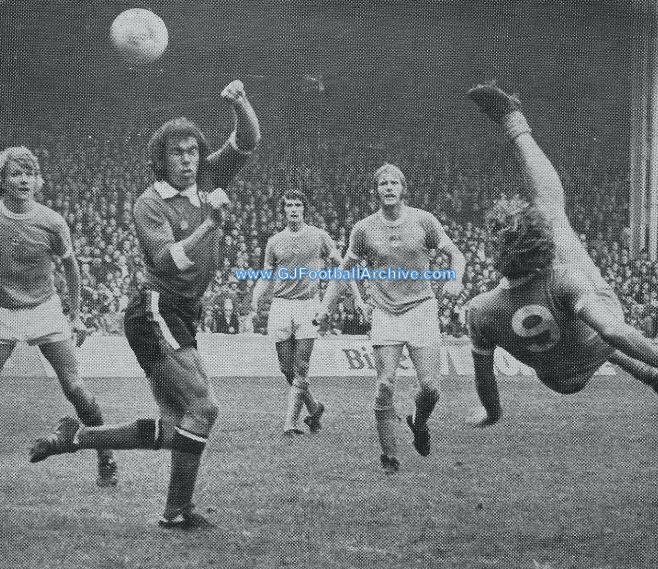
The one being featured is Rodney Marsh’s overhead kick from the Manchester City-QPR Division One game of September 1974.
This article is available for subscribers to the website. It costs £20 a year (it works out £1.67 per month) and you get full access to all articles posted, including PDFs of the out of print Manchester A Football History and my first ever book about Manchester City. There are also audio interviews & more. Do a few searches on past content to see what’s available.
Subscribe to get access
Read more of this content when you subscribe today.
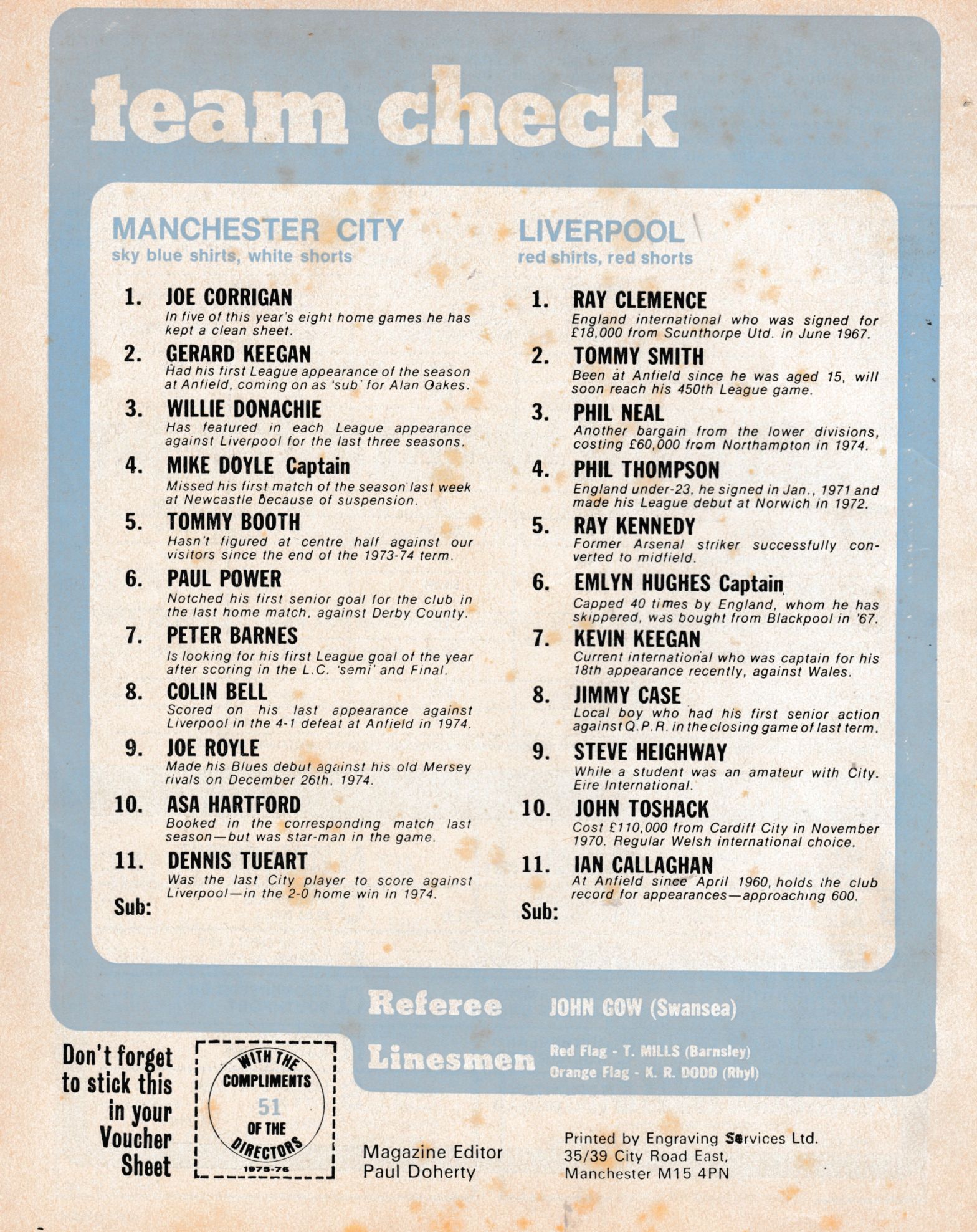
Maine Road’s highest crowd of the season, 50,439, witnessed a pulsating game against League title hopefuls Liverpool on this day (19 April) in 1976. The game was goalless until the 74th minute when Steve Heighway scored the opener. In the 87thminute, as City searched for an equaliser, the Blues were unlucky when a David Fairclough attempt was diverted in off Tommy Booth and then in the final minute future Blue Fairclough blasted home a Kevin Keegan pass from 14 yards out.
Paul Power came close to scoring a consolation goal a few moments later, as goalkeeper Ray Clemence and Emlyn Hughes scrambled the ball off the line, but the game ended 3-0 to new League leaders Liverpool, who led the table from QPR by a point. The Daily Express report praised City’s performance: ‘City stuck manfully to their job and until Fairclough began to create his havoc they always looked likely to take at least a point.’
You can read more on the 1975-76 season with this 5,320 word article – a season which saw Tony Book guide the club to major success. If you want to know more on this incredible decade for Manchester City Football Club then why not subscribe and read it all? You could even subscribe for a month and see what you think. The following 5,320 word article is on the 1975-76 season and is available to subscribers below. Enjoy!
Subscribe to get access – Monthly
Read more of this content when you subscribe today. It costs £3 per month (cancel anytime) to access everything posted since 1 October 2022 or there’s a special annual rate below which gives greater access and works out much cheaper.
Read more of this content when you subscribe today. It costs £3 per month (above) or £20 a year (here) to access everything posted since the site was created in December 2020. This special rate works out about £1.67 a week and gives access to everything posted, including PDFs of 3 of my books.
If you enjoy all the free material on my website and would like to support my research and keep this website going (but don’t want to subscribe) then why not make a one-time donation (or buy me a coffee). All support for my research is valued and welcome. It allows me to keep some free material available for all. Thanks.
If you enjoy all the free material on my website and would like to support my research and keep this website going (but don’t want to subscribe) then why not make a one-time donation (or buy me a coffee). All support for my research is valued and welcome. It allows me to keep some free material available for all. Thanks.
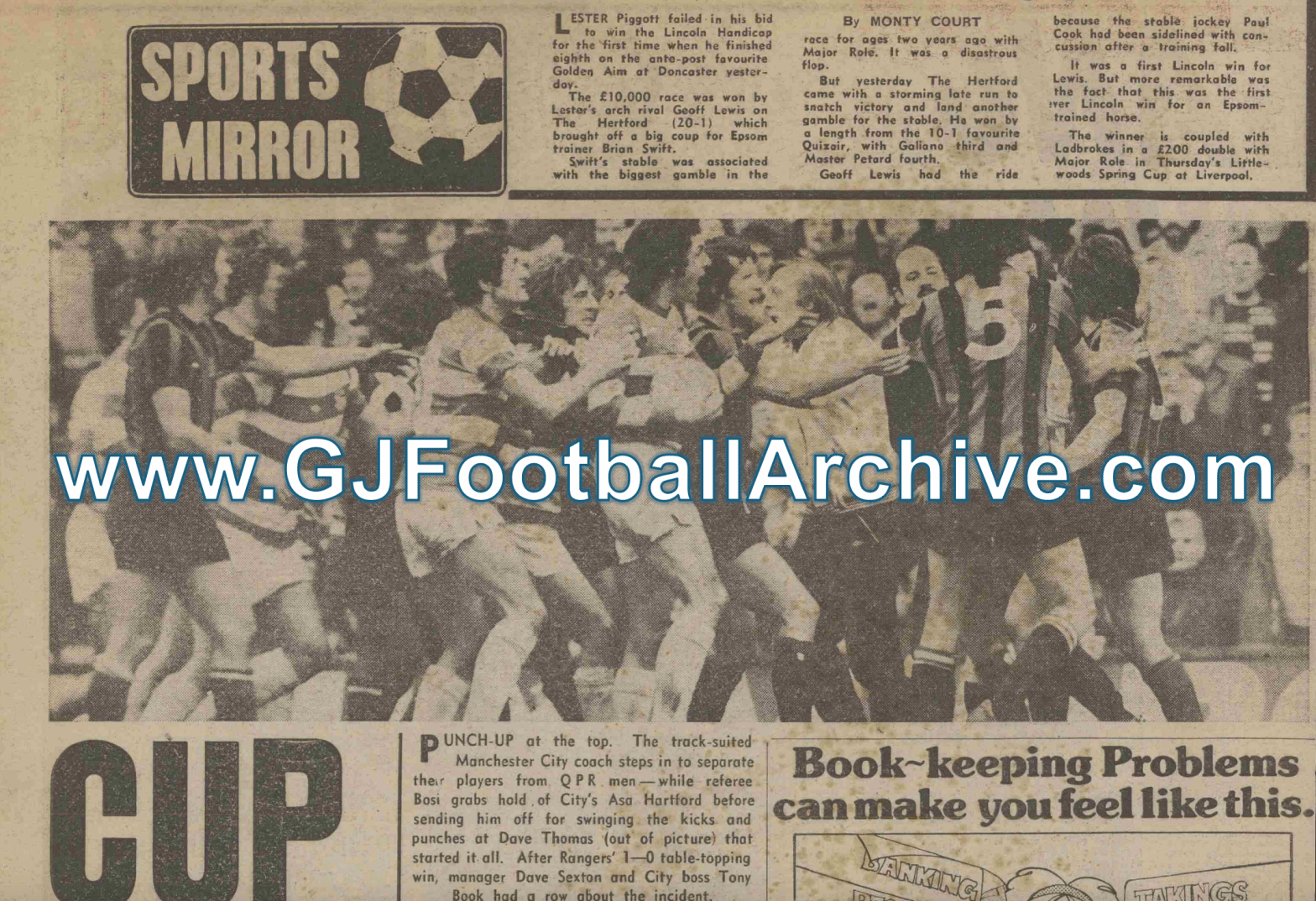
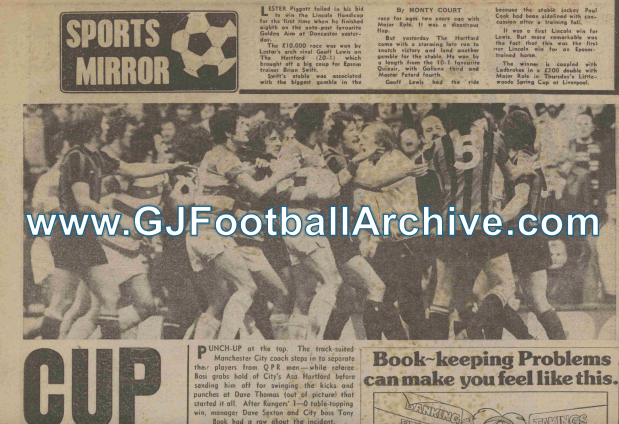
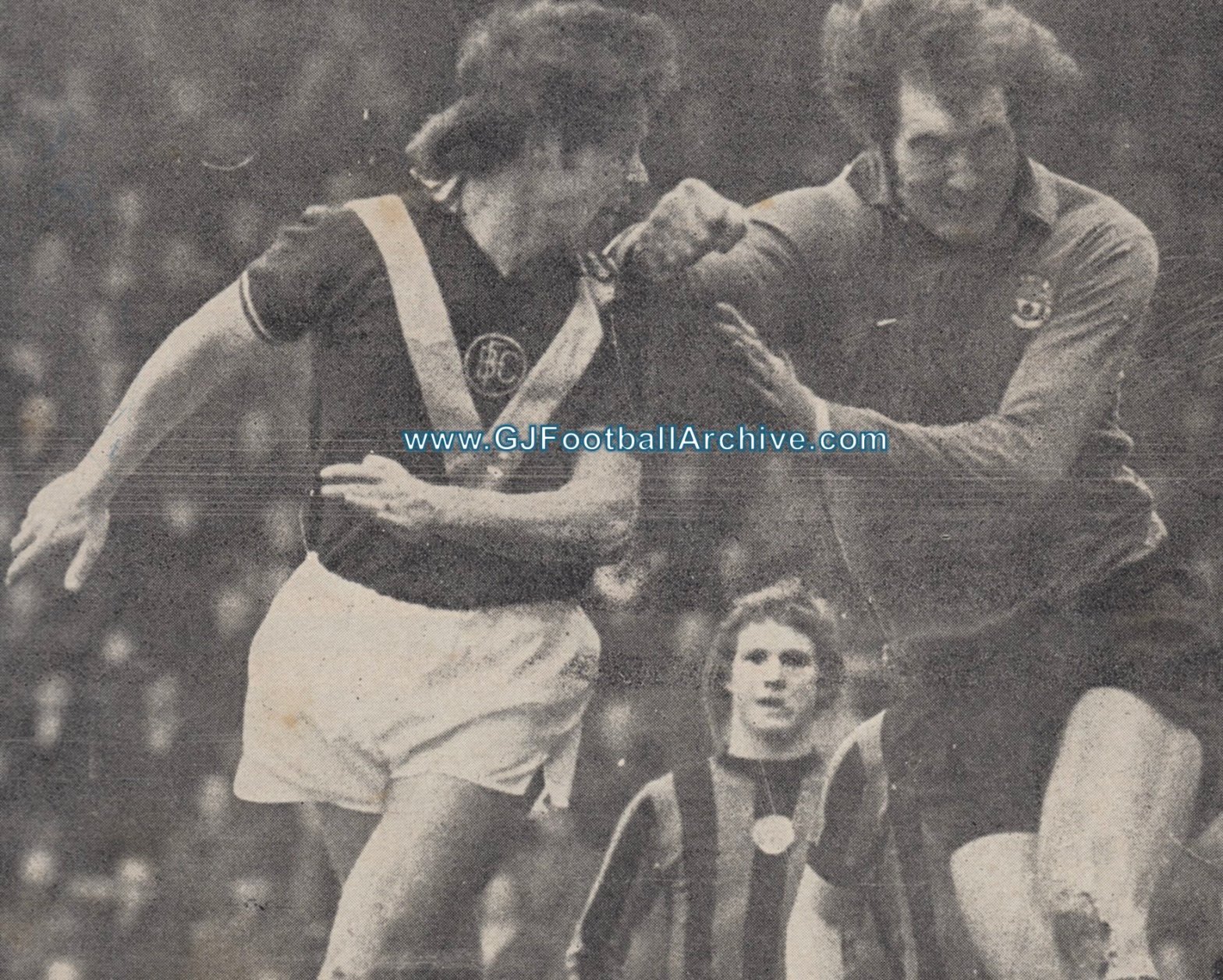
A hugely controversial away game at QPR on this day (27 March) in 1976 brought unsavoury headlines. Manchester City lost 1-0 to an 81st minute goal to the League leaders but that wasn’t the real issue this day, it was the extremely negative way the London club played. This all led to a controversial incident following an Asa Hartford tackle. The Belfast Newsletter reported: ‘The already tattered disciplinary reputation of the League leaders took another knock in the game with Manchester City at Loftus Road… In the 75th minute City’s Asa Hartford went in to tackle with foot held high, and Wolverhampton referee Terry Bosi immediately whistled for a foul. He was talking to Hartford when Thomas, not concerned in the original incident, ran a dozen yards to attack the City player from behind and pull his hair. Hartford retaliated with a blow, and within seconds other players were involved.’
Hartford was sent off much to the dismay of City fans, staff and most neutral journalists. The Sunday Express reported: ‘Don Masson kicked Hartford and Dave Thomas aimed a punch… the Rangers pair were lucky to escape without even a booking.’
After the game the rival managers, Tony Book and Dave Sexton, publicly argued in front of journalists about the physical nature of QPR and Hartford’s sending off.
The suspension of Hartford and an injury to Dave Watson led to selection issues for the away game at Stoke the following Friday. In the end a magnificent performance from youngster Paul Power was rightly praised in a goalless draw seen as a positive result in the circumstances.
Five days later a third successive away game saw City lose 2-1 to Bobby Robson’s Ipswich Town. Ipswich opened the scoring four minutes before half time, with Ged Keegan equalising in the 47th minute. Eleven minutes later Ipswich scored their winner and their pressure from then on disrupted every opportunity City had to search for an equaliser.
One point from three games led to Tony Book taking a decision that would excite the Maine Road faithful: Colin Bell was to return for the following game.
You can read more on the 1975-76 season with this 5,320 word article – a season which saw Tony Book guide the club to major success. If you want to know more on this incredible decade for Manchester City Football Club then why not subscribe and read it all? You could even subscribe for a month and see what you think. The following 5,320 word article is on the 1975-76 season and is available to subscribers below. Enjoy!
Subscribe to get access – Monthly
Read more of this content when you subscribe today. It costs £3 per month (cancel anytime) to access everything posted since 1 October 2022 or there’s a special annual rate below which gives greater access and works out much cheaper.
Read more of this content when you subscribe today. It costs £3 per month (above) or £20 a year (here) to access everything posted since the site was created in December 2020. This special rate works out about £1.67 a week and gives access to everything posted, including PDFs of 3 of my books.
If you enjoy all the free material on my website and would like to support my research and keep this website going (but don’t want to subscribe) then why not make a one-time donation (or buy me a coffee). All support for my research is valued and welcome. It allows me to keep some free material available for all. Thanks.
If you enjoy all the free material on my website and would like to support my research and keep this website going (but don’t want to subscribe) then why not make a one-time donation (or buy me a coffee). All support for my research is valued and welcome. It allows me to keep some free material available for all. Thanks.
Manchester City, the League Cup winners, travelled to Turf Moor for a League game with struggling Burnley on this day (13 March) in 1976. It was a strange day with City in control for much of the game. It seemed inevitable Tony Book’s side would win, especially when they were awarded a penalty in the 44th minute. Burnley’s centre-half Jim Thomson was sent off for kicking Dennis Tueart while he lay on the ground following a collision with the ‘keeper. Tueart said afterwards: ‘When Thomson was sent off the goalie and I stood looking at each other wondering what had happened. It was a bit silly really! There was a bit of a skirmish with Thomson, but I didn’t even feel a blow of any kind.’
Wembley hero Tueart stepped up to take the resulting penalty but Burnley ‘keeper Gerry Peyton saved brilliantly.
The game became ill-tempered and former City hero Mike Summerbee, playing for Burnley, clashed with Tueart at times, causing both men to be spoken to by the referee.
In the second half City, playing in red & black stripes, were awarded another penalty. This time Tueart’s spot-kick entered the net, but the referee judged that a City played had encroached the area and the penalty was retaken. This time Tueart’s shot hit the post!The game ended goalless and City were now sixth, eleven points (2 points for a win) behind leaders QPR with three games in hand.
You can read more on the 1975-76 season with this 5,320 word article – a season which saw Tony Book guide the club to major success. If you want to know more on this incredible decade for Manchester City Football Club then why not subscribe and read it all? You could even subscribe for a month and see what you think. The following 5,320 word article is on the 1975-76 season and is available to subscribers below. Enjoy!
Subscribe to get access – Monthly
Read more of this content when you subscribe today. It costs £3 per month (cancel anytime) to access everything posted since 1 October 2022 or there’s a special annual rate below which gives greater access and works out much cheaper.
Read more of this content when you subscribe today. It costs £3 per month (above) or £20 a year (here) to access everything posted since the site was created in December 2020. This special rate works out about £1.67 a week and gives access to everything posted, including PDFs of 3 of my books.
If you enjoy all the free material on my website and would like to support my research and keep this website going (but don’t want to subscribe) then why not make a one-time donation (or buy me a coffee). All support for my research is valued and welcome. It allows me to keep some free material available for all. Thanks.
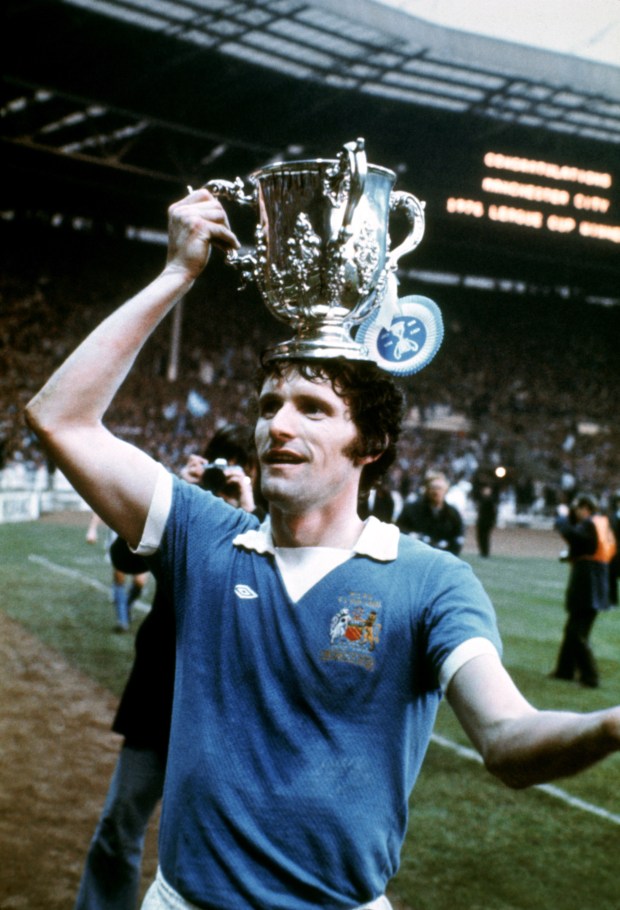
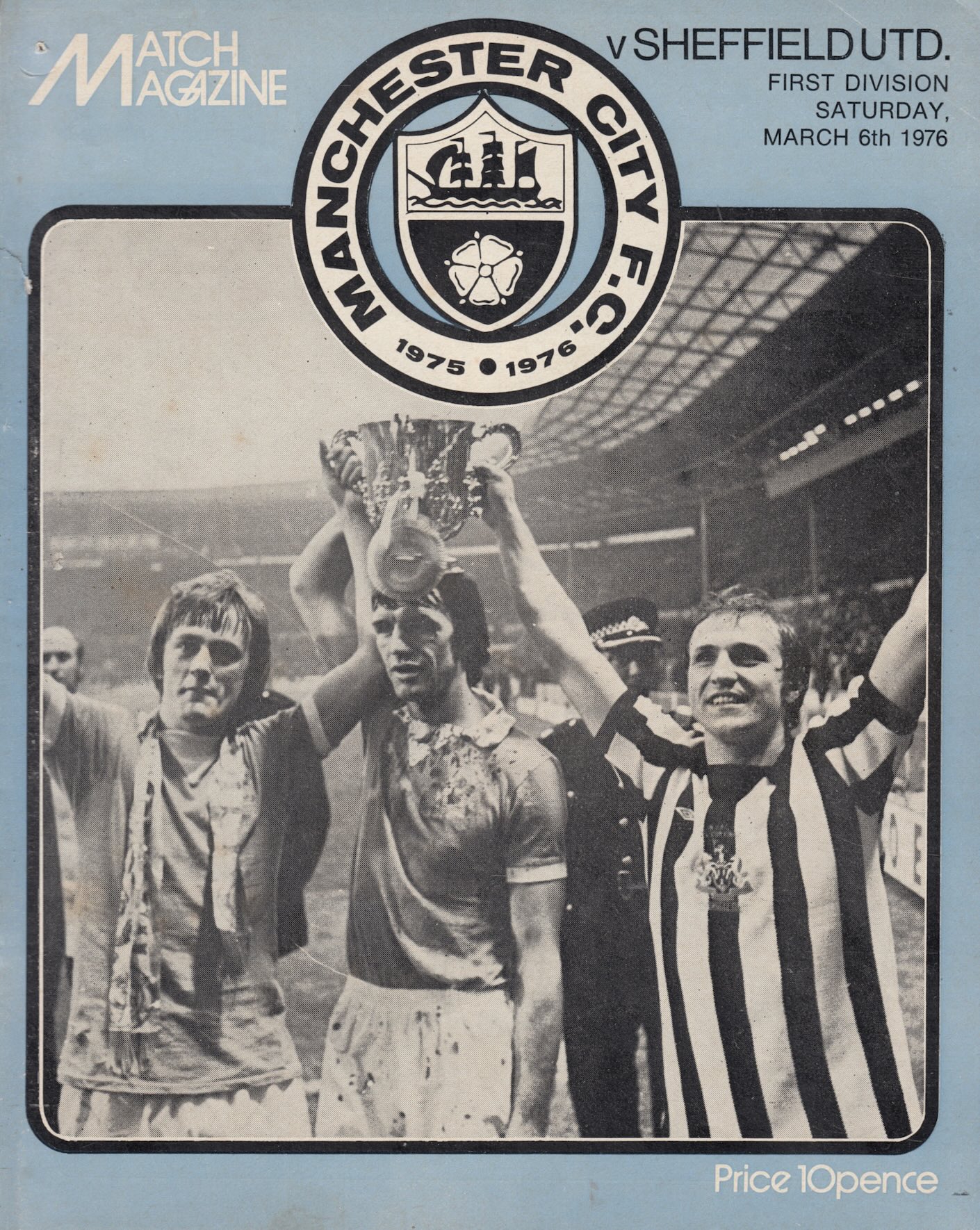
League Cup holders Manchester City played Sheffield United in the League on 6 March 1976. It’s a game often overlooked and for the first 50 minutes or so had little to offer. Some thought City were off form because of their exploits at Wembley but suddenly they burst in to life when Tommy Booth latched on to a loose ball. He fed it to Asa Hartford who made it 1-0 after 59 minutes.
Eight minutes later Booth headed the ball to Dennis Tueart 15 yards out from goal. Amazingly, the City winger repeated his famous scissor kick from the League Cup final to give the Blues a 2-0 lead and total dominance. Joe Royle headed a third after 71 minutes and Hartford netted his second – a devastating low drive – to make it a 4-0 win. Significantly, in the days before assists were formally recorded, Tommy Booth had supplied the final pass for all four City goals.
A dismal game had been transformed into a real demonstration of City’s strengths. The Blues were now seventh, ten points behind leaders QPR, though the Blues had played 3 fewer League games. However, with eleven games left and only two points for a win it seemed unlikely that further trophy success would follow this season.
You can read more on the 1975-76 season with this 5,320 word article – a season which saw Tony Book guide the club to major success. If you want to know more on this incredible decade for Manchester City Football Club then why not subscribe and read it all? You could even subscribe for a month and see what you think. The following 5,320 word article is on the 1975-76 season and is available to subscribers below. Enjoy!
Subscribe to get access – Monthly
Read more of this content when you subscribe today. It costs £3 per month (cancel anytime) to access everything posted since 1 October 2022 or there’s a special annual rate below which gives greater access and works out much cheaper.
Read more of this content when you subscribe today. It costs £3 per month (above) or £20 a year (here) to access everything posted since the site was created in December 2020. This special rate works out about £1.67 a week and gives access to everything posted, including PDFs of 3 of my books.
If you enjoy all the free material on my website and would like to support my research and keep this website going (but don’t want to subscribe) then why not make a one-time donation (or buy me a coffee). All support for my research is valued and welcome. It allows me to keep some free material available for all. Thanks.
On this day fifty years ago (26 November 1975) the League tables for England’s top two tiers looked like this. Surprising top two clubs? You can find out what happened to Manchester City that season by reading the following 5,320 word article on the entire 1975-76 season for the Blues – a season which saw Tony Book guide the club to major success. You can read this below.
Subscribe to get access – Monthly
Read more of this content when you subscribe today. It costs £3 per month (cancel anytime) to access everything posted since 1 October 2022 or there’s a special annual rate below which gives greater access and works out much cheaper.
Read more of this content when you subscribe today. It costs £3 per month (above) or £20 a year (here) to access everything posted since the site was created in December 2020. This special rate works out about £1.67 a week and gives access to everything posted, including PDFs of 3 of my books.
If you enjoy all the free material on my website and would like to support my research and keep this website going (but don’t want to subscribe) then why not make a one-time donation (or buy me a coffee). All support for my research is valued and welcome. It allows me to keep some free material available for all. Thanks.
Last week I posted the top flight attendances for this last week forty years ago and this led to a number of comments/questions and so to answer some of those I’ve now posted the top two divisions attendances together with the two League tables AND the end of season average attendances. People asked for clarity on how the figures compared to the second tier and whether League position played its part in affecting crowds. As a reminder here’s last week’s attendances…
And here’s this week’s (published 24 November 1985) and the League table too.
Obviously, these are only snapshots from that season but to add a bit more context here are the end of season averages here are the top 46 best supported clubs in order that season (hopefully it might make those who sing songs like ‘Where Were You?’ think about the crowds at their own clubs first):
A few notable League positions for those who do sing ‘Where Were You?’… The top eight clubs in the League were: Liverpool (champions), Everton, West Ham, Man Utd, Sheff Wed, Chelsea, Arsenal and Forest. Manchester City (who were 4th best supported club) were 15th (only 4 points above relegation zone), Spurs were tenth, Newcastle 11th and Aston Villa 16th.
In the Second Division best supported club Sunderland were 18th (avoiding relegation by 4 points); the top four were Norwich, Charlton, Wimbledon and Portsmouth.
If you’d like to know more about Manchester City at this time, here’s a 2,500 word subscriber feature on the 1985-86 season. Enjoy!
Subscribe to get access – Monthly
Read more of this content when you subscribe today. It costs £3 per month (cancel anytime) to access everything posted since 1 October 2022 or there’s a special annual rate below which gives greater access and works out much cheaper.
Read more of this content when you subscribe today. It costs £3 per month (above) or £20 a year (here) to access everything posted since the site was created in December 2020. This special rate works out about £1.67 a week and gives access to everything posted, including PDFs of 3 of my books.
These two results tables for top flight football in November 1985 make interesting reading. I’ve included the details published today (17 November, for games played the previous day) in 1985 and also the week after’s details too. This gives an idea of what the top clubs were attracting back then. Notice West Ham’s game attracted more at home than Arsenal’s and that Liverpool were over 26,000 less than Manchester United. Arsenal’s crowd was 6,000 less than struggling Manchester City and Tottenham attracted more than Arsenal too. Reigning League champions Everton were some way ahead of the London clubs and only about 600 behind Liverpool. Obviously, these are only snapshots from two weekends but hopefully it might make those who sing songs like ‘Where Were You?’ think about the crowds at their own clubs first.
the Marwood scoring for Sheffield Wednesday was of course Brian Marwood who went on to play a key part in Manchester City’s modern return to glory. If you’d like to know more about Manchester City at this time, here’s a 2,500 word subscriber feature on the 1985-86 season. Enjoy!
Subscribe to get access – Monthly
Read more of this content when you subscribe today. It costs £3 per month (cancel anytime) to access everything posted since 1 October 2022 or there’s a special annual rate below which gives greater access and works out much cheaper.
Read more of this content when you subscribe today. It costs £3 per month (above) or £20 a year (here) to access everything posted since the site was created in December 2020. This special rate works out about £1.67 a week and gives access to everything posted, including PDFs of 3 of my books.
On this day (5 November) in 2011 Manchester City defeated Neil Warnock’s Queen’s Park Rangers 3-2 with goals from Edin Dzeko, David Silva and Yaya Toure. The game is often overlooked in the history of games between the two clubs mainly due to the fact that the second game of the season between these teams was such an important occasion. But this match also had its twists and turns, with the three points of course proving vital at the season’s end. People inevitably focus on the final day, title winning matches but in a season where a title is decided on goal difference then every game and goal is important.
QPR opened the scoring in the 28th minute (a header from Jay Bothroyd) with man of the match Edin Dzeko equalising two minutes before half time. David Silva (photographed) made it 2-1 seven minutes into the second half but Heidar Helguson equalised in the 69th minute. The game was won with a 74th minute headed effort from Yaya Toure.
After the match manager Roberto Mancini rightly commented: ‘It was important we beat QPR. I knew that we could have a problem. The win was very important because we’ve played 6 very, very hard games and we’ve won, it was important because of the international break.’