The Origins of City In The Community

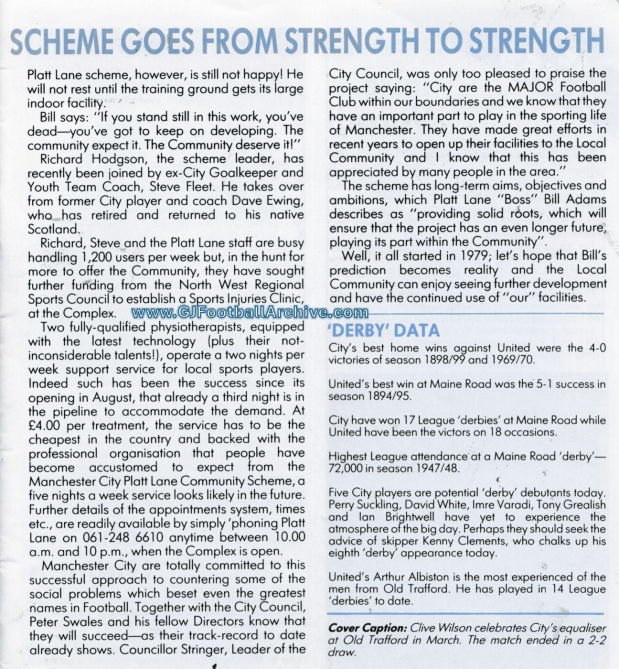
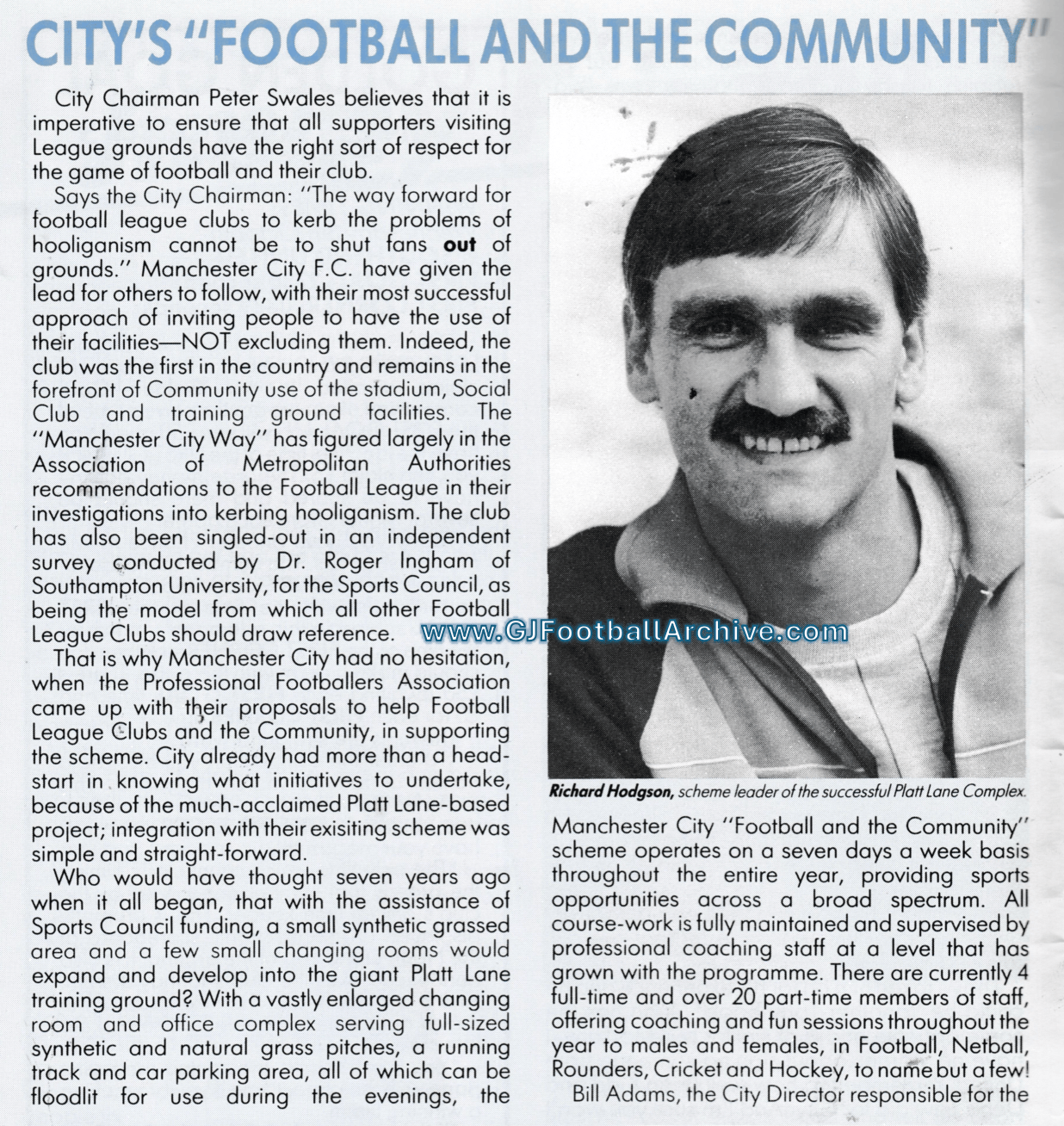
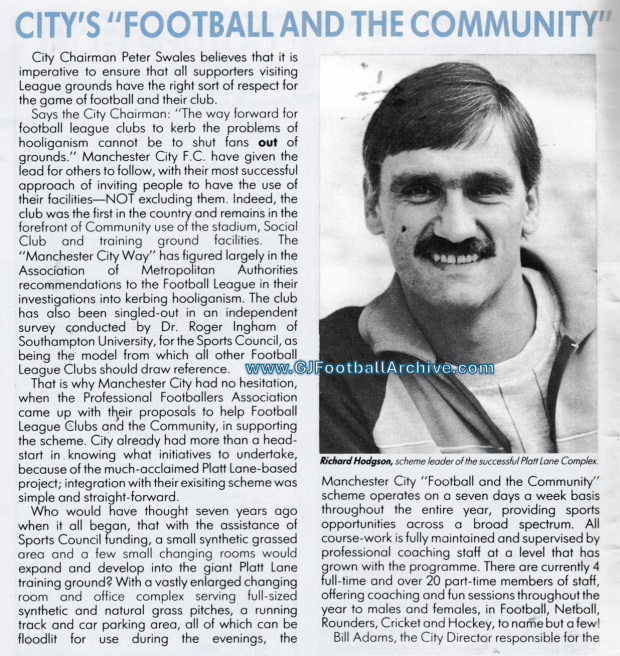
In 1979 Manchester City established a programme of community work called ‘The Manchester City Way’. It was so successful that academic studies were performed on it and it was then used to form ideas that led to the establishment of the PFA’s Football in the Community. In 1986 City became one of the clubs that pioneered the new ‘Football in the Community’ and today, forty years on ‘City In The Community’ remains a major contributor to Mancunian life. It’s also the inspiration for the City Football Group’s community initiatives around the globe.

People often forget, or overlook, the significance of ‘The Manchester City Way’ that proved so successful, so I’ve decided to post this article from October 1986 that talks about that and the establishment of Football in the Community. Notice Graham Stringer’s comments on the second page (some Blues will like this, coming from a United fan!). Enjoy!

Kaziu Deyna Goal v Forest

On this day (13 October) in 1979 Kaziu Deyna scored the only goal of the City-Nottingham Forest League game at Maine Road. The photograph shows Deyna in action during this game.  A crowd of 41,683 witnessed the City win with future Spanish TV presenter Michael Robinson wearing the number 9 shirt for the Blues that day.

Back in 2003 I wrote this profile of former Manchester City player and Polish World Cup star Kazimierz Deyna. Deyna was such an important and unusual signing at the time he joined City in November 1978 that I feel this article is still appropriate and of interest to subscribers to my blog today.

Subscribe to get access – Annual

If you would like to read this in-depth article and all the others on this site (including the entire Manchester A Football History book) then please subscribe. It works out about £1.67 a month if you take out an annual subscription (£20 per year) or £3 a month (see below) if you’d like to sign up for a month at a time. Each subscriber gets full access to the 1000+ articles posted so far and the hundreds scheduled to be posted in the coming weeks.

Subscribe to get access – Monthly

If you would like to read this in-depth article and all the others on this site (including the entire Manchester A Football History book) then please subscribe. It costs £3 a month (cancel anytime) of take out a special annual subscription for £20 (above).

Manchester City’s Undersoil Heating

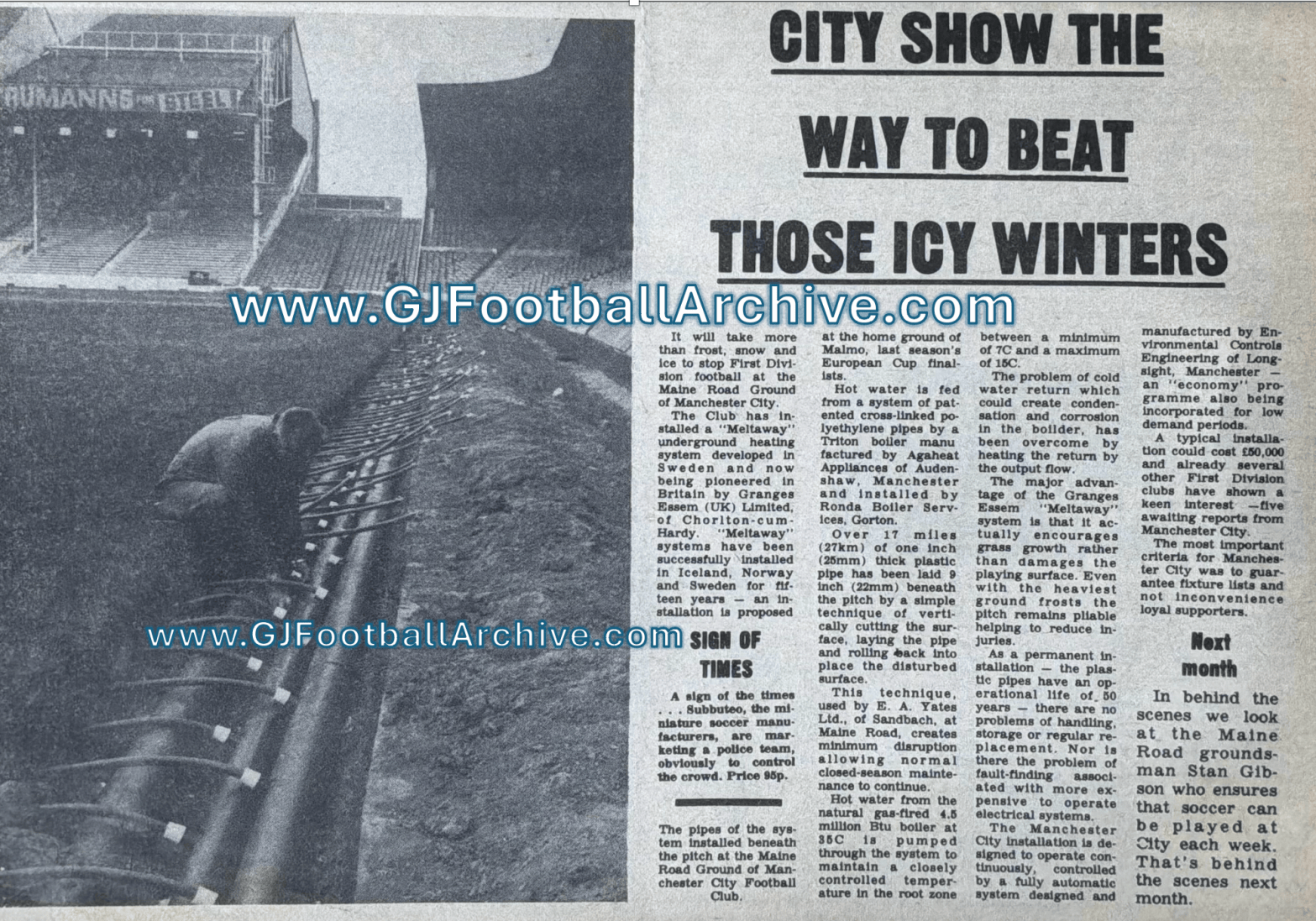
Here’s a great article and photo of Manchester City’s undersoil heating at Maine Road. It gives some background to what was a revolutionary pitch system when installed in the 1970s. Back in 2002 I interviewed former chairman Eric Alexander about it and he explained that it had been his idea to install a Swedish system. The idea came when he was in Sweden on business and noticed that the offices where he had a meeting had a heated car park. He thought that if that could be achieved with a car park imagine what could be done with a football pitch. He contacted the company and the rest was history.

There’s more on the system and its installation in my 2003 book Farewell To Maine Road, including the regret that the system was installed relying on pipes running lengthways, i.e. end to end. According to Bernard Halford this meant that the full pitch had to be heated even if only one goal was frozen. ‘It was too expensive when we were financially stretched,’ claimed Bernard, although the money that came from TV was significant. Often City’s games were played when other games were postponed and City frequently ended up on TV when games at Bolton, Oldham and other northwest clubs were postponed due to frozen pitches.

Subscribers can download a PDF of Farewell To Maine Road here:

Steve Daley, MCFC Player of the Month

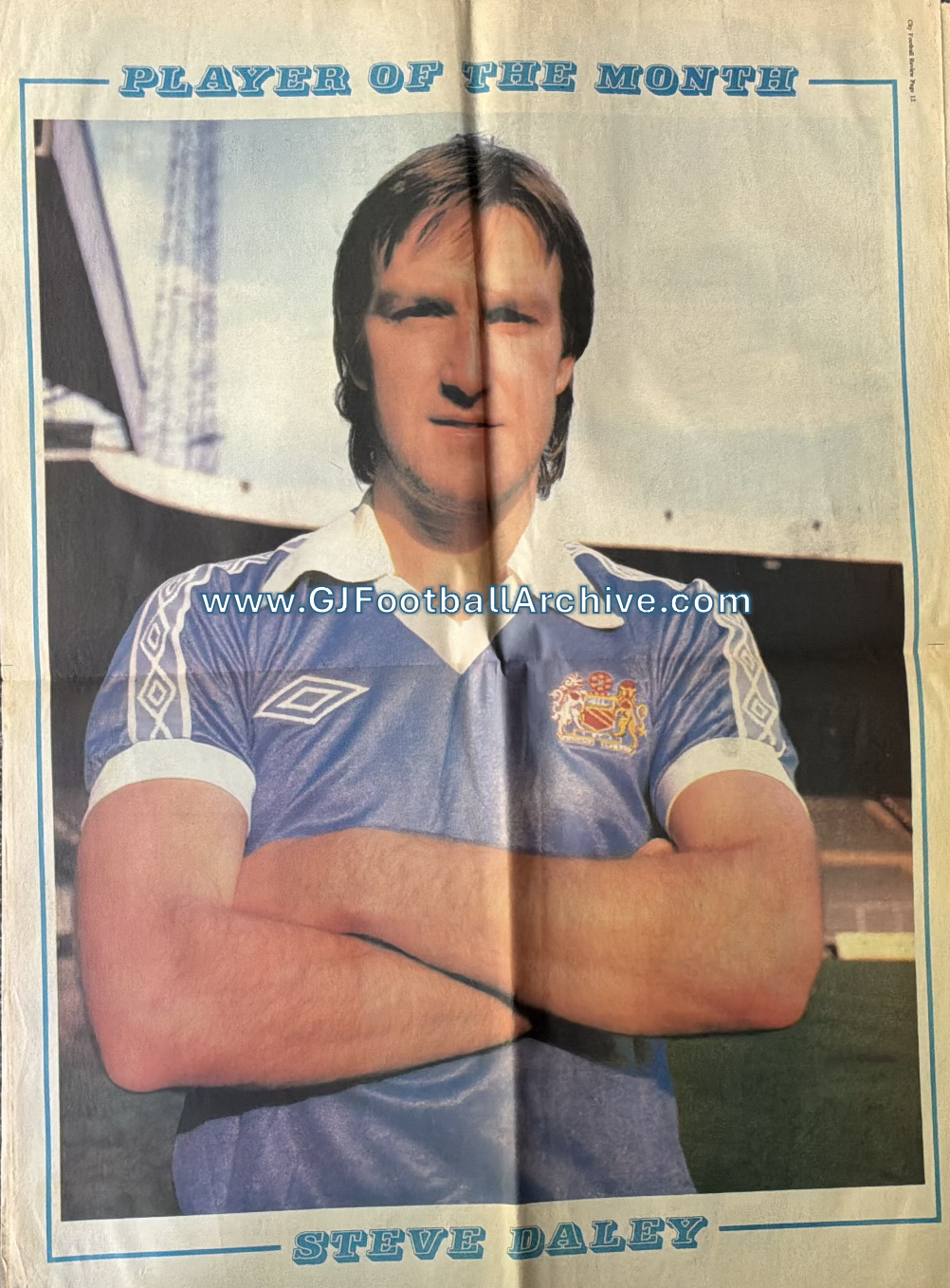
Over the years much has been said about Steve Daley and his time at Manchester City with many myths developing. While his price tag had a direct impact on his performances it is unfair to suggest that he achieved nothing (which is often said these days!) during his time at City. This image actually shows something positive and is a nice reminder that late in 1979 he was viewed so positively that he was acclaimed as City’s player of the month for November. Presumably his match winner v Bolton that month played its part.

Obviously, things like this are subjective but I do believe the wider narrative of him as a ‘failed’ player developed simply because the media focus on how expensive he was was overwhelming. As fans we were told that he HAD to deliver game after game because of his price (think about how that narrative is used today and consider what happens when a player doesn’t perform as the highest level expected of him; how many times are we told ‘Haaland hasn’t had a touch yet!’ because it’s a story that some want to tell?). Steve Daley was for many, many years City’s record transfer. It wasn’t Daley’s fault his transfer was so expensive but it was something that was always hurled at him if he had a poor game. I interviewed him a few years back and we discussed his transfer, City fans and the ridiculous spending City did. It was great to interview Steve and I enjoyed it immensely, helping fill in some gaps.

This interview is available to subscribers below.

Subscribe to get access – Monthly

Read more of this content when you subscribe today. It costs £3 per month to subscribe or sign up for a year at the special price of £20 (works out about £1.67 a month). Monthly subscribers can cancel anytime, so why not give it a try for a month? Monthly subscribers access everything posted since 1 October 2022 whereas annual subscribers get everything posted since the site started in December 2020 (see below).

Subscribe to get access – Annual

It costs £20 to subscribe for a year (here). Books, interviews (audio and written), images, features and more have been posted to this site so far. More to come.

You can find out more about subscriber benefits here:

Kaziu Deyna v Manchester United

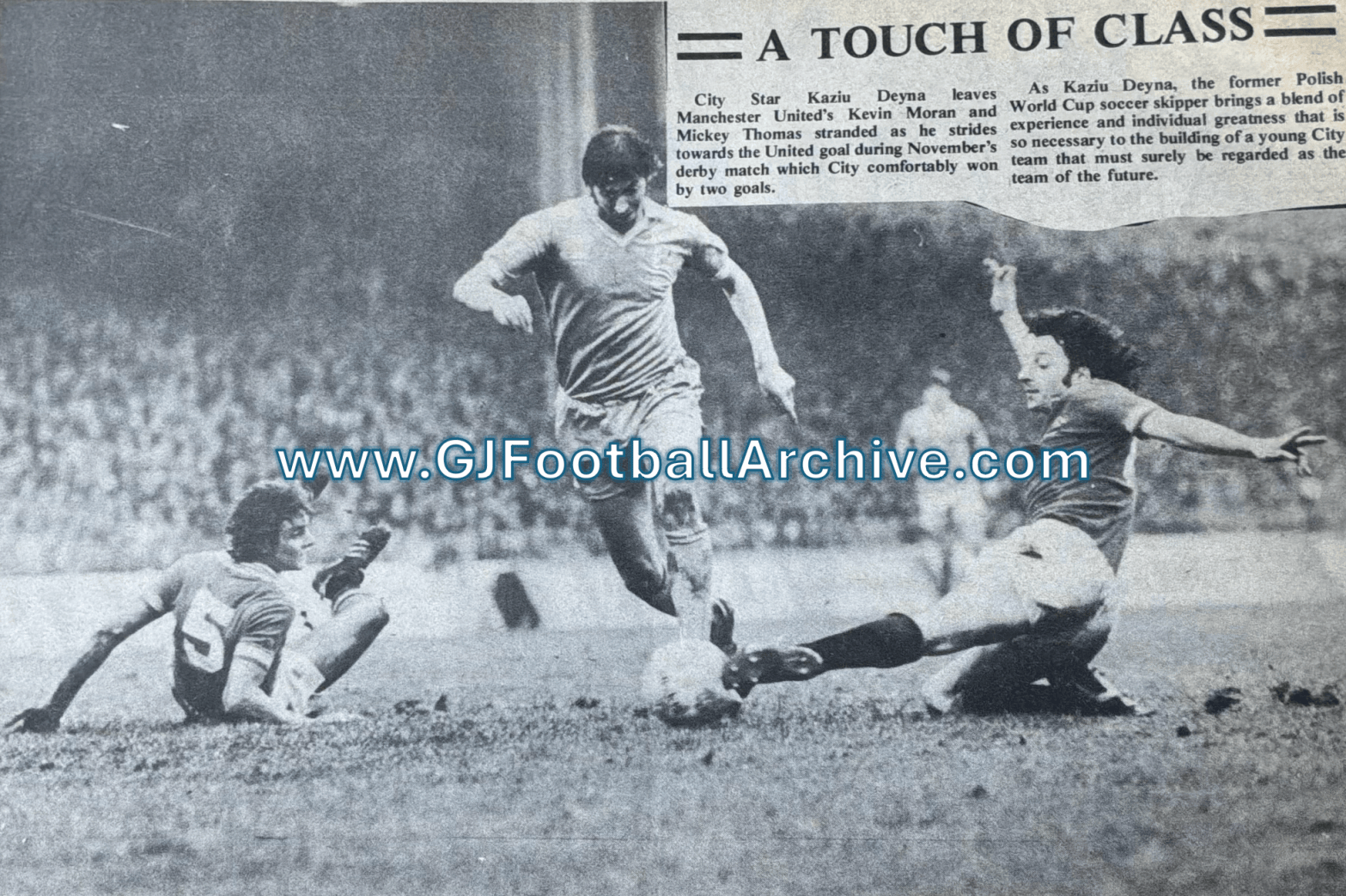
A few days ago I posted an image of Deyna on the cover of a City monthly magazine published during 1979-80 (see image below). Now here’s another photo from that magazine showing Kazimierz Deyna in action. This photo shows him during the Manchester derby of 10 November 1979 when City beat United 2-0 (goals from Tony Henry and Mike Robinson). United players Kevin Moran and Mickey Thomas are there too of course.

Back in 2003 I wrote this profile of former Manchester City player and Polish World Cup star Deyna. He was such an important and unusual signing at the time he joined City in November 1978 that I feel this article is still appropriate and of interest to subscribers to my blog today.

Subscribe to get access

If you would like to read this in-depth article and all the others on this site (including the entire Manchester A Football History book) then please subscribe. It works out about £1.67 a month if you take out an annual subscription (£20 per year) or £3 a month if you’d like to sign up for a month at a time. Each subscriber gets full access to every article posted so far and all those posted throughout your subscription.

H

From The Archive: When Will Steve Daley Play For England

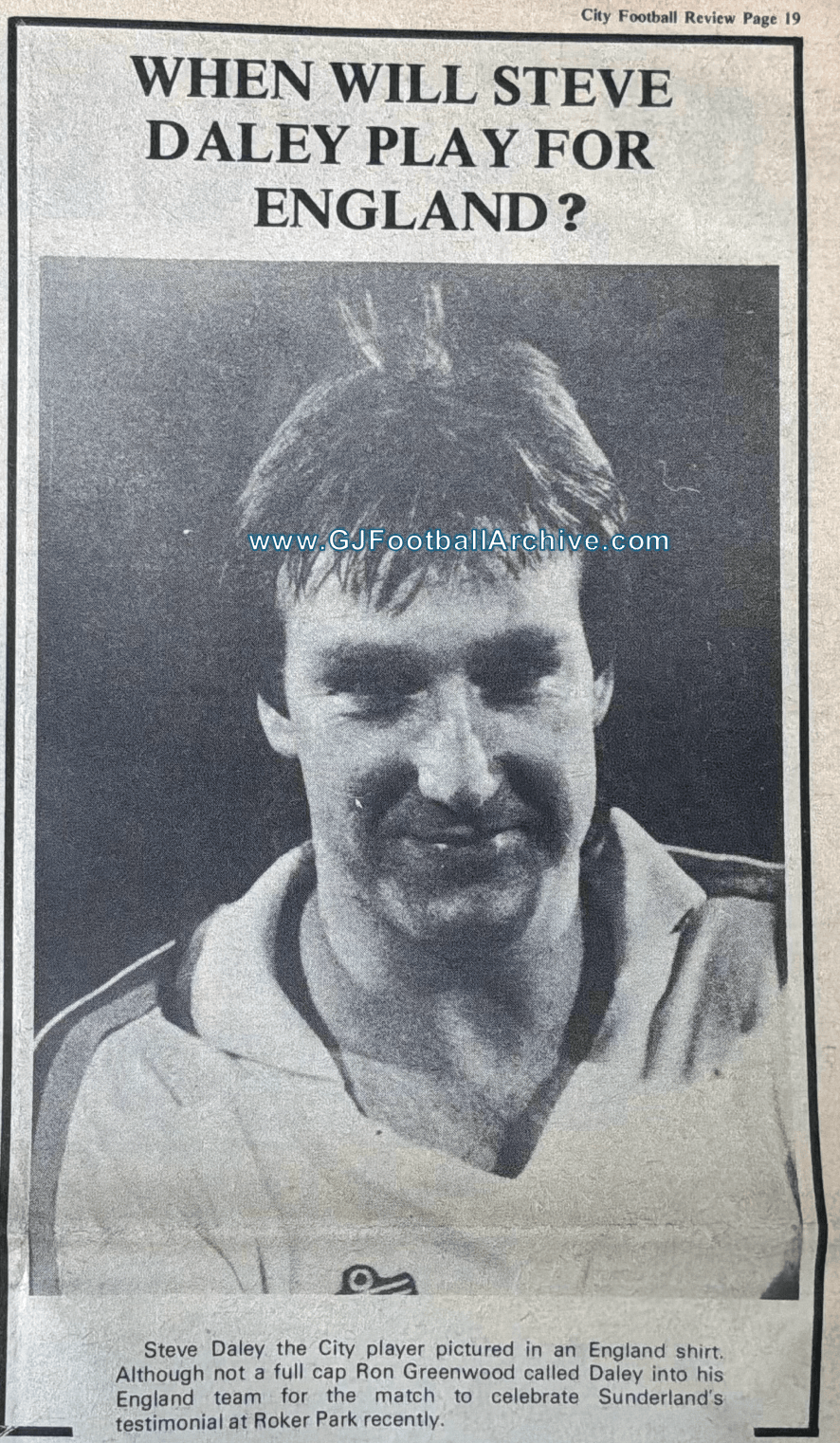
In my collection is this newspaper called ‘City Football Monthly Review’ from the 1979-80 season and this cutting asks what a lot of us wanted to know back then. Over the years people have tried to suggest Steve Daley was not a great player, but it was the ridiculous price tag that was an issue. He was un doubtedly a talented player before he arrived and multiple clubs wanted him. Regardless of what was said in later years there was a bidding war with Aston Villa and Everton offering various deals, including multiple players at one point in the days immediately prior to City signing Daley. I interviewed Daley a few years back about it all and that can be read here:

https://gjfootballarchive.com/2024/10/19/steve-daley-interview-2/

If you’d like to find out more on the 1979-80 season then why not subscribe? Subscribers can read the following 4,220 word article on the entire 1979-80 season – a season which saw heroes leave and spending get ridiculous!). My article, like the other indepth subscriber pieces, contains material from interviews I have performed with many of the key figures – chairman, managers, players and others. You can read this below.

Subscribe to get access – Monthly

Read more of this content when you subscribe today. It costs £3 per month (cancel anytime) to access everything posted since 1 October 2022 or there’s a special annual rate below which gives greater access and works out much cheaper.

Subscribe to get access – Annual

Read more of this content when you subscribe today. It costs £3 per month (above) or £20 a year (here) to access everything posted since the site was created in December 2020. This special rate works out about £1.67 a week and gives access to everything posted, including PDFs of 3 of my books.

If you’d like to know more about subscribing then see:

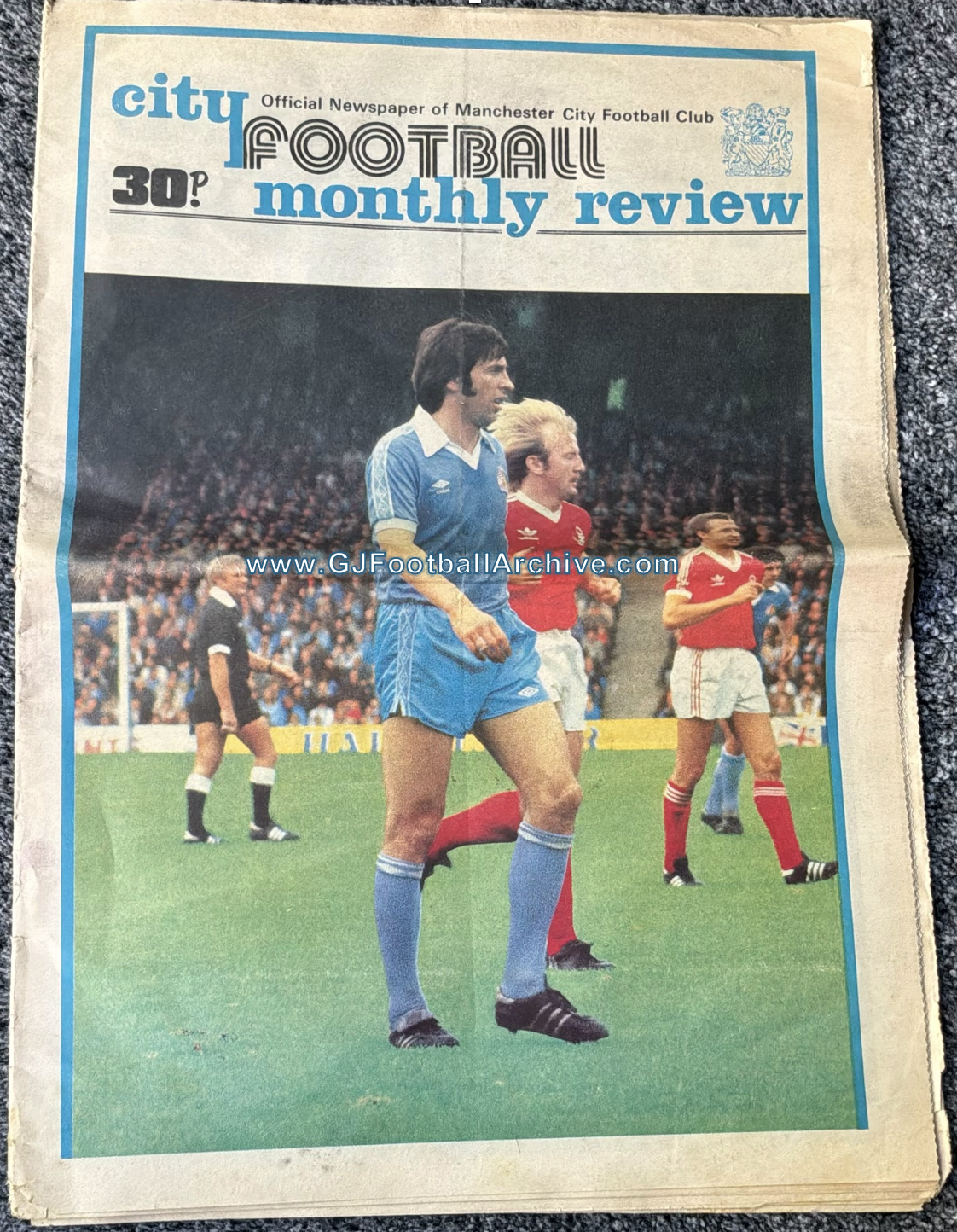
From The Archive: Anyone Remember This Manchester City Magazine?

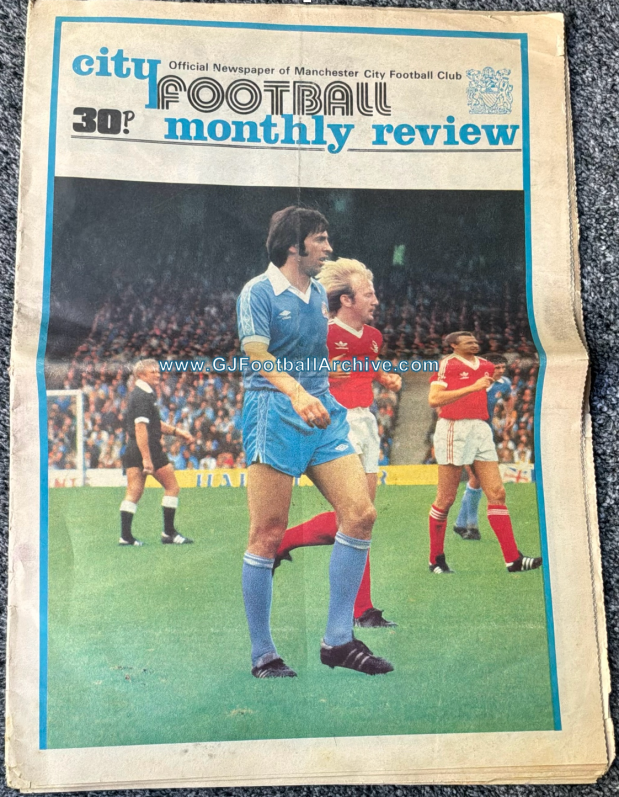
In my collection is this newspaper called ‘City Football Monthly Review’ from the 1979-80 season. I’m not certain how many issues were printed but I think I’ve got a couple. This one fell out of a box I was sorting through the other day containing a few late 1970s items. The player on the front is Kaziu Deyna, a brilliant footballer who arrived at City perhaps too late in his career. His arrival was high profile at the time.

The newspaper carries quite a few interesting articles. Do you have a copy of one of the other issues? I’d be keen on seeing pages from other issues.

If you’d like to find out more on the 1979-80 season then why not subscribe? Subscribers can read the following 4,220 word article on the entire 1979-80 season – a season which saw heroes leave and spending get ridiculous!). My article, like the other indepth subscriber pieces, contains material from interviews I have performed with many of the key figures – chairman, managers, players and others. You can read this below.

Subscribe to get access – Monthly

Read more of this content when you subscribe today. It costs £3 per month (cancel anytime) to access everything posted since 1 October 2022 or there’s a special annual rate below which gives greater access and works out much cheaper.

Subscribe to get access – Annual

Read more of this content when you subscribe today. It costs £3 per month (above) or £20 a year (here) to access everything posted since the site was created in December 2020. This special rate works out about £1.67 a week and gives access to everything posted, including PDFs of 3 of my books.

If you’d like to know more about subscribing then see:

Record Average Crowds

I’ve not done one of these for a while but I know they always prompt a bit of debate, so here goes… a feature on Manchester City FC attendances. It is a fact that the Blues have, generation after generation, been one of the English game’s top attractions. Like all – and I do mean all – English clubs there have been some average attendance lows over the years, but when the entire history of Manchester City is reviewed and the club’s average figures are compared with the national average it is clear that the Blues have consistently been one of football’s most attractive draws.  Take a look at the following:

  • Since the beginning of the Football League in 1888 only nine sides have topped the table for average attendances.  In chronological order of their first appearance at the top of the average table they are: Everton (1888-9), Villa (1898-99), Newcastle (1904-05), Chelsea (1907-08), Tottenham (1909-10), City (1910-11), Liverpool (1922-23), Arsenal (1929-30), & Manchester United (1956-57) 
  • As early as 1895-96 City were the third best supported side in the entire League despite being a Second Division side.  Only First Division sides Everton & Aston Villa could better the Blues.  Modern day giants Arsenal were 10th; Liverpool were 19th; United were 21st and Chelsea had yet to exist.
  • In 1900-01 City were the 2nd best supported side in the entire League with only 400 people separating Villa (1st) and City 
  • The 1910-11 season saw Manchester’s Blues top the attendance charts for the first time.  City’s average was 26,000 and was the 8th highest average of all time at that point (all clubs, all seasons). 
  • Regularly amongst the best supported sides throughout the inter war period, City’s average exceeded 37,000 for the first time in 1927-28 when the Blues established a record average crowd for the Second Division.  This was also the entire League’s highest.
  • In 1947-48 City’s average crowd exceeded 42,000 for the first time.  Prior to that season only Chelsea (1919-20 & 1946-7), Arsenal (1934-5, 1936-7, 1937-8, & 1946-7) , Newcastle (1946-7), Liverpool (1946-7), United (1946-7), and Wolves (1946-7) had exceeded that figure.
  • From 1975 to relegation in 1983 City were always one of the top 4 best supported sides, usually third behind United and Liverpool.
  • Since the 1980s whenever City have played outside of the top division, they have tended to be the best supported side in that division.  
  • Since moving to their current home in 2003, the increased capacity has allowed City to re-establish itself as one of best supported clubs again. Maine Road’s capacity from 1994 onwards was extremely low compared to the club’s entire history and prevented the Blues from staging games in front of attendances of approximateley 35,000 upwards.

In general many people believe success increases support, and while that is undoubtedly true to some extent, for City it is often periods of adversity that prove the loyalty of the Club’s fans.  It is highly significant, for example, that the first time City were the best supported side in the entire League (1910-11) Manchester United (6th best supported side) won the League title for the second time in 3 seasons.

Similarly, in 1925-26 when City were the best supported side in Division One and had established a new record average, the Blues were actually relegated.  This coupled with significant poverty and hardship in Manchester at the time should have reduced support but loyalty increased!  In my book “Manchester A Football History” I explore the relationship between attendances and Manchester’s major sides and it is fair to say that City fans can feel immensely proud of their loyalty throughout the history of the game.  Something that cannot be said by all of the League’s biggest names.  

In fact, it is worth highlighting that City have never been the worst supported side in their division but, of today’s so-called giants, Arsenal (1912-13 – average = 9,100) and Manchester United (1930-31 – average = 11,685) have.  City’s worst average of the Twentieth Century came in the desperate 1964-65 season and was 14,753 (half the average of 1960-61 and a 3rd of the 1957-8 figure).  However it is significant that for every League season City’s average has always been above the divisional average and, apart from 17 seasons, has always been in the top 11 nationally.  Again, few of today’s giants can’t say that – United’s 20th Century low stands at 4,650 and Chelsea averaged 15,731 as recently as 1988-89. In fact City’s lowest League attendance is more than double United’s lowest League attendance at Old Trafford (United have several crowds of less than 4,000 at Old Trafford, including top flight games; City’s lowest in the League was a little over 8000 in the second tier).

For fans average attendances are often used as an indicator of size of club and so a number of people over the years have tried to produce a definitive ‘all-time’ attendance table.  Several years ago analysis by a member of the Association of Football Statisticians claimed that if stadium capacity was not an issue for any club City would be the fourth biggest side in terms of attendance.  That analysis compared postwar attendance detail with performance on the pitch.  

In 2002 writer Brian Tabner calculated an all-time attendance table based on each club’s average attendance position during seasons 1925-2002.  His top ten were:  Arsenal, Liverpool, United, Everton, Tottenham, Newcastle, City, Chelsea, Villa and Sunderland.  Since 2002 several clubs have increased their capacities of course and this will have a positive impact on each club’s standing in a more up to date analysis.   

Figures can be manipulated in many different ways, but City should feel proud that they have many attendance firsts that can never be matched by today’s perceived biggest clubs.  

The Seasons City Have Topped the Divisional Charts

The following figures show the seasons when City were the best supported side in their division and the Club’s highest individual crowd that season.  Those crowds marked in italics were also the highest individual crowds for the entire division that season (crowds pre-1925 are inconsistently recorded and so have not been highlighted).  It is fair to say that when an average crowd is within 4,000 of the highest then the stadium is likely to have been full for the majority of games with the size of away support varying.     

Average         Season          Highest Crowd                                  

10,000            1895-96         30,000 (Liverpool)                

10,000            1898-99         25,000 (N. Heath)    

16,000            1902-03         30,000 (United)        

18,275            1909-10         40,000 (Oldham)

26,000            1910-11         40,000 (Liverpool)    

21,000            1914-15         40,000 (Oldham)

32,000            1925-26         62,994 (United)

30,848            1926-27         49,384 (Bradford C)

37,468            1927-28         59,500 (Preston)

31,715            1928-29         61,007 (United)

35,016            1950-51         45,842 (Hull)

27,739            1965-66         47,171 (Huddersfield)

24,220            1984-85         47,285 (Charlton)

23,500            1988-89         40,070 (Chelsea)

26,753            1996-97         30,729 (Oldham)

28,273            1998-99         32,471 (York)

32,001            1999-00         33,027 (Blackburn)

33,059            2001-02         34,657 (Portsmouth)

With the increase in capacity at the Etihad coming this year it will be interesting to see how attendances develop. No doubt I’ll post more on this as the season progresses. Undoubtedly City will establish a new record average attendance in 2026-27.
The Allison Curse and City’s Nightmare at Halifax

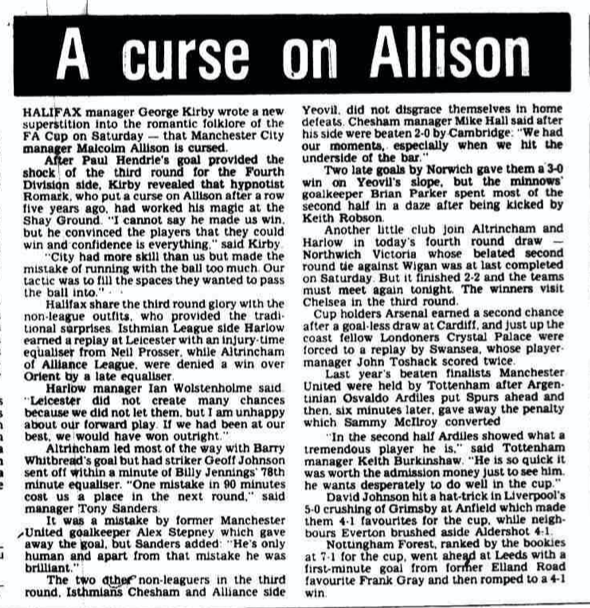
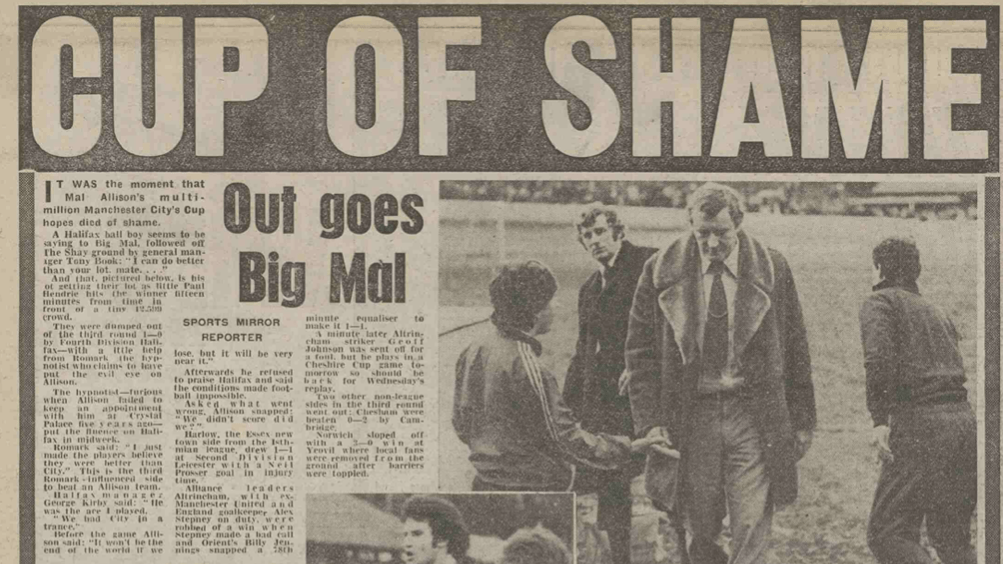
Malcolm Allison’s multi-million pound Manchester City side were humbled 1-0 at Fourth Division Halifax Town in the FAC on this day (5 January) in 1980 but there’s so much more to it than that. At Christmas 1979 big spending City were 12th in the League and Malcolm Allison was in charge of the most expensive British team ever assembled up to that point.12th was disappointing of course but it wasn’t the end of the world. In those days a decent run in the League could easily lift a team (similar to the 2025-26 season in terms of the number of clubs capable of winning the League at Christmas). Sadly, City collapsed in the weeks that followed.  

A 1-1 draw at Stoke on Boxing Day was disappointing, but it wasn’t the end of the world.  Then a 4-1 defeat at First Division newcomers Brighton knocked confidence at an important time.  The next game was the third round F.A. Cup clash against Fourth Division Halifax Town at the Shay.

In his programme notes for the match Halifax Manager George Kirby predicted a shock:  “In today’s F.A. Cup 3rd round the only certainty is that there are going to be some surprises, especially with the wintry conditions underfoot.  I like to think that we are among one of the possible giant killers.  This is because we are playing against one of the certain to be ‘top teams’ of the 80s.  A 4th Div side at home to a 1st Div outfit with such stars as Joe Corrigan, Steve Daley, and Mike Robinson is a possible shock result.  It only needs an off day by a key player and Halifax are in the hunt.”

Kirby was determined to defeat football’s biggest spenders and even brought in an hypnotist, Romark (who had previously ‘cursed’ Allison while the City boss had been manager of Crystal Palace – a really interesting story which will be covered in my biography of Peter Barnes to be published in 2021), to get his players in the right frame of mind.  The game itself was played in horrendous conditions, with multi-million pound City struggling to achieve anything.  In the 75th minute it was all over as the ex-Birmingham City player Paul Hendrie converted a cross from former City schoolboy Andy Stafford to give Halifax a 1-0 victory.  It was the biggest result in Halifax history, and the most embarrassing City defeat of the Allison period.  Even today the name of Halifax and the sight of the Shay brings back nightmares for a large number of Blues.

Subscribe to get access

If you have enjoyed this then why not subscribe and read content like this plus more in-depth material. It’s £3 per month or £20 a year with access to every post so far and many hundreds to come.

The First Time: Manchester City V Real Madrid

Almost 46 years since their first ever meeting Manchester City and Real Madrid meet tomorrow (10 December 2025) in the Champions League. I doubt anyone in the media covering the game will mention the first meeting but if there is anyone interested it took place on 19 December in 1979. Back in 1979 the game was considered a prestigious friendly, or at least that’s what it was supposed to be, but it turned out to be a controversial game with implications for the Blues for some time. Here for subscribers is an 1800 word article with images of that game and the controversy surrounding it.

Subscribe to get access – Monthly

This article is available to subscribers to the website. It costs £3 per month (cancel anytime) or £20 a year (see below).

Subscribe to get access – Annual

This article is available to subscribers to the website. Annual subscribers access everything on the site (books, articles, videos, history talks, interviews etc.) posted since it was created in December 2020. Monthly subscribers access everything since 1 October 2022. Both Monthly & Annual subscribers access all new content too throughout their subscription.