Record Average Crowds

I’ve not done one of these for a while but I know they always prompt a bit of debate, so here goes… a feature on Manchester City FC attendances. It is a fact that the Blues have, generation after generation, been one of the English game’s top attractions. Like all – and I do mean all – English clubs there have been some average attendance lows over the years, but when the entire history of Manchester City is reviewed and the club’s average figures are compared with the national average it is clear that the Blues have consistently been one of football’s most attractive draws.  Take a look at the following:

  • Since the beginning of the Football League in 1888 only nine sides have topped the table for average attendances.  In chronological order of their first appearance at the top of the average table they are: Everton (1888-9), Villa (1898-99), Newcastle (1904-05), Chelsea (1907-08), Tottenham (1909-10), City (1910-11), Liverpool (1922-23), Arsenal (1929-30), & Manchester United (1956-57) 
  • As early as 1895-96 City were the third best supported side in the entire League despite being a Second Division side.  Only First Division sides Everton & Aston Villa could better the Blues.  Modern day giants Arsenal were 10th; Liverpool were 19th; United were 21st and Chelsea had yet to exist.
  • In 1900-01 City were the 2nd best supported side in the entire League with only 400 people separating Villa (1st) and City 
  • The 1910-11 season saw Manchester’s Blues top the attendance charts for the first time.  City’s average was 26,000 and was the 8th highest average of all time at that point (all clubs, all seasons). 
  • Regularly amongst the best supported sides throughout the inter war period, City’s average exceeded 37,000 for the first time in 1927-28 when the Blues established a record average crowd for the Second Division.  This was also the entire League’s highest.
  • In 1947-48 City’s average crowd exceeded 42,000 for the first time.  Prior to that season only Chelsea (1919-20 & 1946-7), Arsenal (1934-5, 1936-7, 1937-8, & 1946-7) , Newcastle (1946-7), Liverpool (1946-7), United (1946-7), and Wolves (1946-7) had exceeded that figure.
  • From 1975 to relegation in 1983 City were always one of the top 4 best supported sides, usually third behind United and Liverpool.
  • Since the 1980s whenever City have played outside of the top division, they have tended to be the best supported side in that division.  
  • Since moving to their current home in 2003, the increased capacity has allowed City to re-establish itself as one of best supported clubs again. Maine Road’s capacity from 1994 onwards was extremely low compared to the club’s entire history and prevented the Blues from staging games in front of attendances of approximateley 35,000 upwards.

In general many people believe success increases support, and while that is undoubtedly true to some extent, for City it is often periods of adversity that prove the loyalty of the Club’s fans.  It is highly significant, for example, that the first time City were the best supported side in the entire League (1910-11) Manchester United (6th best supported side) won the League title for the second time in 3 seasons.

Similarly, in 1925-26 when City were the best supported side in Division One and had established a new record average, the Blues were actually relegated.  This coupled with significant poverty and hardship in Manchester at the time should have reduced support but loyalty increased!  In my book “Manchester A Football History” I explore the relationship between attendances and Manchester’s major sides and it is fair to say that City fans can feel immensely proud of their loyalty throughout the history of the game.  Something that cannot be said by all of the League’s biggest names.  

In fact, it is worth highlighting that City have never been the worst supported side in their division but, of today’s so-called giants, Arsenal (1912-13 – average = 9,100) and Manchester United (1930-31 – average = 11,685) have.  City’s worst average of the Twentieth Century came in the desperate 1964-65 season and was 14,753 (half the average of 1960-61 and a 3rd of the 1957-8 figure).  However it is significant that for every League season City’s average has always been above the divisional average and, apart from 17 seasons, has always been in the top 11 nationally.  Again, few of today’s giants can’t say that – United’s 20th Century low stands at 4,650 and Chelsea averaged 15,731 as recently as 1988-89. In fact City’s lowest League attendance is more than double United’s lowest League attendance at Old Trafford (United have several crowds of less than 4,000 at Old Trafford, including top flight games; City’s lowest in the League was a little over 8000 in the second tier).

For fans average attendances are often used as an indicator of size of club and so a number of people over the years have tried to produce a definitive ‘all-time’ attendance table.  Several years ago analysis by a member of the Association of Football Statisticians claimed that if stadium capacity was not an issue for any club City would be the fourth biggest side in terms of attendance.  That analysis compared postwar attendance detail with performance on the pitch.  

In 2002 writer Brian Tabner calculated an all-time attendance table based on each club’s average attendance position during seasons 1925-2002.  His top ten were:  Arsenal, Liverpool, United, Everton, Tottenham, Newcastle, City, Chelsea, Villa and Sunderland.  Since 2002 several clubs have increased their capacities of course and this will have a positive impact on each club’s standing in a more up to date analysis.   

Figures can be manipulated in many different ways, but City should feel proud that they have many attendance firsts that can never be matched by today’s perceived biggest clubs.  

The Seasons City Have Topped the Divisional Charts

The following figures show the seasons when City were the best supported side in their division and the Club’s highest individual crowd that season.  Those crowds marked in italics were also the highest individual crowds for the entire division that season (crowds pre-1925 are inconsistently recorded and so have not been highlighted).  It is fair to say that when an average crowd is within 4,000 of the highest then the stadium is likely to have been full for the majority of games with the size of away support varying.     

Average         Season          Highest Crowd                                  

10,000            1895-96         30,000 (Liverpool)                

10,000            1898-99         25,000 (N. Heath)    

16,000            1902-03         30,000 (United)        

18,275            1909-10         40,000 (Oldham)

26,000            1910-11         40,000 (Liverpool)    

21,000            1914-15         40,000 (Oldham)

32,000            1925-26         62,994 (United)

30,848            1926-27         49,384 (Bradford C)

37,468            1927-28         59,500 (Preston)

31,715            1928-29         61,007 (United)

35,016            1950-51         45,842 (Hull)

27,739            1965-66         47,171 (Huddersfield)

24,220            1984-85         47,285 (Charlton)

23,500            1988-89         40,070 (Chelsea)

26,753            1996-97         30,729 (Oldham)

28,273            1998-99         32,471 (York)

32,001            1999-00         33,027 (Blackburn)

33,059            2001-02         34,657 (Portsmouth)

With the increase in capacity at the Etihad coming this year it will be interesting to see how attendances develop. No doubt I’ll post more on this as the season progresses. Undoubtedly City will establish a new record average attendance in 2026-27.

Manchester Central

Over 90 years ago Manchester City and Manchester United worked together to help kill off the threat of an ambitious Manchester club, Manchester Central. At the time United we’re struggling, while City we’re riding high, but what exactly happened? I’ve researched the story extensively over the years and here’s an overview I wrote about 16 years ago on it. Enjoy!

In recent years much has been made of the growth of FC United of Manchester and their impact on support, community work and attitudes in Manchester. However, the United offshoot were not the first Mancunian side created following dissatisfaction among supporters. In fact FC United arrived 80 years after a bigger offshoot had seriously challenged the livelihood of Manchester’s two major sides. The difference being that in the Twenties it was Manchester City’s move to Maine Road that prompted the creation of a new forward-looking club – Manchester Central FC, who joined the semi-professional Lancashire Combination in 1928-29. 

One of the main figures behind Central was former City director John Ayrton, who that felt that Maine Road, in the south of Manchester, was too far from City’s old base in the east: “Ever since the City club left the Hyde Road district, I have thought of having a club on this side of Manchester. Our whole object is to develop local talent, and gradually to build up the club so that one day it may take its place in the Third Division of the Football League. Manchester has the biggest sporting community in the provinces. Surely then we have every reason to hope that there is plenty of room for our club.”

Many well known figures in Manchester football were involved in the creation of Central, including the great Billy Meredith, plus Charlie Pringle and Charlie Roberts, former captains of City and United respectively. As with FC United, the side attracted significantly better players than many of their Combination rivals – who included Morecambe, Chorley and Darwen – simply because of who they were. Central was chosen as a name so that the club could use the initials MCFC, which were spelt out on the ironwork above the main entrance of their 40,000-capacity Belle Vue ground on Hyde Road, half a mile from City’s old stadium.

After a couple of failed attempts, Central were on the verge of League football when Wigan Borough withdrew from Division Three (North) during October 1931. Central, now based in the Cheshire League, immediately offered to take over their fixtures. The existing Division Three sides supported Central’s application, including, significantly, Stockport County, who saw Central’s acceptance as being a positive development for local football.

In the Daily Dispatch, journalist ­“Adjutant” commented: “Manchester Central potentially are not merely a Second Division, but a First Division club of the future. There should be room in Manchester for three League clubs.” Second Division United and First Division City did not share the enthusiasm. Working together they complained to the League and, as they were classed as full members of the League while Division Three’s clubs had fewer rights, the League rejected Central.

The local press was appalled, as were many City and United supporters. So why did the two clubs object? At first glance it would seem that Central’s aim to be “the new MCFC” simply upset City. However, the truth is that Central were actually more of a threat to United, who were struggling on and off the pitch. Crowds were small – United’s nearest home gate to Central’s bid was 6,694 (against Notts County), while Central had attracted several crowds higher than this despite being non-League.

Respected journalist Ivan Sharpe of the Sunday Chronicle argued that Central should have been admitted because United were failing: “A third club in Manchester would not damage the City at all seriously. It would build up football interest. I don’t like the way Manchester is slipping back in football. Where are those 30,000 football followers who used to assemble at Old Trafford? The odd 25,000 are missing. It is time something was done about it.” 

Central were hugely disappointed and chairman George Hardman said: “We think there ought to be League football in the Belle Vue area, where there are 440,000 people within two miles, and a million people within four miles. This is surely enough for two League clubs in a place like Manchester.There seems to be a sad lack of enterprise so far as League football is concerned.”

It seems Hardman deliberately ignored United when he talked of “two” clubs as he knew it was the threat to United that was the deciding factor. Ivan Sharpe: “In view of Manchester United’s sorry position I certainly think Manchester Central should have been admitted.” “Nomad”, writing in the Evening Chronicle, held a similar view: “Keen disappointment is expressed that Manchester is not to have a third Football League club, especially as there is a splendid ground available at Belle Vue, and that Manchester United are so signally failing to keep Manchester on the football map.”

Within a year Central folded, feeling the close relationship of City and United would continue to severely restrict their progress. At City the 1930s proved to be a golden era with record crowds and significant success, while United struggled. Post-1945 it all changed, of course, but had Central been accepted into the League during 1931 then football in Manchester today might have been very different.

A more detailed account of Manchester Central’s story appears in my book Manchester A Football History, which subscribers can download and read here:

United Supporters Club Boycott Committee-Yes, Really!

I’m sure some will believe this didn’t happen but on this day (31 October) in 1930 the previous night’s meeting of the so-called Boycotting Committee of the Manchester United Supporters Club met to discuss their next boycott of a first team game. There was widespread dissatisfaction of the plight of the Reds that season and the season would end with United’s Old Trafford average being 11,685 (the lowest average for either United/Newton Heath or City since Newton Heath averaged 4,650 in 1902). Neither side has attracted a lower average since.

What’s significant about this brief article is the mention of the planned boycott v Arsenal – that game attracted the highest crowd of the season to date! This demonstrates how difficult it is to plan a protest and for all fans to join in.

I explored the boycott and fan related issues in Manchester A Football History (my 2008/2010 update) book. This has been out of print for over a decade but PDFs of every chapter are free to download for all who subscribe. See the following for details of how to subscribe:

New Monthly Football Column – Manchester Confidential

I’ve got some good news to report. From today Manchester Confidential will be publishing my new monthly column on football in Greater Manchester. Each month I’ll be focusing on a different club from the region and will write a piece combining the team’s modern day situation with a historical angle. My first feature is about Manchester United and next month’s piece will be about Manchester City. Follow the link below for this month’s first article:

https://confidentials.com/manchester/manchester-united-looking-backward-to-push-forward?id=63c9274f540ba

I do intend covering the League clubs of Greater Manchester, plus some of our other prominent sides, over the coming months. I hope you enjoy them. Thanks.

A Dominant Derby Performance

On this day (4 October) in 1930 the Manchester derby ended City 4 United 1. It was
the Reds’ ninth straight defeat of the season and they were relegated at the end of it.  The Athletic News claimed:  “City obviously grew sympathetic and declined to rub it in.” That’s the kind of wording they could have used again to describe the October 2022 derby when City were leading 6-1! Here’s the detailed story of that day:

Subscribe to get access

Read more of this content when you subscribe today. £20 per year to subscribe and for that you get access to all the interviews, articles and books already posted. Those subscribing £20 a year have access to everything posted since December 2020.

Subscribe to get access

Read more of this content when you subscribe today. You can subscribe at either £20 per year (above) or at £3 per month here (cancel any time). For those subscribing £3 per month you will be able to access all content from October 2022 onwards for as long as you are a subscriber. Those subscribing £20 a year have access to everything posted since December 2020.

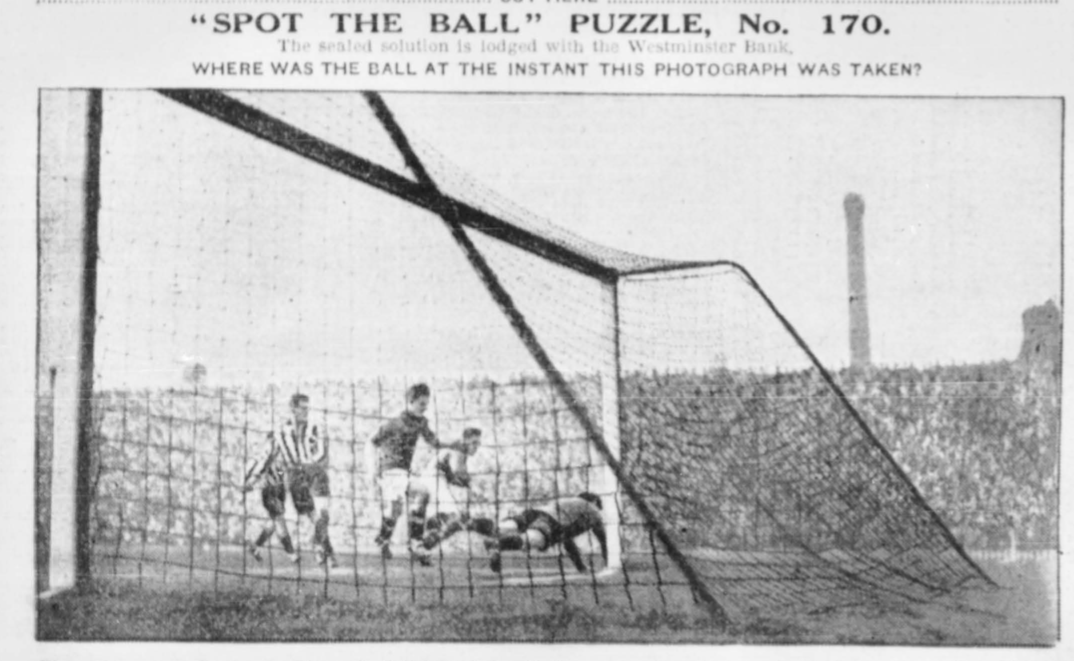
Remember the old Spot The Ball competition?

Here’s one (above) I’ve spotted from the 1930s at Old Trafford. Can you work out where the ball should be? The winner wasn’t the person who accurately identified where the ball was, instead it was the person who accurately identified where football experts, employed by the newspaper or pools company, said the ball would be.

So where do you think the ball was? Is it in the goal; has it been saved and at the feet of a striker; could it have been curled around the post; maybe it’s flying high over that Trafford Park chimney?

See below for the answer…

Sadly, I don’t know which game this was (and they never said at the time) but it is Old Trafford and it appeared in the Athletic News in January 1931.

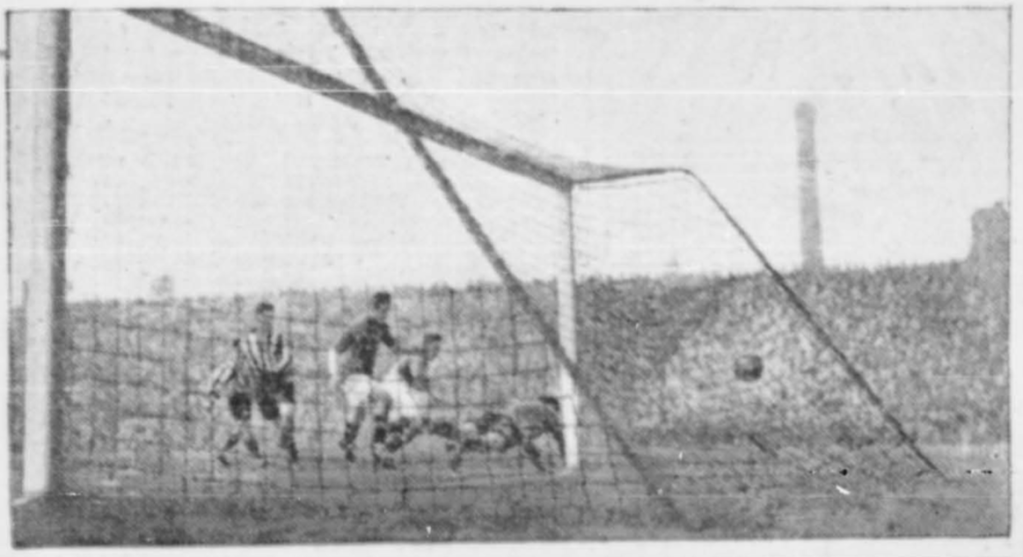
The experts identified that the ball would be here:

I can’t make out if that’s in the back of the net (possible – these were bad days for United and the club was relegated this season) or if it’s been curled around the post.