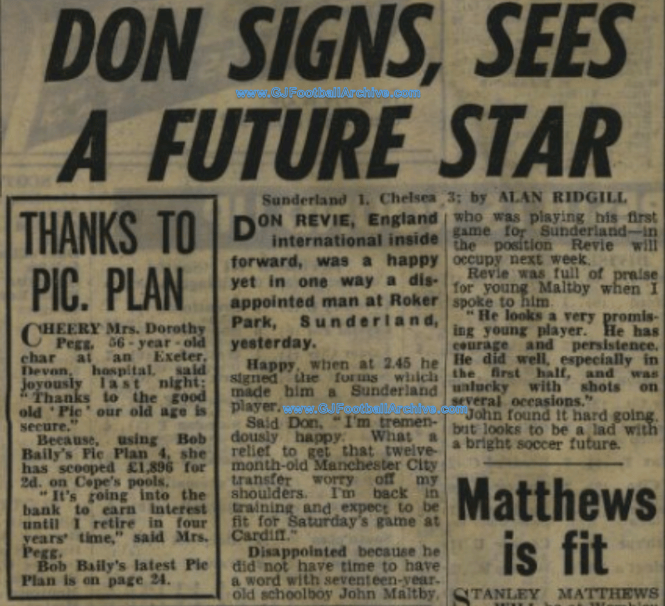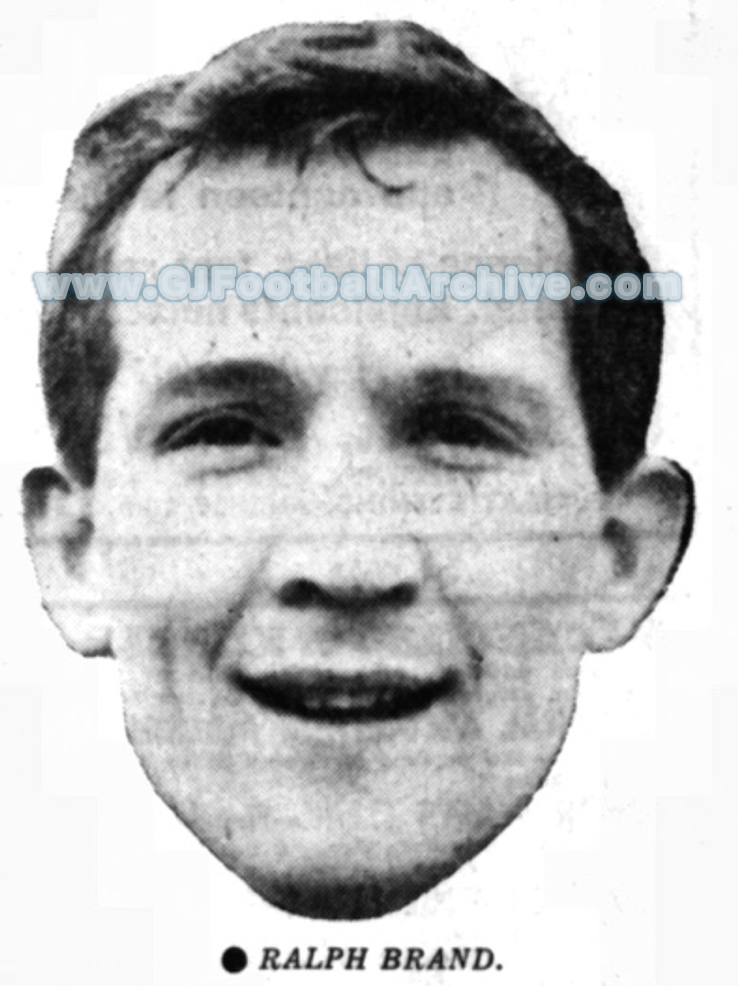
Ralph Brand

Yesterday I heard the news of Ralph Brand’s death and I mentioned I’d post a more fitting tribute today, so here it is… I hope this does him justice. Inevitably, as this is a site primarily focusing on Greater Manchester football, I talk mostly of his time in Manchester.
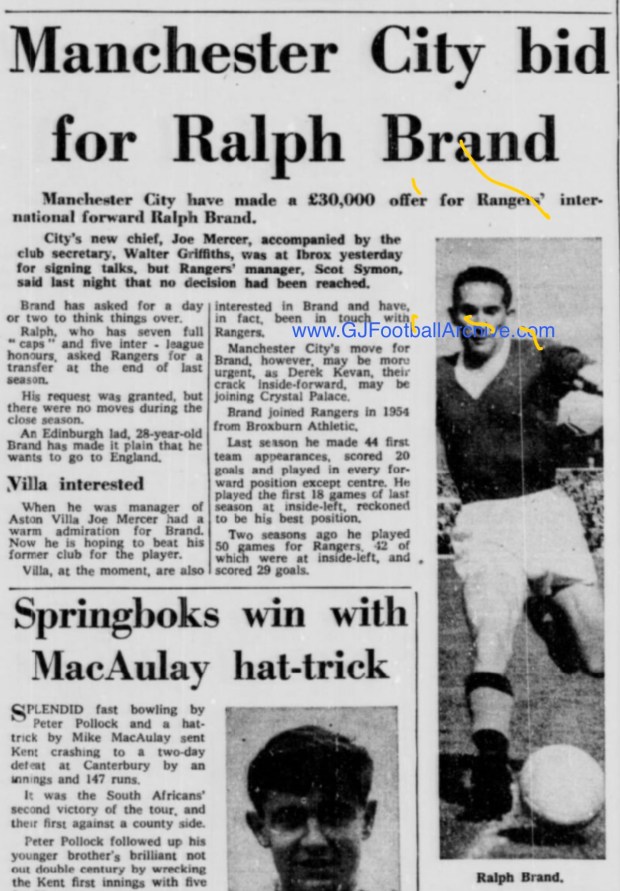
Before joining City as Joe Mercer’s first signing in 1965 Ralph Brand had a glittering career with Rangers. He amassed an enviable collection of 11 major honours, including four Scottish League titles, four League Cups, and three Scottish Cups.

A prolific striker who netted 222 goals in 347 appearances for the Ibrox club between 1954 and 1965, his talent was also recognised at every level of the Scottish game. After catching the eye as a Scottish Schoolboys international, he went on to earn 10 caps for the Scotland Under-23 side and made five appearances for the Scottish League XI, where he scored an impressive eight goals.

On the senior international stage, he earned eight full caps for Scotland—maintaining a remarkable strike rate of eight goals in eight games despite fierce competition for places (including from former Blue Denis Law).

Born in Edinburgh on 18 December 1936 Ralph had played football for Carricknowe School, Slateford Athletic and Broxburn Athletic before joining Rangers in June 1952. He arrived at City thirteen years later.

Joe Mercer became City boss in July 1965, knowing that new faces were needed urgently. The day after a drawn friendly at Walsall, Ralph was signed from Rangers. He seemed to be just the player City needed and there was a great deal of optimism around the transfer.
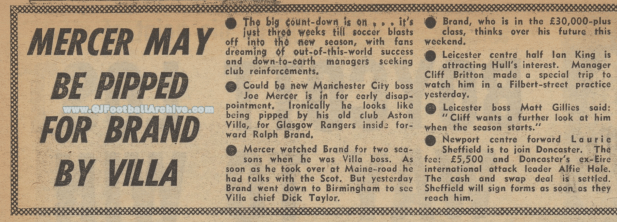
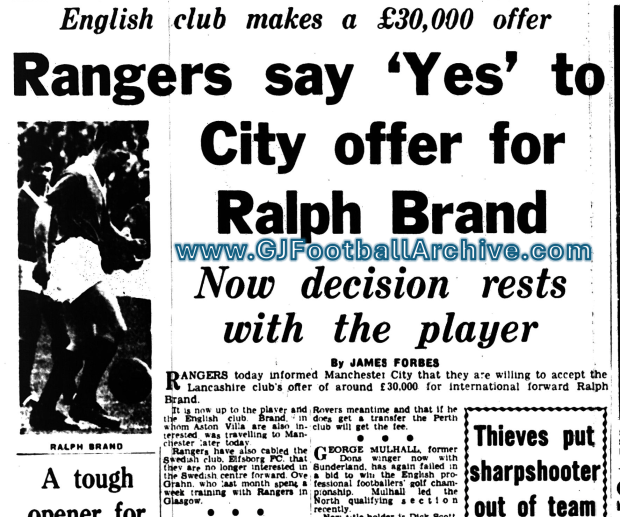
Lots of clubs, including Aston Villa, had shown interest in him but it was City that secured his signature for £30,000. He made his debut at Middlesbrough on 21 August 1965 and scored his first goal seven days later in a 2-2 draw against Bristol City. Sadly, his time at City was not the success either the player or the club had hoped.
Brand scored twice in his two seasons at Maine Road and fellow Scot Bobby Kennedy told me when I interviewed him in the 200os: ‘At that time Ralph had been a big star in Scotland and was an international player but, I guess, so much was expected of him that it may have put too much pressure on him.  There was a lot of competition for his place – Neil Young and Dave Connor really leaped above him once Malcolm Allison started working with them. I was fortunate when I arrived that there wasn’t too much competition but, as time progressed, Tony Book was signed and opportunities became limited for me also.’

On 11 August 1967 Brand joined Sunderland after two years with City. During his Maine Road career he netted twice in 20 League appearances. He also made one appearance in the FA Cup and one in the League Cup, plus he scored 12 goals in 48 reserve appearances.

After Sunderland he moved to Raith Rovers in June 1969 and Hamilton Academicals in 1971. According to John Maddocks, City’s historian during the 1980s and 1990s, who did significant research on the Blues’ players, after Brand’s playing career finished he coached at Albion Rovers (1971), managed Darlington (1972-73) before going back to Albion in the same capacity. In 1974 Ralph was coaching at Dunfermline.

In later years he took over a shop in Edinburgh and then became a taxi-driver.

My thoughts are with Ralph’s family, friends and former playing colleagues.

90 Years Ago Today: City v Sunderland

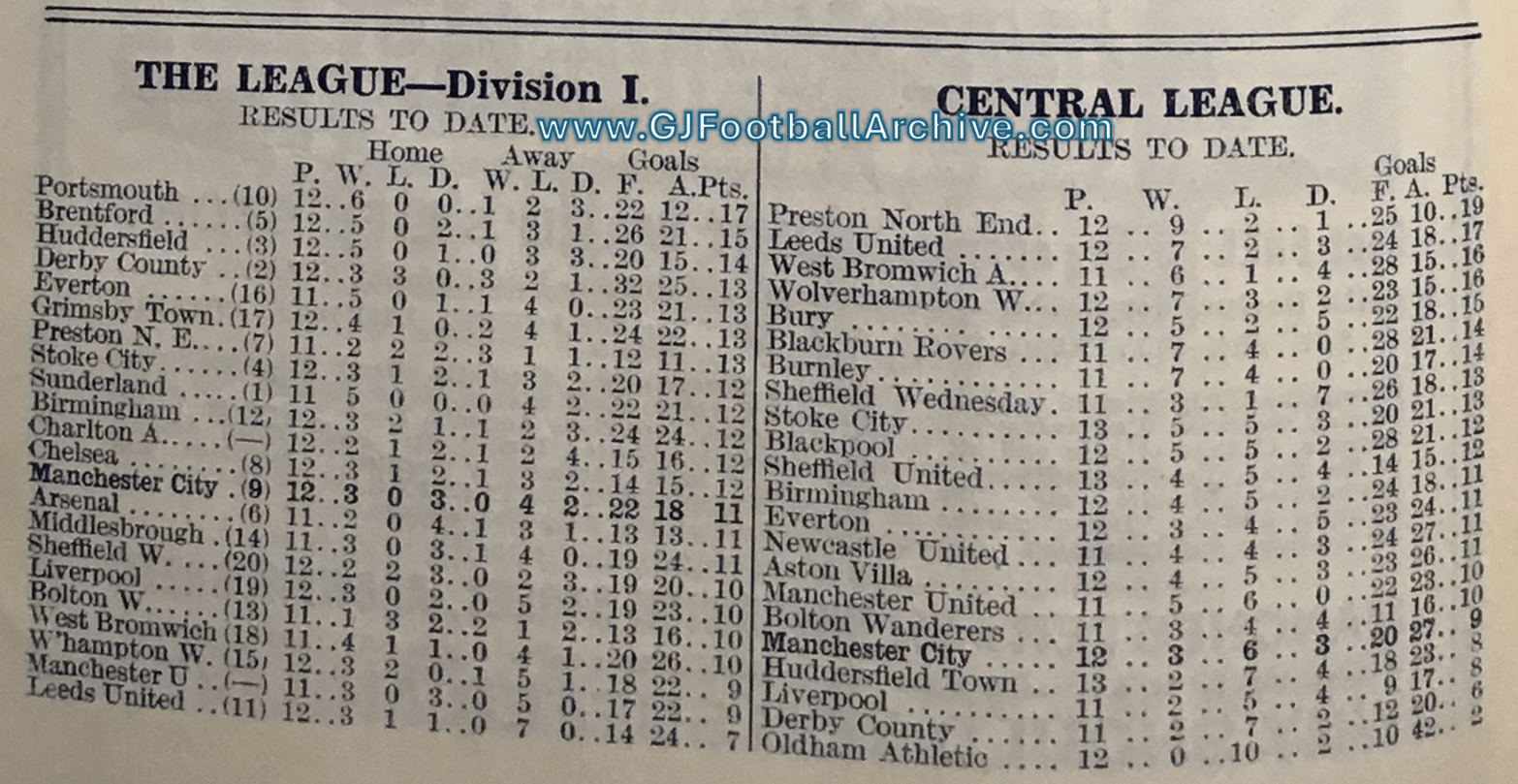
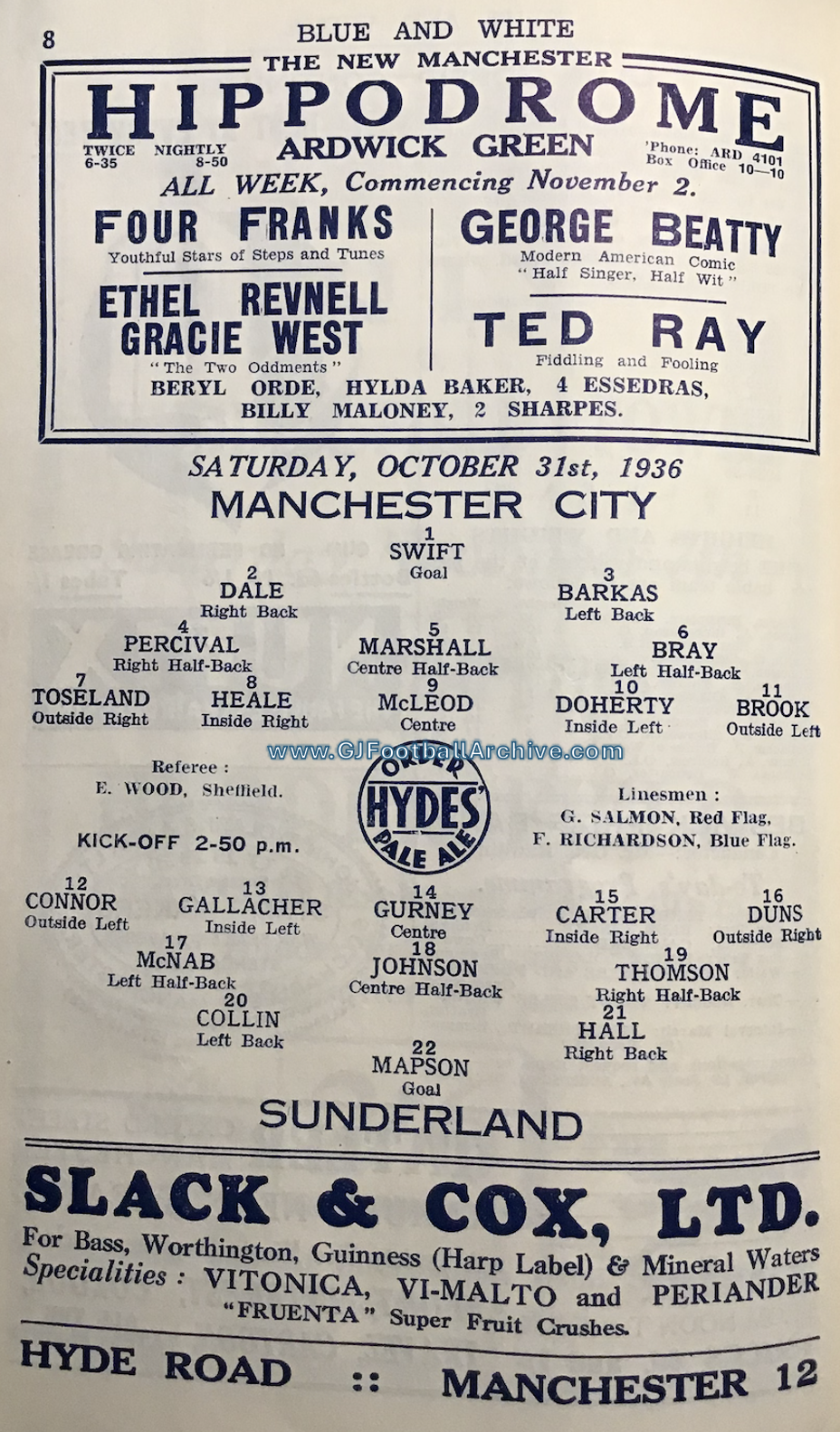
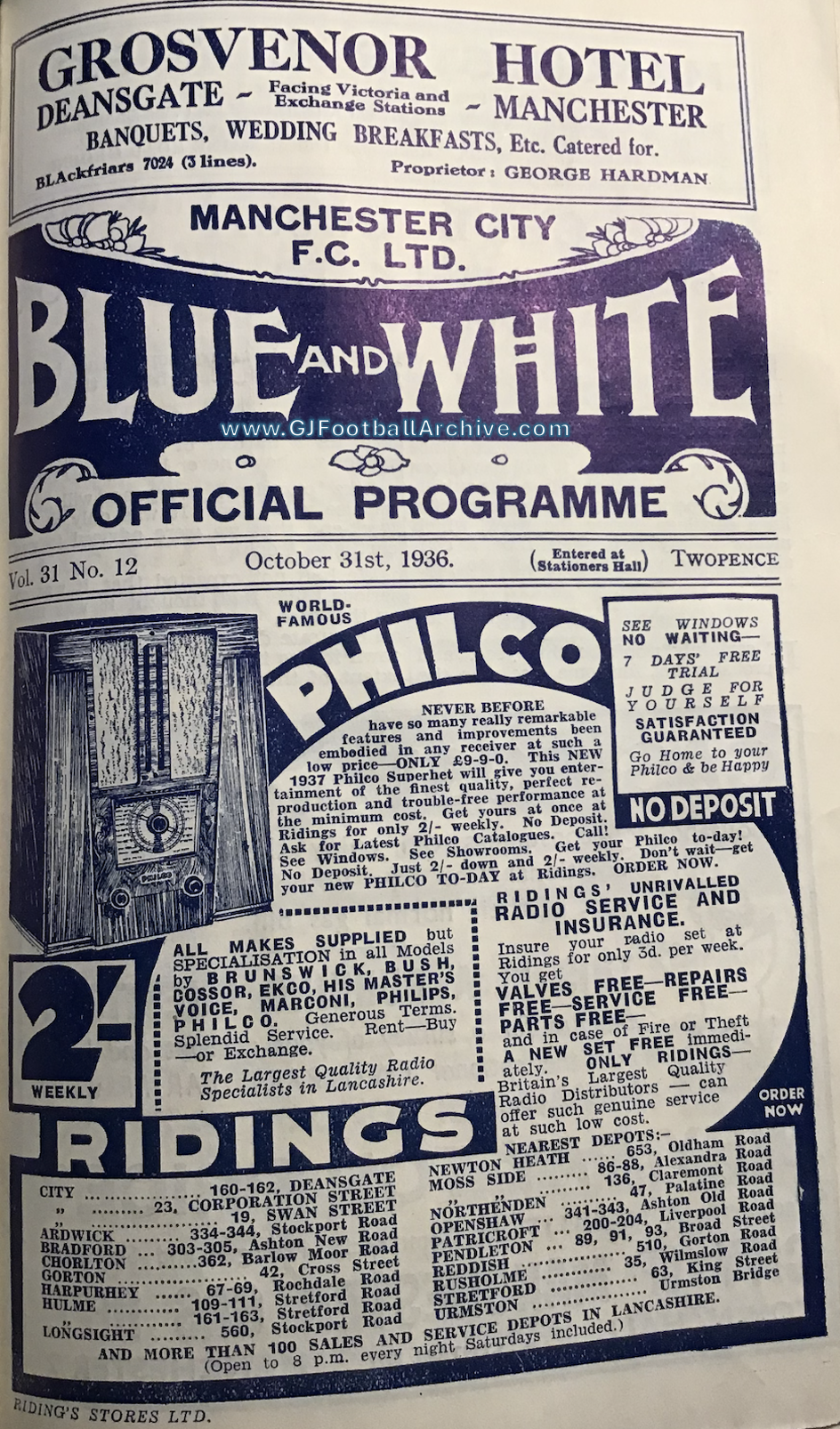
90 years ago today (31 October) a crowd of 38,444 watched Manchester City lose 4-2 at home to Sunderland. Here’s the League table from before that game. Notice the clubs at the top and spread throughout the top flight: always worth remembering that football clubs that claim to be today’s giants were not always the game’s elite. Arsenal, for example, didn’t start winning trophies until the 1930s, whereas City, Villa, Newcastle and Everton had won their first trophies decades earlier (and each were the best supported teams in the League multiple times before Arsenal, United and Liverpool achieved that accolade). Here’s the cover and team sheet page of the programme for this game. Look at the adverts too – any one fancy going to see Ted Ray and Hylda Baker after the match?

My series on Manchester City in the 1930s continues with a 2,500 word subscriber article on the 1936-37 season. If you subscribe (see below) I hope you enjoy it. If you don’t subscribe then why not try it for a month (£3 per month or sign up for a year at a discounted £20 per year)?

Here’s the article:

Subscribe to get access

Read more of this content when you subscribe today. It costs £3 a month (cancel anytime) or sign up for a year at £20 per year. Subscribers have access to the 1000s of articles, features, interviews etc. posted so far and all those posted during your subscription.

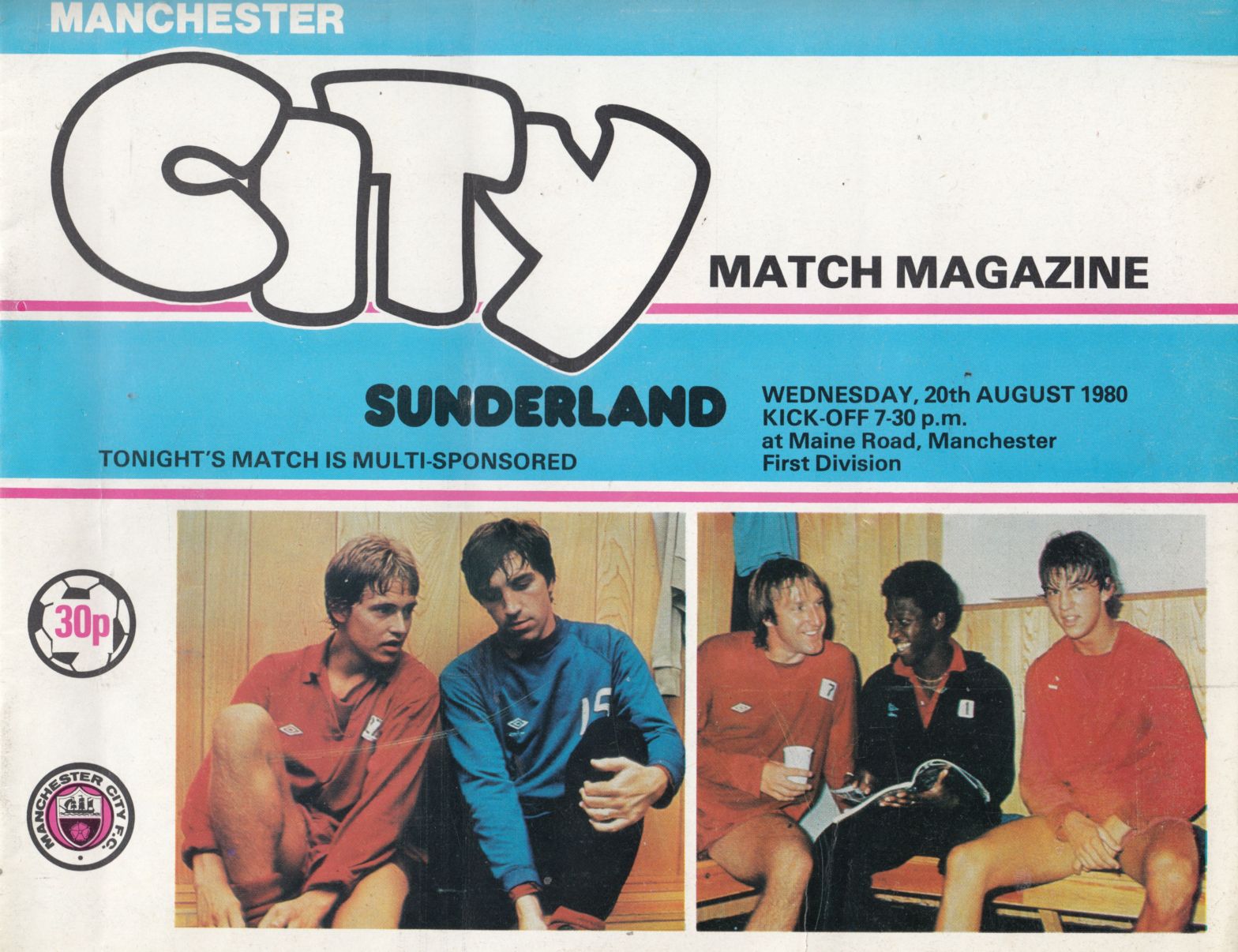
Manchester City v Sunderland

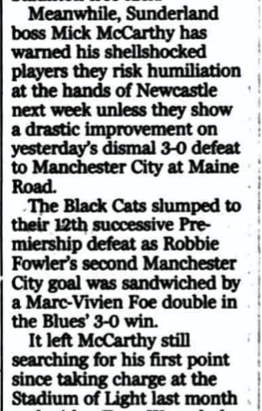
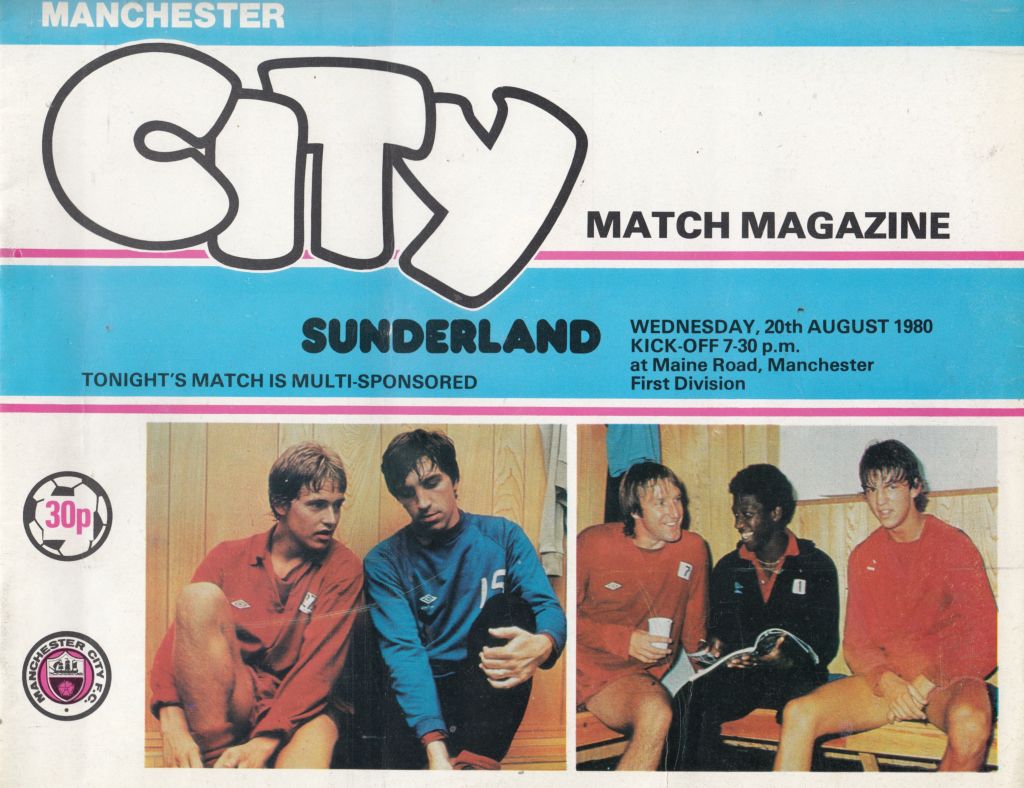
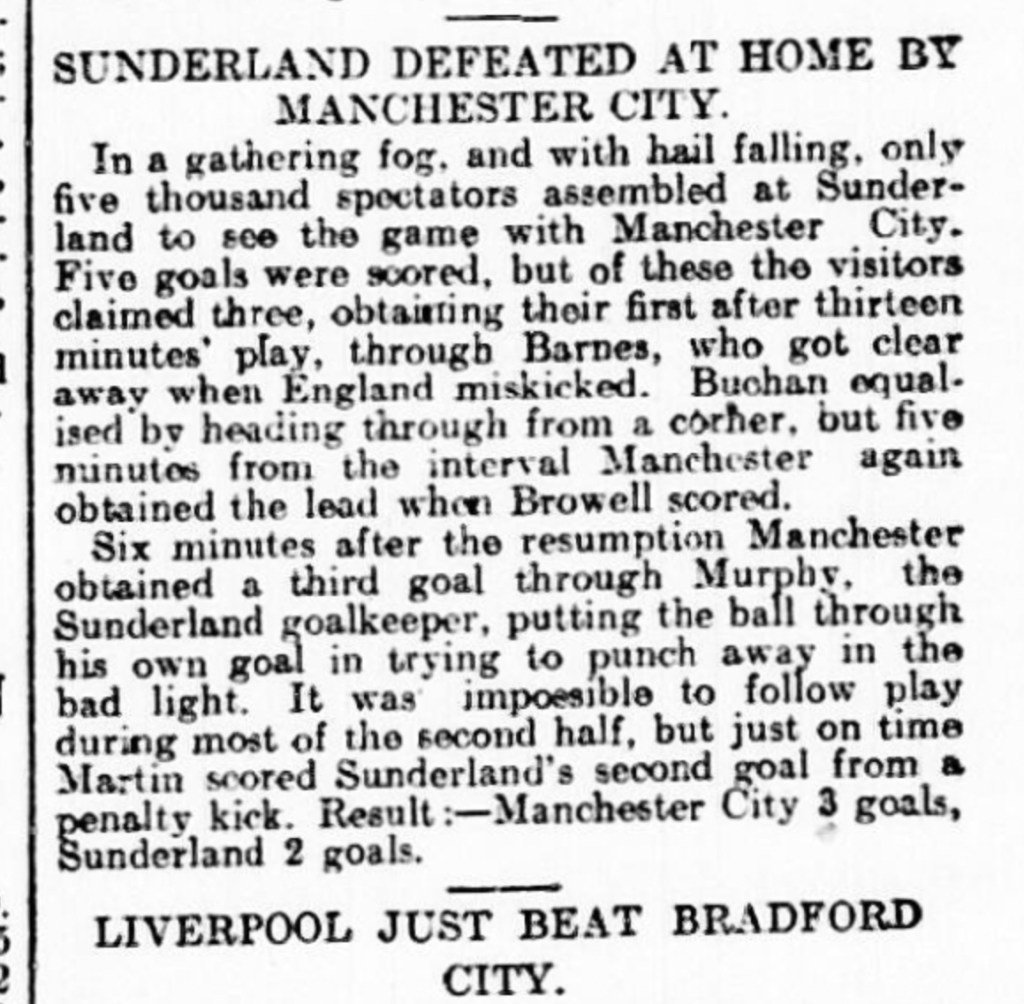
It’s City v Sunderland today. the first meeting between these clubs was a 2-1 City win in December 1899. The legendary Billy Meredith scored one of City’s goals that day. There have been cup finals, charity shield games and key matches in the League. Many of these are featured on this site. Here’s a link to all the articles tagged Sunderland:

https://gjfootballarchive.com/tag/sunderland

The 2010s: Victory over Sunderland

Manager Roberto Mancini knew that victory over Sunderland on this day (3 April) in 2011 would lift Manchester City to third place in the League. Despite early season optimism that a League title could be possible that opportunity had faded and now the target, as far as the League was concerned, was to finish third or better. While fourth place would bring a Champions League play-off place, third would bring automatic qualification.

City took a ninth minute lead, but it wasn’t until Carlos Tevez doubled that lead via a penalty six minutes later that Mancini’s team looked in total control. An adventurous looking City pushed and pressed Sunderland and further chances came from Tevez and Balotelli before the break, but it remained 2-0. That changed in the second half as the Blues’ dominance brought reward.

Three goals in ten minutes made this an extremely positive day with City looking at their absolute best. In the 63rd minute a shot from Balotelli rebounded for David Silva to send home the rebound. Four minutes later Aleksandar Kolarov fired across goal following a corner and Patrick Vieira slid in to steer the ball in at the back post. Vieira had only come on as substitute two minutes earlier.

The fifth and final goal was slotted in by Yaya Toure in the 73rd minute. The win meant third placed City were a point clear of fourth placed Chelsea (though they had a game in hand) and ten behind leaders United. Mancini’s team were six points clear of fifth placed Tottenham with seven games left for the Blues.

The 1910s: 1912-1913 Mangnall Walks Out On United 

The new series of features on Manchester City in the 1910s continues today with a 2800 word article on the 1912-13 season – A season which saw United’s most successful manager (at the time) walk out on the Reds to become City’s manager (he believed that City, with the larger pulling power, was a more ambitious club). If you’re a subscriber you can read all about that and the rest of the season below. If you’re not a subscriber then why not sign up for a month and see what you think?

Subscribe to get access

Read more of this content when you subscribe today. It costs £3 per month (cancel anytime) or sign up a year at a time for the discounted annual fee of £20. This gives access to everything on the site, including PDFs of 3 of my books and various other articles, interviews and audio material. Each subscriber has access to all content posted during their subscription period too. Why not sign up for a month and see what you think?

More on the 1910s soon. Why not subscribe and read this and all the other subscriber features?

Top Two Divisions Attendances and Table From 40 Years Ago!

Last week I posted the top flight attendances for this last week forty years ago and this led to a number of comments/questions and so to answer some of those I’ve now posted the top two divisions attendances together with the two League tables AND the end of season average attendances. People asked for clarity on how the figures compared to the second tier and whether League position played its part in affecting crowds. As a reminder here’s last week’s attendances…

And here’s this week’s (published 24 November 1985) and the League table too.

Obviously, these are only snapshots from that season but to add a bit more context here are the end of season averages here are the top 46 best supported clubs in order that season (hopefully it might make those who sing songs like ‘Where Were You?’ think about the crowds at their own clubs first):

A few notable League positions for those who do sing ‘Where Were You?’… The top eight clubs in the League were: Liverpool (champions), Everton, West Ham, Man Utd, Sheff Wed, Chelsea, Arsenal and Forest. Manchester City (who were 4th best supported club) were 15th (only 4 points above relegation zone), Spurs were tenth, Newcastle 11th and Aston Villa 16th.

In the Second Division best supported club Sunderland were 18th (avoiding relegation by 4 points); the top four were Norwich, Charlton, Wimbledon and Portsmouth.

If you’d like to know more about Manchester City at this time, here’s a 2,500 word subscriber feature on the 1985-86 season. Enjoy!

Subscribe to get access – Monthly

Read more of this content when you subscribe today. It costs £3 per month (cancel anytime) to access everything posted since 1 October 2022 or there’s a special annual rate below which gives greater access and works out much cheaper.

Subscribe to get access – Annual

Read more of this content when you subscribe today. It costs £3 per month (above) or £20 a year (here) to access everything posted since the site was created in December 2020. This special rate works out about £1.67 a week and gives access to everything posted, including PDFs of 3 of my books.

If you’d like to know more about subscribing then see:

1937 Making History

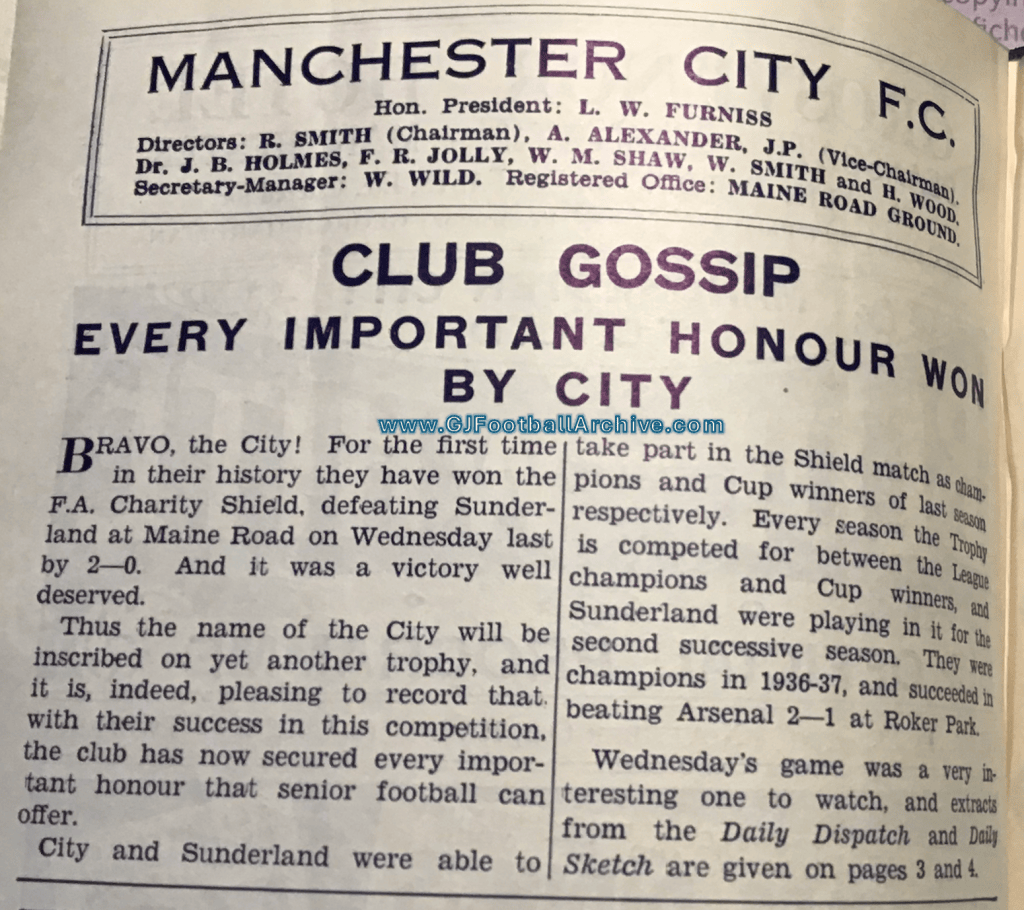
It wouldn’t get the same focus today but back on 3 November 1937 Manchester City’s first Charity Shield (nowadays Community Shield) win was heralded as a major achievement. The 2-0 success over Sunderland meant that City had at some point in their existence won every major honour available to them. This meant League, FA Cup and also the Second Division (often quoted in club histories, not just City’s, as a major success back then), as well as the Shield.

City’s scorers in the 2-0 win were Alec Herd and Peter Doherty.

You can read more on this period for Manchester City with this 1,800 word subscriber article on the 1937-38 season. If you subscribe (see below) I hope you enjoy it. If you don’t subscribe then why not try it for a month (£3 per month or sign up for a year at a discounted £20 per year)?

Here’s the article:

Subscribe to get access

Read more of this content when you subscribe today. It costs £3 a month (cancel anytime) or sign up for a year at £20 per year. Subscribers have access to the 1000s of articles, features, interviews etc. posted so far and all those posted during your subscription.

An Official Programme from October 1900

Here’s the Official Programme cover and Manchester City comments (below), published on 27 October 1900 for City’s game with Derby at Hyde Road. Back then the programme was a shared one with Second Division Newton Heath (later United) and a couple of rugby clubs. the comments below on City’s performances and preview of the Derby game are interesting. The 3-0 game it opens with was City’s 3-0 Division One defeat at Sunderland. The Monday game it mentions was a 2-0 victory over Newton Heath in the Lancashire Cup.

The ‘Doctor’ mentioned lower down was City half back William ‘Doc’ Holmes. The preview suggested this would be a tough game for City, though the return of Jimmy Ross was welcomed. Ross, a former Preston Invincible, was a key member of the side and he’d been sidelined for the previous six League games.

The match with Derby ended in a 2-0 victory with both goals scored by Fred Williams. If you’d like to find out more on this season for Manchester City then why not read the following 1200+ word article telling the story of 1900-01? Why not subscribe and read this and all the other content on here? You can even try it for a month at a time if that works best?

Subscribe to get access

Read more of this content when you subscribe today. It costs £3 per month (cancel anytime) or sign up a year at a time for the discounted annual fee of £20. This gives access to everything on the site, including PDFs of 3 of my books and various other articles, interviews and audio material. Each subscriber has access to all content posted during their subscription period too. Why not sign up for a month and see what you think?

Stadium of Light: First Penalty

Georgi Kinkladze scored the first penalty at Sunderland’s Stadium of Light when he equalised in the 75th minute of Manchester City’s 3-1 defeat on Friday 15 August 1997.  Earlier that night former Blue Niall Quinn scored the stadium’s historic first League goal.

While you’re here, why not subscribe and read an indepth article on the 1997-98 season? The article is almost 9,500 words long – there’s so much to say! Some people write entire football club histories that are shorter than that. It’s available to subscribers, so why not subscribe and relive this season and an extraordinary decade? As with many other subscriber features it contains material from interviews I’ve performed with key figures from that time.

Here’s the 9500 word article on that season:

Subscribe to get access – Monthly

Read more of this content when you subscribe today. It costs £3 per month (cancel anytime) to access everything posted since 1 October 2022 or there’s a special annual rate below which gives greater access and works out much cheaper.

Subscribe to get access – Annual

Read more of this content when you subscribe today. It costs £3 per month (above) or £20 a year (here) to access everything posted since the site was created in December 2020. This special rate works out about £1.67 a week and gives access to everything posted, including PDFs of 3 of my books.

If you’d like to know more about subscribing then see: