Guess Manchester City’s FA Cup Final Shirts: The Answer And More

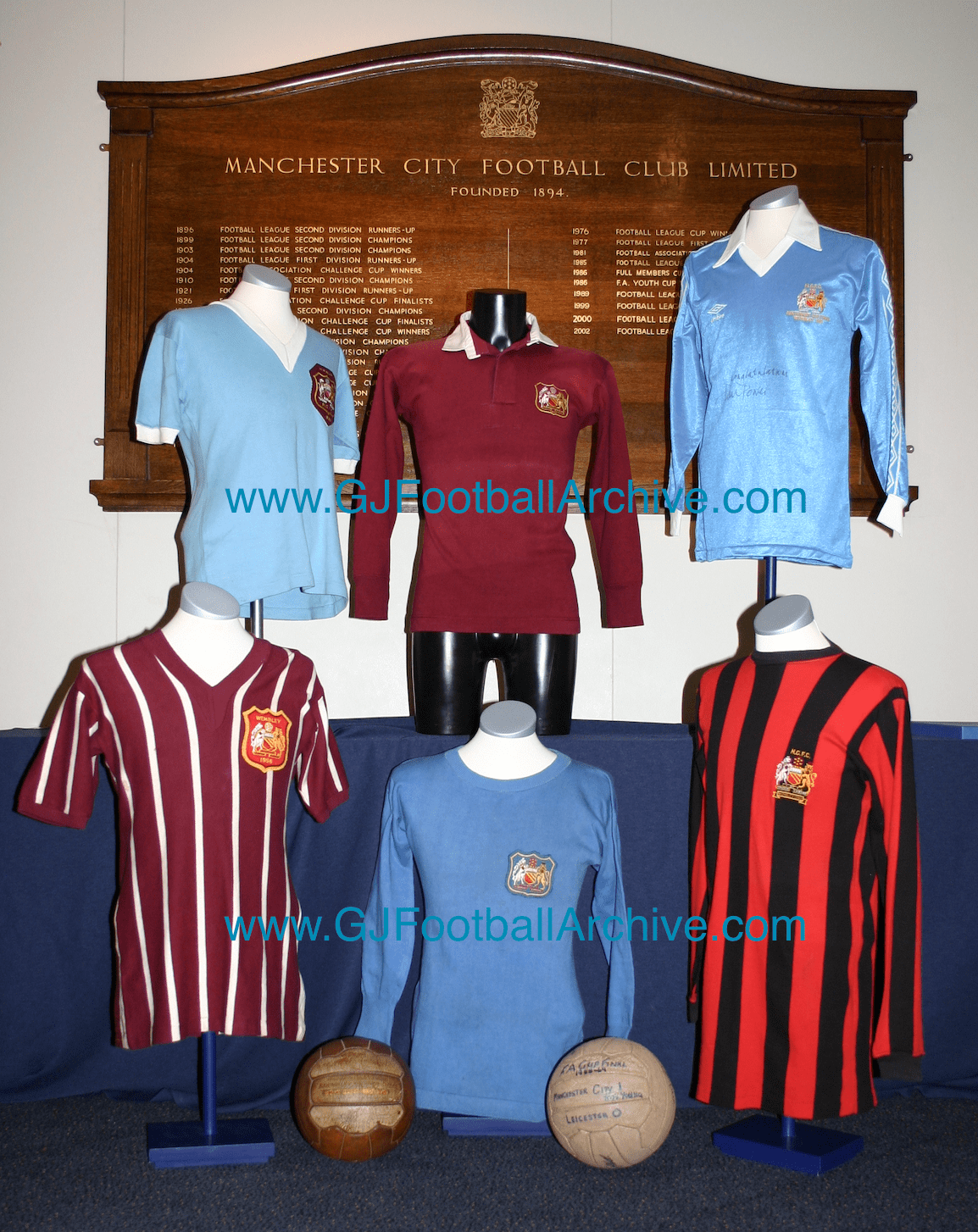
Yesterday I posted images of early Manchester City FA Cup final shirts and asked ‘which shirts are from which finals’ with a bonus question of ‘can anyone work out the players’ who wore these (no searching on t’internet for matching player numbers please!).’ So here are the answers and further details on these players/shirts.

The shirts and players who wore them are:

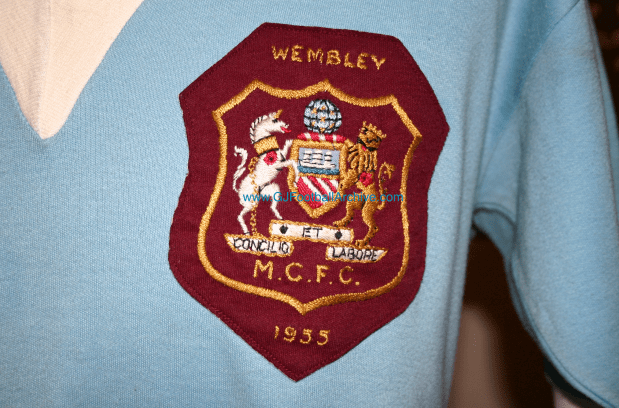
4, pale blue, top right – Ken Barnes 1955 FA Cup Final

Unnumbered maroon, top middle – Ernie Toseland 1934 FA Cup Final

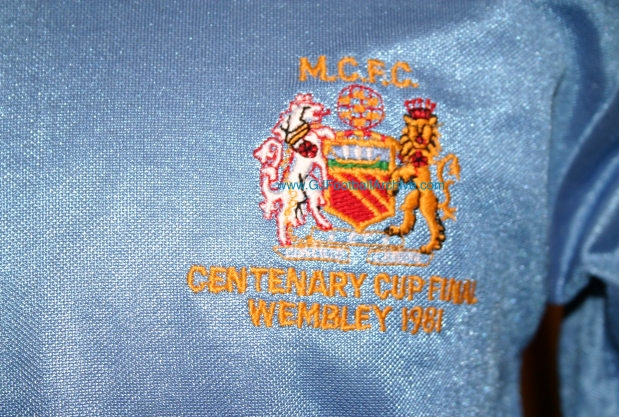
5, shiny blue, top right – Paul Power 1981 FA Cup Final

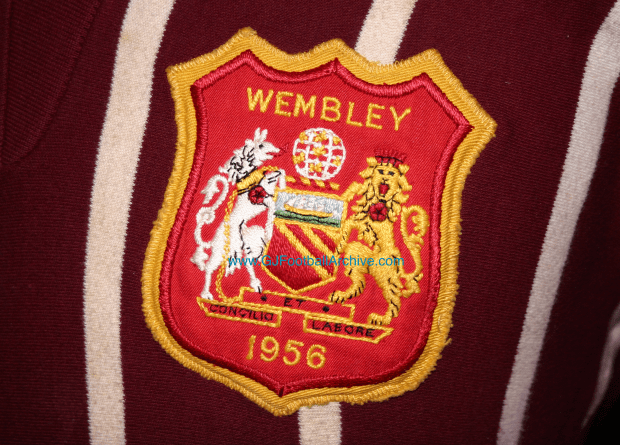
4, maroon & white, bottom left – Ken Barnes 1956 FA Cup Final

Cornflower blue, bottom middle – Sam Cookson 1926 FA Cup Final

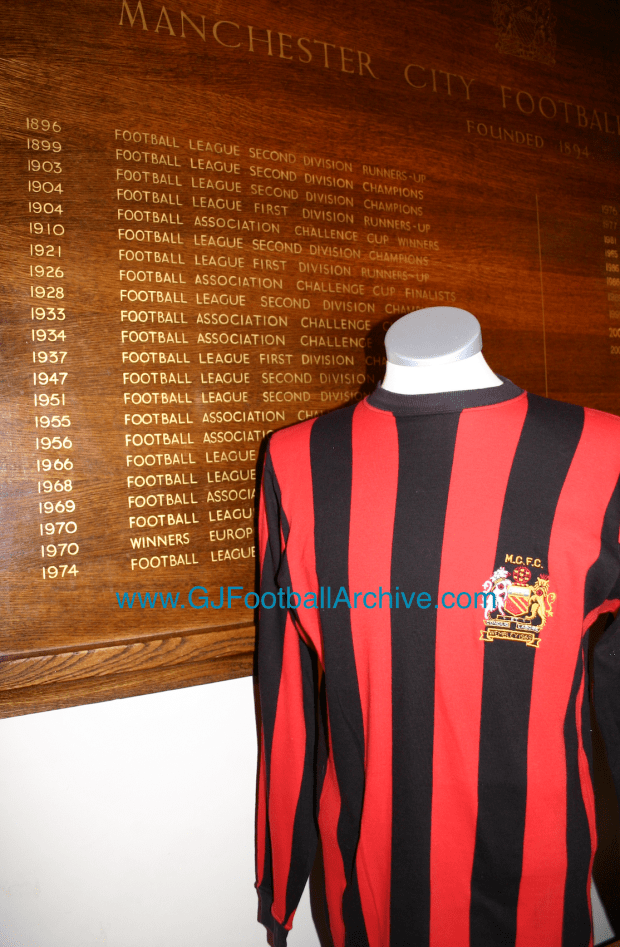
8, red/black, bottom right – Colin Bell 1969 FA Cup Final

Notice the two balls on the photographs? They are the 1956 FAC Final ball and the 1969 FAC final ball. All shirts and balls were on loan to the Manchester City Experience (the original club museum set up in 2003) as part of our exhibition.

I’ve got further images and more information on these shirts below but first it’s worth talking about the only City FA Cup final shirts missing when we did this exhibition in the mid 2000s (obviously City have reached multiple FA Cup finals since that time) being 1904 and 1933. We simply could not track down shirts from either final, though we kept getting close to borrowing a scarlet shirt from the 1933 final. We put the shirts together and I took these photos of them.

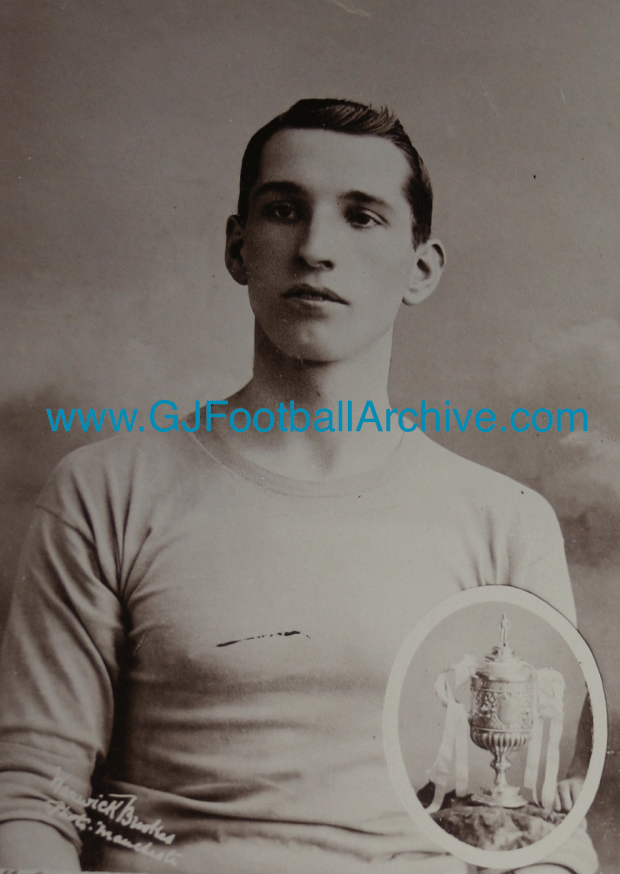
Here’s a contemporary photo of the 1904 FA Cup final shirt. The player here is James McMahon.

James McMahon wearing his 1904 FA Cup final shirt

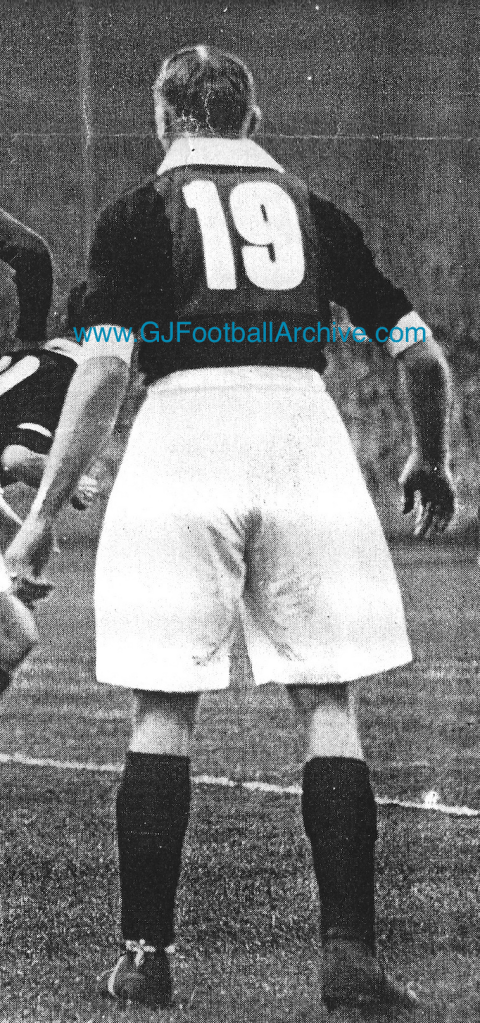
The 1933 FA Cup final was the first final to feature numbered shirts (Everton wore 1-11, City 12-22) and City’s shirts were usually described as being scarlet. City had word what they called ‘Lucky Scarlet’ a few times in the previous decade, though it never quite seemed that lucky! Here’s a contemporary image of the 1933 FA Cup final shirt back, worn by Matt Busby, showing the numbering used.

Matt Busby in the 1933 FA Cup Final

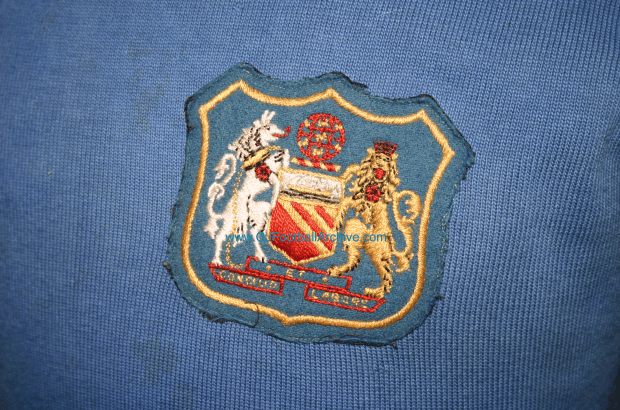
The oldest shirt we had on display was Sam Cookson’s 1926 FA Cup final shirt and here’s a close up of the Manchester coat of arms worn on that shirt. This was the first time City had worn the coat of arms in a final (City didn’t wear any emblem in 1904):

Notice the shade of blue too. It’s a darker blue than City were known to wear and was known as cornflower blue at the time. It was a special colour for the final against Bolton. Someone at City must have remembered (or maybe it was the FA) that there had been some comments in 1904 that City’s blue and Bolton’s white were too close in colour. I’ve always found that a bit odd but I guess City didn’t want to take any chances when the two sides met again in 1926.

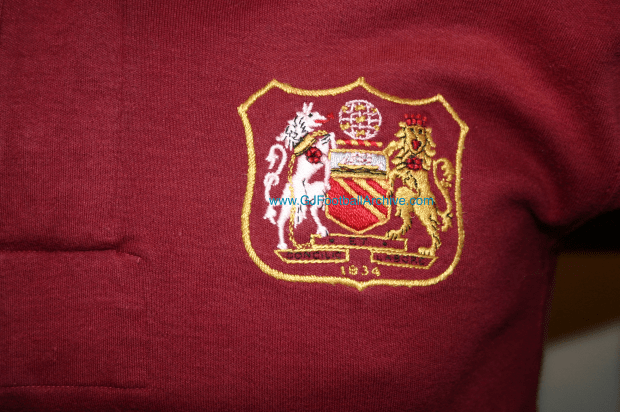
The 1933 final was scarlet as mentioned earlier and the players wore numbers for the first time but in 1934 numbers were not worn. Personally I’d have thought they’d keep up the idea but maybe someone somewhere moaned about these new fangled ideas like wearing numbers in a similar way to how some moaned when squad numbers were introduced and player names were added. Here’s a close up of Ernie Toseland’s 1934 shirt badge. The shirt was described as maroon and the shorts were revolutionary…. We had an expert from Umbro come to visit and he looked at the shorts (we had Toseland’s full kit on display) and was delighted to see an exclusive design. They contained a diamond shaped piece of fabric stitched in and he told me that this was a pair of Umbro’s ‘crotch resistant’ shorts. He explained more, but whether they gave benefit is open to question.

Here’s Ken Barnes’ 1955 emblem. A more traditional blue but it’s interesting that the away colour of maroon makes its way on to the emblem. I wonder if they thought City would wear maroon at some point when the sew on patch was created?

In 1956 the emblem colour was red with yellow edging (to match the numbers on the back). People often try to suggest yellow is not a traditional City colour but it has been used on plenty of kits, including the numbering in 1956 and as the main colour of the away shirt in 1959-60.

Here’s Colin Bell’s 1969 FA Cup final shirt in front of the old honours board. I believe this honours board is still held in City’s archive somewhere. Maybe we should dig it out and update it. I may post another feature on the board itself another day – people think it’s as old as Maine Road but Bernard Halford had it made in the mid 1970s, just after the League Cup win if my memory is working today!

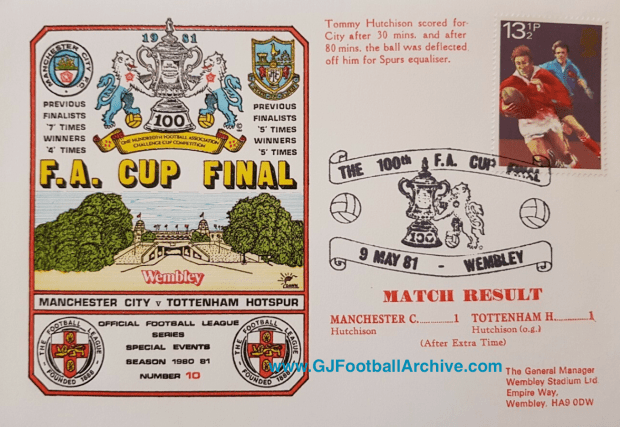
Here’s the special emblem to mark the 100th FA Cup Final. People get confused about this cup final with some saying it was the Centenary Cup Final (as the emblem does!) or the 100th FA Cup Final. The FA were quite clear at the time – the 1972 FA Cup Final was the Centenary Cup Final (marking 100 years since the FA Cup was established) and 1981 was the 100th FA Cup Final. So City or Umbro got this wrong and if you look at the First Day Cover (below) or any of the match programmes, souvenirs etc. you’ll see they created a special 100th cup final emblem.

I’ve done a lot of research on City’s kits over the decades. There’s lots of comments on them in my books, especially Manchester The Greatest City, Farewell To Maine Road and my City Folklore book. There are also other features across this website. Some only for subscribers and some for all. Why not subscribe (see below) and read all the content on this site? You can subscribe for a month at £3 per month or sign up for a year at £20. Why not try it for a month?

Guess Manchester City’s FA Cup Final Shirts

In the mid 2000s we set up a FA Cup final display as part of a special exhibition at the Manchester City Experience (the original club museum set up in 2003). We managed to borrow shirts from several star players and their families with the only City FA Cup finals missing being 1904 and 1933. We simply could not track down shirts from either final, though we kept getting close to borrowing a scarlet shirt from the 1933 final.

We put the shirts together and I took these photos of them. So which shirts are from which finals and can anyone work out the players’ who wore these (no searching on t’internet for matching player numbers please!).

I’ll post the answer tomorrow along with a lot more detail about these shirts and the other missing kits.

Sam Cowan’s Often Incorrectly Reported Quote

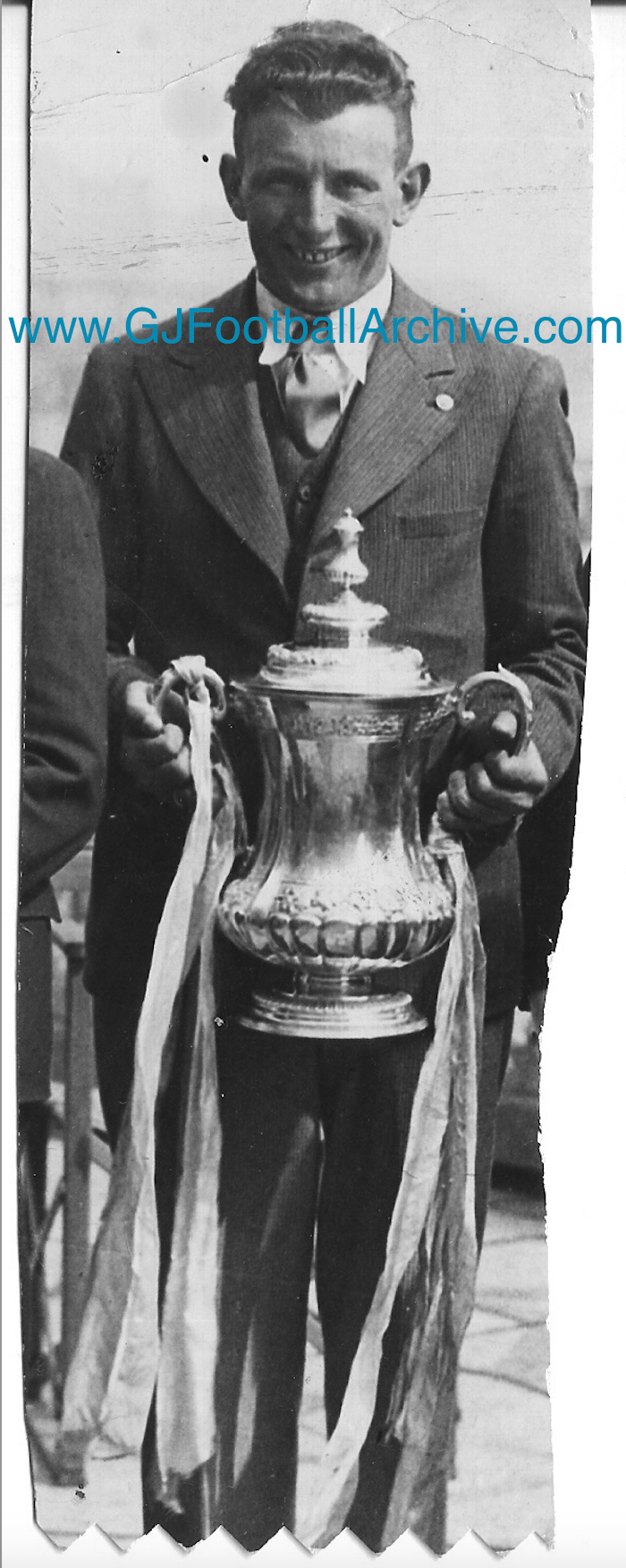
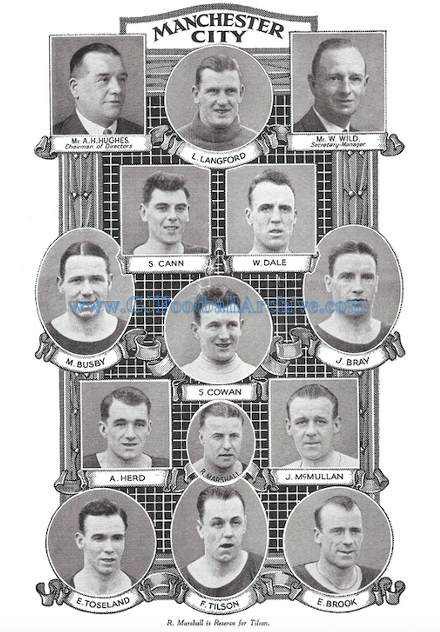
Manchester City’s 1930s captain Sam Cowan is often reported to have said something like ‘We’ll be back next year’ to the King when City lost the 1933 FA Cup final to Everton BUT this cannot have been true. So, here to spell it all out is the story… City reached the FA Cup final in 1926 (losing 1-0 to Bolton), and again in 1933 (losing 3-0 to Everton).  Sam Cowan had played in both these games and felt bitterly disappointed with each defeat.  By the time of the 1933 final Cowan was City’s captain and that defeat had hurt him more than the 1926 final.  He hated being runner up and was determined to see the Blues triumph.  He vowed to guide the Blues to glory and promised supporters that City would be back in 1934 to win the trophy.  His promise became a reality and over the years Sam’s promise has become part of City folklore with various publications, including official City magazines and other works, claiming that Sam had told King George V at the 1933 final that the Blues would be back in 1934 to win the trophy.  Sadly, the story has become corrupted and Sam never did make a promise to the King.

So what did Sam say and why did everyone believe he had made a promise to the King?  The Guest of Honour at the 1933 final was the Duke Of York, the present King’s grandfather and the future King George VI.  He attended because King George V was too ill to make the final, and so that simple fact proves Sam could not have made a promise to the King.  

Lawrence Furniss, the City President, told journalists immediately after the 1934 final that Sam had predicted that the Blues would be back twelve months earlier, and he also suggested that Sam had mentioned this to the Duke Of York.  So it’s possible this comment is the one which later became adapted by journalists looking for an even better story.

As an aside here’s a photo of the King at City’s Hyde Road ground in 1920 and Lawrence Furniss is the man stood immediately behind the King:

The King with the Mayor in Hyde Road’s ‘Royal Box’. Notice Lawrence Furniss stood, behind the King. Furniss was a major figure from the 1880s to the 1940s at City.

What is known is that Sam appeared on a newsreel shortly after the 1933 final with Everton’s Dixie Dean where both men toasted each other for the future and Sam stated that he hoped his team, Manchester City, would win the Cup in 1934.  This film was shown across the country and made it clear that Sam wanted to return to Wembley.

In 1934 Sam guided City to a 2-1 victory over Portsmouth.  Apart from Furniss’s comments nothing was said of a prediction by Sam to the King or Duke of York, it was only years later when it was mentioned.  In fact the first time the story was quoted appears to be in 1955 when City’s fifties captain Roy Paul talked of emulating Sam Cowan by guiding City back to Wembley the following year. Books and articles from the period then made the claim that Sam had told the King in 1933 the Blues would return.  Clearly, this was a corruption of the truth, but the story sounded great and future generations accepted this as fact.

Clearly, reaching Wembley in successive seasons was a major achievement for Sam and his team.  Likewise any losing captain is likely to make a statement saying ‘We’ll be back’.  As Sam was not a boastful character it is unlikely he would have said anything more than he was determined to guide his side back to Wembley for what he hoped would be a successful trip.

Regardless of the validity of Sam’s prediction it is clear that Sam was a major influence with the Blues, and he became the first City man to appear in three FA Cup finals while with the club.

1904 or 1926 FA Cup Train: The Answer

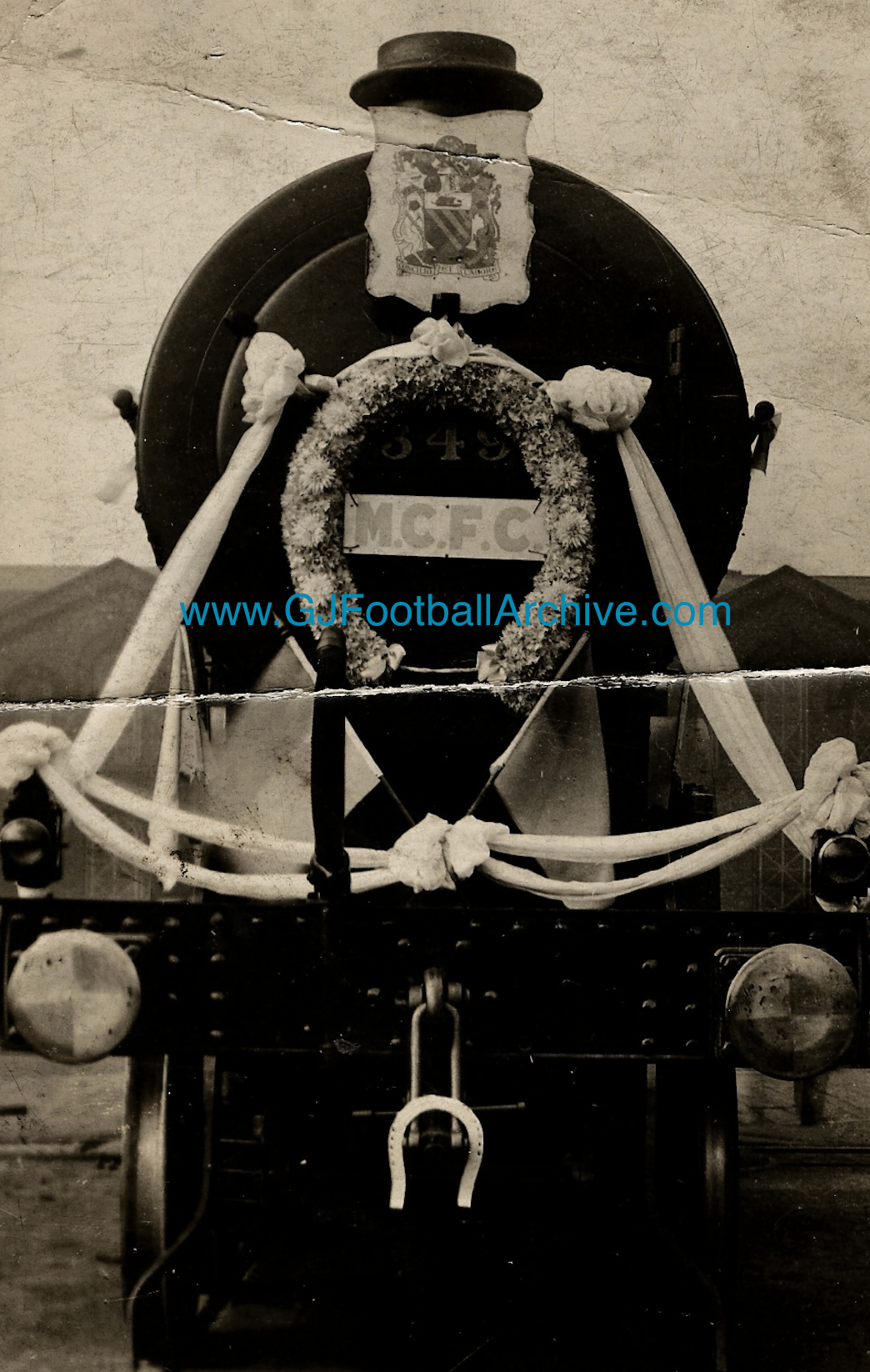
A few days ago I asked for train enthusiasts to help identify a train so that I could work out whether this photo I was given about twenty years ago was from 1904 or 1926. The person who gave it to me was certain it was from 1904 but someone else suggested 1926. Personally I had no idea whether it was either year but I hoped someone out there could help. Obviously, the year of construction could help identify the year the photo was taken. Well, the call for help worked and various people contacted me with suggestions.

John Nisbet found a piece on the engine and wrote to me after identifying the train numbers 349: ‘I found this with a search showing a loco with the number 349. It mentions that it was withdrawn after a 35 year working life which suggests it was built around 1922 ish.’

If that’s true then the train was not around in 1904 and therefore the image seems to be more likely to be 1926.

While you’re here why not subscribe to the site and see all the material posted over the last five years or so?

Any Train Experts Able To Help?

About twenty years ago I was given this photo of a train dressed to take Manchester City to the FA Cup Final. The person who gave it to me was certain it was from 1904 but someone else suggested 1926. Personally I have no idea whether it was either year but hopefully someone out there can help. Is anyone able to work out whether the train itself would’ve been around in 1904 or 1926? Obviously, the year of construction could help identify the year the photo was taken. Any help appreciated.

While you’re here why not subscribe to the site and see all the material posted over the last five years or so?

Record Average Crowds

I’ve not done one of these for a while but I know they always prompt a bit of debate, so here goes… a feature on Manchester City FC attendances. It is a fact that the Blues have, generation after generation, been one of the English game’s top attractions. Like all – and I do mean all – English clubs there have been some average attendance lows over the years, but when the entire history of Manchester City is reviewed and the club’s average figures are compared with the national average it is clear that the Blues have consistently been one of football’s most attractive draws.  Take a look at the following:

  • Since the beginning of the Football League in 1888 only nine sides have topped the table for average attendances.  In chronological order of their first appearance at the top of the average table they are: Everton (1888-9), Villa (1898-99), Newcastle (1904-05), Chelsea (1907-08), Tottenham (1909-10), City (1910-11), Liverpool (1922-23), Arsenal (1929-30), & Manchester United (1956-57) 
  • As early as 1895-96 City were the third best supported side in the entire League despite being a Second Division side.  Only First Division sides Everton & Aston Villa could better the Blues.  Modern day giants Arsenal were 10th; Liverpool were 19th; United were 21st and Chelsea had yet to exist.
  • In 1900-01 City were the 2nd best supported side in the entire League with only 400 people separating Villa (1st) and City 
  • The 1910-11 season saw Manchester’s Blues top the attendance charts for the first time.  City’s average was 26,000 and was the 8th highest average of all time at that point (all clubs, all seasons). 
  • Regularly amongst the best supported sides throughout the inter war period, City’s average exceeded 37,000 for the first time in 1927-28 when the Blues established a record average crowd for the Second Division.  This was also the entire League’s highest.
  • In 1947-48 City’s average crowd exceeded 42,000 for the first time.  Prior to that season only Chelsea (1919-20 & 1946-7), Arsenal (1934-5, 1936-7, 1937-8, & 1946-7) , Newcastle (1946-7), Liverpool (1946-7), United (1946-7), and Wolves (1946-7) had exceeded that figure.
  • From 1975 to relegation in 1983 City were always one of the top 4 best supported sides, usually third behind United and Liverpool.
  • Since the 1980s whenever City have played outside of the top division, they have tended to be the best supported side in that division.  
  • Since moving to their current home in 2003, the increased capacity has allowed City to re-establish itself as one of best supported clubs again. Maine Road’s capacity from 1994 onwards was extremely low compared to the club’s entire history and prevented the Blues from staging games in front of attendances of approximateley 35,000 upwards.

In general many people believe success increases support, and while that is undoubtedly true to some extent, for City it is often periods of adversity that prove the loyalty of the Club’s fans.  It is highly significant, for example, that the first time City were the best supported side in the entire League (1910-11) Manchester United (6th best supported side) won the League title for the second time in 3 seasons.

Similarly, in 1925-26 when City were the best supported side in Division One and had established a new record average, the Blues were actually relegated.  This coupled with significant poverty and hardship in Manchester at the time should have reduced support but loyalty increased!  In my book “Manchester A Football History” I explore the relationship between attendances and Manchester’s major sides and it is fair to say that City fans can feel immensely proud of their loyalty throughout the history of the game.  Something that cannot be said by all of the League’s biggest names.  

In fact, it is worth highlighting that City have never been the worst supported side in their division but, of today’s so-called giants, Arsenal (1912-13 – average = 9,100) and Manchester United (1930-31 – average = 11,685) have.  City’s worst average of the Twentieth Century came in the desperate 1964-65 season and was 14,753 (half the average of 1960-61 and a 3rd of the 1957-8 figure).  However it is significant that for every League season City’s average has always been above the divisional average and, apart from 17 seasons, has always been in the top 11 nationally.  Again, few of today’s giants can’t say that – United’s 20th Century low stands at 4,650 and Chelsea averaged 15,731 as recently as 1988-89. In fact City’s lowest League attendance is more than double United’s lowest League attendance at Old Trafford (United have several crowds of less than 4,000 at Old Trafford, including top flight games; City’s lowest in the League was a little over 8000 in the second tier).

For fans average attendances are often used as an indicator of size of club and so a number of people over the years have tried to produce a definitive ‘all-time’ attendance table.  Several years ago analysis by a member of the Association of Football Statisticians claimed that if stadium capacity was not an issue for any club City would be the fourth biggest side in terms of attendance.  That analysis compared postwar attendance detail with performance on the pitch.  

In 2002 writer Brian Tabner calculated an all-time attendance table based on each club’s average attendance position during seasons 1925-2002.  His top ten were:  Arsenal, Liverpool, United, Everton, Tottenham, Newcastle, City, Chelsea, Villa and Sunderland.  Since 2002 several clubs have increased their capacities of course and this will have a positive impact on each club’s standing in a more up to date analysis.   

Figures can be manipulated in many different ways, but City should feel proud that they have many attendance firsts that can never be matched by today’s perceived biggest clubs.  

The Seasons City Have Topped the Divisional Charts

The following figures show the seasons when City were the best supported side in their division and the Club’s highest individual crowd that season.  Those crowds marked in italics were also the highest individual crowds for the entire division that season (crowds pre-1925 are inconsistently recorded and so have not been highlighted).  It is fair to say that when an average crowd is within 4,000 of the highest then the stadium is likely to have been full for the majority of games with the size of away support varying.     

Average         Season          Highest Crowd                                  

10,000            1895-96         30,000 (Liverpool)                

10,000            1898-99         25,000 (N. Heath)    

16,000            1902-03         30,000 (United)        

18,275            1909-10         40,000 (Oldham)

26,000            1910-11         40,000 (Liverpool)    

21,000            1914-15         40,000 (Oldham)

32,000            1925-26         62,994 (United)

30,848            1926-27         49,384 (Bradford C)

37,468            1927-28         59,500 (Preston)

31,715            1928-29         61,007 (United)

35,016            1950-51         45,842 (Hull)

27,739            1965-66         47,171 (Huddersfield)

24,220            1984-85         47,285 (Charlton)

23,500            1988-89         40,070 (Chelsea)

26,753            1996-97         30,729 (Oldham)

28,273            1998-99         32,471 (York)

32,001            1999-00         33,027 (Blackburn)

33,059            2001-02         34,657 (Portsmouth)

With the increase in capacity at the Etihad coming this year it will be interesting to see how attendances develop. No doubt I’ll post more on this as the season progresses. Undoubtedly City will establish a new record average attendance in 2026-27.

100 Years Ago Today – The First All-Manchester FAC Semi-Final

100 years ago today (27 March 1926) the first all-Manchester FA Cup semi final occurred. You can see film of that game here and subscribers can read about the match below. Here’s the film from Bramall Lane:

https://www.britishpathe.com/asset/51947/

Subscribers can read the article below:

Subscribe to get access

Read everything on the site when you subscribe today. Monthly subscription is £3 per month (cancel anytime). Monthly subscribers access everything posted since 1 October 2022. Alternatively, sign up for a year at a time for the special discounted annual subscription of £20 for access to everything posted since the site’s creation in 2020.

A Couple of Odd Results

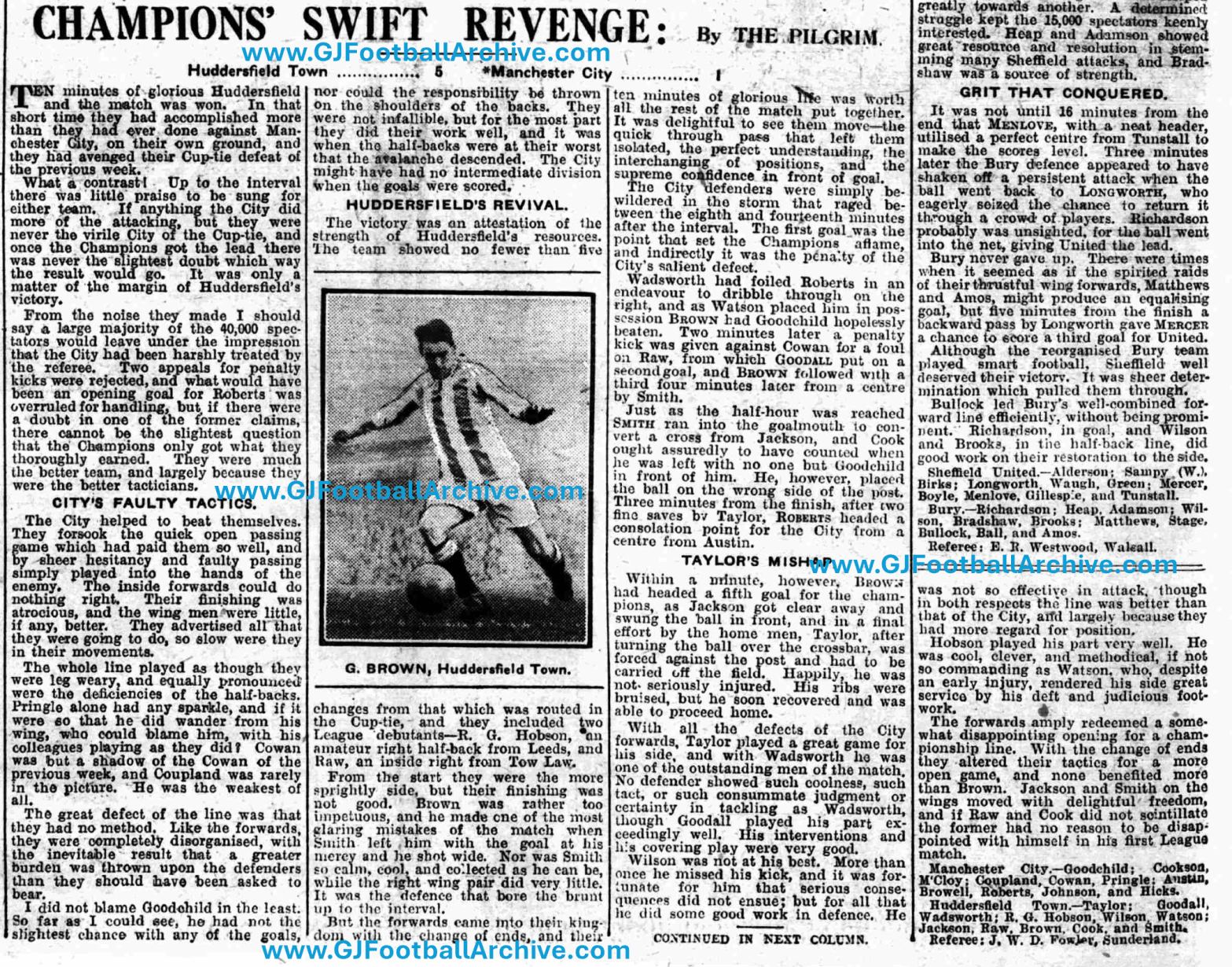
100 years ago today (6 February 1926) and only a week after 74,799 had watched Manchester City defeat reigning League champions Huddersfield Town 4-0 in the FA Cup at Maine Road the two teams met again. This time the visitors to Maine Road gained revenge for their humiliation by defeating City 5-1. This newspaper report explains all and shows how, despite City ultimately reaching the FA Cup final, the two clubs were heading in opposite directions. Huddersfield would retain the title (their third in a row; only one club has ever achieved four in a row) but City would be relegated at the season’s end.

The City scorer in the League game with Huddersfield was Frank Roberts.

If you’d like to know more about this season for Manchester City why not read the following 4,900 word subscriber article on the 1925-26 season. If you subscribe (see below) I hope you enjoy it. If you are not currently a subscriber then why not try it for a month (£3 per month or sign up for a year at a discounted £20 per year)?

Here’s the article:

Subscribe to get access

Read more of this content when you subscribe today. It costs £3 a month (cancel anytime) or sign up for a year at £20 per year. Subscribers have access to the 1000s of articles, features, interviews etc. posted so far and all those posted during your subscription.
100 Years Ago Today: Highest Christmas Day Score

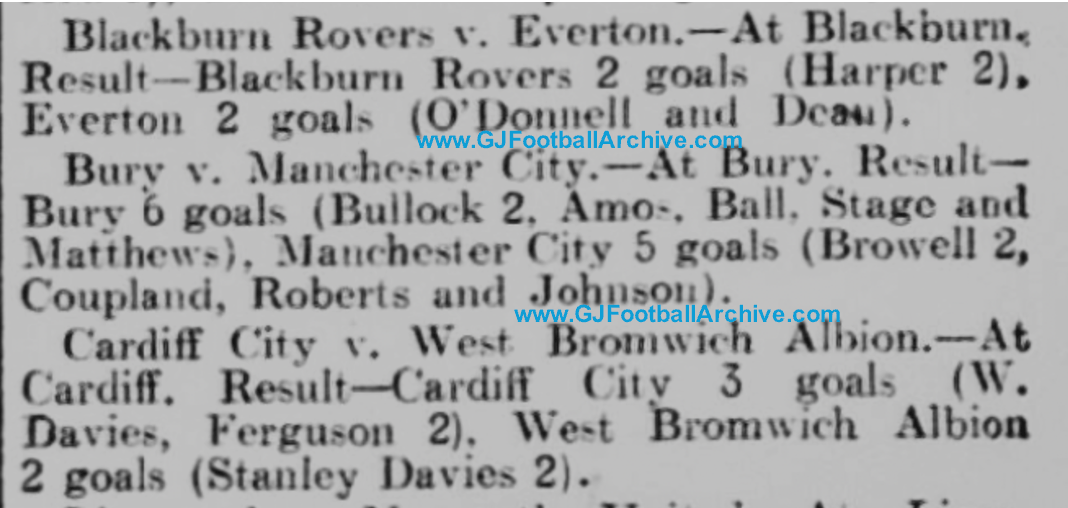
On Christmas Day 1925 Bury FC defeated Manchester City 6-5 in an extraordinary top flight game. This was the highest scoring Christmas Day game Manchester’s Blues ever played in. As this was over the Christmas period detailed match reports are rare but this cutting gives a brief idea of the scorers. On Boxing Day the two teams met again with Bury beating the Blues 2-0 at Maine Road before 50,168 (the Gigg Lane attendance had been 23,621)

From My Collection… Whalley Range AFC

During my tidy-up of my writing space I’ve rediscovered items I’ve used in my research over the years and thought I’d post some on here. Today here are a couple of images taken of parts of the Whalley Range AFC Diamond Jubilee Booklet. First a team photo from 1900-01. Anybody related to any of these players?

Next some text mentioning a game between Whalley Range and Manchester City:

I’ve checked the usually comprehensive records compiled by statistician Ray Goble (given to me shortly before his death) and there’s no mention of this game. I’ve also searched several newspapers looking for a report of it and haven’t yet found one (no doubt there’d be a report in a local newspaper in the Whalley Range area), proving that there are still many unknowns in City’s history.