Today (14 October) marks the anniversary of the death of legendary Manchester City coach Malcolm Allison. He passed away in 2010. I’ve interviewed Malcolm often over the years and you can listen to one of those interviews here:
Here’s also an article I published in September this year on Allison. It included comments from a variety of interviews I have performed over the decades. Allison’s views on then young footballer Shaun Wright-Phillips are captured and comments from various people who know Allison well are included.
Subscribe to get access – Annual
Read more of this content when you subscribe today. It costs £20 per year (equivalent to about £1.67 a month) to subscribe annually or if you’d prefer a month at a time then it’s £3 per month (see below). Annual subscribers access all the interviews, books, articles and features posted here since the site was launched in December 2020.
Read more of this content when you subscribe today. It costs £3 per month (cancel anytime) or special price of £20 a year (above). Monthly subscribers access all the interviews, books, articles and features posted here since 1st October 2022.
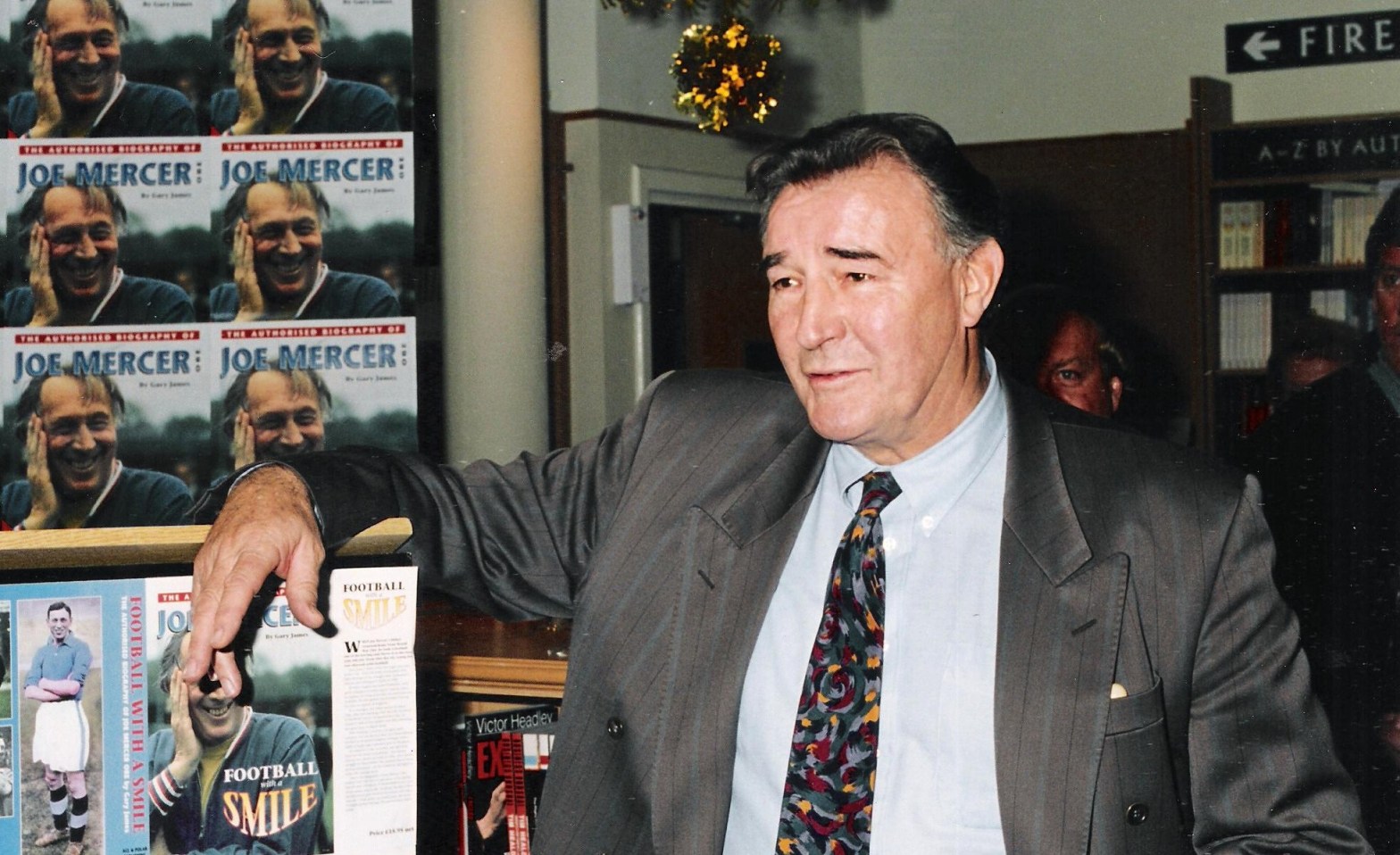
On this day (July 20) in 1965 Malcolm Allison was formally interviewed by the Manchester City board to be manager Joe Mercer’s assistant. Mercer had wanted to bring Allison in since he took the job earlier in the month. Here is a feature I did on Allison back in January 2005.
I first interviewed Malcolm in 1991, and, using material from several conversations with him, and in 2005 I took the opportunity of a MCFC v Crystal Palace game to remind everyone of his significance. Today, for subscribers, I’m posting it here.
Subscribe to get access
Read this article and all other content when you subscribe today.
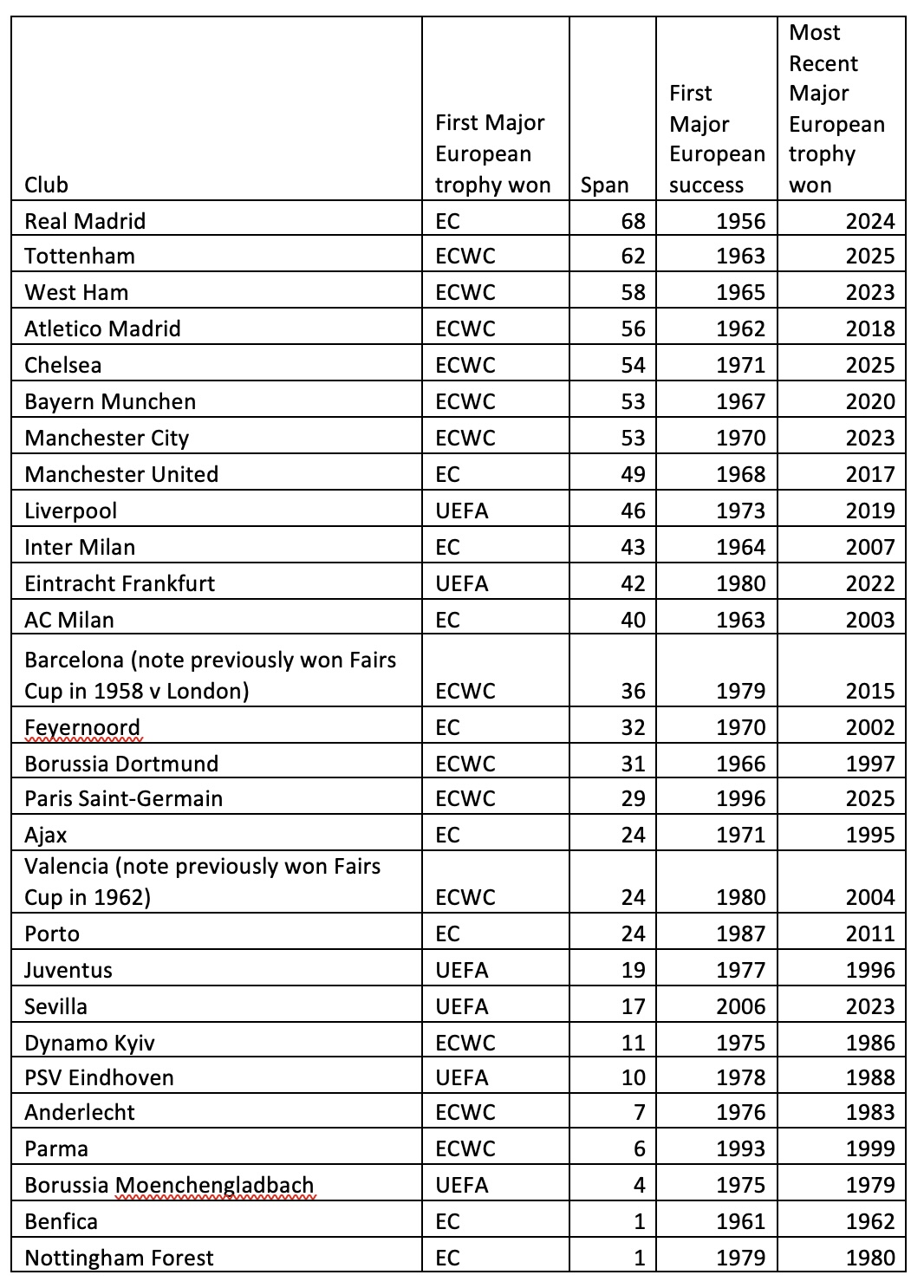
Each year, following the end of the UEFA football season I update the UEFA European Span of Success table. What is this? It’s a list of those clubs who have won two or more (sorry Palace) major UEFA tournaments showing the span between their first UEFA success and their most recent. The list may surprise some who think that football is all about those perceived as European giants with ‘history’. This is how the table stands today (19 May 2026). Chelsea and Tottenham have moved up the table in recent seasons.
UEFA European Major Trophy Span of Success 2025
I can imagine a few Arsenal fans looking at this and saying ‘Why aren’t we on there?’ They won the Fairs Cup in 1970 and the ECWC in 1994 BUT the Fairs Cup wasn’t a UEFA tournament and had some odd entry rules over the years! For your benefit here’s a table including the Fairs Cup lower down on this page. The above table includes the four major UEFA tournaments: European Cup/Champions League; European Cup Winner’s Cup; UEFA Cup/Europa League & the Europa Conference League. It does not include non-UEFA tournaments such as the Mitropa Cup and Fairs Cup. Nor does it include the Intertoto Cup or similar.
So why are they excluded… I recognise that the Mitropa Cup had some significant clubs competing in it. However, it was predominantly an East European competition and participants were not spread over the entire continent.
With the Fairs Cup… It is true that this was later transformed into the UEFA Cup and I have included all UEFA Cup finals in my analysis. But the Fairs Cup had an odd series of entry rules at times. Cities, rather than clubs, often entered with Barcelona beating London in one final for example. It was set up as a friendly type of competition with cities that had staged trade fairs playing each other. As time wore on entry came via the League Cup or League position in England, which added significance to it. But two teams from the same city were not allowed to participate, which meant that teams finishing way down the table could be (and were) included if those above them were multiple clubs from the same city.
In 1970 Manchester City’s Mike Doyle joked that by winning the League Cup he was satisfying his aim of ‘keeping United out of Europe’ (he joked about creating car stickers with that slogan!) because it appeared at that time that United’s only chance of Europe had gone with City’s qualification for the Fairs Cup.
City went on to win the ECWC that season, meaning that Fairs Cup place was opened up to League position, but United had finished lower down the table anyway and qualified for the Watney Cup instead. Actually, the Watney Cup is one worth talking about, but I’ll save that for another day. In 1970 Fourth placed Derby County qualified for the Watney Cup, while 5th to 7th (Liverpool, Coventry and Newcastle) all got a Fairs Cup place, alongside 12th placed Arsenal (Fairs Cup winners). I’ve not investigated this fully but it does seem odd that the Watney Cup took precedence over the Fairs Cup.
Arsenal’s 1970 Fairs Cup success was their first European trophy but is not included in the span, neither are those Fairs Cup wins of Barcelona. However, as quite a few Arsenal fans seemed to get a bit upset when the table was posted the other year I’ve decided to include the Fairs Cup in the following version of the table. So this table is the winners of the main UEFA competitions I mentioned earlier plus the Fairs Cup with its odd rules:
Club
First Major European trophy won
Span
First Major European success
Most Recent Major European trophy won
Real Madrid
EC
68
1956
2024
Tottenham
ECWC
62
1963
2025
Roma
Fairs
61
1961
2022
West Ham
ECWC
58
1965
2023
Barcelona
Fairs
57
1958
2015
Atletico Madrid
ECWC
56
1962
2018
Chelsea
ECWC
54
1971
2025
Bayern Munchen
ECWC
53
1967
2020
Manchester City
ECWC
53
1970
2023
Manchester United
EC
49
1968
2017
Liverpool
UEFA
46
1973
2019
Inter Milan
EC
43
1964
2007
Valencia
Fairs
42
1962
2004
Eintracht Frankfurt
UEFA
42
1980
2022
AC Milan
EC
40
1963
2003
Feyernoord
EC
32
1970
2002
Real Zaragoza
Fairs
31
1964
1995
Borussia Dortmund
ECWC
31
1966
1997
Paris Saint-Germain
ECWC
29
1996
2025
Arsenal
Fairs
24
1970
1994
Ajax
EC
24
1971
1995
Porto
EC
24
1987
2011
Juventus
UEFA
19
1977
1996
Sevilla
UEFA
17
2006
2023
Dynamo Kyiv
ECWC
11
1975
1986
PSV Eindhoven
UEFA
10
1978
1988
Anderlecht
ECWC
7
1976
1983
Parma
ECWC
6
1993
1999
Borussia Moenchengladbach
UEFA
4
1975
1979
Leeds United (BOTH FAIRS CUP)
Fairs
3
1968
1971
Benfica
EC
1
1961
1962
Nottingham Forest
EC
1
1979
1980
Obviously, neither table shows the number of major trophies won, but it does indicate trophy-winning longevity for those who obsess over ‘my cup’s bigger than yours’ and similar debates. Personally, I think we should all be proud of our club’s achievements and not worry about what a rival has won.
Hopefully, those Arsenal fans who were somewhat upset last year will now be happy. Note that both Roma and Barcelona have moved up the table. Both ‘Rome’ and ‘Barcelona’ won the Fairs Cup when it was city based and not club based, adding to the questionable nature of including the Fairs Cup. ‘London’ once competed in it!
Arsenal are now 20th in this combined table, behind their fellow English clubs Tottenham, West Ham, City, Chelsea, United and Liverpool. But they could move up, as could Aston Villa.
As an example of the odd qualification rules in place for the Fairs Cup at times it’s worth looking at the 1969 qualification via the English League system.
In 1969 champions Leeds entered the European Cup. The ECWC place went to FA Cup winners Manchester City and the Fairs Cup places went to: Arsenal (4th), Southampton (7th) and Newcastle (9th). Swindon had won the League Cup, beating Arsenal in the final, but the Fairs Cup organisers wouldn’t allow them to participate as they were not a top flight club! This adds to the reason the competition is usually excluded. It is certainly not a UEFA competition in any case.
Similarly, Everton (3rd), Chelsea (5th), Spurs (6th) and West Ham (8th) who all finished above Newcastle were denied because of the rule that only one club from each city be allowed. So Liverpool and Arsenal’s inclusion meant their rivals stood less chance of winning the trophy than Newcastle simply because there were multiple clubs in their cities.
That rule does make me wonder what would have happened if both Manchester clubs had qualified for the competition as City are within the city of Manchester boundaries and United are not. Would the two clubs have challenged any decision not to include one of them based on the age old argument of Manchester’s boundaries?
Maybe I’ll post more on the odd rules of football competitions and tell the story of some of those long forgotten competitions.
If you’re interested in the wider span of success for English clubs (listing those who have the longest span between their first trophy and most recent, not simply European trophies) then take a look at this I posted Sunday:
If you enjoy all the free material on my website and would like to support my research and keep this website going (but don’t want to subscribe) then why not make a one-time donation (or buy me a coffee). All support for my research is valued and welcome. It allows me to keep some free material available for all. Thanks.
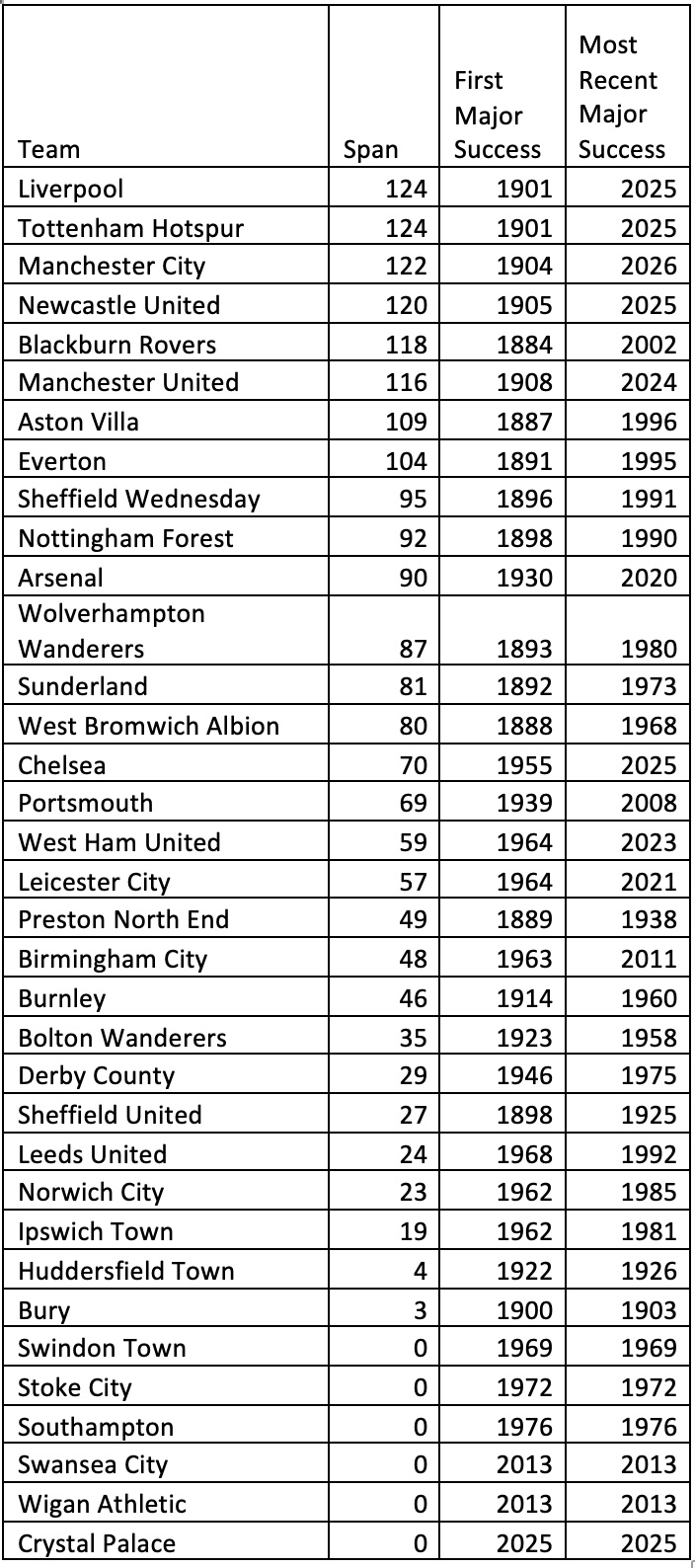
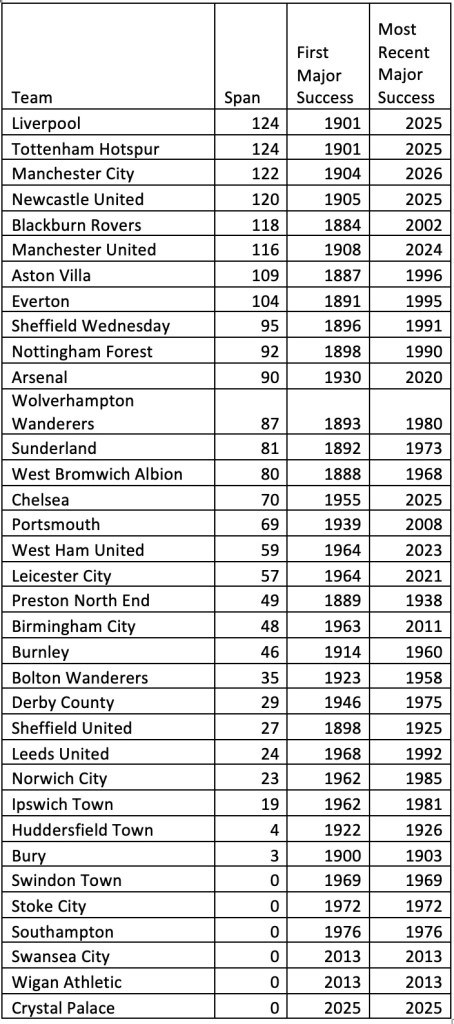
Every year, once the domestic season ends I update the table showing the English clubs’ span of success – i.e. the number of years between a club’s first major success (FA Cup, League, League Cup, major European trophy) and their most recent. Here’s the table as it stands today (17 May 2026) after Manchester City’s success in the FA Cup. Obviously, there’s a chance for Arsenal (currently 11th), Aston Villa (7th but could be top if they win their European final) and Crystal Palace (just on the table following last year’s FAC success but could rise above those other ‘one major trophy’ clubs) to move up the table this month.
2026 Span of Success (as of 17/5/26, after FAC final)
Even if Arsenal do win the League or Champions League this year they’ll only rise to ninth as they didn’t win a major trophy until the 1930s.
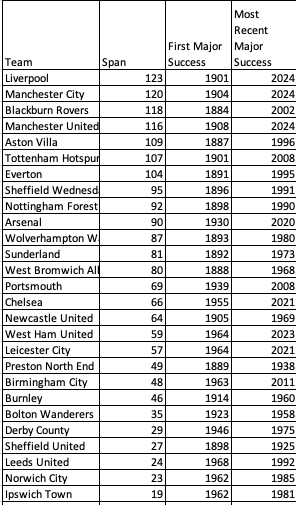
For comparison purposes here’s the table after the 2023-24 season ended (see below). Notice the moves up the table of Spurs and Newcastle in recent seasons:
As I always say, the span of success does not show how many trophies each club has won nor does it show how frequently that club has experienced great eras of success, but it does demonstrate how wrong those people are who believe certain clubs were unsuccessful until recent years, or those who think certain clubs have always been giants. The column on first major success helps to show when some clubs first became trophy-winning significant (often after transformational investment too!).
I know clubs focus on their financials but winning a trophy has longevity, gaining the odd Premier League place provides a bit of extra cash now but no long term kudos. Winning a trophy attracts new fans and brings money-spinning opportunities too. Look at how winning the FA Cup has helped Palace this last year or so.
If I was a supporter of any of the major clubs who have not found significant success in recent decades then I would absolutely want my team to go for whichever cup competition seems the most likely to win. That’s what I always wanted from Manchester City before they were able to compete for the League again. Winning the FA Cup in 2011 helped everything that followed happen – it gave confidence and a trophy winning mentality.
While you’re here why not take a look at the wide range of articles available on this site? Such as the 100 day series of features on Maine Road:
If you enjoy all the free material on my website and would like to support my research and keep this website going (but don’t want to subscribe) then why not make a one-time donation (or buy me a coffee). All support for my research is valued and welcome. It allows me to keep some free material available for all. Thanks.
On July 20 in 1965 Malcolm Allison was formally interviewed by the Manchester City board to be manager Joe Mercer’s assistant. Mercer had wanted to bring Allison in since he took the job earlier in the month. Here is a feature I did on Allison back in January 2005.
I first interviewed Malcolm in 1991, and, using material from several conversations with him, and in 2005 I took the opportunity of a MCFC v Crystal Palace game to remind everyone of his significance. Today, for subscribers, I’m posting it here.
Subscribe to get access
Read this article and all other content when you subscribe today.
It’s the men’s FA Cup final today. For those wanting to read content in preparation for the big game here are all the articles/features on my site that are tagged ‘Crystal Palace’ and all those tagged ‘FA Cup’. Enjoy:
With City and Palace now scheduled to meet in the FA Cup final it’s worth remembering that on 20 February 1926 City recorded an amazing victory over Palace in the competition. It was a fifth round FA Cup tie with Crystal Palace at Maine Road. The Blues, without a manager since November, were being managed by committee with director Albert Alexander senior making the final decisions. It’s an incredible thought that a director without ever being known as a player, could make these decisions but Alexander was a knowledgeable football man and had been with the club since formation in 1894.
By half-time the score was 7-0 to the Blues, but Palace would not give up and quickly pulled back four goals. City were knocked out of their period of complacency and soon found their goalscoring touch again. By the end it was 11-4 and, according to a number of spectators present on the day, Manchester fans rushed on at the final whistle and carried off the Palace ‘keeper shoulder high. Apparently he had played extremely well and, somehow, managed to keep the score down, although one cannot help wondering if he’d have been given such a reception had the scores been reversed.
Frank Roberts was the City star for this particular game, scoring a remarkable five, while Tommy Browell also earned a few plaudits with his hat-trick. The other scorers were: Billy Austin, George Hicks and Tommy Johnson.
With no management and such a miserable time in the League, no one could believe how City had been able to deliver such strong cup performances. Here’s film of the game:
Here are some highlights of the Crystal Palace-Manchester City game played on this day (1 April) in 1991 when the Blues won 3-1 with a hat trick from Niall Quinn. Here’s the clip:
The 1990-91 season had included a shock managerial departure which could have disrupted the club but ultimately the Blues finished 5th, 3 points ahead of Manchester United. Here’s a 2,700 word article on that season:
Subscribe to get access – Monthly
Read more of this content when you subscribe today. It costs £3 per month (cancel anytime) to access everything posted since 1 October 2022 or there’s a special annual rate below which gives greater access and works out much cheaper.
Read more of this content when you subscribe today. It costs £3 per month (above) or £20 a year (here) to access everything posted since the site was created in December 2020. This special rate works out about £1.67 a week and gives access to everything posted, including PDFs of 3 of my books.
This series of articles and features will run throughout March with indepth articles some days and smaller ‘on this day’ style posts on others. There will be flashbacks to great games, players and more. Every day in March will offer something to enjoy.
Subscribers will get access to everything, while some on this day material will be free for all to view.
If you want to know more on this incredible decade for Manchester City Football Club then why not subscribe and read it all? If you’d like to know more about subscribing then see:
On this day (16 December) in 2024 Manchester City’s last competitive game before appearing in the Club World Cup ended in a 2-2 draw at home to Crystal Palace. City’s scorers were Jack Grealish and Rico Lewis and you can see highlights here:
On this day (12 October) in 1965 1980s Manchester City ‘keeper Perry Suckling was born in Hackney. Here’s a brief profile of him:
Perry Suckling
Bought for £50,000 plus the popular David Phillips, England youth international Perry Suckling was anticipated to be City’s first choice for several years when he arrived from Coventry City in May 1986. It didn’t work out that way however and by the end of December 1987 he was on loan at Chelsea. A permanent move to Crystal Palace followed in January 1988 – City received £100,000 – and after 39 League appearances that was it.
Spells for West Ham, Brentford, Watford and Doncaster followed.
Appearances: League: 39 FAC: 1 League Cup: 3
You can read a 4,000 word article on the 1987-88 season here:
Enjoying this website? Fancy supporting my research into Manchester football history? Why not subscribe? Every subscription directly helps support my research and provides the subscriber with access to everything posted on this site, including the entire Manchester A Football History and From Maine Men To Banana Citizens books, plus interviews, articles and more. I am not employed by anyone and all my research is self funded or comes from subscriptions to this site. You can subscribe at either £20 per year or at £3 per month (cancel any time). For those subscribing £3 per month you will be able to access all content from October 2022 onwards for as long as you are a subscriber. Those subscribing £20 a year have access to everything posted since December 2020.
If you enjoy all the free material on my website and would like to support my research and keep this website going (but don’t want to subscribe) then why not make a one-time donation (or buy me a coffee). All support for my research is valued and welcome. It allows me to keep some free material available for all. Thanks.