Record Average Crowds

I’ve not done one of these for a while but I know they always prompt a bit of debate, so here goes… a feature on Manchester City FC attendances. It is a fact that the Blues have, generation after generation, been one of the English game’s top attractions. Like all – and I do mean all – English clubs there have been some average attendance lows over the years, but when the entire history of Manchester City is reviewed and the club’s average figures are compared with the national average it is clear that the Blues have consistently been one of football’s most attractive draws.  Take a look at the following:

  • Since the beginning of the Football League in 1888 only nine sides have topped the table for average attendances.  In chronological order of their first appearance at the top of the average table they are: Everton (1888-9), Villa (1898-99), Newcastle (1904-05), Chelsea (1907-08), Tottenham (1909-10), City (1910-11), Liverpool (1922-23), Arsenal (1929-30), & Manchester United (1956-57) 
  • As early as 1895-96 City were the third best supported side in the entire League despite being a Second Division side.  Only First Division sides Everton & Aston Villa could better the Blues.  Modern day giants Arsenal were 10th; Liverpool were 19th; United were 21st and Chelsea had yet to exist.
  • In 1900-01 City were the 2nd best supported side in the entire League with only 400 people separating Villa (1st) and City 
  • The 1910-11 season saw Manchester’s Blues top the attendance charts for the first time.  City’s average was 26,000 and was the 8th highest average of all time at that point (all clubs, all seasons). 
  • Regularly amongst the best supported sides throughout the inter war period, City’s average exceeded 37,000 for the first time in 1927-28 when the Blues established a record average crowd for the Second Division.  This was also the entire League’s highest.
  • In 1947-48 City’s average crowd exceeded 42,000 for the first time.  Prior to that season only Chelsea (1919-20 & 1946-7), Arsenal (1934-5, 1936-7, 1937-8, & 1946-7) , Newcastle (1946-7), Liverpool (1946-7), United (1946-7), and Wolves (1946-7) had exceeded that figure.
  • From 1975 to relegation in 1983 City were always one of the top 4 best supported sides, usually third behind United and Liverpool.
  • Since the 1980s whenever City have played outside of the top division, they have tended to be the best supported side in that division.  
  • Since moving to their current home in 2003, the increased capacity has allowed City to re-establish itself as one of best supported clubs again. Maine Road’s capacity from 1994 onwards was extremely low compared to the club’s entire history and prevented the Blues from staging games in front of attendances of approximateley 35,000 upwards.

In general many people believe success increases support, and while that is undoubtedly true to some extent, for City it is often periods of adversity that prove the loyalty of the Club’s fans.  It is highly significant, for example, that the first time City were the best supported side in the entire League (1910-11) Manchester United (6th best supported side) won the League title for the second time in 3 seasons.

Similarly, in 1925-26 when City were the best supported side in Division One and had established a new record average, the Blues were actually relegated.  This coupled with significant poverty and hardship in Manchester at the time should have reduced support but loyalty increased!  In my book “Manchester A Football History” I explore the relationship between attendances and Manchester’s major sides and it is fair to say that City fans can feel immensely proud of their loyalty throughout the history of the game.  Something that cannot be said by all of the League’s biggest names.  

In fact, it is worth highlighting that City have never been the worst supported side in their division but, of today’s so-called giants, Arsenal (1912-13 – average = 9,100) and Manchester United (1930-31 – average = 11,685) have.  City’s worst average of the Twentieth Century came in the desperate 1964-65 season and was 14,753 (half the average of 1960-61 and a 3rd of the 1957-8 figure).  However it is significant that for every League season City’s average has always been above the divisional average and, apart from 17 seasons, has always been in the top 11 nationally.  Again, few of today’s giants can’t say that – United’s 20th Century low stands at 4,650 and Chelsea averaged 15,731 as recently as 1988-89. In fact City’s lowest League attendance is more than double United’s lowest League attendance at Old Trafford (United have several crowds of less than 4,000 at Old Trafford, including top flight games; City’s lowest in the League was a little over 8000 in the second tier).

For fans average attendances are often used as an indicator of size of club and so a number of people over the years have tried to produce a definitive ‘all-time’ attendance table.  Several years ago analysis by a member of the Association of Football Statisticians claimed that if stadium capacity was not an issue for any club City would be the fourth biggest side in terms of attendance.  That analysis compared postwar attendance detail with performance on the pitch.  

In 2002 writer Brian Tabner calculated an all-time attendance table based on each club’s average attendance position during seasons 1925-2002.  His top ten were:  Arsenal, Liverpool, United, Everton, Tottenham, Newcastle, City, Chelsea, Villa and Sunderland.  Since 2002 several clubs have increased their capacities of course and this will have a positive impact on each club’s standing in a more up to date analysis.   

Figures can be manipulated in many different ways, but City should feel proud that they have many attendance firsts that can never be matched by today’s perceived biggest clubs.  

The Seasons City Have Topped the Divisional Charts

The following figures show the seasons when City were the best supported side in their division and the Club’s highest individual crowd that season.  Those crowds marked in italics were also the highest individual crowds for the entire division that season (crowds pre-1925 are inconsistently recorded and so have not been highlighted).  It is fair to say that when an average crowd is within 4,000 of the highest then the stadium is likely to have been full for the majority of games with the size of away support varying.     

Average         Season          Highest Crowd                                  

10,000            1895-96         30,000 (Liverpool)                

10,000            1898-99         25,000 (N. Heath)    

16,000            1902-03         30,000 (United)        

18,275            1909-10         40,000 (Oldham)

26,000            1910-11         40,000 (Liverpool)    

21,000            1914-15         40,000 (Oldham)

32,000            1925-26         62,994 (United)

30,848            1926-27         49,384 (Bradford C)

37,468            1927-28         59,500 (Preston)

31,715            1928-29         61,007 (United)

35,016            1950-51         45,842 (Hull)

27,739            1965-66         47,171 (Huddersfield)

24,220            1984-85         47,285 (Charlton)

23,500            1988-89         40,070 (Chelsea)

26,753            1996-97         30,729 (Oldham)

28,273            1998-99         32,471 (York)

32,001            1999-00         33,027 (Blackburn)

33,059            2001-02         34,657 (Portsmouth)

With the increase in capacity at the Etihad coming this year it will be interesting to see how attendances develop. No doubt I’ll post more on this as the season progresses. Undoubtedly City will establish a new record average attendance in 2026-27.
A Rare Positive From 1996-97

Due to the general downward trajectory of Manchester City during the late 1990s the 1996-97 season often gets overlooked but it is important to remember that, even in the darkest of seasons, there can be positive moments, experiences and wonderful performances by talented players. Even at the bleakest of times a young fan may be experiencing their club for the first time and, no doubt, in 1996-97 the magic of watching Manchester City for the first time was experienced by Blues who, as adults today have enjoyed some of the greatest football ever seen. Today (25 January) is the anniversary of one positive moment in the dreadful 1996-97 season: City’s FA Cup victory over Brentford. Nicky Summerbee scored the only goal of that away game. Were you there? Any memories to share? You can read about that game and the season’s FA Cup run below.

Subscribe to get access – Annual

Read more of this content when you subscribe today. It costs £20 a year or £3 per month (see below). Annual subscribers get access to all content posted since December 2020 plus everything posted during their subscription.

Subscribe to get access – Monthly

Read more of this content when you subscribe today. It costs £20 a year (see above) or £3 per month. Monthly subscribers get access to all content posted since 1 October 2022 plus everything posted during their subscription. Cancel anytime. So why not try it for a month?

Frank Clark Becomes City Boss

On this day (30 December) in 1996 Frank Clark became the Manchester City manager. These were odd days for the Blues. There’s more on Frank Clark elsewhere on the site, such as:

Maine Road’s 1994 Redevelopment Plan

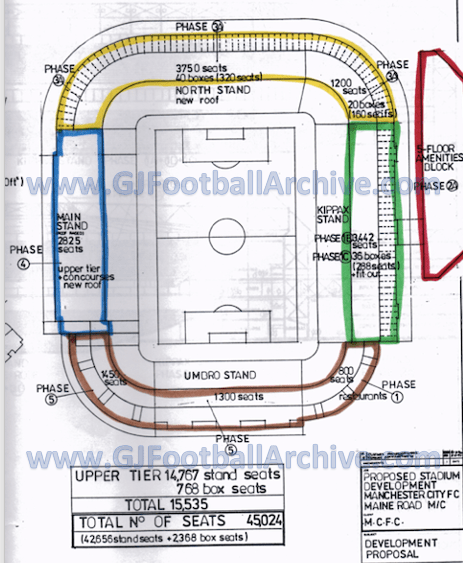
Here’s a 1994 plan of what might have been in terms of Maine Road’s development. This image is of how the entire stadium was supposed to look. To explain the colour image looks towards the stadium from above the Kippax car park. The North Stand is on the right and the Platt Lane on the left. The black and white image is from the other side of the ground, looking towards the Kippax from the Main Stand.

1990s Maine Rd redevelopment plans as seen in Farewell To Maine Road

You can see from the black and white image that the plan was to replicate the general look of the new Kippax (being planned at this stage – this was January 1994 and the old Kippax was still standing) around the ground. The North Stand was to have a second tier added and hospitality boxes between the levels, like the new Kippax. The Platt Lane was to have a second tier added above the two lines of existing hospitality boxes.

The Main Stand would have part of the seating chopped away and a new second tier added.

To facilitate all of this some houses were to be bought and demolished on the streets immediately behind the North Stand and the Kippax/Platt Lane corner.

The new Kippax was the first phase of the development but Manchester’s bids for the Olympics changed thinking. Couple that with relegation in 1996 and the wholesale redevelopment of Maine Road was postponed after the Kippax opened and then dropped completely.

As mentioned previously, Francis Lee’s plans would have seen the new Kippax followed by a phased development of each of the other three stands. These images might give an indication of how it would have progressed.

The following 1971 aerial image shows the proximity of the housing on Thornton Road (bottom left, near number 6) and behind the North Stand (number 10). They were planned to be demolished in Lee’s 1994 plan.

Maine Road aerial 1971 from Farewell To Maine Road

If you’d like to read more on the history of Maine Road, take a look at Farewell To Maine Road, which can be downloaded from this page:

Coppell Arrives

It’s that day each year (7 October) when we remember that on this day in 1996 the former Manchester United player Steve Coppell arrived as Manchester City manager at Maine Road. A month later he resigned after only 33 days in the job. This contemporary article explains that he was suffering with stress:

So much different from the start of his reign:

Manchester City 2 Charlton 1

Goals from Gerry Creaney and Uwe Rosler gave City a 2-1 victory over Charlton Athletic on this day (3 September) in 1996. Subscribers can read an indepth article on the 1996-97 season below. If you don’t know what happened then brace yourself! The article is almost 4,900 words long.


Why not subscribe and relive this season (it’s okay, we’ve had success since then)? As with all my 1990s subscriber features it contains material from interviews I’ve performed with key figures from that time, including Phil Neal who talks about Steve Coppell’s shock resignation.

Here’s the 4900 word article on that season:

Subscribe to get access – Monthly

Read more of this content when you subscribe today. It costs £3 per month (cancel anytime) to access everything posted since 1 October 2022 or there’s a special annual rate below which gives greater access and works out much cheaper.

Subscribe to get access – Annual

Read more of this content when you subscribe today. It costs £3 per month (above) or £20 a year (here) to access everything posted since the site was created in December 2020. This special rate works out about £1.67 a week and gives access to everything posted, including PDFs of 3 of my books.

If you’d like to know more about subscribing then see:

The 1990s: Season Ticket Sales

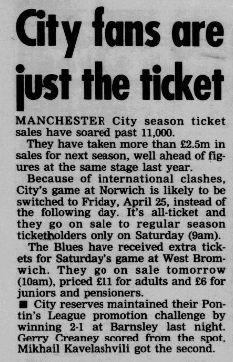
The series of features covering Manchester City in the 1990s continues today with this reminder of the loyalty of fans. This cutting is from today (8 April) in 1997 and highlights that season ticket sales had increased to 11,000 at this stage of the season. In those days there wasn’t a cut off but there were different pricing structures, so if you bought early you’d get the best benefit.

11,000 is far from the final tally (City had more than double that number of season ticket holders and actually capped it due to segregation and ticket sales needs for FA cup games etc.), but it does show that even though this was a particularly dark period for the club fans would commit month many, many weeks before knowing which division the club would play in the following season.

While you’re here why not read a 4,900 word long article on the 1996-97 season? It’s available to subscribers, so why not subscribe and relive this season and an extraordinary decade? As with all these 1990s subscriber features it contains material from interviews I’ve performed with key figures from that time, including Phil Neal who talks about Steve Coppell’s shock resignation.

Here’s the 4900 word article on that season:

Subscribe to get access – Monthly

Read more of this content when you subscribe today. It costs £3 per month (cancel anytime) to access everything posted since 1 October 2022 or there’s a special annual rate below which gives greater access and works out much cheaper.

Subscribe to get access – Annual

Read more of this content when you subscribe today. It costs £3 per month (above) or £20 a year (here) to access everything posted since the site was created in December 2020. This special rate works out about £1.67 a week and gives access to everything posted, including PDFs of 3 of my books.

This series of articles and features will run throughout March with indepth articles some days and smaller ‘on this day’ style posts on others. There will be flashbacks to great games, players and more. Every day in March will offer something to enjoy.

Subscribers will get access to everything, while some on this day material will be free for all to view.

If you want to know more on this incredible decade for Manchester City Football Club then why not subscribe and read it all? If you’d like to know more about subscribing then see:

The 1990s: Fire in the North Stand

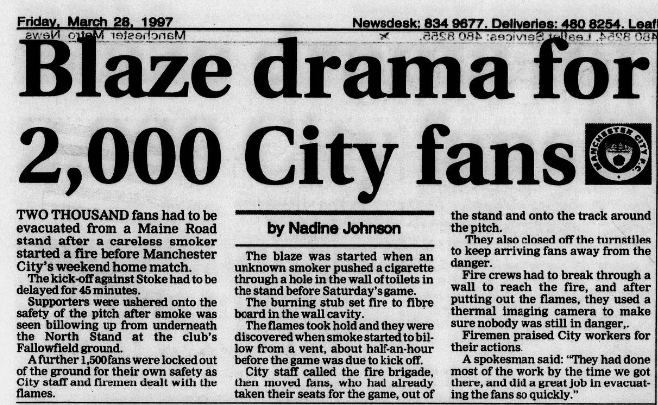
The series of features covering Manchester City in the 1990s continues today with this reminder of a day when fans had to be evacuated from Maine Road’s North Stand due to a fire. I remember the day well – I was sat at the opposite end – and it did seem a little worrying for a time. I remember seeing some smoke coming out of the stand. This cutting is from today (28 March) in 1997 and highlights the day of the fire (previous weekend).

The article claims the fire was started because a fan had pushed a cigarette into a cavity which set fire to materials behind the wall. I don’t think I ever knew this at the time (the rumour was that a chip fryer or burger stand had overheated in some way) but reading this all these years later is a little chilling. In 1985 the cause of the Bradford fire was believed to be a stray cigarette going through a whole and setting waste material under the stand on fire.

Unlike at Bradford the North Stand fire was soon extinguished and City’s game was delayed but played. Nevertheless, reading that brief report now does make you think of what could have happened.

This was not the first time a stand at Manchester City experienced a fire of course. Elsewhere on this site you can read about the Hyde Road fire.

While you’re here why not read a 4,900 word long article on the 1996-97 season? It’s available to subscribers, so why not subscribe and relive this season and an extraordinary decade? As with all these 1990s subscriber features it contains material from interviews I’ve performed with key figures from that time, including Phil Neal who talks about Steve Coppell’s shock resignation.

Here’s the 4900 word article on that season:

Subscribe to get access – Monthly

Read more of this content when you subscribe today. It costs £3 per month (cancel anytime) to access everything posted since 1 October 2022 or there’s a special annual rate below which gives greater access and works out much cheaper.

Subscribe to get access – Annual

Read more of this content when you subscribe today. It costs £3 per month (above) or £20 a year (here) to access everything posted since the site was created in December 2020. This special rate works out about £1.67 a week and gives access to everything posted, including PDFs of 3 of my books.

This series of articles and features will run throughout March with indepth articles some days and smaller ‘on this day’ style posts on others. There will be flashbacks to great games, players and more. Every day in March will offer something to enjoy.

Subscribers will get access to everything, while some on this day material will be free for all to view.

If you want to know more on this incredible decade for Manchester City Football Club then why not subscribe and read it all? If you’d like to know more about subscribing then see:

The 1990s: 1996-1997 Further Managerial Changes

The series of articles covering Manchester City in the 1990s continues today with an indepth article on the 1996-97 season. If you don’t know what happened then brace yourself! The article is almost 4,900 words long. It’s available to subscribers, so why not subscribe and relive this season and an extraordinary decade? As with all these 1990s subscriber features it contains material from interviews I’ve performed with key figures from that time, including Phil Neal who talks about Steve Coppell’s shock resignation.

Here’s the 4900 word article on that season:

Subscribe to get access – Monthly

Read more of this content when you subscribe today. It costs £3 per month (cancel anytime) to access everything posted since 1 October 2022 or there’s a special annual rate below which gives greater access and works out much cheaper.

Subscribe to get access – Annual

Read more of this content when you subscribe today. It costs £3 per month (above) or £20 a year (here) to access everything posted since the site was created in December 2020. This special rate works out about £1.67 a week and gives access to everything posted, including PDFs of 3 of my books.

This series of articles and features will run throughout March with indepth articles some days and smaller ‘on this day’ style posts on others. There will be flashbacks to great games, players and more. Every day in March will offer something to enjoy.

Subscribers will get access to everything, while some on this day material will be free for all to view.

If you want to know more on this incredible decade for Manchester City Football Club then why not subscribe and read it all? If you’d like to know more about subscribing then see:

The 1990s: Rosler Winner

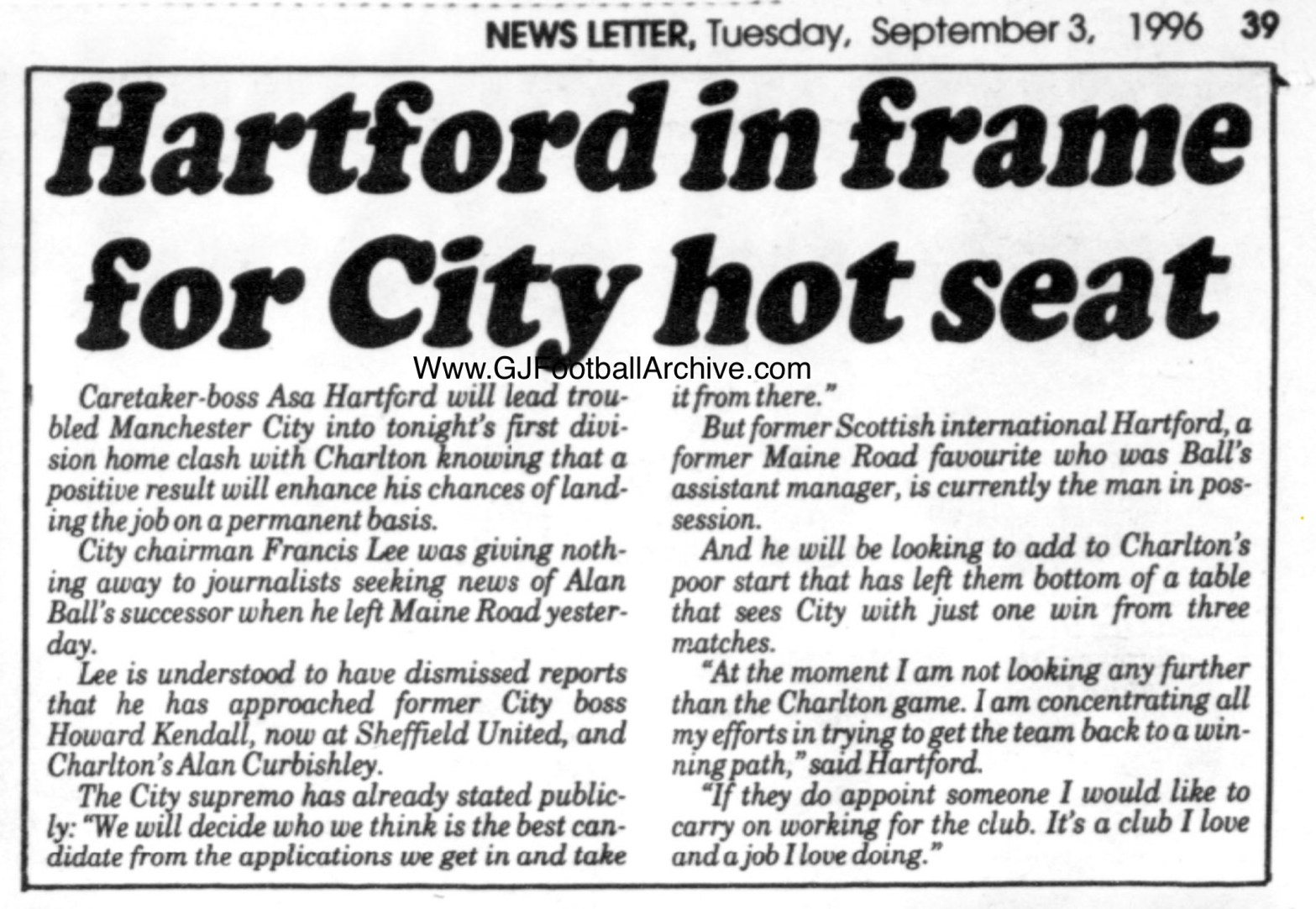
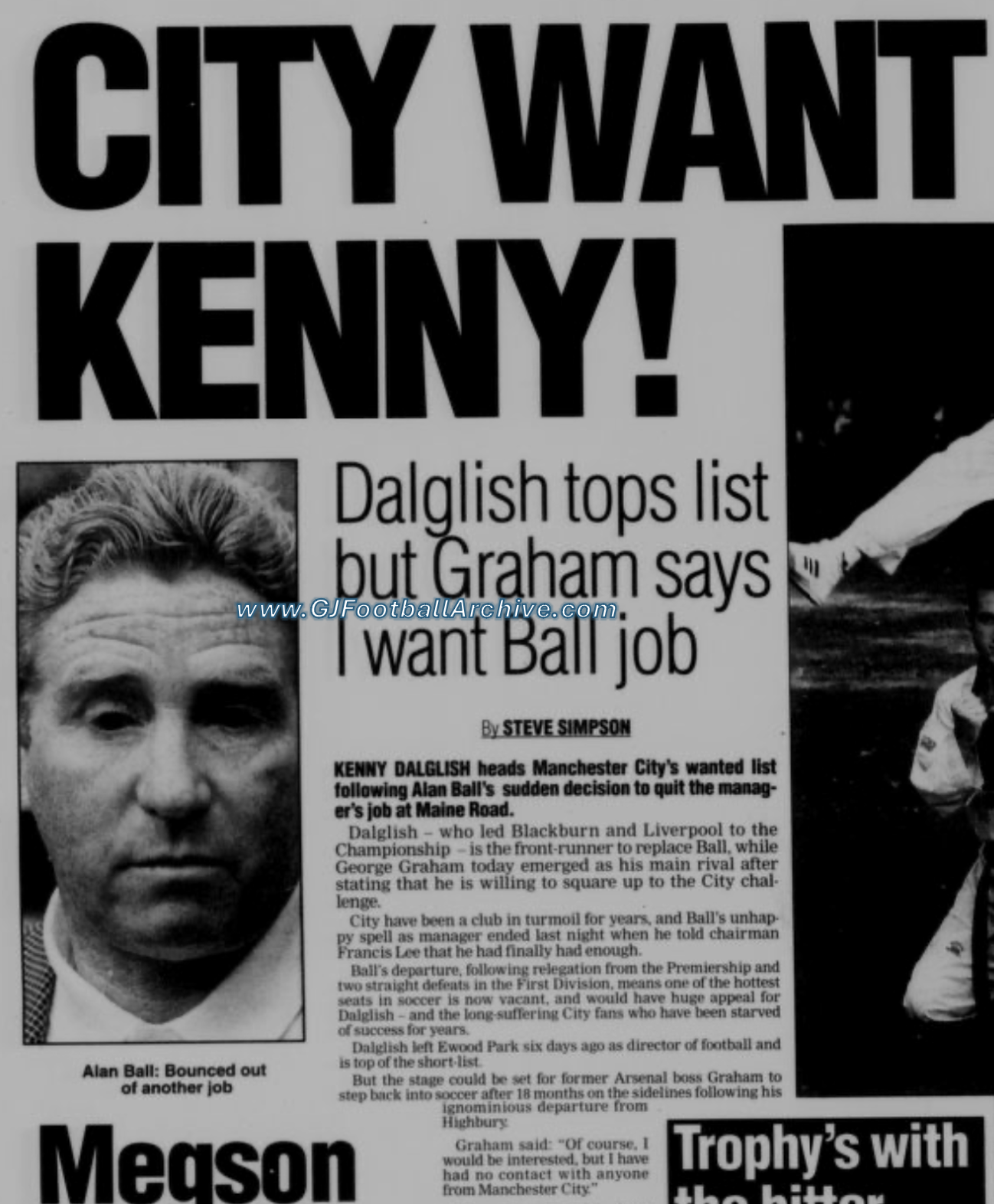
The series of articles covering Manchester City in the 1990s continues with a game against near neighbours Oldham Athletic on this day (8 March) in 1997. The Blues had been unbeaten in 8 consecutive League games since the arrival of Frank Clark in December. There had also been 2 victories in the FA Cup during that time (plus a frustratingly controversial 1-0 defeat at home to Middlesbrough) and so Clark was actually restoring some positivity to the club after a dismal start of the season had seen two permanent managers (Alan Ball and Steve Coppell) precede Clark. There were also temporary managerial spells by Asa Hartford and Phil Neal which lasted longer than Coppell’s permanent role! I’ll save all of that for another day! In the meantime more on the game with Oldham…

The match was watched by 30,729 – the third highest crowd of the day and only about 8,000 less than title challengers Arsenal (the best crowd of the day). Not bad for a second tier team that was struggling overall!

Uwe Rosler scored the only goal of the game but was booked afterwards for an over enthusiastic celebration. Oldham boss Neil Warnock wasn’t happy, claiming the goal should not have been allowed. Oh the days before VAR and the ability of both managers to be absolutely certain that what they say is the truth (wait a minute… VAR hasn’t resolved that even when the cameras prove the truth!). Here’s the match report….

For more on the 1990s why not subscribe and see everything I’m posting? You can start with this 1,300 word article on the end of the 1989-90 season. It is available to subscribers below. Enjoy!

Subscribe to get access – Monthly

Read more of this content when you subscribe today. It costs £3 per month (cancel anytime) to access everything posted since 1 October 2022 or there’s a special annual rate below which gives greater access and works out much cheaper.

Subscribe to get access – Annual

Read more of this content when you subscribe today. It costs £3 per month (above) or £20 a year (here) to access everything posted since the site was created in December 2020. This special rate works out about £1.67 a week and gives access to everything posted, including PDFs of 3 of my books.

If you’d like to know more about subscribing then see: