Record Average Crowds

I’ve not done one of these for a while but I know they always prompt a bit of debate, so here goes… a feature on Manchester City FC attendances. It is a fact that the Blues have, generation after generation, been one of the English game’s top attractions. Like all – and I do mean all – English clubs there have been some average attendance lows over the years, but when the entire history of Manchester City is reviewed and the club’s average figures are compared with the national average it is clear that the Blues have consistently been one of football’s most attractive draws.  Take a look at the following:

  • Since the beginning of the Football League in 1888 only nine sides have topped the table for average attendances.  In chronological order of their first appearance at the top of the average table they are: Everton (1888-9), Villa (1898-99), Newcastle (1904-05), Chelsea (1907-08), Tottenham (1909-10), City (1910-11), Liverpool (1922-23), Arsenal (1929-30), & Manchester United (1956-57) 
  • As early as 1895-96 City were the third best supported side in the entire League despite being a Second Division side.  Only First Division sides Everton & Aston Villa could better the Blues.  Modern day giants Arsenal were 10th; Liverpool were 19th; United were 21st and Chelsea had yet to exist.
  • In 1900-01 City were the 2nd best supported side in the entire League with only 400 people separating Villa (1st) and City 
  • The 1910-11 season saw Manchester’s Blues top the attendance charts for the first time.  City’s average was 26,000 and was the 8th highest average of all time at that point (all clubs, all seasons). 
  • Regularly amongst the best supported sides throughout the inter war period, City’s average exceeded 37,000 for the first time in 1927-28 when the Blues established a record average crowd for the Second Division.  This was also the entire League’s highest.
  • In 1947-48 City’s average crowd exceeded 42,000 for the first time.  Prior to that season only Chelsea (1919-20 & 1946-7), Arsenal (1934-5, 1936-7, 1937-8, & 1946-7) , Newcastle (1946-7), Liverpool (1946-7), United (1946-7), and Wolves (1946-7) had exceeded that figure.
  • From 1975 to relegation in 1983 City were always one of the top 4 best supported sides, usually third behind United and Liverpool.
  • Since the 1980s whenever City have played outside of the top division, they have tended to be the best supported side in that division.  
  • Since moving to their current home in 2003, the increased capacity has allowed City to re-establish itself as one of best supported clubs again. Maine Road’s capacity from 1994 onwards was extremely low compared to the club’s entire history and prevented the Blues from staging games in front of attendances of approximateley 35,000 upwards.

In general many people believe success increases support, and while that is undoubtedly true to some extent, for City it is often periods of adversity that prove the loyalty of the Club’s fans.  It is highly significant, for example, that the first time City were the best supported side in the entire League (1910-11) Manchester United (6th best supported side) won the League title for the second time in 3 seasons.

Similarly, in 1925-26 when City were the best supported side in Division One and had established a new record average, the Blues were actually relegated.  This coupled with significant poverty and hardship in Manchester at the time should have reduced support but loyalty increased!  In my book “Manchester A Football History” I explore the relationship between attendances and Manchester’s major sides and it is fair to say that City fans can feel immensely proud of their loyalty throughout the history of the game.  Something that cannot be said by all of the League’s biggest names.  

In fact, it is worth highlighting that City have never been the worst supported side in their division but, of today’s so-called giants, Arsenal (1912-13 – average = 9,100) and Manchester United (1930-31 – average = 11,685) have.  City’s worst average of the Twentieth Century came in the desperate 1964-65 season and was 14,753 (half the average of 1960-61 and a 3rd of the 1957-8 figure).  However it is significant that for every League season City’s average has always been above the divisional average and, apart from 17 seasons, has always been in the top 11 nationally.  Again, few of today’s giants can’t say that – United’s 20th Century low stands at 4,650 and Chelsea averaged 15,731 as recently as 1988-89. In fact City’s lowest League attendance is more than double United’s lowest League attendance at Old Trafford (United have several crowds of less than 4,000 at Old Trafford, including top flight games; City’s lowest in the League was a little over 8000 in the second tier).

For fans average attendances are often used as an indicator of size of club and so a number of people over the years have tried to produce a definitive ‘all-time’ attendance table.  Several years ago analysis by a member of the Association of Football Statisticians claimed that if stadium capacity was not an issue for any club City would be the fourth biggest side in terms of attendance.  That analysis compared postwar attendance detail with performance on the pitch.  

In 2002 writer Brian Tabner calculated an all-time attendance table based on each club’s average attendance position during seasons 1925-2002.  His top ten were:  Arsenal, Liverpool, United, Everton, Tottenham, Newcastle, City, Chelsea, Villa and Sunderland.  Since 2002 several clubs have increased their capacities of course and this will have a positive impact on each club’s standing in a more up to date analysis.   

Figures can be manipulated in many different ways, but City should feel proud that they have many attendance firsts that can never be matched by today’s perceived biggest clubs.  

The Seasons City Have Topped the Divisional Charts

The following figures show the seasons when City were the best supported side in their division and the Club’s highest individual crowd that season.  Those crowds marked in italics were also the highest individual crowds for the entire division that season (crowds pre-1925 are inconsistently recorded and so have not been highlighted).  It is fair to say that when an average crowd is within 4,000 of the highest then the stadium is likely to have been full for the majority of games with the size of away support varying.     

Average         Season          Highest Crowd                                  

10,000            1895-96         30,000 (Liverpool)                

10,000            1898-99         25,000 (N. Heath)    

16,000            1902-03         30,000 (United)        

18,275            1909-10         40,000 (Oldham)

26,000            1910-11         40,000 (Liverpool)    

21,000            1914-15         40,000 (Oldham)

32,000            1925-26         62,994 (United)

30,848            1926-27         49,384 (Bradford C)

37,468            1927-28         59,500 (Preston)

31,715            1928-29         61,007 (United)

35,016            1950-51         45,842 (Hull)

27,739            1965-66         47,171 (Huddersfield)

24,220            1984-85         47,285 (Charlton)

23,500            1988-89         40,070 (Chelsea)

26,753            1996-97         30,729 (Oldham)

28,273            1998-99         32,471 (York)

32,001            1999-00         33,027 (Blackburn)

33,059            2001-02         34,657 (Portsmouth)

With the increase in capacity at the Etihad coming this year it will be interesting to see how attendances develop. No doubt I’ll post more on this as the season progresses. Undoubtedly City will establish a new record average attendance in 2026-27.

A 2nd Successive Manchester League Derby At United Ends early!

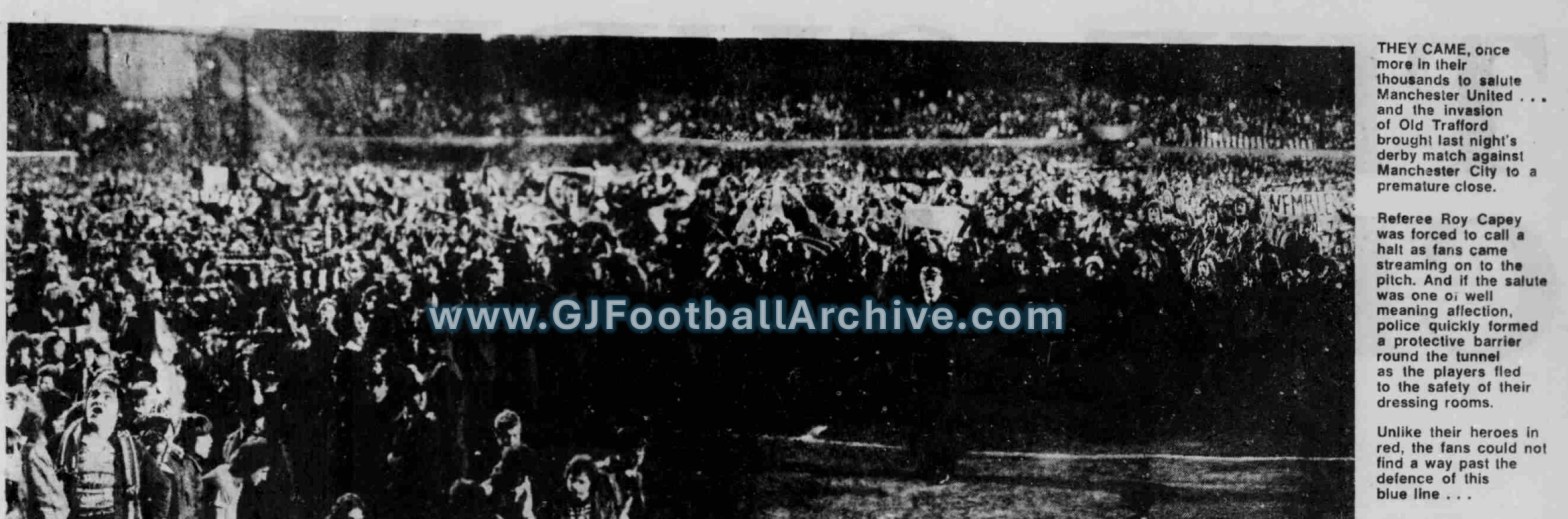
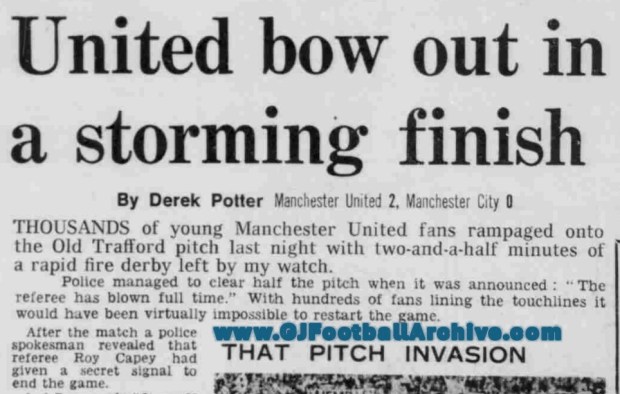
On 4 May 1976 and for the second consecutive League derby at Old Trafford, a meeting between United and City was cut short when thousands stormed the pitch before its natural conclusion. Home fans invaded the pitch before the 90th minute with United leading 2-0. Afterwards it was reported that the police had signalled to the referee to blow the whistle while fans were on the pitch. Referee Roy Capey told reporters: ‘My only concern was for the linesman who had to run from the far side of the ground. But he got into the dressing room safely.’

Screenshot

Derek Wallis, writing for the Daily Mirror, explained that United fans had raced on to the pitch: ‘ahead of time last night – nearly three minutes by my watch – and diplomatically referee Roy Capey promptly blew for time.’

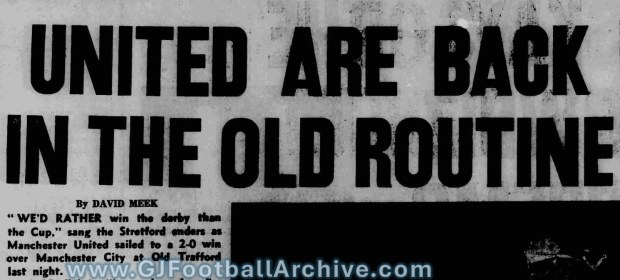
A few days earlier United had been defeated by Second Division Southampton in the FA Cup final and United reporter David Meek started his Manchester Evening News report of the derby with this interesting line (his emphasis): ‘”WE’D RATHER win the derby than the Cup,” sang the Stretford enders as Manchester United sailed to a 2-0 win over Manchester City at Old Trafford last night.’

Fifty Years Ago Today: City v Liverpool

Maine Road’s highest crowd of the season, 50,439, witnessed a pulsating game against League title hopefuls Liverpool on this day (19 April) in 1976. The game was goalless until the 74th minute when Steve Heighway scored the opener. In the 87thminute, as City searched for an equaliser, the Blues were unlucky when a David Fairclough attempt was diverted in off Tommy Booth and then in the final minute future Blue Fairclough blasted home a Kevin Keegan pass from 14 yards out. 

Paul Power came close to scoring a consolation goal a few moments later, as goalkeeper Ray Clemence and Emlyn Hughes scrambled the ball off the line, but the game ended 3-0 to new League leaders Liverpool, who led the table from QPR by a point. The Daily Express report praised City’s performance: ‘City stuck manfully to their job and until Fairclough began to create his havoc they always looked likely to take at least a point.’

You can read more on the 1975-76 season with this 5,320 word article – a season which saw Tony Book guide the club to major success. If you want to know more on this incredible decade for Manchester City Football Club then why not subscribe and read it all? You could even subscribe for a month and see what you think. The following 5,320 word article is on the 1975-76 season and is available to subscribers below. Enjoy!

Subscribe to get access – Monthly

Read more of this content when you subscribe today. It costs £3 per month (cancel anytime) to access everything posted since 1 October 2022 or there’s a special annual rate below which gives greater access and works out much cheaper.

Subscribe to get access – Annual

Read more of this content when you subscribe today. It costs £3 per month (above) or £20 a year (here) to access everything posted since the site was created in December 2020. This special rate works out about £1.67 a week and gives access to everything posted, including PDFs of 3 of my books.

If you’d like to know more about subscribing then see:

Fifty Years Ago Today: Colin Bell Scores in 2nd Comeback Game

An unlucky away game at Leeds on this day (17 April) in 1976 was noteworthy for a goal by Colin Bell, playing his second comeback game for Manchester City. Journalist Alan Thompson writing for the Daily Express summed up the game well: ‘Leeds were awful for most of the first half, went in a goal down, but they won the match… As Mike Doyle says, “We threw the game away… AGAIN!”’

City’s goal came after five minutes when the ball was swung out to Colin Bell, playing his second comeback game after his devastating injury in the November derby match, on the edge of the box. Bell scored with a magnificent shot which went in off the upright.  Sadly, the game ended in a 2-1 defeat after two goals in three minutes from Leeds (McNiven 62nd minute & Harris 64th minute).

You can read more on the 1975-76 season with this 5,320 word article – a season which saw Tony Book guide the club to major success. If you want to know more on this incredible decade for Manchester City Football Club then why not subscribe and read it all? You could even subscribe for a month and see what you think. The following 5,320 word article is on the 1975-76 season and is available to subscribers below. Enjoy!

Subscribe to get access – Monthly

Read more of this content when you subscribe today. It costs £3 per month (cancel anytime) to access everything posted since 1 October 2022 or there’s a special annual rate below which gives greater access and works out much cheaper.

Subscribe to get access – Annual

Read more of this content when you subscribe today. It costs £3 per month (above) or £20 a year (here) to access everything posted since the site was created in December 2020. This special rate works out about £1.67 a week and gives access to everything posted, including PDFs of 3 of my books.

If you’d like to know more about subscribing then see:

King Colin’s Crown

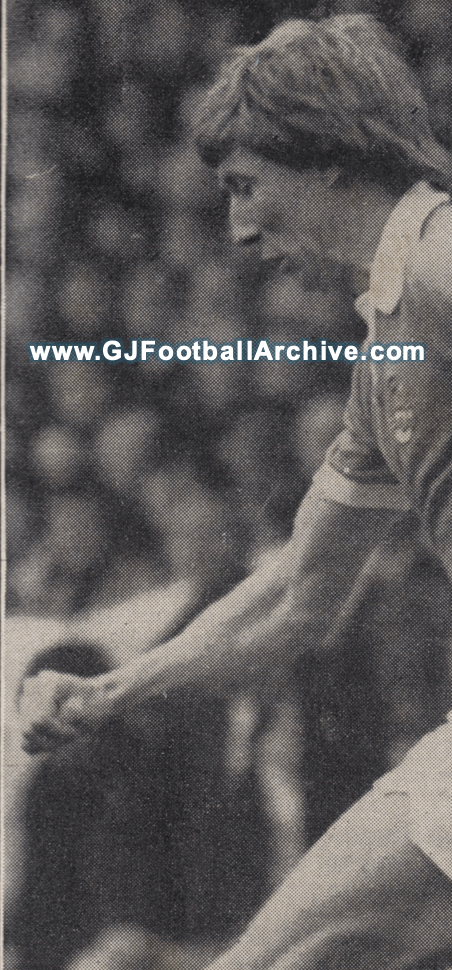
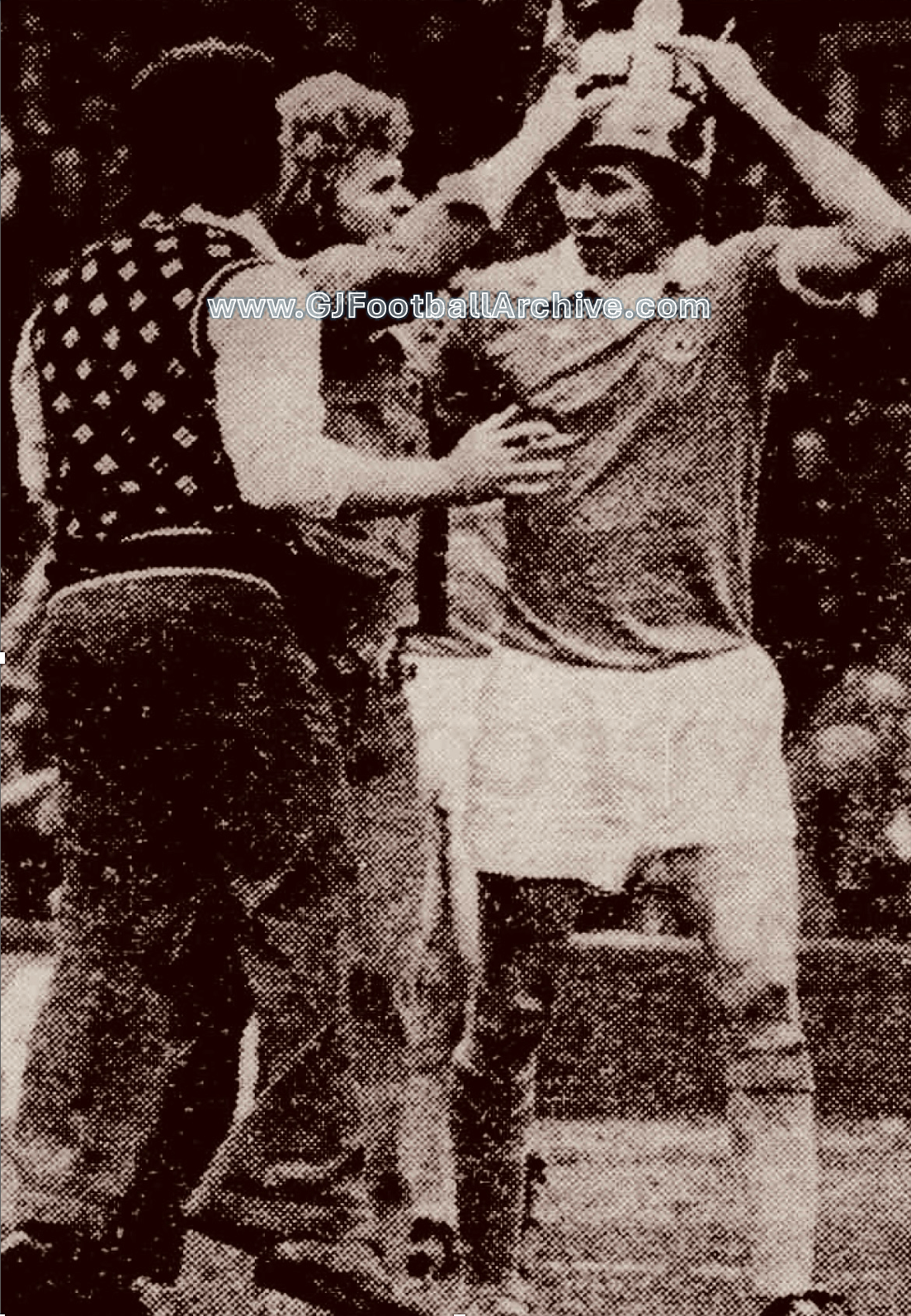
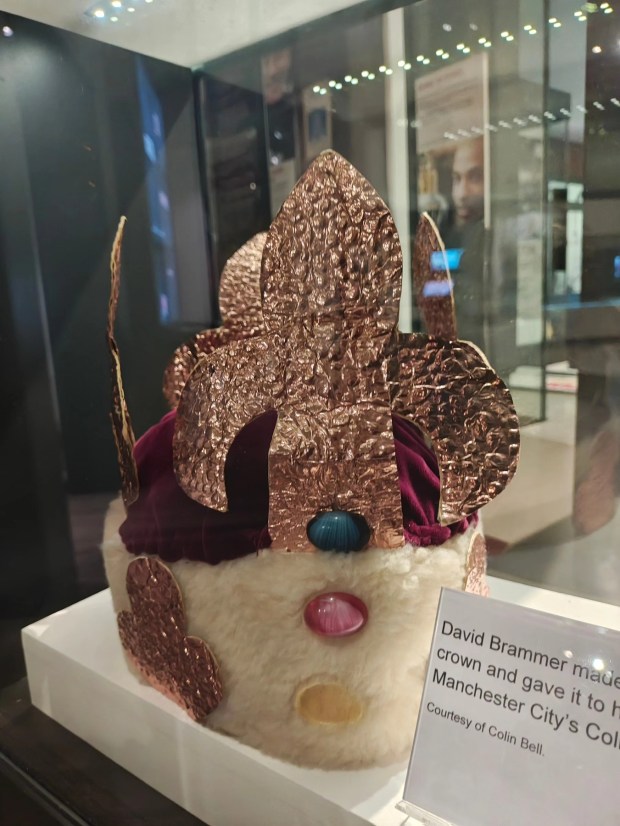
Today (10 April 2026) marks the 50th anniversary of the day City legend Colin Bell was crowned. The story has entered folklore about the day when a fan – Dave Brammer – ran on to the Maine Road pitch with a crown he had specially made for the occasion and placed it on the head of Colin as the player warmed up just before kick-off.  This photo recently rediscovered captures the moment and you can read more about this remarkable day and see other photos of Colin in action that day below (this is a subscriber article – see below for details).

There’s also plenty of other stuff on Colin throughout the site so why not have a search and see what you can see?

Subscribe to access great content and support Gary’s research

If you want to read this full article or have enjoyed the free content on this site then why not subscribe? At the same time you’ll be supporting my research and writing (I’m not employed by anyone and my research/writing is self-funded). It costs £3 per month (cancel anytime) or sign up on an annual basis for the discounted rate of £20 per year. You’ll also get to read all content posted during your subscription. Thanks.

Fifty Years Ago Today: Controversial Hartford Dismissal

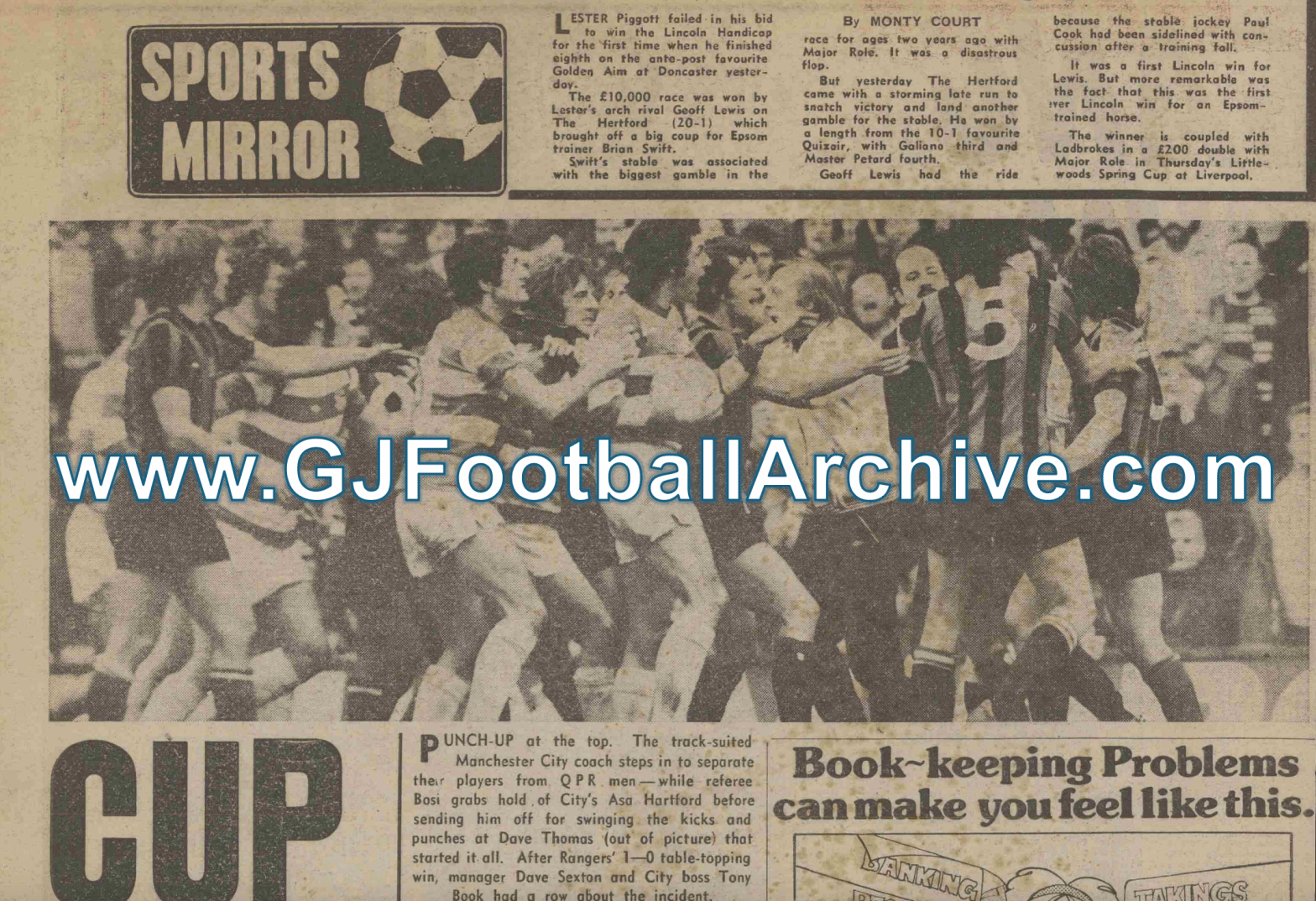
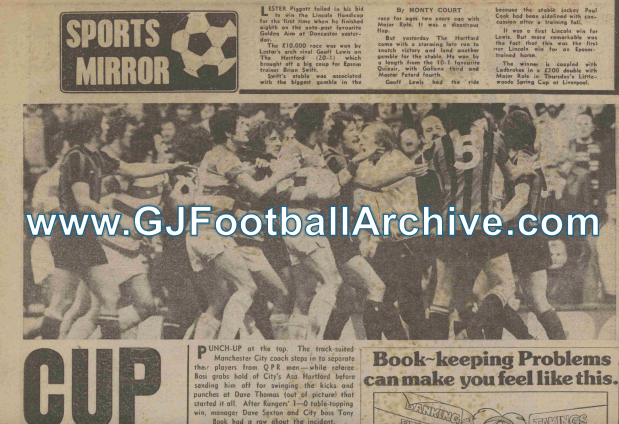
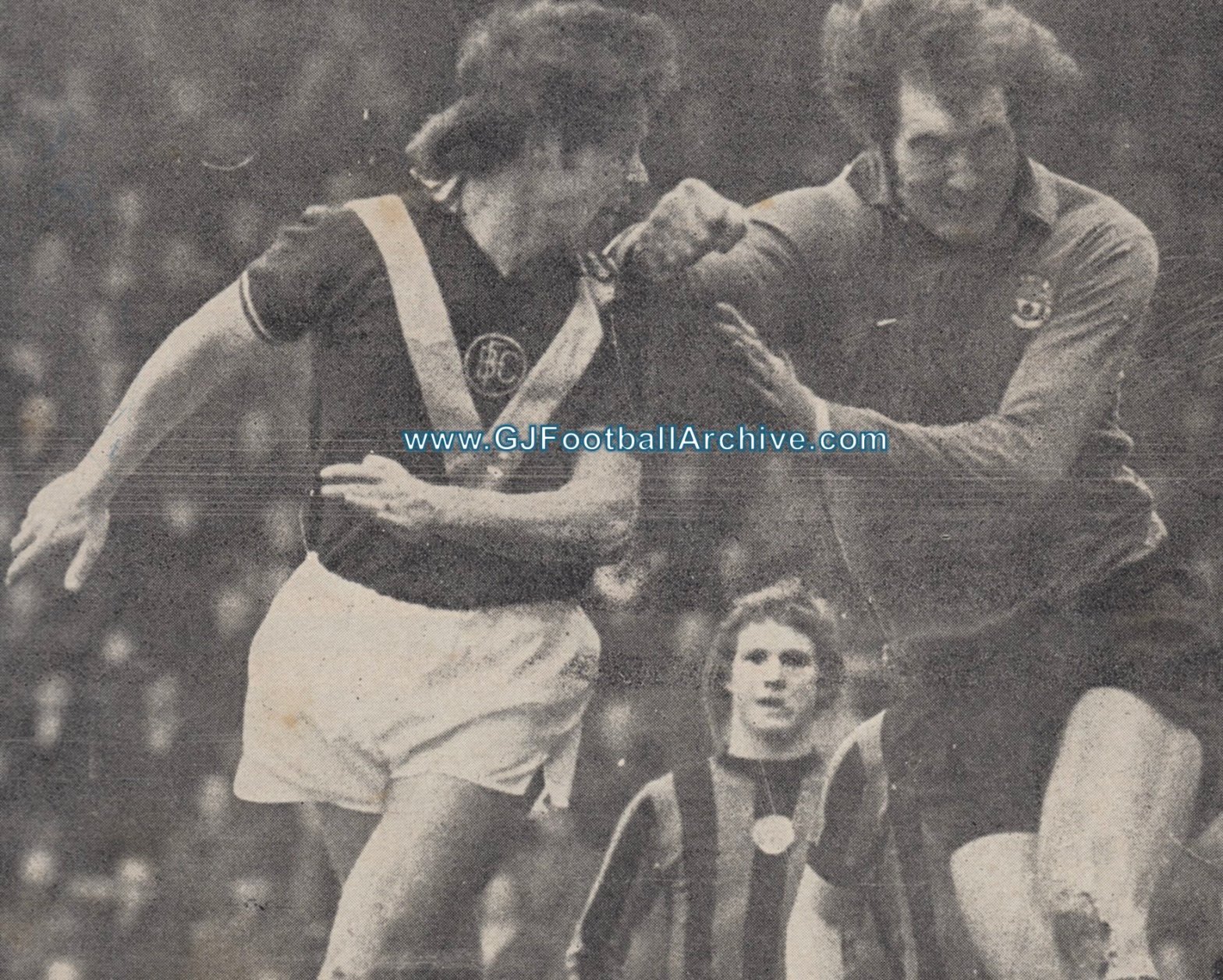
A hugely controversial away game at QPR on this day (27 March) in 1976 brought unsavoury headlines. Manchester City lost 1-0 to an 81st minute goal to the League leaders but that wasn’t the real issue this day, it was the extremely negative way the London club played. This all led to a controversial incident following an Asa Hartford tackle. The Belfast Newsletter reported: ‘The already tattered disciplinary reputation of the League leaders took another knock in the game with Manchester City at Loftus Road… In the 75th minute City’s Asa Hartford went in to tackle with foot held high, and Wolverhampton referee Terry Bosi immediately whistled for a foul. He was talking to Hartford when Thomas, not concerned in the original incident, ran a dozen yards to attack the City player from behind and pull his hair. Hartford retaliated with a blow, and within seconds other players were involved.’

Hartford was sent off much to the dismay of City fans, staff and most neutral journalists. The Sunday Express reported: ‘Don Masson kicked Hartford and Dave Thomas aimed a punch… the Rangers pair were lucky to escape without even a booking.’

After the game the rival managers, Tony Book and Dave Sexton, publicly argued in front of journalists about the physical nature of QPR and Hartford’s sending off.

The suspension of Hartford and an injury to Dave Watson led to selection issues for the away game at Stoke the following Friday. In the end a magnificent performance from youngster Paul Power was rightly praised in a goalless draw seen as a positive result in the circumstances.

Five days later a third successive away game saw City lose 2-1 to Bobby Robson’s Ipswich Town. Ipswich opened the scoring four minutes before half time, with Ged Keegan equalising in the 47th minute. Eleven minutes later Ipswich scored their winner and their pressure from then on disrupted every opportunity City had to search for an equaliser.

One point from three games led to Tony Book taking a decision that would excite the Maine Road faithful: Colin Bell was to return for the following game.

You can read more on the 1975-76 season with this 5,320 word article – a season which saw Tony Book guide the club to major success. If you want to know more on this incredible decade for Manchester City Football Club then why not subscribe and read it all? You could even subscribe for a month and see what you think. The following 5,320 word article is on the 1975-76 season and is available to subscribers below. Enjoy!

Subscribe to get access – Monthly

Read more of this content when you subscribe today. It costs £3 per month (cancel anytime) to access everything posted since 1 October 2022 or there’s a special annual rate below which gives greater access and works out much cheaper.

Subscribe to get access – Annual

Read more of this content when you subscribe today. It costs £3 per month (above) or £20 a year (here) to access everything posted since the site was created in December 2020. This special rate works out about £1.67 a week and gives access to everything posted, including PDFs of 3 of my books.

If you’d like to know more about subscribing then see:

Daily Mirror showing QPR v City brawl on 27 March 1976

Fifty Years Ago Today: Gary Owen’s Debut

The League Cup winners faced Wolves at Maine Road on this day (20 March) in 1976. The game looked like a certain defeat – or at best a draw – for most of the match with Wolves dominating the early stages and even a Dennis Tueart scissor kick was unable to find the net (saved by goalkeeper Phil Parkes). Wolves took the lead via a low shot from future Blue Steve Daley in the 29th minute.

The second half saw City play with more fluidity and came close to scoring when 17-year-old debutant Gary Owen fired in a low shot following a free kick. Parkes managed a good save at the foot of the post. Eight minutes into the half City did equalise through another young player, Ged Keegan. 

After 81 minutes Wolves took the lead again with a Kindon header. Three minutes later a handling offence in the area gave City a penalty which Tueart blasted past Parkes to equalise.

Only a minute later, and with the game entering its final five minutes, Mike Doyle stormed in to head City in front, making it 3-2. The victory for Tony Book’s side was a little harsh on Wolves, particularly after some excellent saves from Parkes, but it demonstrated the never-say-die attitude that seemed to be a key feature of City at this time.

Post match much of the talk was on City’s final flourish, but journalist Peter Gardner was also keen to write about Gary Owen, claiming: ‘Owen provided one of the most startling League debuts I have ever seen… he is essentially an exciting player with abundant flair and ability. He shows too, a crispness in the tackle that comes from a stocky build reminiscent of an early Ball or Bremner. Doubtless his display exceeded the expectations of many as City rallied after the break to come up on the post and snatch victory from the grasp of a Wolves side ready to celebrate.’

You can read more on the 1975-76 season with this 5,320 word article – a season which saw Tony Book guide the club to major success. If you want to know more on this incredible decade for Manchester City Football Club then why not subscribe and read it all? You could even subscribe for a month and see what you think. The following 5,320 word article is on the 1975-76 season and is available to subscribers below. Enjoy!

Subscribe to get access – Monthly

Read more of this content when you subscribe today. It costs £3 per month (cancel anytime) to access everything posted since 1 October 2022 or there’s a special annual rate below which gives greater access and works out much cheaper.

Subscribe to get access – Annual

Read more of this content when you subscribe today. It costs £3 per month (above) or £20 a year (here) to access everything posted since the site was created in December 2020. This special rate works out about £1.67 a week and gives access to everything posted, including PDFs of 3 of my books.

If you’d like to know more about subscribing then see:

An Ill-Tempered Day at Burnley

Manchester City, the League Cup winners, travelled to Turf Moor for a League game with struggling Burnley on this day (13 March) in 1976. It was a strange day with City in control for much of the game. It seemed inevitable Tony Book’s side would win, especially when they were awarded a penalty in the 44th minute. Burnley’s centre-half Jim Thomson was sent off for kicking Dennis Tueart while he lay on the ground following a collision with the ‘keeper. Tueart said afterwards: ‘When Thomson was sent off the goalie and I stood looking at each other wondering what had happened. It was a bit silly really! There was a bit of a skirmish with Thomson, but I didn’t even feel a blow of any kind.’

Wembley hero Tueart stepped up to take the resulting penalty but Burnley ‘keeper Gerry Peyton saved brilliantly.

The game became ill-tempered and former City hero Mike Summerbee, playing for Burnley, clashed with Tueart at times, causing both men to be spoken to by the referee.

In the second half City, playing in red & black stripes, were awarded another penalty. This time Tueart’s spot-kick entered the net, but the referee judged that a City played had encroached the area and the penalty was retaken. This time Tueart’s shot hit the post!The game ended goalless and City were now sixth, eleven points (2 points for a win) behind leaders QPR with three games in hand.

You can read more on the 1975-76 season with this 5,320 word article – a season which saw Tony Book guide the club to major success. If you want to know more on this incredible decade for Manchester City Football Club then why not subscribe and read it all? You could even subscribe for a month and see what you think. The following 5,320 word article is on the 1975-76 season and is available to subscribers below. Enjoy!

Subscribe to get access – Monthly

Read more of this content when you subscribe today. It costs £3 per month (cancel anytime) to access everything posted since 1 October 2022 or there’s a special annual rate below which gives greater access and works out much cheaper.

Subscribe to get access – Annual

Read more of this content when you subscribe today. It costs £3 per month (above) or £20 a year (here) to access everything posted since the site was created in December 2020. This special rate works out about £1.67 a week and gives access to everything posted, including PDFs of 3 of my books.

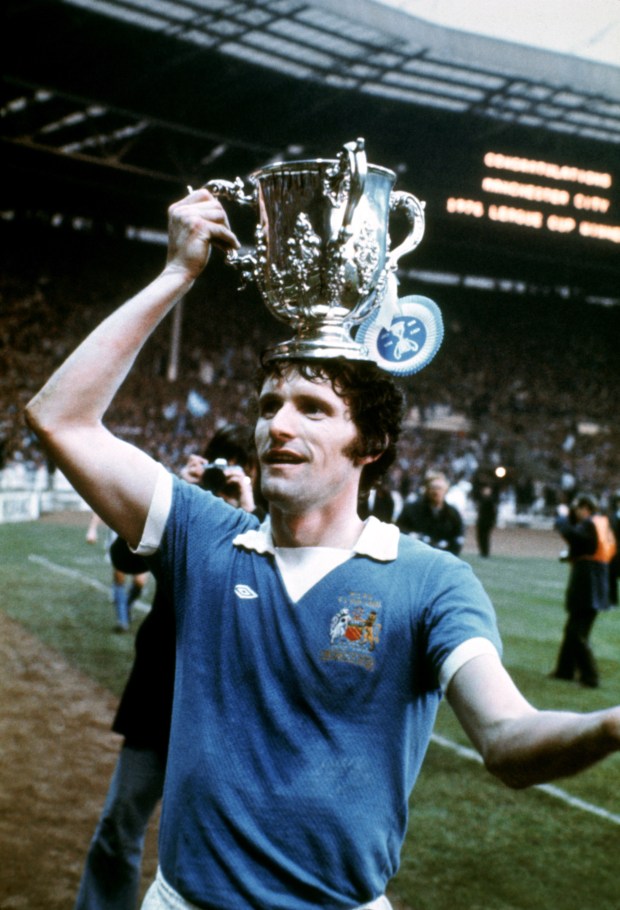
Manchester City’s Mike Doyle celebrates with the League Cup (PAPhotos/Alamy)

If you’d like to know more about subscribing then see:

Fifty Years Ago Today: Manchester City v Sheffield United and a Tueart Overhead Goal!

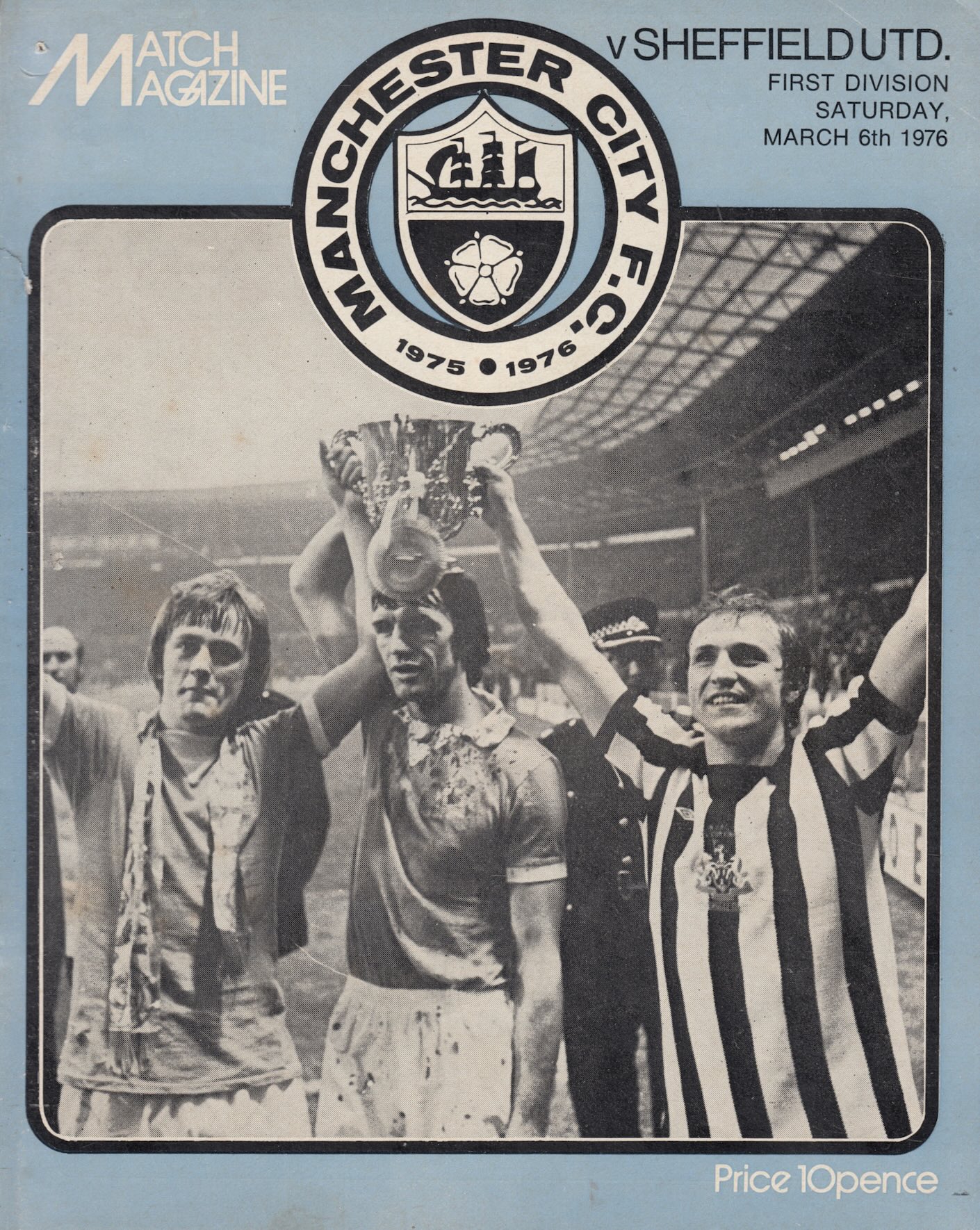
League Cup holders Manchester City played Sheffield United in the League on 6 March 1976. It’s a game often overlooked and for the first 50 minutes or so had little to offer. Some thought City were off form because of their exploits at Wembley but suddenly they burst in to life when Tommy Booth latched on to a loose ball. He fed it to Asa Hartford who made it 1-0 after 59 minutes. 

Eight minutes later Booth headed the ball to Dennis Tueart 15 yards out from goal. Amazingly, the City winger repeated his famous scissor kick from the League Cup final to give the Blues a 2-0 lead and total dominance. Joe Royle headed a third after 71 minutes and Hartford netted his second – a devastating low drive – to make it a 4-0 win. Significantly, in the days before assists were formally recorded, Tommy Booth had supplied the final pass for all four City goals.

A dismal game had been transformed into a real demonstration of City’s strengths. The Blues were now seventh, ten points behind leaders QPR, though the Blues had played 3 fewer League games. However, with eleven games left and only two points for a win it seemed unlikely that further trophy success would follow this season.

You can read more on the 1975-76 season with this 5,320 word article – a season which saw Tony Book guide the club to major success. If you want to know more on this incredible decade for Manchester City Football Club then why not subscribe and read it all? You could even subscribe for a month and see what you think. The following 5,320 word article is on the 1975-76 season and is available to subscribers below. Enjoy!

Subscribe to get access – Monthly

Read more of this content when you subscribe today. It costs £3 per month (cancel anytime) to access everything posted since 1 October 2022 or there’s a special annual rate below which gives greater access and works out much cheaper.

Subscribe to get access – Annual

Read more of this content when you subscribe today. It costs £3 per month (above) or £20 a year (here) to access everything posted since the site was created in December 2020. This special rate works out about £1.67 a week and gives access to everything posted, including PDFs of 3 of my books.

Manchester City’s Mike Doyle celebrates with the League Cup (PAPhotos/Alamy)

If you’d like to know more about subscribing then see:

Fifty Years Ago Today: 1976 League Cup Final

Manchester City travelled to Wembley for the League Cup final on this day (28 February) in 1976. Here’s a story of that day…

The huge demand for tickets had seen City secretary Bernard Halford take the unusual step of writing to all the other League clubs, apart from Newcastle of course, asking for any spare tickets from their allocations for the final. Many clubs obliged but still thousands of Blues were denied tickets.

Reaching Wembley was an extraordinary achievement considering the injuries (most notably Colin Bell) and suspensions, and demonstrated a wonderful team spirit that had been galvanised by manager Tony Book and captain Mike Doyle following the controversy surrounding former captain Rodney Marsh earlier in the season. Doyle told the media: ‘The success of this City is the complete team work – and individuals don’t count. I’m sorry Colin [Bell] hasn’t made it, but I’m damned sure it hasn’t weakened our chances, because we’ve proved it. We’ve been without him for three months and still reached Wembley.’

Significantly, every member of the side had already played at Wembley except youngsters Peter Barnes and Ged Keegan. When questioned whether those players would be the weak links Doyle said: ‘Peter is not only a tremendously talented player – he’s got his head screwed on the right way. He just isn’t the sort to get all worked up. In fact, I’ll bet that he could prove the biggest success of the whole match. He’s a natural. He does things superbly without having to think or worry. Keegan is in the same mould. He’ll feel at home, because he’s already one of the City first team pool.  If he wasn’t something special, he wouldn’t be in it!’

The final began with both teams playing attractive football. Newcastle seemed to have the edge for a while, but a foul by Newcastle’s Keeley on Joe Royle brought an important free-kick. Hartford sent the ball to Royle, who headed the ball across the face of the goal. Barnes stormed in to fire a half-volley into the net to give City an eleventh minute lead.

Barnes, who would be announced as the PFA Young player of the Year that weekend, immediately ran off the pitch towards the stands in celebration.

Twenty-four minutes later Newcastle’s Macdonald sent in a low centre. Watson and Corrigan raced for it, but Newcastle’s Gowling managed to get to it first and stab home the equaliser.

The second half started with City determined to get an early goal – and they did! Years later Dennis Tueart explained: ‘The goal itself… [Donachie’s] going, I’ve gone to the far post, then come away from the far post because Tommy [Booth’s] gone there. But as I’ve checked back into the centre, I’d gone in too far, the ball’s gone over to Tommy. Tommy’s got half a head on it and knocked it back. It just went a wee bit behind me. Well, I’d always been fairly good at volleying right from an early age, and I’d scored a goal, probably it was the first or second game of the season, against Norwich. Which I think was technically a better goal, it flew in the net, overhead kick. I’d scored overhead kicks at school, I’d side volleyed which is slightly different, but timing and volleying had always been a strength, and it just came… Any balls that come to you as a forward, no matter which way they come to you, you just try and twist your body and get some kind of contact onto it. Because you know the general area where the goal is, and I connected pretty well, it went across and bounced in.

‘It was important because it was the 46th minute, just after half time, when we got ourselves back in front.’

Manchester City’s Mike Doyle celebrates with the League Cup (PAPhotos/Alamy)

Manager Tony Book, who became the first man to win the trophy as a player and as a manager, was delighted with City’s 2-1 win: ‘This was my greatest moment. It was a tremendous final and Tueart’s goal was something special… quite out of this world.’

On the Sunday, City returned home to an incredible tour of Manchester. It was a great day of celebration, and the final would be shown on ITV later that day. In the days before the League Cup was shown live on television, this gave those unable to get a ticket the chance to see the game for the first time. 

Match Stats

28 February 1976

Manchester City 2 (Barnes & Tueart)) Newcastle United 1 (Gowling)

Attendance 100,000

You can read more on the 1975-76 season with this 5,320 word article – a season which saw Tony Book guide the club to major success. If you want to know more on this incredible decade for Manchester City Football Club then why not subscribe and read it all? You could even subscribe for a month and see what you think. The following 5,320 word article is on the 1975-76 season and is available to subscribers below. Enjoy!

Subscribe to get access – Monthly

Read more of this content when you subscribe today. It costs £3 per month (cancel anytime) to access everything posted since 1 October 2022 or there’s a special annual rate below which gives greater access and works out much cheaper.

Subscribe to get access – Annual

Read more of this content when you subscribe today. It costs £3 per month (above) or £20 a year (here) to access everything posted since the site was created in December 2020. This special rate works out about £1.67 a week and gives access to everything posted, including PDFs of 3 of my books.

If you’d like to know more about subscribing then see: