Joe Mercer OBE

Today (9 August) is both the anniversary of Joe Mercer’s birth and the anniversary of his death. He was born in 1914 and died in 1990 and I spent several happy hours visiting him in his final years. I also wrote his authorised biography in 1993 (updated in 2010). In 1965 Joe Mercer became Manchester City manager. Until the successes of Pep Guardiola Joe remained City’s most successful boss. Back in 2004 I wrote the following piece for the Manchester City match programme which, for those Blues wondering who Joe was and why he was significant, may help to explain his importance to the club. Enjoy… it starts with the original introduction (and all references to Joe’s family etc, are from 2004 of course).

***

In Search of The Blues considers the life and career of a former City great who sadly is no longer with us, Joe Mercer OBE.  The reason we have decided to reflect on Joe’s life today is that last Monday (9th August 2004) marked the 90th anniversary of the birth of the former City & England manager.  Sadly Joe passed away on the same date in 1990 – his 76th birthday. Joe was City’s manager during the Club’s most successful period, and Gary James, author of “Football With A Smile: The Authorised Biography of Joe Mercer, OBE”, provides a commentary on Joe’s lifetime of achievements.

Why is Joe Mercer so important to this Club?

Joe breathed new life into a club that was struggling to survive.  During the early sixties City had reached a critical level – one director actually suggested the Blues should merge with United! – and Joe’s appointment was one which had to succeed.  Joe brought in a highly enthusiastic Malcolm Allison as his number two and between them they transformed City from a struggling sleeping giant into League Champions, FA Cup winners, League Cup victors and European Cup Winners’ Cup winners. 

The Blues became renowned for their positive approach and swashbuckling style and Joe encouraged everyone to enjoy life at Maine Road.

Without Joe’s arrival in July 1965 it’s very difficult to see how City’s fortunes could be resurrected.

How did his partnership with Malcolm Allison work?

There have been many theories over the years of how the two men worked together.  Many people focus on their contrasting styles – Malcolm the flamboyant one; Joe the fatherly figure – but during the 1990s Malcolm answered a similar question by stating:  “we made it work because we told each other the truth, and we never really fell out.  We had a great relationship.  I enjoyed it all and I think, like Joe, those first five years were the best ever for me.  I think that fortune favours the brave, and I think that sometimes you have to be fortunate where you work and who you work with.  I was very lucky when Joe got the City job, and took me there.  And we started right from the grass roots, right from the bottom and took them to the top.  That is real achievement!”

How does Joe compare to football’s other great managers?

In 1990 Bobby Charlton said he was one of football’s most important figures and added:  “Joe was a great, great person and we don’t say that about many people.  They don’t produce people like him very often.  He was a true great, along with the likes of Bill Shankly.”

Joe’s period as City manager coincided with a number of famous managerial careers – Shankly (Liverpool), Busby (United), Revie (Leeds), Nicholson (Spurs), Stein (Celtic) – and so comparisons should be easy, however each Club was at a different phase in development and it would be foolish to directly compare.  However, it is clear however that during 1967-8 City swept aside the great sides created by his contemporaries and that the Mercer-Allison side won many admirers across the Country because of the style of play and positive attitude.  

In addition to Joe’s time at City he did have some success away from Maine Road and, of course, he managed England for a brief but entertaining spell.

Why did Joe Leave?

Initially, because of Joe’s health problems at Villa, he had anticipated being at City for only a few years.  Naturally, Malcolm was keen to manage the Club in his own right but that didn’t seem possible while Joe was still at the Club.  In 1971 Malcolm was given the role of Team Manager but Joe’s position was less clear.  Power struggles in the Boardroom and various other issues placed Joe and Malcolm in different camps and, when an offer from Coventry came in 1972, Joe felt it was time to move on.  

What was Joe’s managerial record away from Maine Road like?

His first League management role was at Sheffield United.  The Blades were struggling when he arrived mid season and were relegated (1956), however during the course of the next couple of seasons he developed a good cup-fighting side and was offered the Arsenal manager’s job at one point. 

In December 1958 he became the Aston Villa manager and again created a good cup fighting side and brought the Villa Park club the Second Division Championship in 1960.  He also guided them to success in the 1961 League Cup and took them to the final again in 1963.

Sadly, problems at Villa during 1964 caused Joe health problems.  He went to see a doctor and according to Joe some years later:  “He told me ‘It’s either polio or a stroke.’ And as I was leaving the room he called me back and said ‘What about the fee?’  I turned and said ‘well, I must be a bloody bad risk then!”

At the time Joe was also managing the England under-23s and had even been tipped as England manager (August 1962) – that proves how highly Joe was thought of as a manager prior to his phenomenal success at City.

After City, Joe won a manager of the month award at Coventry and took on the role as England caretaker manager during 1974 for 7 games.  His first game in charge saw Kevin Keegan and Stan Bowles – a former player under Mercer at City – both score in a victory over Wales.  Joe was offered the job on a permanent basis but turned it down for health reasons:  “I had the most terrible sciatica.  I was almost a cripple with it.  I was offered the job but I didn’t feel fit enough.  It was as simple as that.”

Why did he join City in the first place?

After his health problems at Villa Joe missed the daily involvement with the game.  He started to report on games for newspapers but reporting was a poor substitute for management.  In 1965 when the City approach came it was a major gamble for all concerned.  Joe was not really fit enough to take on the role immediately and the Club had to think carefully about the appointment.  Joe didn’t think about it for long.  He was desperate to get back into the game and was determined to take on the job.  He recognised the potential at the Club – a year earlier he had stressed he wanted only to take on a job at a progressive, positive club.

His family was not as enthusiastic at first but his wife Norah knew he had to take it on:  “I married a footballer.  I realised he had to go back – it would have killed him hot to.”

Who was his first signing at City?

Ralph Brand, a Scottish international who had scored 128 goals in 207 games for Rangers, was the first signing but it was not a success.  Joe’s second signing was considerably more successful however, that was Mike Summerbee.

What did Joe achieve as a player?

As a player he had enormous success.  With his first club Everton he won the League Championship in 1939 – who knows what else Everton and Joe would have won had war not intervened – while his time at Arsenal saw him win two further Championships (one as captain) and the FA Cup.  He also captained the Gunners to the 1952 final where they were reduced to ten men for a significant part of their defeat by a strong Newcastle side. 

In 1986 when Arsenal celebrated their centenary they introduced many significant and famous players from their history on to the pitch.  According to Arsenal author Keith Fisher Joe Mercer received the biggest ovation of them all.

Joe also had a great England career, and captained the international side during crucial wartime morale boosting internationals.

His popularity was so high he even appeared on magazine covers.  

How is Joe remembered outside of Manchester?

Joe is remembered as a truly great player at both Everton and Arsenal.  Both sides recognise that his contribution to their history is immense while at a national level Joe is remembered as one of the Football League’s 100 legends.  

As a manager, Joe’s record at Aston Villa is not perhaps viewed as positively as it should be, however his time at Coventry (1972-1974) is remembered fondly.  As is his period as England manager.

In 1976 he was awarded the OBE for services to football.

Which team did he support as a boy?

As a boy growing up in Ellesmere Port, Joe was an Evertonian.  However he also had a soft spot for Nottingham Forest and, in particular, Tranmere Rovers as his father, Joe Mercer Snr, had played League football for both sides.  Sadly, he passed away while Joe was still a young boy, but Joe always retained a strong feeling for Tranmere.  In later life he became a regular attendee at Prenton Park.

Did he achieve any notable milestones during his playing and managerial career?

At the age of 35 in 1950 he was presented with the Football Writers’ Player of the Year trophy and continued to play top class football until injury forced him to retire at 39.  Naturally, there were all his trophy successes as a player.

By managing City to the FA Cup in 1969 he became the first man to win both the FA Cup and the League as a player and as a manager.  The first man to surpass this achievement was Arsenal’s George Graham who had actually been brought to England by Joe when he was Aston Villa manager.

In 1970, Joe managed City to the League Cup and ECWC double – this is recognised as the first major English/European trophy double although Leeds did win the Fairs Cup and League Cup (but some leading sides still boycotted this competition at the time) in 1968.

Since Joe passed away have his family retained their love of the Blues?

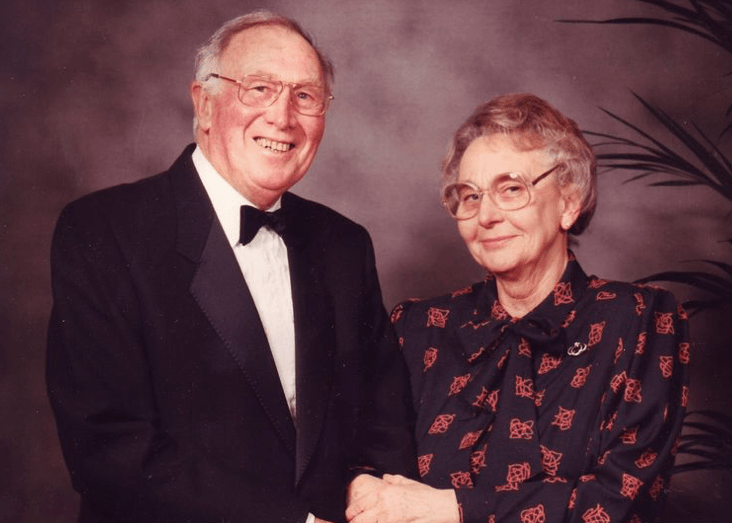
Definitely, Joe’s 84 year old widow Norah is a regular attendee – she came to the Lazio game last week and is determined to be here today.  She loves the Club and is a very popular presence on match day.  She has also been to the stadium for various other activities including last season’s Hall of Fame dinner and the official opening of the Manchester City Experience in April.

Norah has been part of City life since her husband first accepted the City job.  She is also a keen member of the Merseyside CSA.

Finally, how did Joe view the game during his later life?  Did he still love it with the passion he had as a boy?

Joe tried to keep focus on the game rather than activity off it.  During the 1980s, towards the end of his life, he was asked his views on the problems of the ‘modern game’ and gave a comment which is as relevant today as it was then:

“Football is a great game.  It is all about goals, goalmouth incidents, and end-to-end attacking football.  There is nothing wrong with the game; plenty wrong with managers, players, directors, legislators, and the media.  Football has been very kind to me and I really mustn’t complain so can I leave you with this thought – The object of playing any game is for enjoyment.  If you have enjoyed it and done your best you have won no matter what the result!”
Record Average Crowds

I’ve not done one of these for a while but I know they always prompt a bit of debate, so here goes… a feature on Manchester City FC attendances. It is a fact that the Blues have, generation after generation, been one of the English game’s top attractions. Like all – and I do mean all – English clubs there have been some average attendance lows over the years, but when the entire history of Manchester City is reviewed and the club’s average figures are compared with the national average it is clear that the Blues have consistently been one of football’s most attractive draws.  Take a look at the following:

  • Since the beginning of the Football League in 1888 only nine sides have topped the table for average attendances.  In chronological order of their first appearance at the top of the average table they are: Everton (1888-9), Villa (1898-99), Newcastle (1904-05), Chelsea (1907-08), Tottenham (1909-10), City (1910-11), Liverpool (1922-23), Arsenal (1929-30), & Manchester United (1956-57) 
  • As early as 1895-96 City were the third best supported side in the entire League despite being a Second Division side.  Only First Division sides Everton & Aston Villa could better the Blues.  Modern day giants Arsenal were 10th; Liverpool were 19th; United were 21st and Chelsea had yet to exist.
  • In 1900-01 City were the 2nd best supported side in the entire League with only 400 people separating Villa (1st) and City 
  • The 1910-11 season saw Manchester’s Blues top the attendance charts for the first time.  City’s average was 26,000 and was the 8th highest average of all time at that point (all clubs, all seasons). 
  • Regularly amongst the best supported sides throughout the inter war period, City’s average exceeded 37,000 for the first time in 1927-28 when the Blues established a record average crowd for the Second Division.  This was also the entire League’s highest.
  • In 1947-48 City’s average crowd exceeded 42,000 for the first time.  Prior to that season only Chelsea (1919-20 & 1946-7), Arsenal (1934-5, 1936-7, 1937-8, & 1946-7) , Newcastle (1946-7), Liverpool (1946-7), United (1946-7), and Wolves (1946-7) had exceeded that figure.
  • From 1975 to relegation in 1983 City were always one of the top 4 best supported sides, usually third behind United and Liverpool.
  • Since the 1980s whenever City have played outside of the top division, they have tended to be the best supported side in that division.  
  • Since moving to their current home in 2003, the increased capacity has allowed City to re-establish itself as one of best supported clubs again. Maine Road’s capacity from 1994 onwards was extremely low compared to the club’s entire history and prevented the Blues from staging games in front of attendances of approximateley 35,000 upwards.

In general many people believe success increases support, and while that is undoubtedly true to some extent, for City it is often periods of adversity that prove the loyalty of the Club’s fans.  It is highly significant, for example, that the first time City were the best supported side in the entire League (1910-11) Manchester United (6th best supported side) won the League title for the second time in 3 seasons.

Similarly, in 1925-26 when City were the best supported side in Division One and had established a new record average, the Blues were actually relegated.  This coupled with significant poverty and hardship in Manchester at the time should have reduced support but loyalty increased!  In my book “Manchester A Football History” I explore the relationship between attendances and Manchester’s major sides and it is fair to say that City fans can feel immensely proud of their loyalty throughout the history of the game.  Something that cannot be said by all of the League’s biggest names.  

In fact, it is worth highlighting that City have never been the worst supported side in their division but, of today’s so-called giants, Arsenal (1912-13 – average = 9,100) and Manchester United (1930-31 – average = 11,685) have.  City’s worst average of the Twentieth Century came in the desperate 1964-65 season and was 14,753 (half the average of 1960-61 and a 3rd of the 1957-8 figure).  However it is significant that for every League season City’s average has always been above the divisional average and, apart from 17 seasons, has always been in the top 11 nationally.  Again, few of today’s giants can’t say that – United’s 20th Century low stands at 4,650 and Chelsea averaged 15,731 as recently as 1988-89. In fact City’s lowest League attendance is more than double United’s lowest League attendance at Old Trafford (United have several crowds of less than 4,000 at Old Trafford, including top flight games; City’s lowest in the League was a little over 8000 in the second tier).

For fans average attendances are often used as an indicator of size of club and so a number of people over the years have tried to produce a definitive ‘all-time’ attendance table.  Several years ago analysis by a member of the Association of Football Statisticians claimed that if stadium capacity was not an issue for any club City would be the fourth biggest side in terms of attendance.  That analysis compared postwar attendance detail with performance on the pitch.  

In 2002 writer Brian Tabner calculated an all-time attendance table based on each club’s average attendance position during seasons 1925-2002.  His top ten were:  Arsenal, Liverpool, United, Everton, Tottenham, Newcastle, City, Chelsea, Villa and Sunderland.  Since 2002 several clubs have increased their capacities of course and this will have a positive impact on each club’s standing in a more up to date analysis.   

Figures can be manipulated in many different ways, but City should feel proud that they have many attendance firsts that can never be matched by today’s perceived biggest clubs.  

The Seasons City Have Topped the Divisional Charts

The following figures show the seasons when City were the best supported side in their division and the Club’s highest individual crowd that season.  Those crowds marked in italics were also the highest individual crowds for the entire division that season (crowds pre-1925 are inconsistently recorded and so have not been highlighted).  It is fair to say that when an average crowd is within 4,000 of the highest then the stadium is likely to have been full for the majority of games with the size of away support varying.     

Average         Season          Highest Crowd                                  

10,000            1895-96         30,000 (Liverpool)                

10,000            1898-99         25,000 (N. Heath)    

16,000            1902-03         30,000 (United)        

18,275            1909-10         40,000 (Oldham)

26,000            1910-11         40,000 (Liverpool)    

21,000            1914-15         40,000 (Oldham)

32,000            1925-26         62,994 (United)

30,848            1926-27         49,384 (Bradford C)

37,468            1927-28         59,500 (Preston)

31,715            1928-29         61,007 (United)

35,016            1950-51         45,842 (Hull)

27,739            1965-66         47,171 (Huddersfield)

24,220            1984-85         47,285 (Charlton)

23,500            1988-89         40,070 (Chelsea)

26,753            1996-97         30,729 (Oldham)

28,273            1998-99         32,471 (York)

32,001            1999-00         33,027 (Blackburn)

33,059            2001-02         34,657 (Portsmouth)

With the increase in capacity at the Etihad coming this year it will be interesting to see how attendances develop. No doubt I’ll post more on this as the season progresses. Undoubtedly City will establish a new record average attendance in 2026-27.

This is Your Life Joe Mercer

Broadcast live on 25 March in 1970 was the This is Your Life TV episode with Manchester City boss Joe Mercer as the subject. Here are the details plus a special recording which supporters of all the clubs Joe was involved with could be interested in.

This Is Your Life was viewed at the time as significant recognition for a lifetime’s achievement. Only major stars and personalities were featured in those days, and the main idea would be that the subject of the programme would be surprised by the sudden appearance of presenter Eamonn Andrews and his ‘Big Red Book’. The subject would then be whisked away to a studio or other location where a variety of figures from the person’s life would be brought out to tell anecdotes and the like. The main part of the show would be broadcast live.

This is Your Life Joe Mercer 1970

Back in 1970 young Manchester City supporter John Stapleton was working on the series and he suggested they feature Joe Mercer as the topic of one show. John, who went on to be a prominent broadcaster with a well-regarded TV career, was interviewed by me a few years back and we discussed the programme and John’s part in the idea of featuring Joe: ‘I did it purely for the benefit of me and my dad.  Eamon Andrews, the presenter, had of course a great interest in sport and I put the idea to him and the rest of the production team.  Together with Norah, Joe’s wife who in recent years I often sat with at games sharing her boiled sweets, we concocted a situation where Joe and Malcolm were in a London hotel before a trip to watch a European game in 1970. Malcolm disappeared – deliberately as part of the show though Joe didn’t know this – and Joe was called to reception urgently.  Eamon leaped out to do the big “This Is Your Life” reveal and Joe had no idea whatsoever. It was a great day for us all and Joe was thoroughly deserving of it as well.’

Joe was staying at a Hilton Hotel in London. As John described, He had been due to fly with Malcolm Allison to the continent to watch ECWC semi-final opponents Schalke but he had received a message to say the game was off. It was all a ruse of course. That night television viewers watched as Eamonn Andrews surprised Joe at the hotel reception desk: ‘Joe Mercer, former England playing star, now manager of Cup winning Manchester City, tonight. This Is Your Life!’

Eamon Andrews This is Your Life Joe Mercer 1970

At the start of the show the City team appeared. This had been an extremely busy time for the Blues. Over a 18 day period City had played two League games, the League Cup final, the second leg of the ECWC quarter-final with Coimbra and found time to work with television to honour their manager. This live show occurred on Wednesday 25 March and City were to face Derby in the League on 27th and Manchester United on 28th, plus they had to play the first leg of the ECWC semi-final with Schalke on 1st. It was incredible that a team would be involved in this at such a busy time but that’s the way it was.

This is Your Life Joe Mercer 1970 MCFC squad

As Joe explains in the show Malcolm Allison was nowhere to be seen. He had been staying with Joe at the hotel and the City manager commented: ‘I’m a great sleeper you see, and subconsciously I heard Malcolm getting up and I thought, oh, he’s going to the bathroom. I thought, well, he hasn’t come back, so he must be having a bath, and then I went back to sleep. I woke about ten and Malcolm had gone, but occasionally this happens – Malcolm disappears!’

Andrews explained that Allison had left early to watch the match which was still on. Joe was flabbergasted: ‘He’s left all his clothes! I’ve had to pack his bag as well!’

During the course of the show, Andrews informed Joe that Alf Ramsey had named the squad he was to take to the 1970 World Cup: ‘I know you haven’t had a chance to hear the news, but I’m going to tell it to you now, that two of your boys have been named by Alf for the World Cup – Francis Lee and Colin Bell. And two more in the twelve reserves – Mike Summerbee and Alan Oakes. Congratulations lads, and to the whole of the Manchester City.’

Joe was overjoyed.

Subscribers to this website are now in for a special treat as an audio of the entire episode has been preserved and can now be listened to here:

Subscribe to get access – Monthly

You can listen to this special recording of Joe Mercer, Eamon Andrews, Dixie Dean, Malcolm Allison, Stan Cullis, Stanley Matthews etc. by subscribing. It costs £3 per month (cancel anytime) to access everything posted since 1 Oct 2022 or there’s an annual option (below).

Subscribe to get access – Annual

You can listen to this special recording of Joe Mercer, Eamon Andrews, Dixie Dean, Malcolm Allison, Stan Cullis, Stanley Matthews etc. by subscribing. It costs £20 per year (cancel anytime) to access everything posted since the site began in December 2020, that includes history talks, videos, a couple of my books, hundreds of articles etc.

Joe appeared on several other This Is Your Life shows including in November 1988 when Tom Finney was the subject and in 1980 when Emlyn Hughes was. He also appeared on two for Matt Busby, one in 1958 and one in 1971 (which opened at Maine Road).

The Programme details for the Joe Mercer episode are:

  • Edition No: 274
  • Subject No: 276
  • Broadcast live: Wed 25 Mar 1970
  • Broadcast time: 7.00-7.30pm
  • Venue: Euston Road Studios
  • Series: 10
  • Edition: 18
  • Director: Margery Baker
  • Producer: Robert Tyrrell
  • City supporter and broadcaster John Stapleton worked on the show

The guests were:

  • Norah – wife
  • members of Manchester City FC team 
  • Francis Lee
  • Colin Bell
  • Mike Summerbee
  • Alan Oakes
  • Alan Percival
  • David – son
David & Joan Mercer, This is Your Life Joe Mercer 1970
  • Joan – daughter-in-law
  • Arthur – brother
  • Stan Cullis
Stan Cullis, This is Your Life Joe Mercer 1970
  • Billy Dixie Dean
Billy ‘Dixie’ Dean, This is Your Life Joe Mercer 1970
  • Jim Morris
  • Charles Palmer
  • Matt Busby
  • Frank Soo
  • Walley Barnes
  • Maurice Edelston
  • Bernard Joy
  • Roy White
  • George Hardwick
  • Raich Carter
  • Neil Franklin
  • Stanley Matthews
Stanley Matthews, This is Your Life Joe Mercer 1970

Filmed tributes:

  • Malcolm Allison
  • Susan – granddaughter
  • Albert Dyson – father-in-law

If you have enjoyed this article then why not subscribe (see above for details) for other material like this? If you don’t want to subscribe but would like to support the research into Manchester football by Gary James then it’s possible to donate below. All support is used to help perform further research that will be posted here for future generations. Thanks for the support.

European Span of Success 2025: Will Villa & Arsenal Move Up The Table?

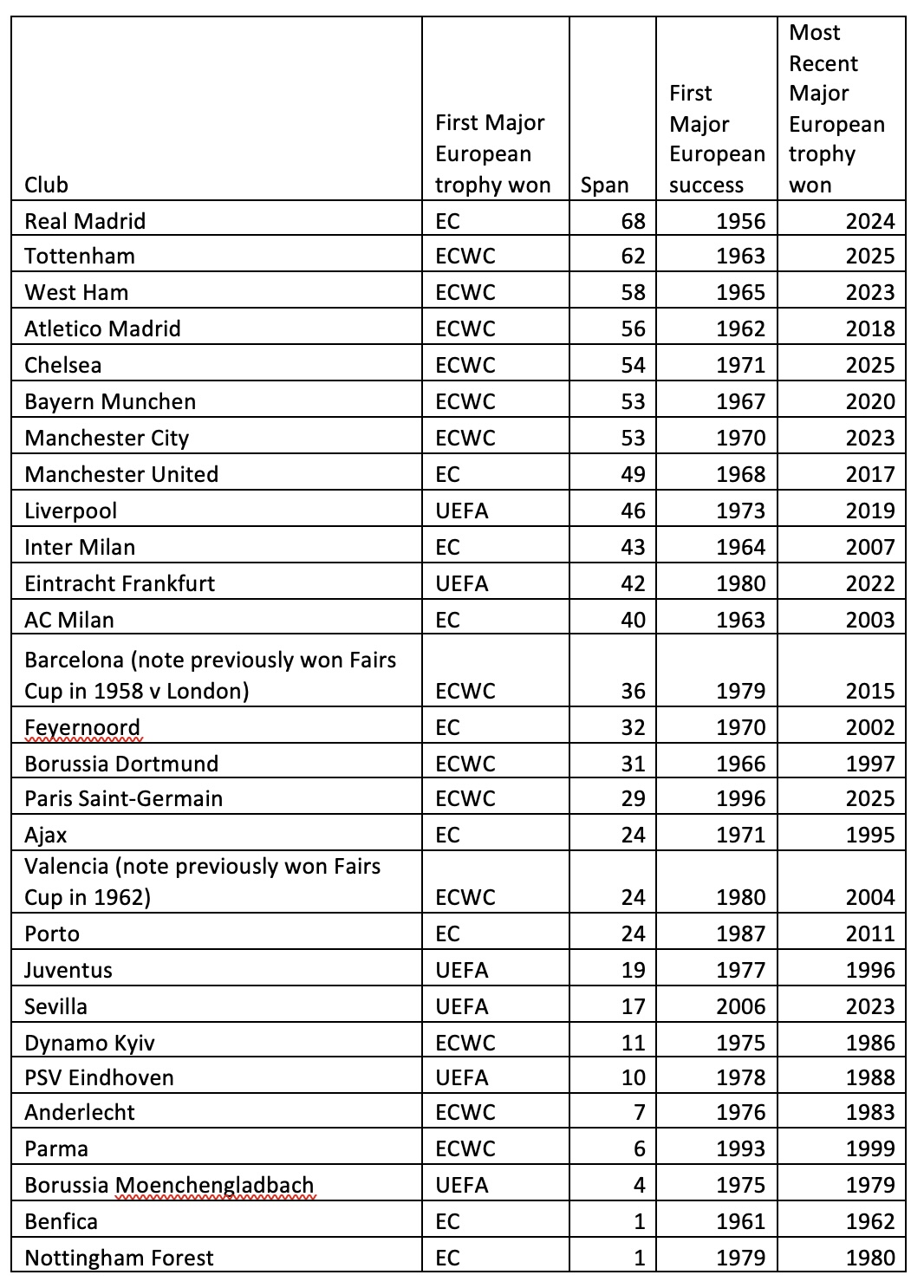
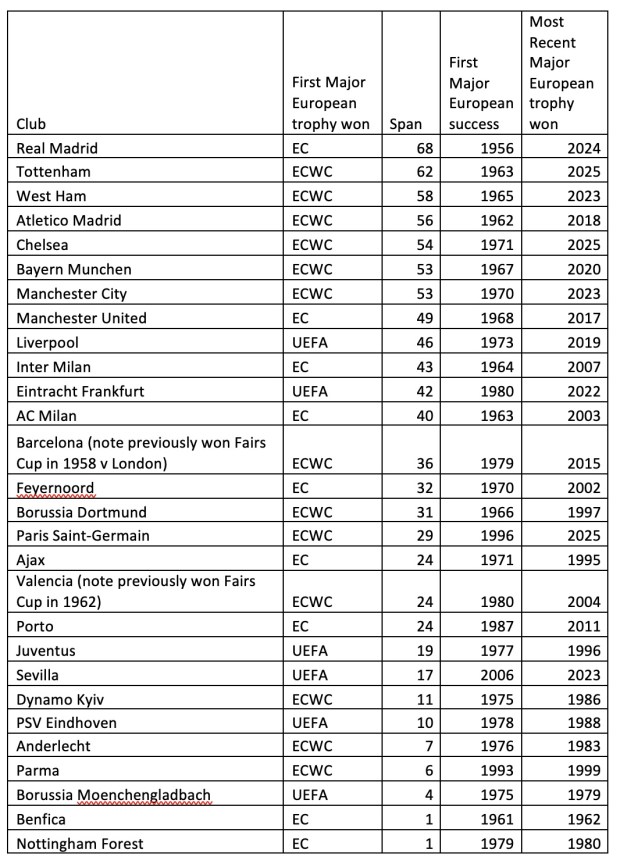
Each year, following the end of the UEFA football season I update the UEFA European Span of Success table. What is this? It’s a list of those clubs who have won two or more (sorry Palace) major UEFA tournaments showing the span between their first UEFA success and their most recent. The list may surprise some who think that football is all about those perceived as European giants with ‘history’. This is how the table stands today (19 May 2026). Chelsea and Tottenham have moved up the table in recent seasons.

UEFA European Major Trophy Span of Success 2025

I can imagine a few Arsenal fans looking at this and saying ‘Why aren’t we on there?’ They won the Fairs Cup in 1970 and the ECWC in 1994 BUT the Fairs Cup wasn’t a UEFA tournament and had some odd entry rules over the years! For your benefit here’s a table including the Fairs Cup lower down on this page. The above table includes the four major UEFA tournaments: European Cup/Champions League; European Cup Winner’s Cup; UEFA Cup/Europa League & the Europa Conference League. It does not include non-UEFA tournaments such as the Mitropa Cup and Fairs Cup. Nor does it include the Intertoto Cup or similar.

So why are they excluded… I recognise that the Mitropa Cup had some significant clubs competing in it. However, it was predominantly an East European competition and participants were not spread over the entire continent.

With the Fairs Cup… It is true that this was later transformed into the UEFA Cup and I have included all UEFA Cup finals in my analysis. But the Fairs Cup had an odd series of entry rules at times. Cities, rather than clubs, often entered with Barcelona beating London in one final for example. It was set up as a friendly type of competition with cities that had staged trade fairs playing each other. As time wore on entry came via the League Cup or League position in England, which added significance to it. But two teams from the same city were not allowed to participate, which meant that teams finishing way down the table could be (and were) included if those above them were multiple clubs from the same city.

In 1970 Manchester City’s Mike Doyle joked that by winning the League Cup he was satisfying his aim of ‘keeping United out of Europe’ (he joked about creating car stickers with that slogan!) because it appeared at that time that United’s only chance of Europe had gone with City’s qualification for the Fairs Cup.

City went on to win the ECWC that season, meaning that Fairs Cup place was opened up to League position, but United had finished lower down the table anyway and qualified for the Watney Cup instead. Actually, the Watney Cup is one worth talking about, but I’ll save that for another day. In 1970 Fourth placed Derby County qualified for the Watney Cup, while 5th to 7th (Liverpool, Coventry and Newcastle) all got a Fairs Cup place, alongside 12th placed Arsenal (Fairs Cup winners). I’ve not investigated this fully but it does seem odd that the Watney Cup took precedence over the Fairs Cup.

Arsenal’s 1970 Fairs Cup success was their first European trophy but is not included in the span, neither are those Fairs Cup wins of Barcelona. However, as quite a few Arsenal fans seemed to get a bit upset when the table was posted the other year I’ve decided to include the Fairs Cup in the following version of the table. So this table is the winners of the main UEFA competitions I mentioned earlier plus the Fairs Cup with its odd rules:

ClubFirst Major European trophy wonSpanFirst Major European successMost Recent Major European trophy won
Real MadridEC 6819562024
TottenhamECWC6219632025
RomaFairs6119612022
West HamECWC5819652023
BarcelonaFairs5719582015
Atletico MadridECWC5619622018
ChelseaECWC5419712025
Bayern MunchenECWC5319672020
Manchester CityECWC5319702023
Manchester UnitedEC4919682017
LiverpoolUEFA4619732019
Inter MilanEC 4319642007
ValenciaFairs4219622004
Eintracht FrankfurtUEFA4219802022
AC MilanEC 4019632003
FeyernoordEC 3219702002
Real Zaragoza Fairs3119641995
Borussia DortmundECWC3119661997
Paris Saint-GermainECWC2919962025
ArsenalFairs2419701994
AjaxEC 2419711995
Porto EC 2419872011
JuventusUEFA1919771996
SevillaUEFA1720062023
Dynamo KyivECWC1119751986
PSV EindhovenUEFA1019781988
AnderlechtECWC719761983
ParmaECWC619931999
Borussia MoenchengladbachUEFA419751979
Leeds United (BOTH FAIRS CUP)Fairs319681971
BenficaEC 119611962
Nottingham ForestEC119791980

Obviously, neither table shows the number of major trophies won, but it does indicate trophy-winning longevity for those who obsess over ‘my cup’s bigger than yours’ and similar debates. Personally, I think we should all be proud of our club’s achievements and not worry about what a rival has won.

Hopefully, those Arsenal fans who were somewhat upset last year will now be happy. Note that both Roma and Barcelona have moved up the table. Both ‘Rome’ and ‘Barcelona’ won the Fairs Cup when it was city based and not club based, adding to the questionable nature of including the Fairs Cup. ‘London’ once competed in it!

Arsenal are now 20th in this combined table, behind their fellow English clubs Tottenham, West Ham, City, Chelsea, United and Liverpool. But they could move up, as could Aston Villa.

As an example of the odd qualification rules in place for the Fairs Cup at times it’s worth looking at the 1969 qualification via the English League system.

In 1969 champions Leeds entered the European Cup. The ECWC place went to FA Cup winners Manchester City and the Fairs Cup places went to: Arsenal (4th), Southampton (7th) and Newcastle (9th). Swindon had won the League Cup, beating Arsenal in the final, but the Fairs Cup organisers wouldn’t allow them to participate as they were not a top flight club! This adds to the reason the competition is usually excluded. It is certainly not a UEFA competition in any case.

Similarly, Everton (3rd), Chelsea (5th), Spurs (6th) and West Ham (8th) who all finished above Newcastle were denied because of the rule that only one club from each city be allowed. So Liverpool and Arsenal’s inclusion meant their rivals stood less chance of winning the trophy than Newcastle simply because there were multiple clubs in their cities.

That rule does make me wonder what would have happened if both Manchester clubs had qualified for the competition as City are within the city of Manchester boundaries and United are not. Would the two clubs have challenged any decision not to include one of them based on the age old argument of Manchester’s boundaries?

Maybe I’ll post more on the odd rules of football competitions and tell the story of some of those long forgotten competitions.

If you’re interested in the wider span of success for English clubs (listing those who have the longest span between their first trophy and most recent, not simply European trophies) then take a look at this I posted Sunday:

You can find out the benefits of subscribing here:

Manchester City Women: The 1st WSL Goal and Win

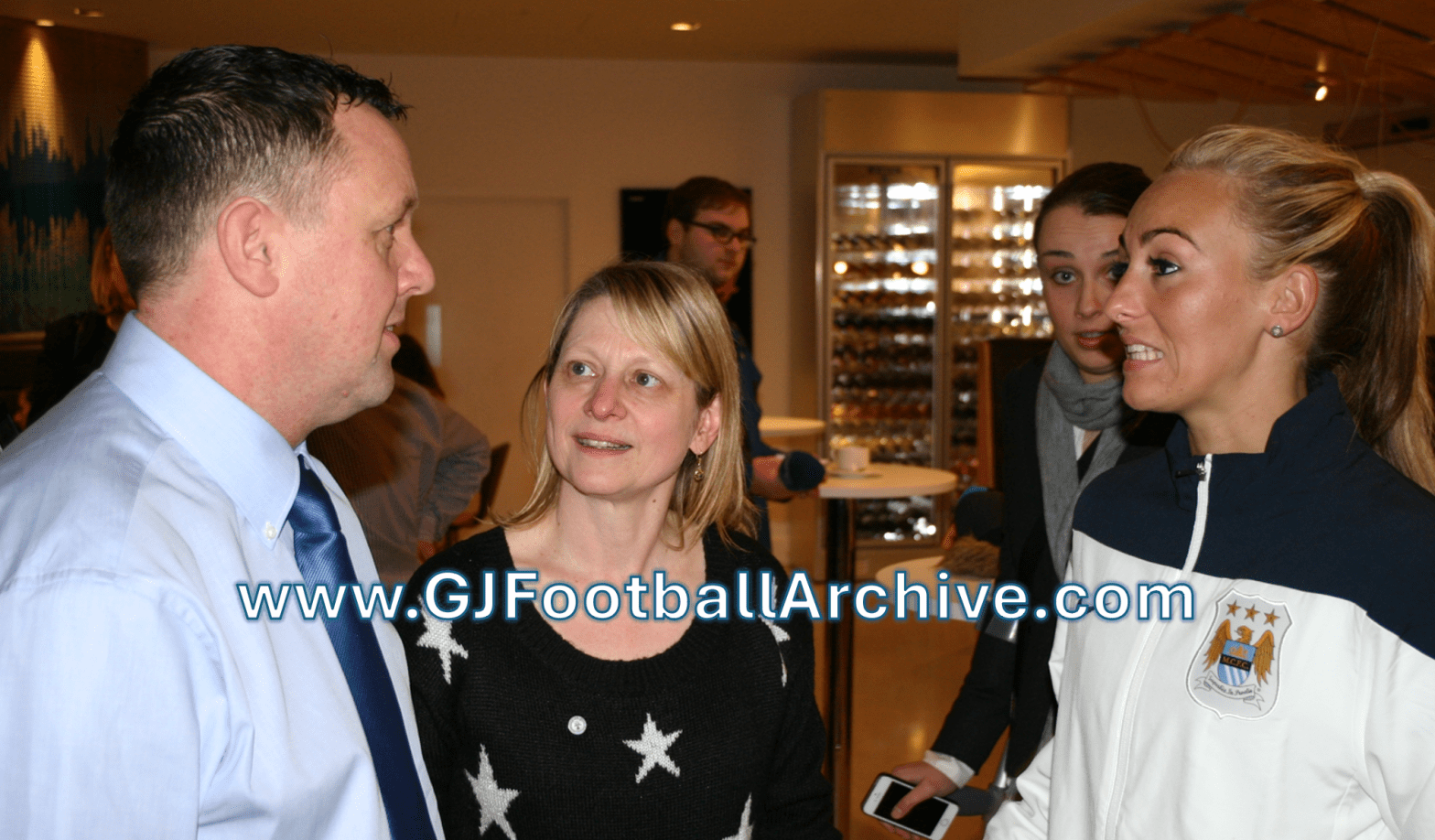
A crowd of 829 attended Manchester City Women’s WSL game away against Arsenal on this day (18 May) in 2014. This was a historic day as City not only scored their first goal in the WSL but they also defeated Arsenal. The historic goal was scored by Toni Duggan in the 11th minute and the match ended 1-0. The photo is of Duggan (far right) with Neil Mather (the original manager of Manchester City’s women’s team when founded in 1988) and Debbie Darbyshire (who played in the club’s historic first game back in 1988).

If you’re interested in the history of women’s football then you may be interested in my Authorised History of the Manchester Corinthians. You can get your name in the second edition if you subscribe to it here. All subscribers will get a copy of the second edition book (posted out before it appears in the shops) and your name will be included in a special roll of honour published within the book if ordered before publication:

UK ONLY – Manchester Corinthians: The Authorised History (second edition)

The story of a pioneering women’s club as told to Gary James by those who were there. This is UK only at £19.95 (incl UK postage and packaging). Outside UK contact for additional postage costs. This revised and updated second edition will be a paperback edition and contain more pages than the first edition.

£19.95

Opportunities to buy multiple copies, sponsor the book or donate to ensure it’s published to the size and standard the women who played deserve exist. Please email Gary@GJFootballArchive.com for more information on those opportunities.

This book is a must for anyone interested in Manchester or women’s football and will consist of over 360 pages. It will be fully illustrated throughout and subscribers can order it now for £19.95 (including UK postage and packaging). All orders received before publication will have the purchaser’s name included within the special roll of honour at the back of the book. You can order the book for someone else – all details will be checked and confirmed before publication.

The book will be published this October (2026).

If you live outside the UK then please contact for details of additional postage costs.

You do not need to have a PayPal account to order – use the ‘Pay with PayPal’ button above and it will give you the option to pay by credit/debit card without creating a PayPal account.

The Span of Success: Will This Change This Month?

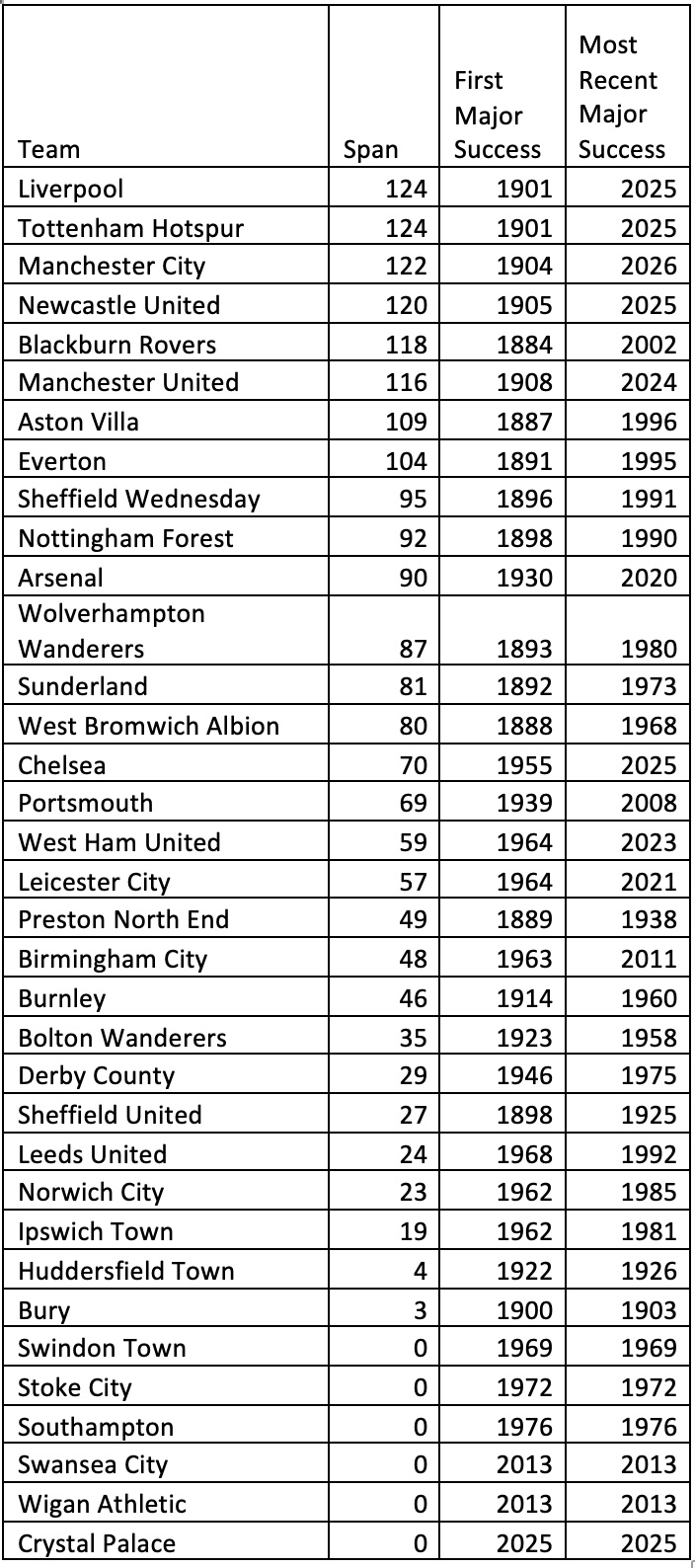
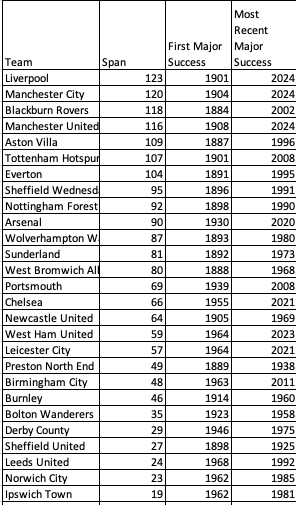
Every year, once the domestic season ends I update the table showing the English clubs’ span of success – i.e. the number of years between a club’s first major success (FA Cup, League, League Cup, major European trophy) and their most recent. Here’s the table as it stands today (17 May 2026) after Manchester City’s success in the FA Cup. Obviously, there’s a chance for Arsenal (currently 11th), Aston Villa (7th but could be top if they win their European final) and Crystal Palace (just on the table following last year’s FAC success but could rise above those other ‘one major trophy’ clubs) to move up the table this month.

2026 Span of Success (as of 17/5/26, after FAC final)

Even if Arsenal do win the League or Champions League this year they’ll only rise to ninth as they didn’t win a major trophy until the 1930s.

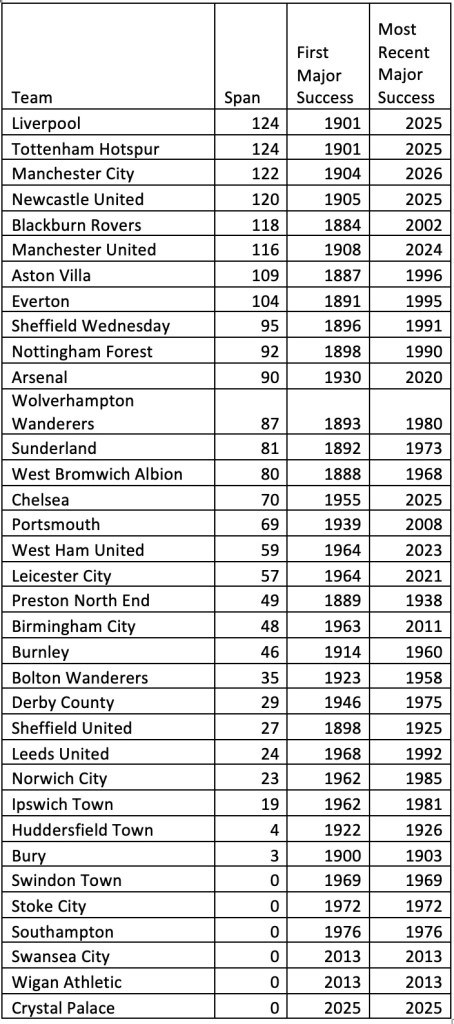
For comparison purposes here’s the table after the 2023-24 season ended (see below). Notice the moves up the table of Spurs and Newcastle in recent seasons:

As I always say, the span of success does not show how many trophies each club has won nor does it show how frequently that club has experienced great eras of success, but it does demonstrate how wrong those people are who believe certain clubs were unsuccessful until recent years, or those who think certain clubs have always been giants. The column on first major success helps to show when some clubs first became trophy-winning significant (often after transformational investment too!).

I know clubs focus on their financials but winning a trophy has longevity, gaining the odd Premier League place provides a bit of extra cash now but no long term kudos. Winning a trophy attracts new fans and brings money-spinning opportunities too. Look at how winning the FA Cup has helped Palace this last year or so.

If I was a supporter of any of the major clubs who have not found significant success in recent decades then I would absolutely want my team to go for whichever cup competition seems the most likely to win. That’s what I always wanted from Manchester City before they were able to compete for the League again. Winning the FA Cup in 2011 helped everything that followed happen – it gave confidence and a trophy winning mentality.

While you’re here why not take a look at the wide range of articles available on this site? Such as the 100 day series of features on Maine Road:

The 2010s: Champions League Qualification

Manchester City qualified for the Champions League for the first time when they defeated Tottenham 1-0 via an own goal from Peter Crouch on this day (10 May) in 2011. Crouch had deflected a James Milner cross past his own ‘keeper. This had been a rather tense game against a Spurs team desperate to get into a European place. They ended the day sixth, behind fifth place Liverpool. City were fourth, two points behind third placed Arsenal and seven ahead of fifth placed Liverpool with only two games remaining.The target remained third place, as this avoided a Champions League play off, and success in the FA Cup final. Finishing in the top four for the first time since the 1970s was an achievement in its own right, but winning the FA Cup would end 35 years without success at the highest levels of the game. The final was against Stoke at Wembley on 14 May.

The 2010s: Victory over West Ham

On this day (1 May) in 2011 a 2-1 victory for Manchester City over West Ham left the Blues fourth on 62 points, five points behind third placed Arsenal, though City had a game in hand. A confident looking side took an early 2-0 lead with De Jong (10th minute) scoring his first goal and then Zabaleta (15th min) added a second. West Ham did score via Demba Ba in the 33rd minute and this caused some nervousness. Mancini’s side did hang on to some extent, but overall they had much more to offer than the Hammers.

The 2021 League Cup Final

Pep Guardiola’s team won the League Cup for a record-equalling fourth time in succession with a deserved victory over Tottenham on this day (25 April) in 2021. The London club had dismissed manager Jose Mourinho earlier that week, placing coach Ryan Mason in charge for this final. At 29 Mason became the youngest man to be in charge for a League Cup final.

City were the dominant team for most of the game, but the game’s only goal didn’t arrive until eight minutes from time. Aymeric Laporte rose to head home Kevin De Bruyne’s free kick.

After the final Pep Guardiola told the BBC: ‘That is what these players give for the future generations of this club. It is not winning [just] one title. This team in the last decade was the team in England – since Roberto Mancini won the Premier League, this team wins a lot of times in England. It’s nice, four Carabao Cups in a row, it means consistency in the team to be there. We beat Arsenal and Manchester United on the way so we can say we deserved to win this competition. The way we played was fantastic and it’s nice when you win a title. The most impressive thing is in the last 33 games we won 30.’

The victory meant City were now level with Liverpool on eight League Cup final wins and no team had bettered that success. Similarly no manager had won the competition more than Pep Guardiola.

In this Covid-hit season there was some positive news for fans as a limited number were allowed to attend the final wearing face masks. Stewards were told to actively look for fans taking them off and frequently they went into the crowd to ask fans to re-mask otherwise they’d face expulsion. The final attendance of 7,773 included around 2,000 from each club and a number of locally based residents. At the end those from Manchester and the neutrals present stayed to watch the Blues lift their eighth League Cup.

Match Stats

25 April 2021

Manchester City 1 (Laporte) Tottenham Hotspur 0

Attendance 7,773 (Covid restrictions)

You can read my comments about attending the final here:

Manchester City v Arsenal: History Comparison

‘History Tradition Class’ is often used on Arsenal banners (particularly when they play City it seems; there was one at Wembley) and with the two sides meeting on Sunday (19 April 2026) it seems like the same lines will be trotted out again. So for today’s feature I’ve decided to have a look at the history of the two clubs to compare successes. It seems to me that if a club claims that their club has something that another does not then it’s only fair to test that idea. Anyway here goes….

What do we mean by history? Is it success? Is it a ‘first’ that predates the rest. Is it more trophies? Is it longevity? Is it just nonsense? (probably!). So here are a few comparisons of achievements just to get the ball rolling:

Major trophies won or achievements made:

Trophy/AchievementYear & teamOther Team
Joined the League1892 (City as Ardwick AFC)1893 (Woolwich Arsenal)
Promotion1899 (City)1904 (Arsenal)
Second Division Champions1899 (City)Never
Major Trophy1904 (City)1930 (Arsenal)
FA Cup1904 (City)1930 (Arsenal)
League1931 (Arsenal)1937 (City)
League Cup1970 (City)1987 (Arsenal)
ECWC1970 (City)1994 (Arsenal)
Fairs Cup1970 (Arsenal)Never
Domestic Treble2019 (City)Never
Traditional Treble2023 (City)Never
European Cup2023 (City)Never
Super Cup2023 (City)Never
Club World Cup2023 (City)Never
Community Shield1930 (Arsenal)1937 (City)

I’ll show more comparisons on success in a moment but first how about attendance comparisons?

The highest home attendance by either club is: 84,569 (City). Arsenal’s record attendance is over 10,000 lower at 73,707, achieved at a European game at Wembley.

Record League attendance: 79,491 (City);  73,295 (Arsenal).

The first time either side were the best supported team in the League: 1910-11 (City). Arsenal first achieved this feat almost 20 years later in 1929-30.

Okay, what about first and most recent successes? Here’s a list of the major trophies won by these sides listed with the first time one of the team’s achieved that success and the most recent time:

Trophy/AchievementFirst TeamMost RecentTeam
Major Trophy1904City2026City
FA Cup1904City2023City
League1931Arsenal2024City
League Cup1970City2026City
ECWC1970City1994Arsenal
Fairs Cup1970Arsenal1970Arsenal
European Cup2023City2023City
Super Cup2023City2023City
Club World Cup2023City2023City
Community Shield1930Arsenal2024City
Domnestic Treble2019City2019City
Traditional Treble2023City2023City

Interesting stats but what about most trophies won? Surely there’s a big difference? Err, well not really:

MOST TROPHIES WON
TrophyNumber & TeamOther Team
FA Cup14 (Arsenal)7 (City)
League13 (Arsenal)10 (City)
League Cup 9 (City)2 (Arsenal)
Club World Cup1 (City)
Super Cup1 (City)
European Cup 1 (City)
ECWC1 (both City & Arsenal)
Fairs Cup1 (Arsenal)
Total31 (Arsenal)30 (City)

I’m sure someone will say ‘but take the Super Cup off as it’s like the Community Shield’. Okay but that still means that after all these decades there are only 2 major trophies separating City and Arsenal. Also, there are some sports historians who would say ‘remove the Fairs Cup’ as that wasn’t a UEFA tournament and the rules of entry meant that often teams finishing in a position that should allow entry couldn’t enter as only one team per city could enter. In 1969 Everton finished above Arsenal and were denied entry into the Fairs Cup because Liverpool had already qualified. Similarly Chelsea, Spurs and West Ham were denied entry due to Arsenal qualifying. The same was true across Europe. In earlier years ‘London’ had entered the competition.

I’m not going to say that Manchester City’s history is greater than any other club, nor should any other person say that about their club. Each club has its own successes and failures; reasons to be proud and moments to forget. However, when a club or its fans try to claim superiority over another because of their ‘history’ or ‘tradition’ or ‘class’ (maybe I’ll do that another day) then it’s only fair to highlight the history and tradition of success other clubs have enjoyed.