Here’s the front of a match programme for the FA Youth Cup tie between Manchester City and Manchester United on this day (13 December) in 1965. How many names do you recognise? The match ended in a 5-0 United win.
You can find out more on Manchester City during the 1965-66 season by reading the following 4100 word article. As with most of the other features in this series it includes words from interviews I have performed with those who were there. This is a subscriber article (see below).
Subscribe to get access
Read more of this content when you subscribe today. It costs £3 per month (cancel anytime) or sign up for a year at the discounted price of £20 per year (works out £1.67 per month). Subscribers access the 1000+ articles posted so far and the others scheduled during the life of your subscription.
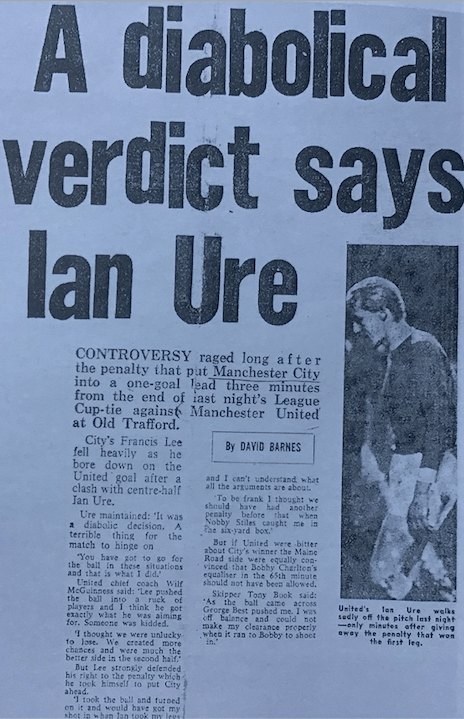
On this day (12 December) in 1970 a hat-trick from Francis Lee was City’s last hat-trick in a Manchester derby until Haaland and Foden in October 2022! The 1970 game also saw a goal from Mike Doyle to gave City a comfortable 4-1 victory over Manchester United before an Old Trafford crowd of 52,636. That victory meant City had won 5 and only dropped 4 points in 8 consecutive League derby meetings with the Reds. There was also a devastating injury to Glyn Pardoe (more on that in another post!). Here is the background, report and verdict of that game…
Subscribe to get access – Annual
Read more of this content when you subscribe today. Annual subscribers pay £20 per year to access all material posted since December 2020 and all articles throughout the life of their subscription. Monthly subscribers pay £3 per month (see below).
Read more of this content when you subscribe today. Monthly subscribers pay £3 per month to access all material posted since 1st October 2022 and all articles throughout the life of their subscription. Annual subscribers pay £20 per year (see above).
During my tidy-up of my writing space I’ve rediscovered items I’ve used in my research over the years and thought I’d post some on here. Today here are some images and information from the Topical Times Sporting Annual 1934-35. There’s some interesting aspects and information that I’m sure some of you will find interesting. let’s start with the cover…
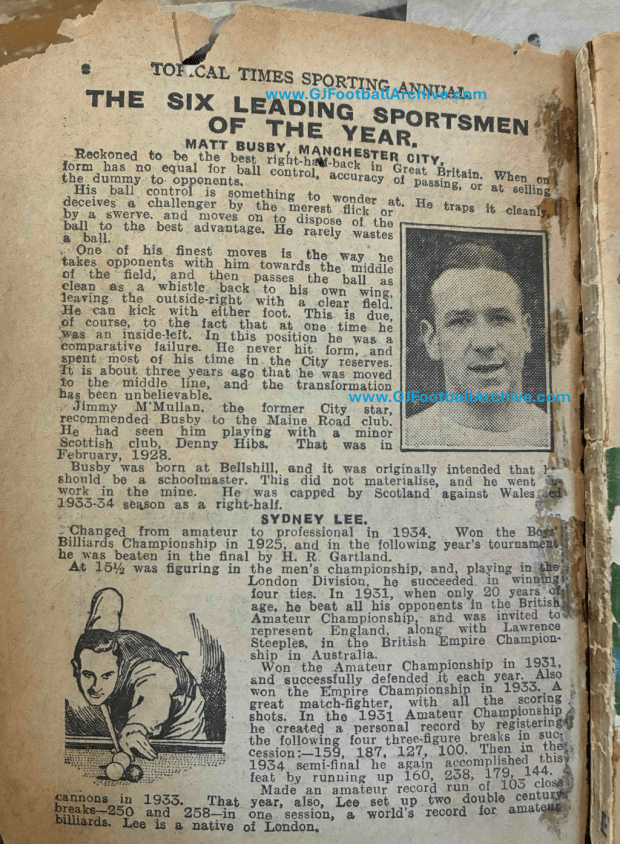
The player in the blue shirt is Manchester City’s Matt Busby who the yearbook regarded as one of the 6 sporting stars of 1934. Here’s what they said about him:
The book included a small section on each team. City’s looked like this (notice the record attendance has a typo; it should be 84,569. Also, look at Middlesbrough’s record crowd. It has since been passed though!):
For those wondering why this alphabetical list of clubs went from City to Middlesbrough and not Manchester United, the list was by division. At that time City were in the top tier and United were in the second. Here’s their profile:
At that time United’s record crowd was for a game staged at Old Trafford but not featuring United. That has since been surpassed but Old Trafford’s record is still for a game not featuring United (Wolves v Grimsby FAC tie). Note also the official colours of United.
If you enjoy all the free material on my website and would like to support my research and keep this website going (but don’t want to subscribe) then why not make a one-time donation (or buy me a coffee). All support for my research is valued and welcome. It allows me to keep some free material available for all. Thanks.
Today (3 December) in 1969 saw this image of United star Nobby Stiles having ‘dialogue’ as the original caption claims with City fans at the Platt Lane end of Maine Road. This was the first leg of the League Cup semi final and City won the leg 2-1 with goals from Colin Bell and Franny Lee. You can watch highlights here: https://www.youtube.com/watch?v=H0Y1KpM49Og
Manchester’s two top flight clubs met in their first ever League Cup tie between them during the 1969-70 season. That was the first season when all 92 League clubs entered the competition.
Here, for subscribers, is the background to each of the 1969-70 semi-final legs and a report on each game with lineups, attendance details etc.
Subscribe to get access
Read more of this content when you subscribe today. Subscribing gives access to all the articles posted so far, including a PDF of the book Manchester A Football History
On this day fifty years ago (26 November 1975) the League tables for England’s top two tiers looked like this. Surprising top two clubs? You can find out what happened to Manchester City that season by reading the following 5,320 word article on the entire 1975-76 season for the Blues – a season which saw Tony Book guide the club to major success. You can read this below.
Subscribe to get access – Monthly
Read more of this content when you subscribe today. It costs £3 per month (cancel anytime) to access everything posted since 1 October 2022 or there’s a special annual rate below which gives greater access and works out much cheaper.
Read more of this content when you subscribe today. It costs £3 per month (above) or £20 a year (here) to access everything posted since the site was created in December 2020. This special rate works out about £1.67 a week and gives access to everything posted, including PDFs of 3 of my books.
If you enjoy all the free material on my website and would like to support my research and keep this website going (but don’t want to subscribe) then why not make a one-time donation (or buy me a coffee). All support for my research is valued and welcome. It allows me to keep some free material available for all. Thanks.
Last week I posted the top flight attendances for this last week forty years ago and this led to a number of comments/questions and so to answer some of those I’ve now posted the top two divisions attendances together with the two League tables AND the end of season average attendances. People asked for clarity on how the figures compared to the second tier and whether League position played its part in affecting crowds. As a reminder here’s last week’s attendances…
And here’s this week’s (published 24 November 1985) and the League table too.
Obviously, these are only snapshots from that season but to add a bit more context here are the end of season averages here are the top 46 best supported clubs in order that season (hopefully it might make those who sing songs like ‘Where Were You?’ think about the crowds at their own clubs first):
A few notable League positions for those who do sing ‘Where Were You?’… The top eight clubs in the League were: Liverpool (champions), Everton, West Ham, Man Utd, Sheff Wed, Chelsea, Arsenal and Forest. Manchester City (who were 4th best supported club) were 15th (only 4 points above relegation zone), Spurs were tenth, Newcastle 11th and Aston Villa 16th.
In the Second Division best supported club Sunderland were 18th (avoiding relegation by 4 points); the top four were Norwich, Charlton, Wimbledon and Portsmouth.
If you’d like to know more about Manchester City at this time, here’s a 2,500 word subscriber feature on the 1985-86 season. Enjoy!
Subscribe to get access – Monthly
Read more of this content when you subscribe today. It costs £3 per month (cancel anytime) to access everything posted since 1 October 2022 or there’s a special annual rate below which gives greater access and works out much cheaper.
Read more of this content when you subscribe today. It costs £3 per month (above) or £20 a year (here) to access everything posted since the site was created in December 2020. This special rate works out about £1.67 a week and gives access to everything posted, including PDFs of 3 of my books.
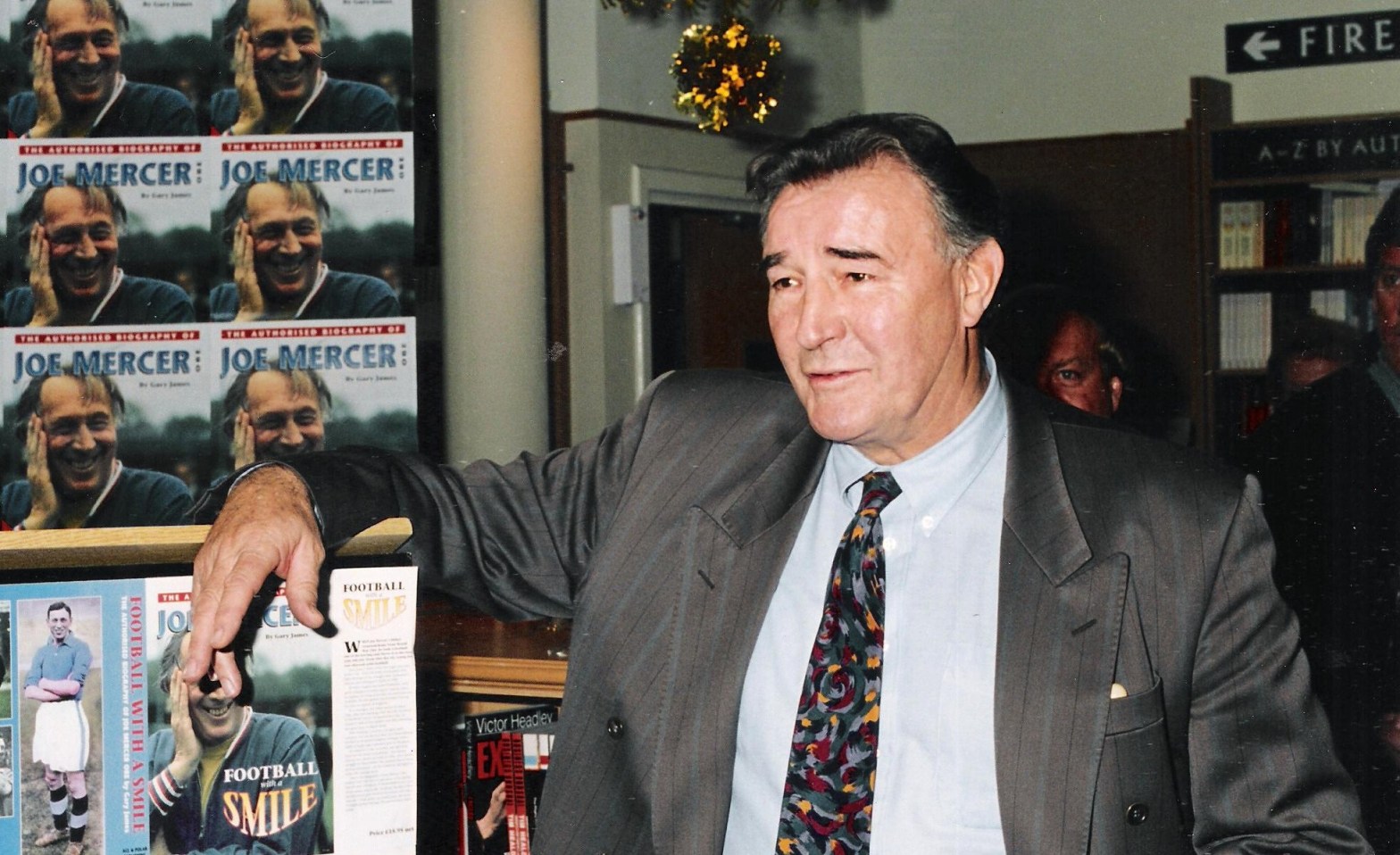
On this day (21 November) in 1964 Manchester City travelled away to Plymouth Argyle. The Blues lost 3-2 but you really need to take a look at this penalty captured on film that day. Malcolm Allison (seen here at my Joe Mercer book launch in 1993) was the Plymouth manager back then, so I guess he had a hand in the plan:
You can read more on Malcolm Allison (and listen to an interview I did with him), Plymouth and on Manchester City in the 1960s across this website. Why not sta, here’s a subscriber article on Manchester City during the 1964-65 season. This was a remarkable season when a City director held meetings, hoping to merge City and United! Plus much more. If you’d like to read this 2350 word article, plus all other articles on the site, then please subscribe (see below). As with most of the other features in this series it includes words from interviews I have performed with those who were there.
Subscribe to get access
Read more of this content when you subscribe today. It costs £3 per month (cancel anytime) or sign up for a year at the discounted price of £20 per year (works out £1.67 per month). Subscribers access the 1000+ articles posted so far and the others scheduled during the life of your subscription.
These two results tables for top flight football in November 1985 make interesting reading. I’ve included the details published today (17 November, for games played the previous day) in 1985 and also the week after’s details too. This gives an idea of what the top clubs were attracting back then. Notice West Ham’s game attracted more at home than Arsenal’s and that Liverpool were over 26,000 less than Manchester United. Arsenal’s crowd was 6,000 less than struggling Manchester City and Tottenham attracted more than Arsenal too. Reigning League champions Everton were some way ahead of the London clubs and only about 600 behind Liverpool. Obviously, these are only snapshots from two weekends but hopefully it might make those who sing songs like ‘Where Were You?’ think about the crowds at their own clubs first.
the Marwood scoring for Sheffield Wednesday was of course Brian Marwood who went on to play a key part in Manchester City’s modern return to glory. If you’d like to know more about Manchester City at this time, here’s a 2,500 word subscriber feature on the 1985-86 season. Enjoy!
Subscribe to get access – Monthly
Read more of this content when you subscribe today. It costs £3 per month (cancel anytime) to access everything posted since 1 October 2022 or there’s a special annual rate below which gives greater access and works out much cheaper.
Read more of this content when you subscribe today. It costs £3 per month (above) or £20 a year (here) to access everything posted since the site was created in December 2020. This special rate works out about £1.67 a week and gives access to everything posted, including PDFs of 3 of my books.
Here’s a magazine advert from November 1978 which gives mention to Manchester City. The brewery involved had no connection to City at the time, so it may seem remarkable to some but back then the fact City had won the FA Cup in the same year as a canned beer was launched in the UK was too good for an ad agency to miss. They could have picked the 1956 League champions (Manchester United) but maybe their spell in the Second Division (promoted in 1975) or the stories of crowd disorder that had dogged United during this era may have given more of a negative angle for the beer.
If you’d like to find out more about Manchester City in the 1970s then take a look at the following 5,700 word article on the entire 1978-79 season – a season which saw City mount a UEFA Cup challenge and a former hero return (if only he hadn’t!). My article, like most of my other indepth pieces, contains material from interviews I have performed with many of the key figures – chairman, managers, players and others. You can read this below.
The article is available to subscribers below. Enjoy!
Subscribe to get access – Monthly
Read more of this content when you subscribe today. It costs £3 per month (cancel anytime) to access everything posted since 1 October 2022 or there’s a special annual rate below which gives greater access and works out much cheaper.
Read more of this content when you subscribe today. It costs £3 per month (above) or £20 a year (here) to access everything posted since the site was created in December 2020. This special rate works out about £1.67 a week and gives access to everything posted, including PDFs of 3 of my books.
If you enjoy all the free material on my website and would like to support my research and keep this website going (but don’t want to subscribe) then why not make a one-time donation (or buy me a coffee). All support for my research is valued and welcome. It allows me to keep some free material available for all. Thanks.
You can find out more about the 1971-72 season for Manchester City in the this 4,700 word article on the entire season – a hugely significant season though one that’s often neglected. This is available to subscribers below. Enjoy!
Subscribe to get access – Monthly
Read more of this content when you subscribe today. It costs £3 per month (cancel anytime) to access everything posted since 1 October 2022 or there’s a special annual rate below which gives greater access and works out much cheaper.
Read more of this content when you subscribe today. It costs £3 per month (above) or £20 a year (here) to access everything posted since the site was created in December 2020. This special rate works out about £1.67 a week and gives access to everything posted, including PDFs of 3 of my books.
If you enjoy all the free material on my website and would like to support my research and keep this website going (but don’t want to subscribe) then why not make a one-time donation (or buy me a coffee). All support for my research is valued and welcome. It allows me to keep some free material available for all. Thanks.








 Gary James' Football Archive