The 1970s: Attendance Facts Not Fiction

It seems that some have a view that the giant clubs remain giant clubs forever and that there are some clubs who have only recently become prominent. Others believe that teams that were giants decades before some of today’s major trophy winners were never actually that prominent. I could spend hours challenging those who hold these views and pointing out that teams such as Everton, Newcastle & City won major trophies before many of these clubs and were perceived as giants years earlier too (decades before in some cases!), but it doesn’t feel like they’d listen. Ah well! Instead as part of my series of features/articles covering Manchester City in the 1970s I’d like to post a few attendance details that may interest some.

The following are a list of the top seven best supported top flight clubs for the ten seasons prior to City’s relegation in 1983. The Manchester clubs are in bold and the numbers in brackets show each club’s league position that season. In addition if any of the clubs won the European Cup, UEFA Cup, ECWC, FA Cup or League Cup that is also listed in brackets.

AVERAGE ATTENDANCES – Top Tier 1973-74

42712 MUFC (21st); 42332 Liverpool (2nd & FA Cup winners); 38666 Leeds (1st); 33048 Birmingham (19th); 32861 Newcastle (15th); 30756 MCFC (14th).

AVERAGE ATTENDANCES – Top Tier 1974-75

45966 LFC (2nd); 40021 Everton (4th); 34822 Leeds (9th); 34614 Newcastle (15th); 32898 MCFC (8th); 30854 Birmingham (17th); 29872 West Ham (13th & FA Cup winners). Both Manchester United (48387) and Sunderland (29931) were in Division Two but had an average higher than some of those in the top seven top tier averages.

AVERAGE ATTENDANCES – Top Tier 1975-76

54750 MUFC (3rd); 41623 Liverpool (1st & UEFA Cup winners); 38874 Aston Villa (16th); 34280 MCFC (8th & LC winners); 33060 Newcastle (15th); 31511 Leeds (5th); 28350 Derby (4th). Sunderland in Division Two had an average of 31250.

AVERAGE ATTENDANCES – Top Tier 1976-77

53710 MUFC (6th & FA Cup winners); 47221 Liverpool (1st & European Cup winners); 40058 MCFC (2nd); 37903 Aston Villa (4th & LC winners); 33599 Newcastle (5th); 32743 Sunderland (20th), 32671 Arsenal (8th).

AVERAGE ATTENDANCES – Top Tier 1977-78

51860 MUFC (10th); 45546 Liverpool (2nd & European Cup winners); 41687 MCFC (4th); 39513 Everton (3rd); 35464 Aston Villa (8th); 35446 Arsenal (5th); 32501 Nottm Forest (1st & LC winners). Tottenham were in Division Two with an average of 33417.

AVERAGE ATTENDANCES – Top Tier 1978-79

46430 MUFC (9th); 46407 Liverpool (1st); 36371 Arsenal (7th & FA Cup winners); 36203 MCFC (15th); 35456 Everton (4th); 34902 Tottenham (11th); 32838 Aston Villa (8th).

AVERAGE ATTENDANCES – Top Tier 1979-80

51608 MUFC (2nd); 44586 Liverpool (1st); 35272 MCFC (17th); 33596 Arsenal (4th); 32018 Tottenham (14th); 29794 Crystal Palace (13th); 28711 Everton (19th).

1979-80 League table and attendance detail up to 26/4/1980

AVERAGE ATTENDANCES – Top Tier 1980-81

45071 MUFC (8th); 37547 Liverpool (5th & LC winners); 34117 Aston Villa (1st); 33587 MCFC (12th); 32480 Arsenal (3rd); 30724 Tottenham (10th & FA Cup winners); 26477 Sunderland (17th). West Ham were in Division Two with an average of 27140.

Kippax Stand c.1980

AVERAGE ATTENDANCES – Top Tier 1981-82

44571 MUFC (3rd); 35100 Tottenham (4th & FA Cup winners); 35061 Liverpool (1st & LC winners); 34063 MCFC (10th); 26780 Aston Villa (11th & European Cup winners); 26585 West Ham (9th); 25589 Arsenal (5th).

1981 City v United Maine Road

AVERAGE ATTENDANCES – Top Tier 1982-83

41552 MUFC (3rd & FA Cup winners); 34758 Liverpool (1st & LC winners); 30581 Tottenham (4th); 26789 MCFC (20th); 24153 Arsenal (10th); 23748 Aston Villa (6th); 22822 West Ham (8th). Second Division Newcastle attracted an average of 24166.

Fans storming the main entrance in 1983. Mirrorpix photo

For those wondering Manchester City did drop a little in terms of position in the attendance chart during their Second Division days but they were still the 6th best supported club (of all clubs) in 1983-84 and 8th best in 1984-85. Back in Division One in 1985-86 the Blues were once again the 4th best supported team in the entire League.

This series of articles and features on Manchester City in the 1970s has been running throughout January with indepth articles some days and smaller ‘on this day’ style posts on others. Every day in January will offer something to enjoy.

Subscribers will get access to everything. If you want to know more on this incredible decade for Manchester City Football Club then why not subscribe and read it all? You could even subscribe for a month and see what you think. The following 1,600 word article is on the 1974-75 season and is available to subscribers below. Enjoy!

Subscribe to get access – Monthly

Read more of this content when you subscribe today. It costs £3 per month (cancel anytime) to access everything posted since 1 October 2022 or there’s a special annual rate below which gives greater access and works out much cheaper.

Subscribe to get access – Annual

Read more of this content when you subscribe today. It costs £3 per month (above) or £20 a year (here) to access everything posted since the site was created in December 2020. This special rate works out about £1.67 a week and gives access to everything posted, including PDFs of 3 of my books.

If you’d like to know more about subscribing then see:

Manchester City V Real Madrid, 19 December 1979

On this day (19 December) in 1979 Manchester City’s first meeting with Real Madrid occurred. Back then it was viewed as a prestigious friendly, or at least that’s what it was supposed to be, but it turned out to be a controversial game with implications for the Blues for some time. Here’s an 1800 word article with images of that game and the controversy surrounding it.

Subscribe to get access – Monthly

This article is available to subscribers to the website. It costs £3 per month (cancel anytime) or £20 a year (see below).

Subscribe to get access – Annual

This article is available to subscribers to the website. Annual subscribers access everything on the site (books, articles, videos, history talks, interviews etc.) posted since it was created in December 2020. Monthly subscribers access everything since 1 October 2022. Both Monthly & Annual subscribers access all new content too throughout their subscription.

Kaziu Deyna Goal v Forest

On this day (13 October) in 1979 Kaziu Deyna scored the only goal of the City-Nottingham Forest League game at Maine Road.  A crowd of 41,683 witnessed the City win with future Spanish TV presenter Michael Robinson wearing the number 9 shirt for the Blues that day.

Back in 2003 I wrote this profile of former Manchester City player and Polish World Cup star Kazimierz Deyna. Deyna was such an important and unusual signing at the time he joined City in November 1978 that I feel this article is still appropriate and of interest to subscribers to my blog today.

Subscribe to get access – Annual

If you would like to read this in-depth article and all the others on this site (including the entire Manchester A Football History book) then please subscribe. It works out about £1.67 a month if you take out an annual subscription (£20 per year) or £3 a month (see below) if you’d like to sign up for a month at a time. Each subscriber gets full access to the 1000+ articles posted so far and the hundreds scheduled to be posted in the coming weeks.

Subscribe to get access – Monthly

If you would like to read this in-depth article and all the others on this site (including the entire Manchester A Football History book) then please subscribe. It costs £3 a month (cancel anytime) of take out a special annual subscription for £20 (above).

Dennis Tueart Interview

Here’s a video of my latest interview with Dennis Tueart. In this we focus on him leaving Manchester City for the NASL and New York Cosmos; his experiences there and his return to City. Dennis is always a great talker and there are some wonderful moments in this as he talks about this significant time in the changing Manchester City and in the excitement of New York soccer.

The conversation links Tony Book, Leonard Rossiter, Pele, Carlos Alberto, John Cleese, Dave Sexton, Malcolm Allison and Franz Beckenbauer amongst others.

It lasts about 50 minutes so get your self a brew and sit down to watch:

Dennis’s biography is still available (see link below).

If you have enjoyed this interview then why not subscribe to access other interviews in the archive, plus over 1000 articles/features. See below for details.

Dennis Tueart’s biography is available at most bookshops, including the usual online retailers such as:

Steve Daley Interview

Yesterday (6 September 2023) I posted a story highlighting the transfer of Steve Daley to Manchester City in 1979. Today I’d like to expand on that by posting here an interview I did with Steve where we discuss that transfer, City fans and the spending City were doing at the time we did the interview. It was a great time to interview Steve and I enjoyed it immensely, helping fill in some gaps.

This interview is available to subscribers below.

Subscribe to get access – Monthly

Read more of this content when you subscribe today. It costs £3 per month to subscribe or sign up for a year at the special price of £20 (works out about £1.67 a month). Monthly subscribers can cancel anytime, so why not give it a try for a month? Monthly subscribers access everything posted since 1 October 2022 whereas annual subscribers get everything posted since the site started in December 2020 (see below).

Subscribe to get access – Annual

It costs £20 to subscribe for a year (here). Books, interviews (audio and written), images, features and more have been posted to this site so far. More to come.

You can find out more about subscriber benefits here:

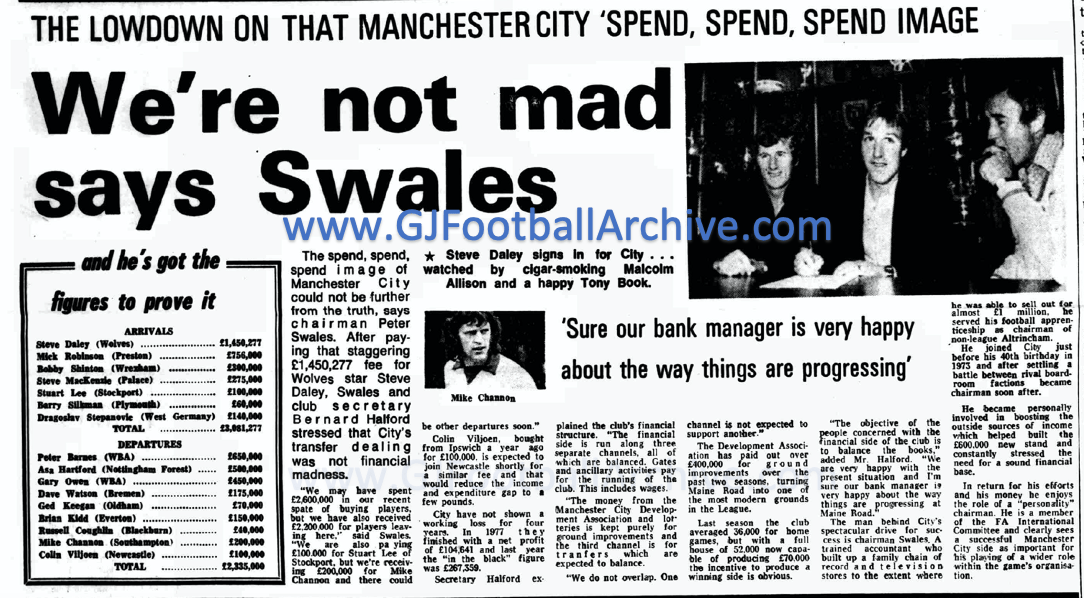
Spend, Spend, Spend Image of Manchester City

Well, it seems the norm today to talk about the cost of Manchester City’s squad with TV commentators frequently talking about the price of City’s bench. It gets tiring. However, this is not the first time the media talked of City as a ‘spend, spend, spend’ club. Today marks the anniversary of one day in particular when City’s spending caught the media’s attention. That day was on 6 September 1979 when Steve Daley signed for the Blues at a cost of £1,450,277.

City had to defend this spending which – and I know it’s difficult to understand in the modern world of £100m+ footballers – absolutely stunned football. This transfer was the British record but it was perceived as huge.

Chairman Peter Swales’ defence for the spending was that City was a profitable club (see the article) and this is true. City were a hugely profitable club in the 1970s but that all changed over the coming years with Swales, his supporting directors and managers getting giddy trying to buy success. As we all know it takes more than money to generate success and this period of City’s history is the one that actually created the club’s fall from grace, leading to some to believe in the 2010s & 2020s that the club had ‘no history’ and was not a ‘giant’. All that is balderdash. City were a giant who fell unlucky through poor management by a board of directors who did not plan for long term development.

Anyway, lots to say on this but read the article here from 1979 and hopefully that will show the position of strength the club was in (but soon messed up!).

While you’re here why not listen to one of my interviews with Malcolm Allison. You can hear a taster here:

The full interview is available to subscribers here:

More details on the benefits of subscribing here:

Maine Road 100 – Day 93

For Day 93 in my series of free articles counting down the 100 days to the centenary of Maine Road’s first game I want to do a bit of an attendance feature. Maybe this will put a few myths to bed!  

The Blues have, generation after generation, been one of the English game’s top attractions and Maine Road was an incredible and poweful venue over the years. The Etihad has seen City establish new record average attendances but no English club venue can match what Maine Road achieved in terms of record crowds and it still, all these years on, holds the record for the highest crowd on an English club ground and the record attendance for an English League game – a record City set in 1935 which is currently held by a game featuring United and Arsenal at Maine Road.

The record attendance on a club ground was first set by City in 1924 – 99 years ago! – and was eclipsed by a figure of 84,569 in 1934 – almost 90 years ago. City know how to establish and keep records for decades!

Like all – and I do mean all – English clubs there have been some average attendance lows at Maine Road over the years, but when the entire history of Manchester City at the old stadium is reviewed and the club’s average figures are compared with the national average it is clear that the Blues have consistently been one of football’s most attractive draws.  Take a look at the following:

  • Since the beginning of the Football League in 1888 only nine sides have topped the table for average attendances.  In chronological order of their first appearance at the top of the average table they are: Everton (1888-9), Villa (1898-99), Newcastle (1904-05), Chelsea (1907-08), Tottenham (1909-10), City (1910-11), Liverpool (1922-23), Arsenal (1929-30), & Manchester United (1956-57). City were not based at Maine Road back in 1910 (which makes that even more remarkable) and they were the best supported club again before moving to Maine Road. The first time Maine Road attracted the highest national average was in 1925-26 – which means that City are the ONLY team to have topped the attendance charts at two different venues! 
  • Regularly amongst the best supported sides throughout the inter war period, City’s average exceeded 37,000 for the first time in 1927-28 when the club established a record average crowd for the Second Division.  This was also the entire League’s highest.
  • In 1947-48 City’s average crowd exceeded 42,000 for the first time.  Prior to that season only Chelsea (1919-20 & 1946-7), Arsenal (1934-5, 1936-7,1937-8, & 1946-7) , Newcastle (1946-7), Liverpool (1946-7), United (1946-7), and Wolves (1946-7) had exceeded that figure.
  • From 1975 to relegation in 1983 City were always one of the top 4 best supported sides. Yes, even in a relegation season they were better than all but 3 teams and those 3 teams all finished in the top 4 (one won the League, one the FA Cup and the other finished 4th after winning the FA Cup in the previous two seasons).
  • Since the 1980s whenever City have played outside of the top division, they have tended to be the best supported side in that division.  

In general many people believe success increases support, and while that is undoubtedly true to some extent, for City at Maine Road it was often periods of adversity that proved the loyalty of the Club’s fans.  For example, in 1925-26 when City were the best supported side in Division One and had established a new record average, the Blues were actually relegated.  This coupled with significant poverty and hardship in Manchester at the time should have reduced support but loyalty increased!  In my book “Manchester A Football History” I explore the relationship between attendances and Manchester’s major sides and it is fair to say that City fans can feel immensely proud of their loyalty throughout the history of the game.  Something that cannot be said by all of the League’s biggest names.  

In fact, it is worth highlighting that City have never been the worst supported side in their division at Maine Road (or anywhere else for that matter!) but, of today’s perceived giants, Arsenal (1912-13 – average = 9,100) and Manchester United (1930-31 – average = 11,685) have.  City’s worst average at Maine Road came in the desperate 1964-65 season and was 14,753 (half the average of 1960-61 and a 3rd of City’s 1957-8 figure).  However it is significant that for every League season the club’s average has always been above the divisional average and, apart from 17 seasons, has always been in the top 11 nationally.  Again, few of today’s giants can say that – United’s 20th Century low stands at 4,650 and Chelsea averaged 15,731 as recently as 1988-89. 

For fans average attendances are often used as an indicator of size of club and so a number of people over the years have tried to produce a definitive ‘all-time’ attendance table.  A few years ago analysis by a member of the Association of Football Statisticians (It wasn’t my research – though I was a life member of this organisation) claimed that if stadium capacity was not an issue for any club City would be the fourth biggest side in terms of attendance.  That analysis compared postwar attendance detail with performance on the pitch.   

Figures can be manipulated in many different ways, but City fans should feel proud that the Blues have many attendance firsts that can never be matched by today’s perceived biggest clubs.   

If you have enjoyed this and the other Maine Road 100 articles/features then why not subscribe? For details see:

Maine Road 100 – Day 19

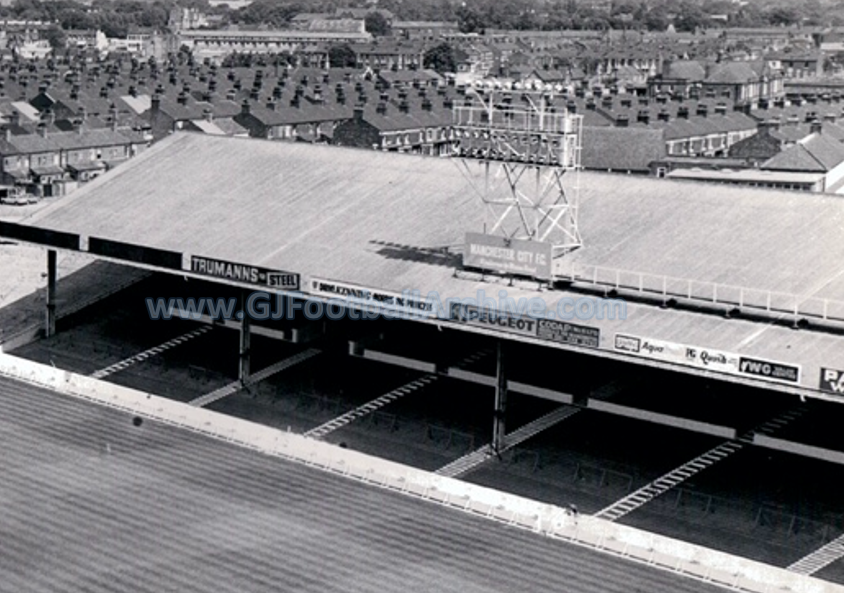
Welcome to Maine Road… It’s day 19 of my posts counting down to the centenary of Maine Road’s opening game. A photograph can bring back so many memories. Today’s is of a simple sign but it welcomed many to Manchester City’s ground for decades.

This was replaced by another version of the sign, which was then removed in 1994 when the Kippax Stand was demolished, but for much of the 1970s & 1980s this original sign was a popular part of Maine Road for many fans.

Kippax Stand c.1980

It sat proudly on a metal floodlight gantry on the roof of the Kippax in front of the original central lighting. In later years it was swamped by advertising and extensive roof lighting, once the corner pylons had gone.

Anyone running out from the players’ tunnel would see it straight in front of them. Like the This Is Anfield sign at Liverpool this was a recognisable feature proudly saying Manchester City and Welcome to Maine Road.

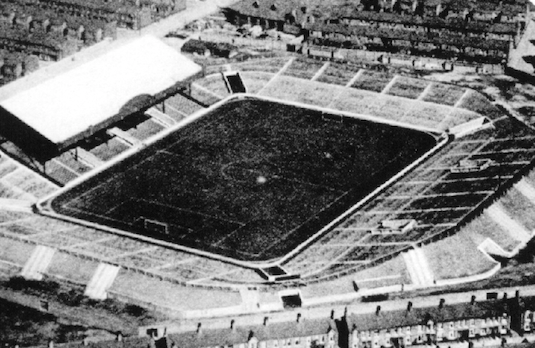
For those unfamiliar with Maine Road this photo may help locate where the sign was. You can see the Kippax roof central lighting tower above number 7. The sign was attached to that, opposite the players’ tunnel (number 1).

Maine Road aerial 1971 from Farewell To Maine Road

If you’d like to read more on the history of Maine Road, take a look at Farewell To Maine Road, which can be downloaded from this page:

MCFC Managers – MALCOLM ALLISON

Malcolm Allison gave Manchester City confidence and a will to win that few have ever equalled.  He was an exceptionally brilliant and confident coach – some would say the greatest the world has ever seen (probably Allison himself would say this!) – and working with Joe Mercer he helped the Blues achieve incredible success.

Subscribe to get access

Read more of this content when you subscribe today.

On This Day (5th January) in 1980 – Allison’s Nightmare at Halifax

Malcolm Allison’s multi-million pound Manchester City side were humbled 1-0 at Fourth Division Halifax Town in the FAC.

At Christmas 1979 big spending Manchester City were 12th in the League. Malcolm Allison was in charge of the most expensive British team ever assembled up to that point and 12th was disappointing but it wasn’t the end of the world. In those days a decent run in the League could easily lift a team (similar to the 2020-21 season in terms of the number of clubs capable of winning the League at Christmas). Sadly, City collapsed in the weeks that followed.  

A 1-1 draw at Stoke on Boxing Day was disappointing, but it wasn’t the end of the world.  Then a 4-1 defeat at First Division newcomers Brighton knocked confidence at an important time.  The next game was the third round F.A. Cup clash against Fourth Division Halifax Town at the Shay.

In his programme notes for the match Halifax Manager George Kirby predicted a shock:  “In today’s F.A. Cup 3rd round the only certainty is that there are going to be some surprises, especially with the wintry conditions underfoot.  I like to think that we are among one of the possible giant killers.  This is because we are playing against one of the certain to be ‘top teams’ of the 80s.  A 4th Div side at home to a 1st Div outfit with such stars as Joe Corrigan, Steve Daley, and Mike Robinson is a possible shock result.  It only needs an off day by a key player and Halifax are in the hunt.”

Kirby was determined to defeat football’s biggest spenders and even brought in an hypnotist, Romark (who had previously ‘cursed’ Allison while the City boss had been manager of Crystal Palace – a really interesting story which will be covered in my biography of Peter Barnes to be published in 2021), to get his players in the right frame of mind.  The game itself was played in horrendous conditions, with multi-million pound City struggling to achieve anything.  In the 75th minute it was all over as the ex-Birmingham City player Paul Hendrie converted a cross from former City schoolboy Andy Stafford to give Halifax a 1-0 victory.  It was the biggest result in Halifax history, and the most embarrassing City defeat of the Allison period.  Even today the name of Halifax and the sight of the Shay brings back nightmares for a large number of Blues.

Subscribe to get access

If you have enjoyed this then why not subscribe and read content like this plus more in-depth material. It’s £3 per month or £20 a year with access to every post so far and many hundreds to come.