Continuing the series of features on the 1960s, here’s a subscriber article on Manchester City during the 1962-63 season. If you’d like to read this 1900 word article, plus all other articles on the site, then please subscribe (see below). As with most of the other features in this series it includes words from interviews I have performed with those who were there.
Subscribe to get access
Read more of this content when you subscribe today. It costs £3 per month (cancel anytime) or sign up for a year at the discounted price of £20 per year (works out £1.67 per month). Subscribers access the 1000+ articles posted so far and the others scheduled during the life of your subscription.
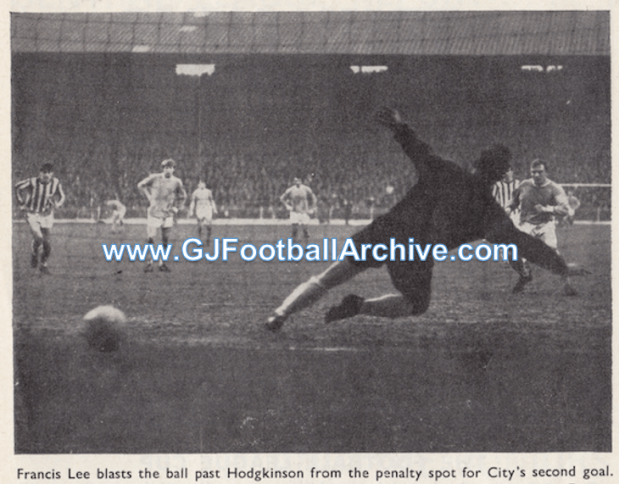
This day (21 November) in 1970 saw England international Francis Lee score twice as Manchester City defeated West Ham United 2-0 at Maine Road. Franny was a wonderful, attacking player and a statue of him alongside Colin Bell and Mike Summerbee has been erected at the Etihad Stadium. I met Francis a lot over the years and interviewed him frequently. So, if you’ve not seen this before, here’s an interview I did with him at his home in February 2010. This was published in the City match programme back then and you can read Franny’s views on his career here as published at the time. Enjoy!
In a glittering career Francis won two League Championships, the ECWC, League Cup and the FA Cup.
Francis, let’s begin with your early career at Bolton. Is it true you started on the groundstaff?
That’s right. I set myself a target that I had to get into the first team by the time I was 17 or 18. If I didn’t I was going to go back to college and train as a draughtsman. That was my plan, but I managed to get into the first team at 16 and I made my debut against City (5/11/60). We won 3-1 and I scored a header at 3.15 against Bert Trautmann – I think Bert must have thought he was getting over the hill for me to score a header past him!
I had about a dozen games over two seasons, then in 1962-63 I was top scorer with 12 goals from 23 League games.
You topped the goalscoring charts each season at Bolton from 1962 until you left. You were playing on the wing. Was that your preferred position?
I think my best position was as support striker to a big fella. I only played in that role twice really – at Bolton with Wyn Davies when I scored 23 League goals one season and then at City with Wyn again when I scored 33 League goals in 1971-72. A lot of my career was spent at centre-forward which is a bit of a difficult position to play if you’re only 5ft 7. When I played for England I was support to Geoff Hurst and that suited me. At centre-forward I had my back to the ball but when I was support striker – the free player – that suited me fine. I could pick up the ball going forward and that was great.
At Bolton you scored 106 goals in 210 appearances. A great record, but when you left the club the stories were that you were in dispute. Is that true?
Well, what happened is that we were relegated in 1964 and, despite a near-miss in 1965 when we finished third, it didn’t feel as if we were going forward. My ambition was still to see how far I could develop in the game and in the back of my mind I had the ambition to play for England, but I wasn’t even selected for the under 23s. The story was going around that I was difficult to handle – which is funny because Joe Mercer said that I was the easiest player to handle at one point.
Were you difficult to handle at Bolton?
I was opinionated and ambitious, but not difficult. I think that message was going around because I was on a weekly contract at that time. The club knew that it would be difficult for them to stop me moving on if another club came in. So any player with a reputation for being difficult would not be on anyone else’s shopping list, would they? Bolton offered me a new contract worth something like £150 a week but my wage was only £35. That actually upset me and I said: “if you now think I’m worth £150 a week what about all those years you’ve been underpaying me?” It wasn’t the money that was an issue it was the way they handled it. What they were doing was trying to get me on that contract and then my value would increase if someone came in to buy me. Once they saw how dissatisfied I was with the way they were handling it, they said that it’d be best if we made a clean break, and so I said I’d pack the game in. I had my business by then and so I said: “give me my employment cards and I’ll pack it in.” They thought I was bluffing.
It’d been a decent season – I’d scored 9 goals in 11 games including when we beat the great Liverpool side in the League Cup – but then it ended in September 1967. They gave me my cards and that was it.
Were you absolutely certain you’d pack it all in at that point?
I kept myself fit but I was working on my business. I was driving my lorry around, collecting the waste paper and so on. The business was growing and I felt that if I wasn’t wanted then I’d concentrate on that. It was always my fallback.
I know how stories can get exaggerated over the years, but is it true that in between games you were going around collecting the waste paper?
I used to drive my lorry during the week and even on the Thursday or Friday before a game I’d be collecting waste paper. I used to put on a flat cap and muffler so that nobody would recognise me! In the end I was driving articulated lorries and it was getting to be a very good business. My last pick up was the day before I signed for City! I roped and sheeted about 15 ton of paper and cardboard from a spinning mill in Bolton. Took it to the Sun Paper Mill in Blackburn and when I got back about 5pm I got a call from Joe Mercer. He didn’t give his name at first but I recognised him. “Who is that?” He said: “Tom Jones.” I said: “It doesn’t sound like Tom Jones, sounds more like a man called Mercer!” and he asked: “Where’ve you been?” I told him I’d been playing golf – I couldn’t play the game at all then but I couldn’t tell him what I had been doing!
This is Your Life Joe Mercer 1970 MCFC squad
Did you immediately want to sign for City?
Other teams had shown interest in signing me. Liverpool offered £100,000 I understand but then when I wasn’t playing it affected my price. In later years Shanks often used to grab me and say in that strong Scottish accent: “Son, I should’ve signed ya the night I saw ya!”
City was just right of course. It meant the business could carry on. I don’t know if Bolton had told Joe about my contract or the £150 offer but the first thing he said to me before we talked it through was: “I’ll be honest with you son. We’ve no money. We’re skint!” I said: “It doesn’t matter. I’ll just be delighted to start playing again.” I meant it as well.
I signed for City for £60 a week – remember I’d turned down £150 at Bolton! But it was well worth it. The way the team developed and, of course, when I realised my ambition and played for England.
I left a lot of friends of mine at Bolton – Freddie Hill, Tommy Banks, Roy Hartle, Gordon Taylor – and we had some great times. Those of us who had come through the ranks were poorly paid for the job we were doing at the time, but we enjoyed ourselves. I never had any argument with the players, fans or people at Bolton, it was just those that ran it. I loved my time at Bolton.
When you joined City the Blues were ninth in Division One after losing 5 of the 11 games played. But the side was transformed from the moment you came. Unbeaten in your first 11 League games. Were you the difference?
The team just clicked and I was only part of a good group of players. We had that great run up to Christmas, then a bit of a blip, but in the New Year we just rattled on. It was a terrific period. Mike Summerbee was playing at centre-forward and our culture at the time was to play with five forwards. It was very unusual for the time. The only system we played was that we all played – we had ten players who went up together, and ten who defended together. When we won the League at Newcastle at the end of the season it was wonderful and particularly special because none of us had ever won anything significant. This was our first major success and that’s why the following season the ordeal of playing a European Cup tie was so tough.
Francis Lee after scoring at Newcastle
Was it just inexperience that caused City to lose the Fenerbahce European Cup tie 2-1 on aggregate?
None of us had played in Europe before. Mike Summerbee had only made his England debut against Scotland in February 1968. Colin Bell had played in two England friendlies, but apart from that none of us had any concept of what it could be like in Turkey. Had we played the first leg in Istanbul and the second at Maine Road I think we’d have gone through, but the goalless 1st leg at Maine Road killed us really. We worked hard in Istanbul and it was a creditable result over there but we were out and it was because we were inexperienced. It was a culture shock.
Confidence was at a real low after that game. We’d had a bad run and only had a small squad so we struggled. But that was the way it was. Back then the motivation for all of us was to be in the team and to keep your place.
I think younger readers may be surprised to read that City tried to keep the same eleven players game after game, competition after competition. Would you have enjoyed a squad rotation policy when you played?
The aim of a footballer is to play. Why would anyone want to be rested? If a manager had said to me ten minutes before full time that he wanted to bring me off even though I was playing well, I’d have told him “no way! I’m enjoying myself. This is what you bought me for, now let me do it!” It wouldn’t matter what the manager says I’d want to stay on. That’s what the game is about – enjoyment! Every player wanted to play. None of us wanted to be on the bench.
People talk about the number of games played today but in 1969-70, ignoring friendlies, you played 72 competitive games for England and City. Would squad rotation have helped?
No. Playing is always better than being on the training pitch and I used to love playing, so I tried not to miss a game. It didn’t matter whether it was an England friendly, Anglo-Italian cup or whatever, I wanted to play and represent my club and my country. I think it’s best for all players. Look at Tevez. He’s improved his fitness and form by playing, and I think a lot of players are like that. He needs to play, and that’s what I always wanted.
Francis Lee v Schalke 15 April 1970
Some of the other players from the 1969-70 season have talked about Franny’s Grand Slam. Your aim to win four trophies in one season inspired them. What do you remember of that?
Well, we wanted to win every game so it seemed natural to me that we should go for all four. We won the League Cup and Cup Winners’ Cup, so that wasn’t bad. In the FA Cup we ended up suffering a rare defeat at United. We were doing okay in the League then we had a few injuries – Mike, Colin Bell and Neil Young were injured at key times – otherwise I think we would have won three trophies. But the thing about the ‘Grand Slam’ was that it was the ambition of the place. I remember we were going to London on the train and could see Wembley, and I shouted to the lads to take a look because two of our ‘Grand Slam’ games would be played there!
1970 ECWC
Moving forward a couple of years, we missed the title by a point in 1972. Why?
Rodney Marsh has told you himself that his signing affected the 1971-72 season. Malcolm played Rodney and disrupted a team that I’m convinced would have won the League that year. I don’t blame Rodney. There was one game near the end where we should have had a couple of penalties for hand ball but, because this was the season when we got that record number of penalties, they weren’t given. That season our luck changed and everything went against us.
A lot has been made about you ‘diving’ but the factual evidence is that the majority of those penalties were given for things like handball or fouls on other players. Nevertheless, the myths survive. So, big question, did you ever dive?
I couldn’t say that I always stayed on my feet unless I was absolutely knocked down. In those days you used to get some horrendous treatment by the defenders, but I will tell you that the season before those penalties we only had a couple, and before that I think it was one. The reason we got so many in 1971-72 is that they had changed the law, plus we were going for the title so we were putting sides under a lot of pressure and they reacted. I was fouled only 5 times out of the 13 league penalties we got.
When I was attacking I used to play the odds. If a defender was coming towards me I’d carry on, or I’d run towards the defender because there were only three things that could happen – he pulls me down, he gets the ball off me – well done, or I get a cracking shot at goal. So the odds were in my favour. You have to play them.
I think the reason people go on about penalties with me is because I was the one taking them. It didn’t seem to matter what they were given for, the headlines were that I had scored from a penalty. The season after I think we only got one penalty. I would say that for every dubious penalty that was awarded there were another twenty that we should have had.
Francis Lee’s first penalty for City January 1968 v Sheffield United
Was the move to Derby something you really wanted?
By that time my business was substantial so going to Derby was going to cause problems. Derby offered City more than anyone else and that was that. We won the title in my first season – I’d only signed a contract for a year – and they were a very good side, so I stayed with them for another season. The pitch was awful – even Maine Road’s pitch was better – but I felt we could have won the European Cup that second season. We beat Real Madrid 4-1 but I missed the return game because I’d been sent off in the Hunter incident against Leeds. We lost 5-1.
They actually changed the rule after that saying it was unfair to automatically ban a player from a European game after a domestic match when the player had yet to be proved to be guilty. There wasn’t much chance of me being ‘not guilty’ – the footage was there for everyone to see!
People often suggest that City sold you too soon and that had you stayed a couple of seasons longer we might have won the title again. Do you hold this view?
I think if I’d have stayed and Mike Summerbee – remember he was sold a year after me – then I do think we’d have mounted a serious challenge for the title. Mike had plenty to offer and should not have been sold.
You came back to Maine Road and scored for Derby (28/12/74). I was in Platt Lane that day and I remember a surreal moment when City fans cheered your goal. Did that actually happen?
Yes, it did. Then I think they thought: “What have we done, he’s playing for them!”
I enjoyed my football and I loved scoring. I loved that goal. I picked it up with my back to the line, went through two people and on to score the goal. The film shows me smiling because I’d scored what I thought was a good goal. It had nothing to do with City or revenge or anything like that. I think I enjoyed about 95% of every game I ever played. It was fun. A great way to earn a living, so on that day I was happy.
Why did you retire in 1976 only a few weeks after your 32nd birthday?
My business was taking over. I had about 110 people working for me and was travelling all over the country. Had I been playing closer to Bolton then I may have carried on. Derby wanted me to stay on, and I made a promise to Dave Mackay that if I was to play again then I’d do it for him. Tommy Docherty tried to persuade me to join United but I wouldn’t break my promise to Derby.
Your business and horse racing interests grew, but then in 1993 you were back, mounting a takeover of City. Why?
I wasn’t looking to get back into the game at all during those years. I had a successful career and was happy. But City were in a desperate state and I genuinely felt that I could not let a club I cared passionately for struggle like that.
When we finally gained control there were so many issues. So many skeletons coming out of the cupboards. The financial state of the club was appalling. I should have known then that it wouldn’t work!
The biggest problem at the start was having to build the new Kippax Stand –there really wasn’t a workable plan in place before we arrived and yet the stand had to be replaced within months of us arriving. We ended up spending about £16m in the end – even removing the waste from underneath the old terracing cost £1.8m because it was contaminated. I thought then that my luck had changed. Everything we tried to do became an issue and the Kippax was a millstone.
1994-95 the new Kippax takes shape
It’s extraordinary when you think that prior to us, Blackburn and Everton, no one ever put money into a football club. People bought shares but never invested, we did invest.
Off the pitch things did improve significantly, but on the pitch we struggled. What’s your view?
People like John Dunkerley worked very hard during that spell and the training facilities were improved and so on. Then, just when we finished the Kippax, Manchester Council started to talk to me about becoming tenants of the new stadium – now that turned out to be the best thing that happened to City during the decade that followed. We spent a lot of time working with them and talking with various people to make it happen. Full marks must go to the Council for having the foresight and it became very important for City to become anchor tenants. I think I had a lot of bad luck as Chairman and things certainly didn’t work on the pitch, but I do think that was one thing that the club got right.
Finally, thinking of your time as a player, many people claim the 1970 League Cup Final was your greatest City game, do you feel that?
I don’t think of individual games in that way. You have to look at the club during your time there and see what that club won and what you contributed to the overall success of the club, not necessarily individual games.
1970 League Cup final. Francis Lee facing ball and Glyn Pardoe
My role was to make things happen, and if I was making things happen, especially if it was causing some aggravation for the opposition, then I was happy. When you hear the opposition players shouting things like: “don’t let him turn!” that’s a real pat on the back. You know you’re getting to them.
In terms of individual games or goals… I think one of the goals I scored at West Ham (18/11/67) was the best goal I’ve ever scored. I was playing against Bobby Moore and I think I had a fantastic game.
I always think that a top class player should go on to the pitch and have enough confidence in his own ability to know that it is very rare for him to have a bad game. It’s not arrogance or anything, but it is the mark of a top class player. If you go onto the pitch feeling that then more often than not you will have a good game. The next step is to take it up the levels until you walk on to the pitch believing you’ll have a great game and score a couple of goals.
At City most of us developed that confidence and on some days, when the entire team was at that level, we had some tremendous games. There are signs that the current side are heading in that same direction.
You can read more on Francis throughout the website. Use the Francis Lee tab lower down on this page or search using his name. As an example, here’s a detailed profile of him I wrote a few years back:
Subscribe to access great content and support Gary’s research
If you’ve enjoyed this piece then why not subscribe and read the rest of the great material on here. At the same time you’ll be supporting my research and writing (I’m not employed by anyone and my research/writing is self-funded). It costs £3 per month (here; access everything posted since 1 October 2022) or £20 per year (below; access everything posted since December 2020). You’ll also get to read all content posted during your subscription. Thanks.
Subscribe to access great content and support Gary’s research
If you’ve enjoyed this piece then why not subscribe and read the rest of the great material on here. At the same time you’ll be supporting my research and writing (I’m not employed by anyone and my research/writing is self-funded). It costs £3 per month (above) or £20 per year (here; access everything posted since December 2020). You’ll also get to read all content posted during your subscription. Thanks.
Back in November twenty years ago I interviewed the former England international goalkeeper Joe Corrigan. He made 592 League, Cup and European appearances with Manchester City between 1967 and 1983. I caught up with him at Stockport’s training ground in November 2004 and this article was first published that month. Enjoy!
Let’s start with your school days. I believe you went to a rugby playing school?
I went to Sale Grammar School and there was no football at all. I played rugby union for the school and for Cheshire, and I guess that helped my ball control, catching ability etc. Despite this, I always wanted to be a ‘keeper and I played football at any opportunity really. When I started as an apprentice at AEI in Trafford Park the chance came to play for the works side and I played at centre-half. I had no choice about that – I wanted to play ‘keeper. I guess my size made me a defender.
Then one day I had to go in nets at half time and I suppose I must have looked all right because I was encouraged to go for a trial. Both City and United were contacted, and a reply came from Maine Road within a fortnight. After the trial Harry Godwin, City’s Chief Scout, asked me to sign and I joined a youth set up that included Tommy Booth and Ray Hatton – Boxer Ricky Hatton’s dad.
United offered me a trial as well, but once City showed the interest they did I turned them down. I wanted to be loyal and City had faith in me. That mattered a great deal.
You mentioned you’d always wanted to be a ‘keeper, who were your early heroes?
There were two – Harry Gregg and Bert Trautmann. I was fortunate enough to go on loan to Shrewsbury when Gregg was there and he taught me so much. He really helped. Trautmann of course was a phenomenal ‘keeper and a wonderful man. Being a City legend he was the type of ‘keeper I aspired to. He offered me good advice as well.
I remember one day after West Ham had beaten us 5-1 – it was Jimmy Greaves’ debut (21/3/70) – I felt awful. It was my first proper season and I felt I’d ruined my chance. This was the game when my clearance went straight to Ronnie Boyce and he sent it straight back over my head. When something like that happens, being a goalkeeper is the loneliest job in the world.
Anyway, I was told that Bert was at the game. He took me to one side and told me not to worry about that result or that goal. He pointed out that these things can happen to any ‘keeper and that he’d had some awful individual moments. I felt much better after that and, I guess, because he had said it, it meant more than if the manager or anyone else had said it. Bert had been one of football’s greatest ‘keepers and so he knew more than most about how I was feeling. Mind you, it didn’t stop the BBC showing the goal whenever they had the opportunity!
One of my strongest early City memories is of you watching Bert play in Johnny Hart’s testimonial in 1974. How did that feel?
Bert was such a great player that I thought it’d be good to crouch on the touchline and just watch. Even at that age – he must have been 51 – he was fit and agile and someone you could learn from. The only problem was that I had to tell him he was coming off! I went over to him and a bloke in the stand shouted, “leave him in nets, he’s still better than you!”
Thinking about your early City days, you made a couple of League Cup appearances in 1967/8 and then 1969/70 saw you make your League debut. You made 34 League appearances and also played in the ECWC Cup run. Did winning the ECWC make you feel as if you’d ‘made it’ as a player?
Never! I never felt that. Even when I was playing for England I didn’t take anything for granted. Playing in the ECWC final was awesome. It was a terribly wet night and the crowd was low, but that didn’t detract from the importance at all. To play in such a great side and at that level is a tremendous feeling but you have to keep your feet on the ground. I’m glad I did, because it wasn’t long before it looked as if my City career was over.
You remained first choice for most of the period up to the signing of Keith MacRae in October 1973, did his arrival feel like the end for you?
Definitely! They paid an incredible amount – I think it was a world record fee for a ‘keeper – so you know that he has to be first choice. You don’t pay that and leave him in the reserves. Plus he was a great ‘keeper. No question.
I was on my way out and this was a very difficult time. The Club was also going through a few managerial changes, so it wasn’t easy. Then in 1975 Keith was injured shortly before the transfer deadline. I thought I’d get back in, but I bought the Evening News and saw photos and names of a whole host of ‘keepers that the Club were supposed to be interested in. It seemed to me at the time that anybody but Corrigan would do. This was a tormenting time. I couldn’t bear it. Every night it was the same.
Fortunately for me transfer day came and went and no one was bought. I don’t know if time ran out or what, but I know I was relieved.
You got back into the side and retained your place when MacRae was fit. What was the turning point?
I’d been working hard when I was in the Reserves. I’d tried to develop and I was determined not to lose whatever opportunity came my way. Having said that, we had mixed results and I was worried. Then we played at Wolves and they were all over us. I remember Dougan and Richards both came up for a cross and I was whacked. The ball ended up in the net and I felt awful. Then the ref blew for a foul on me and from that moment on the luck was on my side. I truly believe that a lot of football is about luck and opportunity and that day everything switched to my favour. We beat Chelsea and Burnley in the weeks that followed and I only missed 1 League game in the following 5 seasons.
You became a major hero over those seasons, how do you think the fans treated you throughout your City career?
There were two definite spells. The early years when received a lot of criticism – I accept that because if you pay your money you are entitled to say what you think, but it was difficult to take at times. Then there were the later years when I had matured and developed, and the fans gave me incredible support. I loved going to events like the Junior Blues and meeting real fans. I think we had it drummed into us when we first arrived at the Club by Joe Mercer that supporters are the most important people – they pay your wages and you must never forget that! Once the Junior Blues were created it was stressed that these children would in the future pay your wages. They are not simply here for a party, they are here because you are an important part of their lives. Every player should always make the effort.
I had it drummed into me by Mercer that you should visit hospitals and kids homes and the like. It’s all great PR for the Club and the player. Actually, when I was playing in the States at Seattle a local policeman was shot. I was appalled and told the team I was going to see him in hospital. They all thought I was out of my mind. “Why do it? What is he to you?” I went to see him, invited him to a game, and he loved it, but I was stunned to find that I made the news. The headlines read “Do Gooder Joe Corrigan” – they made out I was a saint, but all I was doing was the PR that was the norm at City.
Thinking of fans, Helen Turner (the lady with the bell) must hold special memories for you?
She always sat behind me in the North Stand and before every game she would give me a sprig of heather for good luck. At away games she wasn’t always near me, so sometimes it was difficult for her to get the heather to me. If I hadn’t received it by kick off time I’d be worried. Partly I’d wonder if she was all right, but I also used to worry about my luck. If ever we lost and I’d not seen Helen I’d believe that was the reason. She’s a marvellous, devoted fan, and I know she’s done a tremendous amount of work for good causes.
Your career spanned several managerial reigns, is there one manager who stands out as the best for you?
Because the goalkeeper’s role is so specialised, I gained most from other goalies such as Trautmann and Gregg, but Joe Mercer was the greatest City manager of all time. He was such a warm, nice man. He knew how to tell you off as well, of course, but his enthusiasm and love of football was clear. Malcolm Allison, as coach, was tremendous. He was doing stuff in 1969 that coaches are only just introducing now and often they claim it’s a new idea! He tried to make sure the ‘keepers received their own coaching and specialist time, and when Tony Book became manager he tried to ensure this developed further. Coaches Bill Taylor and Ian McFarlane worked hard with me and I used to come in on the morning of a game to do additional training. The view was that I would get used to the actual conditions of the day and this definitely worked.
If we were playing away I’d train in the hotel grounds, or in a park. On the morning of the 1981 FA Cup final I was training in a public park.
Thinking of the 1981 final, one of my key memories is of you immediately going over to Tommy Hutchison when he scored the own goal. You lifted him up, patted him on the back and whispered something to him. What encouragement did you give?
My view was that we still had a few minutes left. We’d still been on top for most of the game. We could still win. I also knew that what had happened to him could have happened to any one of us. So I just told him to “get up, get on with it. It’s only 1-1 and we are still going to win!” He was devastated to be fair, but we did almost win it in the dying minutes. Personally, I believe the game should have been played to a conclusion on that night. The FA Cup is all about the Saturday and I know we would have won had it gone to a conclusion. I never liked facing penalties – I think I only saved two – but that night we’d have won. No question. The Saturday was our day, after that it all switched.
Tottenham had no travelling to do; their fans could buy tickets from either Spurs or directly from Wembley’s allocation; and our fans were simply outnumbered in the replay even though we were by far a better supported team.
Despite our eventual defeat, you were made ‘man of the final’ for your performance. That must have felt like a great achievement.
Obviously, it does mean a lot to me, but I’d rather have won the final. After the second match I was presented with it by the Spurs manager Keith Burkenshaw. I remember thanking him and then saying something like “Good luck in Europe next season” and at that very moment it hit home to me what had happened. I suddenly realised that we’d lost and that we wouldn’t be playing in Europe. I was devastated. It was an awful feeling. I missed out in another way because the game went to a replay. England were playing Brazil at Wembley on the Wednesday after the final and, although there was nothing official, I understand I was due to play, but the replay (played the following night) meant I couldn’t play.
You played during many great seasons, what were your own highlights?
There were two great sides – the one I joined in the 60s that had already achieved so much and the mid to late 70s. Both sides were tremendous and the players really knew how to entertain. Colin Bell was a truly great player and I’m certain he would have gone on to captain England had it not been for that horrific injury. Losing him was the biggest blow this club has had to face. He bridged the two great sides and had he been fully fit he would have helped that late 70s side achieve the League title. People often forget how good that late 70s side was – Dave Watson, Dennis Tueart, Joe Royle, Willie Donachie and the rest.
The John Bond transformation was great as well. Steve Mackenzie’s goal in the 81 replay has to be one of the greatest Cup Final goals of all time. The problem with that replay was that Hutchison and Gow had given so much in the first game that they must have been drained for the second match. They still did well, but they didn’t have enough time to recover in between games. Kevin Reeves was injured early on and that was a major blow – he is one of City’s most underrated players. Reeves was a very, very good player.
Let’s talk about England. You were unfortunate to play when there were so many great English ‘keepers. Do you ever wish you’d played at another time?
No. I enjoyed playing when I did. It was good that there were so many great ‘keepers around because that pushed you more. Sadly, for me it meant I’d have to try and reach a level above Shilton, Clemence, Parkes, and Rimmer. If I’d been an outfield player, it may have been easier because with a goalie there is only one place to fill. When I did play for England it meant more than anything else – in football playing for the national side is the highest honour you can have. One of my favourite performances was when I played against Brazil – the best team in the world at the time by a long way – and we managed a 1-1 draw. I was under pressure the whole time and remember a couple of saves I am particularly proud of.
Did you enjoy being under pressure more than trouble free games?
Sometimes ‘trouble-free’ games are the worst because you have to be more alert. It would be easy to sit back and focus on other things, but then if you’re tested you could fail. I remember one game I had no saves to make at all, but I acme off the pitch totally drained. Everyone said ‘what’s up with you, you’ve done nothing?’ I would much have preferred to be under pressure for 90 minutes.
Eventually you left City. First for Seattle Sounders and later for Brighton, why did you move on?
I think I should have left a little earlier. I love City but it got to the stage where I knew I wasn’t really wanted here. The fans were marvellous; the players were great; but maybe it wasn’t really my time any more. I was approached by Spurs, shortly after the Cup Final, and then Liverpool after we’d beat them 3-1 (Boxing Day 1981) but both moves were blocked, so that made it clear someone still wanted me, but then when Seattle made their approach in 1983 I was told I could go. Something had changed.
At Seattle I had a great time and the pressures were completely different. It was a wonderful time. Sadly, City were relegated while I was away and I felt awful. It really hit me. I know I wouldn’t have changed things – Alex Williams did an excellent job – but I felt the same pain I would have felt had I been here. I worried about the fans. Funnily enough when I was in the States I played a game at New York and I wasn’t happy with our performance and tactics and I shouted a bit of abuse at the bench. My own supporters started booing me and telling me I shouldn’t swear at a football match – in my early days at City I was given abuse for being too quiet! It was all so different.
You eventually moved into coaching – something you still do today. Presumably, you enjoy putting something back in to the game.
That day when Bert Trautmann came to offer advice and reassure me in 1969 meant so much to me that I guess I’ve always felt I should do the same. Bert and the other ‘keepers taught me more than other coaches could because they had been there. They had experience what I was experiencing, and I feel that I need to do the same. I’ve coached all over the UK and, at one point, I was flying to Scotland, driving to Yorkshire and the north-east the next day… every day I was on the road. Then I had ten very enjoyable years at Liverpool, and now there’s Stockport and Chester as well. It’s great to put something back.
Finally, you were one of the inaugural entrants in to City’s Hall Of Fame. You received the 3rd highest number of votes after Trautmann and then Bell. How does it feel to still be remembered by fans in this way?
The Hall of Fame is such a wonderful honour. On the night I had no idea. I was interviewed by TV and thought I was making up the numbers but then I was the first one up. I was choked, truly choked, and couldn’t get the right words in to my head. Can I take this opportunity to pass on my thoughts to Norah Mercer – Joe Mercer was a fantastic man and he made such a big impression on me when I was first starting out. Also, I’d like to thank all the players who have worked with me, and of course the supporters. I was deeply touched by the award.
Joe Corrigan after an amazing save at Arsenal 6 February 1971
If you enjoy all the free material on my website and would like to support my research and keep this website going (but don’t want to subscribe) then why not make a one-time donation (or buy me a coffee). All support for my research is valued and welcome. It allows me to keep some free material available for all. Thanks.
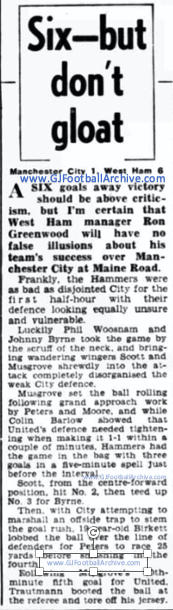
It was a miserable day all round as Manchester City’s Bert Trautmann was sent off for booting the ball at the referee on this day (8 September) in 1962. City lost the game with West Ham 6-1 with Trautmann’s dismissal coming after the fifth goal.
After he had booted the ball at the ref, the official took out his notebook and ordered Trautmann off. The German goalkeeper immediately took his shirt off and headed down the tunnel and straight out of the ground and into his car.
Here are Trautmann’s views, as told to a journalist the following day:
The view from West Ham was that their team was not particularly worth the 6-1 victory. This London report makes interesting reading:
If you enjoy all the free material on my website and would like to support my research and keep this website going (but don’t want to subscribe) then why not make a one-time donation (or buy me a coffee). All support for my research is valued and welcome. It allows me to keep some free material available for all. Thanks.
As Manchester City visit West Ham today (31st August 2024) in the Premier League I thought I’d post a small feature remembering a relegation game in 1987 that entered folklore as the You’ll Be Back game. What was it all about? Here goes…
City and West Ham fans have developed a special relationship over the years. There has been a mutual recognition of the journey our clubs have been on.
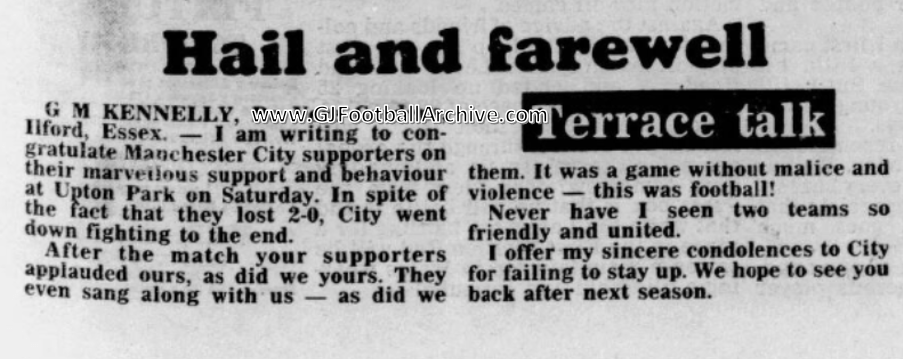
The biggest demonstration of the special relationship between the fans of the two clubs came in May 1987. City were relegated after a 2-0 defeat at West Ham. At the end of the game City supporters and West Ham fans climbed over the fences and onto the pitch. Some thought that the two sets of supporters were about to confront each other, but the fans knew differently. The Hammers began chanting “You’ll be back” and both groups swapped scarves and souvenirs on the pitch. It was the kind of moment that should have been widely reported in the media but at the time focus tended to be on hooliganism and confrontation rather than the positives of football support. City had been relegated, but their supporters did not seek revenge. The West Ham fans could have ridiculed, but they didn’t. If only those condemning football fans at the time could have seen the two sets of loyal supporters genuinely appreciating and understanding each other.
The relationship between the fans of the two clubs is not something that is widely discussed or promoted but it is something that has endured. City fans have never forgotten the ‘You’ll be back’ game and in recent years, as others have unfairly mocked both sets of fans, the supporters of both the Blues and the Hammers seem to understand and respect each other. Inevitably, there will always be banter during a game but outside of the match the mutual recognition and respect always seems to win through.
To many West Ham are the City of the South – a proud football club with a great history and heritage, combined with a loyal and passionate fanbase.
I reckon that City and West Ham fans have a shared understanding of football history, status and achievements with supporters aware of their club’s traditions, rivalries and shared history. The two clubs’ roots are very much based around hardworking working class areas of their cities with the supporters of both the Hammers and the Blues coming traditionally from the working classes. In recent years an analysis of the original shareholders at the majority of Football League clubs identified that by 1900 City’s shareholders came mostly from the working class – a larger percentage than at any club other than West Ham who had a slightly higher percentage. This demonstrates that those who owned both City and West Ham were representative of the fans on the terraces and that these clubs were similarly organised and run. As a result of this both clubs were representative of their communities in ways in which their nearest local rivals were not at the time.
Both clubs have enjoyed stylish, attractive football over the years with a belief that the game should be an entertainment. The roots of this go back decades at both clubs with West Ham’s Ted Fenton and Ron Greenwood influencing men such as Malcolm Allison and John Bond who managed the Blues.
Recently, City fans were delighted to see Manuel Pellegrini and Pablo Zabaleta become Hammers following a line that includes other popular Blues such as Ian Bishop and Trevor Morley.
Want To Read More Like This?
If you would like to read more like this and all the in-depth articles on this site (including the entire Manchester A Football History book and the audio interview with John Bond) then please subscribe. It works out about £1.67 a month if you take out an annual subscription (£20 per year) or £3 a month if you’d like to sign up for a month at a time. Subscribers get full access to the 1600+ articles posted so far and the hundreds scheduled to be posted in the coming weeks.
Each year, following the end of the UEFA football season I update the UEFA European Span of Success table. What is this? It’s a list of those clubs who have won two or more major UEFA tournaments showing the span between their first UEFA success and their most recent. The list may surprise some who think that football is all about those perceived as European giants with ‘history’.
The table hasn’t really changed much from last year as Real Madrid were Champions League winners. Atalanta, who won the Europa League, and Olympiacos (Conference winners) have only won one major European trophy and so they do not yet make it on to the list of multiple winners:
European Span of success 2024
The ‘history’ ‘no history’ thing really irritates me. All clubs have history and even when that’s recognised some still go on about history as if it started in 1992, 1999 or 2008 etc. depending on whether your club was successful or your rivals were failing. The two highest placed English teams are West Ham and Manchester City, who both found major European success before some of those clubs recognised today as Europe’s elite.
Obviously, this table does not show the number of major trophies won, but it does give an indication of trophy winning longevity for those who obsess on ‘my cup’s bigger than yours’ and similar debates. Personally, I think we should all be proud of our club’s achievements and not worry about what a rival has won.
West Ham have the second longest span of all Europe’s clubs and City have the fourth equal. Nice work Hammers and Blues!
The above table includes the four major UEFA tournaments: European Cup/Champions League; European Cup Winner’s Cup; UEFA Cup/Europa League & the Europa Conference League. It does not include non-UEFA tournaments such as the Mitropa Cup and Fairs Cup. Nor does it include the Intertoto Cup or similar.
I’m sure some will say but why aren’t the Mitropa or Fairs Cups in there? It’s a good point but these were not UEFA tournaments, though I recognise that the Mitropa Cup had some significant clubs competing in it. It was predominantly an East European competition and participants were not spread over the entire continent.
With the Fairs Cup… It is true that this was later transformed into the UEFA Cup and I have included all UEFA Cup finals in my analysis. But the Fairs Cup had an odd series of entry rules at times. Cities, rather than clubs, often entered with Barcelona beating London in one final for example. It was set up as a friendly type of competition with cities that had staged trade fairs playing each other. As time wore on entry came via the League Cup or League position in England, which added significance to it. But two teams from the same city were not allowed to participate, which meant that teams finishing way down the table could be (and were) included if those above them were multiple clubs from the same city.
In 1970 Manchester City’s Mike Doyle joked that by winning the League Cup he was satisfying his aim of ‘keeping United out of Europe’ (he joked about creating car stickers with that slogan!) because it appeared at that time that United’s only chance of Europe had gone with City’s qualification for the Fairs Cup.
1970 ECWC
City went on to win the ECWC that season, meaning that Fairs Cup place was opened up to League position, but United had finished lower down the table anyway and qualified for the Watney Cup instead. Actually, the Watney Cup is one worth talking about, but I’ll save that for another day. In 1970 Fourth placed Derby County qualified for the Watney Cup, while 5th to 7th (Liverpool, Coventry and Newcastle) all got a Fairs Cup place, alongside 12th placed Arsenal (Fairs Cup winners). I’ve not investigated this fully but it does seem odd that the Watney Cup took precedence over the Fairs Cup.
Arsenal’s 1970 Fairs Cup success was their first European trophy but is not included in the span, neither are those Fairs Cup wins of Barcelona. However, as quite a few Arsenal fans seemed to get a bit upset when the table was posted last year I’ve decided to include the Fairs Cup in the following version of the table. So this table is the winners of the main UEFA competitions I mentioned earlier plus the Fairs Cup with its odd rules:
European Span of success 2024 including Fairs Cup
Hopefully, those Arsenal fans who were somewhat upset last year will now be happy. Note that West Ham have now been overtaken by Roma and that Barcelona are now above Manchester City, Bayern & Atletico Madrid. Both ‘Rome’ and ‘Barcelona’ won the Fairs Cup when it was city based and not club based.
Arsenal are now 18th in this combined table, behind their fellow English clubs West Ham, City, Chelsea, United and Liverpool.
As an example of the odd qualification rules in place for the Fairs Cup at times it’s worth looking at the 1969 qualification via the English League system.
In 1969 champions Leeds entered the European Cup. The ECWC place went to FA Cup winners Manchester City and the Fairs Cup places went to: Arsenal (4th), Southampton (7th) and Newcastle (9th). Swindon had won the League Cup, beating Arsenal in the final, but the Fairs Cup organisers wouldn’t allow them to participate as they were not a top flight club! This adds to the reason the competition is usually excluded. It is certainly not a UEFA competition in any case.
Similarly, Everton (3rd), Chelsea (5th), Spurs (6th) and West Ham (8th) who all finished above Newcastle were denied because of the rule that only one club from each city be allowed. So Liverpool and Arsenal’s inclusion meant their rivals stood less chance of winning the trophy than Newcastle simply because there were multiple clubs in their cities.
That rule does make me wonder what would have happened if both Manchester clubs had qualified for the competition as City are within the city of Manchester boundaries and United are not. Would the two clubs have challenged any decision not to include one of them based on the age old argument of Manchester’s boundaries?
Maybe I’ll post more on the odd rules of football competitions and tell the story of some of those long forgotten competitions.
If you’re interested in the wider span of success for English clubs (listing those who have the longest span between their first trophy and most recent, not simply European trophies) then take a look at this (Manchester City are second):
If you enjoy all the free material on my website and would like to support my research and keep this website going (but don’t want to subscribe) then why not make a one-time donation (or buy me a coffee). All support for my research is valued and welcome. It allows me to keep some free material available for all. Thanks.
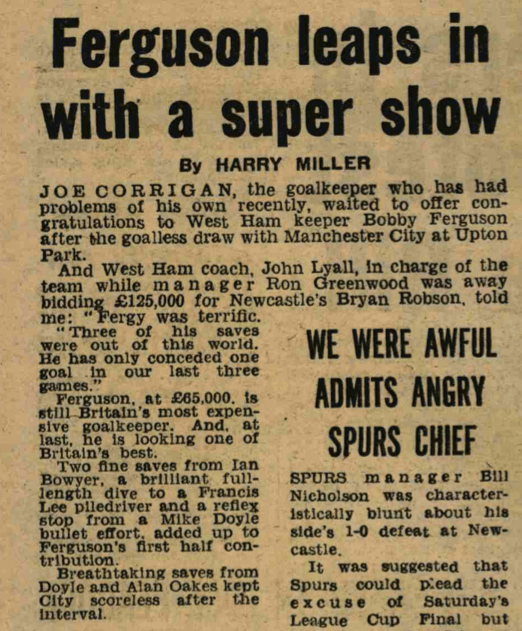
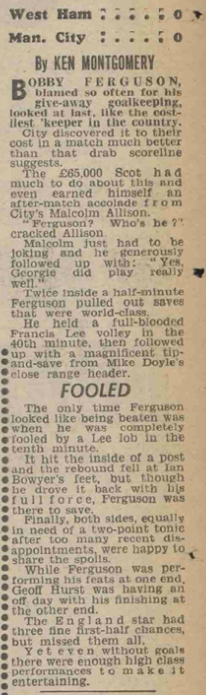
On this day (20 February) in 1971 Manchester City played out a goalless game at West Ham United. Often games without goals are perceived as dull but this match was full of goal action – even if no actual goals were scored. The brilliance of West Ham’s ‘keeper ensured Manchester City could not score and at the end of the game City’s Joe Corrigan ensured he congratulated Ferguson, even if Malcolm Allison joked that he had no idea who journalists were talking about when they asked him about the Hammers’ goalie. Here’s a report of the game:
Every day in January and February so far has offered something to enjoy in this series focusing on Manchester City in the 1970s. Subscribers can access everything. If you want to know more on this incredible decade for Manchester City Football Club then why not subscribe and read it all? You could even subscribe for a month and see what you think. The following 5,200 word article is on the 1970-71 season and is available to subscribers below. Enjoy!
Subscribe to get access – Monthly
Read more of this content when you subscribe today. It costs £3 per month (cancel anytime) to access everything posted since 1 October 2022 or there’s a special annual rate below which gives greater access and works out much cheaper.
Read more of this content when you subscribe today. It costs £3 per month (above) or £20 a year (here) to access everything posted since the site was created in December 2020. This special rate works out about £1.67 a week and gives access to everything posted, including PDFs of 3 of my books.
If you enjoy all the free material on my website and would like to support my research and keep this website going (but don’t want to subscribe) then why not make a one-time donation (or buy me a coffee). All support for my research is valued and welcome. It allows me to keep some free material available for all. Thanks.
It seems that some have a view that the giant clubs remain giant clubs forever and that there are some clubs who have only recently become prominent. Others believe that teams that were giants decades before some of today’s major trophy winners were never actually that prominent. I could spend hours challenging those who hold these views and pointing out that teams such as Everton, Newcastle & City won major trophies before many of these clubs and were perceived as giants years earlier too (decades before in some cases!), but it doesn’t feel like they’d listen. Ah well! Instead as part of my series of features/articles covering Manchester City in the 1970s I’d like to post a few attendance details that may interest some.
The following are a list of the top seven best supported top flight clubs for the ten seasons prior to City’s relegation in 1983. The Manchester clubs are in bold and the numbers in brackets show each club’s league position that season. In addition if any of the clubs won the European Cup, UEFA Cup, ECWC, FA Cup or League Cup that is also listed in brackets.
AVERAGE ATTENDANCES – Top Tier 1973-74
42712 MUFC (21st); 42332 Liverpool (2nd & FA Cup winners); 38666 Leeds (1st); 33048 Birmingham (19th); 32861 Newcastle (15th); 30756 MCFC (14th).
AVERAGE ATTENDANCES – Top Tier 1974-75
45966 LFC (2nd); 40021 Everton (4th); 34822 Leeds (9th); 34614 Newcastle (15th); 32898 MCFC (8th); 30854 Birmingham (17th); 29872 West Ham (13th & FA Cup winners). Both Manchester United (48387) and Sunderland (29931) were in Division Two but had an average higher than some of those in the top seven top tier averages.
AVERAGE ATTENDANCES – Top Tier 1975-76
54750 MUFC (3rd); 41623 Liverpool (1st & UEFA Cup winners); 38874 Aston Villa (16th); 34280 MCFC (8th & LC winners); 33060 Newcastle (15th); 31511 Leeds (5th); 28350 Derby (4th). Sunderland in Division Two had an average of 31250.
AVERAGE ATTENDANCES – Top Tier 1976-77
53710 MUFC (6th & FA Cup winners); 47221 Liverpool (1st & European Cup winners); 40058 MCFC (2nd); 37903 Aston Villa (4th & LC winners); 33599 Newcastle (5th); 32743 Sunderland (20th), 32671 Arsenal (8th).
AVERAGE ATTENDANCES – Top Tier 1977-78
51860 MUFC (10th); 45546 Liverpool (2nd & European Cup winners); 41687 MCFC (4th); 39513 Everton (3rd); 35464 Aston Villa (8th); 35446 Arsenal (5th); 32501 Nottm Forest (1st & LC winners). Tottenham were in Division Two with an average of 33417.
AVERAGE ATTENDANCES – Top Tier 1978-79
46430 MUFC (9th); 46407 Liverpool (1st); 36371 Arsenal (7th & FA Cup winners); 36203 MCFC (15th); 35456 Everton (4th); 34902 Tottenham (11th); 32838 Aston Villa (8th).
AVERAGE ATTENDANCES – Top Tier 1979-80
51608 MUFC (2nd); 44586 Liverpool (1st); 35272 MCFC (17th); 33596 Arsenal (4th); 32018 Tottenham (14th); 29794 Crystal Palace (13th); 28711 Everton (19th).
1979-80 League table and attendance detail up to 26/4/1980
AVERAGE ATTENDANCES – Top Tier 1980-81
45071 MUFC (8th); 37547 Liverpool (5th & LC winners); 34117 Aston Villa (1st); 33587 MCFC (12th); 32480 Arsenal (3rd); 30724 Tottenham (10th & FA Cup winners); 26477 Sunderland (17th). West Ham were in Division Two with an average of 27140.
Kippax Stand c.1980
AVERAGE ATTENDANCES – Top Tier 1981-82
44571 MUFC (3rd); 35100 Tottenham (4th & FA Cup winners); 35061 Liverpool (1st & LC winners); 34063 MCFC (10th); 26780 Aston Villa (11th & European Cup winners); 26585 West Ham (9th); 25589 Arsenal (5th).
1981 City v United Maine Road
AVERAGE ATTENDANCES – Top Tier 1982-83
41552 MUFC (3rd & FA Cup winners); 34758 Liverpool (1st & LC winners); 30581 Tottenham (4th); 26789 MCFC (20th); 24153 Arsenal (10th); 23748 Aston Villa (6th); 22822 West Ham (8th). Second Division Newcastle attracted an average of 24166.
Fans storming the main entrance in 1983. Mirrorpix photo
For those wondering Manchester City did drop a little in terms of position in the attendance chart during their Second Division days but they were still the 6th best supported club (of all clubs) in 1983-84 and 8th best in 1984-85. Back in Division One in 1985-86 the Blues were once again the 4th best supported team in the entire League.
This series of articles and features on Manchester City in the 1970s has been running throughout January with indepth articles some days and smaller ‘on this day’ style posts on others. Every day in January will offer something to enjoy.
Subscribers will get access to everything. If you want to know more on this incredible decade for Manchester City Football Club then why not subscribe and read it all? You could even subscribe for a month and see what you think. The following 1,600 word article is on the 1974-75 season and is available to subscribers below. Enjoy!
Subscribe to get access – Monthly
Read more of this content when you subscribe today. It costs £3 per month (cancel anytime) to access everything posted since 1 October 2022 or there’s a special annual rate below which gives greater access and works out much cheaper.
Read more of this content when you subscribe today. It costs £3 per month (above) or £20 a year (here) to access everything posted since the site was created in December 2020. This special rate works out about £1.67 a week and gives access to everything posted, including PDFs of 3 of my books.
If you enjoy all the free material on my website and would like to support my research and keep this website going (but don’t want to subscribe) then why not make a one-time donation (or buy me a coffee). All support for my research is valued and welcome. It allows me to keep some free material available for all. Thanks.
The series of features/articles covering Manchester City in the 1970s continues with this brief post about average attendances. We hear so much baloney these days about which clubs are giants and so on but the truth is that in terms of success no team has ALWAYS been at the top and in terms of support most clubs have had highs and lows. There are some clubs that generation after generation have been popular with fans and this cutting from the Manchester City match programme of 1977-78 may interest some.
I’m not going to point to any club or anything but look at the numbers and make your own minds up. Manchester City, incidentally, tended to be the 3rd best supported club (no matter where they finished) behind United and Liverpool throughout the mid to late 70s and early 1980s. They occasionally dropped to 4th depending on whether Everton or Spurs had a good season and even in City’s 1982-83 relegation season Manchester’s Blues were the 4th best supported club. Not bad for a failing club!
This series of articles and features on Manchester City in the 1970s will run throughout January with indepth articles some days and smaller ‘on this day’ style posts on others. There will be flashbacks to great games, players and more. Every day in January will offer something to enjoy.
Subscribers will get access to everything. If you want to know more on this incredible decade for Manchester City Football Club then why not subscribe and read it all? You could even subscribe for a month and see what you think. The following 5,200 word article is on the 1970-71 season and is available to subscribers below. Enjoy!
Subscribe to get access – Monthly
Read more of this content when you subscribe today. It costs £3 per month (cancel anytime) to access everything posted since 1 October 2022 or there’s a special annual rate below which gives greater access and works out much cheaper.
Read more of this content when you subscribe today. It costs £3 per month (above) or £20 a year (here) to access everything posted since the site was created in December 2020. This special rate works out about £1.67 a week and gives access to everything posted, including PDFs of 3 of my books.
If you enjoy all the free material on my website and would like to support my research and keep this website going (but don’t want to subscribe) then why not make a one-time donation (or buy me a coffee). All support for my research is valued and welcome. It allows me to keep some free material available for all. Thanks.
Today (28 November) in 2021 Manchester City manager Pep Guardiola believed that City groundsman Lee Jackson and his team were the real stars as City defeated West Ham 2-1 in snowy conditions. Pep said: ‘I think the groundkeepers, the men who took care of the pitch, were the men of the match. They did an incredible job so we could play the game today.’
In the first half with heavy snow falling on a pitch already covered in it, there was a real fear the game might not reach its conclusion. Lee Jackson and his team got to work and, with the aid of a half-time interval extended by referee Michael Oliver by five minutes, the surface was clear enough to play on.
City won the game with goals from Gundogan (33rd minute) and Fernandinho (90). West Ham scored a consolation (Lanzini) in the 4th minute of added time.








 Gary James' Football Archive