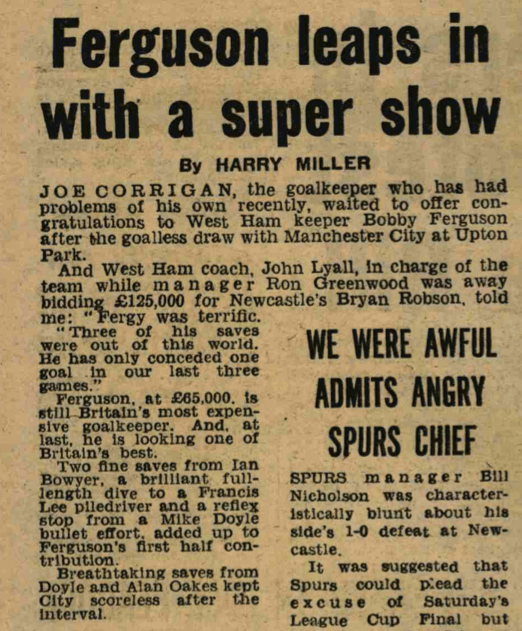
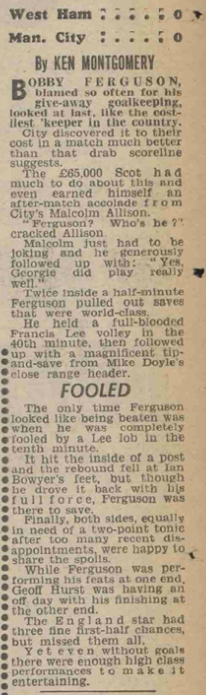
On this day (20 February) in 1971 Manchester City played out a goalless game at West Ham United. Often games without goals are perceived as dull but this match was full of goal action – even if no actual goals were scored. The brilliance of West Ham’s ‘keeper ensured Manchester City could not score and at the end of the game City’s Joe Corrigan ensured he congratulated Ferguson, even if Malcolm Allison joked that he had no idea who journalists were talking about when they asked him about the Hammers’ goalie. Here’s a report of the game:
Every day in January and February so far has offered something to enjoy in this series focusing on Manchester City in the 1970s. Subscribers can access everything. If you want to know more on this incredible decade for Manchester City Football Club then why not subscribe and read it all? You could even subscribe for a month and see what you think. The following 5,200 word article is on the 1970-71 season and is available to subscribers below. Enjoy!
Subscribe to get access – Monthly
Read more of this content when you subscribe today. It costs £3 per month (cancel anytime) to access everything posted since 1 October 2022 or there’s a special annual rate below which gives greater access and works out much cheaper.
Read more of this content when you subscribe today. It costs £3 per month (above) or £20 a year (here) to access everything posted since the site was created in December 2020. This special rate works out about £1.67 a week and gives access to everything posted, including PDFs of 3 of my books.
If you enjoy all the free material on my website and would like to support my research and keep this website going (but don’t want to subscribe) then why not make a one-time donation (or buy me a coffee). All support for my research is valued and welcome. It allows me to keep some free material available for all. Thanks.
It seems that some have a view that the giant clubs remain giant clubs forever and that there are some clubs who have only recently become prominent. Others believe that teams that were giants decades before some of today’s major trophy winners were never actually that prominent. I could spend hours challenging those who hold these views and pointing out that teams such as Everton, Newcastle & City won major trophies before many of these clubs and were perceived as giants years earlier too (decades before in some cases!), but it doesn’t feel like they’d listen. Ah well! Instead as part of my series of features/articles covering Manchester City in the 1970s I’d like to post a few attendance details that may interest some.
The following are a list of the top seven best supported top flight clubs for the ten seasons prior to City’s relegation in 1983. The Manchester clubs are in bold and the numbers in brackets show each club’s league position that season. In addition if any of the clubs won the European Cup, UEFA Cup, ECWC, FA Cup or League Cup that is also listed in brackets.
AVERAGE ATTENDANCES – Top Tier 1973-74
42712 MUFC (21st); 42332 Liverpool (2nd & FA Cup winners); 38666 Leeds (1st); 33048 Birmingham (19th); 32861 Newcastle (15th); 30756 MCFC (14th).
AVERAGE ATTENDANCES – Top Tier 1974-75
45966 LFC (2nd); 40021 Everton (4th); 34822 Leeds (9th); 34614 Newcastle (15th); 32898 MCFC (8th); 30854 Birmingham (17th); 29872 West Ham (13th & FA Cup winners). Both Manchester United (48387) and Sunderland (29931) were in Division Two but had an average higher than some of those in the top seven top tier averages.
AVERAGE ATTENDANCES – Top Tier 1975-76
54750 MUFC (3rd); 41623 Liverpool (1st & UEFA Cup winners); 38874 Aston Villa (16th); 34280 MCFC (8th & LC winners); 33060 Newcastle (15th); 31511 Leeds (5th); 28350 Derby (4th). Sunderland in Division Two had an average of 31250.
AVERAGE ATTENDANCES – Top Tier 1976-77
53710 MUFC (6th & FA Cup winners); 47221 Liverpool (1st & European Cup winners); 40058 MCFC (2nd); 37903 Aston Villa (4th & LC winners); 33599 Newcastle (5th); 32743 Sunderland (20th), 32671 Arsenal (8th).
AVERAGE ATTENDANCES – Top Tier 1977-78
51860 MUFC (10th); 45546 Liverpool (2nd & European Cup winners); 41687 MCFC (4th); 39513 Everton (3rd); 35464 Aston Villa (8th); 35446 Arsenal (5th); 32501 Nottm Forest (1st & LC winners). Tottenham were in Division Two with an average of 33417.
AVERAGE ATTENDANCES – Top Tier 1978-79
46430 MUFC (9th); 46407 Liverpool (1st); 36371 Arsenal (7th & FA Cup winners); 36203 MCFC (15th); 35456 Everton (4th); 34902 Tottenham (11th); 32838 Aston Villa (8th).
AVERAGE ATTENDANCES – Top Tier 1979-80
51608 MUFC (2nd); 44586 Liverpool (1st); 35272 MCFC (17th); 33596 Arsenal (4th); 32018 Tottenham (14th); 29794 Crystal Palace (13th); 28711 Everton (19th).
1979-80 League table and attendance detail up to 26/4/1980
AVERAGE ATTENDANCES – Top Tier 1980-81
45071 MUFC (8th); 37547 Liverpool (5th & LC winners); 34117 Aston Villa (1st); 33587 MCFC (12th); 32480 Arsenal (3rd); 30724 Tottenham (10th & FA Cup winners); 26477 Sunderland (17th). West Ham were in Division Two with an average of 27140.
Kippax Stand c.1980
AVERAGE ATTENDANCES – Top Tier 1981-82
44571 MUFC (3rd); 35100 Tottenham (4th & FA Cup winners); 35061 Liverpool (1st & LC winners); 34063 MCFC (10th); 26780 Aston Villa (11th & European Cup winners); 26585 West Ham (9th); 25589 Arsenal (5th).
1981 City v United Maine Road
AVERAGE ATTENDANCES – Top Tier 1982-83
41552 MUFC (3rd & FA Cup winners); 34758 Liverpool (1st & LC winners); 30581 Tottenham (4th); 26789 MCFC (20th); 24153 Arsenal (10th); 23748 Aston Villa (6th); 22822 West Ham (8th). Second Division Newcastle attracted an average of 24166.
Fans storming the main entrance in 1983. Mirrorpix photo
For those wondering Manchester City did drop a little in terms of position in the attendance chart during their Second Division days but they were still the 6th best supported club (of all clubs) in 1983-84 and 8th best in 1984-85. Back in Division One in 1985-86 the Blues were once again the 4th best supported team in the entire League.
This series of articles and features on Manchester City in the 1970s has been running throughout January with indepth articles some days and smaller ‘on this day’ style posts on others. Every day in January will offer something to enjoy.
Subscribers will get access to everything. If you want to know more on this incredible decade for Manchester City Football Club then why not subscribe and read it all? You could even subscribe for a month and see what you think. The following 1,600 word article is on the 1974-75 season and is available to subscribers below. Enjoy!
Subscribe to get access – Monthly
Read more of this content when you subscribe today. It costs £3 per month (cancel anytime) to access everything posted since 1 October 2022 or there’s a special annual rate below which gives greater access and works out much cheaper.
Read more of this content when you subscribe today. It costs £3 per month (above) or £20 a year (here) to access everything posted since the site was created in December 2020. This special rate works out about £1.67 a week and gives access to everything posted, including PDFs of 3 of my books.
If you enjoy all the free material on my website and would like to support my research and keep this website going (but don’t want to subscribe) then why not make a one-time donation (or buy me a coffee). All support for my research is valued and welcome. It allows me to keep some free material available for all. Thanks.
The series of features/articles covering Manchester City in the 1970s continues with this brief post about average attendances. We hear so much baloney these days about which clubs are giants and so on but the truth is that in terms of success no team has ALWAYS been at the top and in terms of support most clubs have had highs and lows. There are some clubs that generation after generation have been popular with fans and this cutting from the Manchester City match programme of 1977-78 may interest some.
I’m not going to point to any club or anything but look at the numbers and make your own minds up. Manchester City, incidentally, tended to be the 3rd best supported club (no matter where they finished) behind United and Liverpool throughout the mid to late 70s and early 1980s. They occasionally dropped to 4th depending on whether Everton or Spurs had a good season and even in City’s 1982-83 relegation season Manchester’s Blues were the 4th best supported club. Not bad for a failing club!
This series of articles and features on Manchester City in the 1970s will run throughout January with indepth articles some days and smaller ‘on this day’ style posts on others. There will be flashbacks to great games, players and more. Every day in January will offer something to enjoy.
Subscribers will get access to everything. If you want to know more on this incredible decade for Manchester City Football Club then why not subscribe and read it all? You could even subscribe for a month and see what you think. The following 5,200 word article is on the 1970-71 season and is available to subscribers below. Enjoy!
Subscribe to get access – Monthly
Read more of this content when you subscribe today. It costs £3 per month (cancel anytime) to access everything posted since 1 October 2022 or there’s a special annual rate below which gives greater access and works out much cheaper.
Read more of this content when you subscribe today. It costs £3 per month (above) or £20 a year (here) to access everything posted since the site was created in December 2020. This special rate works out about £1.67 a week and gives access to everything posted, including PDFs of 3 of my books.
If you enjoy all the free material on my website and would like to support my research and keep this website going (but don’t want to subscribe) then why not make a one-time donation (or buy me a coffee). All support for my research is valued and welcome. It allows me to keep some free material available for all. Thanks.
Today (28 November) in 2021 Manchester City manager Pep Guardiola believed that City groundsman Lee Jackson and his team were the real stars as City defeated West Ham 2-1 in snowy conditions. Pep said: ‘I think the groundkeepers, the men who took care of the pitch, were the men of the match. They did an incredible job so we could play the game today.’
In the first half with heavy snow falling on a pitch already covered in it, there was a real fear the game might not reach its conclusion. Lee Jackson and his team got to work and, with the aid of a half-time interval extended by referee Michael Oliver by five minutes, the surface was clear enough to play on.
City won the game with goals from Gundogan (33rd minute) and Fernandinho (90). West Ham scored a consolation (Lanzini) in the 4th minute of added time.
A new daily series of articles for subscribers started last week covering the 1980s. This is a seasonal journey through a truly important decade in the history of Manchester City Football Club. Today’s article is a 2,500 word feature on the 1986-87 season. Enjoy!
Subscribe to get access – Monthly
Read more of this content when you subscribe today. It costs £3 per month (cancel anytime) to access everything posted since 1 October 2022 or there’s a special annual rate below which gives greater access and works out much cheaper.
Read more of this content when you subscribe today. It costs £3 per month (above) or £20 a year (here) to access everything posted since the site was created in December 2020. This special rate works out about £1.67 a week and gives access to everything posted, including PDFs of 3 of my books.
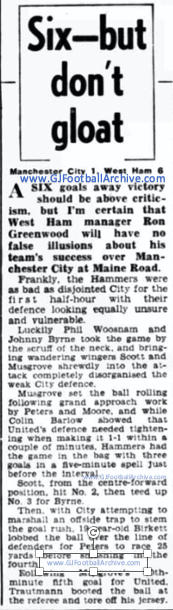
It was a miserable day all round as Manchester City’s Bert Trautmann was sent off for booting the ball at the referee on this day (8 September 1962). City lost the game with West Ham 6-1 with Trautmann’s dismissal coming after the fifth goal.
After he had booted the ball at the ref, the official took out his notebook and ordered Trautmann off. The German goalkeeper immediately took his shirt off and headed down the tunnel and straight out of the ground and into his car.
Here are Trautmann’s views, as told to a journalist the following day:
The view from West Ham was that their team was not particularly worth the 6-1 victory. This London report makes interesting reading:
Demonstrations followed the game expressing anger towards the manager Les McDowall but Trautmann managed to escape fan criticism.
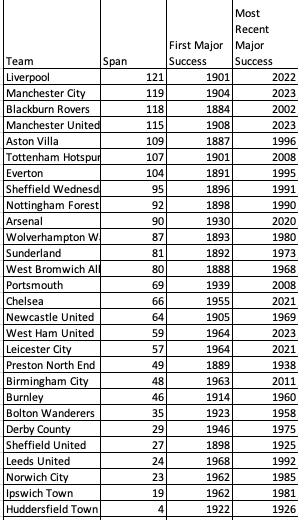
Following Sevilla’s, West Ham’s and Manchester City’s successes in major UEFA competition this season I’ve updated the UEFA European Span of Success table. What is this? It’s a list of those clubs who have won two or more major UEFA tournaments showing the span between their first UEFA success and their most recent. The list may surprise some who think that football is all about those perceived as European giants with ‘history’.
The ‘history’ ‘no history’ thing really irritates me. All clubs have history and even when that’s recognised some still go on about history as if it started in 1992, 1999 or 2008 etc. depending on whether your club was successful or your rivals were failing. Both West Ham and Manchester City found major European success before some of those clubs recognised today as Europe’s elite and while this table does not show the number of major trophies won, it does give an indication of trophy winning longevity for those who obsess on ‘my cup’s bigger than yours’ and similar debates. Personally, I think we should all be proud of our club’s achievements and not worry about what a rival has won.
West Ham have the second longest span of all Europe’s clubs and City have the fifth. Nice work Hammers and Blues!
Anyway, here’s the table showing all those with two or more successes:
European span of success 2023, showing EC/CL, ECWC, UEFA/Europa & Europa Conference
The table includes the four major UEFA tournaments: European Cup/Champions League; European Cup Winner’s Cup; UEFA Cup/Europa League & the Europa Conference League. It does not include non-UEFA tournaments such as the Mitropa Cup and Fairs Cup. Nor does it include the Intertoto Cup or similar.
I’m sure some will say but why aren’t the Mitropa or Fairs Cups in there? It’s a good point but these were not UEFA tournaments, though I recognise that the Mitropa Cup had some significant clubs competing in it. It was predominantly an East European competition and participants were not spread over the entire continent.
With the Fairs Cup… It is true that this was later transformed into the UEFA Cup and I have included all UEFA Cup finals in my analysis. But the Fairs Cup had an odd series of entry rules at times. Cities, rather than clubs, often entered with Barcelona beating London in one final for example. It was set up as a friendly type of competition with cities that had staged trade fairs playing each other. As time wore on entry came via the League Cup or League position in England, which added significance to it. But two teams from the same city were not allowed to participate, which meant that teams finishing way down the table could be (and were) included if those above them were multiple clubs from the same city.
In 1970 Manchester City’s Mike Doyle joked that by winning the League Cup he was satisfying his aim of ‘keeping United out of Europe’ (he joked about creating car stickers with that slogan!) because it appeared at that time that United’s only chance of Europe had gone with City’s qualification for the Fairs Cup.
1970 ECWC
City went on to win the ECWC that season, meaning that Fairs Cup place was opened up to League position, but United had finished lower down the table anyway and qualified for the Watney Cup instead. Actually, the Watney Cup is one worth talking about, but I’ll save that for another day. In 1970 Fourth placed Derby County qualified for the Watney Cup, while 5th to 7th (Liverpool, Coventry and Newcastle) all got a Fairs Cup place, alongside 12th placed Arsenal (Fairs Cup winners). I’ve not investigated this fully but it does seem odd that the Watney Cup took precedence over the Fairs Cup.
Arsenal’s 1970 Fairs Cup success was their first European trophy but is not included in the span, neither are those Fairs Cup wins of Barcelona. As an example of the odd qualification rules at times it’s worth looking at the 1969 qualification via the English League system.
In 1969 champions Leeds entered the European Cup. The ECWC place went to FA Cup winners Manchester City and the Fairs Cup places went to: Arsenal (4th), Southampton (7th) and Newcastle (9th). Swindon had won the League Cup, beating Arsenal in the final, but the Fairs Cup organisers wouldn’t allow them to participate as they were not a top flight club! This adds to the reason the competition is not included.
Similarly, Everton (3rd), Chelsea (5th), Spurs (6th) and West Ham (8th) who all finished above Newcastle were denied because of the rule that only one club from each city be allowed. So Liverpool and Arsenal’s inclusion meant their rivals stood less chance of winning the trophy than Newcastle simply because there were multiple clubs in their cities.
That rule does make me wonder what would have happened if both Manchester clubs had qualified for the competition as City are within the city of Manchester boundaries and United are not. Would the two clubs have challenged any decision not to include one of them based on the age old argument of Manchester’s boundaries?
Maybe I’ll post more on the odd rules of football competitions and tell the story of some of those long forgotten competitions.
If you enjoy all the free material on my website and would like to support my research and keep this website going (but don’t want to subscribe) then why not make a one-time donation (or buy me a coffee). All support for my research is valued and welcome. It allows me to keep some free material available for all. Thanks.
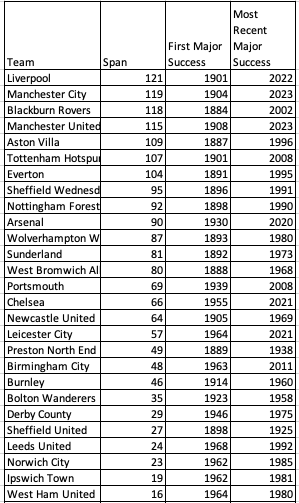
Congratulations to West Ham on your success in last night’s Europa Conference League. Great news for your club and for those clubs who wonder whether competitions like this are a drain or something to aim for. I’ve now updated the table showing the span of success – i.e. the number of years between a club’s first major success (FA Cup, League, League Cup, European trophy) and their most recent. West Ham have jumped some way up that list.
Okay, the span of success does not show how many trophies each club has won or how frequently that club has experienced great eras of success, but it does demonstrate how wrong those people are who believe certain clubs were unsuccessful until recent years, or those who think certain clubs have always been giants. The column on first major success helps to show when some clubs first became trophy-winning significant (often after transformational investment).
West Ham have proved that if you’re a club that hasn’t won a major trophy for a while putting your focus on achieving trophy success ahead of the odd Premier League position can bring significant reward. In future decades no one will remember who finished seventh, tenth or fifteenth but they will remember the trophies.
I know clubs focus on their financials but winning a trophy has longevity, gaining the odd Premier League place provides a bit of extra cash now but no long term kudos. Winning a trophy attracts new fans and brings money-spinning opportunities too.
If I was a supporter of Everton, Aston Villa or any of the other major clubs who have not found significant success in recent decades then I would absolutely want my team to go for whichever cup competition seems most likely to win. That’s what I always wanted from City before they were able to compete for the League again. Winning the FA Cup in 2011 helped everything that followed happen.
While you’re here… why not take a look at the free to read daily Maine Road features counting down to the old stadium’s 100th anniversary of its first game? Here are a sample couple of features (follow the Maine Road tag or search for more):
Ahead of West Ham’s European final tomorrow night (7 June) I thought I’d post the latest update to the table showing the span of success – i.e. the number of years between a club’s first major success (FA Cup, League, League Cup, European trophy) and their most recent. If West Ham win tomorrow they will leap ahead of Leicester City.
This season has seen City overtake Blackburn Rovers and they are now second to Liverpool.
Okay, the span of success does not show how many trophies each club has won or how frequently that club has experienced great eras of success, but it does demonstrate how wrong those people are who believe certain clubs were unsuccessful until recent years, or those who think certain clubs have always been giants. The column on first major success helps to show when some clubs first became trophy-winning significant (often after transformational investment).
While you’re here… why not take a look at the free to read daily Maine Road features counting down to the old stadium’s 100th anniversary of its first game? Here are a sample couple of features (follow the Maine Road tag or search for more):
I was quite pleased with my MCFC V WHU programme article the other night (3 May). The article challenged the perception that City’s triumphs in recent years are somehow less significant than others as City have ‘bought success’. I feel quite strongly about that, so the article compares past decades to see if the last decade or so has been more competitive at the top of the League. Subscribers can see the full article below but here’s a taster:
Subscribe to get access – Monthly
Read more of this content when you subscribe today. It costs £3 a month (cancel anytime) or £20 a year (below)
Read more of this content when you subscribe today. Annual subscribers access everything (books, articles, videos, talks, interviews etc) since the site was created in December 2020. Monthly