Here’s another 1980s themed story. On this day (26 December) in 1981 Manchester City defeated Liverpool 3-1 at Anfield but it was a day marred when City keeper Joe Corrigan was felled by a bottle thrown at him. Here are highlights of the game plus a brief audio clip of John Bond talking about the LFC reaction that day.
In 1995 I interviewed former City boss John Bond at his home. The interview lasted about two hours and here’s a brief snippet from that interview where he talks about that win over Liverpool on Boxing Day 1981.
The Blues won 3-1 (Bond, Hartford & Reeves) then two days later (Bond says it’s the next day in this clip but it was 28th December) City defeated Wolves 2-1 at Maine Rd. John discusses a brilliant goal from Trevor Francis. City went top of the League after the Wolves victory.
Stick with the clip because it ends with Bond’s views on how Liverpool used to react to wins and defeats. I’d best not comment – have a listen:
This weekend marks the latest in the series of games between one of the Manchester clubs and a Liverpool team. Today (25 November 2023) treble winners City face second placed Liverpool at the Etihad. Tomorrow it’s 6th placed United v 19th placed Everton (who have been docked points for Financial Fair Play breach). Understandably, much will be made of the Manchester-Liverpool rivalry and it is true that the two cities have been rivals for over 150 years (it certainly predates the building of the Ship Canal!) BUT the football clubs have not always been rivals. In fact Utd and Liverpool have been close over the decades at times while the on-the-pitch rivalry between City and Liverpool was extremely strong in the late 60s and 70s.
The strength of the two conurbations’ footballing rivalries came during the late 1960s but intensified in the late 70s. Prior to this one-off seasons may have seen grudge matches or significant games between clubs from the cities but nothing more than that. In fact for many, many years Manchester United and Liverpool, for example, were extremely close. They once put forward a suggestion to the Football League that all home teams should wear red and away teams white – the rest of football soon got wise to the plan!
There was also the time when United and Liverpool ‘fixed’ a game of football. It’s a long story (amazingly United’s solicitor was part of the ‘neutral’ investigating committee!) and can be read here:
The rivalry between the footballing clubs developed in the 60s and there were many significant games between all the clubs in the two cities with several prominent matches (there were significant grudge matches between Everton and City for example in the 60s and at one point Liverpool’s Bill Shankly told the media that City were Liverpool’s biggest rival!).
Back in 1995 I interviewed former Manchester City boss John Bond at his home. The interview lasted about two hours and here’s a brief snippet from that interview where Bond talks about beating Liverpool on Boxing Day 1981.
The Blues won 3-1 (Bond, Hartford & Reeves) then two days later (Bond says it’s the next day in this clip but it was 28th December) City defeated Wolves 2-1 at Maine Rd. John discusses a brilliant goal from Trevor Francis. City went top of the League after the Wolves victory.
Stick with the clip because it ends with Bond’s views on how Liverpool used to react to wins and defeats. I’d best not comment – have a listen:
I’ve covered one particularly bitter moment in the City-Liverpool rivalry from the 80s that concerns John Bond here:
I hope this weekend’s games between go well and it’d be great if one of Manchester’s Blues could score four goals as Fred Howard did on his debut against Liverpool – see:
This game was at Hyde Road and on this image is a ‘palpable foul’ from a Manchester City player against Liverpool but the caption says ‘Cries of “Play fair” were frequent.’ As this was a home game for City it feels like the City fans would have been making those noises as few Liverpool fans travelled back then to this game. Liverpool won the match 1-0 on 28 October 1905. Did they play fair though?
If you enjoy all the free material on my website and would like to support my research and keep this website going (but don’t want to subscribe) then why not make a one-time donation (or buy me a coffee). All support for my research is valued and welcome. It allows me to keep some free material available for all. Thanks.
On this day (17 September) in 1910 Old Trafford staged its first Manchester derby and City were even awarded a penalty there too! The penalty was saved and the game ended in a 2-1 United win in front of a crowd estimated to be about 60,000. Here’s a brief match report from that day. Note also the preview for City’s next game at Hyde Road:
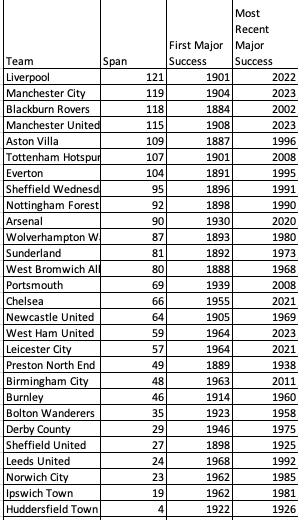
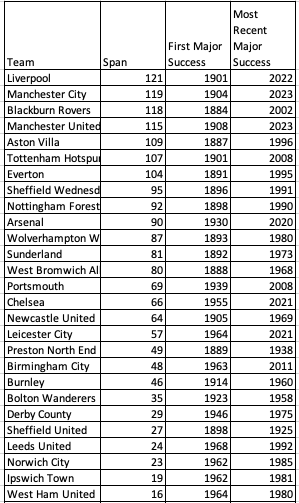
Congratulations to West Ham on your success in last night’s Europa Conference League. Great news for your club and for those clubs who wonder whether competitions like this are a drain or something to aim for. I’ve now updated the table showing the span of success – i.e. the number of years between a club’s first major success (FA Cup, League, League Cup, European trophy) and their most recent. West Ham have jumped some way up that list.
Okay, the span of success does not show how many trophies each club has won or how frequently that club has experienced great eras of success, but it does demonstrate how wrong those people are who believe certain clubs were unsuccessful until recent years, or those who think certain clubs have always been giants. The column on first major success helps to show when some clubs first became trophy-winning significant (often after transformational investment).
West Ham have proved that if you’re a club that hasn’t won a major trophy for a while putting your focus on achieving trophy success ahead of the odd Premier League position can bring significant reward. In future decades no one will remember who finished seventh, tenth or fifteenth but they will remember the trophies.
I know clubs focus on their financials but winning a trophy has longevity, gaining the odd Premier League place provides a bit of extra cash now but no long term kudos. Winning a trophy attracts new fans and brings money-spinning opportunities too.
If I was a supporter of Everton, Aston Villa or any of the other major clubs who have not found significant success in recent decades then I would absolutely want my team to go for whichever cup competition seems most likely to win. That’s what I always wanted from City before they were able to compete for the League again. Winning the FA Cup in 2011 helped everything that followed happen.
While you’re here… why not take a look at the free to read daily Maine Road features counting down to the old stadium’s 100th anniversary of its first game? Here are a sample couple of features (follow the Maine Road tag or search for more):
Ahead of West Ham’s European final tomorrow night (7 June) I thought I’d post the latest update to the table showing the span of success – i.e. the number of years between a club’s first major success (FA Cup, League, League Cup, European trophy) and their most recent. If West Ham win tomorrow they will leap ahead of Leicester City.
This season has seen City overtake Blackburn Rovers and they are now second to Liverpool.
Okay, the span of success does not show how many trophies each club has won or how frequently that club has experienced great eras of success, but it does demonstrate how wrong those people are who believe certain clubs were unsuccessful until recent years, or those who think certain clubs have always been giants. The column on first major success helps to show when some clubs first became trophy-winning significant (often after transformational investment).
While you’re here… why not take a look at the free to read daily Maine Road features counting down to the old stadium’s 100th anniversary of its first game? Here are a sample couple of features (follow the Maine Road tag or search for more):
On this day (9 May) in 1898 the first ever Newton Heath and Salford match programme was produced however all is not what it seems. This was actually a mock up of what a Manchester football programme could look like and was used to officially register the new publication. Everything in this issue was mocked up based on an Everton-Liverpool style programme. The company behind the Manchester programme was Merseyside based.
From 9 May 1898 the first Manchester football programme was a mock up based on Everton Liverpool programme
When the programme properly began the following football season it carried the details of not only Newton Heath and Salford but also Broughton Rangers and Manchester City.
One interesting image the original mock up contained was this scene from an Everton Liverpool game which it described as the finest picture of football ever published (hyperbole, hey?).
From 9 May 1898 the first Manchester football programme was a mock up based on Everton Liverpool programme
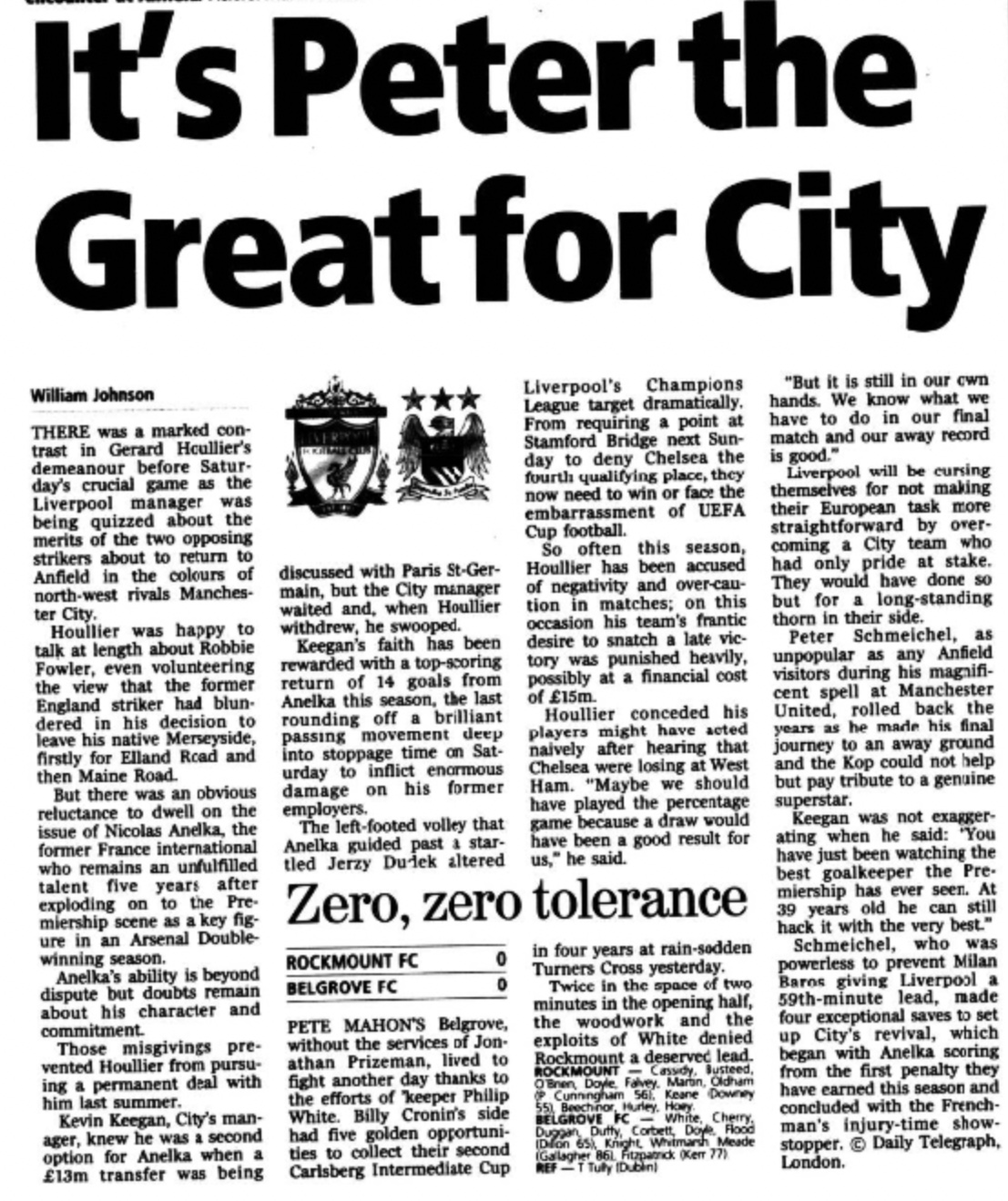
Twenty years ago today (5 May 2003) newspaper reports reflected on Manchester City’s 2-1 victory at Liverpool two days earlier. They tended to praise City ‘keeper Peter Schmeichel most, even though Nicolas Anelka had scored both goals for the Blues. It was a hugely popular City win of course in Manchester but this was a strange and emotional period for all connected with the Blues. The following game would be City’s last first team match at Maine Road and while fans celebrated a rare win at Anfield there were many emotions as the club now looked ahead to Maine Road’s farewell.
Today (4 May) in 1929 the legendary Tommy Johnson netted his 38th League goal of the season at Anfield when City drew 1-1 with Liverpool. This is at the moment (4 May 2023) Manchester City’s record number of goals by a player in a League season. His 38th goal came in the 22nd minute of the final game. Here for subscribers is a detailed look at Tommy’s record (while it stands!) and his life.
Subscribe to get access – Monthly
Read more of this content when you subscribe today. It costs £3 per month or £20 a year.
Annual subscribers get access to all the books, articles, videos, interviews and talks posted since the site was created in December 2020. Monthly subscribers get access to everything since 1 October 2022. All subscribers access everything new during their subscription too.
In terms of football the two cities of Manchester and Liverpool were extremely close for decades but in business and everyday life they have been rivals (bitter at times) for over 150 years. People will talk about all sorts of factors with the main one discussed being about the trade issues Manchester faced because Liverpool basically controlled Manchester’s access to the sea. I don’t want to go on too much about it all but I do want to show these sections from American newspapers which give an indication of what the situation was from another nation’s point of view.
It’s interesting to note that at least one of these articles shows that Manchester tried to ensure the whole of England benefitted from the city’s growing prosperity, suggesting that previously Liverpool only benefitted from this kind of trade.
Crittenden Record, July 04, 1907Americus Times, April 14, 1903,The Morning News, July 23, 1894
There are lots of articles on my site about Manchester’s teams and those from Liverpool. Here are details of articles than are tagged ‘Liverpool’: