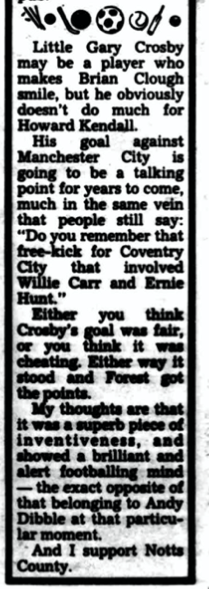
The 1990s: That Crosby Goal!

The series of articles covering Manchester City in the 1990s continues with a story from the opening months of 1990. On 3 March in 1990 City lost 1-0 to a controversial goal from Nottingham Forest’s Gary Crosby. Was it fair? Watch the highlights here and see what you think:

The debate rumbled on for weeks. Here are a few newspaper headlines from the weeks that followed, starting with one from this day (6 March) in 1990:

Oooh, it was one of those haunting footballing moments that lived with goalkeeper Andy Dibble for years and was something us fans could not forget whenever we went to Forest!

For more on that season, have a read of this 1,300 word article on the end of the 1989-90 season. It is available to subscribers below. Enjoy!

Subscribe to get access – Monthly

Read more of this content when you subscribe today. It costs £3 per month (cancel anytime) to access everything posted since 1 October 2022 or there’s a special annual rate below which gives greater access and works out much cheaper.

Subscribe to get access – Annual

Read more of this content when you subscribe today. It costs £3 per month (above) or £20 a year (here) to access everything posted since the site was created in December 2020. This special rate works out about £1.67 a week and gives access to everything posted, including PDFs of 3 of my books.

If you’d like to know more about subscribing then see:

Stan Bowles

I’ve just heard the news of Stan Bowles’ death. He was born on 24 December 1948 and was a great maverick Mancunian footballer. Here’s a profile of him, focusing on his Manchester City days.

Bowles joined City as an amateur on 27 July 1965, becoming an apprentice on 1 October 1965 and then professional on 29 December 1966.

Then in 1967 things really began to happen and Bowles’ first game was as a substitute in a League Cup tie at home to Leicester City. He scored two goals in the second half and the following Saturday he made his League debut another memorable one. He scored two again!

Lots of stories have circulated over the years about his time at City. Like Mario Balotelli many years later some are truthful; others are exaggerations and some are completely make up.

The stories go that Bowles once missed a flight to Amsterdam where City were to play against Ajax, and that Bowles’ interest in the horses led to Joe Mercer saying: ‘If Stan could pass a betting shop like he can pass a ball, he’d be a world beater.’ Suspensions and other issues led to Stan refusing to sign a new contract and he asked to leave. That in itself led to him being suspended for 14 days on the advice of the Football League.

Inevitably Bowles moved on, first to Bury (July 1970) and then to Crewe (September 1970).

A spell at Carlisle followed and then in September 1972 a bid of £110,000 took him to Loftus Road where he won five England caps as a QPR player.

Seven years later Nottingham Forest’s Brian Clough bought him for £210,000 but sold him again less than a year later after further issues. Further spells were reported at Orient, Brentford, Hounslow and Epping.

In 2015 it was announced he was suffering with Alzheimer’s Disease, like his former boss Joe Mercer.

At City Bowles made a total of 20 first team appearances, scoring 4 goals, but he remains recognised as a hugely talented player.

There are articles on this site mentioning Bowles. Here’s a selection:

The 1970s: 1977-1978 Bell’s Return

The series of features/articles covering Manchester City in the 1970s continues with a 3,700 word article on the entire 1977-78 season – a season which saw an emotional return to the League for Colin Bell and a MCFC title challenge (well, we hoped!). You can read this below. This series of articles and features on Manchester City in the 1970s has been running throughout January and now into February with indepth articles some days and smaller ‘on this day’ style posts on others. Every day in January offered something to enjoy and I’ll continue this series for a little while yet. Thanks for all the positive comments about it.

Subscribers can access everything. If you want to know more on this incredible decade for Manchester City Football Club then why not subscribe and read it all? You could even subscribe for a month and see what you think. The following 3,700 word article is on the 1977-78 season and is available to subscribers below. Enjoy!

Subscribe to get access – Monthly

Read more of this content when you subscribe today. It costs £3 per month (cancel anytime) to access everything posted since 1 October 2022 or there’s a special annual rate below which gives greater access and works out much cheaper.

Subscribe to get access – Annual

Read more of this content when you subscribe today. It costs £3 per month (above) or £20 a year (here) to access everything posted since the site was created in December 2020. This special rate works out about £1.67 a week and gives access to everything posted, including PDFs of 3 of my books.

If you’d like to know more about subscribing then see:

If you enjoy all the free material on my website and would like to support my research and keep this website going (but don’t want to subscribe) then why not make a one-time donation (or buy me a coffee). All support for my research is valued and welcome. It allows me to keep some free material available for all. Thanks.

Choose an amount

£2.50
£5.00
£7.50

Or enter a custom amount

£

Your contribution is appreciated.

Donate

The 1970s: Attendance Facts Not Fiction

It seems that some have a view that the giant clubs remain giant clubs forever and that there are some clubs who have only recently become prominent. Others believe that teams that were giants decades before some of today’s major trophy winners were never actually that prominent. I could spend hours challenging those who hold these views and pointing out that teams such as Everton, Newcastle & City won major trophies before many of these clubs and were perceived as giants years earlier too (decades before in some cases!), but it doesn’t feel like they’d listen. Ah well! Instead as part of my series of features/articles covering Manchester City in the 1970s I’d like to post a few attendance details that may interest some.

The following are a list of the top seven best supported top flight clubs for the ten seasons prior to City’s relegation in 1983. The Manchester clubs are in bold and the numbers in brackets show each club’s league position that season. In addition if any of the clubs won the European Cup, UEFA Cup, ECWC, FA Cup or League Cup that is also listed in brackets.

AVERAGE ATTENDANCES – Top Tier 1973-74

42712 MUFC (21st); 42332 Liverpool (2nd & FA Cup winners); 38666 Leeds (1st); 33048 Birmingham (19th); 32861 Newcastle (15th); 30756 MCFC (14th).

AVERAGE ATTENDANCES – Top Tier 1974-75

45966 LFC (2nd); 40021 Everton (4th); 34822 Leeds (9th); 34614 Newcastle (15th); 32898 MCFC (8th); 30854 Birmingham (17th); 29872 West Ham (13th & FA Cup winners). Both Manchester United (48387) and Sunderland (29931) were in Division Two but had an average higher than some of those in the top seven top tier averages.

AVERAGE ATTENDANCES – Top Tier 1975-76

54750 MUFC (3rd); 41623 Liverpool (1st & UEFA Cup winners); 38874 Aston Villa (16th); 34280 MCFC (8th & LC winners); 33060 Newcastle (15th); 31511 Leeds (5th); 28350 Derby (4th). Sunderland in Division Two had an average of 31250.

AVERAGE ATTENDANCES – Top Tier 1976-77

53710 MUFC (6th & FA Cup winners); 47221 Liverpool (1st & European Cup winners); 40058 MCFC (2nd); 37903 Aston Villa (4th & LC winners); 33599 Newcastle (5th); 32743 Sunderland (20th), 32671 Arsenal (8th).

AVERAGE ATTENDANCES – Top Tier 1977-78

51860 MUFC (10th); 45546 Liverpool (2nd & European Cup winners); 41687 MCFC (4th); 39513 Everton (3rd); 35464 Aston Villa (8th); 35446 Arsenal (5th); 32501 Nottm Forest (1st & LC winners). Tottenham were in Division Two with an average of 33417.

AVERAGE ATTENDANCES – Top Tier 1978-79

46430 MUFC (9th); 46407 Liverpool (1st); 36371 Arsenal (7th & FA Cup winners); 36203 MCFC (15th); 35456 Everton (4th); 34902 Tottenham (11th); 32838 Aston Villa (8th).

AVERAGE ATTENDANCES – Top Tier 1979-80

51608 MUFC (2nd); 44586 Liverpool (1st); 35272 MCFC (17th); 33596 Arsenal (4th); 32018 Tottenham (14th); 29794 Crystal Palace (13th); 28711 Everton (19th).

1979-80 League table and attendance detail up to 26/4/1980

AVERAGE ATTENDANCES – Top Tier 1980-81

45071 MUFC (8th); 37547 Liverpool (5th & LC winners); 34117 Aston Villa (1st); 33587 MCFC (12th); 32480 Arsenal (3rd); 30724 Tottenham (10th & FA Cup winners); 26477 Sunderland (17th). West Ham were in Division Two with an average of 27140.

Kippax Stand c.1980

AVERAGE ATTENDANCES – Top Tier 1981-82

44571 MUFC (3rd); 35100 Tottenham (4th & FA Cup winners); 35061 Liverpool (1st & LC winners); 34063 MCFC (10th); 26780 Aston Villa (11th & European Cup winners); 26585 West Ham (9th); 25589 Arsenal (5th).

1981 City v United Maine Road

AVERAGE ATTENDANCES – Top Tier 1982-83

41552 MUFC (3rd & FA Cup winners); 34758 Liverpool (1st & LC winners); 30581 Tottenham (4th); 26789 MCFC (20th); 24153 Arsenal (10th); 23748 Aston Villa (6th); 22822 West Ham (8th). Second Division Newcastle attracted an average of 24166.

Fans storming the main entrance in 1983. Mirrorpix photo

For those wondering Manchester City did drop a little in terms of position in the attendance chart during their Second Division days but they were still the 6th best supported club (of all clubs) in 1983-84 and 8th best in 1984-85. Back in Division One in 1985-86 the Blues were once again the 4th best supported team in the entire League.

This series of articles and features on Manchester City in the 1970s has been running throughout January with indepth articles some days and smaller ‘on this day’ style posts on others. Every day in January will offer something to enjoy.

Subscribers will get access to everything. If you want to know more on this incredible decade for Manchester City Football Club then why not subscribe and read it all? You could even subscribe for a month and see what you think. The following 1,600 word article is on the 1974-75 season and is available to subscribers below. Enjoy!

Subscribe to get access – Monthly

Read more of this content when you subscribe today. It costs £3 per month (cancel anytime) to access everything posted since 1 October 2022 or there’s a special annual rate below which gives greater access and works out much cheaper.

Subscribe to get access – Annual

Read more of this content when you subscribe today. It costs £3 per month (above) or £20 a year (here) to access everything posted since the site was created in December 2020. This special rate works out about £1.67 a week and gives access to everything posted, including PDFs of 3 of my books.

If you’d like to know more about subscribing then see:

If you enjoy all the free material on my website and would like to support my research and keep this website going (but don’t want to subscribe) then why not make a one-time donation (or buy me a coffee). All support for my research is valued and welcome. It allows me to keep some free material available for all. Thanks.

Choose an amount

£2.50
£5.00
£7.50

Or enter a custom amount

£

Your contribution is appreciated.

Donate

The 1970s: Attendance Flashback to 1978

The series of features/articles covering Manchester City in the 1970s continues with this brief post about average attendances. We hear so much baloney these days about which clubs are giants and so on but the truth is that in terms of success no team has ALWAYS been at the top and in terms of support most clubs have had highs and lows. There are some clubs that generation after generation have been popular with fans and this cutting from the Manchester City match programme of 1977-78 may interest some.

I’m not going to point to any club or anything but look at the numbers and make your own minds up. Manchester City, incidentally, tended to be the 3rd best supported club (no matter where they finished) behind United and Liverpool throughout the mid to late 70s and early 1980s. They occasionally dropped to 4th depending on whether Everton or Spurs had a good season and even in City’s 1982-83 relegation season Manchester’s Blues were the 4th best supported club. Not bad for a failing club!

This series of articles and features on Manchester City in the 1970s will run throughout January with indepth articles some days and smaller ‘on this day’ style posts on others. There will be flashbacks to great games, players and more. Every day in January will offer something to enjoy.

Subscribers will get access to everything. If you want to know more on this incredible decade for Manchester City Football Club then why not subscribe and read it all? You could even subscribe for a month and see what you think. The following 5,200 word article is on the 1970-71 season and is available to subscribers below. Enjoy!

Subscribe to get access – Monthly

Read more of this content when you subscribe today. It costs £3 per month (cancel anytime) to access everything posted since 1 October 2022 or there’s a special annual rate below which gives greater access and works out much cheaper.

Subscribe to get access – Annual

Read more of this content when you subscribe today. It costs £3 per month (above) or £20 a year (here) to access everything posted since the site was created in December 2020. This special rate works out about £1.67 a week and gives access to everything posted, including PDFs of 3 of my books.

If you’d like to know more about subscribing then see:

If you enjoy all the free material on my website and would like to support my research and keep this website going (but don’t want to subscribe) then why not make a one-time donation (or buy me a coffee). All support for my research is valued and welcome. It allows me to keep some free material available for all. Thanks.

Choose an amount

£2.50
£5.00
£7.50

Or enter a custom amount

£

Your contribution is appreciated.

Donate

Kaziu Deyna Goal v Forest

On this day (13 October) in 1979 Kaziu Deyna scored the only goal of the City-Nottingham Forest League game at Maine Road.  A crowd of 41,683 witnessed the City win with future Spanish TV presenter Michael Robinson wearing the number 9 shirt for the Blues that day.

Back in 2003 I wrote this profile of former Manchester City player and Polish World Cup star Kazimierz Deyna. Deyna was such an important and unusual signing at the time he joined City in November 1978 that I feel this article is still appropriate and of interest to subscribers to my blog today.

Subscribe to get access – Annual

If you would like to read this in-depth article and all the others on this site (including the entire Manchester A Football History book) then please subscribe. It works out about £1.67 a month if you take out an annual subscription (£20 per year) or £3 a month (see below) if you’d like to sign up for a month at a time. Each subscriber gets full access to the 1000+ articles posted so far and the hundreds scheduled to be posted in the coming weeks.

Subscribe to get access – Monthly

If you would like to read this in-depth article and all the others on this site (including the entire Manchester A Football History book) then please subscribe. It costs £3 a month (cancel anytime) of take out a special annual subscription for £20 (above).

City 6 Forest 0

On this day (31 August 2022) last year Manchester City defeated Nottingham Forest 6-0 in the Premier League. Haaland scored a hat trick, Alvarez two and one from Cancelo. It was a Wednesday night and the attendance was 53,409. You can watch highlights here:

https://www.mancity.com/citytv/mens/manchester-city-6-0-nottingham-forest-extended-highlights-63797575

Trevor Francis

I was saddened to hear the news of Trevor Francis’ death this afternoon. My thoughts are with his family and friends. I interviewed Trevor 13 years ago for a MCFC match programme article and have reproduced it below. It feels appropriate to use his own words to tell his Manchester City story.

IN SEARCH OF THE BLUES – Trevor Francis

Continuing our series tracking down former City players and managers, today’s feature focuses on Britain’s first £1m footballer, Trevor Francis.  The former City and Birmingham player discussed his record-breaking career with particular focus on life in Birmingham and Manchester with author Gary James.

Let’s start by talking about your arrival at Birmingham.  How did it feel to move from the south-west and then make your debut at the age of 16?

I was fine with making the move.  At that age you don’t really think about it, but having a family of my own I now realise how my mum must have felt.  It must have been awful for her to see her boy travel all that way to a big city, I guess.  I was only 15 when I left home.  Looking back it’s a young age, and with my boys I’ve made comparisons.  When they reached the age I was when I left I wondered what I’d feel.

Plymouth, Bristol City and Birmingham had looked at me, but because I was down in Plymouth few clubs really took much notice.  Birmingham, of course, were the biggest and at 16 I made my debut, coming on as substitute at Cardiff (5/9/70) and the following week I started and scored in a 1-1 draw against Oxford.

The following February you became the first 16 year old to score 4 goals in a League game.  Do you remember much about that game with Bolton (20/2/71)?

Unfortunately, I don’t remember too much about the goals.  I remember that after I’d scored my fourth I got a knock on my thigh with about 70 minutes gone.  And all I was interested in when I went off was to know if my replacement had had any chances.  I wanted to know if I’d have had the opportunity to score more.  Never mind the injury, I just thought about playing.

I don’t think anyone will get the chance to beat that record because of the way the game and school leaving age and so on has changed.

Did it bring you a lot of attention?

I was on quite a good run at the time.  I scored a couple in the two games either side of the four, so it did bring quite a bit of attention to myself.  I’ve always been quite a grounded person, so the attention wasn’t a problem.  It didn’t go to my head or anything.  In fact it was quite a pleasure.  At the time I was very fortunate and grateful that I was appearing in the first team, scoring goals and making the headlines.

You scored 16 goals in 21 (plus 1) League appearances and the following season you made 39 appearances as Birmingham won promotion from Division Two.  This must have been a great time, for you?

It was.  Winning promotion in 1972 was a good achievement but we also reached the semi-final of the FA Cup, losing to Leeds.  I enjoyed the moment.  Every day I was learning and I do consider myself very fortunate because my job was football – something I enjoyed doing enormously.

After a total of 328 (plus 2) appearances, 133 goals and another FA Cup semi-final (1975 V Fulham at Maine Road) appearance you eventually moved to Nottingham Forest for £1m in February 1979.  How did you feel about the fee?

How I felt at the time is different to how I felt later.  At the time I was aware of the attention and knew that the fee was around double the next highest, but I took it all in my stride.  To hit that £1m target was big news but it didn’t really affect me.  If you ask me how I feel now I’ll have to say I feel very honoured that it happened to me.  I also feel very honoured that the greatest manager there has ever been, in my opinion, was prepared to pay that much for me.  That was Brian Clough of course.

A lot’s been said about Clough in recent years and there’s been the fictional book and film.  However, it’s worth hearing from someone who actually played for him.  So, can you explain what Clough was really like and how he motivated you?

I get asked this question more than any other and it’s one I wish I had a stock answer for.  I never tire of talking about Clough.  Everyone’s fascinated by the guy.  What was he like to play for?  Well, I just think he gave you maximum confidence.  There was such a belief that he transmitted to the players.  We often felt we were invincible because of what he did and said to us.  Having his presence around you made you feel like you had an extra man on the field.  He was highly talented.  A fantastic motivator of players and he had everyone’s absolute respect.  He was just a pleasure to play for.  It was wonderful to be given that opportunity to play for him. 

If you think about his appearances on television, he was always compulsive viewing because of his knowledge, talent, opinions and some of his controversial statements.  That’s the reason everyone is still so interested in him today.  The first question anyone asks me is always about Brian Clough.

Clough knew every player inside out and knew how to get the most out of them individually.  He was a little unorthodox and eccentric at times, but it worked.

In 1979 you scored in the European Cup final, is it true that the final was actually your first European game?

Yes it is.  I was signed in February, and there was a strange rule at the time which wouldn’t allow me to play in the earlier rounds, but once we got to the final I was eligible to play.  So I consider myself very fortunate that I got that chance.  I think, once again, it’s only in later years that you think of the implications of it all and what the experience meant.  One of my best friends in football is Martin O’Neill and Martin and I have a bit of friendly banter about it because he was left out to make way for me.  This must have been a very tough decision for Brian because Martin had been playing very well and suddenly Brian put me in the team instead but, I guess, that was Brian’s job.  Brian was more than capable of making decisions.

I felt for Martin of course, but I was so happy to make that appearance.  Because of Brian’s faith in me I felt I had to put in a great performance, and so scoring the goal was the least I could do for Brian.  We won the final 1-0 in Munich.

This was a major achievement, and was followed by a second European Cup win the following year, although you missed the final.  How did that feel?

I was injured just before the final, so that was a disappointment for me, but Martin O’Neill played.  It was ironic I guess, but that was very pleasing because Martin deserved that.  Forest’s success over those seasons was incredible for a club of that size.  It was amazing and won’t be matched.  No club of that size could do it today.

Apart from Liverpool who had won the European Cup in 1977 and 1978, so only just before Forest, no British side had ever managed two European Cups before Forest, and it wasn’t until 1999 that another British club reached that milestone.

Moving on to the move to Maine Road, was this something you sought?

No, not at all.  I was very happy at Forest.  I was disappointed to have to leave and I feel the team was broken up far too quickly.  I was one of the ones who left and was very disappointed.  However, I have to say that a year or so later when I was leaving Manchester City my feelings of disappointment at leaving matched the feelings I had when I left Forest.  I didn’t want to leave such a wonderful club as City. I know I’m jumping ahead, but I enjoyed my time at City… had built a great relationship with the fans… great relationship… and although I’d missed a few games through injury I thought it had been a good season.  A good start at my new club.  I like to think I gave a bit of excitement and entertainment during my time there, and I felt great warmth from the fans.  Ever since, when I’ve gone back to Maine Road or to Eastlands now, I get a fantastic reception from fans, and I really do appreciate that.

You signed for £1m and was City’s third £1m signing.  When you first arrived at Maine Road was there anything in particular that impressed you?

I think that the manager John Bond sold the club to me really well.  He told me of the plans.  Remember City had just been to the FA Cup Final and everything I was told matched my view that City were on the up.  I was told other players would be signed to build a quality team capable of challenging for the title.

When I arrived there I was very impressed with the organisation of the club, the friendliness, the facilities, the people.  It was without doubt the best club I had been to as a footballer at that time.  I was very impressed and really happy.  City were a progressive club.

I think it was too good for some of the players.  I don’t think some of the younger players at the time quite appreciated how well they were looked after in comparison with other clubs.           

When you made your debut at Stoke (5/9/81) thousands of City fans travelled down.  Do you remember much about the game?

I didn’t realise at the time how many fans would travel down, so when I saw the crowds and heard the noise I couldn’t believe it.  It was a strange few days for me.  I trained with Forest on the Friday and I only met up with the City players on either Friday night or possibly Saturday morning.  But that day was very special to me.  It goes down as one of the greatest memories of my career.  To see so many fans… magnificent away support.  I got a couple of goals and that made an immediate impact for me.  It was a great welcome.

As the season progressed did you still feel so positively about your move?

Yes, definitely.  I loved being at City.  I scored a goal at home to Wolves (28/12/81) which I think was the best goal I scored for City and the win put us top of the League.  I think at that time if we’d been able to strengthen the side with perhaps a couple of signings I think we’d have strengthened our position and stayed at the top for some time.  I think it would have been the start of a great era but the exact opposite happened (Gow, Hutchison & O’Neill amongst others were sold during the season).  We didn’t know about financial problems, but clearly looking back City decided the policy had to be to sell instead of strengthen.  We fell away and the chance went.

It’s worth remembering that we went to Anfield on Boxing Day and beat Liverpool 3-1.  They were about 12th at the time, but they went on an incredible run and won the League by four points.  We dropped and finished 10th, but what could we have done? 

In those days when you started the season there were about 12 teams who could win the title.  And we were certainly one of those sides.

You picked up a few injuries during the season and your critics said you were injury prone.  Did you feel that?

Throughout my career I picked up injuries.  It was so frustrating.  I wouldn’t hesitate to answer that throughout my career I sustained too many injuries.  It’s not just the injury, it’s more the getting back into the rhythm, finding peak form, and then another injury comes along.  I had to battle against injury when all I wanted to do was play.  It was frustrating. 

Your City record is 14 goals in 29 first team appearances.  It’s a pity it’s only 29 games but that’s not a bad ratio, is it?

1 in 2, but I wish it had been more.  I’ll tell my grandchildren we used the rotation system.  That’ll fool ‘em!

So what happened with your departure from City?

Strangely, I was on holiday and was told of this opportunity to go Sampdoria.  It wasn’t my doing.  I had no inclination or desire to leave City.  Absolutely no thoughts, but I was told that City had instigated it.  It was like my departure from Forest.

So when it becomes clear the club are going to sell you there’s not much you can do about it really.  It all happened after the 1982 World Cup in Spain.  I was later told that Sampdoria had been watching me at the World Cup and then it all happened a short time afterwards.

City’s Chairman, Peter Swales, was a FA councillor and would have been in Spain representing the FA.  Perhaps he met Sampdoria’s officials while he was there?

I don’t know, but I do know I had no intention of leaving.  After the World Cup I went off on holiday and within a few days I got a call from my agent telling me a transfer had been agreed between City and Sampdoria.  It was a real shock.  A bolt out of the blue.  From what I understand City had overstretched themselves and needed to bring in some cash.

That is certainly the general view that was circulated in the years that followed.  A new roof went on the Main Stand in the summer of 1982 and fans dubbed it the “Trevor Francis Stand” because it felt as if you’d been sold to pay for the roof.  Were you aware that later still there was a “Bring Back Trevor Francis” campaign?

Really?  I had no idea. I wish I’d known at the time.

It wasn’t particularly high profile – a few leaflets were handed out – but it shows how supporters felt about your time at Maine Road.

I’d had a very good relationship with City fans and I was sorry to leave them.  City more or less got their money back on my transfer, but that wasn’t an issue for me or I guess for the fans.  I’d always wanted to play and always thought I’d help City find that success that John Bond had hoped for when he told me of his plans for the squad.  I really wish it had been a much longer spell.

After City your career developed with Sampdoria and Rangers, but eventually you moved into management.  How did that come about?

I started to get interested at Rangers.  Then my old friend Jim Smith took me to QPR on a free – he’d sold me to Forest for a £1m all those years before.  When Jim went to Newcastle I was asked if I wanted to be player-manager.  It wasn’t a great desire to move into management at that time, but I took the opportunity. 

I had about 12 years in management with 4 different clubs, including Birmingham.  I was always intrigued about management and, although I can’t show you medals from my managerial career, I did come close on numerous occasions with Sheffield Wednesday (including FA Cup & League Cup finalists) and Birmingham.

Looking back over your entire career, which club means most?

Who do I have the greatest feeling for?  Well, it has to be Birmingham because of the time I was there as a young player and as a manager.  You always have a special feeling for your first club, but that’s not to say I don’t have great memories of the other clubs I played for, including City.

What do you make of City’s current position?

I find it enthralling and when you consider that it was the financial problems the club had back in 1982 that forced my sale, then I am obviously delighted.  It’s gone full circle and it feels as if City are now back at the level in the game they were at on the day I arrived in 1981.

When you have money it doesn’t guarantee success of course, but the one word I would use is ‘patience’.  I think City fans have been very patient over the years and I’m sure success will happen, but patience is needed.  You still need to build clubs to have lasting success.  It’s great for City and for football, but everyone has to have patience.

*******

Trevor Francis’ debut was my first away game. Previously (on the anniversary of it) I posted the story of that game for subscribers here:

2023, 1999 & 1975 Comparisons – Any Point?

Driving back from Wembley last Saturday both Talksport and BBC Radio 5 Live had phone-in shows where the question kept being brought up about comparing Manchester United’s treble in 1999 with the possibility of City managing the same achievement this year. Obviously, a football game can go any direction and no success is guaranteed ever, so I am absolutely not going to talk as if something has been achieved when it hasn’t. If City do manage this incredible feat then the comparisons are likely to be made again BUT how sensible is this?

I am against making these comparisons because I think they’re futile. A bit like when I asked former City player Johnny Williamson, who had played with both Frank Swift and Bert Trautmann, which was best. He said: ‘It doesn’t matter. You pick one and I’ll pick the other because the two of them were head and shoulders above the rest!’

United’s treble in 1999 was absolutely incredible and a major achievement. If City manage the same this weekend then that will also be incredible and a major achievement. Which is best doesn’t matter and even if it did can we really do an accurate comparison? 24 years is a long time in football and the game changes so much in that time.

Much has been made about where City were in 1999 (winning promotion from ‘new’ Division Two) when United won their treble. People have said: ‘How can a team go from promotion challengers to potential treble winners in 24 years?’ Well, guess where United were 24 years before their treble…. they were promotion challengers in ‘old’ Division Two!

Martin Buchan and Alex Stepney celebrating United’s promotion in 1975 at Old Trafford

In the years that followed United’s promotion in 1975 they had a few peaks and troughs as City have. It wasn’t until 1993 (18 years after promotion) that they won the League for the first time since the 1960s but they had won the FA Cup 2 years after promotion. It took City only 13 years after their 1999 promotion to win the League but the FA Cup came in 2011 (12 years after the 1999 promotion). Both clubs spent a lot of money to find those first successes with City receiving Abu Dhabi investment and United borrowing heavily (the increasing level of debt was frequently raised by shareholders back then who questioned whether the club could sustain making purchases like they had to create the most expensive British team ever up to that point) to fund Ferguson’s first successful team.

Comparisons would need to look into every aspect of both clubs – for example Pep’s team are the only team to win a domestic treble as well, so does that elevate their current achievements? Similarly, Ferguson led United to a period of sustained success and dominance that no one else has matched so far. Comparisons are really fairly pointless.

To United fans their treble will always be the best and to City fans, if the club is lucky enough to achieve the same, that will be the best. For most neutrals it will be ‘so what?’, although they’ll downplay any success by a rival. I remember in 1999 someone phoning in a BBC radio show after United had won the Champions League for the second time. The caller was a Nottingham Forest fan who had got fed up with all the praise being heaped on United and, like many United fans today about City, he felt his club was more worthy. He said something like: ‘You keep going on about this United team but what have they done? They’ve just matched what Forest and Brian Clough achieved years ago. We’ve had two European Cups for years and our team was better and cheaper than this lot!’

It’s all a game to fill programmes and articles. It’s not needed. If you think about it 24 years is an extremely long time. If both Manchester clubs can go from promotion chasing teams to European finals in those years then that’s some journey. You have to be well into your 30s to stand a chance of being able to compare 1999 and 2023 and for anyone under that age it’s ancient history and another ‘so what?’.

When United won the treble in 1999 I was an adult with two kids and was just in my 30s. I’d written four major books on Manchester football (including the Pride of Manchester on Manchester derby matches) by this time and had researched the history of both clubs in-depth, so I did get interviewed a lot by TV and radio. I was perceived as an expert, but if you’d have asked me to compare United’s 1975 promotion team with City’s 1999 promotion team I would’ve had to admit I was too young to appreciate what United’s 1975 achievement was like. I’d be able to quote journalists and interviewees but I couldn’t give an honest view which group of players was better. It’s the same now, yet we’ve a whole range of people offering views who are either invested in one club or who are too young to be able to talk with knowledge about it. In any case football in 2023 is somewhat different to football in 1999 – just as that was so different from 1975 and that so different from 1951.

Paul Dickov at Wembley 1999

Maybe we should have filled phone-ins after City had won the double on Saturday with questions like: ‘How does City’s League and Cup double compare with past doubles? Was this City team better than Preston in 1889?’ It’s ludicrous to even try.

Tommy Wright

Here’s a profile of goalkeeper Tommy Wright who made his Manchester City debut on this day (18 January) in 1997. Enjoy….

Northern Ireland international Tommy Wright joined City from Nottingham Forest on loan in January 1997 and despite being cup-tied and missing out on his new club’s 1997 FA Cup run (City reached the fifth round, losing controversially to Middlesbrough), Tommy made a terrific impression on the fans at Maine Road and finally signed a permanent deal in March 1997.  The Blues had endured a managerial merry-go-round during the early part of the season with four men taking charge of first team games before the arrival of Frank Clark as manager on 30th December 1996.  With injury to Immel both Andy Dibble and Martyn Margetson had played but Clark felt he needed to bring in more experience, especially as naming a goalkeeper as substitute meant that a bigger pool of players was needed than a decade earlier.

Wright made his debut on 18 January 1997 as City drew 1-1 with Huddersfield in Division One and made a total of 13 League games that season.  It would have been more but a leg injury caused him to miss the final six games of the campaign and the start of the 1997-98 season – he suffered a torn quadriceps muscle during the club’s close-season tour to Scotland.  Nevertheless, when fitness returned Clark made sure Wright knew that he was the manager’s first choice and the ‘keeper made 18 appearances in 1997-98.  Clark was dismissed in February and less than a month after the arrival of Joe Royle the new manager replaced Wright with Margetson.

The following season Nicky Weaver became City’s first choice with Wright helping the young ‘keeper develop.  Wright went on loan to Newcastle and Wrexham, making a total of 19 appearances, in 1999 and then in January 2001 he went to Bolton where he made four League appearances.

Appearances:  League: 33 FAC: 2 League Cup: 1

Subscribe to get access

If you have enjoyed this free post and would like to support my research and writing then please subscribe. Annual subscribers (£20 per year, sign up here) get access to everything posted on the site including PDFs of 2 of my out of print books and archived content like my exclusive audio interviews with John Bond, Malcolm Allison etc. Not only that but you’ll be helping to support this site’s development.

Subscribe to get access

If you have enjoyed this free post and would like to support my research and writing then please subscribe. Monthly subscribers (£3 per month, cancel anytime and sign up here) get access to everything posted on the site since 1 October 2022. Not only that but you’ll be helping to support this site’s development.