The new series on Manchester City in the 1920s continues today with a 700 word subscriber article on the 1927-28 season. If you subscribe (see below) I hope you enjoy it. If you are not currently a subscriber then why not try it for a month (£3 per month or sign up for a year at a discounted £20 per year)?
Here’s the article:
Subscribe to get access
Read more of this content when you subscribe today. It costs £3 a month (cancel anytime) or sign up for a year at £20 per year. Subscribers have access to the 1000s of articles, features, interviews etc. posted so far and all those posted during your subscription.
Continuing the series on Manchester City in the 1920s here’s a brief post on 1920s City manager Peter Hodge. Enjoy!
Peter Hodge
City Manager between: 26 April 1926 – 12 March 1932
Previously: Former Leicester City manager.
Took Over From: Committee led by vice-chairman Albert Alexander snr.
Inherited: Sam Cowan, Tommy Johnson & Frank Roberts.
Players Brought In: Eric Brook & Fred Tilson.
Youngster Gave Debut To: Matt Busby
Players He Let Go/Sold: Tommy Johnson in 1930, leading to widespread demonstrations and a boycott (crowds dropped by around 8,000 following the move).
First Game: City 2 Leeds Utd 0 (City scorers Austin & Johnson), 27 April 1926, Division One, attendance 43,475
Lows: Relegation five days and 2 games after taking over in 1926.
Last Game: Arsenal 1 City 0, 12 March 1932, FA Cup semi final at Villa Park, attendance 50,337.
Unusual Start: It was agreed Hodge would become City manager in 1926 but would only take up the post after his current club Leicester ended their own season. Their last game was on 24th April 1926 and he became City’s manager with 2 League games left the following Monday. The Blues looked safe from relegation, but defeat at Newcastle saw City demoted (a point would have kept them up).
Similar End: Hodge’s City career ended with defeat by a solitary goal in the dying seconds of the FA Cup semi-final with Arsenal in 1932. The manager had already agreed to return to his previous club Leicester once City’s FA Cup campaign ended.
Season By Season Record:
League
1925-26 P 2 W 1 D 0 L 1 GF 4 GA 4 Pts 2
1926-27 P 42 W 22 D 10 L 10 GF 108 GA 61 Pts 54
1927-28 P 42 W 25 D 9 L 8 GF 100 GA 59 Pts 59
1928-29 P 42 W 18 D 9 L 15 GF 95 GA 86 Pts 45
1929-30 P 42 W 19 D 9 L 14 GF 91 GA 81 Pts 47
1930-31 P 42 W 18 D 10 L 14 GF 75 GA 70 Pts 46
1931-32 P 32 W 11 D 10 L 11 GF 70 GA 59 Pts 32
2 points for a win
FA Cup
1925-26 City competed in the FA Cup Final 2 days before he took over.
1926-27 P 1 W 0 D 0 L 1 GF 1 GA 4 Reached 3rd round
1927-28 P 3 W 2 D 0 L 1 GF 3 GA 2 Reached 5th round
1928-29 P 1 W 0 D 0 L 1 GF 1 GA 3 Reached 3rd round
1929-30 P 5 W 2 D 2 L 1 GF 18 GA 7 Reached 5th round
1930-31 P 1 W 0 D 0 L 1 GF 0 GA 3 Reached 3rd round
1931-32 P 5 W 4 D 0 L 1 GF 16 GA 7 Reached semi-final
TOTAL (League & cup fixtures)
P260 W122 D59 L79 GF 582 GA 446
Trophies Won: Second Division title 1927-28, the season after missing out on promotion by the tightest margin in the history of the game.
Followed By: City secretary Wilf Wild who went on to become a truly successful manager.
If you enjoy all the free material on my website and would like to support my research and keep this website going (but don’t want to subscribe) then why not make a one-time donation (or buy me a coffee). All support for my research is valued and welcome. It allows me to keep some free material available for all. Thanks.
Read more of this content when you subscribe today. It costs £20 a year to subscribe (it works out £1.67 a month) or £3 if you’d like to sign up a month at a time. Annual subscribers get full access for as long as you subscribe (you can always try it for a month). It’s worth bearing in mind that the 2010 Manchester A Football History cost £24.95 and all subscribers will be able to access all of that for as long as they are a subscriber (plus all the other stuff of course).
It costs £3 a month to subscribe a month at a time. Why not give it a try! Monthly subscribers get access to everything posted since 1 October 2022 for as long as you subscribe.
On this day (5 April) in 1969 Jimmy Mundy came on as substitute, replacing Tony Book, to make his Manchester City debut. The Manchester born player’s first appearance saw the reigning champions defeated 1-0 at Elland Road. Mundy was spotted playing for Ashland Rovers just before his 18th birthday, and after trials signed for the Blues.
His reserve debut came in December 1967 at left-half against Bolton Wanderers, and he went on City’s tour to the USA the following summer. Unfortunately, Mundy only managed a further two league appearances. After a loan spell at Oldham, Jimmy moved to non-League Bangor City on a free transfer.
You can read more on Manchester City during the 1968-69 season (another trophy winning season!) below. If you’d like to read this 6,000 word article, plus all other articles on the site, then please subscribe (see below). As with most of the other features in this series it includes words from interviews I have performed with those who were there.
Subscribe to get access
Read more of this content when you subscribe today. It costs £3 per month (cancel anytime) or sign up for a year at the discounted price of £20 per year (works out £1.67 per month). Subscribers access the 1000+ articles posted so far and the others scheduled during the life of your subscription.
Remember that day in 1992 when Alex Ferguson claimed Manchester City would let Leeds United beat them at Maine Road because City didn’t want United to win the League? He was of course wrong about the Blues helping Leeds to the title and you can see what happened on this day (4 April) in 1992 below. The players and the fans (listen to the atmosphere) clearly wanted City to win no matter what the potential implications. It was a memorable day for all of us at Maine Road that day:
Andy Hill was City’s first scorer that day and the image at the top of this page shows the celebration after that goal. Some may have thought that the title was on its way to Old Trafford for the first time since 1966-67 but Manchester’s Blues were to play their part in stopping that occurring a few days later when they faced the Reds at Old Trafford. Leeds ultimately won the title, with City finishing fifth.
If you’d like to know more on the 1991-92 season when the Blues finished 5th for the second season running, have a read of this 2,100 word article on that season:
Subscribe to get access – Monthly
Read more of this content when you subscribe today. It costs £3 per month (cancel anytime) to access everything posted since 1 October 2022 or there’s a special annual rate below which gives greater access and works out much cheaper.
Read more of this content when you subscribe today. It costs £3 per month (above) or £20 a year (here) to access everything posted since the site was created in December 2020. This special rate works out about £1.67 a week and gives access to everything posted, including PDFs of 3 of my books.
This series of articles and features will run throughout March with indepth articles some days and smaller ‘on this day’ style posts on others. There will be flashbacks to great games, players and more. Every day in March will offer something to enjoy.
Subscribers will get access to everything, while some on this day material will be free for all to view.
If you want to know more on this incredible decade for Manchester City Football Club then why not subscribe and read it all? If you’d like to know more about subscribing then see:
On this day (23 March) in 1968 came a game between two title challenging teams – Leeds Utd and Manchester City. The view was that this game could knock City out of the title race if it went Leeds’ way. So what happened? Here’s film of the game:
You can find out more aboutthe potential impact of this game by reading this subscriber article on Manchester City during the 1967-68 season. If you’d like to read this 7,600 word article (yes, 7,600 words on one season!), plus all other articles on the site, then please subscribe (see below). As with most of the other features in this series it includes words from interviews I have performed with those who were there.
Subscribe to get access
Read more of this content when you subscribe today. It costs £3 per month (cancel anytime) or sign up for a year at the discounted price of £20 per year (works out £1.67 per month). Subscribers access the 1000+ articles posted so far and the others scheduled during the life of your subscription.
Today’s article on the 1960s is free for anyone to read and tells the story of Manchester City signing Denis Law back on 15 March 1960. There’s also film here of his debut and a great colour film of City and Law that season (see below). City manager Les McDowall had been after signing Denis Law for many, many months before he finally signed the Scottish striker for a British record fee of £55,000 the day before the transfer deadline on 15 March 1960. It had been a tense negotiation. Law himself had expected to join Arsenal to link up with his Scottish colleague Tommy Docherty, however, Huddersfield were adamant that they could not sell Law for anything less than £55,000.
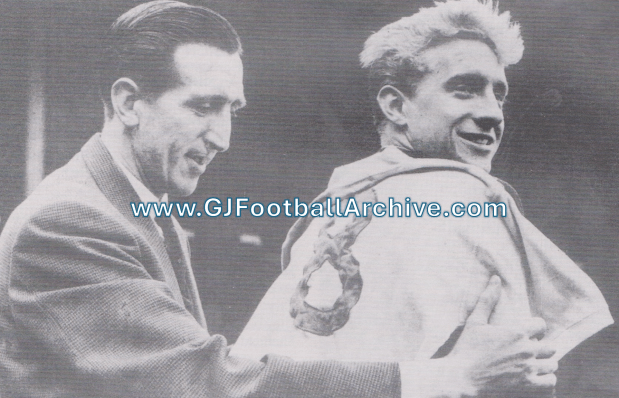
Ken Barnes welcomes Denis Law to Maine Road, 1960
It all came to a head at Leeds Road where Arsenal had sent coach Ron Greenwood to negotiate a good deal. At the same time City, represented by Les McDowall and Chairman Alan Douglas, were keen to sign the 20 year old Scotsman. The Gunners had only given Greenwood power to offer £25,000 plus David Herd, making a total of £50,000, whereas McDowall and Douglas were able to discuss the pros and cons of offering more. The discussions and negotiations went on while Law himself was playing Table Tennis in the games room. When the young player was summoned he quickly realised that his move to Arsenal was off and, after less than ten minutes, he agreed to join the Blues at a cost that was said to be three times his weight in gold.
Denis Law’s Manchester City debut 1960
Law made his debut a memorable one by scoring in the 4-3 defeat at Leeds on 19th March 1960. You can view Law’s first goal for City here:
I think the commentary was added some time after and that the commentary was done in a studio over the top. The commentator (is it Stuart Hall?) mentions City’s kit as being old gold and black but colour film of kit from that season shows City wearing yellow and maroon – as can be seen in this wonderful film from that same year which includes Tottenham v City from about 5 minutes in:
Eleven days after Law’s debut he scored again as City defeated West Ham 3-1. He made one other appearance, away at Chelsea, before the player became the subject of his first controversy at the Club. Law was selected to play for Scotland at Hampden Park on 9th April – the date of the vital home game with West Bromwich Albion – and the City management took the view that playing for your country was more important than playing for your club. This angered many supporters, who realised that a Law-less City would struggle and that relegation was still a strong possibility. The Blues were only two points above the relegation zone.
The controversy heightened when other clubs took a different view and refused to release players. The City Board then felt justified in asking the League for a postponement, but the League refused. In the programme for the game, the Board outlined their views and explained how the circumstance had occurred. The article ended by stressing that the situation of club V Country cannot be allowed to continue.
As expected, without Law the Blues were defeated 1-0.
You can find out more on Manchester City in the 1959-60 season by reading the following article on the season. This is available to subscribers.
Subscribe to get access
Read more of this content when you subscribe today. It costs £3 per month (cancel anytime) or sign up for a year at the discounted price of £20 per year (works out £1.67 per month). Subscribers access the 1000+ articles posted so far and the others scheduled during the life of your subscription.
If you enjoy all the free material on my website and would like to support my research and keep this website going (but don’t want to subscribe) then why not make a one-time donation (or buy me a coffee). All support for my research is valued and welcome. It allows me to keep some free material available for all. Thanks.
Manchester City’s recent results have inevitably brought many headlines and, of course, if you support a team whose form is one of mainly defeats then inevitably you’re bound to worry. For me, one thing it demonstrates more than anything else though is how wrong some were to claim that football is dominated by one club in a way that it has never been before. For several years now some have been claiming that City winning trophies is all about money; all about financial power that leaves others unable to cope. When we fail in life it’s easy to blame others but maybe those who make those comments should look at themselves first?
Instead, of analysing why their clubs fail, some have suggested ‘it’s not fair!’ and that there has never been a time when money has ruled football. I’ve been saying that this is untrue and that wealthy football clubs – or clubs that have received significant investment – have always been there, and that money is no guarantee of success. Those of us old enough to remember the late 1970s and early 1980s well know that City, Leeds, Wolves, Chelsea and others found that spending money could also lead to ruin.
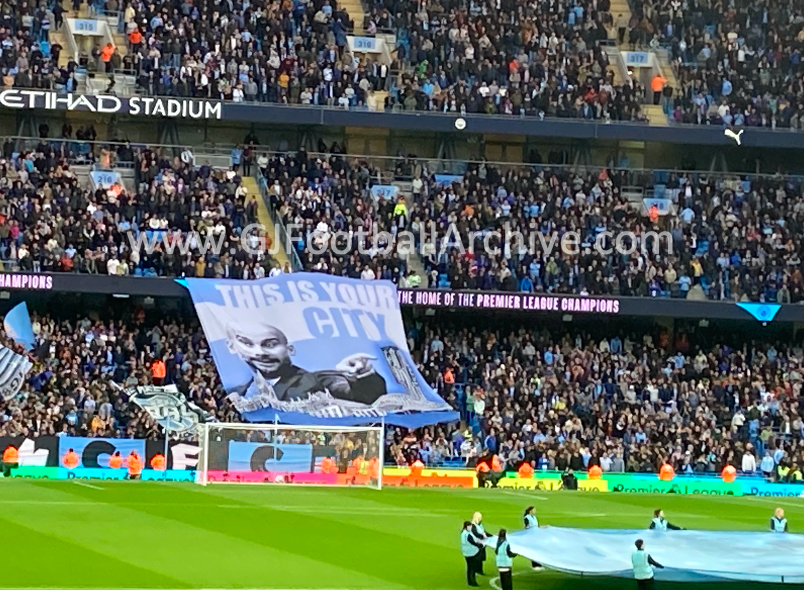
You don’t have to look far for articles from this last year which have talked about how unhealthy the Premier League is ‘because of City’ but, as I said at the time, those comments really were out of place. Recent results have demonstrated this further. What I said earlier this year (and in recent seasons) is that significant praise was due to City and their manager Pep Guardiola for everything they’ve achieved in a highly competitive domestic and European scene. It’s also clear that those clubs, fans and others who have tried to explain away a club’s failings by simply stating: ‘It’s unfair, we can’t compete with City’ actually need to look at their own club and recognise its failings. When we fail in life it’s easy to blame others but maybe look at your self first?
City’s current form is not great and defeats are either because the opposition are better or City have failed. It’s not because one team has more money than another; it’s because they played the game better. When City win trophies it’s not because they have more money; it’s because they’ve played better; coached better; found a way to play that’s better… So can those who claim that football is uncompetitive because of City now start to look at themselves first and see why their team fails?
We should all remember, whether at times of success or failure, that football is an entertaining game. Sometimes we win; sometimes we fail… no team has ever dominated for decades and therefore successes like City’s 4 league title in a row really are major achievements that should be celebrated and recognised by all!
Here’s a few articles from months/years ago that challenge/discuss some of the comments about dominance in the past:
On this day (10 November) in 1956 the great Don Revie left Manchester City for Sunderland. Revie had been in and out of favour with manager Les McDowall for over a year, but fans recognised his qualities. Here for subscribers is a profile of Don. Enjoy.
Subscribe to get access
Read more of this content when you subscribe today. It costs £3 per month or there’s a special discounted rate of £20 a year. Subscribers have access to everything posted on the site, including PDFs or Manchester A Football History and my 1st book on MCFC (published in 1989).
Colin Bell getting angry in a game? No, never! Err, yes actually. The unassuming, introverted Colin Bell had had enough on this day (30 January) in 1971 and you can see exactly why and his reaction in this video clip.
It’s actually a City defeat at home to Leeds but it is worth watching for Bell’s reaction – a nice reminder that all players have moments when they get angry with the ref. In the clip you’ll notice that it’s Francis Lee who acts as the calming influence with Bell – you’d expect it to be the other way around!
Also, look out for the old Invacar disabled cars parked pitchside in the corner between Kippax and Platt Lane. Just before Leeds score their second you can see that one of the guys in an Invacar has his windscreen wiper on – looking at the conditions it must have been difficult to see at times from inside those vehicles. Prior to this clip ITV presenter Brian Moore had told viewers that this was third placed City v leaders Leeds and that there was no game of more significance in the League that week.
This is part of my series of features/articles covering Manchester City in the 1970s. Watch the highlights of this game here:
Were you at the game and do you remember it? Feel free to give your story in the comments.
This series of articles and features on Manchester City in the 1970s will run throughout January with indepth articles some days and smaller ‘on this day’ style posts on others. There will be flashbacks to great games, players and more. Every day in January will offer something to enjoy.
Subscribers will get access to everything. If you want to know more on this incredible decade for Manchester City Football Club then why not subscribe and read it all? You could even subscribe for a month and see what you think. The following 5,200 word article is on the 1970-71 season and is available to subscribers below. Enjoy!
Subscribe to get access – Monthly
Read more of this content when you subscribe today. It costs £3 per month (cancel anytime) to access everything posted since 1 October 2022 or there’s a special annual rate below which gives greater access and works out much cheaper.
Read more of this content when you subscribe today. It costs £3 per month (above) or £20 a year (here) to access everything posted since the site was created in December 2020. This special rate works out about £1.67 a week and gives access to everything posted, including PDFs of 3 of my books.
If you enjoy all the free material on my website and would like to support my research and keep this website going (but don’t want to subscribe) then why not make a one-time donation (or buy me a coffee). All support for my research is valued and welcome. It allows me to keep some free material available for all. Thanks.
It seems that some have a view that the giant clubs remain giant clubs forever and that there are some clubs who have only recently become prominent. Others believe that teams that were giants decades before some of today’s major trophy winners were never actually that prominent. I could spend hours challenging those who hold these views and pointing out that teams such as Everton, Newcastle & City won major trophies before many of these clubs and were perceived as giants years earlier too (decades before in some cases!), but it doesn’t feel like they’d listen. Ah well! Instead as part of my series of features/articles covering Manchester City in the 1970s I’d like to post a few attendance details that may interest some.
The following are a list of the top seven best supported top flight clubs for the ten seasons prior to City’s relegation in 1983. The Manchester clubs are in bold and the numbers in brackets show each club’s league position that season. In addition if any of the clubs won the European Cup, UEFA Cup, ECWC, FA Cup or League Cup that is also listed in brackets.
AVERAGE ATTENDANCES – Top Tier 1973-74
42712 MUFC (21st); 42332 Liverpool (2nd & FA Cup winners); 38666 Leeds (1st); 33048 Birmingham (19th); 32861 Newcastle (15th); 30756 MCFC (14th).
AVERAGE ATTENDANCES – Top Tier 1974-75
45966 LFC (2nd); 40021 Everton (4th); 34822 Leeds (9th); 34614 Newcastle (15th); 32898 MCFC (8th); 30854 Birmingham (17th); 29872 West Ham (13th & FA Cup winners). Both Manchester United (48387) and Sunderland (29931) were in Division Two but had an average higher than some of those in the top seven top tier averages.
AVERAGE ATTENDANCES – Top Tier 1975-76
54750 MUFC (3rd); 41623 Liverpool (1st & UEFA Cup winners); 38874 Aston Villa (16th); 34280 MCFC (8th & LC winners); 33060 Newcastle (15th); 31511 Leeds (5th); 28350 Derby (4th). Sunderland in Division Two had an average of 31250.
AVERAGE ATTENDANCES – Top Tier 1976-77
53710 MUFC (6th & FA Cup winners); 47221 Liverpool (1st & European Cup winners); 40058 MCFC (2nd); 37903 Aston Villa (4th & LC winners); 33599 Newcastle (5th); 32743 Sunderland (20th), 32671 Arsenal (8th).
AVERAGE ATTENDANCES – Top Tier 1977-78
51860 MUFC (10th); 45546 Liverpool (2nd & European Cup winners); 41687 MCFC (4th); 39513 Everton (3rd); 35464 Aston Villa (8th); 35446 Arsenal (5th); 32501 Nottm Forest (1st & LC winners). Tottenham were in Division Two with an average of 33417.
AVERAGE ATTENDANCES – Top Tier 1978-79
46430 MUFC (9th); 46407 Liverpool (1st); 36371 Arsenal (7th & FA Cup winners); 36203 MCFC (15th); 35456 Everton (4th); 34902 Tottenham (11th); 32838 Aston Villa (8th).
AVERAGE ATTENDANCES – Top Tier 1979-80
51608 MUFC (2nd); 44586 Liverpool (1st); 35272 MCFC (17th); 33596 Arsenal (4th); 32018 Tottenham (14th); 29794 Crystal Palace (13th); 28711 Everton (19th).
1979-80 League table and attendance detail up to 26/4/1980
AVERAGE ATTENDANCES – Top Tier 1980-81
45071 MUFC (8th); 37547 Liverpool (5th & LC winners); 34117 Aston Villa (1st); 33587 MCFC (12th); 32480 Arsenal (3rd); 30724 Tottenham (10th & FA Cup winners); 26477 Sunderland (17th). West Ham were in Division Two with an average of 27140.
Kippax Stand c.1980
AVERAGE ATTENDANCES – Top Tier 1981-82
44571 MUFC (3rd); 35100 Tottenham (4th & FA Cup winners); 35061 Liverpool (1st & LC winners); 34063 MCFC (10th); 26780 Aston Villa (11th & European Cup winners); 26585 West Ham (9th); 25589 Arsenal (5th).
1981 City v United Maine Road
AVERAGE ATTENDANCES – Top Tier 1982-83
41552 MUFC (3rd & FA Cup winners); 34758 Liverpool (1st & LC winners); 30581 Tottenham (4th); 26789 MCFC (20th); 24153 Arsenal (10th); 23748 Aston Villa (6th); 22822 West Ham (8th). Second Division Newcastle attracted an average of 24166.
Fans storming the main entrance in 1983. Mirrorpix photo
For those wondering Manchester City did drop a little in terms of position in the attendance chart during their Second Division days but they were still the 6th best supported club (of all clubs) in 1983-84 and 8th best in 1984-85. Back in Division One in 1985-86 the Blues were once again the 4th best supported team in the entire League.
This series of articles and features on Manchester City in the 1970s has been running throughout January with indepth articles some days and smaller ‘on this day’ style posts on others. Every day in January will offer something to enjoy.
Subscribers will get access to everything. If you want to know more on this incredible decade for Manchester City Football Club then why not subscribe and read it all? You could even subscribe for a month and see what you think. The following 1,600 word article is on the 1974-75 season and is available to subscribers below. Enjoy!
Subscribe to get access – Monthly
Read more of this content when you subscribe today. It costs £3 per month (cancel anytime) to access everything posted since 1 October 2022 or there’s a special annual rate below which gives greater access and works out much cheaper.
Read more of this content when you subscribe today. It costs £3 per month (above) or £20 a year (here) to access everything posted since the site was created in December 2020. This special rate works out about £1.67 a week and gives access to everything posted, including PDFs of 3 of my books.
If you enjoy all the free material on my website and would like to support my research and keep this website going (but don’t want to subscribe) then why not make a one-time donation (or buy me a coffee). All support for my research is valued and welcome. It allows me to keep some free material available for all. Thanks.





 Gary James' Football Archive