Swansea and City

It’s Swansea v Manchester City tonight in the League Cup and so Here’s a few historical facts and stats about games between the two clubs.

Game One: The first competitive meeting between the two teams came in Division Two on 25 September 1926. The Blues had been relegated the previous May and the historic first meeting with Swansea Town (Swansea was not a city at this point) ended in a 3-1 City victory at Maine Road, before 24,314 fans. George Hicks, Tommy Johnson & Frank Roberts netted for the Blues.

The return game also ended in a 3-1 win on 12 February 1927. Hicks and Johnson both scored again, with Johnson netting twice. A Swansea crowd of 20,345 watched on.

The first top flight game between the sides didn’t come until 21 November 1981 (following Swansea’s promotion) and saw two each from Kevin Reeves and Dennis Tueart (the first a penalty 4 minutes before half time) help City to a 4-0 win.

The first Premier League meeting came on 15 August 2011 – another 4-0 City win. This time Dzeko, Aguero (2) and David Silva each scored at the Etihad before 46,802. Film of that game here:

https://www.mancity.com/citytv/match-highlights/2011/august/city-v-swansea-60-seconds

Incredibly the first FA Cup meeting didn’t come until 16 March 2019 and this saw City win 3-2 at Swansea (OG from Kristoffer Nordfeldt, Bernardo Silva & Sergio Aguero). City had been losing 2-0 (a penalty from Matt Grimes in 20th minute and Bersant Celina netted the other in 29th minute) up until Silva’s 69th minute goal. The action from this game can be viewed here:

https://www.mancity.com/citytv/match-highlights/2019/march/swansea-v-city-highlights-extended

The first League Cup tie was a 2-1 City win at Swansea in 2016:

https://bluemoon-mcfc.co.uk/History/Matches/Match.aspx?id=5300

The highest scoring game between the teams came in August 1927 when City beat Swansea Town 7-4 in Division Two. 34,316 watched a hat trick from Tommy Johnson and other goals from Peter Bell, Charlie Broadhurst, George Hicks and Frank Roberts.

Here’s hoping tonight’s game brings as much entertainment as that one did.

While you’re here, it’s worth taking a look at something else already posted on http://www.GJFootballArchive.com. It’s a profile of Tommy Hutchison who was a cult hero at MCFC and also spent time with Swansea City:

THE STARTING ELEVEN – Tommy Hutchison

Manchester City’s Three Royal Boxes!

Last Saturday (25 October 2025) I was fortunate to be invited to the England v Brazil women’s international as a guest of the FA. My seat was in the Royal Box at the Etihad (City of Manchester Stadium as it was named on the night due to sponsorship reasons). On social media someone commented that the Royal Box was a bit of a stretch in terms of its name but the truth is that the Directors Box (as it’s more commonly known) has housed members of the British royal family, including the late Queen Elizabeth II. In fact it was originally named the Royal Box for the Commonwealth Games in 2002. Back then I remember suggesting it should retain the name and now, maybe, the original name should return?

Other royals, including the former King of Spain, have sat there for Manchester City games and other events, so the name would be quite apt. Funnily enough, the Etihad’s ‘Royal Box’ isn’t the first part of a City ground to be given that name. It’s not even the second but the third! Both Maine Road and before that Hyde Road, had visits from senior members of the British Royal Family and on each occasion the Directors Box was spruced up and renamed the Royal Box for the game. Here’s the current King’s great grandad at Hyde Road’s Royal Box in 1920:

The King with the Mayor in Hyde Road’s ‘Royal Box’. Notice Lawrence Furniss stood, behind the King. Furniss was a major figure from the 1880s to the 1940s at City.

So, City, how about renaming the Directors Box the Royal Box again?

The following subscriber article talks about all of that, but in essence the current King’s dad, grandad and great grandad have all attended City matches at one of City’s home grounds. You can read about those visits here:

Subscribe to get access – Monthly

Read this 1,600 word article when you subscribe today. It costs £3 per month (cancel any time) or £20 a year. As well as this article you get to access books, videos, history talks, interviews and other articles.

Subscribe to get access – Annual

Annual subscribers access everything since the site went live in December 2020. Monthly subscribers get everything since 1 October 2022. All subscribers access new posts throughout their subscription.

The New Badge & Pep’s Arrival

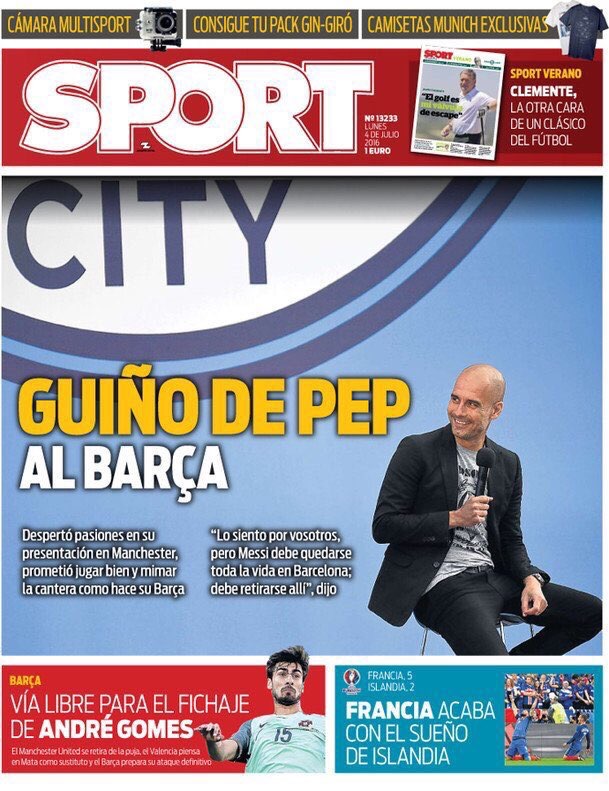
On this day (3 July) in 2016 the new Manchester City badge was officially launched at the Cityzens Weekend. It was also the formal official welcome for new manager Pep Guardiola. There was a surreal moment for me when I was asked to go on stage to be interviewed about the new badge.

I had been consulted by the club on the history of all of City’s badges, emblems and similar for about a year or so, and had performed a series of talks to fans throughout the consultation period.

https://gjfootballarchive.com/wp-content/uploads/2024/07/img_2377.mov

This was the most detailed badge consultation had ever performed with fans at any club – sadly too many clubs impose a badge without listening to fans. Doing the talks as part of the consultation helped bring out the stories of each emblem and why it was significant – or not! Understanding why, for example, the red rose was introduced in 1972 following the takeover of the club by Joe Smith & Co. or how the 3 emblazoned lines had always been a part of City’s badge (apart from 1972 and the Swales years that followed) helped some determine what elements mattered most to them.

You can find out more about City’s badge history here:

In 2016 I was the warm up act for Pep so it’s a wonder anybody listened. It was a great, positive day for the club and for all of us there. The years since Pep’s arrival have been truly outstanding. We all had hope on this day in 2016 but who’d have thought it would have been as great as it has been?

The New Badge & Pep’s Arrival

On this day (3 July) in 2016 the new Manchester City badge was officially launched at the Cityzens Weekend. It was also the formal official welcome for new manager Pep Guardiola. There was a surreal moment for me when I was asked to go on stage to be interviewed about the new badge.

I had been consulted by the club on the history of all of City’s badges, emblems and similar for about a year or so, and had performed a series of talks to fans throughout the consultation period.

https://gjfootballarchive.com/wp-content/uploads/2024/07/img_2377.mov

This was the most detailed badge consultation had ever performed with fans at any club – sadly too many clubs impose a badge without listening to fans. Doing the talks as part of the consultation helped bring out the stories of each emblem and why it was significant – or not! Understanding why, for example, the red rose was introduced in 1972 following the takeover of the club by Joe Smith & Co. or how the 3 emblazoned lines had always been a part of City’s badge (apart from 1972 and the Swales years that followed) helped some determine what elements mattered most to them.

You can find out more about City’s badge history here:

In 2016 I was the warm up act for Pep so it’s a wonder anybody listened. It was a great, positive day for the club and for all of us there. The years since Pep’s arrival have been truly outstanding. We all had hope on this day in 2016 but who’d have thought it would have been as great as it has been?

Royal Blues

On this day (20 October 1934) King Charles III’s grandad attended Maine Road to watch Manchester City face Derby County in the League. It wasn’t the first time a senior member of the royal family attended a City home game, nor was it the last time a future monarch or monarch attended Manchester City’s home. You can read about those visits here:

Subscribe to get access – Monthly

Read this 1,600 word article when you subscribe today. It costs £3 per month (cancel any time) or £20 a year. As well as this article you get to access books, videos, history talks, interviews and other articles.

Subscribe to get access – Annual

Annual subscribers access everything since the site went live in December 2020. Monthly subscribers get everything since 1 October 2022. All subscribers access new posts throughout their subscription.

Goalscoring Nationalities

Prior to this weekend’s game with Spurs, Manchester City have had players from 41 different nations score for the Blues in the Premier League. Can you remember them all? The following 1200 word article tells the story…

Subscribe to get access

Read this content when you subscribe today. It costs £20 a year or £3 per month (see below). Annual subscribers access everything posted to the site including interviews, talks, books and hundreds of articles plus everything posted during your subscription.

Subscribe to get access

Monthly subscribers (£3, cancel anytime) get access to everything posted to the site since 1 October 2022 plus everything posted during your subscription.

Incoming: Pep

On this day (1 February) in 2016 after increasing speculation from the media Manchester City announced that Pep Guardiola would succeed Manuel Pellegrini as their manager in the summer. The BBC’s Phil McNulty said at the time: “The combination of the charismatic Catalan’s coaching brilliance and the financial backing he will receive makes this a partnership the rest of football world could come to fear.”

Here’s the BBC Report from that day:

https://www.bbc.co.uk/sport/football/35461090

Jesus’ First

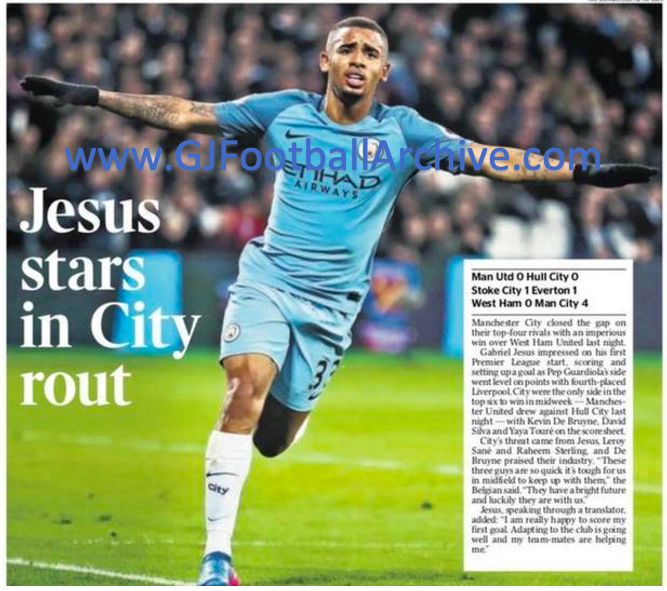
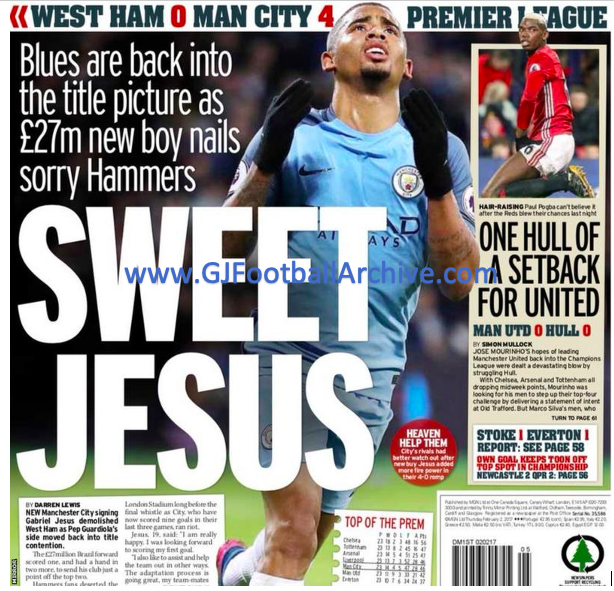
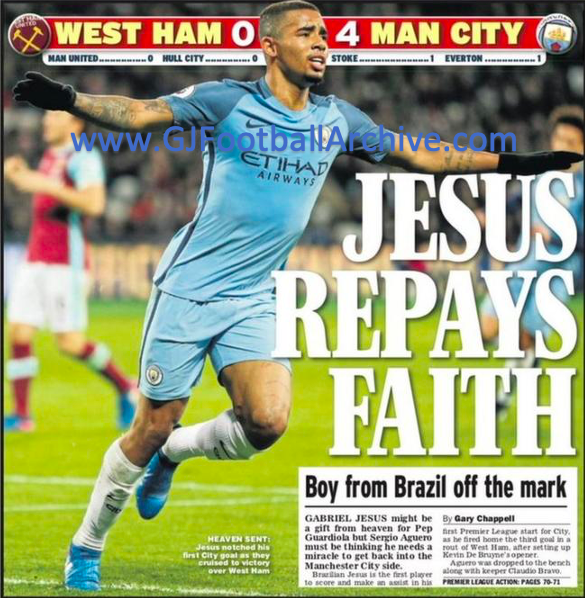
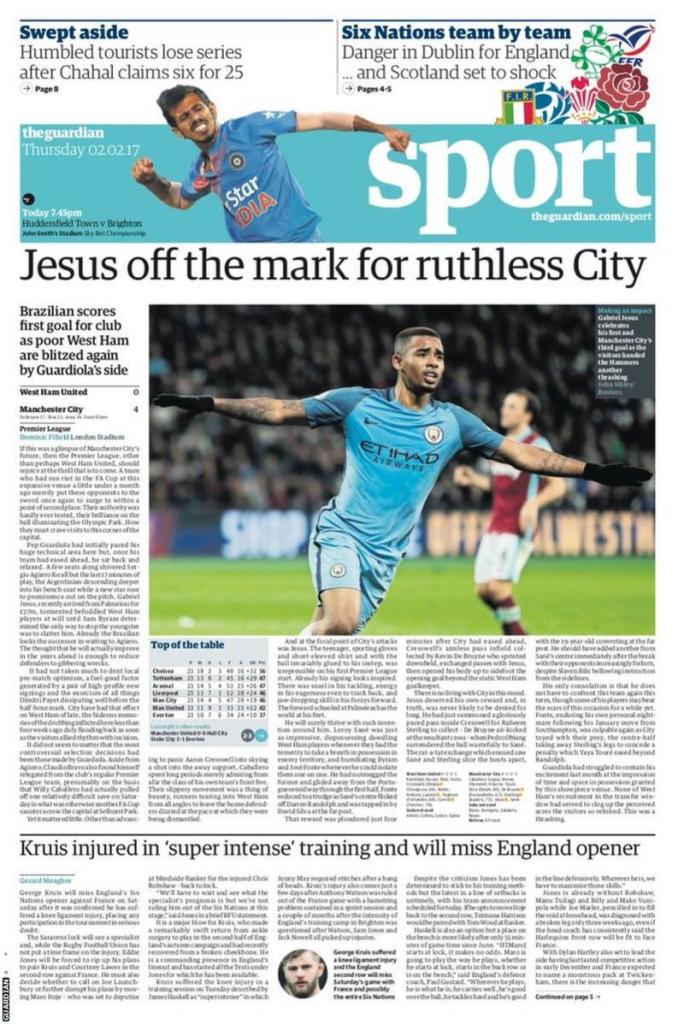
Today (1 February) in 2017 Gabriel Jesus scored his first Manchester City goal as the Blues defeated West Ham 4-0. The goals were from De Bruyne (17), David Silva (21), Jesus (39) and Toure (pen, 67) at the former London Olympic Stadium. Attendance 56,980. A few stats and reports from that day/the game here:

  • Gabriel Jesus became the first player to both score and assist a goal on their first Premier League start for Manchester City.
  • Jesus also became the second youngest Brazilian player to score his first Premier League goal (19yrs 304days), after Rafael for Manchester United in November 2008 (18yrs 122days).
  • David Silva scored his third away Premier League goal against West Ham – his highest tally of away goals against another opponent in the competition.
  • Yaya Toure has scored all 11 of his Premier League penalties – the best 100% record in the competition.
  • In his 50th Premier League game, Kevin de Bruyne recorded his 30th goal involvement in the competition (11 goals, 19 assists).
  • City have scored nine goals in two games in all competitions at London Stadium – just half the number West Ham have (18) in 17 games there.

FA Cup: Manchester City v Arsenal

It’s Manchester City v Arsenal on Friday. The first FA Cup tie between these clubs came in 1904 and was part of Manchester’s first major trophy winning campaign. The two sides met at Arsenal in the second round of the competition. Back then City were a top flight team while Woolwich Arsenal were in the Second Division and some reports talked of the Gunners being envious of Manchester City and their status (how often do modern interpretations of a club’s status forget the game’s full history hey?). Arsenal had defeated Fulham 1-0 in the previous round. 

The Blues defeated the Gunners 2-0 with goals from Sandy Turnbull and Frank Booth, prompting the Manchester Evening News to print a cartoon of Billy Meredith leapfrogging over the Gunners while Tom Maley, dressed in kilt, watches. 

Outside-left Frank Booth, one of the scorers, had joined City in April 1902 making his first appearance for the Club in a friendly with Celtic on 1 September 1902.  That friendly appearance brought a little bad luck to the player as fairly early on in the match he accidentally collided with Celtic’s Right-back Hugh Watson causing him to leave the field for twenty minutes or so.  When he returned however he seemed more determined than ever to prove what he was capable of and, when a chance came his way, he scored what was described as a “very fine” goal to give City a 1-0 victory.

Throughout Booth’s career prior to the Arsenal game he had been rather unlucky with injuries and, at times, must have seriously considered concentrating on a life outside of the sport.  He was a hatter by trade, coming from the local hatting areas surrounding the towns of Hyde and Denton, and had only completed his apprenticeship in 1903.  Nevertheless a career in football had to be more appealing than life in one of the large hatting factories of east Manchester.

Here’s a brief cutting mentioning the game. Note also the difficulties being experienced by Second Division Manchester United (again, how often do modern day commentators on the game’s history forget the full history?).

After the tie with Arsenal at Plumstead, George Robey, a very famous Music Hall comedian with a love of football, took the City team to visit the capital’s top Music Halls.  Such light relief was needed in the City camp as the realisation was now dawning that the Blues might seriously be contenders for the League and Cup double that at this point in history had only been achieved by Preston (1889) and Aston Villa (1897). 

For a side (indeed a city) whose only national success so far had been to win the Second Division, this must have felt like an impossible dream but, as the season progressed it became increasingly possible.

You can read about what happened next here:

The next FA Cup meeting between the teams didn’t come until 1932 when they met in at the semi-final stage.

You can read all about that here:

Since 1932 the sides have met in the competition on 17/2/1971 at Maine Road (a 2-1 Arsenal win); the 2017 semi-final (2-1 aet for Arsenal); and again in the 2020 semi played on 18 July 2020 (a 2-0 Arsenal win).

A City FA Cup win over Arsenal is long overdue!

Manchester City Women’s First FA Cup Final

Manchester City Women’s (then as Manchester City Ladies) first FA Cup tie was a 7-2 defeat at Robin Park, Wigan on 17 September 1989. This was only the second competitive game ever played by the club and came less than a year after formation. Since then, apart from a couple of seasons in the 1990s when the Blues decided not to enter, City have been regular competitors in the competition. In September 1999 City achieved their record score in the competition: 26-0 v Norton, WFA Cup Extra Preliminary Round and on this day (May 13) in 2017 they reached the FA Cup final for the first time.

Here for subscribers is the story of that final as told by those involved and those who were there… as documented in Manchester City Women: An Oral History – get your copy here if you don’t want to subscribe to this site:

Subscribe to get access

Read more of this content and every thing else on this when you subscribe today. £20 per year (about £1.67 a month) or £3 a month at a time. Thanks