This weekend it’s Manchester City v Ipswich. My new series of programme articles starts on Saturday. It’s a 2 page feature in which I find a photo from City’s past and then explain the image and talk about those involved and the moment itself. I’ll leave everyone to guess which image has been selected but before then here’s another image from a City-Ipswich match.
This is from 6 December 1980. It’s a photo of tenacious Gerry Gow scoring against Bobby Robson’s Ipswich Town at Maine Road.
City were losing 1-0 and then in the 76th minute a scramble in the visitors penalty area saw Phil Boyer (centre of this photo) battling for the ball close to future City ‘keeper Paul Cooper. In the end it’s Gerry Gow, on the right being challenged by John Wark, who digs out the ball and sends it goalwards to make it 1-1.
This was a season of classic games against Ipswich, who were chasing a potential treble trophy success. You can read about the others if you’re a subscriber. Subscribers can read the following ten thousand word long read on the 1980-81 season. Enjoy!
Subscribe to get access – Monthly
Read more of this content when you subscribe today. It costs £3 per month (cancel anytime) to access everything posted since 1 October 2022 or there’s a special annual rate below which gives greater access and works out much cheaper.
Read more of this content when you subscribe today. It costs £3 per month (above) or £20 a year (here) to access everything posted since the site was created in December 2020. This special rate works out about £1.67 a week and gives access to everything posted, including PDFs of 3 of my books.
On this day (May 9) in 1981 the 100th FA Cup Final took place between Manchester City and Tottenham. Below is a long read on the final but before details of that, there are also profiles of City’s starting 11 on the site. Here’s a link to the one on Tommy Hutchison published 3 years ago (it’s a free read). Enjoy:
Here for subscribers is a long read on the build up, the final and the post-final scenes. It contains material from interviews I have performed over the years with Dennis Tueart, John Bond and Joe Corrigan. There are also a few quotes that may surprise readers of what discussions took place after the final.
Here goes….
Subscribe to get access
Read more of this content when you subscribe today.
On this day (April 11) in 1981 John Bond’s Manchester City faced Bobby Robson’s Ipswich in the FA Cup semi-final. Here’s a piece I wrote for the Times a few years back on the significance of the game for both teams.
Subscribers can view the article and all others on here (including the entire Manchester A Football History and a PDF of my first book). It costs £20 a year (works out about £1.67 a month) or join up a month at a time for £3 and you can sign up below. Thanks.
Subscribe to get access
Read more of this content when you subscribe today.
The series of features/articles covering Manchester City in the 1970s continues with this article on Malcolm Allison. Allison’s two spells as City manager only saw the Blues receive one trophy – the 1972 Charity Shield – however he deserves to be profiled as his contribution during the glory years of 1965 to 1972 was equal to that of manager Joe Mercer.
Allison arrived at Maine Road in July 1965 as assistant manager to Mercer, and by the time he left for the first time over seven years later, City had won almost every trophy possible.
During that time Allison worked closely with the players and it’s worth noting that the close relationship he developed with the players fostered a great team spirit which, possibly above all else, helped the Blues succeed. Allison’s influence was felt throughout the club and his approach was refreshing. He was like a breath of fresh air and helped bring life to the club after a particularly depressing spell – remember earlier in 1965 the club attracted only eight thousand for a couple of League games and some felt the Blues would never return to the top flight never mind find trophy success.
Allison was a major influence throughout the club and his ‘fortune favours the brave’ swashbuckling approach helped sweep aside all opposition. In fact as the 1960s progressed Allison typified Sixties Manchester, and he became a man idolised by most Blues and many neutrals. He had a certain charisma which few leading footballing figures possessed at the time, and his dynamism was infectious. If Allison said City was going to win everybody believed him; when he said City would terrify Europe no one doubted him. Of course, the terrify Europe comment came to haunt him when the Blues were defeated by Fenerbahce in their first European tie, however Allison had the last laugh when City won the European Cup Winners’ Cup the following season. When I interviewed him in the early 1990s he laughed: “I said we’d terrify Europe, but I didn’t say when!”
During his time at Maine Road Allison was responsible for a number of the key transfers which transformed the club’s fortunes. Colin Bell and Francis Lee were two signings he claimed personal credit for when I interviewed him: “When I signed Bell I had to pretend he was no good to put the other clubs off because we didn’t have enough money and couldn’t afford to get into a bidding war. With Francis Lee I told him I’d make him a great player, and when I left the room he told everyone I was an arrogant so and so! But he did join us and he was a great player, perhaps the key to the Championship success.”
Allison was also responsible for the arrival of captain Tony Book. Book brought a steadying influence to City both in defence and across the pitch, and flourished at Maine Road as a player and later as a manager.
Another great aspect of Allison’s time at City was his ability to grab the headlines for the club. Prior to his arrival, City struggled to get positive coverage in the local press but, together with Joe Mercer, Allison knew how to bring attention to the club. Mercer was the all-smiling public establishment type figure who would provide a serious story in a light-hearted way, while Allison was more boastful and always likely to make the bold statements many supporters demanded. Allison would often taunt the opposition. He once walked up to the Stretford End before an early seventies derby match and held up four fingers to indicate how many goals he expected City to score against the Reds. Understandably, the United fans hurled abuse at him, but by the end of the match the confident Allison was laughing as City won 4-1. That’s why he was such an important figure. He understood what made City tick.
Sadly, the early seventies saw a rift between Mercer and Allison – they supported different groups during a takeover battle – and the partnership fell apart. Allison became Manager in his own right but he was no longer able to motivate himself in the right way. In 1992 he told me: “Kenny Dalglish wanted a sabbatical at Liverpool to ease the pressure a few years back, and I think if I’d been offered something similar I’d have come back stronger but in those days you either managed or left. There was no choice.”
Allison then started a journey which would see him return to Maine Road in 1979, as well as have spells at Crystal Palace, Lisbon, Istanbul, Middlesbrough, Kuwait, and a whole host of other locations. Some like his image were exotic, others were not. He achieved some real success – most notably in Portugal – and some abject failure but he always remained the ‘Big Mal’ every City fan loved. His last public managerial role saw him help Bristol Rovers face Ron Atkinson’s Aston Villa in the Cup during the 1992-3 season. The media had described it as ‘Big Mal V Big Ron’ but Allison insisted on telling the BBC that he was the only ‘Big’ in football and that his opponent was ‘Fat Ron’. It didn’t alter the result of the game, but it gained the headlines.
Of course, despite Allison’s enormous role in Manchester football it has to be stressed that his second spell at Maine Road was not a successful period. With hindsight Allison should never have returned, but when the announcement had initially been made there wasn’t a single supporter who complained. Everybody wanted him back.
Allison remains one of the most important figures in the history of the club and in European football.
This series of articles and features on Manchester City in the 1970s has been running throughout January and February with indepth articles some days and smaller ‘on this day’ style posts on others. Every day offered something to enjoy.
Subscribers have access to everything. If you want to know more on this incredible decade for Manchester City Football Club then why not subscribe and read it all? You could even subscribe for a month and see what you think. The following 1,700 word article is on the 1972-73 season and is available to subscribers below. Enjoy!
Subscribe to get access – Monthly
Read more of this content when you subscribe today. It costs £3 per month (cancel anytime) to access everything posted since 1 October 2022 or there’s a special annual rate below which gives greater access and works out much cheaper.
Read more of this content when you subscribe today. It costs £3 per month (above) or £20 a year (here) to access everything posted since the site was created in December 2020. This special rate works out about £1.67 a week and gives access to everything posted, including PDFs of 3 of my books.
If you enjoy all the free material on my website and would like to support my research and keep this website going (but don’t want to subscribe) then why not make a one-time donation (or buy me a coffee). All support for my research is valued and welcome. It allows me to keep some free material available for all. Thanks.
It seems that some have a view that the giant clubs remain giant clubs forever and that there are some clubs who have only recently become prominent. Others believe that teams that were giants decades before some of today’s major trophy winners were never actually that prominent. I could spend hours challenging those who hold these views and pointing out that teams such as Everton, Newcastle & City won major trophies before many of these clubs and were perceived as giants years earlier too (decades before in some cases!), but it doesn’t feel like they’d listen. Ah well! Instead as part of my series of features/articles covering Manchester City in the 1970s I’d like to post a few attendance details that may interest some.
The following are a list of the top seven best supported top flight clubs for the ten seasons prior to City’s relegation in 1983. The Manchester clubs are in bold and the numbers in brackets show each club’s league position that season. In addition if any of the clubs won the European Cup, UEFA Cup, ECWC, FA Cup or League Cup that is also listed in brackets.
AVERAGE ATTENDANCES – Top Tier 1973-74
42712 MUFC (21st); 42332 Liverpool (2nd & FA Cup winners); 38666 Leeds (1st); 33048 Birmingham (19th); 32861 Newcastle (15th); 30756 MCFC (14th).
AVERAGE ATTENDANCES – Top Tier 1974-75
45966 LFC (2nd); 40021 Everton (4th); 34822 Leeds (9th); 34614 Newcastle (15th); 32898 MCFC (8th); 30854 Birmingham (17th); 29872 West Ham (13th & FA Cup winners). Both Manchester United (48387) and Sunderland (29931) were in Division Two but had an average higher than some of those in the top seven top tier averages.
AVERAGE ATTENDANCES – Top Tier 1975-76
54750 MUFC (3rd); 41623 Liverpool (1st & UEFA Cup winners); 38874 Aston Villa (16th); 34280 MCFC (8th & LC winners); 33060 Newcastle (15th); 31511 Leeds (5th); 28350 Derby (4th). Sunderland in Division Two had an average of 31250.
AVERAGE ATTENDANCES – Top Tier 1976-77
53710 MUFC (6th & FA Cup winners); 47221 Liverpool (1st & European Cup winners); 40058 MCFC (2nd); 37903 Aston Villa (4th & LC winners); 33599 Newcastle (5th); 32743 Sunderland (20th), 32671 Arsenal (8th).
AVERAGE ATTENDANCES – Top Tier 1977-78
51860 MUFC (10th); 45546 Liverpool (2nd & European Cup winners); 41687 MCFC (4th); 39513 Everton (3rd); 35464 Aston Villa (8th); 35446 Arsenal (5th); 32501 Nottm Forest (1st & LC winners). Tottenham were in Division Two with an average of 33417.
AVERAGE ATTENDANCES – Top Tier 1978-79
46430 MUFC (9th); 46407 Liverpool (1st); 36371 Arsenal (7th & FA Cup winners); 36203 MCFC (15th); 35456 Everton (4th); 34902 Tottenham (11th); 32838 Aston Villa (8th).
AVERAGE ATTENDANCES – Top Tier 1979-80
51608 MUFC (2nd); 44586 Liverpool (1st); 35272 MCFC (17th); 33596 Arsenal (4th); 32018 Tottenham (14th); 29794 Crystal Palace (13th); 28711 Everton (19th).
1979-80 League table and attendance detail up to 26/4/1980
AVERAGE ATTENDANCES – Top Tier 1980-81
45071 MUFC (8th); 37547 Liverpool (5th & LC winners); 34117 Aston Villa (1st); 33587 MCFC (12th); 32480 Arsenal (3rd); 30724 Tottenham (10th & FA Cup winners); 26477 Sunderland (17th). West Ham were in Division Two with an average of 27140.
Kippax Stand c.1980
AVERAGE ATTENDANCES – Top Tier 1981-82
44571 MUFC (3rd); 35100 Tottenham (4th & FA Cup winners); 35061 Liverpool (1st & LC winners); 34063 MCFC (10th); 26780 Aston Villa (11th & European Cup winners); 26585 West Ham (9th); 25589 Arsenal (5th).
1981 City v United Maine Road
AVERAGE ATTENDANCES – Top Tier 1982-83
41552 MUFC (3rd & FA Cup winners); 34758 Liverpool (1st & LC winners); 30581 Tottenham (4th); 26789 MCFC (20th); 24153 Arsenal (10th); 23748 Aston Villa (6th); 22822 West Ham (8th). Second Division Newcastle attracted an average of 24166.
Fans storming the main entrance in 1983. Mirrorpix photo
For those wondering Manchester City did drop a little in terms of position in the attendance chart during their Second Division days but they were still the 6th best supported club (of all clubs) in 1983-84 and 8th best in 1984-85. Back in Division One in 1985-86 the Blues were once again the 4th best supported team in the entire League.
This series of articles and features on Manchester City in the 1970s has been running throughout January with indepth articles some days and smaller ‘on this day’ style posts on others. Every day in January will offer something to enjoy.
Subscribers will get access to everything. If you want to know more on this incredible decade for Manchester City Football Club then why not subscribe and read it all? You could even subscribe for a month and see what you think. The following 1,600 word article is on the 1974-75 season and is available to subscribers below. Enjoy!
Subscribe to get access – Monthly
Read more of this content when you subscribe today. It costs £3 per month (cancel anytime) to access everything posted since 1 October 2022 or there’s a special annual rate below which gives greater access and works out much cheaper.
Read more of this content when you subscribe today. It costs £3 per month (above) or £20 a year (here) to access everything posted since the site was created in December 2020. This special rate works out about £1.67 a week and gives access to everything posted, including PDFs of 3 of my books.
If you enjoy all the free material on my website and would like to support my research and keep this website going (but don’t want to subscribe) then why not make a one-time donation (or buy me a coffee). All support for my research is valued and welcome. It allows me to keep some free material available for all. Thanks.
Here’s a nice Christmassy Manchester City match programme cover from today (27 December) in 1980. This was for City’s game with Wolves. Some of the players look happy others seem to have a fixed stare as if to say ‘do we really need to hold this banner?’
That day City defeated Wolves 4-0 with goals from Tommy Hutchison (2 goals; holding the banner above the ‘a’ in Christmas), Bobby McDonald (3rd player from right) and Kevin Reeves (4th player from right).
You can find out more on the 1980s, John Bond (including a fairly frank audio interview I did with him years ago) and City elsewhere on this website. Subscribers get access to a lot of extra content. To subscribe see the following:
If you enjoy all the free material on my website and would like to support my research and keep this website going (but don’t want to subscribe) then why not make a one-time donation (or buy me a coffee). All support for my research is valued and welcome. It allows me to keep some free material available for all. Thanks.
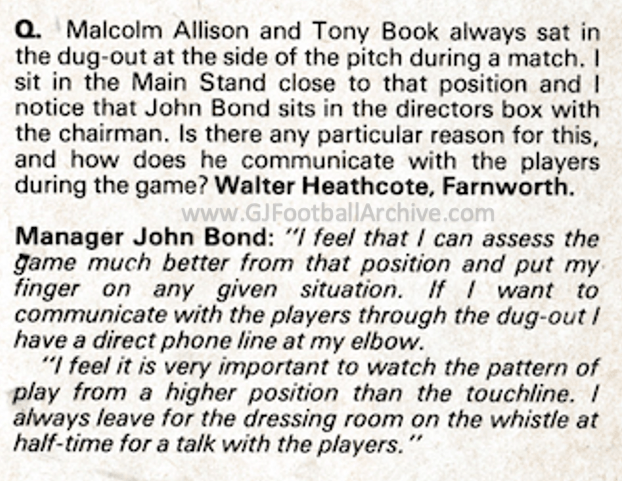
It’s December 1980 and the City match programme’s letters page contained this letter about new City boss John Bond. Back then many managers would prefer to sit in the directors’ box at games as it would give them a good view and John Bond chose to do that for many games during his opening months as manager (often throughout his actual time at City to be fair). It wasn’t so unusual but this fan wanted to understand why and wrote to the City programme looking for an answer.
It’s actually the sort of question that would seem more appropriate today as few managers ever really spend time in the directors’ box. I certainly wouldn’t expect Pep to sit up there on a regular basis.
Just one of the many things that has changed over the decades. The letter writer claimed that Malcolm Allison never sat in the directors’ box – that’s not true. There are plenty of occasions in the 60s & 70s when Allison sat up there.
You can find out more on the 1980s, John Bond (including a fairly frank audio interview I did with him years ago) and City elsewhere on this website. Subscribers get access to a lot of extra content. To subscribe see the following:
If you enjoy all the free material on my website and would like to support my research and keep this website going (but don’t want to subscribe) then why not make a one-time donation (or buy me a coffee). All support for my research is valued and welcome. It allows me to keep some free material available for all. Thanks.
Continuing the series of articles covering the 1980s. Today’s is an on this day (20 December) from 1980 when Kevin Reeves scored a City goal at Maine Road against Leeds United. City are wearing their popular all blue (and white numbers etc.) kit. You can see Reeves’ goal here:
The game ended 1-0 and if you’d like to know more about that season then why not subscribe and read the following ten thousand word long read on the 1980-81 season. Enjoy!
Subscribe to get access – Monthly
Read more of this content when you subscribe today. It costs £3 per month (cancel anytime) to access everything posted since 1 October 2022 or there’s a special annual rate below which gives greater access and works out much cheaper.
Read more of this content when you subscribe today. It costs £3 per month (above) or £20 a year (here) to access everything posted since the site was created in December 2020. This special rate works out about £1.67 a week and gives access to everything posted, including PDFs of 3 of my books.
Continuing the series focusing on Manchester City in the 1980s here’s a list of items available at the City Souvenir Shop in December 1982. It’s an interesting list but what would you want to buy?
For a few minutes I was puzzled by the items marked ‘centenary’ thinking are they talking of the centenary of the earliest known game as St Mark’s in 1880 or have they got things completely wrong? Then I realised these items refer to the 100th FA Cup Final (so not really a centenary of the FA Cup either, but I do know City’s souvenir shop did talk of it as the ‘Centenary Final’, though that is usually regarded as the 1972 final; the 1981 final was known as the ‘100th Final’).
I bet there are a few reading this who bought some of the items on the list.
If you want to know more about this period then why not subscribe? As well as all the other benefits you could read the following 3,500 word feature on the 1982-83 season. Enjoy (well, if you know the outcome of this season you can enjoy this memory refresh while reflecting on the modern day successes of the Blues!).
Subscribe to get access – Monthly
Read more of this content when you subscribe today. It costs £3 per month (cancel anytime) to access everything posted since 1 October 2022 or there’s a special annual rate below which gives greater access and works out much cheaper.
Read more of this content when you subscribe today. It costs £3 per month (above) or £20 a year (here) to access everything posted since the site was created in December 2020. This special rate works out about £1.67 a week and gives access to everything posted, including PDFs of 3 of my books.
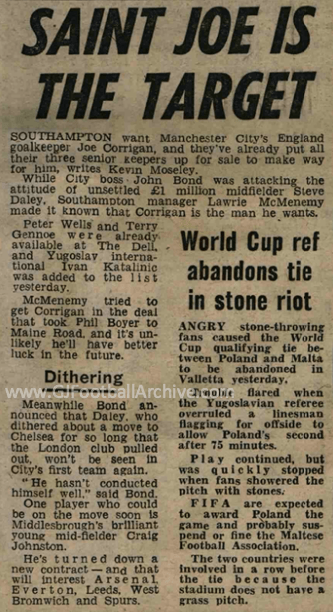
Continuing the series of articles covering the 1980s. Today’s is an on this day (8 December) from 1980. It’s a newspaper story about Joe Corrigan and Steve Daley potentially moving from Maine Road to other clubs. Have a read of the piece. Ultimately Corrigan stayed but Daley never did play for Manchester City again. If you want to know more about the trials and tribulations of this period then why not subscribe and read the following ten thousand word long read on the 1980-81 season. Enjoy!
Subscribe to get access – Monthly
Read more of this content when you subscribe today. It costs £3 per month (cancel anytime) to access everything posted since 1 October 2022 or there’s a special annual rate below which gives greater access and works out much cheaper.
Read more of this content when you subscribe today. It costs £3 per month (above) or £20 a year (here) to access everything posted since the site was created in December 2020. This special rate works out about £1.67 a week and gives access to everything posted, including PDFs of 3 of my books.






 Gary James' Football Archive