Steve Daley Interview

Yesterday (6 September 2023) I posted a story highlighting the transfer of Steve Daley to Manchester City in 1979. Today I’d like to expand on that by posting here an interview I did with Steve where we discuss that transfer, City fans and the spending City were doing at the time we did the interview. It was a great time to interview Steve and I enjoyed it immensely, helping fill in some gaps.

This interview is available to subscribers below.

Subscribe to get access – Monthly

Read more of this content when you subscribe today. It costs £3 per month to subscribe or sign up for a year at the special price of £20 (works out about £1.67 a month). Monthly subscribers can cancel anytime, so why not give it a try for a month? Monthly subscribers access everything posted since 1 October 2022 whereas annual subscribers get everything posted since the site started in December 2020 (see below).

Subscribe to get access – Annual

It costs £20 to subscribe for a year (here). Books, interviews (audio and written), images, features and more have been posted to this site so far. More to come.

You can find out more about subscriber benefits here:

Maine Road 100 – Day 98

It’s Day 98 of my Maine Road 100 countdown to the centenary of Maine Road’s first game. I hope you’ve enjoyed these. Today it’s about the players who have scored most goals in individual games at Maine Road. Any ideas who may be heading the list and how many goals they may have scored in a single game at Maine Road?

The following are the players who have scored most in a single game for each of the domestic competitions at Maine Road:

League: 5 goals – scored by Tommy Browell v Burnley 24/10/25 & George Smith v Newport 14/6/47

FA Cup: 5 goals – scored by Frank Roberts v Crystal Palace 20/2/26

League Cup: 4 goals – scored by Dennis Tueart v Notts County 29/10/80. You can see stuff on this here:

You can read about Frank Roberts v Palace here:

If you have enjoyed this series of articles and posts on Maine Road then why not become a subscriber and access all the other great content. To find out more see:

Maine Road 100 – Day 93

For Day 93 in my series of free articles counting down the 100 days to the centenary of Maine Road’s first game I want to do a bit of an attendance feature. Maybe this will put a few myths to bed!  

The Blues have, generation after generation, been one of the English game’s top attractions and Maine Road was an incredible and poweful venue over the years. The Etihad has seen City establish new record average attendances but no English club venue can match what Maine Road achieved in terms of record crowds and it still, all these years on, holds the record for the highest crowd on an English club ground and the record attendance for an English League game – a record City set in 1935 which is currently held by a game featuring United and Arsenal at Maine Road.

The record attendance on a club ground was first set by City in 1924 – 99 years ago! – and was eclipsed by a figure of 84,569 in 1934 – almost 90 years ago. City know how to establish and keep records for decades!

Like all – and I do mean all – English clubs there have been some average attendance lows at Maine Road over the years, but when the entire history of Manchester City at the old stadium is reviewed and the club’s average figures are compared with the national average it is clear that the Blues have consistently been one of football’s most attractive draws.  Take a look at the following:

  • Since the beginning of the Football League in 1888 only nine sides have topped the table for average attendances.  In chronological order of their first appearance at the top of the average table they are: Everton (1888-9), Villa (1898-99), Newcastle (1904-05), Chelsea (1907-08), Tottenham (1909-10), City (1910-11), Liverpool (1922-23), Arsenal (1929-30), & Manchester United (1956-57). City were not based at Maine Road back in 1910 (which makes that even more remarkable) and they were the best supported club again before moving to Maine Road. The first time Maine Road attracted the highest national average was in 1925-26 – which means that City are the ONLY team to have topped the attendance charts at two different venues! 
  • Regularly amongst the best supported sides throughout the inter war period, City’s average exceeded 37,000 for the first time in 1927-28 when the club established a record average crowd for the Second Division.  This was also the entire League’s highest.
  • In 1947-48 City’s average crowd exceeded 42,000 for the first time.  Prior to that season only Chelsea (1919-20 & 1946-7), Arsenal (1934-5, 1936-7,1937-8, & 1946-7) , Newcastle (1946-7), Liverpool (1946-7), United (1946-7), and Wolves (1946-7) had exceeded that figure.
  • From 1975 to relegation in 1983 City were always one of the top 4 best supported sides. Yes, even in a relegation season they were better than all but 3 teams and those 3 teams all finished in the top 4 (one won the League, one the FA Cup and the other finished 4th after winning the FA Cup in the previous two seasons).
  • Since the 1980s whenever City have played outside of the top division, they have tended to be the best supported side in that division.  

In general many people believe success increases support, and while that is undoubtedly true to some extent, for City at Maine Road it was often periods of adversity that proved the loyalty of the Club’s fans.  For example, in 1925-26 when City were the best supported side in Division One and had established a new record average, the Blues were actually relegated.  This coupled with significant poverty and hardship in Manchester at the time should have reduced support but loyalty increased!  In my book “Manchester A Football History” I explore the relationship between attendances and Manchester’s major sides and it is fair to say that City fans can feel immensely proud of their loyalty throughout the history of the game.  Something that cannot be said by all of the League’s biggest names.  

In fact, it is worth highlighting that City have never been the worst supported side in their division at Maine Road (or anywhere else for that matter!) but, of today’s perceived giants, Arsenal (1912-13 – average = 9,100) and Manchester United (1930-31 – average = 11,685) have.  City’s worst average at Maine Road came in the desperate 1964-65 season and was 14,753 (half the average of 1960-61 and a 3rd of City’s 1957-8 figure).  However it is significant that for every League season the club’s average has always been above the divisional average and, apart from 17 seasons, has always been in the top 11 nationally.  Again, few of today’s giants can say that – United’s 20th Century low stands at 4,650 and Chelsea averaged 15,731 as recently as 1988-89. 

For fans average attendances are often used as an indicator of size of club and so a number of people over the years have tried to produce a definitive ‘all-time’ attendance table.  A few years ago analysis by a member of the Association of Football Statisticians (It wasn’t my research – though I was a life member of this organisation) claimed that if stadium capacity was not an issue for any club City would be the fourth biggest side in terms of attendance.  That analysis compared postwar attendance detail with performance on the pitch.   

Figures can be manipulated in many different ways, but City fans should feel proud that the Blues have many attendance firsts that can never be matched by today’s perceived biggest clubs.   

If you have enjoyed this and the other Maine Road 100 articles/features then why not subscribe? For details see:

Maine Road 100 – Day 85

Post 85 of my Maine Road 100 countdown is a FA Cup reminder of a day that I know I loved as a kid. It was the day (24 January) in 1981 when John Bond’s Manchester City defeated his former club Norwich 6-0 in the FA Cup fourth round tie. I was sat in that uncovered bit between the Main Stand and the North Stand (it was cheaper but if it rained it was somewhat unpleasant, especially when the rain blew off the Main Stand roof on to us!).

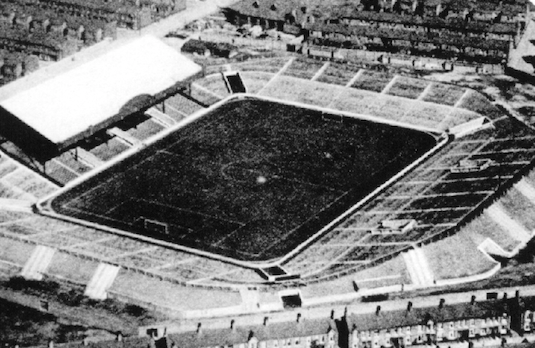
This 1971 image shows the area I was sat in (number 2) that day:

Maine Road aerial 1971 from Farewell To Maine Road

Subscribers can read a report and watch highlights of the game here:

Subscribe to get access

If you would like to read this and all the other great content on here then please subscribe. Annual subscribers (£20 per year, sign up here) get access to everything posted on the site including PDFs of 2 of my out of print books and archived content like my exclusive audio interviews with John Bond, Malcolm Allison etc. Not only that but you’ll be helping to support this site’s development.

Subscribe to get access

If you would like to read this and all other great content on here then please subscribe. Monthly subscribers (£3 per month, cancel anytime and sign up here) get access to everything posted on the site since 1 October 2022. Not only that but you’ll be helping to support this site’s development.

Maine Road 100 – Day 19

Welcome to Maine Road… It’s day 19 of my posts counting down to the centenary of Maine Road’s opening game. A photograph can bring back so many memories. Today’s is of a simple sign but it welcomed many to Manchester City’s ground for decades.

This was replaced by another version of the sign, which was then removed in 1994 when the Kippax Stand was demolished, but for much of the 1970s & 1980s this original sign was a popular part of Maine Road for many fans.

Kippax Stand c.1980

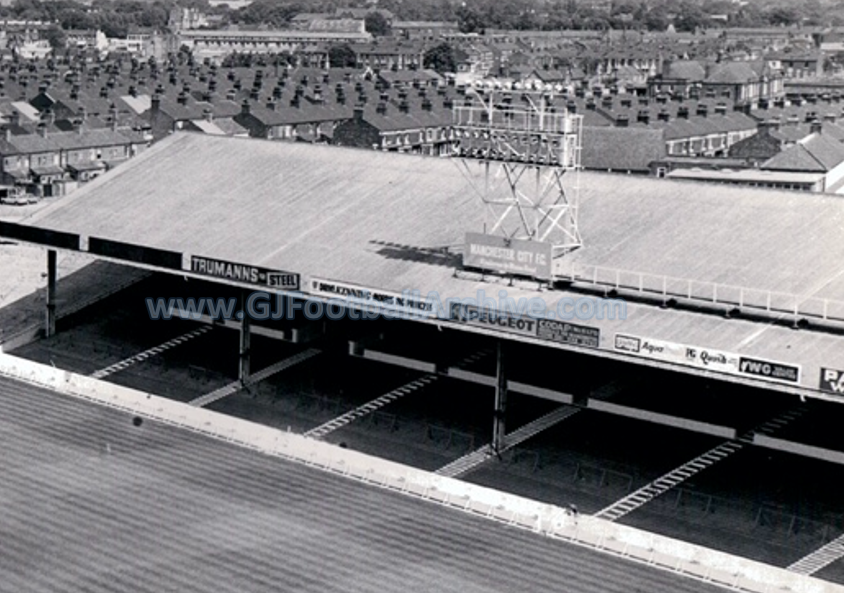
It sat proudly on a metal floodlight gantry on the roof of the Kippax in front of the original central lighting. In later years it was swamped by advertising and extensive roof lighting, once the corner pylons had gone.

Anyone running out from the players’ tunnel would see it straight in front of them. Like the This Is Anfield sign at Liverpool this was a recognisable feature proudly saying Manchester City and Welcome to Maine Road.

For those unfamiliar with Maine Road this photo may help locate where the sign was. You can see the Kippax roof central lighting tower above number 7. The sign was attached to that, opposite the players’ tunnel (number 1).

Maine Road aerial 1971 from Farewell To Maine Road

If you’d like to read more on the history of Maine Road, take a look at Farewell To Maine Road, which can be downloaded from this page:

Maine Road 100 – Day 8

Day 8 of my posts counting down to the centenary of Maine Road’s opening game. Today here’s an image of the Maine Road forecourt in the 1980s. So much to say on this. Notice the Granada TV vehicle and the newspaper adverts hung up for the Sunday Mirror and News of the World. There’s also the advert above the main entrance ‘cage’ – that was covering up the original central mosaic which I wish they’d been able to keep visible but an air conditioning unit was smashed through this at some point. So much for preserving the club’s history back then, hey?

The forecourt looked much the same as this from its opening through to later in the 80s, although there had already been a pebble dash render placed on the lower part of the main stand frontage. Later the decade more render would be place on sections of the front and then in the 1990s the whole stand was clad in metal.

There’s one of the floodlights (second set) showing and this is obviously pre-match as fans are mostly heading to the stands. Also, post match for many games in the 80s the forecourt would have housed a demo!

Those cars are heading towards the directors car park, past the stand, on the left.

This image was from a 1981 Manchester derby.

1981 City v United Maine Road

If you’d like to read more on the history of Maine Road, take a look at Farewell To Maine Road, which can be downloaded from this page:

To help those unfamiliar with Maine Road locate the specific location, the Main Stand is number 1 on this plan and its frontage faced Maine Road, the street running above the stand.

Maine Road aerial 1971 from Farewell To Maine Road

Maine Road 100 – Day 7

Day 7 of my posts counting down to the centenary of Maine Road’s opening game. Today it’s the story of the Platt Lane tunnel. Maine Road had four large corner tunnels, plus two in the Kippax and three (including the Players’ tunnel) in the Main Stand. The corner tunnels when built were all the same but the one in the Platt Lane/Main Stand corner was altered within 8 years of being built. Many people don’t realise this or know why, so here’s the story…

The tunnels were designed by architect Charles Swain to make access to and departure from the terracing easy after the problems Wembley experienced in its opening game. These huge tunnels became a feature of Maine Road for most of its existence but ground developments led to them all, apart from the Main Stand’s tunnels disappearing by the mid 1990s.

The first one to change was the Platt Lane/Main Stand corner tunnel.

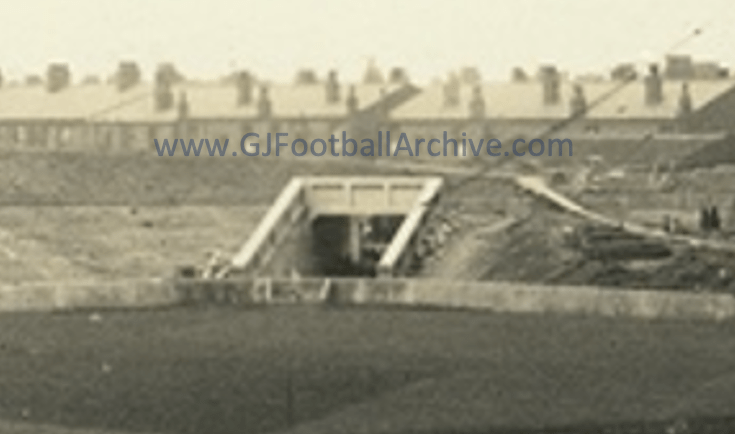
In 1931 the club decided to enlarge Maine Road and they started with that corner. There was a demand for additional seating and so the club rebuilt the corner terracing. They built on top of what was already there by increasing the terracing rake to make it more appropriate for seating. They didn’t demolish the original corner, they built on top of it. This created a problem because the walls of the tunnel were now too low in parts, creating a potential safety issue. So the club raised and remodelled the tunnel walls a little. These are not great images but I hope they give you enough of a feel for how the tunnel was adapted.

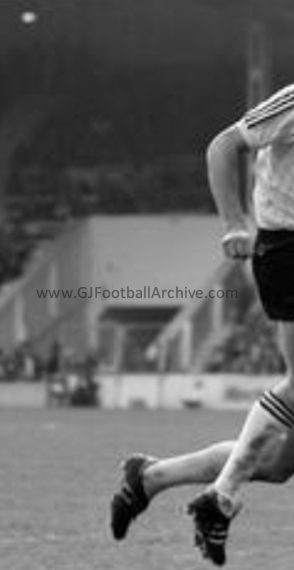
The older image is during construction, with the other image showing the stand in 1981. That corner stand was extended a little on wooden steps, as was the rest of the stand when it was extended in 1935. The difference was that the rake of the terracing elsewhere in the stand was not changed.

Remodelled Platt Lane/Main Stand corner tunnel as seen in 1981

If you’d like to read more on the history of Maine Road, take a look at Farewell To Maine Road, which can be downloaded from this page:

1923 Platt Lane/Main Stand corner tunnel

Manchester City Hall of Fame: Joe Corrigan’s significant game

City 2 Tottenham 3

FA Cup Final Replay

14th May 1981

City Team: Corrigan, Ranson, McDonald (Tueart), Reid, Power, Caton, Bennett, Gow, Mackenzie, Hutchison, Reeves

Attendance: 92,500

For Joe Corrigan these two matches may not have brought him a winner’s medal but they did raise his profile nationally and bring him the accolade of ‘man of the final’.  An enormous television audience worldwide witnessed this the 100th FA Cup final and the story of City’s season captured a great deal of attention.  The Blues had commenced the season with Malcolm Allison as manager but results, performances, and a general air of doom and gloom made the first few months extremely difficult.  Then John Bond arrived in October and the atmosphere transformed totally as City progressed to the League Cup semi-finals and the 100th FA Cup final.

City were in control for most of the initial match at Wembley.  Tommy Hutchison had put City into the lead in the 29th minute and the Blues looked unstoppable.  Danger did come from Spurs at times but Joe played magnificently and blocked any danger.  Unfortunately, ten minutes from the end disaster struck.  Tottenham were awarded a free kick twenty yards out.  Osvaldo Ardiles tapped the ball to Glenn Hoddle, who curled it around the wall.  Joe knew he had the shot covered but Hutchison somehow got in the way.  The ball hit his shoulder and was diverted passed Joe and into the net for Tottenham’s equaliser.  Joe:  “I’m sure Hoddle’s free-kick was going wide until Tommy got in the way and deflected it past me.”

Immediately after the equalising goal Joe, clearly disconsolate himself, walked over to the devastated Hutchison, helped him to his feet, and muttered a few words as he patted him on the back.  Clearly at a time when blame would have been easy to apportion the City ‘keeper thought more about the feelings of his team mate than the incident itself.  That says a great deal about Joe’s humanity.

The game went into extra time and with the score at 1-1 after 120 minutes, a replay was scheduled for the following Thursday.  Joe and most of the City side received considerable praise in the media with the Daily Mail stating:  “For what they are worth to the bewildered Tommy Hutchison, the defiant Joe Corrigan, the prodigious Nicky Reid and the inspiring John Bond, my sympathies are with City.  At least they gave their all for 90 minutes and then dredged up a little extra for the additional half-hour.  With the exception of Graham Roberts, Tottenham’s approach was a disgrace.”

All neutrals seemed to share those views and City felt aggrieved.  Personally Joe would have preferred to see the game settled on the Saturday:  “For me the FA Cup Final is all about the Saturday.  The players are all hyped up, the fans are all hyped up, the television is all hyped up.  The Cup Final is meant to be all about who is best on the day.  I’ve no doubt that on the Saturday we were the better team.  The second game did not feel like an FA Cup final.”

Despite Joe’s views, the second game has become recognised as a classic.  It ended 3-2 to Spurs, but contained a couple of superb goals.  The most famous one is Ricky Villa’s 75th minute Tottenham winner, but City fans will always remember Steve Mackenzie’s twenty yard volley as a classic goal.

For Joe the second game put him under more pressure than the first and he certainly performed heroically.  In the years since the final the story of Ricky Villa’s goal has grown and grown yet on the day itself it was the performance of City’s brilliant ‘keeper which won the acclaim.  His profile was raised once again, but undoubtedly Joe would have much preferred to see City win the Cup rather than receive the glory himself.

Kevin Reeves Joins Manchester City

On this day (11 March) in 1980 Kevin Reeves became the fourth player to be transferred for a million pounds or more (Manchester City had been responsible for 50% of those) when he signed for City. I have interviewed many of the people involved in that deal and you can read quotes from some of those involved (Reeves, Allison & Steve Daley) in my article.

Subscribe to get access – Annual

Read more of this content when you subscribe today. It costs £20 a year or £3 per month (see below). Annual subscribers get full access to everything on the site.

Subscribe to get access – Monthly

Read more of this content when you subscribe today. It costs £20 a year (above) or £3 per month. Monthly subscribers get full access to everything posted on the site since 1 October 2022.

City 6 Norwich 0

On this day (24 January) 1981 John Bond’s Manchester City defeated his former club Norwich 6-0 in the FA Cup fourth round tie. Subscribers can read a report and watch highlights here:

Subscribe to get access

If you would like to read this and all the other great content on here then please subscribe. Annual subscribers (£20 per year, sign up here) get access to everything posted on the site including PDFs of 2 of my out of print books and archived content like my exclusive audio interviews with John Bond, Malcolm Allison etc. Not only that but you’ll be helping to support this site’s development.

Subscribe to get access

If you would like to read this and all other great content on here then please subscribe. Monthly subscribers (£3 per month, cancel anytime and sign up here) get access to everything posted on the site since 1 October 2022. Not only that but you’ll be helping to support this site’s development.