League Dominance – Gap Between Top and Bottom

Following on from my piece the other day about League domination where I challenged a few myths that have developed about Premier League domination. It continues to be said that the Premier League is not as competitive as in the past and that teams at the bottom have no chance. This is of course concerning and there are definitely issues between the haves and have nots in football but is this a recent phenomenon? Is this caused by one club in particular?

Each season there are often one or two clubs who have an extremely low points total and, to be frank, I’m not certain whether the champions (whoever they are and whenever they succeed) can be blamed for the results of games not involving them.

Surely, even if City, Liverpool, Arsenal, Chelsea, United etc. win the League every season by a record amount of points the results between all other 19 clubs have zero to do with that club’s dominance?  If you’re a supporter of a relegated club can you honestly say that you’d stand a chance of winning the League if City or another team did not exist?  You’d need possibly the top ten to disappear before it had a major impact on your chance of League success (I’m not saying that’s acceptable – I’m just stating that it can never be the fault of one club).

Those finishing second may blame the dominant club but surely not anyone outside of those challenging. Blame all the elite maybe. These things never happen over night and because one club wins the League.

So, how do we calculate the gap between the champions and those struggling?  Where do we start?

One method is to look at the team that wins the League and see how big a gap is between them and the relegated clubs. There are often one or two teams that gather few points and so I’ve looked at the difference between the champions and the team finishing 17th (safe from relegation). I’ve taken the lowest points accumulated by the 17th placed team and compared that to the Champions.

This makes interesting reading and shows that the lowest points gathered by the 17th placed ‘safe’ team was almost two decades ago! That’s right, it’s not the current era – it’s all those years ago!

Chelsea were the champions when the lowest points total was accrued by the 17th placed club in 2004-05 (in fact the three lowest were all in the 2000s not the last decade). The five lowest points accumulated by a team in 17th place are (note: 5 of these are 2010 or earlier):

1: 2004-05 Champions Chelsea earned 61 points more than 17th placed WBA (34)

2: 2009-10 Chelsea earned 51 points more than 17th placed West Ham (35)

2: 2008-09 United earned 55 points more than 17thplaced Hull (35)

2: 2019-20 Liverpool earned 64 points more than 17th placed Aston Villa (35)

5th: 1999-00 United earned 55 points more than 17th placed Bradford (36)

5th: 2007-08 United earned 51 points more than 17th placed Fulham (36)

5th: 2013-14 City earned 50 points more than 17th placed WBA (36)

5th: 2017-18 City earned 64 points more than 17th placed Southampton (36)

5th: 2018-19 City earned 62 points more than 17th placed Brighton (36)

5th: 2022-23 City earned 53 points more than 17th placed Everton (36)

Ignoring the first few seasons when there were more than 20 clubs in the Premier League, the highest points total ever gathered by the club in 17th place was 44 (Bolton) in 2002-03 – only two seasons before the lowest points total, showing how these things can vary.

Okay but what about teams actually relegated? Here are the five lowest points accumulated by a team finishing 20th and the difference with the champions that season. Again the lowest points gathered was in the 2000s, not 2020s (Only 2 of these are since 2015 and none are from the 2020s!):

1: 2007-08 Champions United gathered 76 points more than 20th Derby (11 points)

2: 2005-06 Chelsea gathered 76 more than Sunderland (15)

3: 2018-19 City gathered 82 more than Huddersfield (16)

4: 2015-16 Leicester gathered 64 more than Aston Villa (17)

5: 2002-03 United gathered 64 more than Sunderland (19)

5: 2009-10 Liverpool gathered 78 more than Portsmouth (19)

Okay, so what about the actual points gap between the champions and the 20th placed club? Again analysis of every Premier League season shows some interesting information.  The five biggest points differences between top and bottom are (again two of these are from the 2000s):

1st: 2018-19 City 82 points over Huddersfield

2nd: 2019-20 Liverpool 78 points over Norwich

3rd: 2005-06 Chelsea 76 points over Sunderland

3rd: 2007-08 United 76 points over Derby

5th: 2021-22 City 71 points over Norwich

For the next analysis I’ve calculated the difference between the champions and the club finishing in 18th place (usually a relegated place, but not in the first couple of years of the Premier League). The idea being that the bottom two could be way off the pace.

This shows that City’s record 100 points season was the biggest gap between them and the 18th place relegated club. That’s significant, however that was an incredible record breaking season of wins for City. Interestingly though, for a team that’s supposed to be creating barriers between the top and the bottom City only hold two of the top five biggest gaps (Chelsea also hold 2) and one of those top 5 champions is actually Chelsea in 2004-05 – 19 years ago!

If we look beyond the top five there are 3 clubs in joint 6th place including Manchester United in 1998-99 – 25 years ago! Yet it’s supposed to be only now that the gap between top and relegation is vast.

For those wondering here are the highest 10 or so gaps between top and relegated clubs (18th place):

1st: 2017-18 City (the record 100 points season) 67 points over Swansea

2nd: 2019-20 Liverpool 65 points over Bournemouth

3rd: 2018-19 City 64 points over Cardiff

4th: 2004-05 Chelsea 62 points over Crystal Palace

5th: 2016-17 Chelsea 59 points over Hull

6th: 1999-00 United 58 points over Wimbledon

6th: 2020-21 City 58 points over Fulham

6th: 2021-22 City 58 points over Burnley

9th: 2003-04 Arsenal 57 points over Leicester

9th: 2005-06 Chelsea 57 points over Birmingham

11th: 2008-09 United 56 points over Newcastle

11th: 2009-10 Chelsea 56 points over Burnley

What does all this statistical information prove? Well there doesn’t appear to be much difference between the 2000s and the last decade. Some seasons in each decade there were huge gaps.

We all know that the elite are some way ahead of those that struggle and there is an imbalance. That’s concerning for football and the introduction of Financial Fair Play and similar has, so far, strengthened the position of the elite and limited the opportunity for investment at lower clubs. 

You can read my previous post here:

City 1 Leicester 0, the FA Cup Final

On this day (April 26) in 1969 Manchester City defeated Leicester City in the FA Cup final. It is worth pausing to consider how the Blues compared to football’s other successful sides in the competition at this time in football history.  City’s four FA Cup successes placed them 7th in the all-time list of FA Cup winners – can you guess the clubs they were behind? Liverpool? No! MUFC? No! Arsenal? No! Keep going…

They were behind Aston Villa (7), Blackburn Rovers (6), Newcastle United (6), Tottenham Hotspur (5), The Wanderers (5) and West Bromwich Albion (5).  Bolton, Sheffield United and Wolves had, like City, each won four FA Cups, while Manchester United and Arsenal had only won three, Liverpool one and Chelsea had not yet won the trophy.  In fact Chelsea had only won one major trophy (the League Championship) at this point in their history.  

Here for subscribers is a long read on that final and the events surrounding it:

Subscribe to get access

Read more of this content when you subscribe today.

The 1970s: Attendance Flashback to 1978

The series of features/articles covering Manchester City in the 1970s continues with this brief post about average attendances. We hear so much baloney these days about which clubs are giants and so on but the truth is that in terms of success no team has ALWAYS been at the top and in terms of support most clubs have had highs and lows. There are some clubs that generation after generation have been popular with fans and this cutting from the Manchester City match programme of 1977-78 may interest some.

I’m not going to point to any club or anything but look at the numbers and make your own minds up. Manchester City, incidentally, tended to be the 3rd best supported club (no matter where they finished) behind United and Liverpool throughout the mid to late 70s and early 1980s. They occasionally dropped to 4th depending on whether Everton or Spurs had a good season and even in City’s 1982-83 relegation season Manchester’s Blues were the 4th best supported club. Not bad for a failing club!

This series of articles and features on Manchester City in the 1970s will run throughout January with indepth articles some days and smaller ‘on this day’ style posts on others. There will be flashbacks to great games, players and more. Every day in January will offer something to enjoy.

Subscribers will get access to everything. If you want to know more on this incredible decade for Manchester City Football Club then why not subscribe and read it all? You could even subscribe for a month and see what you think. The following 5,200 word article is on the 1970-71 season and is available to subscribers below. Enjoy!

Subscribe to get access – Monthly

Read more of this content when you subscribe today. It costs £3 per month (cancel anytime) to access everything posted since 1 October 2022 or there’s a special annual rate below which gives greater access and works out much cheaper.

Subscribe to get access – Annual

Read more of this content when you subscribe today. It costs £3 per month (above) or £20 a year (here) to access everything posted since the site was created in December 2020. This special rate works out about £1.67 a week and gives access to everything posted, including PDFs of 3 of my books.

If you’d like to know more about subscribing then see:

The 1970s: Kidd’s Four for 3rd Placed City

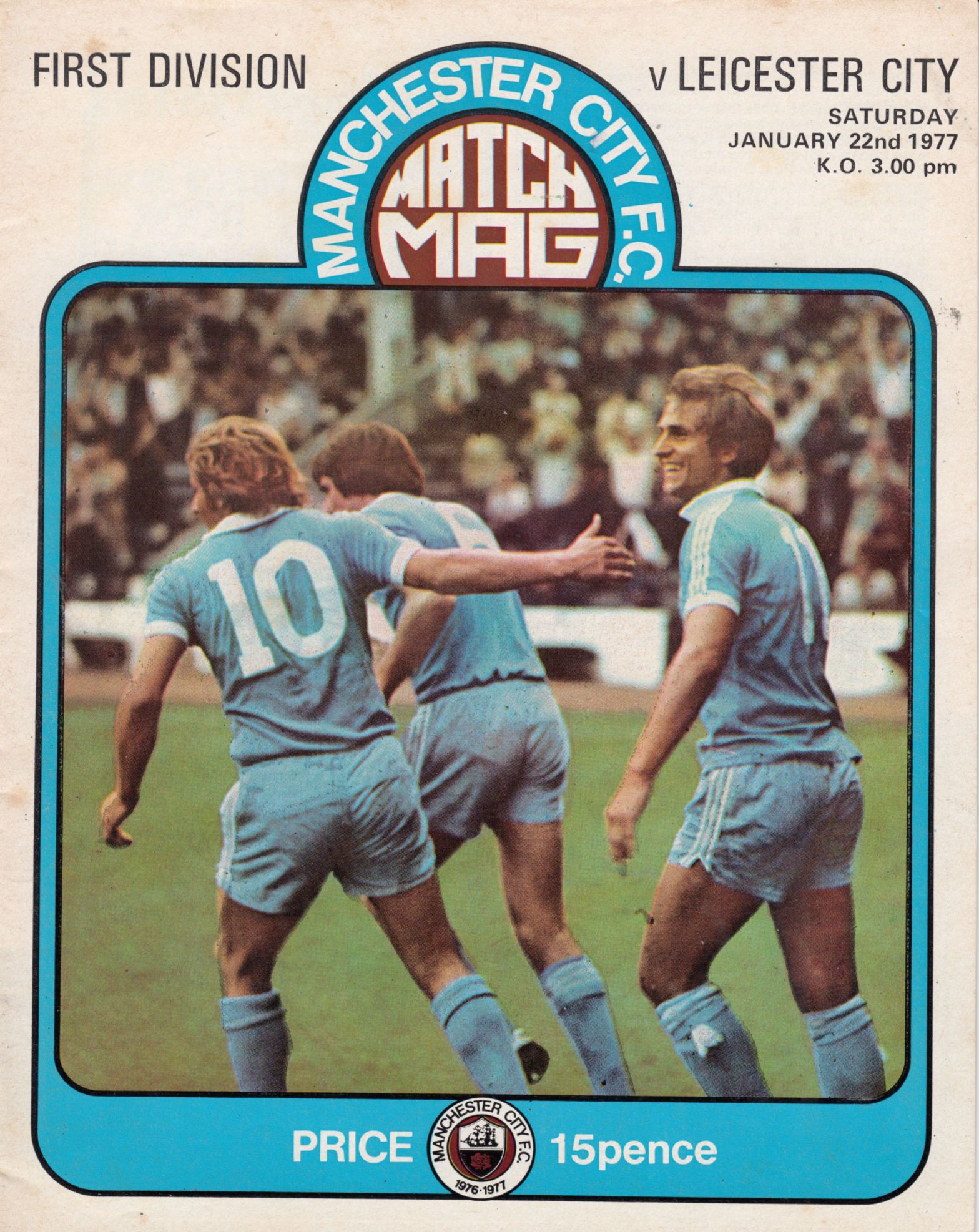
Today (22 January) in 1977 the title race hotted up a little as Manchester City defeated Leicester 5-0 with goals from Mike Doyle and Brian Kidd (4). This was a great day to be a Blue and I know I was in the Platt Lane Stand behind the goal (right of camera). It’s great to see City fans in that stand celebrating again and it takes me right back to the excitement felt in my childhood. Back then we hoped City would win the title and they did come close (missing it by a point). You can watch the goals from the game here (listen for Barry Davies’ comment about foreigners watching the 3rd best team!):

The 1970s: Law and Marsh

Here are highlights of the goals from fifty years ago today (12 January 1974) when Denis Law and Rodney Marsh both scored in Manchester City’s 2-0 victory over Leicester City at a muddy Maine Road. I’m sure that second goal would go through one of those panels these days to try and work out who actually scored it though I think both Law and Marsh knew it was Marsh’s. Watch out for Colin Bell too.

Maine Road 100 – Day 97

It’s Day 97 of my Maine Road 100 countdown (almost there!) to the centenary of Maine Road’s first game and today it’s a simple one on the club that visited Maine Road as an away team the most. Any ideas who that was?

The team that’s played as a away side the most at Maine Road in League games is Arsenal. Of course Manchester United did play home games at Maine Road during the 1940s, but as an away team Arsenal have been the visitors the most. They’ve played City in 56 League games at Maine Road.

The team that’s appeared as an away team against the Blues the most in the FA Cup is Leicester City (6) while Blackpool (7) have been the most frequent Maine Road opponents in the League Cup.

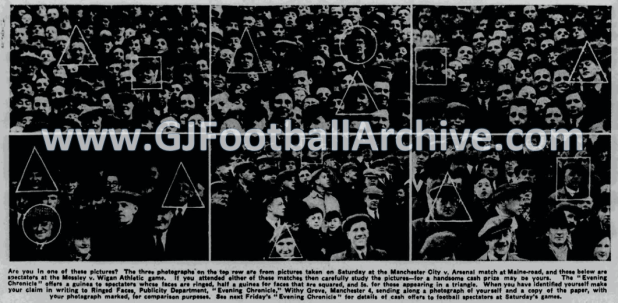
Fans at MCFC v Arsenal and Mossley v Wigan, February 1935

If you have enjoyed this series of articles and posts on Maine Road then why not become a subscriber and access all the other great content. To find out more see:

The Span of Success 2023

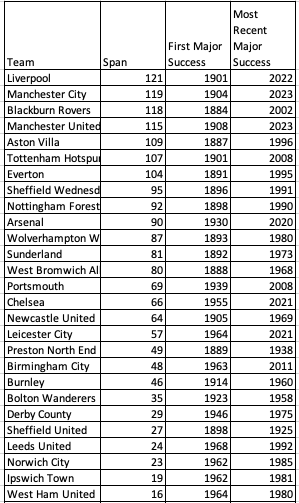
Ahead of West Ham’s European final tomorrow night (7 June) I thought I’d post the latest update to the table showing the span of success – i.e. the number of years between a club’s first major success (FA Cup, League, League Cup, European trophy) and their most recent. If West Ham win tomorrow they will leap ahead of Leicester City.

This season has seen City overtake Blackburn Rovers and they are now second to Liverpool.

Okay, the span of success does not show how many trophies each club has won or how frequently that club has experienced great eras of success, but it does demonstrate how wrong those people are who believe certain clubs were unsuccessful until recent years, or those who think certain clubs have always been giants. The column on first major success helps to show when some clubs first became trophy-winning significant (often after transformational investment).

While you’re here… why not take a look at the free to read daily Maine Road features counting down to the old stadium’s 100th anniversary of its first game? Here are a sample couple of features (follow the Maine Road tag or search for more):

A Captain’s Performance

Today (6 May) in 2019 Manchester City captain Vincent Kompany scored a wonder strike to give City a 1-0 victory over Leicester City at the Etihad. The goal scored in the 70th minute meant that City knew they would retain the Premier League title if they won on the final day of the season at Brighton.

Kompany’s strike from 25 yards out arrowed into the top corner of the net.

You can watch highlights here:

https://www.mancity.com/citytv/match-highlights/2019/may/city-v-leicester-extended-highlights

On This Day 1963: The 1st FA Cup Tie

On this day (6 March) in 1963, due to an exceptionally snowy winter, both Manchester City’s and Manchester United’s first appearances in the FA Cup that season occurred. The games had been delayed until this date due to the poor weather.  

For the record, the Blues won away at Walsall 1-0 in the 3rd round (Alex Harley scored).  7 days later they beat Bury (1-0 at Maine Road, 41,575 crowd) in the 4th round and then lose to Norwich (2-1 at Maine Road on 16 March) in round 5.

The Reds defeated Huddersfield 5-0 at Old Trafford (Law 3, Giles & Quixall) before 47,703. They also defeated Aston Villa (1-0 on 11 March at Old Trafford), Chelsea (2-1 on 16 March at Old Trafford), Coventry (3-1 on 30th March), Southampton (1-0 at Villa Park on 27th April) and Leicester City 3-1 in the final at Wembley on 25 May.

Subscribe to get access to the entire site

This was a brief sample of the site. If you would like to read the in-depth articles (including the books, articles, history talks and interviews etc.) then please subscribe. It works out about £1.67 a month if you take out an annual subscription (£20 per year) or £3 a month if you’d like to sign up for a month at a time (see below).

Subscribe to get access to the entire site

If you would like to read the in-depth articles (including the books, articles, history talks and interviews etc.) then please subscribe. It costs £3 a month (access everything since 1 October 2022; cancel anytime) or £20 a year (see above)

Denis Law and Rodney Marsh Both Score

On this day (12 January) in 1974 Denis Law and Rodney Marsh provided the goals as Manchester City defeated Leicester City 2-0 in a thrilling game at Maine Road.  

City were in blistering form for this game and absolutely tore in to Leicester. Only the brilliance of England ‘keeper Peter Shilton kept the score down as the report shows.

I was six years old and sat in the ‘old’ Platt Lane Stand with my dad that day. Were you also at this match? If you were why not leave your memory as a comment or email it to me for possible future use on this website?

Film of the game here:

Subscribe to get access

Read more of this website when you subscribe today. It works out about £1.67 a month if you take out an annual subscription (£20 per year – you can access everything posted since December 2020 including PDFs of 2 out of print books and listen to audio interviews with John Bond and others) or £3 a month (access everything posted since 1 October 2022) if you’d like to sign up for a month at a time. Sign up for annual here and monthly below.

Subscribe to get access

Read more of this website when you subscribe today. It works out about £1.67 a month if you take out an annual subscription (£20 per year) or £3 a month (access everything posted since 1 October 2022) if you’d like to sign up for a month at a time. Sign up for annual above and monthly here.