Maine Road 100 – Day 93

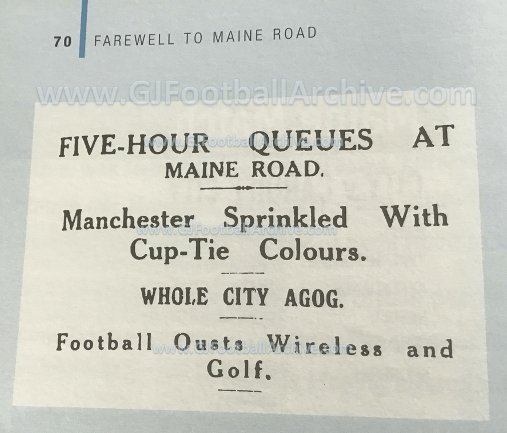
For Day 93 in my series of free articles counting down the 100 days to the centenary of Maine Road’s first game I want to do a bit of an attendance feature. Maybe this will put a few myths to bed!  

The Blues have, generation after generation, been one of the English game’s top attractions and Maine Road was an incredible and poweful venue over the years. The Etihad has seen City establish new record average attendances but no English club venue can match what Maine Road achieved in terms of record crowds and it still, all these years on, holds the record for the highest crowd on an English club ground and the record attendance for an English League game – a record City set in 1935 which is currently held by a game featuring United and Arsenal at Maine Road.

The record attendance on a club ground was first set by City in 1924 – 99 years ago! – and was eclipsed by a figure of 84,569 in 1934 – almost 90 years ago. City know how to establish and keep records for decades!

Like all – and I do mean all – English clubs there have been some average attendance lows at Maine Road over the years, but when the entire history of Manchester City at the old stadium is reviewed and the club’s average figures are compared with the national average it is clear that the Blues have consistently been one of football’s most attractive draws.  Take a look at the following:

  • Since the beginning of the Football League in 1888 only nine sides have topped the table for average attendances.  In chronological order of their first appearance at the top of the average table they are: Everton (1888-9), Villa (1898-99), Newcastle (1904-05), Chelsea (1907-08), Tottenham (1909-10), City (1910-11), Liverpool (1922-23), Arsenal (1929-30), & Manchester United (1956-57). City were not based at Maine Road back in 1910 (which makes that even more remarkable) and they were the best supported club again before moving to Maine Road. The first time Maine Road attracted the highest national average was in 1925-26 – which means that City are the ONLY team to have topped the attendance charts at two different venues! 
  • Regularly amongst the best supported sides throughout the inter war period, City’s average exceeded 37,000 for the first time in 1927-28 when the club established a record average crowd for the Second Division.  This was also the entire League’s highest.
  • In 1947-48 City’s average crowd exceeded 42,000 for the first time.  Prior to that season only Chelsea (1919-20 & 1946-7), Arsenal (1934-5, 1936-7,1937-8, & 1946-7) , Newcastle (1946-7), Liverpool (1946-7), United (1946-7), and Wolves (1946-7) had exceeded that figure.
  • From 1975 to relegation in 1983 City were always one of the top 4 best supported sides. Yes, even in a relegation season they were better than all but 3 teams and those 3 teams all finished in the top 4 (one won the League, one the FA Cup and the other finished 4th after winning the FA Cup in the previous two seasons).
  • Since the 1980s whenever City have played outside of the top division, they have tended to be the best supported side in that division.  

In general many people believe success increases support, and while that is undoubtedly true to some extent, for City at Maine Road it was often periods of adversity that proved the loyalty of the Club’s fans.  For example, in 1925-26 when City were the best supported side in Division One and had established a new record average, the Blues were actually relegated.  This coupled with significant poverty and hardship in Manchester at the time should have reduced support but loyalty increased!  In my book “Manchester A Football History” I explore the relationship between attendances and Manchester’s major sides and it is fair to say that City fans can feel immensely proud of their loyalty throughout the history of the game.  Something that cannot be said by all of the League’s biggest names.  

In fact, it is worth highlighting that City have never been the worst supported side in their division at Maine Road (or anywhere else for that matter!) but, of today’s perceived giants, Arsenal (1912-13 – average = 9,100) and Manchester United (1930-31 – average = 11,685) have.  City’s worst average at Maine Road came in the desperate 1964-65 season and was 14,753 (half the average of 1960-61 and a 3rd of City’s 1957-8 figure).  However it is significant that for every League season the club’s average has always been above the divisional average and, apart from 17 seasons, has always been in the top 11 nationally.  Again, few of today’s giants can say that – United’s 20th Century low stands at 4,650 and Chelsea averaged 15,731 as recently as 1988-89. 

For fans average attendances are often used as an indicator of size of club and so a number of people over the years have tried to produce a definitive ‘all-time’ attendance table.  A few years ago analysis by a member of the Association of Football Statisticians (It wasn’t my research – though I was a life member of this organisation) claimed that if stadium capacity was not an issue for any club City would be the fourth biggest side in terms of attendance.  That analysis compared postwar attendance detail with performance on the pitch.   

Figures can be manipulated in many different ways, but City fans should feel proud that the Blues have many attendance firsts that can never be matched by today’s perceived biggest clubs.   

If you have enjoyed this and the other Maine Road 100 articles/features then why not subscribe? For details see:

Maine Road 100 – Day 77

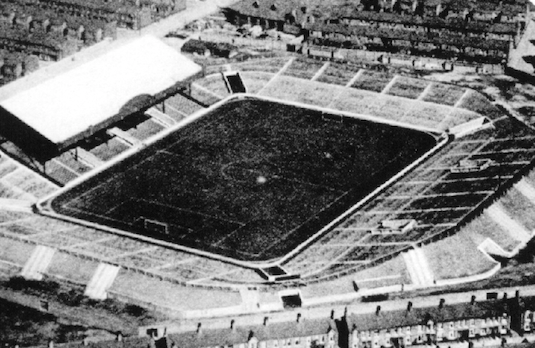
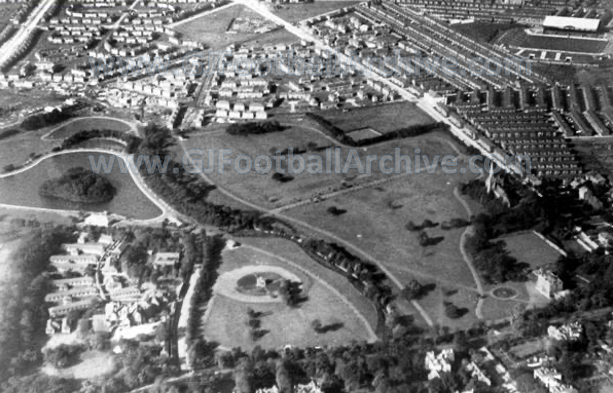
For post 77 in my Maine Rd 100 countdown a reminder of a record City have held for almost a century! This image is of a day in 1924 when City attracted the highest crowd on a club ground. The drawing is looking from the Main Stand towards the Popular Side, later Kippax. It’s no longer the record attendance because it was beaten by another record crowd at Maine Rd a decade later. Want to know more? The read on…

1925 Aerial photo of Maine Road and Platt Fields Park

A record Manchester City have held for 99 years was set on 8 March in 1924 – the record is the highest attendance on a club ground! The record set in 1924 saw 76,166 attend City v Cardiff. City had moved to their new Maine Road stadium in August 1923. The capacity of the venue was estimated at around 90,000 but was actually approximately 83,000 when the stadium opened (it was enlarged in 1931 and 1935).

In its first season the capacity was tested and, on that day (8 March) in 1924 the largest attendance for any footballing fixture (including three FA Cup Finals) in Manchester gathered to watch the Blues. This was also, at the time, the record crowd for any game played on an English club ground. It was beaten ten years later when 84,569 watched City v Stoke. You can read about the remarkable day in 1924 below:

Subscribe to get access

Read more of this content when you subscribe today. It costs £20 a year (access to everything) or £3 per month (see below).

Subscribe to get access

Read more of this content when you subscribe today. It costs £20 a year (see above) or £3 per month (cancel anytime; access to everything posted since 1 October 2022).

You can read about the attendance that brought this record (again by City at Maine Road) here:

A National Record – 84,569

Other record crowd articles can be seen here:

Welcome to Gary James’ Football Archive

Subscribe to get access

This has been a sample of the material on http://www.GJFootballArchive.com If you would like to read all the in-depth articles (including the entire Manchester A Football History book and the audio interview with John Bond) then please subscribe. It works out about £1.67 a month if you take out an annual subscription (£20 per year) or £3 a month if you’d like to sign up for a month at a time. Each subscriber gets full access to the 260+ articles posted so far and the hundreds scheduled to be posted in the coming weeks.

MCFC & LFC: Attendance Malarky

For some reason whenever Manchester City and Liverpool are due to meet at the Etihad there’s quite a lot of nonsense said about attendances so I thought I’d best get some analysis done and post it here. It’s always nice to post the facts not the fiction, so here goes (some of this may surprise those who only listen to the negativity about Etihad crowds and the positivity about Anfield attendances, not the facts).

The general criticism City get is often about ’empty seats’. No club can boast that every single season ticket holder or fan who has bought a ticket attends every game for which they’ve bought the ticket, so inevitably there are ’empty seats’ at most games for all clubs. Family tragedy, illness, emergency, work commitments, travel problems etc. all contribute to missing fans. As we don’t have a system whereby you have to get a note from a family member to pass on to the club’s manager (it seems some think you do need to get permission!) if you’re going to miss a game it is impossible to have an accurate record of who simply cannot be bothered to attend, rather than a specific reason that stops them attending.

Personally, I think it’s all nonsense and I’d much rather focus on tickets sold as that is something that can be compared. So, here are some facts based on attendances at Anfield and the Etihad since City’s new stadium was built in 2003:

Since 2003 City have attracted a higher average attendance than Liverpool in all but 5 seasons. Some will say ‘ah, but the Etihad’s capacity has been larger than Anfield for most of that time’ and that is true, but that’s only significant if Anfield is a sell out every game. So it’s also worth looking at those seasons to see if Liverpool attendances show a full stadium or not.

Well, Anfield was not full every game. In fact Liverpool’s lowest home League crowd of the season has been lower than City’s in every season except five since 2003. Add to that that City’s lowest PL crowd at the Etihad since 2003 is higher than three of Liverpool’s home PL attendances. The four lowest individual League crowds experienced at either Anfield or the Etihad since 2003 are:

34,663 Liverpool v Portsmouth, 17/3/04 (ended the season 4th)

35,064 Liverpool v Portsmouth, 14/12/04 (ended the season 5th & Champions League winners)

35,400 Liverpool v Bolton, 1/1/11 (ended the season 6th)

35,776 City v Fulham, 18/11/06 (ended the season 14th)

That 34,663 Liverpool crowd was some 10,699 below capacity. Had the crowd been 44,163 (still less than season’s highest of 44,374) that would have added another 500 to Liverpool’s average attendance that season.

Away allocations and segregation impact on whether a stadium is full of course, but we can assume that an away allocation is approximately 3,000 for Premier League games. As Anfield’s stated capacity in 2003 was 45,362 (it was reported as 45,522 by 2010), it is fair to assume that the actual maximum number of tickets available to Liverpool fans is about 42,100. So any crowd less than that figure is not a sell out (assuming zero away fans – of course there could be a full away allocation and spaces elsewhere but for the purpose of this let us give Liverpool the benefit of the doubt and assume there are zero away fans).

In 2003-04 there were 6 League games at Anfield that attracted less than 42,100. As we’ve already seen Liverpool’s average could have increased by 500 had their lowest crowd been closer to the season’s highest, so imagine what the increase would have been had all these games been full.

That pattern is repeated in other seasons. In 2004-05 the average crowd at City was less than Liverpool’s stated capacity, and that season Anfield again officially had over 10,000 empty seats for their lowest League crowd of the season. Had they filled Anfield every game then they’d have attracted a higher average than City, but they didn’t.

In 2010-11 there were 6 games attracting less than 42,100 at Anfield with the lowest again officially having over 10,000 empty seats.

Of course City have also had over 10,000 empty seats for some games, though not since 24/8/2008 when 36,635 watched City v West Ham at a time when there were rumours of players’ wages not being paid and even the existence of the club was in doubt.

Anfield last officially had over 10,000 empty seats for a Premier League game in 2011 for the visit of Bolton.

Over the last decade both clubs have tended to enjoy capacity crowds for every game, subject to away allocations and segregation, but that is definitely not true for either club prior to that. I find it ridiculous that City receive so much inaccurate reporting of crowds when actual official figures paint a different picture.

Some will try to make out that official figures are incorrect but of course these things are audited and, in any case, when rival fans criticise City they tend to imply its attendances in recent years that are inaccurate. Yet when comparing Liverpool and City’s crowds it is clear that City were attracting better crowds than Liverpool twenty years ago and that Liverpool’s lowest official crowds were lower than City’s.

Oh, it’s all a load of codswallop. Those who attend games know the truth and the facts and evidence paint a picture somewhat different to those ‘Emptyhad’ and ‘Anfield’s always been full’ jibes aimed at City fans.

A National Crowd Record Set in 1924

A record Manchester City have held for 99 years was set on this day (8 March) in 1924 – the record is the highest attendance on a club ground! Happy anniversary! The record set in 1924 saw 76,166 attend City v Cardiff. City had moved to their new Maine Road stadium in August 1923. The capacity of the venue was estimated at around 90,000 but was actually approximately 83,000 when the stadium opened (it was enlarged in 1931 and 1935).

In its first season the capacity was tested and, on this day (8 March) in 1924 the largest attendance for any footballing fixture (including three FA Cup Finals) in Manchester gathered to watch the Blues. This was also, at the time, the record crowd for any game played on an English club ground. It was beaten ten years later when 84,569 watched City v Stoke. You can read about the remarkable day in 1924 below:

Subscribe to get access

Read more of this content when you subscribe today. It costs £20 a year (access to everything) or £3 per month (see below).

Subscribe to get access

Read more of this content when you subscribe today. It costs £20 a year (see above) or £3 per month (cancel anytime; access to everything posted since 1 October 2022).

You can read about the attendance that brought this record (again by City at Maine Road) here:

A National Record – 84,569

Other record crowd articles can be seen here:

Welcome to Gary James’ Football Archive

Subscribe to get access

This has been a sample of the material on http://www.GJFootballArchive.com If you would like to read all the in-depth articles (including the entire Manchester A Football History book and the audio interview with John Bond) then please subscribe. It works out about £1.67 a month if you take out an annual subscription (£20 per year) or £3 a month if you’d like to sign up for a month at a time. Each subscriber gets full access to the 260+ articles posted so far and the hundreds scheduled to be posted in the coming weeks.

Manchester City Stadium Developments

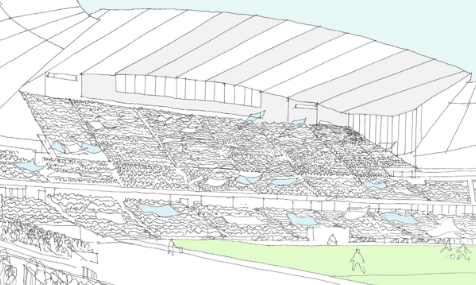
Manchester City have announced plans to develop the Etihad Stadium further, increading capacity to about 60,000 plus lots of other stuff. There’s a fan and community consultation as part of the plans too. The club have said: ‘Manchester City is delighted to unveil concepts for a best-in-class fan experience and year-round entertainment and leisure destination at the Etihad Stadium, with fans and the local community invited to share their feedback from today until Sunday 26 March.’

The announcement follows City’s announcement in December 2022 that feasibility studies were underway to explore concepts that could form part of ‘a future stadium development, consistent with the long-held vision to establish the Etihad Campus and the wider area as a globally relevant and competitive sport, leisure and entertainment destination.’

According to the plans released today: ‘several connected all-weather facilities, fully integrated into the stadium, are centred around an expanded North Stand with one larger, single upper tier above the existing lower tier, increasing stadium capacity to over 60,000.’

City Square will also be improved with: ‘a covered City Square fan zone, with a capacity of 3,000 and a wide variety of food and drink outlets, new club shop, museum and hotel, are all proposed in order to offer a broader range of dynamic matchday and non-matchday activities.’

It all sounds good and continues the investment in Manchester, community and facilities. If only all clubs could invest in their communities like this. More details:

https://www.mancity.com/etihad-stadium-consultation

68,614 Afternoon Attendance

On 21 February 1934 Manchester City defeated Sheffield Wednesday 2-0 at Maine Road in a fifth round FA Cup replay.  A remarkable Wednesday afternoon crowd of 68,614 enjoyed the match.  Four days earlier Hillsborough’s record attendance of 72,841 had witnessed a 2-2 draw. Subscribers to this blog can read the story of that game, including photographs below:

Subscribe to get access

If you would like to read this piece and all the other in-depth articles (including the entire Manchester A Football History book) then please subscribe. It works out about £1.67 a month if you take out an annual subscription (£20 per year) or £3 a month (see below). Annual subscribers get full access to the articles, books, interviews and talks posted so far and the hundreds scheduled to be posted in the coming year.

Subscribe to get access

If you would like to read this piece and all the other in-depth articles then please subscribe. It costs £3 a month (cancel anytime). Monthly subscribers get full access to the articles, books, interviews and talks posted since 1 October 2022 and all posted during your subscription.

The Day’s Highest Attendance

The 18th of February 1984 brought a crowd of 41,767 (the division’s second biggest crowd of the season) to the Second Division match between Manchester City and Newcastle United. This crowd was over 15,000 higher than the best in the top flight (Arsenal v Aston Villa attracted 26,640). City were third prior to the match, with Newcastle fourth. and here’s some background and highlights.

With three promotion places available City felt certain they could achieve an immediate return, however they did not account for the role Kevin Keegan would play in Newcastle’s fortunes.  Newcastle had been struggling to make an impact since relegation in 1978, but then Keegan returned as a player and the whole place seemed revitalised, indeed he had helped the Geordies achieve a 5-0 thrashing of City in October.  McNeill:  “There are few players that I have greater respect for than Keegan and this time, I’m referring only to his ability on the pitch, he was the heart and soul of Newcastle.  It’s a terrible thing to admit, but every time I read that Kevin had an injury I hoped it would keep him out of the Newcastle side for a game or two.  Usually it didn’t and I was glad in the end because I have such a high regard for him.  He was certainly the difference between City and Newcastle.  They had Keegan’s inspirational qualities and we didn’t.”

By 11 February City and Newcastle were level on points with the Blues in third place, and Newcastle fourth with a game in hand.  Above them lay Chelsea and Sheffield Wednesday.  The four sides were termed the ‘Big Four’ by the media who regularly chose to feature games from the Second above those in the First.  As always Liverpool seemed destined to win the Championship and so much attention turned to the glamour clubs of the Second, especially Newcastle with the charismatic Keegan. 

On 18 February came the vital Maine Road clash between the ‘Jocks’ and the Geordies.  A win would put City six points ahead of Newcastle, yet defeat would put the two sides level with Keegan’s men also having a game in hand.  A crowd of 41,767 – City’s and the division’s second biggest crowd of the season – saw future Blues Peter Beardsley and Kevin Keegan netting fine goals to give the Geordies the initiative with Steve Kinsey scoring for the Blues.  Highlights:

City finished the season fourth and missed out on promotion.

Attendance Differences

I’ve been doing quite a bit of research into attendance figures this week and thought I’d share a couple of findings which may surprise some. There has been a lot of talk in recent years about certain clubs having ‘empty seats’ and I think many Manchester City fans will remember the Manchester Evening News feature where a young journalist used a red highlighter to circle every empty seat he saw at a particular game. This was challenged by fans, including myself, who questioned the time the image he utilised had been taken and the purpose of the article.

Since then fans of rival clubs have often pointed their finger at City and accused the club of having ‘empty seats’ at every game and so I’ve decided to look at the last 30 years and compare each top flight team. Obviously, I could compare average attendances and leave it at that, but as so many people talk about ‘empty seats’ I’ve decided to take a different approach and look at the difference between the highest crowd for each club in a season and that club’s average attendance. I’ve taken the highest attendance as this gets over any potential issue with the reported capacity of a ground.  

The average attendance for each club is inevitably lower than the highest crowd and with away support typically being about 3,000, any difference of a few hundred between the figures could simply be additional segregation for high profile games or maybe away allocations not selling out. Once we get into the thousands then that would suggest the home allocations have not sold out.

Comparing the highest crowd with the average may not necessarily be the best way to compare clubs but it does give an indication of how full a stadium is or not, so it fits with those who obsess about ‘empty seats’.

As well as comparing those figures I’ve also compared the highest crowd with the lowest crowd for each club. The difference between these attendances shows how many ‘empty seats’ (to use that awful phrase) a club has for certain games each season.

Okay, so what does all this show?  Well, I’ll be explaining more in another article soon but a few headlines to include here that may surprise some fans are:

  • Manchester City have generally had one of the ‘fuller’ stadia over the last 30 years since the Premier League was established, even during seasons when the Blues were out of the top division.
  • In 2000-01 (a relegation season for City) the difference between City’s highest crowd and average attendance was 571 and the difference between their highest and lowest crowds was 2576. At Liverpool the equivalent differences were 1,107 and 6,332, meaning that typically there were about twice as many ‘empty seats’ at Anfield than at City and that the worst attended League fixture at Anfield had 6,332 less people at it than their best. At Everton the differences were even greater: 6,130 between highest and average with 12,590 the difference between the highest and lowest attended games. Aston Villa’s figures were even more extreme.
  • In 1998-99 (City’s only season in the third tier) some games were, quite frankly, poorly attended when compared with the best in the Premier League but remember this was the 3rd tier. Those crowds were extraordinary for that league. City fans often believe the ground sold out every week but sadly it didn’t and the difference between City’s best crowd and worst attendance was 8,180, which seems excessive. However, comparing this to the Premier League clubs of the era or today’s giants shows that some had even greater differences. For example, Aston Villa (9,682 difference), Everton (9,828), Leeds (10,243), Liverpool (8,833), Wolves (9,109) and so on. Ultimately, City’s figures in the third tier were absolutely astounding compared to some of those clubs who were in the Premier League or 2nd tier.
  • In 2004-05 the difference between City’s highest and lowest attendances was 4,768. Aston Villa’s was 11,281; Everton’s was 8,146; Leeds’ was 9,911; Leicester was 8,982; Liverpool’s was 9,160 etc.

These are just a few examples of attendance analysis I’m currently performing and there is so much more to say. Often fans of some clubs will say that the capacity of their stadium limits attendances and there is obviously truth in that, but if a club’s lowest attendance is almost 9,000 lower than their best (as with Liverpool in 2004-05) then the capacity of the stadium is not an issue on that day. A few hundred and it’s an issue, but almost 9,000?  

Watch this space for more information over the coming months. The whole ‘empty seats’ accusations are ridiculous and statistics show that all clubs have experienced this phenomenon on occasion during the Premier League era.

Allison Wins Bet With Crerand!

Today’s the day (27 October) in 1965 when Malcolm Allison won a significant bet with Pat Crerand about attendances at Manchester City. The Blues had drawn 0-0 with Norwich at Maine Road, ensuring City were top of Division Two and looking like promotional hopefuls. A crowd of 34,091 watched the match and Allison was delighted with that figure. The attendance had won him ten pounds off Manchester United’s Paddy Crerand who had told the City coach that City were a ‘dying club’ and bet him the Blues would never get a crowd above 30,000 at Maine Road again!  Later that season 63,034 watched City play Everton – an attendance greater than any domestic crowd at Old Trafford that season. Allison had the last laugh of course!

Subscribe to get access

If you’ve enjoyed this then why not subscribe? Every subscription directly helps support my research and provides each annual subscriber with access to everything posted on this site, including the entire Manchester A Football History and From Maine Men To Banana Citizens books, plus interviews, articles and more. I am not employed by anyone and all my research is self funded or comes from subscriptions to this site.

Subscribe to get access

You can subscribe at either £20 per year (above) or at £3 per month here (cancel any time). For those subscribing £3 per month you will be able to access all content from October 2022 onwards for as long as you are a subscriber. Those subscribing £20 a year have access to everything posted since December 2020.

Where Were You?

On this day (January 20) in 1900 the attendance stats (see image) seen here were published in various newspapers. Of course, as a historian who researches these sorts of things it does not surprise me at all that Manchester City were the best supported club at this stage. However, I can understand why some may have been surprised back then. City had only just been promoted for the first time the previous season.

In the end Manchester’s Blues ended the season as the third best supported club with an average of 16,000 (League champions Aston Villa attracted 19,825 and 5th placed Newcastle 16,725). City ended the season 7th in the top division.

For those wondering Newton Heath (Manchester United) averaged 6,225 and were the 16th best supported club. Liverpool averaged 11,325 and were 5th best supported club.