I’ll be talking more about fan loyalty in future weeks but today’s feature on the 1990s is a nice reminder of how City fans were viewed during the mid 1990s. Today certain rival fans or people within the media portray the supporters of Manchester City in negative ways. It’s bonkers but I guess that goes with the territory of being a strong, successful club. They can’t criticise the success so they focus on fans, even when that is misplaced. Ah well!
This cutting is from January 1996 when Premier League City were struggling but still selling out game after game. Of course, things got worse that decade but support actually went up as a series of temporary stands were added. The lower City dropped the more determined fans became it seems.
The series of features/articles covering Manchester City in the 1970s continues with this brief flashback to today (19 February) in 1973. There wasn’t a first team game that day but the Liverpool Echo did publish this article about their local club’s frustrations at facing Manchester City. This followed a 1-1 draw at Maine Road (Tommy Booth had scored shortly before half time; Liverpool equalised in second half).
The two clubs had met three times in 2 weeks with Malcolm Allison’s Blues defeating Bill Shankly’s Liverpool 2-0 in the middle meeting and both other games ended in a draw. It’s a long time ago now but modern football tends to forget that for much of the 1970s City and Liverpool were considered major rivals, more so than LFC-MUFC for many years. In fact Shankly had already said in the late 1960s that he considered City to be Liverpool’s main rivals – it was probably all about who he saw as the greatest team LFC faced in terms of quality, but there were many seasons, including 1972-73 (through to the end of the decade except 1977-78 & 1979-80), where the Anfield crowd for the game with City was greater than it was for a game with United. In 1973-74 it was an incredible 10,000 higher for City than United and at other times around 6,000.
Ah well! Football perceptions change over time but that’s why it’s important to do the research and find contemporary material. Memories fade and change.
1,700 word article on the entire 1972-73 season – a season of major change which saw one man who didn’t want to be manager told to take the manager’s job or you’ll be leaving yourself! Oh City! You can read this below. This series of articles and features on Manchester City in the 1970s has been running throughout January with indepth articles some days and smaller ‘on this day’ style posts on others. Every day in January will offer something to enjoy.
Subscribers will get access to everything. If you want to know more on this incredible decade for Manchester City Football Club then why not subscribe and read it all? You could even subscribe for a month and see what you think. The following 1,700 word article is on the 1972-73 season and is available to subscribers below. Enjoy!
Subscribe to get access – Monthly
Read more of this content when you subscribe today. It costs £3 per month (cancel anytime) to access everything posted since 1 October 2022 or there’s a special annual rate below which gives greater access and works out much cheaper.
Read more of this content when you subscribe today. It costs £3 per month (above) or £20 a year (here) to access everything posted since the site was created in December 2020. This special rate works out about £1.67 a week and gives access to everything posted, including PDFs of 3 of my books.
If you enjoy all the free material on my website and would like to support my research and keep this website going (but don’t want to subscribe) then why not make a one-time donation (or buy me a coffee). All support for my research is valued and welcome. It allows me to keep some free material available for all. Thanks.
Here’s another attendance flashback piece. This is from February 1984 when Second Division Manchester City were reported as only being a few thousand behind League leaders Liverpool. The article praised City fans of course but it also highlighted the support Newcastle were also getting in the second tier of English football at the time.
In recent years it has become fashionable to knock fans when stadia are not quite full but in the past we tended to praise and recognise those that continued to be loyal. With the cost of football now considerably higher than it was back in the 1980s then I think it’s only fair that we start to go back to recognising the dedication and loyalty of fans. It is so frustrating when modern day fans (often who don’t pay to attend games) or even journalists/commentators/former players on TV (again, often who do not pay to attend games) criticise the supporters of any club if they see a seat or so empty. If only they realised the efforts fans go to to attend games at times usually arranged for the media’s benefit and not ours.
Parking issues, money concerns, travel gridlock, strikes, weather, travel, work… a whole host of things get in the way and it takes dedication to attend any game.
Lots more on this website about attendances. If you want to know crowd comparisons for the decade before 1983-84 season then this is well worth reading. It may surprise fans of some clubs:
If you enjoy all the free material on my website and would like to support my research and keep this website going (but don’t want to subscribe) then why not make a one-time donation (or buy me a coffee). All support for my research is valued and welcome. It allows me to keep some free material available for all. Thanks.
It seems that some have a view that the giant clubs remain giant clubs forever and that there are some clubs who have only recently become prominent. Others believe that teams that were giants decades before some of today’s major trophy winners were never actually that prominent. I could spend hours challenging those who hold these views and pointing out that teams such as Everton, Newcastle & City won major trophies before many of these clubs and were perceived as giants years earlier too (decades before in some cases!), but it doesn’t feel like they’d listen. Ah well! Instead as part of my series of features/articles covering Manchester City in the 1970s I’d like to post a few attendance details that may interest some.
The following are a list of the top seven best supported top flight clubs for the ten seasons prior to City’s relegation in 1983. The Manchester clubs are in bold and the numbers in brackets show each club’s league position that season. In addition if any of the clubs won the European Cup, UEFA Cup, ECWC, FA Cup or League Cup that is also listed in brackets.
AVERAGE ATTENDANCES – Top Tier 1973-74
42712 MUFC (21st); 42332 Liverpool (2nd & FA Cup winners); 38666 Leeds (1st); 33048 Birmingham (19th); 32861 Newcastle (15th); 30756 MCFC (14th).
AVERAGE ATTENDANCES – Top Tier 1974-75
45966 LFC (2nd); 40021 Everton (4th); 34822 Leeds (9th); 34614 Newcastle (15th); 32898 MCFC (8th); 30854 Birmingham (17th); 29872 West Ham (13th & FA Cup winners). Both Manchester United (48387) and Sunderland (29931) were in Division Two but had an average higher than some of those in the top seven top tier averages.
AVERAGE ATTENDANCES – Top Tier 1975-76
54750 MUFC (3rd); 41623 Liverpool (1st & UEFA Cup winners); 38874 Aston Villa (16th); 34280 MCFC (8th & LC winners); 33060 Newcastle (15th); 31511 Leeds (5th); 28350 Derby (4th). Sunderland in Division Two had an average of 31250.
AVERAGE ATTENDANCES – Top Tier 1976-77
53710 MUFC (6th & FA Cup winners); 47221 Liverpool (1st & European Cup winners); 40058 MCFC (2nd); 37903 Aston Villa (4th & LC winners); 33599 Newcastle (5th); 32743 Sunderland (20th), 32671 Arsenal (8th).
AVERAGE ATTENDANCES – Top Tier 1977-78
51860 MUFC (10th); 45546 Liverpool (2nd & European Cup winners); 41687 MCFC (4th); 39513 Everton (3rd); 35464 Aston Villa (8th); 35446 Arsenal (5th); 32501 Nottm Forest (1st & LC winners). Tottenham were in Division Two with an average of 33417.
AVERAGE ATTENDANCES – Top Tier 1978-79
46430 MUFC (9th); 46407 Liverpool (1st); 36371 Arsenal (7th & FA Cup winners); 36203 MCFC (15th); 35456 Everton (4th); 34902 Tottenham (11th); 32838 Aston Villa (8th).
AVERAGE ATTENDANCES – Top Tier 1979-80
51608 MUFC (2nd); 44586 Liverpool (1st); 35272 MCFC (17th); 33596 Arsenal (4th); 32018 Tottenham (14th); 29794 Crystal Palace (13th); 28711 Everton (19th).
1979-80 League table and attendance detail up to 26/4/1980
AVERAGE ATTENDANCES – Top Tier 1980-81
45071 MUFC (8th); 37547 Liverpool (5th & LC winners); 34117 Aston Villa (1st); 33587 MCFC (12th); 32480 Arsenal (3rd); 30724 Tottenham (10th & FA Cup winners); 26477 Sunderland (17th). West Ham were in Division Two with an average of 27140.
Kippax Stand c.1980
AVERAGE ATTENDANCES – Top Tier 1981-82
44571 MUFC (3rd); 35100 Tottenham (4th & FA Cup winners); 35061 Liverpool (1st & LC winners); 34063 MCFC (10th); 26780 Aston Villa (11th & European Cup winners); 26585 West Ham (9th); 25589 Arsenal (5th).
1981 City v United Maine Road
AVERAGE ATTENDANCES – Top Tier 1982-83
41552 MUFC (3rd & FA Cup winners); 34758 Liverpool (1st & LC winners); 30581 Tottenham (4th); 26789 MCFC (20th); 24153 Arsenal (10th); 23748 Aston Villa (6th); 22822 West Ham (8th). Second Division Newcastle attracted an average of 24166.
Fans storming the main entrance in 1983. Mirrorpix photo
For those wondering Manchester City did drop a little in terms of position in the attendance chart during their Second Division days but they were still the 6th best supported club (of all clubs) in 1983-84 and 8th best in 1984-85. Back in Division One in 1985-86 the Blues were once again the 4th best supported team in the entire League.
This series of articles and features on Manchester City in the 1970s has been running throughout January with indepth articles some days and smaller ‘on this day’ style posts on others. Every day in January will offer something to enjoy.
Subscribers will get access to everything. If you want to know more on this incredible decade for Manchester City Football Club then why not subscribe and read it all? You could even subscribe for a month and see what you think. The following 1,600 word article is on the 1974-75 season and is available to subscribers below. Enjoy!
Subscribe to get access – Monthly
Read more of this content when you subscribe today. It costs £3 per month (cancel anytime) to access everything posted since 1 October 2022 or there’s a special annual rate below which gives greater access and works out much cheaper.
Read more of this content when you subscribe today. It costs £3 per month (above) or £20 a year (here) to access everything posted since the site was created in December 2020. This special rate works out about £1.67 a week and gives access to everything posted, including PDFs of 3 of my books.
If you enjoy all the free material on my website and would like to support my research and keep this website going (but don’t want to subscribe) then why not make a one-time donation (or buy me a coffee). All support for my research is valued and welcome. It allows me to keep some free material available for all. Thanks.
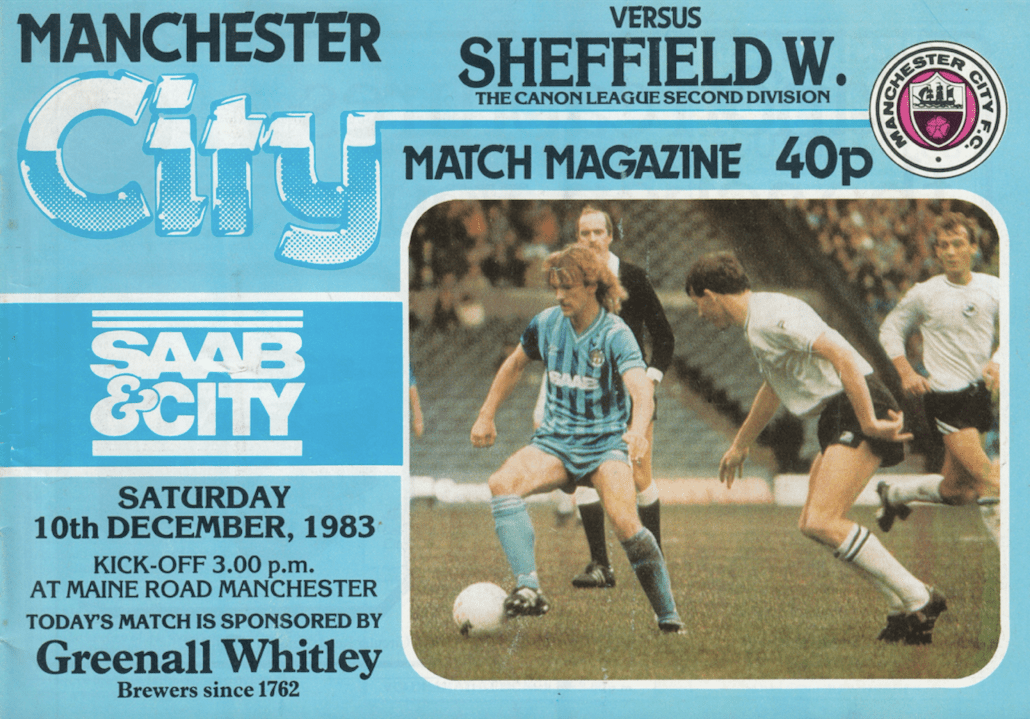
Continuing the series of articles covering Manchester City in the 1980s, here’s a reminder of a game played on this day (10 December) in 1983 when a crowd of 41,862 attended Maine Road for a game with Sheffield Wednesday. At the time this was perceived as a possible promotion showdown for two of Division Two’s biggest clubs. Ultimately, City lost their way and this game actually ended in a 2-1 defeat. City’s goal was scored by Kevin Bond and future Blue Imre Varadi netted both for Wednesday.
If you want to find out more about this season then why not subscribe and read my 2,500 article on the 1983-84 titled ‘Fish Supper’ (because manager Billy McNeill said City were so skint at the time that they could hardly buy a fish supper). Enjoy!
Subscribe to get access – Monthly
Read more of this content when you subscribe today. It costs £3 per month (cancel anytime) to access everything posted since 1 October 2022 or there’s a special annual rate below which gives greater access and works out much cheaper.
Read more of this content when you subscribe today. It costs £3 per month (above) or £20 a year (here) to access everything posted since the site was created in December 2020. This special rate works out about £1.67 a week and gives access to everything posted, including PDFs of 3 of my books.
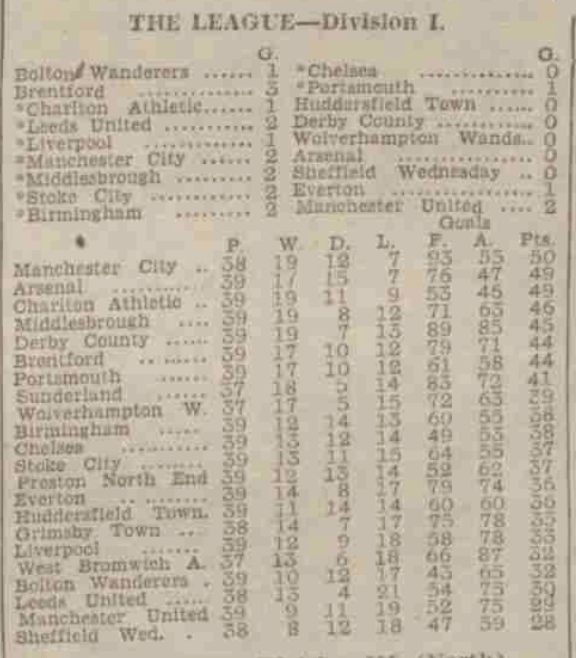
Here’s an interesting photo of Manchester City chairman Bob Smith in 1947 pondering putting up ticket prices. Smith had been chairman for about 12 years at this point – a period that had seen City win the League but also suffer relegation. There was also World War Two of course.
Attendances had increased post WW2 and so it does seem odd that the question of putting up admission prices was raised at all. City, in particular, were a hugely profitable club at this time and Maine Road staged high profile rugby games as well as United renting the stadium (on terms they had suggested).
This photo was taken at the League AGM and shows Smith with John Sarjantson (Southampton). Smith remained chairman for another 8 years after this. I’ve posted the photo because it does seem like an interesting snapshot of City’s boardroom leader at the meeting.
2023 marks the 100th anniversary of Maine Road’s first game and to commemorate this landmark moment I have been posting a different image or feature on the old stadium each day for the last 100 days. Today is day 100 and is the actual centenary of that historic first game. So guess what I’m covering today? On this day (25 August) in 1923 Manchester City’s Maine Road Stadium staged its first game. Here is film of that landmark day in Manchester’s sporting history…
You can also read a 1100 word article about the opening of the stadium and on why the ground was considered to be the ‘English Hampden’ and not the ‘Wembley of the North’ that some have tried to claim in more recent times.
Subscribe to get access – Annual
Read this and all other content when you subscribe. It costs £20 a year to access all the articles, interviews, talks and books on the site plus everything posted during your subscription. There’s also a monthly option (see below)
Monthly subscriptions (cancel any time) costs £3 per month to access all the articles, interviews, talks and books posted on the site since 1 October 2022 plus everything posted during your subscription. Why not try it for a month?
On 18 August 1923 the last ever game, a practice match, was staged at Manchester City’s Hyde Road ground with a crowd of about 10,000. Afterwards the goal posts and a few turnstiles were taken from the old ground and erected at Maine Road – about 6 were still at Maine Road in 2003 when it was demolished. Attempts were made to keep one of the oldest (from 1896) and re-erect it in a public area at the new stadium. Sadly, the day before it was to be removed the external wall was smashed and the turnstile was stolen.
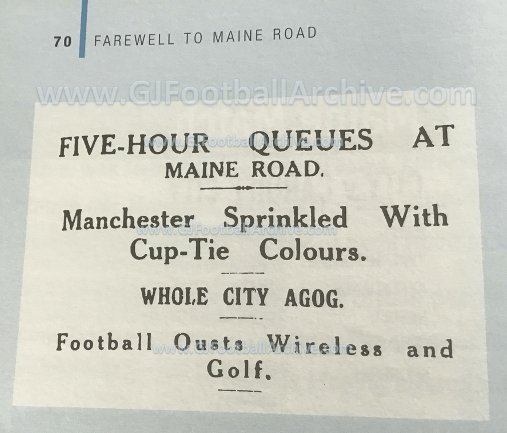
For Day 93 in my series of free articles counting down the 100 days to the centenary of Maine Road’s first game I want to do a bit of an attendance feature. Maybe this will put a few myths to bed!
The Blues have, generation after generation, been one of the English game’s top attractions and Maine Road was an incredible and poweful venue over the years. The Etihad has seen City establish new record average attendances but no English club venue can match what Maine Road achieved in terms of record crowds and it still, all these years on, holds the record for the highest crowd on an English club ground and the record attendance for an English League game – a record City set in 1935 which is currently held by a game featuring United and Arsenal at Maine Road.
The record attendance on a club ground was first set by City in 1924 – 99 years ago! – and was eclipsed by a figure of 84,569 in 1934 – almost 90 years ago. City know how to establish and keep records for decades!
Like all – and I do mean all – English clubs there have been some average attendance lows at Maine Road over the years, but when the entire history of Manchester City at the old stadium is reviewed and the club’s average figures are compared with the national average it is clear that the Blues have consistently been one of football’s most attractive draws. Take a look at the following:
Since the beginning of the Football League in 1888 only nine sides have topped the table for average attendances. In chronological order of their first appearance at the top of the average table they are: Everton (1888-9), Villa (1898-99), Newcastle (1904-05), Chelsea (1907-08), Tottenham (1909-10), City (1910-11), Liverpool (1922-23), Arsenal (1929-30), & Manchester United (1956-57). City were not based at Maine Road back in 1910 (which makes that even more remarkable) and they were the best supported club again before moving to Maine Road. The first time Maine Road attracted the highest national average was in 1925-26 – which means that City are the ONLY team to have topped the attendance charts at two different venues!
Regularly amongst the best supported sides throughout the inter war period, City’s average exceeded 37,000 for the first time in 1927-28 when the club established a record average crowd for the Second Division. This was also the entire League’s highest.
In 1947-48 City’s average crowd exceeded 42,000 for the first time. Prior to that season only Chelsea (1919-20 & 1946-7), Arsenal (1934-5, 1936-7,1937-8, & 1946-7) , Newcastle (1946-7), Liverpool (1946-7), United (1946-7), and Wolves (1946-7) had exceeded that figure.
From 1975 to relegation in 1983 City were always one of the top 4 best supported sides. Yes, even in a relegation season they were better than all but 3 teams and those 3 teams all finished in the top 4 (one won the League, one the FA Cup and the other finished 4th after winning the FA Cup in the previous two seasons).
Since the 1980s whenever City have played outside of the top division, they have tended to be the best supported side in that division.
In general many people believe success increases support, and while that is undoubtedly true to some extent, for City at Maine Road it was often periods of adversity that proved the loyalty of the Club’s fans. For example, in 1925-26 when City were the best supported side in Division One and had established a new record average, the Blues were actually relegated. This coupled with significant poverty and hardship in Manchester at the time should have reduced support but loyalty increased! In my book “Manchester A Football History” I explore the relationship between attendances and Manchester’s major sides and it is fair to say that City fans can feel immensely proud of their loyalty throughout the history of the game. Something that cannot be said by all of the League’s biggest names.
In fact, it is worth highlighting that City have never been the worst supported side in their division at Maine Road (or anywhere else for that matter!) but, of today’s perceived giants, Arsenal (1912-13 – average = 9,100) and Manchester United (1930-31 – average = 11,685) have. City’s worst average at Maine Road came in the desperate 1964-65 season and was 14,753 (half the average of 1960-61 and a 3rd of City’s 1957-8 figure). However it is significant that for every League season the club’s average has always been above the divisional average and, apart from 17 seasons, has always been in the top 11 nationally. Again, few of today’s giants can say that – United’s 20th Century low stands at 4,650 and Chelsea averaged 15,731 as recently as 1988-89.
For fans average attendances are often used as an indicator of size of club and so a number of people over the years have tried to produce a definitive ‘all-time’ attendance table. A few years ago analysis by a member of the Association of Football Statisticians (It wasn’t my research – though I was a life member of this organisation) claimed that if stadium capacity was not an issue for any club City would be the fourth biggest side in terms of attendance. That analysis compared postwar attendance detail with performance on the pitch.
Figures can be manipulated in many different ways, but City fans should feel proud that the Blues have many attendance firsts that can never be matched by today’s perceived biggest clubs.
If you have enjoyed this and the other Maine Road 100 articles/features then why not subscribe? For details see:
For post 77 in my Maine Rd 100 countdown a reminder of a record City have held for almost a century! This image is of a day in 1924 when City attracted the highest crowd on a club ground. The drawing is looking from the Main Stand towards the Popular Side, later Kippax. It’s no longer the record attendance because it was beaten by another record crowd at Maine Rd a decade later. Want to know more? The read on…
1925 Aerial photo of Maine Road and Platt Fields Park
A record Manchester City have held for 99 years was set on 8 March in 1924 – the record is the highest attendance on a club ground! The record set in 1924 saw 76,166 attend City v Cardiff. City had moved to their new Maine Road stadium in August 1923. The capacity of the venue was estimated at around 90,000 but was actually approximately 83,000 when the stadium opened (it was enlarged in 1931 and 1935).
In its first season the capacity was tested and, on that day (8 March) in 1924 the largest attendance for any footballing fixture (including three FA Cup Finals) in Manchester gathered to watch the Blues. This was also, at the time, the record crowd for any game played on an English club ground. It was beaten ten years later when 84,569 watched City v Stoke. You can read about the remarkable day in 1924 below:
Subscribe to get access
Read more of this content when you subscribe today. It costs £20 a year (access to everything) or £3 per month (see below).
Read more of this content when you subscribe today. It costs £20 a year (see above) or £3 per month (cancel anytime; access to everything posted since 1 October 2022).
This has been a sample of the material on http://www.GJFootballArchive.com If you would like to read all the in-depth articles (including the entire Manchester A Football History book and the audio interview with John Bond) then please subscribe. It works out about £1.67 a month if you take out an annual subscription (£20 per year) or £3 a month if you’d like to sign up for a month at a time. Each subscriber gets full access to the 260+ articles posted so far and the hundreds scheduled to be posted in the coming weeks.