League Dominance?

Lots of tosh has been spoken recently about teams dominating English league football with some claiming that there’s ‘never’ been a time when a team has dominated as much as Manchester City do today. Ignoring the fact that the League campaign is not over yet and will go to the final day (so that’s a nonsense for a start) I decided to pull together a few facts that may be useful. They’re certainly relevant.

So, first of all, the question of whether Manchester City is the first to dominate in a way no other has before (again the season isn’t over and it could go either way yet, so ‘dominate’ is not something I believe anyway!)… City have currently won 3 League titles in a row. A feat that has been done several times before, most recently (before City) by Manchester United in 2006-09.

Ah, but City have won 5 out of 6 titles they say… Yes, but United won 7 out of the first 9 Premier Leagues and were runners up in the other 2. Liverpool achieved the same 7 out of 9 League titles in the 1970s and early 80s. We can’t predict the future of course but City have never managed seven titles in 9 seasons. In fact if City do win the League the stats will show it’s 7 in 11 seasons and at present it’s 7 titles in 12 seasons. So that means two other clubs have had longer spells as ‘dominant’ clubs using the language and phraseology that those criticising the reigning Champions usually use.

One of the other criticisms that’s thrown City’s way is about the Premier League being ‘boring’ because it’s a ‘foregone conclusion’ and ‘other teams have to be perfect’ to finish above City. Well, to be the best you have to beat the best but in terms of the League being ‘boring’ and a ‘foregone conclusion’ then the stats in terms of points gaps say otherwise.

Sure, City’s incredible 2017-18 season when they amassed 100 points was one in which the Blues ran away with the title, but it was also a rarity. City won the League by bettering second place by an astounding 19 points but, wait a minute, that amazing gap is only 1 point  more than the (18 point) gap between 2020 champions Liverpool and second placed City (at a time when City are supposed to be the dominant team!). Not only that but United had an 18 point gap between them and second placed Arsenal in 2000.

Worth noting too that in the 31 season history of the Premier League 14 runners-up teams bettered 2nd placed United’s points tally in 2017-18 when City achieved their 100 points. Surely, no title winning team can be blamed if the runners-up have worse results than in more than 45% of the competition’s seasonal history?

What about the ‘foregone conclusion’ and ‘boring’ line? Well, I suppose it can be argued it’s boring if the League is won many, many weeks before the end of the season. Using that logic it should also be ‘not boring’ if it goes down to the last game (like this season) or the last week (could be 2 or 3 games depending on fixture congestion). So I’ve had a look at how many seasons have finished with 3 points or less separating the top two teams. This shows that there have been 9 seasons when this has been the case. Guess what? 4 of those were seasons when City have won the Premier League (2 United, 1 Arsenal, Blackburn & Chelsea).

This means that 57% of all City’s Premier League title wins have been by less than 3 points! For United (13 PL titles) the figure is 15%; Arsenal (3 PL) it’s 33% and Chelsea (5 PL) is 20%.  Four of United’s PL titles have been won by 10 points or more.

Of course, title races can be exciting when teams win the League by ten points or more, but the argument many put across is that it’s boring when one team walks away with it. Surely there’s less chance of that happening when a team wins the title by less than 3 points?

There are lots of statistics that could be posted and, to be frank, they never actually tell the story of a season. How many times do we see possession stats that are in one club’s favour but the other team is actually winning? Nevertheless, when people try to suggest a season is boring because a club (any club) is running away with it then the stats can help show that something is not true. Similarly, when it comes to dominant football clubs – yes, there are eras of dominance by certain clubs and Manchester City certainly are a dominant club at the moment – we must not be fooled into thinking that a situation has NEVER happened before when it so obviously has (and other clubs may actually have been more dominant!).

Ah well! Football, hey? If only people actually looked at history more before jumping to conclusions.

Manchester City Chants

I’ve posted a lot on this in the past but it’s always worth revisiting, especially as recent years have seen dozens of new chants established at Manchester City. Successful eras often bring new chants – and that’s definitely happened recently – but failing periods can also generate new supporter songs.

Chanting at football games is rarely documented correctly with many myths, rumours and stories developing over the years. This feature is designed to give a potted overview of the development of singing at City.

I explained about some of the chants in this talk I did a couple of years ago. If you’ve got time watch it:

Now, for subscribers is an 1800 word article on the history and development of chants at Manchester City:

Subscribe to get access

Read more of this content and everything on the site when you subscribe today.

If you want to know more on subscribing first have a read of this:

Lee Jackson Man of the Match

Today (28 November) in 2021 Manchester City manager Pep Guardiola believed that City groundsman Lee Jackson and his team were the real stars as City defeated West Ham 2-1 in snowy conditions. Pep said: ‘I think the groundkeepers, the men who took care of the pitch, were the men of the match. They did an incredible job so we could play the game today.’

In the first half with heavy snow falling on a pitch already covered in it, there was a real fear the game might not reach its conclusion. Lee Jackson and his team got to work and, with the aid of a half-time interval extended by referee Michael Oliver by five minutes, the surface was clear enough to play on.

City won the game with goals from Gundogan (33rd minute) and Fernandinho (90). West Ham scored a consolation (Lanzini) in the 4th minute of added time.

Royal Blues

On this day (20 October 1934) King Charles III’s grandad attended Maine Road to watch Manchester City face Derby County in the League. It wasn’t the first time a senior member of the royal family attended a City home game, nor was it the last time a future monarch or monarch attended Manchester City’s home. You can read about those visits here:

Subscribe to get access – Monthly

Read this 1,600 word article when you subscribe today. It costs £3 per month (cancel any time) or £20 a year. As well as this article you get to access books, videos, history talks, interviews and other articles.

Subscribe to get access – Annual

Annual subscribers access everything since the site went live in December 2020. Monthly subscribers get everything since 1 October 2022. All subscribers access new posts throughout their subscription.

Newcastle v Manchester City: The Story So Far

City v Newcastle is one of the most enduring fixtures in English football. There have been cup finals, title deciders, dramatic games, shared heroes and so much more. The two clubs first met in the League in October 1893 (Ardwick/MCFC’s 2nd season in the League) and have since played each other 189 times overall with City winning 76 and Newcastle 72 games.

As tonight is a League Cup tie, the most famous meeting of the teams in that competition came in 1976 at Wembley when Peter Barnes and Dennis Tueart both scored for the Blues.

Anyone at Maine Road on the day City played away against Newcastle at Maine Road? See:

100 years ago there was the last meeting at City’s famous old Hyde Road ground:

In 2012 a Newcastle v City game was crucial in the Blues’ title charge:

Elano’s wonder goal in 2007:

In 2021-22 there was a memorable City victory:

Most Blues of my age and above will remember where they were when our King returned to action on Boxing Day 1977. Here’s an interview I did with him a few years back when we talked about that special day:

When I was a teenager there was a second tier meeting that attracted a significant crowd for the period:

My Dad’s generation will remember the 1955 FA Cup final:

During 1956-57 there was a ‘game of the season’ in the FA Cup between the clubs:

My grandad’s generation would’ve remembered Billy Meredith’s last game:

Who remembers the title decider at Newcastle? Details:

There was a really odd thing a while back where a Newcastle paper claimed that their local team had first worn bar scarves at games. A few simple searches soon proved there were much earlier bar scarfs:

Some of the above are free to read and some are for subscribers only. Follow the link below if you want to find out more about subscribing:

Ferran Torres Coincidence

Today (21 September) is the anniversary of Ferran Torres’ first League game from Manchester City AND the anniversary of his last game for City. Considering he played more than one game this is quite a coincidence. His first League appearance was on 21 September 2020 against Wolves and his last was exactly one year later on 21 September 2021 against Wycombe in the League Cup.

The Wolves game ended in a 3-1 City victory. Highlights here:

https://www.mancity.com/citytv/mens/wolves-v-man-city-extended-highlights-1-63736312

The Wycombe match ended in a 6-1 City win and can be seen here:

https://www.mancity.com/citytv/mens/manchester-city-6-1-wycombe-match-highlights-63767857

Manchester City v RB Leipzig

On this day (15 September) in 2021 RB Leipzig and Manchester City met for the first time competitively. That game was played at the Etihad Stadium in the competition’s group stage (Group A). It was Pep Guardiola’s 300th game as manager and City achieved a 6-3 victory which meant that the Blues became the quickest English team to achieve 50 wins in the Champions League. Nice work!

Nathan Ake opened the scoring with a powerful header in the 16th minute, becoming  the tenth different City player to score that season. The lead was increased twelve minutes later when Nordi Mukiele scored what was described by the BBC as a ‘calamitous own goal… The France defender got his angles horribly wrong as his attempted header back to his keeper following Kevin de Bruyne’s delivery ended up in the net.’

Nkunku scored for Leipzig three minutes before half time but City restored their two goal lead by half time with Riyad Mahrez netting a penalty (45+2) awarded after Lukas Klostermann handled.

Leipzig’s Nkunku headed home his second to reduce the deficit six minutes after the restart, but City hit back five minutes later as Jack Grealish scored with a delightful finish on his Champions League debut. Afterwards he commented about the whole experience: ‘I loved it. I’ve been waiting a while. The past few weeks, I couldn’t wait for this game. It’s a great night.’

Talking about the goal Grealish said: ‘The ball came to me and when I’m in that position, running into the area I’d back myself one on one against anyone to have a go and it paid off. I had a few in the first half that were blocked.’

Former Paris St-Germain player Nkunku scored again (73rd minute) to complete his hat-trick, but Joao Cancelo added a stunning 25 yard effort for City two minutes later. The former City player Angelino was dismissed for a second bookable offence four minutes later and then substitute Gabriel Jesus tapped in at the far post to make it six for City with only five minutes of normal time remaining.

The match ended 6-3 but in truth City’s victory was much more convincing than the three conceded goals suggest. Grealish loved the whole experience of his first Champions League match: ‘It was one of those games. It had absolutely everything. In the end we’re delighted to get the win against a good team full of energy and young players… I’m delighted to come away with the three points – and the goal and assist… I went to check the result from the other game [Club Bruges 1-1 PSG] and it shows anything can happen in the Champions League. It’s why it’s such a wonderful competition.’

Leipzig’s hat-trick scorer Christopher Nkunku was not as positive as Grealish however: ‘Every mistake was punished. We made a lot of individual errors. I scored three goals but every time they scored again right away. We needed to show more concentration. We knew the quality Manchester City have.’

For City boss Pep Guardiola there was disappointment that three goals had been conceded and he admitted: ‘Leipzig never give up. They have a special way to attack. They play all or nothing. You never have the feeling it’s over. We scored a few minutes after they scored… and it helped us a lot. They have a young team, so aggressive, so strong. A fantastic team. Leipzig give a good message to football. The quality of the players was better today and that’s why we won.’

Maine Road 100 – Day 92

For Day 92 of the Maine Road 100 countdown I’m taking a look at the history of the Kippax Stand… Enjoy!

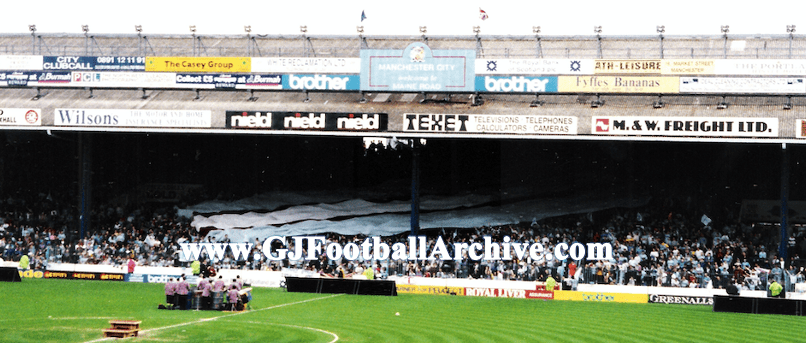
2024 will mark 30 years since we said goodbye to the terraced Kippax Stand and for those of us old enough to remember those days at Maine Road that stand, above all else, represented the passion fans had for their club.

Unlike most other grounds City’s main terracing ran the full length of the pitch and wasn’t tucked away behind a goal. Because of its positioning the Kippax breathed life into every area of the stadium and was huge.  Originally, it held in excess of 35,000, but even in its final days it still gave the impression of power and passion.

The Kippax was originally known as the Popular Side, matching a similarly dominant feature of the Blues’ Hyde Road ground, when it opened in 1923. That first season it held an estimated 35,000 in a crowd of 76,166 – then a national record attendance for a club ground. In 1934 when 84,569 packed into the stadium City’s vast stand may well have held almost 40,000. Incidentally, that 84,569 became the new national record attendance for a club ground (a record that still stands as Wembley is a national stadium, not officially a club ground). You can read about that crowd and game here:

Incidentally, I know City fans get a lot of abuse these days from fans of certain other clubs about filling stadia etc. Well, if you need any ammunition that 84,569 record crowd is over 22,000 higher than Liverpool’s record crowd (61,905 – a figure which wouldn’t get anywhere near City’s top ten crowds!).

Throughout the period up to the mid-50s the Popular Side developed its reputation but it was when it was roofed in 1957 that it became the true heart of the club. Back then it was extended slightly, although legislative changes had reduced terracing capacities by this time. The club announced it would be known as The Kippax Street Stand and that is what it officially remained until 1994 although most of us knew it simply as The Kippax.  Its capacity by this time was about 32,000, reducing to 26,155 by the end of the 1970s.

The Kippax accommodated fans of every age and gender and, although it was a formidable place for opposition supporters, it was a welcoming stand for Manchester’s Blues. Young children would sit on the walls and railings, while older fans would find their own preferred viewing spot. Here’s a few snippets about the old stand:

  • Originally four vast tunnels (one in each corner and two built into the stand) and two significant stairways allowed fans to move onto the Popular Side.
  • A flag pole, positioned at the back of the terracing up to 1957, allowed a blue and white flag emblazoned with the words City FC to proudly fly. The flag was then re-positioned until it disappeared for good in the 1960s. See:

Maine Road 100 – Day 52

  • Chanters Corner, also known as The Sways, was the area where the more vocal members of City’s support gathered. Packed above a tunnel and next to the segregation fence, fans here often generated the main chants.
  • The 1960s saw The Kippax’s reputation grow. Fans sang their way through success after success as Joe Mercer’s Aces won the European Cup Winners’ Cup and every domestic trophy possible. The Kippax would begin every game with the chant “Bring on the Champions!” and then follow up with a song for every player as they warmed up.
  • The final capacity of The Kippax was 18,300 – making this the largest terraced area at a League ground on its final day (The Kop held its final game on the same day but had a smaller capacity).
  • The Kippax was used for the last time on 30 April 1994 for the visit of Chelsea.
  • The Blue Print flag was a popular presence on many match days from the late 1980s until 1994, making its last appearance at The Kippax’s final game. The flag had been reduced in size by then. But it still covered much of the terracing.  Blue Print was a City fanzine and they had paid for the flag.
  • Segregation was unnecessary for most of the stand’s existence, but by the end of the 1960s a rope would often be used to separate City and United fans on derby day. This was replaced by permanent barriers in the mid-70s which were increased over the years to keep home and away fans apart. Away fans were positioned at the Platt Lane end of the stand by this time.
  • It says much about the passion of the place that in the late 1970s the BBC came to film The Kippax chanting and in full flow.
  • In 1985 when City defeated Charlton 5-1 in a promotion decider on the final day of the season the Kippax was so packed that supporters remain convinced that its official capacity of 26,155 was significantly exceeded. Those of us on the terraces that day will never forget the shock we all experienced when the official crowd of 47,285 was announced – some 5,000 short of capacity!

The Kippax is no more, but those of us who experienced the stand will never forget its power, passion and presence. Its spirit lives on with thousands of Blues who stood there now bringing their own children and grandchildren to the Etihad who, if legislation allows, will soon be able to stand in a section specifically created for that purpose.

If you’re interested you can read how Maine Road got its name here:

While you’re here I’d like to thank you for taking the time and trouble to visit my website. I am not employed by anyone and no one pays me to do research or interviews. I do not have sponsorship or advertising either. I’ve set up this website to help share my 32 years plus writing and research. The intention is to develop the archive and to provide access to as much of my material as possible over the coming weeks, months & years. Subscribers can already access over 280 articles/posts including the entire Manchester A Football History book and audio interviews with former City bosses Malcolm Allison and John Bond.

It costs £20 a year (it works out £1.67 a month) or £3 if you’d like to sign up a month at a time to get full access for as long as you subscribe (see below). Thanks for the support, Gary.

Subscribe to get access – Annual

This has been a sample of the material on http://www.GJFootballArchive.com If you would like to read all the in-depth articles and listen to the audio interviews then please subscribe. It works out about £1.67 a month if you take out an annual subscription (£20 per year). Each subscriber gets full access to the 1000+ articles posted so far and the hundreds scheduled to be posted in the coming weeks.

Subscribe to get access – Monthly

This has been a sample of the material on http://www.GJFootballArchive.com If you would like to read all the in-depth articles and listen to the audio interviews then please subscribe. It works out about £3 a month if you take out a monthly subscription (cancel anytime; access everything since 1 October 2022).

There are plenty of other Maine Road related stories on my site. For details and links see:

https://gjfootballarchive.com/category/manchester-city/maine-road/

Maine Road 100 – Day 50

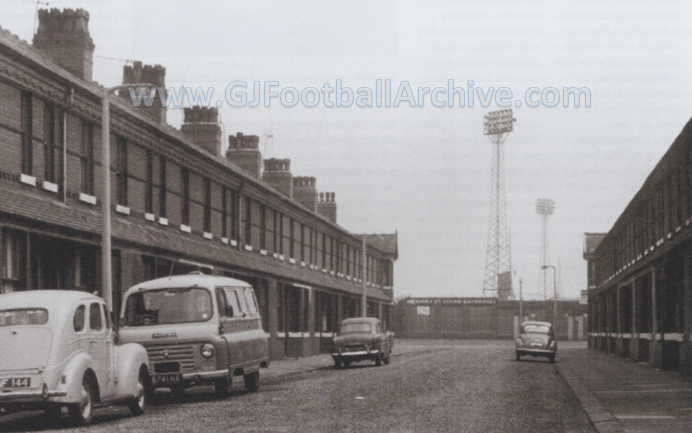
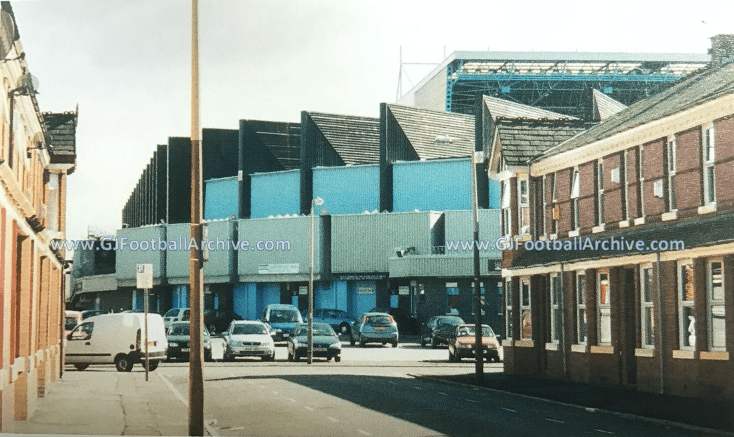
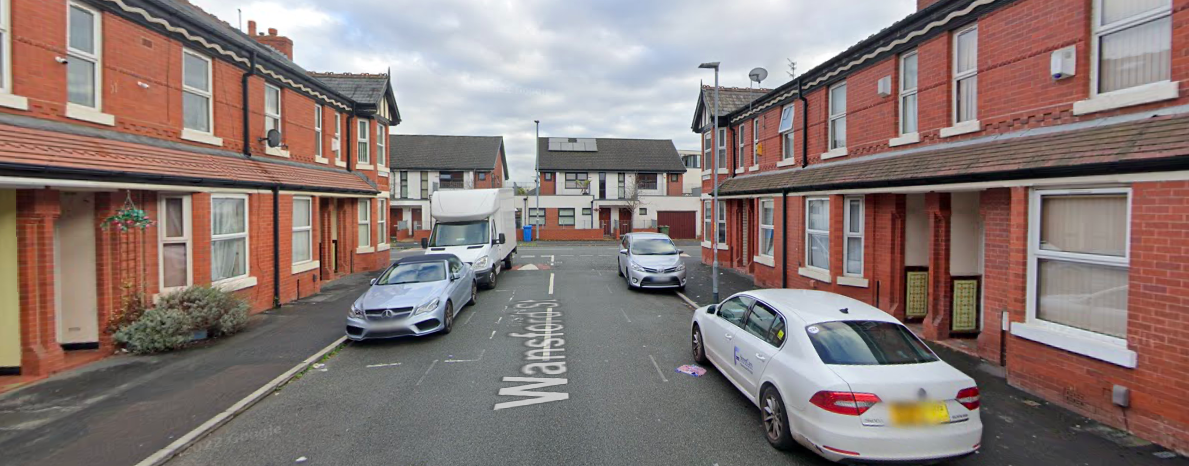
We’re half way through our countdown of 100 features for Maine Road’s centenary. For day 50 of my posts counting down to the centenary of Maine Road’s opening game I’ve posted three photographs of the view down the same street. These are taken on Wansford Street and look towards Maine Road.

The oldest image (black and white) is from the early 1960s and shows the original floodlights, erected in 1953. The following is one I took in 2003, shortly before Maine Road’s final game, and the one below that is a Google image from this last year or so.

The view down Wansford Street towards Maine Road in 2003
The view down Wansford Street towards Maine Road around 2022

Here’s an aerial photo of the ground in 1995 with the North Stand on the left. Wansford Street can just be seen starting almost opposite the club houses to the left of the photo:

This 1971 image shows Wansford Street – it’s the first street to the right of and above the number 2, opposite the North Stand/club houses.

Maine Road aerial 1971 from Farewell To Maine Road

If you’d like to read more on the history of Maine Road, take a look at Farewell To Maine Road, which can be downloaded from this page:

Maine Road 100 – Day 42

For day 42 of my posts counting down to the centenary of Maine Road’s opening game I’ve posted a then and now style feature on Maine Road from the air.

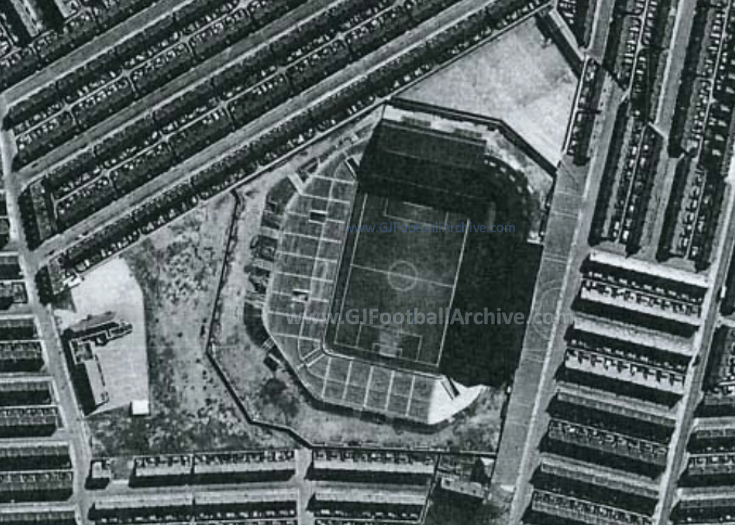
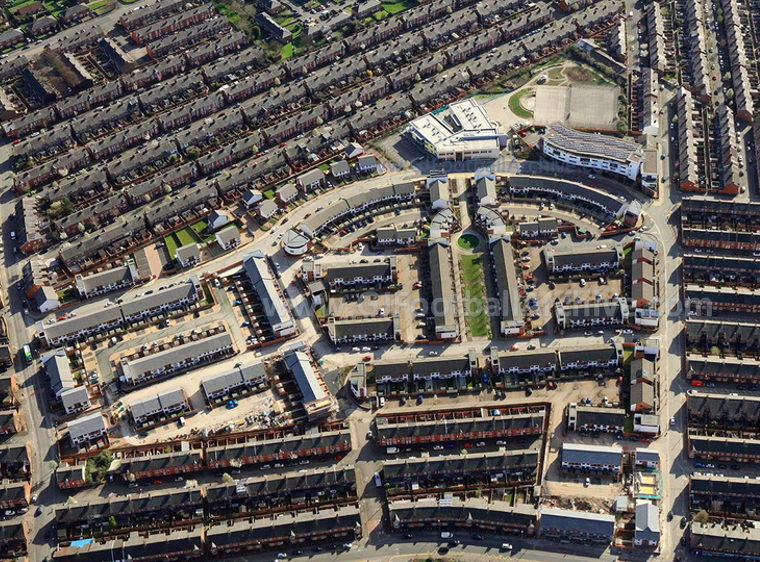
The angles are not quite the same but I hope the following gives you enough of a feel to recognise the differences between Maine Road c.1946 and Maine Road about a year or so ago.

There are a few obvious consistencies between the two photos – mostly the old terraced streets which predated the building of the stadium. Maine Road itself is on the right and Kippax Street is the street that heads towards the terracing (from the bottom/Claremont Road) in the older image. In the newer image it leads into part of the new housing estate. Note the centre spot/circle in the new image. It appears further north than in the older image but that’s mostly the angle (having said that I’m not entirely convinced it’s in exactly the right spot – I’ve not yet compared actual plans but I guess the architects and planners did).

It’s nice to see that the old directors car park (top right) is now a school playground/facility. This seems appropriate as the players often used that car park as a training area during the week. It’s nice to see some continuity. A passageway, known as ‘Pink Passage’ for many years, existed between the directors car park and the external wall of the Platt Lane Stand – you can just about see it on the old photo going from the back of Thornton Road around the Platt Lane to Maine Road.

Notice how the Kippax/Popular Side terracing in the old photo is narrower the closer it gets to Thornton Road (top)… In a previous post I’ve talked about how they had to square off this terracing when they put a roof on in 1957 and how residents objected because they lost the Granada TV signal! See:

Here’s another aerial photo of Maine Road. This is 1971. Notice the away section of the Kippax built on stilts (to left of number 8). The directors car park is the space behind the Platt Lane (numbers 4 & 5) with the Pink Passage between the two walls of the car park and the Platt Lane Stand. Kippax Street itself (the street not the stand) is just visible on the far right (to the right of number 9 on the edge of the photo).

Maine Road aerial 1971 from Farewell To Maine Road

If you’d like to read more on the history of Maine Road, take a look at Farewell To Maine Road, which can be downloaded from this page: