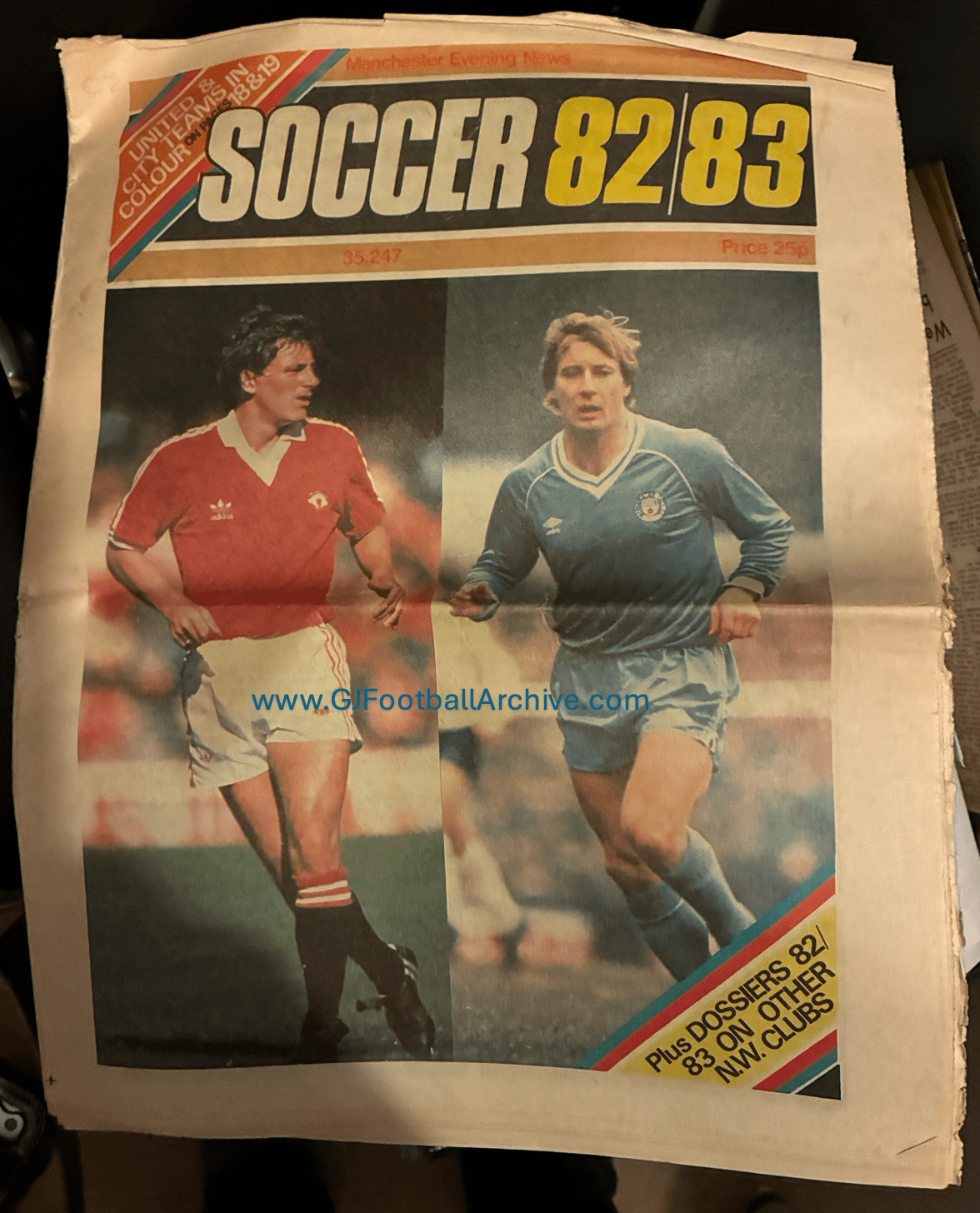
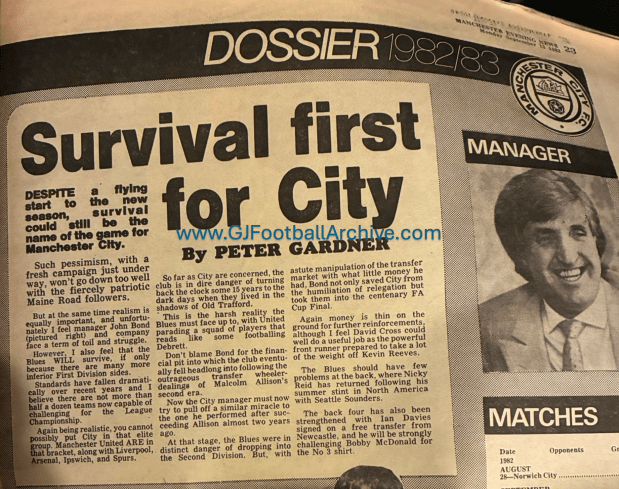
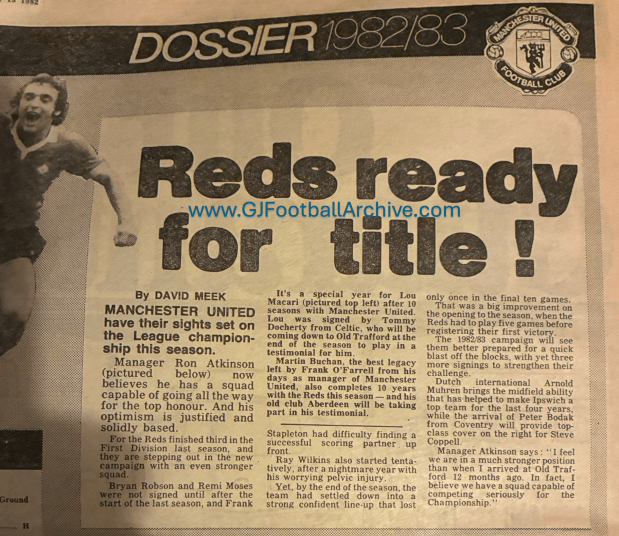
Here’s a few images from the 1982-83 football special publication produced at the start of the season by the Manchester Evening News. Back then the newspaper tended to produce a preview for the season each year. David Meek (United) and Peter Gardner (City) would write features on the two local top flight teams and then there’d also be features on Oldham, Bolton, Stockport and Rochdale. Both Meek and Gardner would also predict what the season would be like for United and City. Typically, Meek would say that the new season was likley to be the one that ‘finally’ brought the League title back to Old Trafford while Gardner would often try to be upbeat about City’s chances in some way. In 1982 Gardner took a different approach though and basically said it would be a difficult season – he was right! – but Meek stuck to the usual approach and said that 1982-83 could be the year the League title returned to Old Trafford for the first time since 1967 (City had won it in 1968).
United didn’t win the title for another decade and if you’d like to know exactly what happened to City, you can read all about the 1982-83 season for the Blues in this 3,500 word subscriber feature. Enjoy (well, if you know the outcome of this season you can enjoy this memory refresh while reflecting on the modern day successes of the Blues!).
Subscribe to get access – Monthly
Read more of this content when you subscribe today. It costs £3 per month (cancel anytime) to access everything posted since 1 October 2022 or there’s a special annual rate below which gives greater access and works out much cheaper.
Read more of this content when you subscribe today. It costs £3 per month (above) or £20 a year (here) to access everything posted since the site was created in December 2020. This special rate works out about £1.67 a week and gives access to everything posted, including PDFs of 3 of my books.
On 8 June 1983 it was reported that both Jack Charlton and Brian Clough were possible for the vacant manager’s position at Manchester City. The Blues had been relegated the previous month, leading to the dismissal of caretaker John Benson. Benson had been appointed following the departure of John Bond in January and Benson was a reluctant manager – basically he’d been told that he either took the job or he’d be sacked from his assistant manager position!
Ultimately, Billy McNeill became the City boss. Notice the comment from Swales about resigning – as I’ve often said it was down to his supporting directors that he remained in charge for as long as he did!
You can read all about the 1982-83 season for City in this 3,500 word subscriber feature. Enjoy (well, if you know the outcome of this season you can enjoy this memory refresh while reflecting on the modern day successes of the Blues!).
Subscribe to get access – Monthly
Read more of this content when you subscribe today. It costs £3 per month (cancel anytime) to access everything posted since 1 October 2022 or there’s a special annual rate below which gives greater access and works out much cheaper.
Read more of this content when you subscribe today. It costs £3 per month (above) or £20 a year (here) to access everything posted since the site was created in December 2020. This special rate works out about £1.67 a week and gives access to everything posted, including PDFs of 3 of my books.
As part if my Maine Rd 100 countdown in 2023 I posted this image of Manchester City fans demonstrating against chairman Peter Swales and his supporting board of directors. It’s always worth remembering those days as a reminder of how things change.
Of course fans still demonstrate and make their feelings known over various issues (as is their right) but these days it tends to be over specific issues. Back then it was about the direction of the full club. This image was from 1983 but protests against Swales and the board began in 1979 and continued until 1993-94. Here’s a photo of John Bond stood in front of the Main Entrance in 1983. The ‘cage’ protecting the entrance would often get locked to prevent fans forcing their way in during demonstrations.
John Bond, 1983
Here’s a 1995 image of Maine Road showing the forecourt in front of the Main Stand where most demonstrations occurred:
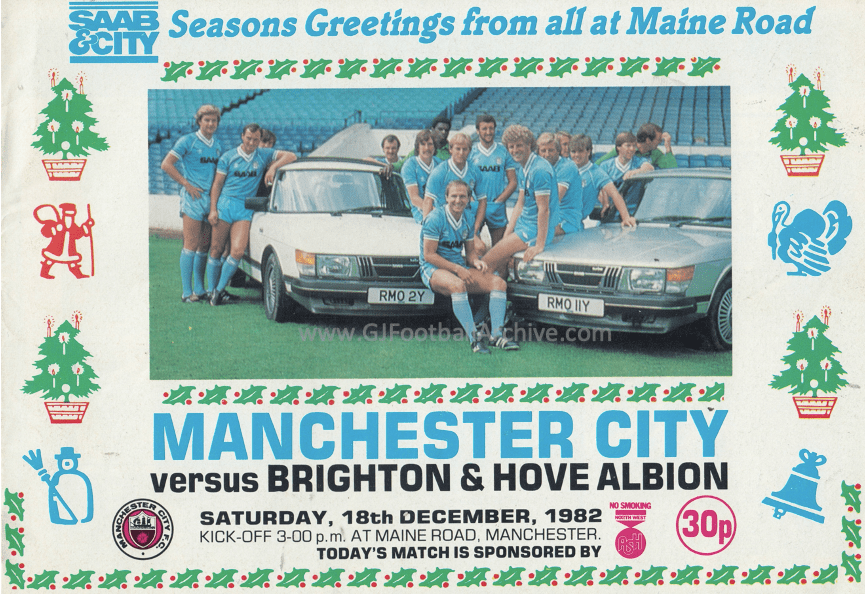
Here’s a nice Christmassy themed programme cover from today (18 December) in 1982. If you’re wondering City’s sponsor was SAAB and this was the first season of shirt sponsorship at Maine Road.
The day’s opponents were Brighton and the game ended 1-1 (Kevin Bond scoring for the Blues). Bond is the player on the far left of this photo. Notice Joe Corrigan (far right)… I get the impression he’s muttering ‘what is the game coming to? Cars on the pitch… there’ll be referees sat in a room miles away awarding a penalty after a perfectly good save is judged to be a foul, by someone sat watching a telly next!’
If you want to know more about this period then why not subscribe? As well as all the other benefits you could read the following 3,500 word feature on the 1982-83 season. Enjoy (well, if you know the outcome of this season you can enjoy this memory refresh while reflecting on the modern day successes of the Blues!).
Subscribe to get access – Monthly
Read more of this content when you subscribe today. It costs £3 per month (cancel anytime) to access everything posted since 1 October 2022 or there’s a special annual rate below which gives greater access and works out much cheaper.
Read more of this content when you subscribe today. It costs £3 per month (above) or £20 a year (here) to access everything posted since the site was created in December 2020. This special rate works out about £1.67 a week and gives access to everything posted, including PDFs of 3 of my books.
Southampton were the visitors to Maine Road on this day (6 November) in 1982. The image heading this feature is of the Kippax Stand about an hour before kick-off that day. Back then fans would queue up outside the turnstiles waiting for them to open at 1pm for a 3pm kick off. Once allowed in Supporters would head for their usual space on the terracing and wait for kick off.
Away fans would typically be positioned in the section to the right of this photo and, depending on the size of the travelling support, they would either have all that final section of the Kippax including the open corner next to it, or would be penned only into the back section of the stand. It may seem odd today but on days when the away fans would be positioned at the back, the front section and corner were usually opened up for home fans. As was the case for this game.
While the Kippax was one vast area of terracing, the more vocal fans would tend to gather close to the away section, above one of two large tunnels that cut through from the back of the stand to the terracing.
Notice the advertising and signage on the roof. As well as the Manchester City sign there are adverts for the Junior Blues and City Bingo, plus several familiar local businesses, including the popular Parkside Hotel, close to the ground.
City defeated Southampton 2-0 on the day this photo was taken with a tenth minute goal from Kevin Reeves – past England ‘keeper Peter Shilton – and a header from Bobby McDonald in the 66th minute. Shilton had saved a penalty in the 38th minute from Kevin Bond while City captain Paul Power was judged the man of the match in most newspapers.
The victory put City second to Liverpool in the League and four days later City and Southampton met again at Maine Road. This time it was a League Cup tie which ended in a 1-1 draw, but the replay ended in a Southampton win.
As for the Kippax… The stand had once accommodated over 35,000 and its capacity when this photo was taken was about 26,500. At the time it was demolished in 1994 it was the largest capacity terraced stand in the country, marginally higher than Anfield’s Kop.
Here are highlights of that match for those who want to know more about the game:
If you enjoy all the free material on my website and would like to support my research and keep this website going (but don’t want to subscribe) then why not make a one-time donation (or buy me a coffee). All support for my research is valued and welcome. It allows me to keep some free material available for all. Thanks.
If you’re at the Manchester City game today and are lucky enough to read the match programme, my One Moment in Time feature includes a photo of the Kippax Stand taken about a hour before kick off of a City-Southampton match in November 1982. Here are highlights of that match for those who want to know more about the game:
If you enjoy all the free material on my website and would like to support my research and keep this website going (but don’t want to subscribe) then why not make a one-time donation (or buy me a coffee). All support for my research is valued and welcome. It allows me to keep some free material available for all. Thanks.
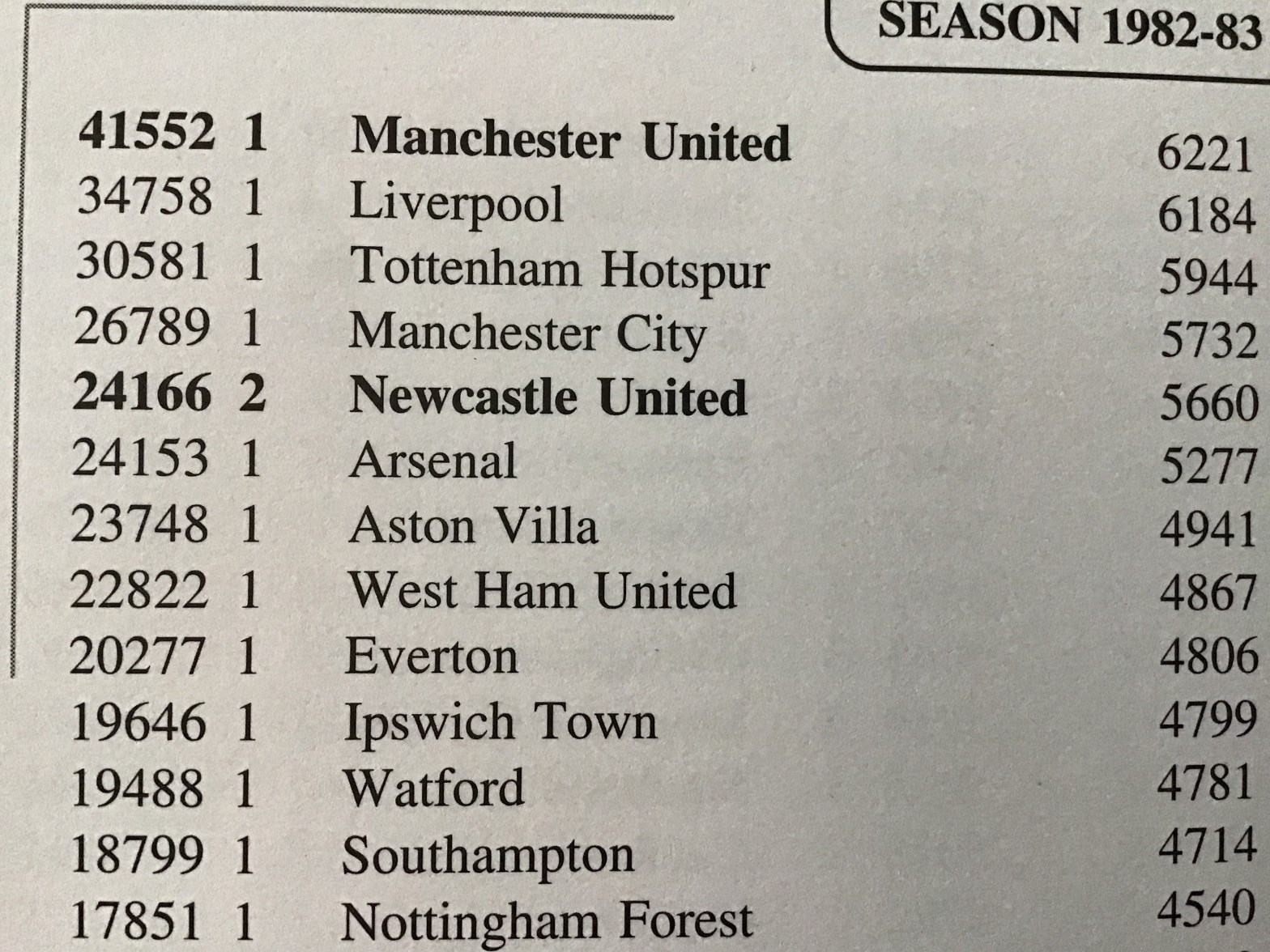
Fairly early on in the game between Manchester City and Arsenal the fans of the London club started to sing the old ‘Where were you when you were…’ chant. You’d think they’d know because often City were attracting better crowds than Arsenal. Let’s look at 1982-83 when I experienced my first relegation as a City fan. Back then City were the 4th best supported club (26,789) and Arsenal were 6th (24,153) – see the average attendance table above. City finished in a relegation position and Arsenal were 10th.
The following season Arsenal did attract a better average than City but they were the 5th best supported club in the entire 4 divisions and City were the 6th. In terms of League position Arsenal were 6th and City were 4th in Division Two.
We could talk about the late 1990s but neither club had a ground that could satisfy the demand to see them, so a sell out Maine Road in 1998-99 for third tier City has to compare with a sell out Highbury for title challenging Arsenal.
Since then stadium size has dictated average support but if we go back to earlier decades and assume that Arsenal’s ‘Where were you when you were sh*t’ refers to City heading towards relegation or being out of the top flight then City’s record is impressive overall. In 1965-66 (the last 2nd division season before the 1980s) City averaged 27,739 (10th best in entire League) while First Division Arsenal were the 9th best supported club on 29,036.
We can jump back even further. In the 1920s Arsenal were perceived as a popular club and in 1925-26 they averaged 31,471 – the 3rd best in the League. Where were City? Oh, City who were relegated that season were the 2nd best supported team with an average of almost 32,000. Not much more than Arsenal but the Gunners were 2nd in the League and City were relegated!
The year after Second Division City were the 3rd best supported club and top flight Arsenal were 4th!
1926-27 Average attendances. Manchester City in Second Division
The year after that (1927-28) Second Division City were the best supported club in the entire League with 37,468. Where were top flight Arsenal? 7th best supported with 27,434.
1927-28 Average attendances. Manchester City were the best supported club despite being in Second Division
It’s all a nonsense but if Arsenal fans, or any other team, want to sing songs like this then it would help if they knew their own history of support.
On this day (28 August) in 1982 Manchester City should have played their first League game with a sponsor’s name on their shirt. However the match was televised and in those days TV did not allow clubs to wear sponsors names in televised games. The match was a 2-1 win away at Norwich and City’s first sponsor was the car company Saab.
New signing David Cross scored the opener after 3 minutes and 5 seconds (below) and we all thought this was going to be a great season. I won’t spoil it by saying what happened the following May!
New signing David Cross scoring after 3 minutes and 5 seconds at Norwich, August 1982
Here’s another SAAB & City photo from later that season:
It seems that some have a view that the giant clubs remain giant clubs forever and that there are some clubs who have only recently become prominent. Others believe that teams that were giants decades before some of today’s major trophy winners were never actually that prominent. I could spend hours challenging those who hold these views and pointing out that teams such as Everton, Newcastle & City won major trophies before many of these clubs and were perceived as giants years earlier too (decades before in some cases!), but it doesn’t feel like they’d listen. Ah well! Instead as part of my series of features/articles covering Manchester City in the 1970s I’d like to post a few attendance details that may interest some.
The following are a list of the top seven best supported top flight clubs for the ten seasons prior to City’s relegation in 1983. The Manchester clubs are in bold and the numbers in brackets show each club’s league position that season. In addition if any of the clubs won the European Cup, UEFA Cup, ECWC, FA Cup or League Cup that is also listed in brackets.
AVERAGE ATTENDANCES – Top Tier 1973-74
42712 MUFC (21st); 42332 Liverpool (2nd & FA Cup winners); 38666 Leeds (1st); 33048 Birmingham (19th); 32861 Newcastle (15th); 30756 MCFC (14th).
AVERAGE ATTENDANCES – Top Tier 1974-75
45966 LFC (2nd); 40021 Everton (4th); 34822 Leeds (9th); 34614 Newcastle (15th); 32898 MCFC (8th); 30854 Birmingham (17th); 29872 West Ham (13th & FA Cup winners). Both Manchester United (48387) and Sunderland (29931) were in Division Two but had an average higher than some of those in the top seven top tier averages.
AVERAGE ATTENDANCES – Top Tier 1975-76
54750 MUFC (3rd); 41623 Liverpool (1st & UEFA Cup winners); 38874 Aston Villa (16th); 34280 MCFC (8th & LC winners); 33060 Newcastle (15th); 31511 Leeds (5th); 28350 Derby (4th). Sunderland in Division Two had an average of 31250.
AVERAGE ATTENDANCES – Top Tier 1976-77
53710 MUFC (6th & FA Cup winners); 47221 Liverpool (1st & European Cup winners); 40058 MCFC (2nd); 37903 Aston Villa (4th & LC winners); 33599 Newcastle (5th); 32743 Sunderland (20th), 32671 Arsenal (8th).
AVERAGE ATTENDANCES – Top Tier 1977-78
51860 MUFC (10th); 45546 Liverpool (2nd & European Cup winners); 41687 MCFC (4th); 39513 Everton (3rd); 35464 Aston Villa (8th); 35446 Arsenal (5th); 32501 Nottm Forest (1st & LC winners). Tottenham were in Division Two with an average of 33417.
AVERAGE ATTENDANCES – Top Tier 1978-79
46430 MUFC (9th); 46407 Liverpool (1st); 36371 Arsenal (7th & FA Cup winners); 36203 MCFC (15th); 35456 Everton (4th); 34902 Tottenham (11th); 32838 Aston Villa (8th).
AVERAGE ATTENDANCES – Top Tier 1979-80
51608 MUFC (2nd); 44586 Liverpool (1st); 35272 MCFC (17th); 33596 Arsenal (4th); 32018 Tottenham (14th); 29794 Crystal Palace (13th); 28711 Everton (19th).
1979-80 League table and attendance detail up to 26/4/1980
AVERAGE ATTENDANCES – Top Tier 1980-81
45071 MUFC (8th); 37547 Liverpool (5th & LC winners); 34117 Aston Villa (1st); 33587 MCFC (12th); 32480 Arsenal (3rd); 30724 Tottenham (10th & FA Cup winners); 26477 Sunderland (17th). West Ham were in Division Two with an average of 27140.
Kippax Stand c.1980
AVERAGE ATTENDANCES – Top Tier 1981-82
44571 MUFC (3rd); 35100 Tottenham (4th & FA Cup winners); 35061 Liverpool (1st & LC winners); 34063 MCFC (10th); 26780 Aston Villa (11th & European Cup winners); 26585 West Ham (9th); 25589 Arsenal (5th).
1981 City v United Maine Road
AVERAGE ATTENDANCES – Top Tier 1982-83
41552 MUFC (3rd & FA Cup winners); 34758 Liverpool (1st & LC winners); 30581 Tottenham (4th); 26789 MCFC (20th); 24153 Arsenal (10th); 23748 Aston Villa (6th); 22822 West Ham (8th). Second Division Newcastle attracted an average of 24166.
Fans storming the main entrance in 1983. Mirrorpix photo
For those wondering Manchester City did drop a little in terms of position in the attendance chart during their Second Division days but they were still the 6th best supported club (of all clubs) in 1983-84 and 8th best in 1984-85. Back in Division One in 1985-86 the Blues were once again the 4th best supported team in the entire League.
This series of articles and features on Manchester City in the 1970s has been running throughout January with indepth articles some days and smaller ‘on this day’ style posts on others. Every day in January will offer something to enjoy.
Subscribers will get access to everything. If you want to know more on this incredible decade for Manchester City Football Club then why not subscribe and read it all? You could even subscribe for a month and see what you think. The following 1,600 word article is on the 1974-75 season and is available to subscribers below. Enjoy!
Subscribe to get access – Monthly
Read more of this content when you subscribe today. It costs £3 per month (cancel anytime) to access everything posted since 1 October 2022 or there’s a special annual rate below which gives greater access and works out much cheaper.
Read more of this content when you subscribe today. It costs £3 per month (above) or £20 a year (here) to access everything posted since the site was created in December 2020. This special rate works out about £1.67 a week and gives access to everything posted, including PDFs of 3 of my books.
If you enjoy all the free material on my website and would like to support my research and keep this website going (but don’t want to subscribe) then why not make a one-time donation (or buy me a coffee). All support for my research is valued and welcome. It allows me to keep some free material available for all. Thanks.
Continuing the series focusing on Manchester City in the 1980s here’s a nice Christmassy themed programme cover from today (18 December) in 1982. If you’re wondering City’s sponsor was SAAB and this was the first season of shirt sponsorship at Maine Road.
The day’s opponents were Brighton and the game ended 1-1 (Kevin Bond scoring for the Blues). Bond is the player on the far left of this photo. Notice Joe Corrigan (far right)… I get the impression he’s muttering ‘what is the game coming to? Cars on the pitch… there’ll be referees sat in a room miles away awarding a penalty after a perfectly good save is judged to be a foul, by someone sat watching a telly next!’
If you want to know more about this period then why not subscribe? As well as all the other benefits you could read the following 3,500 word feature on the 1982-83 season. Enjoy (well, if you know the outcome of this season you can enjoy this memory refresh while reflecting on the modern day successes of the Blues!).
Subscribe to get access – Monthly
Read more of this content when you subscribe today. It costs £3 per month (cancel anytime) to access everything posted since 1 October 2022 or there’s a special annual rate below which gives greater access and works out much cheaper.
Read more of this content when you subscribe today. It costs £3 per month (above) or £20 a year (here) to access everything posted since the site was created in December 2020. This special rate works out about £1.67 a week and gives access to everything posted, including PDFs of 3 of my books.






 Gary James' Football Archive