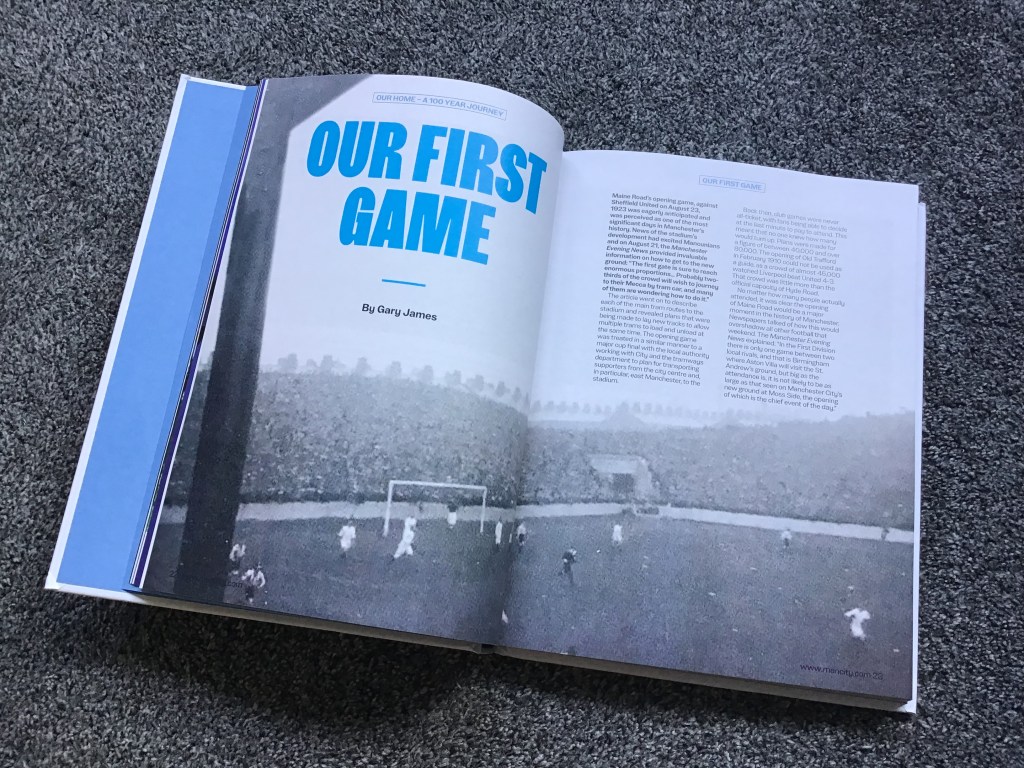
I’m delighted to say I’m one of the co-authors on a new book on the stadia of Manchester City. I’ve contributed the Introduction, the story of Maine Road’s first game and the 100 Maine Memories of Maine Road. I tried to make sure the 100 Maine Memories cover both the great and the unusual so, inevitably, Colin Bell is featured but so is the wonky North Stand scoreboard! If you attended Maine Road it will all make sense and if you didn’t it’ll give you a great feel for what life was like at the old place.
During the 1920s Manchester City had a goalkeeper Jim Mitchell who played in glasses – not specially produced glasses, ordinary glasses of the period!
Here are some images of him in action. I’m not quite certain what’s happened but it looks like he changed his shirt during the game because these are definitely from the same match:
Born in Prestwich, Jim Mitchell was a former Manchester University and Northern Nomads ‘keeper. He also had spells at Blackpool and at Preston where he gained an extremely good reputation. He gained several significant honours and was the Great Britain goalkeeper at the 1920 Olympics. He also kept goal for Preston in the 1922 FA Cup final (the last played at Stamford Bridge before Wembley Stadium opened) against Huddersfield and hit the headlines by leaping around while a penalty was being taken against him – this caused the rules to be changed.
He joined City shortly after the final and replaced Goodchild as City’s number one the following September, making his debut on 9th September 1922 at home to Birmingham. Despite wearing glasses – on the pitch as well as off it – Mitchell was an agile ‘keeper and made 22 appearances in his first season.
Always an amateur, Mitchell made history by being City ‘keeper for the first game at Maine Road (25th August 1923) and was generally recognised as a quality ‘keeper by neutrals. He was certainly known nationwide and was capped at both an amateur level and for the full England side.
He later had a spell at Leicester, though he never appeared in their first team, and joined the footwear firm Stead & Simpson. He went on to become their Managing Director. He passed away in 1975.
Appearances: League: 99 FA Cup: 10
Search my site and you’ll find film of Mitchell at Maine Road’s opening game in 1923. There’s also much more on this 1924 FA Cup semi final featuring Mitchell. It was Billy Meredith’s last game and subscribers can read more and watch film of it here:
2023 marks the 100th anniversary of Maine Road’s first game and to commemorate this landmark moment I have been posting a different image or feature on the old stadium each day for the last 100 days. Today is day 100 and is the actual centenary of that historic first game. So guess what I’m covering today? On this day (25 August) in 1923 Manchester City’s Maine Road Stadium staged its first game. Here is film of that landmark day in Manchester’s sporting history…
You can also read a 1100 word article about the opening of the stadium and on why the ground was considered to be the ‘English Hampden’ and not the ‘Wembley of the North’ that some have tried to claim in more recent times.
Subscribe to get access – Annual
Read this and all other content when you subscribe. It costs £20 a year to access all the articles, interviews, talks and books on the site plus everything posted during your subscription. There’s also a monthly option (see below)
Monthly subscriptions (cancel any time) costs £3 per month to access all the articles, interviews, talks and books posted on the site since 1 October 2022 plus everything posted during your subscription. Why not try it for a month?
It’s Day 99 of my Maine Road 100 countdown to the centenary of Maine Road’s first game. One more day to go! I hope you’ve enjoyed this free series. Today it’s about the oldest and youngest players to have appeared for City at Maine Road. Any ideas who they may be?
Billy Meredith was the oldest to play for City at Maine Road. He was 49 years & 238 days old when he played for City against Preston on 22/3/1924. This was Maine Road’s first season too!
Billy Meredith Returns to MCFC in 1921
Glyn Pardoe was the youngest to play for City at Maine Road. He was 15 years and 314 days old when he made his debut v Birmingham City on 11/4/1961.
Tomorrow will be the centenary of Maine Road’s first game. I hope you have enjoyed my 100 day countdown. If you have enjoyed this series of articles and posts on Maine Road then why not become a subscriber and access all the other great content. To find out more see:
It’s Day 96 of my Maine Road 100 countdown (not long to go now!) to the centenary of Maine Road’s first game and a brief post on the first and last first team penalty takers at Maine Road. Anyone know who they were? I’m sure many people reading this were there when the last penalty was taken in a first team game at Maine Road. Got it?
That’s right the last first team competitive penalty taken at Maine Road was by Stuart Pearce on 21 April 2002 v Portsmouth. He missed (Elsewhere on this site I tell the story of that day – well worth reading if you’re wondering what was so special about it).
The first penalty at Maine Road was also missed. That was taken by Frank Roberts in the opening game v Sheffield United on 25 August 1923.
Of course Garry Bradbury will claim it’s actually him who took the last penalty at Maine Road as he took one for Merseyside CSA in the Supporters’ Club challenge against Prestwich & Whitefield, in a match that was claimed to be the final game at Maine Road on 12 June 2003.
If you have enjoyed this series of articles and posts on Maine Road then why not become a subscriber and access all the other great content. To find out more see:
Busy day today talking about the history of Manchester City, in particular the story of City’s stadia. It’s 100 years on Friday since Maine Road’s first game and we’ve just had the 20th anniversary of the Etihad’s (then known as City of Manchester Stadium) first game. Time flies!
The interviews today started with Mike Sweeney interviewing me about Maine Rd and the Etihad for BBC Radio Manchester – that will be played on Friday assuming all is okay – and then it was off to Manchester City for the next set of interviews about the club’s grounds and other stuff.
Later I’m chatting elsewhere about football, sorry soccer, in the USA. A busy day.
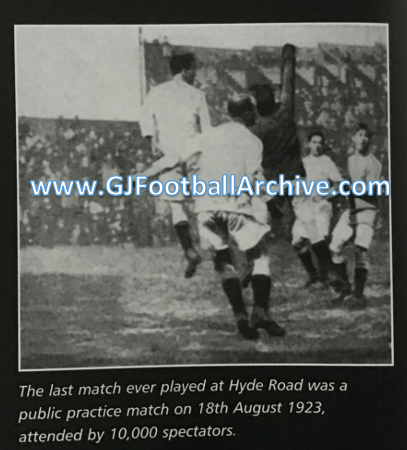
On 18 August 1923 the last ever game, a practice match, was staged at Manchester City’s Hyde Road ground with a crowd of about 10,000. Afterwards the goal posts and a few turnstiles were taken from the old ground and erected at Maine Road – about 6 were still at Maine Road in 2003 when it was demolished. Attempts were made to keep one of the oldest (from 1896) and re-erect it in a public area at the new stadium. Sadly, the day before it was to be removed the external wall was smashed and the turnstile was stolen.
For Day 93 in my series of free articles counting down the 100 days to the centenary of Maine Road’s first game I want to do a bit of an attendance feature. Maybe this will put a few myths to bed!
The Blues have, generation after generation, been one of the English game’s top attractions and Maine Road was an incredible and poweful venue over the years. The Etihad has seen City establish new record average attendances but no English club venue can match what Maine Road achieved in terms of record crowds and it still, all these years on, holds the record for the highest crowd on an English club ground and the record attendance for an English League game – a record City set in 1935 which is currently held by a game featuring United and Arsenal at Maine Road.
The record attendance on a club ground was first set by City in 1924 – 99 years ago! – and was eclipsed by a figure of 84,569 in 1934 – almost 90 years ago. City know how to establish and keep records for decades!
Like all – and I do mean all – English clubs there have been some average attendance lows at Maine Road over the years, but when the entire history of Manchester City at the old stadium is reviewed and the club’s average figures are compared with the national average it is clear that the Blues have consistently been one of football’s most attractive draws. Take a look at the following:
Since the beginning of the Football League in 1888 only nine sides have topped the table for average attendances. In chronological order of their first appearance at the top of the average table they are: Everton (1888-9), Villa (1898-99), Newcastle (1904-05), Chelsea (1907-08), Tottenham (1909-10), City (1910-11), Liverpool (1922-23), Arsenal (1929-30), & Manchester United (1956-57). City were not based at Maine Road back in 1910 (which makes that even more remarkable) and they were the best supported club again before moving to Maine Road. The first time Maine Road attracted the highest national average was in 1925-26 – which means that City are the ONLY team to have topped the attendance charts at two different venues!
Regularly amongst the best supported sides throughout the inter war period, City’s average exceeded 37,000 for the first time in 1927-28 when the club established a record average crowd for the Second Division. This was also the entire League’s highest.
In 1947-48 City’s average crowd exceeded 42,000 for the first time. Prior to that season only Chelsea (1919-20 & 1946-7), Arsenal (1934-5, 1936-7,1937-8, & 1946-7) , Newcastle (1946-7), Liverpool (1946-7), United (1946-7), and Wolves (1946-7) had exceeded that figure.
From 1975 to relegation in 1983 City were always one of the top 4 best supported sides. Yes, even in a relegation season they were better than all but 3 teams and those 3 teams all finished in the top 4 (one won the League, one the FA Cup and the other finished 4th after winning the FA Cup in the previous two seasons).
Since the 1980s whenever City have played outside of the top division, they have tended to be the best supported side in that division.
In general many people believe success increases support, and while that is undoubtedly true to some extent, for City at Maine Road it was often periods of adversity that proved the loyalty of the Club’s fans. For example, in 1925-26 when City were the best supported side in Division One and had established a new record average, the Blues were actually relegated. This coupled with significant poverty and hardship in Manchester at the time should have reduced support but loyalty increased! In my book “Manchester A Football History” I explore the relationship between attendances and Manchester’s major sides and it is fair to say that City fans can feel immensely proud of their loyalty throughout the history of the game. Something that cannot be said by all of the League’s biggest names.
In fact, it is worth highlighting that City have never been the worst supported side in their division at Maine Road (or anywhere else for that matter!) but, of today’s perceived giants, Arsenal (1912-13 – average = 9,100) and Manchester United (1930-31 – average = 11,685) have. City’s worst average at Maine Road came in the desperate 1964-65 season and was 14,753 (half the average of 1960-61 and a 3rd of City’s 1957-8 figure). However it is significant that for every League season the club’s average has always been above the divisional average and, apart from 17 seasons, has always been in the top 11 nationally. Again, few of today’s giants can say that – United’s 20th Century low stands at 4,650 and Chelsea averaged 15,731 as recently as 1988-89.
For fans average attendances are often used as an indicator of size of club and so a number of people over the years have tried to produce a definitive ‘all-time’ attendance table. A few years ago analysis by a member of the Association of Football Statisticians (It wasn’t my research – though I was a life member of this organisation) claimed that if stadium capacity was not an issue for any club City would be the fourth biggest side in terms of attendance. That analysis compared postwar attendance detail with performance on the pitch.
Figures can be manipulated in many different ways, but City fans should feel proud that the Blues have many attendance firsts that can never be matched by today’s perceived biggest clubs.
If you have enjoyed this and the other Maine Road 100 articles/features then why not subscribe? For details see:
For Day 92 of the Maine Road 100 countdown I’m taking a look at the history of the Kippax Stand… Enjoy!
2024 will mark 30 years since we said goodbye to the terraced Kippax Stand and for those of us old enough to remember those days at Maine Road that stand, above all else, represented the passion fans had for their club.
Unlike most other grounds City’s main terracing ran the full length of the pitch and wasn’t tucked away behind a goal. Because of its positioning the Kippax breathed life into every area of the stadium and was huge. Originally, it held in excess of 35,000, but even in its final days it still gave the impression of power and passion.
The Kippax was originally known as the Popular Side, matching a similarly dominant feature of the Blues’ Hyde Road ground, when it opened in 1923. That first season it held an estimated 35,000 in a crowd of 76,166 – then a national record attendance for a club ground. In 1934 when 84,569 packed into the stadium City’s vast stand may well have held almost 40,000. Incidentally, that 84,569 became the new national record attendance for a club ground (a record that still stands as Wembley is a national stadium, not officially a club ground). You can read about that crowd and game here:
Incidentally, I know City fans get a lot of abuse these days from fans of certain other clubs about filling stadia etc. Well, if you need any ammunition that 84,569 record crowd is over 22,000 higher than Liverpool’s record crowd (61,905 – a figure which wouldn’t get anywhere near City’s top ten crowds!).
Throughout the period up to the mid-50s the Popular Side developed its reputation but it was when it was roofed in 1957 that it became the true heart of the club. Back then it was extended slightly, although legislative changes had reduced terracing capacities by this time. The club announced it would be known as The Kippax Street Stand and that is what it officially remained until 1994 although most of us knew it simply as The Kippax. Its capacity by this time was about 32,000, reducing to 26,155 by the end of the 1970s.
The Kippax accommodated fans of every age and gender and, although it was a formidable place for opposition supporters, it was a welcoming stand for Manchester’s Blues. Young children would sit on the walls and railings, while older fans would find their own preferred viewing spot. Here’s a few snippets about the old stand:
Originally four vast tunnels (one in each corner and two built into the stand) and two significant stairways allowed fans to move onto the Popular Side.
A flag pole, positioned at the back of the terracing up to 1957, allowed a blue and white flag emblazoned with the words City FC to proudly fly. The flag was then re-positioned until it disappeared for good in the 1960s. See:
Chanters Corner, also known as The Sways, was the area where the more vocal members of City’s support gathered. Packed above a tunnel and next to the segregation fence, fans here often generated the main chants.
The 1960s saw The Kippax’s reputation grow. Fans sang their way through success after success as Joe Mercer’s Aces won the European Cup Winners’ Cup and every domestic trophy possible. The Kippax would begin every game with the chant “Bring on the Champions!” and then follow up with a song for every player as they warmed up.
The final capacity of The Kippax was 18,300 – making this the largest terraced area at a League ground on its final day (The Kop held its final game on the same day but had a smaller capacity).
The Kippax was used for the last time on 30 April 1994 for the visit of Chelsea.
The Blue Print flag was a popular presence on many match days from the late 1980s until 1994, making its last appearance at The Kippax’s final game. The flag had been reduced in size by then. But it still covered much of the terracing. Blue Print was a City fanzine and they had paid for the flag.
Segregation was unnecessary for most of the stand’s existence, but by the end of the 1960s a rope would often be used to separate City and United fans on derby day. This was replaced by permanent barriers in the mid-70s which were increased over the years to keep home and away fans apart. Away fans were positioned at the Platt Lane end of the stand by this time.
It says much about the passion of the place that in the late 1970s the BBC came to film The Kippax chanting and in full flow.
In 1985 when City defeated Charlton 5-1 in a promotion decider on the final day of the season the Kippax was so packed that supporters remain convinced that its official capacity of 26,155 was significantly exceeded. Those of us on the terraces that day will never forget the shock we all experienced when the official crowd of 47,285 was announced – some 5,000 short of capacity!
The Kippax is no more, but those of us who experienced the stand will never forget its power, passion and presence. Its spirit lives on with thousands of Blues who stood there now bringing their own children and grandchildren to the Etihad who, if legislation allows, will soon be able to stand in a section specifically created for that purpose.
If you’re interested you can read how Maine Road got its name here:
While you’re here I’d like to thank you for taking the time and trouble to visit my website. I am not employed by anyone and no one pays me to do research or interviews. I do not have sponsorship or advertising either. I’ve set up this website to help share my 32 years plus writing and research. The intention is to develop the archive and to provide access to as much of my material as possible over the coming weeks, months & years. Subscribers can already access over 280 articles/posts including the entire Manchester A Football History book and audio interviews with former City bosses Malcolm Allison and John Bond.
It costs £20 a year (it works out £1.67 a month) or £3 if you’d like to sign up a month at a time to get full access for as long as you subscribe (see below). Thanks for the support, Gary.
Subscribe to get access – Annual
This has been a sample of the material on http://www.GJFootballArchive.com If you would like to read all the in-depth articles and listen to the audio interviews then please subscribe. It works out about £1.67 a month if you take out an annual subscription (£20 per year). Each subscriber gets full access to the 1000+ articles posted so far and the hundreds scheduled to be posted in the coming weeks.
This has been a sample of the material on http://www.GJFootballArchive.com If you would like to read all the in-depth articles and listen to the audio interviews then please subscribe. It works out about £3 a month if you take out a monthly subscription (cancel anytime; access everything since 1 October 2022).
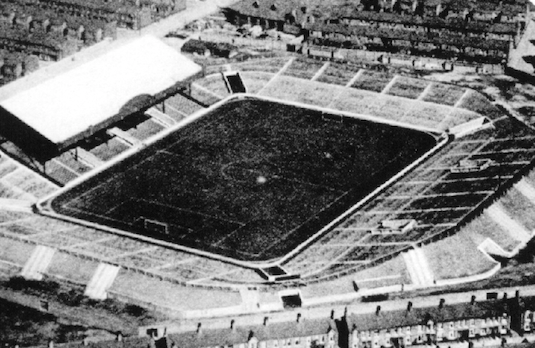
For post 77 in my Maine Rd 100 countdown a reminder of a record City have held for almost a century! This image is of a day in 1924 when City attracted the highest crowd on a club ground. The drawing is looking from the Main Stand towards the Popular Side, later Kippax. It’s no longer the record attendance because it was beaten by another record crowd at Maine Rd a decade later. Want to know more? The read on…
1925 Aerial photo of Maine Road and Platt Fields Park
A record Manchester City have held for 99 years was set on 8 March in 1924 – the record is the highest attendance on a club ground! The record set in 1924 saw 76,166 attend City v Cardiff. City had moved to their new Maine Road stadium in August 1923. The capacity of the venue was estimated at around 90,000 but was actually approximately 83,000 when the stadium opened (it was enlarged in 1931 and 1935).
In its first season the capacity was tested and, on that day (8 March) in 1924 the largest attendance for any footballing fixture (including three FA Cup Finals) in Manchester gathered to watch the Blues. This was also, at the time, the record crowd for any game played on an English club ground. It was beaten ten years later when 84,569 watched City v Stoke. You can read about the remarkable day in 1924 below:
Subscribe to get access
Read more of this content when you subscribe today. It costs £20 a year (access to everything) or £3 per month (see below).
Read more of this content when you subscribe today. It costs £20 a year (see above) or £3 per month (cancel anytime; access to everything posted since 1 October 2022).
This has been a sample of the material on http://www.GJFootballArchive.com If you would like to read all the in-depth articles (including the entire Manchester A Football History book and the audio interview with John Bond) then please subscribe. It works out about £1.67 a month if you take out an annual subscription (£20 per year) or £3 a month if you’d like to sign up for a month at a time. Each subscriber gets full access to the 260+ articles posted so far and the hundreds scheduled to be posted in the coming weeks.