On this day (April 22) in 1899 Manchester City became the first side to gain automatic promotion when they won the Second Division title after a 4-1 victory over Blackpool. Goals from Meredith (2), Gillespie and Ross gave the Blues the win.
A series of test matches, similar to play offs, had been utilised in previous seasons. The Blues were also the first of the Manchester teams ever to earn promotion and the football season ended with Manchester City as comfortable champions of the Second Division. This meant they were the first Manchester team to win a national League competition too.
Near neighbours Glossop were also promoted that day. Here’s the final table:
Subscribers can read about the final game and other information from that season below:
Subscribe to get access
Read more of this content when you subscribe today. It costs £20 a year (here) to access everything since December 2020 or for £3 per month (below) you can access everything from 1 October 2020.
Read more of this content when you subscribe today. It costs £20 a year (above) to access everything since December 2020 or for £3 per month (here) you can access everything from 1 October 2020. Why not join for a month and see what you think?
On this day (2 April) in 1923 Hyde Road’s last victory saw Manchester City defeat Sunderland 1-0. It’s a great coincidence that Maine Road’s last victory was against the same club on 21/4/2003.
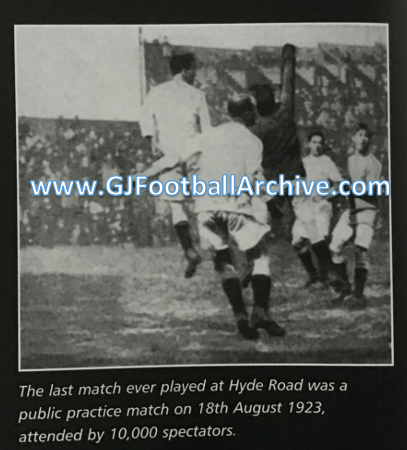
This was not the last match played at Hyde Road, that was a public practice match the following August.
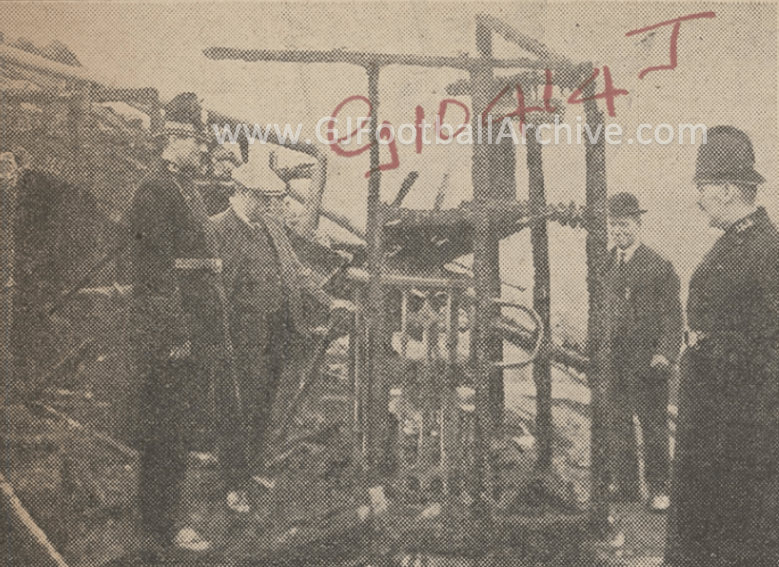
Only a few months after the King had visited Manchester City suffered a major blow when their Main Stand was destroyed by fire (6 November) 1920. Subscribers can read the story of this below (including the story of how City asked United if they could use Old Trafford temporarily which resulted in significant criticism of the Reds in national newspapers) but here’s a rare image that hasn’t been published in any Manchester City publication over the last century or so. It did appear in a contemporary newspaper. Notice the Ellison’s Rush Preventive turnstile that seems to have just about survived.
When City moved to Maine Road quite a few of these turnstiles were taken from Hyde Road and re-erected at Maine Road. In 2003 6 Ellisons turnstiles from the 1890s were still in place and in use during Maine Road’s final season.
In the years that followed the Hyde Rd fire there was a story that developed that the fire was the result of a Irish republican terrorist attack and that both Hyde Rd and Old Trafford were targets. The Old Trafford planned attack was foiled and has been written about in contemporary sources but Hyde Rd’s story cam much later. It doesn’t seem to be the case that the Hyde Rd fire was the result of terrorist activity – if there’s interest then maybe I’ll write the latest research on this in the coming months?
Subscribe to get access: Monthly
Read more of this content when you subscribe today. It costs £3 per month (cancel anytime) and monthly subscribers get access to everything posted since 1 October 2022 and throughout their subscription. Why not try for a month? There’s a special annual subscription for a discounted price and greater access (see below).
Read more of this content when you subscribe today. It costs £20 per year (about £1.67) for this special, discounted annual rate. Annual subscribers get access to everything posted since December 2020 and throughout their subscription.
Here’s a team photo of Manchester City, taken at Hyde Road, in 1900. It’s a typical squad pose in front of the old Hyde Road main stand which was destroyed by fire twenty years later. Notice the way the wooden wall of the stand was painted in City blue and white. People often talk about Hyde Road as if it was this dull, dismal ground but the stand here had only been erected a few years earlier and Joshua Parlby, Lawrence Furniss and the others behind the club made sure it was frequently painted blue and white (plus green) wherever possible.
Over the following twenty years City continued to invest in the ground but the site restricted the club’s growth and 40,000 crowds could not be accommodated particularly well. Often gates would be closed some way off capacity under the orders of the local police who tried to keep crowds back. Bennett Street and even Hyde Road itself were often overcrowded with fans hoping to get in.
There’s lots more on here about Hyde Road and City’s other grounds. Do a few searches and see what you find. Some is only for subscribers but much is available freely. It takes a lot of time, effort and money to research Manchester’s football history so if you want to support this work and get something back then please subscribe. Thanks.
If you enjoy all the free material on my website and would like to support my research and keep this website going (but don’t want to subscribe) then why not make a one-time donation (or buy me a coffee). All support for my research is valued and welcome. It allows me to keep some free material available for all. Thanks.
On this day (20 October 1934) King Charles III’s grandad attended Maine Road to watch Manchester City face Derby County in the League. It wasn’t the first time a senior member of the royal family attended a City home game, nor was it the last time a future monarch or monarch attended Manchester City’s home. You can read about those visits here:
Subscribe to get access – Monthly
Read this 1,600 word article when you subscribe today. It costs £3 per month (cancel any time) or £20 a year. As well as this article you get to access books, videos, history talks, interviews and other articles.
Annual subscribers access everything since the site went live in December 2020. Monthly subscribers get everything since 1 October 2022. All subscribers access new posts throughout their subscription.
This action shot is from 101 years ago today (14 October 1922) and shows Manchester City’s Horace Barnes heading the ball out of the Stoke goalkeeper’s (Scott) hands. City won the match 2-1 (Horace Barnes & Tommy Johnson scoring for City) at Hyde Road and the stand seen in the background is City’s Popular Side.
If you like these daily snippets why not subscribe to the site and see all the other great content. For details see:
City v Newcastle is one of the most enduring fixtures in English football. There have been cup finals, title deciders, dramatic games, shared heroes and so much more. The two clubs first met in the League in October 1893 (Ardwick/MCFC’s 2nd season in the League) and have since played each other 189 times overall with City winning 76 and Newcastle 72 games.
As tonight is a League Cup tie, the most famous meeting of the teams in that competition came in 1976 at Wembley when Peter Barnes and Dennis Tueart both scored for the Blues.
Most Blues of my age and above will remember where they were when our King returned to action on Boxing Day 1977. Here’s an interview I did with him a few years back when we talked about that special day:
There was a really odd thing a while back where a Newcastle paper claimed that their local team had first worn bar scarves at games. A few simple searches soon proved there were much earlier bar scarfs:
If you enjoy all the free material on my website and would like to support my research and keep this website going (but don’t want to subscribe) then why not make a one-time donation (or buy me a coffee). All support for my research is valued and welcome. It allows me to keep some free material available for all. Thanks.
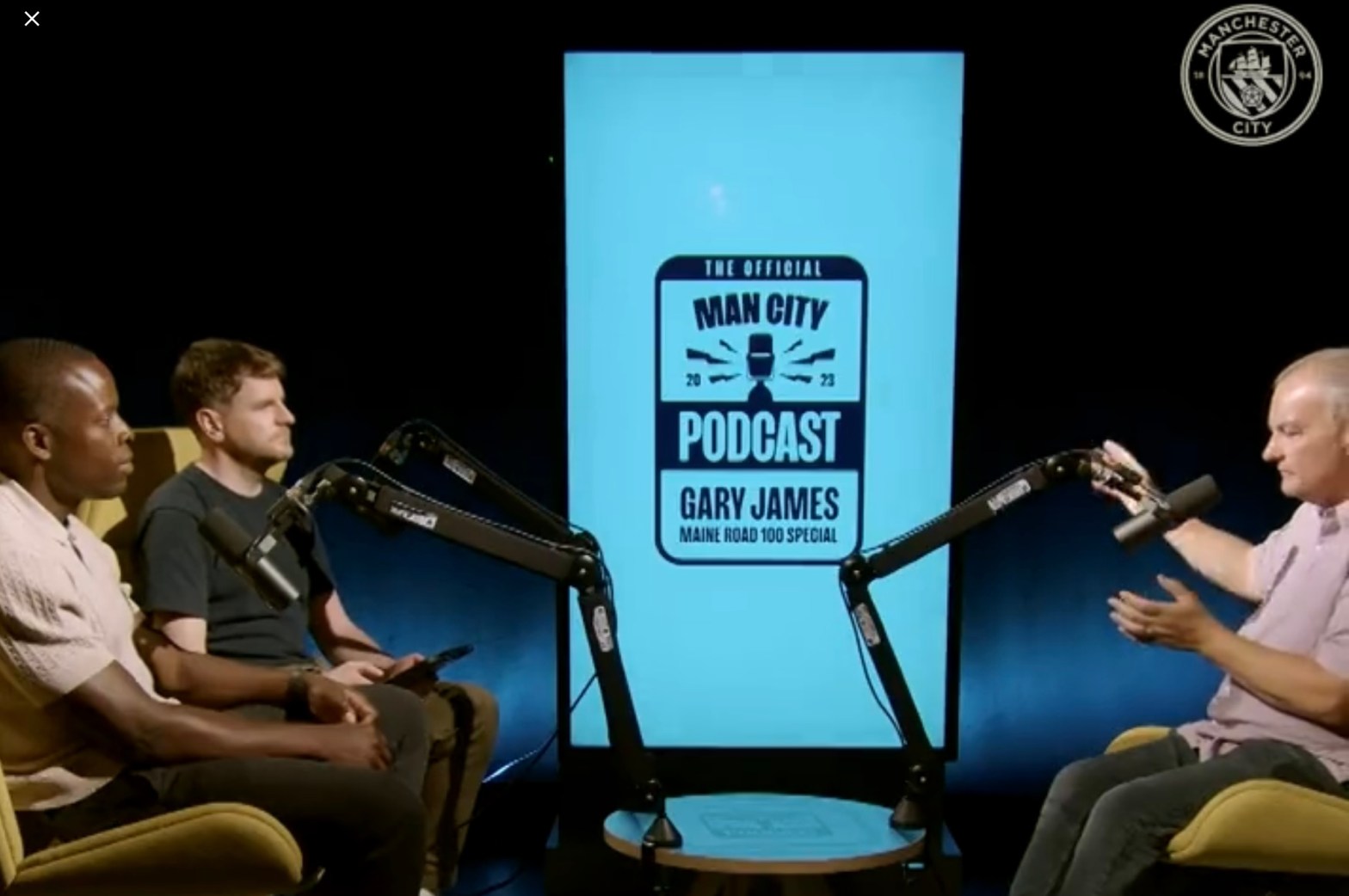
I’ve recently been on the Manchester City Podcast with Rob Pollard and Nedum Onuoha. I was being interviewed about Maine Road, the Etihad and my writing. If you’re lucky enough to have City+ you can watch it here:
Don’t forget I’ve also posted 100 days worth of free features on Maine Road on my website. Each one is titled Maine Road 100 followed by the day (Day One to Day 100 of course). Have a look through past posts or do a search/click the Maine Road tag below. Thanks
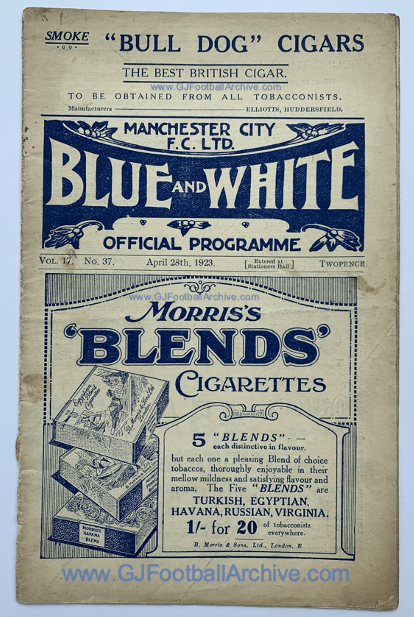
As Manchester City are playing Newcastle today (19 August 2023) and I’ve been doing a 100 day countdown to the centenary of Maine Road’s first game, it’s worth pausing to remember that before Maine Road City had another major venue that had staged games at an international level; semi-finals; been the best supported League club at; and had welcomed the King to. That ground was Hyde Road and the old stadium’s last ever League game came on 28 April 1923 when City drew 0-0 with Newcastle United (hence me doing this reminder today!).
The match was watched by a crowd of around 20,000. On the same date Wembley Stadium, built by the same people who were building Maine Road, hosted its first FA Cup final and, because of the extraordinary scenes, very little space was given over to the City game in the national ‘papers. Instead they concentrated on Bolton’s performance and the exploits of Billy, the white horse, in clearing the Wembley pitch.
Three months after the last Hyde Road League match, on 18 August, the last ever game, a practice match, was staged on the pitch. Afterwards the goal posts and a few turnstiles were taken from the old ground and erected at Maine Road – about 6 were still at Maine Road in 2003 when it was demolished. Attempts were made to keep one of the oldest (from 1896) and re-erect it in a public area at the new stadium. Sadly, the day before it was to be removed the external wall was smashed and the turnstile was stolen.
One of the Hyde Road stand roofs was dismantled and sold to Halifax Town to be re-erected at the Shay.
The Shay had opened approximately twelve months before Hyde Road’s last League match, and a stand had already been constructed. When this stand was extended it coincided with the demolition of City’s ground. Basically, it appears that the metalwork from one of City’s multi-span roofs was dismantled and re-erected along the touchline at the Shay. It was linked to the existing roof, and formed one traditional style roof. The roof still exists at the Shay today, although during the early 1990s it was re-clad.
The front stanchions look suspiciously like those at Hyde Road, while my investigations in the late 1990s highlighted that the metalwork matched that of similar roofing at a factory in Sale. That factory’s roof was also a former stand roof from Hyde Road. Both the Shay roof and that in Sale were so similar that it seems likely they had previously been erected at Hyde Road.
The Sale factory was dismantled and sections of the roof given to Manchester City for possible re-use in a City museum. Sadly, by 2002 the metalwork had vanished from Maine Road and its whereabouts unknown.
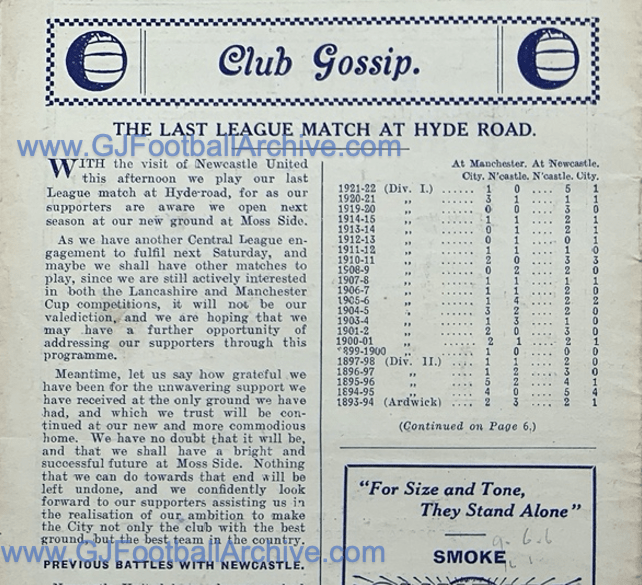
A page from Charles Thurrell’s copy of Hyde Road’s last league game match programme v Newcastle, 28 April 1923Charles Thurrell’s copy of Hyde Road’s last league game match programme v Newcastle, 28 April 1923
On 18 August 1923 the last ever game, a practice match, was staged at Manchester City’s Hyde Road ground with a crowd of about 10,000. Afterwards the goal posts and a few turnstiles were taken from the old ground and erected at Maine Road – about 6 were still at Maine Road in 2003 when it was demolished. Attempts were made to keep one of the oldest (from 1896) and re-erect it in a public area at the new stadium. Sadly, the day before it was to be removed the external wall was smashed and the turnstile was stolen.




 Gary James' Football Archive