City 1 Leicester 0, the FA Cup Final

On this day (April 26) in 1969 Manchester City defeated Leicester City in the FA Cup final. It is worth pausing to consider how the Blues compared to football’s other successful sides in the competition at this time in football history.  City’s four FA Cup successes placed them 7th in the all-time list of FA Cup winners – can you guess the clubs they were behind? Liverpool? No! MUFC? No! Arsenal? No! Keep going…

They were behind Aston Villa (7), Blackburn Rovers (6), Newcastle United (6), Tottenham Hotspur (5), The Wanderers (5) and West Bromwich Albion (5).  Bolton, Sheffield United and Wolves had, like City, each won four FA Cups, while Manchester United and Arsenal had only won three, Liverpool one and Chelsea had not yet won the trophy.  In fact Chelsea had only won one major trophy (the League Championship) at this point in their history.  

Here for subscribers is a long read on that final and the events surrounding it:

Subscribe to get access

Read more of this content when you subscribe today.

Covid and the 2021 League Cup Final

How time flies! Today marks the anniversary (April 25) of the 2021 League Cup Final between Manchester City and Tottenham. It was the first (and only) League Cup Final played during any form of Covid lockdown in England. The 2020 final had been the last major final played in the country before the pandemic led to various lockdowns and then the continuation of football without fans.

Some football clubs, including Tottenham, had been allowed to have a limited number of supporters at their home games during the early stages of the 2020-21 Premier League season, but Manchester City had not as they were in a regional tier that prevented crowds. So, for many of us, the last physical game we attended was the 2020 League Cup final (some City fans did of course attend the 1-0 FA Cup victory at Sheffield Wednesday on March 4 and the Old Trafford derby of March 8 2020).

In the period between our last ‘live’ match and the 2021 League Cup final we had to sit at home watching City’s games played in empty stadia or, occasionally, at grounds with a small number of fans in but never with any ordinary City fans in. Former City star Mike Summerbee, the club’s ambassador, would often be seen, masked-up, at games when TV camera crews recognised him and it was always nice to know there was at least one person steeped in MCFC history there.

When the announcement came that the delayed League Cup Final (it was postponed until April in the hope that fans could attend) was to have up to 8,000 fans at Wembley there were then several dilemmas for fans. This was to be a test event and almost 2,000 tickets were to be issued to each competing club, which fans would have to pay for, and 4,000 would be given away to residents around Wembley and some NHS staff. 

Many fans felt it was unfair that Wembley residents would be given tickets (each could apply to bring a guest too) while fans paid and there were the usual concerns about balance of support – would the fact that tickets were to be given to local residents benefit Spurs for example? 

Most fans had no issue with NHS staff being given tickets with some Blues suggesting that NHS staff (and other key workers) who were season ticket holders of the two clubs should be offered the tickets. Lots of other suggestions were made plus, of course, some fans felt it would only be appropriate to attend a major game like this when ALL fans would be allowed back, though that still seemed some way off in April 2021.

To attend the final Manchester City used their loyalty points system and cup scheme as usual but then there was an added layer where fans had to live in certain postcodes: M, SK, BL, OL, WA, WN, PR, FY, BB, LA, CH, CW, BD, HD and HX​ and Greater London. In addition we had to have covid tests in the build-up to the final, including a lateral flow test that had to be performed at a test centre after 1.30pm on the Saturday before Sunday’s final. 

This was difficult for many to arrange as, for example, some of the councils within the postcodes allowed did not have test sites available at weekend. Some booked to have tests close to Wembley, which caused some logistical issues on cup final day, and others had to travel in to Manchester on the Saturday. Inevitably, some did not get negative tests back in time and missed out.

Those lucky enough to get hold of tickets also had to state their method of travel with a limited number of car parking spaces meaning that option simply was not available for some fans. Specific coach and train travel was set up but the costs were prohibitive for some. Others pointed out their concern that once the trains arrived at Euston (or Watford) there would still be a need to travel to the stadium itself. To some this negated the need for travel on specific trains or coaches, but of course the conditions had been imposed by the Government and footballing authorities, not by the competing clubs.

At the stadium on match day the surrounding area seemed full of shoppers trying to pick up a bargain at the retail store but fans seemed few and far between. The photo above (Wembley Way looking towards the stadium) was taken about one hour before kick off. This would normally be packed at this time.

Close to the stadium the Wembley Way ramps that used to carry people up to the stadium have been demolished and a series of steps have been erected instead. Fans had to show their lateral flow test results, tickets, and photographic ID before being allowed up the steps to the stadium. They had to queue at these checkpoints and then, once they’d been allowed through they could make their way up to the stadium turnstiles. They were discouraged from waiting outside the stadium and were encouraged to go to the turnstile.

In previous years drinks had been allowed into the stadium if they were in plastic bottles and the lids were removed. This year no drinks, not even water, were allowed in the stadium, but staff did allow fans to carry in plastic bottles (without lids) as there were water fountains inside (typically positioned near the disabled toilets) and these could be filled up there. This is well worth remembering if you need to have drinks for medical purposes but do not want to pay Wembley’s expensive prices.

In the stadium bars and catering outlets were open as usual and while there was a considerably smaller number of fans within the concourse area, social distancing was not particularly in evidence. Having said that all fans had been tested but supporters were unclear whether Wembley staff, security, stewards and so on had been tested. 

In the bowl of the stadium all fans had been positioned in the same stand plus the corners. This was the stand containing the Royal Box and directly opposite the TV cameras. The cynic would suggest that this demonstrated, as always, that some think the TV spectacle is more important than those in the stadium. Surely congestion in the toilets and other areas could have been eased had fans been spaced out in a wider area, or even if they’d have chosen blocks around the stadium with perhaps Spurs fans on one side or end and City in the opposite stand? If it’s pure safety then that would be the logical thing to do.

In the seats we were positioned predominantly in alternate seats with the row behind and in front of us following a pattern which was supposed to mean that there would be no one directly in front or behind of you. As some fans were in groups/families who had travelled together they sometimes moved next to others in their group on the same row – officially we were told that wasn’t allowed but inevitably it happened (we all wanted to be next to the people we’d gone to the game with and didn’t want the seat gap) and no one tried to stop it. 

During the game stewards regularly reminded fans that they had to wear face masks throughout – from the moment we had shown our test results and tickets through to leaving the stadium after the presentations we had to be masked up. Of course, when eating or drinking masks were lowered.

Throughout our time in the bowl of the stadium fans would be moving along the rows to their places, and so social distancing was not possible at those times.

After the game we were free to leave en masse if we wanted. As City won the cup most City fans stayed for the presentations and left at various points during the celebrations, meaning there wasn’t a crush to get out. Spurs fans seemed more keen to leave of course, but whether this caused any issues I do not know. Presumably, social distancing is impossible to manage when an entire section chooses to leave at the same time.

If you were one of the lucky ones who had managed to get a car parking space it was refreshing to travel away from Wembley without the huge traffic jams we normally experience. There were roadworks and a few problems on the motorway but nothing like normal.

So, that was the general experience of attending as a Manchester City fan at the first game we’ve been allowed to attend as City fans in over a year. It’s not the story of the game but I hope it gives an idea as to how the crowd management happened.

Several years on this experience now seems alien again but back then it was refreshing to be able to actually attend a game.

The 1990s: The Super League!

The series of features covering Manchester City in the 1990s continues today with this reminder of the days when the creation of a Super League was leaked to the press. The Super League eventually became the Premier League and the key clubs behind the move were Arsenal, Tottenham, Liverpool, Everton and Manchester United. Much of the coverage from this period in 1991 focused on these clubs wanting to exert greater control on football’s finances, i.e. to carve up the game’s riches for the biggest clubs of the era. These cuttings are all from the start of April 1991.

Back then the Football League had four divisions and voting rights were equal for all clubs in the top two divisions (the ‘full members’ of the League, hence the Full Members Cup). The bottom two divisions were classed as associate members and they still had voting rights which many in the top division objected to. They felt the clubs outside the top flight should not control the League’s finances and direction.

It wasn’t the first time the establishment of a Super League had been discussed (usually it involved the idea of bringing leading Scottish clubs into a British league system) but it does appear to be the first time the leading clubs in the top division wanted to limit the influence of the others.

You can see from these articles who the leading architects were and how fans reacted. This piece quotes Frank Horrocks from the MCFC Supporters Club. Many of his concerns have proved to be true in the 30+ years that have followed:

All these years on there have been multiple attempts by certain clubs to limit the opportunities for others and create an environment where they can prosper without necessarily investing. Many of the financial issues between the rich and the rest in football that people talk of today were created as a result of the greed of several clubs in the early 1990s.

For Manchester City the 1990-91 season saw a shock managerial departure could have disrupted the club but ultimately they finished 5th, 3 points ahead of Manchester United. Here’s a 2,700 word article on that season:

Subscribe to get access – Monthly

Read more of this content when you subscribe today. It costs £3 per month (cancel anytime) to access everything posted since 1 October 2022 or there’s a special annual rate below which gives greater access and works out much cheaper.

Subscribe to get access – Annual

Read more of this content when you subscribe today. It costs £3 per month (above) or £20 a year (here) to access everything posted since the site was created in December 2020. This special rate works out about £1.67 a week and gives access to everything posted, including PDFs of 3 of my books.

This series of articles and features will run throughout March with indepth articles some days and smaller ‘on this day’ style posts on others. There will be flashbacks to great games, players and more. Every day in March will offer something to enjoy.

Subscribers will get access to everything, while some on this day material will be free for all to view.

If you want to know more on this incredible decade for Manchester City Football Club then why not subscribe and read it all? If you’d like to know more about subscribing then see:

The 1990s: Spurs, The Umbro Stand, Swales Out and That Pitch Invasion!

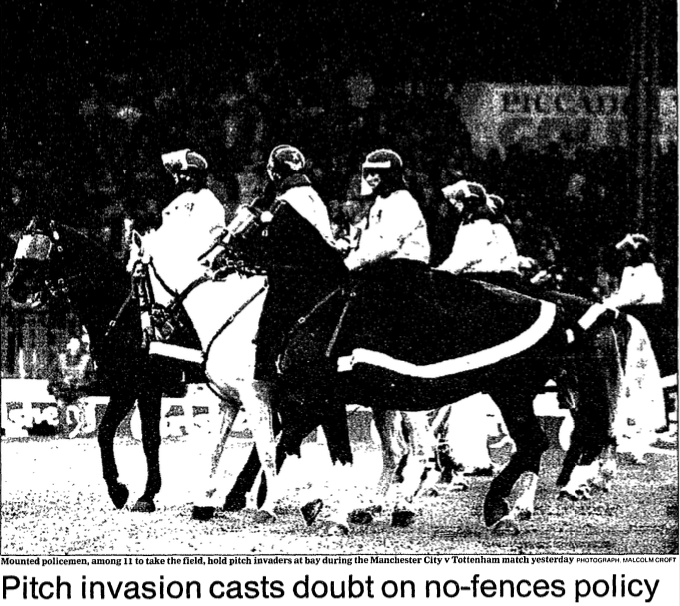
Today’s 1990s flashback is from this month in 1993. It’s actually the 7 March 1993 when Manchester City faced Tottenham in the FA Cup Quarter-Final at Maine Road. It was a day that saw the media express shock at the behaviour of City’s fans when they invaded the pitch during the tie with Spurs.  They condemned the supporters without understanding the background story.  To put the record straight it’s vital the day’s events are covered correctly.  Here for subscribers is the full story of that game, including quotes from Niall Quinn and Peter Swales (from my interviews with them in the years since that day…

Subscribe to get access – Annual

If you would like to read this and all the in-depth articles on this site (including the entire Manchester A Football History book and the audio interview with John Bond) then please subscribe. It works out about £1.67 a month if you take out an annual subscription (£20 per year) or £3 a month if you’d like to sign up for a month at a time (see below).

Subscribe to get access – Monthly

If you would like to read this and all the in-depth articles on this site (including the entire Manchester A Football History book and the audio interview with John Bond) then please subscribe. It works out about £1.67 a month if you take out an annual subscription (£20 per year, above) or £3 a month if you’d like to sign up for a month at a time (here).

The 1970s: A Beauty by Barnes!

Today’s 1970s flashback includes video of a brilliant goal by Peter Barnes during the 3-0 victory over Spurs by MCFC on this day (3 February) in 1979. You can watch the goal and the others in this game here (these highlights were shown on LWT’s Big Match on 4 February 1979:

This series of articles and features on Manchester City in the 1970s has been running throughout January and into February with indepth articles some days and smaller ‘on this day’ style posts on others.

Subscribers can access everything. If you want to know more on this incredible decade for Manchester City Football Club then why not subscribe and read it all? You could even subscribe for a month and see what you think. The following 5,700 word article is on the 1978-79 season and is available to subscribers below. Enjoy!

Subscribe to get access – Monthly

Read more of this content when you subscribe today. It costs £3 per month (cancel anytime) to access everything posted since 1 October 2022 or there’s a special annual rate below which gives greater access and works out much cheaper.

Subscribe to get access – Annual

Read more of this content when you subscribe today. It costs £3 per month (above) or £20 a year (here) to access everything posted since the site was created in December 2020. This special rate works out about £1.67 a week and gives access to everything posted, including PDFs of 3 of my books.

If you’d like to know more about subscribing then see:

If you enjoy all the free material on my website and would like to support my research and keep this website going (but don’t want to subscribe) then why not make a one-time donation (or buy me a coffee). All support for my research is valued and welcome. It allows me to keep some free material available for all. Thanks.

Choose an amount

£2.50
£5.00
£7.50

Or enter a custom amount

£

Your contribution is appreciated.

Donate

The 1970s: 1976-1977 Maintaining A Title Challenge

The series of features/articles covering Manchester City in the 1970s continues with a 2,100 word article on the entire 1976-77 season – a season which saw City come close to League success. You can read this below. This series of articles and features on Manchester City in the 1970s has been running throughout January with indepth articles some days and smaller ‘on this day’ style posts on others. Every day in January has offered something to enjoy.

Subscribers can access everything. If you want to know more on this incredible decade for Manchester City Football Club then why not subscribe and read it all? You could even subscribe for a month and see what you think. The following 1,200 word article is on the 1976-77 season and is available to subscribers below. Enjoy!

Subscribe to get access – Monthly

Read more of this content when you subscribe today. It costs £3 per month (cancel anytime) to access everything posted since 1 October 2022 or there’s a special annual rate below which gives greater access and works out much cheaper.

Subscribe to get access – Annual

Read more of this content when you subscribe today. It costs £3 per month (above) or £20 a year (here) to access everything posted since the site was created in December 2020. This special rate works out about £1.67 a week and gives access to everything posted, including PDFs of 3 of my books.

If you’d like to know more about subscribing then see:

If you enjoy all the free material on my website and would like to support my research and keep this website going (but don’t want to subscribe) then why not make a one-time donation (or buy me a coffee). All support for my research is valued and welcome. It allows me to keep some free material available for all. Thanks.

Choose an amount

£2.50
£5.00
£7.50

Or enter a custom amount

£

Your contribution is appreciated.

Donate

The 1970s: Title Favourites According to Spurs

The series of features/articles covering Manchester City in the 1970s continues with this cutting from today (29 January) in 1972. It’s a story which basically quotes Bill Nicholson, the Spurs manager, who believed that City were the best team Tottenham had faced all season. It came prior to City’s 5-2 thrashing of Wolves that day.

City and Spurs had met at White Hart Lane 21 days earlier and that match had ended in a 1-1 draw (Wyn Davies scoring for City).

People tend to forget how wonderful this period was in City history. The 70s was a brilliant decade with the Blues, for example, winning their first European trophy (beating Liverpool, Chelsea & many others to this feat). They also won more major trophies in the 1970s than United. It’s often overlooked but for much of the 70s City and Liverpool saw themselves as THE Granadaland rivals, especially when United were in the Second Division or when the two clubs challenged each other for the League.

If you want to know more on this incredible decade for Manchester City Football Club then why not subscribe and read it all? You could even subscribe for a month and see what you think. The following 4,700 word article is on the 1971-72 season and is available to subscribers below. Enjoy!

Subscribe to get access – Monthly

Read more of this content when you subscribe today. It costs £3 per month (cancel anytime) to access everything posted since 1 October 2022 or there’s a special annual rate below which gives greater access and works out much cheaper.

Subscribe to get access – Annual

Read more of this content when you subscribe today. It costs £3 per month (above) or £20 a year (here) to access everything posted since the site was created in December 2020. This special rate works out about £1.67 a week and gives access to everything posted, including PDFs of 3 of my books.

If you’d like to know more about subscribing then see:

If you enjoy all the free material on my website and would like to support my research and keep this website going (but don’t want to subscribe) then why not make a one-time donation (or buy me a coffee). All support for my research is valued and welcome. It allows me to keep some free material available for all. Thanks.

Choose an amount

£2.50
£5.00
£7.50

Or enter a custom amount

£

Your contribution is appreciated.

Donate

The 1970s: Attendance Facts Not Fiction

It seems that some have a view that the giant clubs remain giant clubs forever and that there are some clubs who have only recently become prominent. Others believe that teams that were giants decades before some of today’s major trophy winners were never actually that prominent. I could spend hours challenging those who hold these views and pointing out that teams such as Everton, Newcastle & City won major trophies before many of these clubs and were perceived as giants years earlier too (decades before in some cases!), but it doesn’t feel like they’d listen. Ah well! Instead as part of my series of features/articles covering Manchester City in the 1970s I’d like to post a few attendance details that may interest some.

The following are a list of the top seven best supported top flight clubs for the ten seasons prior to City’s relegation in 1983. The Manchester clubs are in bold and the numbers in brackets show each club’s league position that season. In addition if any of the clubs won the European Cup, UEFA Cup, ECWC, FA Cup or League Cup that is also listed in brackets.

AVERAGE ATTENDANCES – Top Tier 1973-74

42712 MUFC (21st); 42332 Liverpool (2nd & FA Cup winners); 38666 Leeds (1st); 33048 Birmingham (19th); 32861 Newcastle (15th); 30756 MCFC (14th).

AVERAGE ATTENDANCES – Top Tier 1974-75

45966 LFC (2nd); 40021 Everton (4th); 34822 Leeds (9th); 34614 Newcastle (15th); 32898 MCFC (8th); 30854 Birmingham (17th); 29872 West Ham (13th & FA Cup winners). Both Manchester United (48387) and Sunderland (29931) were in Division Two but had an average higher than some of those in the top seven top tier averages.

AVERAGE ATTENDANCES – Top Tier 1975-76

54750 MUFC (3rd); 41623 Liverpool (1st & UEFA Cup winners); 38874 Aston Villa (16th); 34280 MCFC (8th & LC winners); 33060 Newcastle (15th); 31511 Leeds (5th); 28350 Derby (4th). Sunderland in Division Two had an average of 31250.

AVERAGE ATTENDANCES – Top Tier 1976-77

53710 MUFC (6th & FA Cup winners); 47221 Liverpool (1st & European Cup winners); 40058 MCFC (2nd); 37903 Aston Villa (4th & LC winners); 33599 Newcastle (5th); 32743 Sunderland (20th), 32671 Arsenal (8th).

AVERAGE ATTENDANCES – Top Tier 1977-78

51860 MUFC (10th); 45546 Liverpool (2nd & European Cup winners); 41687 MCFC (4th); 39513 Everton (3rd); 35464 Aston Villa (8th); 35446 Arsenal (5th); 32501 Nottm Forest (1st & LC winners). Tottenham were in Division Two with an average of 33417.

AVERAGE ATTENDANCES – Top Tier 1978-79

46430 MUFC (9th); 46407 Liverpool (1st); 36371 Arsenal (7th & FA Cup winners); 36203 MCFC (15th); 35456 Everton (4th); 34902 Tottenham (11th); 32838 Aston Villa (8th).

AVERAGE ATTENDANCES – Top Tier 1979-80

51608 MUFC (2nd); 44586 Liverpool (1st); 35272 MCFC (17th); 33596 Arsenal (4th); 32018 Tottenham (14th); 29794 Crystal Palace (13th); 28711 Everton (19th).

1979-80 League table and attendance detail up to 26/4/1980

AVERAGE ATTENDANCES – Top Tier 1980-81

45071 MUFC (8th); 37547 Liverpool (5th & LC winners); 34117 Aston Villa (1st); 33587 MCFC (12th); 32480 Arsenal (3rd); 30724 Tottenham (10th & FA Cup winners); 26477 Sunderland (17th). West Ham were in Division Two with an average of 27140.

Kippax Stand c.1980

AVERAGE ATTENDANCES – Top Tier 1981-82

44571 MUFC (3rd); 35100 Tottenham (4th & FA Cup winners); 35061 Liverpool (1st & LC winners); 34063 MCFC (10th); 26780 Aston Villa (11th & European Cup winners); 26585 West Ham (9th); 25589 Arsenal (5th).

1981 City v United Maine Road

AVERAGE ATTENDANCES – Top Tier 1982-83

41552 MUFC (3rd & FA Cup winners); 34758 Liverpool (1st & LC winners); 30581 Tottenham (4th); 26789 MCFC (20th); 24153 Arsenal (10th); 23748 Aston Villa (6th); 22822 West Ham (8th). Second Division Newcastle attracted an average of 24166.

Fans storming the main entrance in 1983. Mirrorpix photo

For those wondering Manchester City did drop a little in terms of position in the attendance chart during their Second Division days but they were still the 6th best supported club (of all clubs) in 1983-84 and 8th best in 1984-85. Back in Division One in 1985-86 the Blues were once again the 4th best supported team in the entire League.

This series of articles and features on Manchester City in the 1970s has been running throughout January with indepth articles some days and smaller ‘on this day’ style posts on others. Every day in January will offer something to enjoy.

Subscribers will get access to everything. If you want to know more on this incredible decade for Manchester City Football Club then why not subscribe and read it all? You could even subscribe for a month and see what you think. The following 1,600 word article is on the 1974-75 season and is available to subscribers below. Enjoy!

Subscribe to get access – Monthly

Read more of this content when you subscribe today. It costs £3 per month (cancel anytime) to access everything posted since 1 October 2022 or there’s a special annual rate below which gives greater access and works out much cheaper.

Subscribe to get access – Annual

Read more of this content when you subscribe today. It costs £3 per month (above) or £20 a year (here) to access everything posted since the site was created in December 2020. This special rate works out about £1.67 a week and gives access to everything posted, including PDFs of 3 of my books.

If you’d like to know more about subscribing then see:

If you enjoy all the free material on my website and would like to support my research and keep this website going (but don’t want to subscribe) then why not make a one-time donation (or buy me a coffee). All support for my research is valued and welcome. It allows me to keep some free material available for all. Thanks.

Choose an amount

£2.50
£5.00
£7.50

Or enter a custom amount

£

Your contribution is appreciated.

Donate

Buying Success?

In recent years it has become fashionable to claim that football is all about money these days and that certain clubs have ‘bought success’. Well, that may or may not be true but what is an absolute fact is that this has been the situation throughout football history. Take a look at this article from October 1965 which talks about clubs ‘buying success’. It focuses on Everton & Tottenham – two clubs whose fans often criticise City & Chelsea for ‘buying success’.

What this shows is that there’s nothing new in football. If someone talks of football being ‘ruined’ by your clubs spending then remember that at some point in the past the game may have been ‘ruined’ by their clubs’ spending!

Enjoy the cuttings:

Oh, and if you think it’s a one-off about Everton, here’s an article from the Liverpool Daily Post (13 May 1963) congratulating the Toffees on their policy of spending. It basically says that clubs should be applauded for doing that! Interesting how it’s okay when it’s your local club but not when it’s one from a rival city.

If you enjoy all the free material on my website and would like to support my research and keep this website going (but don’t want to subscribe) then why not make a one-time donation (or buy me a coffee). All support for my research is valued and welcome. It allows me to keep some free material available for all. Thanks.

Choose an amount

£2.50
£5.00
£7.50

Or enter a custom amount

£

Your contribution is appreciated.

Donate

George Graham Interview – March 1993

Happy 79th birthday to former Arsenal manager George Graham. George was brought to England by Joe Mercer to play for Aston Villa and on 30 March 1993 I travelled to Arsenal’s old stadium, Highbury, to interview George. I wanted to capture his views on his former boss – and Arsenal legend – Joe Mercer.

As I mentioned earlier, Joe was the Aston Villa manager who brought George to England many, many years before George had found fame as a footballer and Joe had taken Manchester City to their first European honour. Joe did win the League Cup as Aston Villa boss, but these were not great days for the former Everton and Arsenal playing legend, but he did always feel responsible for bringing George to England (and loved the success he brought Arsenal).

My interview with George had been arranged for Tuesday 30 March 1993 some time in advance but then Arsenal’s FA Cup semi-final with Tottenham was scheduled for the following Sunday at Wembley (a highly unusual occurrence at the time!). I expected to get a call cancelling the interview but instead George decided to go ahead with it.

On the day I parked up outside Highbury quite early but as I pulled up I saw George leave the stadium and jump into a car. I was early, so wasn’t too worried. Then I remembered the FA Cup semi-final and assumed that George would be busy with plans. I expected to be told when I entered the marble hall at Highbury that the meeting would be off.

When I spoke with the reception staff they told me to take a seat. They said that George had been called away and so could be a few minutes late (which he was). I was relieved because I’d been convinced he would cancel (it’s happened often with other busy managers).

I sat in reception thinking about the chat and then, a few minutes after we were due to meet, George walked in. He spoke with the receptionist and then came towards me, hand out, saying ‘I’m George Graham’ (I remember thinking ‘I know’ but I did love the fact that he introduced himself). He took me up to his impressive office at Highbury – no other offices at any ground I had been to at that time could match the quality and status of that room.

We then did the interview. It’s not my best – I think I was overawed by the situation – but I was appreciative of George’s time. During the interview Stewart Houston, his assistant, popped in to check something with George (I turned off my recorder) and George ushered him away, telling him that he was busy. Again, I loved this – other managers have sometimes disappeared and not come back but for George he’d set this time aside to see me and chat about Joe Mercer and that’s what he was doing.

Arsenal beat Spurs that weekend so, I suppose, George knew what he was doing but I do remember watching that game on TV thinking that if Arsenal lose I’d never be able to tell anyone that George had spent time being pestered about Joe Mercer when he should’ve been preparing for Tottenham!

If you subscribe to this site you can hear the interview below. I have been researching and writing for a long time and my Joe Mercer book was my third (first published in 1993). I am not employed by anyone and I do not have sponsorship either and so I’ve set up this website to help share my 35 years plus writing and research. The intention is to develop the archive and to provide access to as much of my material as possible over the coming weeks, months & years. Annual subscribers can already access over 1250 articles/posts including the entire Manchester A Football History book, my first book on MCFC (published in 1989) and Farewell To Maine Road, plus audio interviews with Malcolm Allison and John Bond.

It costs £20 a year (it works out £1.67 a month) or £3 if you’d like to sign up a month at a time to get full access for as long as you subscribe.

Anyway, here’s the George Graham interview:

Subscribe to Listen – Monthly Subscription

To listen please subscribe. Each Monthly subscriber gets access to everything posted since 1 October 2022 and everything posted during their subscription. It costs £3 per month (cancel anytime). There’s also a special annual subscription available (see below).

Subscribe to Listen – Annual Subscription

To listen please subscribe. Each annual subscriber gets full access to the 1000+ articles posted so far and the hundreds scheduled to be posted in the coming months. This includes PDFs of 3 of my books and interviews with Malcolm Allison and others. Annual subscription is available at the special price of £20 a year (about £1.67 a month).

An update hardback edition of my Joe Mercer biography can be bought here:

Shop

If you enjoy all the free material on my website and would like to support my research and keep this website going (but don’t want to subscribe) then why not make a one-time donation (or buy me a coffee). All support for my research is valued and welcome. It allows me to keep some free material available for all. Thanks.

Choose an amount

£2.50
£5.00
£7.50

Or enter a custom amount

£

Your contribution is appreciated.

Donate