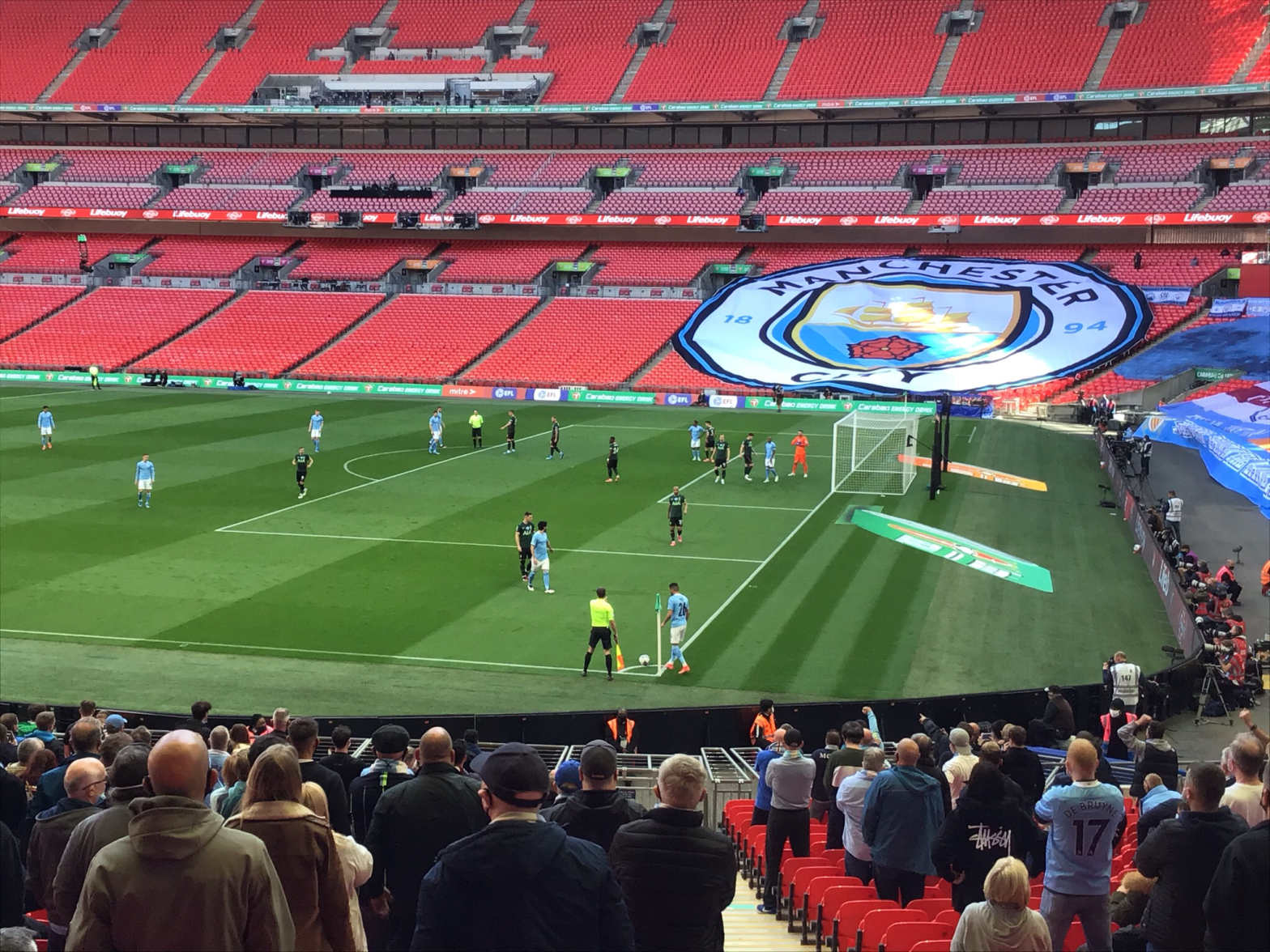
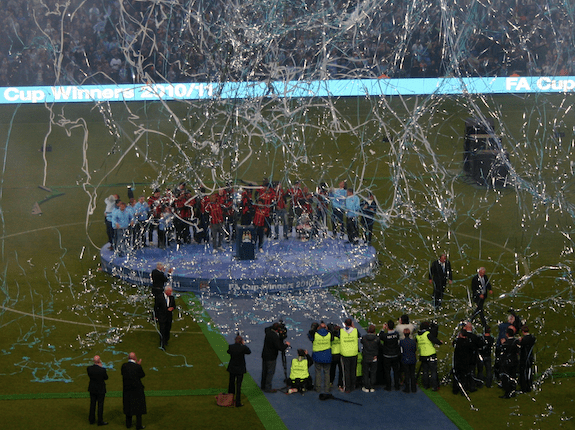
On this day (25 April) in 2021 Manchester City defeated Tottenham Hotspur 1-0 thanks to a Laporte goal in the League Cup final at Wembley. The game was played in front of a Covid restricted crowd of 7,773.
On this day (17 March) in 1956 a solitary goal from Bobby Johnstone was enough to see Manchester City beat Spurs in the FA Cup semi-final at Villa Park. Here for subscribers is the story of that day…
Subscribe to get access
Read more of this content and the entire site when you subscribe.
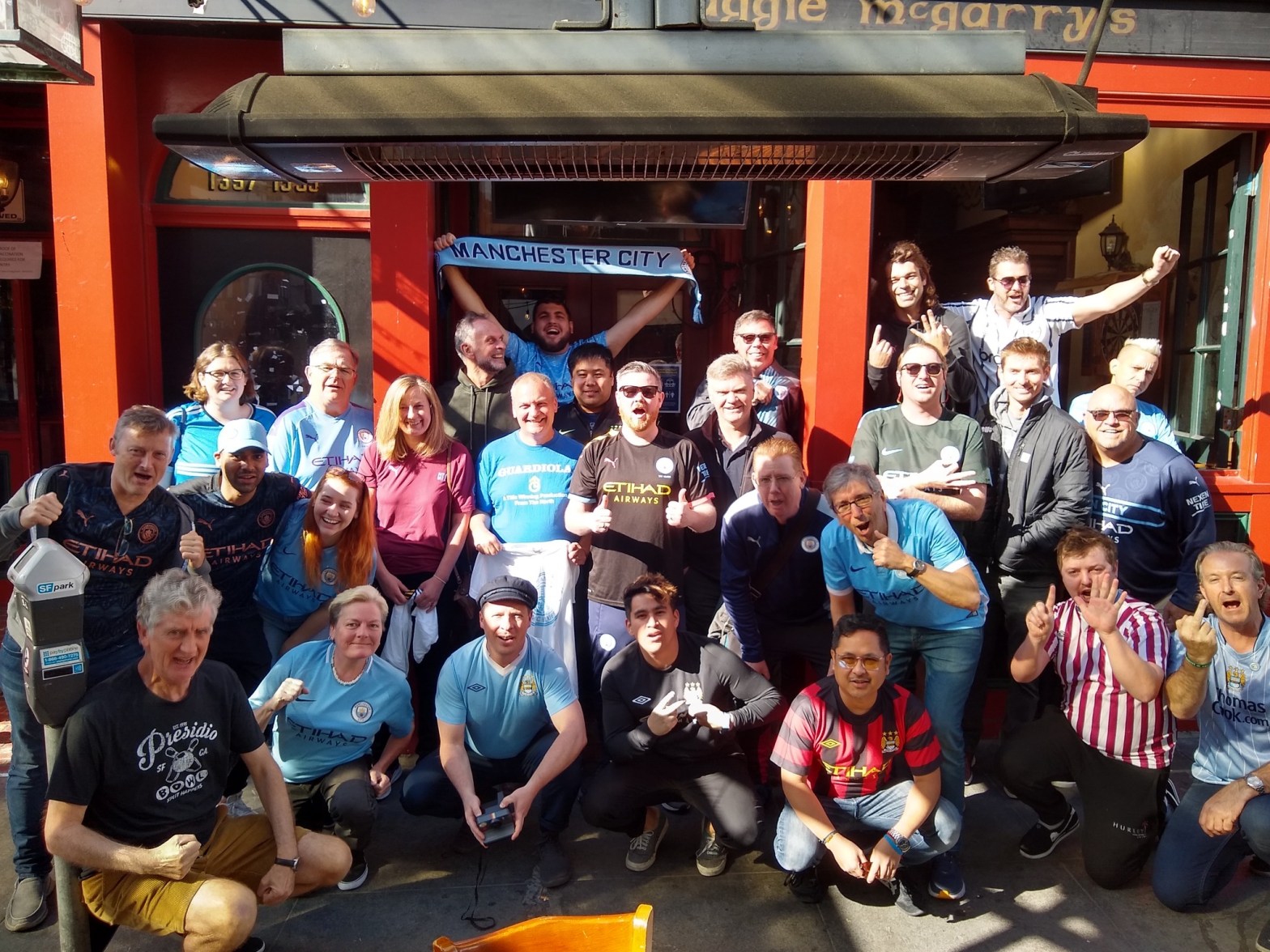
Recently I’ve been in San Francisco and was there when Manchester City played Spurs. I was invited to watch the game at Maggie McGarry’s with the San Francisco Blues. It was a great experience (we’ll ignore the result!) and here are a few thoughts and a bit of film from the day….
Firstly, I want to pay tribute to ALL the City fans who were there and who made us feel so welcome. It’s clearly a great supporters club and we really enjoyed our time there.
I’ve always been proud of the fact that MCFC has been a welcoming club over the decades and fans of the Blues have tended to be welcomed no matter where they are from or who they are. The San Francisco Blues are just as welcoming with wonderful hospitality too.
The branch contained several exiled Mancs, British and Irish members, as well as many, many US born City fans. This was great to see and I enjoyed listening to their stories of how they became City fans, or of how they came together to watch games at the bar. Two Mancs actually went to the same school (1 year apart) but didn’t know each other until they met in San Francisco through their City support. One was a history teacher in the States and asked me ’Was Billy Meredith guilty of the bribery charge?’ Hopefully, US children will now hear the rights and wrongs of FA investigations into perceived nouveau riche clubs, as City were called back in 1905 (I know!).
Some had travelled a couple of hours to get to the bar for the 930am kick off (California time of course!). from what I heard the same happens for earlier kick offs – some feat when you consider a regular 3pm UK kick off would be 7am local time. The landlord, who is also a Blue, opens the bar early for City games.
A few of the branch members had travelled to the Champions League final last year and others told me of their plans to get to the away games at Everton and Peterborough. The atmosphere on Manchester Derby Day is always special there – I think we’re all looking forward to next weekend. I’ll be in my regular seat by then of course but if you are a Blue in San Francisco get yourself down to Maggie McGarry’s.
I often get angry when rival fans or some in the media criticise football supporters for their loyalty, or when some state that ALL City fans are this or that when the truth is that we’re varied and have come to support City in lots of different ways. We live all over the world and show our dedication to the cause in ways that some don’t understand. Fans spend a considerable time, amount of money or put themselves out in lots of different ways to support their club.
I could go on but I’d just like to say thanks again to the San Francisco Blues. Their facebook page is here:
David Humphreys from the branch is heavily involved with a football club called San Francisco Vikings, formed in 1922. They focus on bringing kids through from age 3 onwards to adult leagues and to sponsor kids who can’t pay to play.
It may be some time before I’m in San Francisco again, but when I do make it I’ll aim to get back to the San Francisco Blues. Thanks again for making us so welcome.
Recently it has been fashionable for some to talk of the Premier League being dominated by a single club or that the competition is no longer as entertaining as it was because the same old club(s) win the League. Well, this is absolute balderdash of course, but rather than simply say that I thought I’d look at the facts and the supporting evidence. So, if you’re someone who thinks football is more one sided today than it’s ever been, or someone who wants to challenge those who do, then please read on…
The idea that the League is a one club competition is usually stated in relation to Manchester City these days and recently, as City have increased their lead at the top, the view has been expressed over and over again by rivals and some journalists. Yet, the evidence shows otherwise.
Firstly, at the time of writing Manchester City are 10 points clear of second placed Chelsea. However, if Liverpool win their game in hand then City will be only 8 points clear. I say only because 8 points is less than 3 victories difference and City still have to play both Chelsea and Liverpool, plus of course other potential rivals including Manchester United.
I also say ‘only’ because we can all come up with seasons when one club has been eight points or more ahead and still lost the League – Manchester United fans will not need reminding about how far ahead they were in the 2011-12 title race as it entered its final weeks, only to see City snatch the title in dramatic fashion.
Eight point leads are great to have but, at this point in a season, they do not mean you will be successful. Personally, I hope City are successful but no one seriously believes the title race is over and if they do then they really have not watched enough football!
Alongside the ridiculous view that the League is over there has been a frequently aired view that the League title is less competitive now than at any other time in history. Again, this is a ridiculous view that does not match with the evidence.
Much has been said by City’s rivals and others about how having one team dominating can be boring for English football. Whether that’s true or not is debateable but it’s worth pointing out that since City first won the Premier League in 2012 then five different clubs have won the competition (three of these being first time Premier League champions too!).
Five teams in a decade may not sound like much variety to some but it is better than the 2000s (1999-00 to 2008-09) when only three clubs won the League. Even worse between 1995 and 2004 either United or Arsenal won the title and their duopoly was only broken up when Chelsea became a force following their investment. Even then only those three teams won the League between 1994 and City’s first PL title in 2012!
Had Chelsea not come along would United and Arsenal still be the only teams winning the League? The investment in both Chelsea and City has helped open up the League and, with a greater variety of clubs challenging, the League is now much more open. At the start of each season there are more teams perceived as potential title challengers than in the 2000s.
Did anyone say back when United and Arsenal had a duopoly at the top that the League was boring because it was the same old champions? I don’t remember leading journalists say that then so why now when the PL has had more variety of winners?
Even if City’s rivals or those critical of City’s success accept that United and Arsenal dominated the League back in the 2000s until the ‘new money’ of Chelsea and City came along they tend to suggest that previous decades had enjoyed more variety. Well some did but not all. The 1980s are perceived as an era when the League was varied yet only four clubs won the League during that decade (1979-80 to 1988-89).
So the last decade has not been such a one-sided race after all and is better than the 1980s and 2000s for a start.
Those figures may surprise or shock some who believe City’s rivals or those who promote the view that City dominate the League like no other club ever has. However, I’m sure some will say ‘but it’s not just about League titles, it’s about trophy hauls too!’
Well, as a Manchester City fan I am proud of the success City have achieved during the last decade and I also recognise that they have not dominated in a way that other clubs have in previous periods.
In terms of the most successful club of each era, well, Chelsea and City have clearly been the most successful during the 2010s (2009-10 to 2018-19). Their trophy hauls during this time are (excluding one-off competitions like the Community Shield or European Super Cup):
Chelsea: 10 major trophies (includes 3 major European trophies).
City: 10.
Thinking of domination, it is worth highlighting that neither side has yet won as many trophies in a single decade as Manchester United did between 1989-90 and 1998-99 when they won 12 trophies. They also won ten trophies in the decade that followed.
Again, I don’t remember negative coverage of United’s domination but somehow it seems fair to say Manchester City dominate today yet their trophy haul has not reached the heights of United yet, plus their trophy haul during the 2010s was the same as Chelsea’s anyway (and since then Chelsea have won another European Champions League of course!).
But what about earlier decades and domination? Well, the 1970s (all trophies won in 1969-70 and 1978-79) – an era generally regarded as one of great variety with several clubs challenging – Liverpool won three times as many trophies as their nearest rivals (Manchester City were actually joint-second most successful English club during that period!).
Those who have claimed in recent seasons that having one team dominating is boring may want to think back to how they felt during previous decades.
Each era has its own successful teams but these vary over the decades with no club being regarded as a dominant club throughout its entire history. We’ve all experienced fallow periods or times of struggle, though some may not want to remember that.
Today, no team dominates English football (who remembers all those voices earlier this season telling us how open the League would be or that Liverpool/Chelsea/City/United/Tottenham would be victorious? All of whom could still win the League this year of course!).
There are plenty of issues with English and European football but can we all please remember that football domination has happened in the past and that the situation today is not as one (or two) sided as it was in some past decades.
Subscribe to get access to further content
Read more of this website when you subscribe today. It costs £3 per month or £20 a year and you get PDFs of the entire Manchester A Football History plus hundreds of other articles, interviews etc.
On Monday I asked you to name this ground. I said: ‘This is from the 1920s and is a ground that’s been featured before but this is a different photo and a different decade. The only other clue I’ll give is that this was a Premier League stadium into the 2010s.’
Well, did you get it?
It was Tottenham Hotspur’s White Hart Lane Stadium photographed in 1928.
Here’s a flashback to a difficult period on this day in 2008…
City conceded twice in three consecutive League games during this period, dropping to 13th after a 2-1 defeat to Spurs on 9thNovember. It was a difficult time, especially as manager Mark Hughes felt aggrieved with some refereeing decisions. Most notably, Hughes was unhappy that Middlesbrough on 29th October had been awarded a highly debateable penalty by referee Lee Mason. Replays showed that there had been minimal contact between City’s Sturridge and Boro’s Wheater as the player went down outside the area. That goal switched control in the game. Hughes: “Wheater was not in full control of the ball, he was outside the box and the linesman did not give it. The shape of the game changed… All night the referee took it upon himself to make decisions that were quite frankly disappointing.”
After defeats at Bolton and at home to Spurs the media began to speculate that Mark Hughes’ position was in doubt. City, a point above the relegation zone, had suffered seven defeats in 12 League games causing journalist Daniel Taylor to comment: “Hughes is now at a club where the high expectation levels make him vulnerable…[Hughes] did not sound entirely convincing as he tried to pass some of the blame for this defeat to the referee Mike Dean for ‘not taking into account the [rainy] conditions’.”
It should be noted that City had ended the Spurs game with only nine players following the dismissals of Fernandes (26 min) & Dunne (83) and that Tottenham also had a man sent off.
Today I’m taking a look at the so-called current Premier League Big Six and the significance of football history. It frustrates me when people assume that any group of clubs have been the biggest throughout football history and so I’ve decided to post this article.
It considers the claims of the so-called Big Six and has some findings that may surprise fans of some of those Big Six clubs. This article is available to subscribers to my site. Subscribing costs £20 a year and subscribers have full access to everything posted on the site, including audio interviews with John Bond, Malcolm Allison, George Graham and others, plus the entire text of Manchester A Football History and a PDF of my first book From Maine Men to Banana Citizens. You can always try it out by subscribing £3 per month and cancel at any time. No matter whether you sign up for a year or a month at a time you get full access to everything for as long as you are a subscriber.
Anyway, here’s the article…
Subscribe to get access
Read more of this content when you subscribe today.
On Monday I asked you to name the ground featured in the above photo. Well, here’s the answer…
It’s Tottenham’s old White Hart Lane ground. I also asked if anyone knew the event being staged… It’s a boxing match between 32 year old British Heavyweight Champion Jack London and 24 year old Bruce Woodcock (the winner in the 6th round) in July 1945. There was an attendance of almost 40,000 and this was the first commercial boxing event in the open air in England since 1939.
London’s the boxer on the left with Woodcock on the right.
Come back on Monday for the next ‘Historic Name That Ground’.
Each week for the next few weeks I’ll post an image of a football ground taken in the past and you can see if you can recognise the ground. Some will be easy (believe it or not there are some grounds that have not changed much in all those decades!), others not so. You’ll be able to post your view in comments at the bottom of each page.
On this day (May 9) in 1981 the 100th FA Cup Final took place between Manchester City and Tottenham.
Here for subscribers is a long read on the build up to that game, the final and the post-final scenes. It contains material from interviews I have performed over the years with Dennis Tueart, John Bond and Joe Corrigan. There are also a few quotes that may surprise readers of what discussions took place after the final.
Here goes….
Subscribe to get access
Read more of this content when you subscribe today.
Some people say that history repeats. I’m not so certain about that but I do think we can learn a lot from history about modern society and how things develop. Actions are often similar decades apart and, unless we learn from what’s gone before, we do often make similar mistakes or not consider how things could turn out. Parallels should be looked for and considered.
This weekend (May 2 2021) has seen the postponement of the Manchester United – Liverpool Premier League game due to concerns over the safety of players and staff. Whether it should have been or whether there had been any potential for players to be injured is debateable but postponed it was.
United fans had been protesting on the forecourt outside Old Trafford a few hours before the match and some managed to find their way into the stadium. Footage of some smashing a door down and others seemingly walking straight into the stadium at a door manned by stewards have circulated, causing various conflicting views as to how fans managed to get into a stadium that should be impenetrable (if a few hundred fans can get in to a closed and secure stadium what does this say about the general security of the venue?).
The fans that made it in to the stadium found their way on to the pitch and television broadcast the scenes. Eventually the stadium was cleared, although Sky TV told us of a second group of fans who had got into the stadium through the second tier. Ultimately, all fans were cleared but the game was postponed. Fans were also positioned outside the Lowry Hotel where the United team were and television told us that there were concerns as to whether the team would be able to safely travel to Old Trafford.
Similar views were expressed about Liverpool (don’t get me started on the safety of teams arriving at Anfield!).
Whether any player was in actual danger or not didn’t seem to matter. This was the view being expressed by those paid to describe the scene.
So, what should we make of all this? Well, we have been told that the protests were against the owners of Manchester United, the Glazer family, and the birth of the European Super League. The Super League plan has been halted (I’m sure it will keep coming back as the birth of the Premier League did) but the Glazers still own United.
I opened this post by saying how parallels should be looked for and considered and, as a historian, I cannot help but compare what’s happened this weekend with events at Manchester City in 1993. Back then the Blues were run by chairman Peter Swales.
Swales had mismanaged the club for two decades and had taken a hugely profitable and successful club, piled it with debt and seen it lose pace with some of its traditional rivals. Fans had been angry about his chairmanship for years and had demonstrated regularly. Swales Out was often the most popular chant at Maine Road and the pre and post-match demonstrations were an everyday part of life as a City supporter. Fans loved City but hated Swales.
Inevitably, when City were successful the Swales Out protests were not as visible as they were at times of failure – and this has been true at United. There have been many, many United fans who have constantly highlighted the faults of the club’s ownership and they have campaigned, but the wider fan base has been quiet when the successes have occurred. This was true at City (though successes were less frequent at City during Swales’ chairmanship).
Frustrations at Manchester City continued, even when the club had relatively successful seasons. For example, the Blues finished fifth two years running in 1991 & 1992 – poor by 1970s standards but better than the 80s – but fans still wanted Swales out. Part of the reason lay in his support for the proposed Premier League, which began in 1992-93 but had been discussed for several years before that (it was initially planned as a complete breakaway from the Football League by the biggest clubs who were determined to reduce the money they passed down to the rest of football – hmm, parallels here that often get forgotten!).
The Premier League was anticipated to make the rich richer and clubs that had lost their way, like City because of Swales and his supporting directors who had placed the club in enormous debt (for the time) which meant they struggled to compete for the best, were going to make up the numbers to some extent.
The first season of the Premier League went okay for Manchester City. They finished ninth which was a little disappointing but in itself was not the main concern. That was still Swales’ chairmanship and the general mood was poor. Fans had had enough.
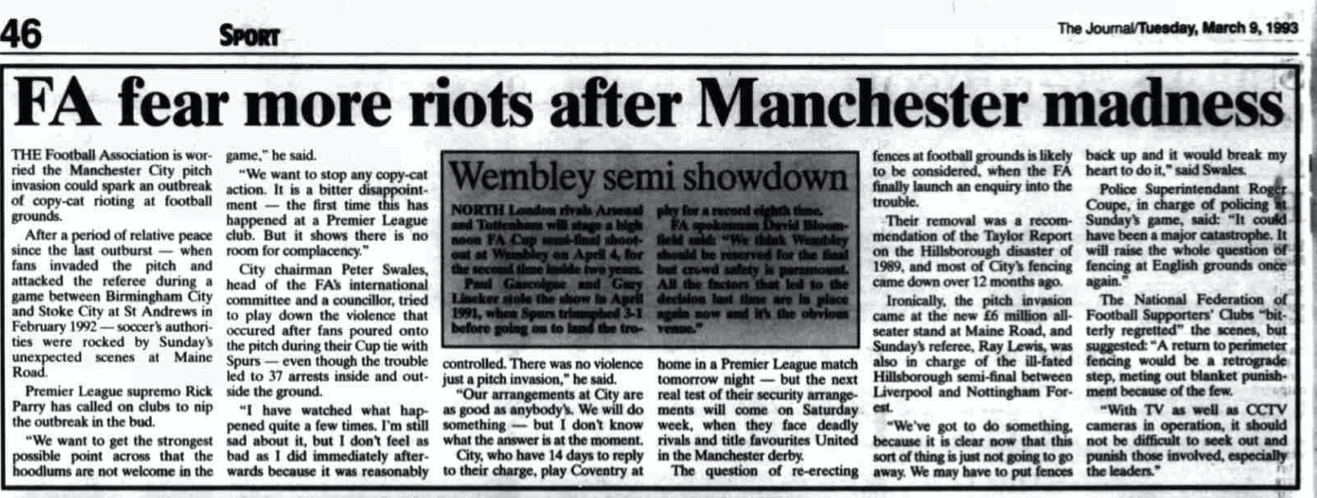
City’s chance of glory that season faded in a FA Cup quarter final with Tottenham and fans’ frustrations at their chairman and directors spilled out. It was a day when Swales’ new stand was opened – the Umbro Stand – and this was small-time compared to the club’s history and heritage. The stand it had replaced held over 9,000 seated. The new stand was basically two rows of executive boxes with about 4,500 seats in front. The ordinary fan felt that with that stand and the birth of the Premier League they were no longer relevant. Hospitality, money and TV deals seemed to matter most to club owners.
The frustrations that had been bubbling for years (and we must NEVER underestimate the efforts City fans made demonstrating against their directors and for how many years they did this) bubbled on to the pitch. Live television captured the scenes as City fans invaded the pitch and the FA Cup quarter final was halted.
The media criticised the couple of hundred fans who made it on to the pitch. They didn’t ask why they’d done it, they just assumed City fans were unhappy at losing a FA Cup game. Had they bothered to ask fans – I was there and knew the situation and have over the years discussed this extensively with people who were on the pitch – they would have realised that they climbed on to the pitch out of frustration. Frustration at the way football was developing and frustration at Peter Swales and his supporting directors.
Fans were right to be frustrated and history has shown that their predictions (covered extensively in City fanzines at the time) about the way football was developing to create an elite and more money for certain clubs was right.
I interviewed Peter Swales about two years after that pitch invasion and he told me that he should have listened to the fans and resigned that night. I agree – things would have been different for him and for City. Maybe in a few years the Glazers will say the same about this weekend?
That 1992-93 season saw Manchester United win the top flight for the first time in 26 years and United’s success brought added pressure to those in charge at Maine Road. The frustration of seeing your nearest rival achieve something that you’ve not done for years (City had been the last Manchester team to win the League prior to 1992-93 as they’d won it in 1967-68) gave fans further ammunition. Fans could point out to Swales that he became chairman of a club that had been hugely successful (four major trophies in the previous 5 seasons before his chairmanship) and profitable (previous chairman Eric Alexander was proud of the profitability of the Blues in the years before Swales). They could also ask ‘where did the money go’, ‘Why were we mismanaged?’ etc.
That event in City’s history is similar to some extent to what’s happened at United. Years of frustration at the owners/directors; the recognition that a rich club had been placed in significant debt; the proposed birth of a new league; the resurrection of a neighbour who seems destined to have a bright future just at a time when your directors don’t seem able or willing to compete etc.
The proposed change of structure to football, where greed of club owners seemed more important than what the fans wanted, was the catalyst to the demonstrations at United this weekend.
Please don’t be fooled into thinking this is a demonstration against the European Super League – that’s the catalyst but United fan dissatisfaction runs much deeper than that. As with City’s 1993 FAC quarter final defeat and the birth of the Premier League that season, these are catalysts that bring the wider fan base on board (and often the media attention), but they are not solely the cause.
In 1993 the media claimed City fans were unhappy because they’d lost the FAC tie. Well, yes, but they’d lost plenty of other FAC ties over the years and never invaded the pitch. That tie became the visible outpouring of dissatisfaction, just like the European Super League has created a situation which has allowed United fans to bring more visibility to their longstanding protests against the club’s owners.
So where do we go from here? Well, there’s one major change since 1993 and that is that the majority of media coverage seems to have sympathy with fans this time. But those working in the media should ensure they go and talk to the fans who were actually on the Old Trafford pitch and ask them why they were there. That would help frame the discussions about what it all actually meant. Some media coverages has said in rather simple terms that United fans were campaigning against the European Super League – no, it’s part of a long standing dissatisfaction with the club’s owners, but I’m not a fan who went on the pitch (that’s my interpretation but best way to find out is to ask those who were in Old Trafford).
In 1993 the media didn’t ask City fans why and they made assumptions which painted football fans extremely negatively. Instead of showing them as people who cared about how their club was developing they were presented as hooligans.
If we’re thinking about parallels then it’s worth considering what happened next in 1993 so that United fans can shape things differently or prepare for the worst! Back in 93 the momentum at Maine Road continued but, as with the widespread protest of the 1980s at City, nothing could change while the majority shareholders supported Swales. Put simply, if you own the club no amount of fan pressure can force you to sell. You only sell when you want to.
Swales felt the protests would die down (he explained all of this to me in an interview) but this time, as protests continued in 1993-94, former player Francis Lee decided to mount a takeover. That was eventually what forced Swales to stand down.
Sadly, for City the damage was done though and financially Lee’s City couldn’t compete with clubs who were able to spend freely like Blackburn (a major benefactor at the time) and those who were already benefitting financially from Premier League success. City ended up dropping to their worst ever position in the late 1990s and were financially adrift of many of their traditional rivals. Only the takeovers of 2007 and 2008 could help the club regain its position as a serious trophy challenger.
If we consider the City situation as an example, then it seems that the best chance United fans have got to change the ownership of the club is if someone like Gary Neville came in to front a major takeover of the club. Even then, as with City, it may well be that the damage done to the Reds and the debt placed on the club limits its future.
It does make you wonder what would have happened had Alex Ferguson, who had spoken out against the Glazers before the takeover, opposed the Glazers when they took over his club. Had Ferguson stood down back then maybe the protests against the Glazers would have been immense?
Football owners have never been properly policed and there are examples throughout the English league system of clubs whose futures were jeopardised by owners who have gambled on future success by borrowing to fund purchases, or who have sold club assets or placed a club in debt for their own personal gain. Change in football’s governance is needed. Simply changing owners is not the answer because football is a business and any owner wants his/her business to be profitable for him/her and shareholders.
Fans views, whether in the 1980s or 1990s campaigning against the Premier League and football chairmen, or in the 2020s campaigning against the Super League and football owners need to be listened to. Understand us and work with us – you might help make football an even greater spectacle.
Subscribe to get access
This is a taster of the material on this site. If you would like to read everything (including the entire Manchester A Football History book) then please subscriber. It’s £20 a year (works out about £1.67 a month) and you’ll have access to all 340+ articles/interviews etc. posted so far and the others coming during your subscription.
Don’t forget if you order The Peter Barnes Authorised Biography before publication you can get your name printed in it and your copy will be signed by Peter and myself. Details here: