Here’s film of the FA Cup final from this day (7 May) in 1955 when Manchester City were defeated by Newcastle 3-1 at Wembley. Bobby Johnstone was the City scorer. Enjoy: https://www.britishpathe.com/asset/59534/
This series on Manchester City in the 1950s includes free items and items only available to subscribers. If you’d like to find out more on the 1954-55 season then subscribe and read the following 3,400 word article on it. It’s a season when City reached the FA Cup final and Don Revie was FWA Footballer of the Year.
This is a subscriber article and you can read it by subscribing below.
Subscribe to get access
Read more of this content when you subscribe today. It costs £3 per month or you can subscriber for the discounted annual rate of £20 per year. Each subscriber gets access to everything posted so far, including PDFs of a couple of my books.
On this day (23 March) in 1968 came a game between two title challenging teams – Leeds Utd and Manchester City. The view was that this game could knock City out of the title race if it went Leeds’ way. So what happened? Here’s film of the game:
You can find out more aboutthe potential impact of this game by reading this subscriber article on Manchester City during the 1967-68 season. If you’d like to read this 7,600 word article (yes, 7,600 words on one season!), plus all other articles on the site, then please subscribe (see below). As with most of the other features in this series it includes words from interviews I have performed with those who were there.
Subscribe to get access
Read more of this content when you subscribe today. It costs £3 per month (cancel anytime) or sign up for a year at the discounted price of £20 per year (works out £1.67 per month). Subscribers access the 1000+ articles posted so far and the others scheduled during the life of your subscription.
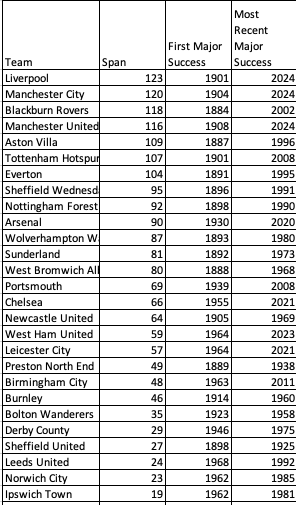
Congratulations Newcastle on defeating Liverpool in today’s League Cup final. The victory also means that 120 years separate their first major trophy success with their most recent. This span equals Manchester City. Every year, usually when the domestic season ends I update the table showing the span of success – i.e. the number of years between a club’s first major success (FA Cup, League, League Cup, major European trophy) and their most recent – for each major men’s trophy winning English club. I last did this after the 2023-24 season ended (see below). There wasn’t much difference between the 2023 final table and the 2024. Both Liverpool and Manchester City increased their span, as did United. Newcastle have leaped from 16th place (just behind Chelsea) to joint second with City. Here’s the table as it stood before today’s game:
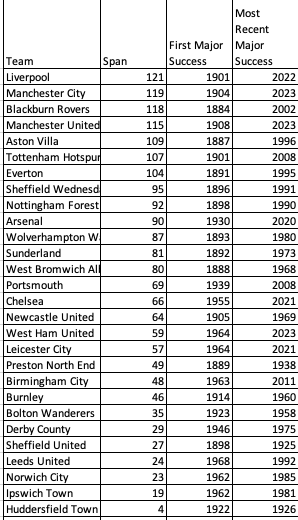
As I always say, the span of success does not show how many trophies each club has won or how frequently that club has experienced great eras of success, but it does demonstrate how wrong those people are who believe certain clubs were unsuccessful until recent years, or those who think certain clubs have always been giants. The column on first major success helps to show when some clubs first became trophy-winning significant (often after transformational investment too!).
There’s not much difference between 2023 and 2024 – numbers have changed but not positions. In 2023 West Ham, like potentially Newcastle this year, proved that if you’re a club that hasn’t won a major trophy for a while putting your focus on achieving trophy success ahead of the odd Premier League position can bring significant reward. In future decades no one will remember who finished seventh, tenth or fifteenth but they will remember the trophies. Here’s the previous year’s table for comparison purposes:
I know clubs focus on their financials but winning a trophy has longevity, gaining the odd Premier League place provides a bit of extra cash now but no long term kudos. Winning a trophy attracts new fans and brings money-spinning opportunities too.
If I was a supporter of any of the major clubs who have not found significant success in recent decades then I would absolutely want my team to go for whichever cup competition seems the most likely to win. That’s what I always wanted from City before they were able to compete for the League again. Winning the FA Cup in 2011 helped everything that followed happen – it gave confidence and a trophy winning mentality.
While you’re here why not take a look at the wide range of articles available on this site? Such as the 100 day series of features on Maine Road:
If you enjoy all the free material on my website and would like to support my research and keep this website going (but don’t want to subscribe) then why not make a one-time donation (or buy me a coffee). All support for my research is valued and welcome. It allows me to keep some free material available for all. Thanks.
The new series on Manchester City in the 1950s continues today with this 1,500 word article on the 1958-59 season. Enjoy!
This is a subscriber article and you can read it by subscribing below.
Subscribe to get access
Read more of this content when you subscribe today. It costs £3 per month or you can subscriber for the discounted annual rate of £20 per year. Each subscriber gets access to everything posted so far, including PDFs of a couple of my books.
Every year, once the domestic season ends I update the table showing the English clubs’ span of success – i.e. the number of years between a club’s first major success (FA Cup, League, League Cup, major European trophy) and their most recent. I last did this after the 2023-24 season ended (see below). There wasn’t much difference between the 2023 final table and the 2024. Both Liverpool and Manchester City increased their span, as did United. Next month there’s a chance Newcastle can leap from 16th place (just behind Chelsea) to joint second with City. Here’s the table as it stands at present:
As I always say, the span of success does not show how many trophies each club has won or how frequently that club has experienced great eras of success, but it does demonstrate how wrong those people are who believe certain clubs were unsuccessful until recent years, or those who think certain clubs have always been giants. The column on first major success helps to show when some clubs first became trophy-winning significant (often after transformational investment too!).
There’s not much difference between 2023 and 2024 – numbers have changed but not positions. In 2023 West Ham, like potentially Newcastle this year, proved that if you’re a club that hasn’t won a major trophy for a while putting your focus on achieving trophy success ahead of the odd Premier League position can bring significant reward. In future decades no one will remember who finished seventh, tenth or fifteenth but they will remember the trophies. Here’s the previous year’s table for comparison purposes:
I know clubs focus on their financials but winning a trophy has longevity, gaining the odd Premier League place provides a bit of extra cash now but no long term kudos. Winning a trophy attracts new fans and brings money-spinning opportunities too.
If I was a supporter of any of the major clubs who have not found significant success in recent decades then I would absolutely want my team to go for whichever cup competition seems the most likely to win. That’s what I always wanted from City before they were able to compete for the League again. Winning the FA Cup in 2011 helped everything that followed happen – it gave confidence and a trophy winning mentality.
While you’re here why not take a look at the wide range of articles available on this site? Such as the 100 day series of features on Maine Road:
If you enjoy all the free material on my website and would like to support my research and keep this website going (but don’t want to subscribe) then why not make a one-time donation (or buy me a coffee). All support for my research is valued and welcome. It allows me to keep some free material available for all. Thanks.
On this day (31 January) in 1968 Manchester City defeated Reading 7-0 in a FA Cup replay. As the players left the field the Elm Park tannoy announcer claimed: ‘Ladies and Gentlemen, you have just seen one of the greatest teams England has produced in a long time.’
Goalscorers were Mike Summerbee (3), Colin Bell, Tony Coleman, George Heslop and Neil Young. This photo is of the Bell, Lee & Summerbee statue at the Etihad today.
Dozens of letters arrived at Maine Road commenting on City’s performance. Many Reading fans wrote in saying they could have watched the Blues all night. Other letters arrived commenting on how well behaved the City supporters were, while fans themselves commented on the cheerfulness of the Reading police.
These points may seem trivial today, but in 1968 football had already begun to enter its hooligan period. Football supporters had started to be seen as trouble causers and incidents of violence, or of vandalism, soon found their way into national newspapers. Although City supporters were never totally blameless, during the late 1960s Blues fans continued to gain commendations rather than condemnation.
You can read more on this remarkable, trophy winning season below. If you’d like to read this 7,600 word article (yes, 7,600 words on one season!), plus all other articles on the site, then please subscribe (see below). As with most of the other features in this series it includes words from interviews I have performed with those who were there.
Subscribe to get access
Read more of this content when you subscribe today. It costs £3 per month (cancel anytime) or sign up for a year at the discounted price of £20 per year (works out £1.67 per month). Subscribers access the 1000+ articles posted so far and the others scheduled during the life of your subscription.
Continuing the series of features on the 1960s, here’s a subscriber article on Manchester City during the 1967-68 season. A trophy winning season. If you’d like to read this 7,600 word article (yes, 7,600 words on one season!), plus all other articles on the site, then please subscribe (see below). As with most of the other features in this series it includes words from interviews I have performed with those who were there.
Subscribe to get access
Read more of this content when you subscribe today. It costs £3 per month (cancel anytime) or sign up for a year at the discounted price of £20 per year (works out £1.67 per month). Subscribers access the 1000+ articles posted so far and the others scheduled during the life of your subscription.
Thirty years ago today (25 October 1994) Manchester City faced QPR in the League Cup in what was an incredible game that kept fans on the edge of their seats. The Blues had already disposed of Barnet 5-2 on aggregate in the second round and clearly expected to put in a good performance at Loftus Road. Sadly, within a minute they conceded a goal just as they had in the earlier League Cup match at Barnet and Brian Horton’s side suffered for a while. By the 37th minute they managed to get their act together a little and Summerbee equalised with a 20 yard volley. A minute later Rangers took the lead again.
Fortunately, in the 46th minute Keith Curle netted a penalty to bring City level once again, followed eight minutes later by a magnificent Beagrie volley which made it 3-2 and brought a series of somersaults from the popular ex-Evertonian. Five minutes later, the same player headed through to Lomas who made it 4-2.
In the 87th minute Rangers pulled a goal back (4-3) to keep City on their toes, but the referee’s whistle signalled the start of a party for the fans while their QPR equivalents began to demonstrate against their chairman. Apparently, some unhappy QPR fans were keen to listen to the advice of a few experienced Mancunian demonstrators!
You can watch highlights of the game here:
The victory gave City a home tie against Kevin Keegan’s Newcastle United.
If you enjoy all the free material on my website and would like to support my research and keep this website going (but don’t want to subscribe) then why not make a one-time donation (or buy me a coffee). All support for my research is valued and welcome. It allows me to keep some free material available for all. Thanks.
On this day (29 September) in 2007 goals from Petrov (38 mins), Mpenza (47) and Elano (87) helped Manchester City to a 3-1 victory over Newcastle United. Elano’s goal came from a truly outstanding free kick and was his first goal for the club. You can see highlights of the game here:
If you enjoy all the free material on my website and would like to support my research and keep this website going (but don’t want to subscribe) then why not make a one-time donation (or buy me a coffee). All support for my research is valued and welcome. It allows me to keep some free material available for all. Thanks.
City v Newcastle is one of the most enduring fixtures in English football. There have been cup finals, title deciders, dramatic games, shared heroes and so much more. The two clubs first met in the League in October 1893 (Ardwick/MCFC’s 2nd season in the League) and City’s record is:
Competition
Played
Won
Drawn
Lost
League
174
71
38
65
FA Cup
12
4
2
6
League Cup
6
3
1
2
European
0
0
0
0
Other
0
0
0
0
There have been lots of significant games in the League, FA Cup and League Cup. A League Cup final in 1976 saw them meet at Wembley when Peter Barnes and Dennis Tueart both scoring for the Blues.
Most Blues of my age and above will remember where they were when our King returned to action on Boxing Day 1977. Here’s an interview I did with him a few years back when we talked about that special day:
There was a really odd thing a while back where a Newcastle paper claimed that their local team had first worn bar scarves at games. A few simple searches soon proved there were much earlier bar scarfs:
If you enjoy all the free material on my website and would like to support my research and keep this website going (but don’t want to subscribe) then why not make a one-time donation (or buy me a coffee). All support for my research is valued and welcome. It allows me to keep some free material available for all. Thanks.




 Gary James' Football Archive