Rare action images from Hyde Road taken on this day (October 12) in 1912 as Manchester City were defeated 1-0 at home to Newcastle before a capacity 40,000 crowd.
If you enjoy all the free material on my website and would like to support my research and keep this website going (but don’t want to subscribe) then why not make a one-time donation (or buy me a coffee). All support for my research is valued and welcome. It allows me to keep some free material available for all. Thanks.
City v Newcastle is one of the most enduring fixtures in English football. There have been cup finals, title deciders, dramatic games, shared heroes and so much more. The two clubs first met in the League in October 1893 (Ardwick/MCFC’s 2nd season in the League) and have since played each other 189 times overall with City winning 76 and Newcastle 72 games.
As tonight is a League Cup tie, the most famous meeting of the teams in that competition came in 1976 at Wembley when Peter Barnes and Dennis Tueart both scored for the Blues.
Most Blues of my age and above will remember where they were when our King returned to action on Boxing Day 1977. Here’s an interview I did with him a few years back when we talked about that special day:
There was a really odd thing a while back where a Newcastle paper claimed that their local team had first worn bar scarves at games. A few simple searches soon proved there were much earlier bar scarfs:
If you enjoy all the free material on my website and would like to support my research and keep this website going (but don’t want to subscribe) then why not make a one-time donation (or buy me a coffee). All support for my research is valued and welcome. It allows me to keep some free material available for all. Thanks.
During the 1920s Manchester City had a goalkeeper Jim Mitchell who played in glasses – not specially produced glasses, ordinary glasses of the period!
Here are some images of him in action. I’m not quite certain what’s happened but it looks like he changed his shirt during the game because these are definitely from the same match:
Born in Prestwich, Jim Mitchell was a former Manchester University and Northern Nomads ‘keeper. He also had spells at Blackpool and at Preston where he gained an extremely good reputation. He gained several significant honours and was the Great Britain goalkeeper at the 1920 Olympics. He also kept goal for Preston in the 1922 FA Cup final (the last played at Stamford Bridge before Wembley Stadium opened) against Huddersfield and hit the headlines by leaping around while a penalty was being taken against him – this caused the rules to be changed.
He joined City shortly after the final and replaced Goodchild as City’s number one the following September, making his debut on 9th September 1922 at home to Birmingham. Despite wearing glasses – on the pitch as well as off it – Mitchell was an agile ‘keeper and made 22 appearances in his first season.
Always an amateur, Mitchell made history by being City ‘keeper for the first game at Maine Road (25th August 1923) and was generally recognised as a quality ‘keeper by neutrals. He was certainly known nationwide and was capped at both an amateur level and for the full England side.
He later had a spell at Leicester, though he never appeared in their first team, and joined the footwear firm Stead & Simpson. He went on to become their Managing Director. He passed away in 1975.
Appearances: League: 99 FA Cup: 10
Search my site and you’ll find film of Mitchell at Maine Road’s opening game in 1923. There’s also much more on this 1924 FA Cup semi final featuring Mitchell. It was Billy Meredith’s last game and subscribers can read more and watch film of it here:
As Manchester City are playing Newcastle today (19 August 2023) and I’ve been doing a 100 day countdown to the centenary of Maine Road’s first game, it’s worth pausing to remember that before Maine Road City had another major venue that had staged games at an international level; semi-finals; been the best supported League club at; and had welcomed the King to. That ground was Hyde Road and the old stadium’s last ever League game came on 28 April 1923 when City drew 0-0 with Newcastle United (hence me doing this reminder today!).
The match was watched by a crowd of around 20,000. On the same date Wembley Stadium, built by the same people who were building Maine Road, hosted its first FA Cup final and, because of the extraordinary scenes, very little space was given over to the City game in the national ‘papers. Instead they concentrated on Bolton’s performance and the exploits of Billy, the white horse, in clearing the Wembley pitch.
Three months after the last Hyde Road League match, on 18 August, the last ever game, a practice match, was staged on the pitch. Afterwards the goal posts and a few turnstiles were taken from the old ground and erected at Maine Road – about 6 were still at Maine Road in 2003 when it was demolished. Attempts were made to keep one of the oldest (from 1896) and re-erect it in a public area at the new stadium. Sadly, the day before it was to be removed the external wall was smashed and the turnstile was stolen.
One of the Hyde Road stand roofs was dismantled and sold to Halifax Town to be re-erected at the Shay.
The Shay had opened approximately twelve months before Hyde Road’s last League match, and a stand had already been constructed. When this stand was extended it coincided with the demolition of City’s ground. Basically, it appears that the metalwork from one of City’s multi-span roofs was dismantled and re-erected along the touchline at the Shay. It was linked to the existing roof, and formed one traditional style roof. The roof still exists at the Shay today, although during the early 1990s it was re-clad.
The front stanchions look suspiciously like those at Hyde Road, while my investigations in the late 1990s highlighted that the metalwork matched that of similar roofing at a factory in Sale. That factory’s roof was also a former stand roof from Hyde Road. Both the Shay roof and that in Sale were so similar that it seems likely they had previously been erected at Hyde Road.
The Sale factory was dismantled and sections of the roof given to Manchester City for possible re-use in a City museum. Sadly, by 2002 the metalwork had vanished from Maine Road and its whereabouts unknown.
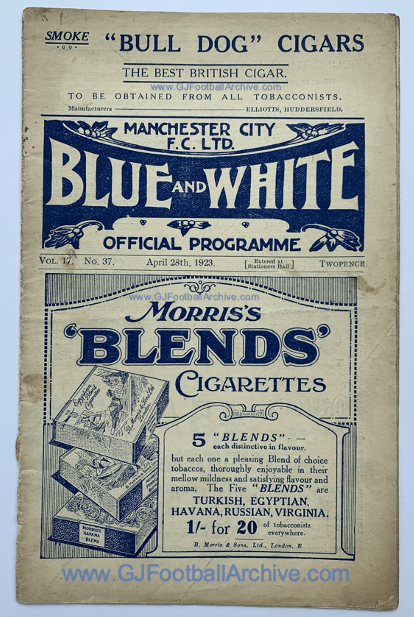
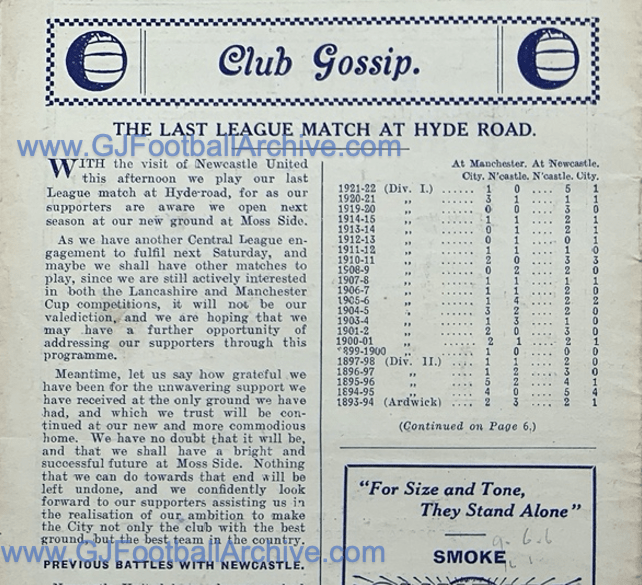
A page from Charles Thurrell’s copy of Hyde Road’s last league game match programme v Newcastle, 28 April 1923Charles Thurrell’s copy of Hyde Road’s last league game match programme v Newcastle, 28 April 1923
It’s time for post 87 of my Maine Rd 100 countdown and this is a reminder of the day (4 January) in 1975 when Manchester City played ‘away’ at Maine Road against Newcastle United in the FA Cup. The tie should have been played at Newcastle but the FA ordered that the match be played at Maine Road following crowd disorder at St. James’ Park the previous season. City lost the match 2-0.
Were you at this match? If so why not leave your memory as a comment or email it to me for possible future use on this website?
You can read a 1500 article on the 1974-75 season here:
Today (28 April) in 1923 Hyde Road staged its last League game as Manchester City drew 0-0 with Newcastle United.
The match was watched by a crowd of around 20,000. On the same date Wembley Stadium, built by the same people who were building Maine Road, hosted its first FA Cup final and, because of the extraordinary scenes, very little space was given over to the City game in the national ‘papers. Instead they concentrated on Bolton’s performance and the exploits of Billy, the white horse, in clearing the Wembley pitch.
Three months after the last Hyde Road League match, on 18 August, the last ever game, a practice match, was staged on the pitch. Afterwards the goal posts and a few turnstiles were taken from the old ground and erected at Maine Road – about 6 were still at Maine Road in 2003 when it was demolished. Attempts were made to keep one of the oldest (from 1896) and re-erect it in a public area at the new stadium. Sadly, the day before it was to be removed the external wall was smashed and the turnstile was stolen.
One of the Hyde Road stand roofs was dismantled and sold to Halifax Town to be re-erected at the Shay.
The Shay had opened approximately twelve months before Hyde Road’s last League match, and a stand had already been constructed. When this stand was extended it coincided with the demolition of City’s ground. Basically, it appears that the metalwork from one of City’s multi-span roofs was dismantled and re-erected along the touchline at the Shay. It was linked to the existing roof, and formed one traditional style roof. The roof still exists at the Shay today, although during the early 1990s it was re-clad.
The front stanchions look suspiciously like those at Hyde Road, while my investigations in the late 1990s highlighted that the metalwork matched that of similar roofing at a factory in Sale. That factory’s roof was also a former stand roof from Hyde Road. Both the Shay roof and that in Sale were so similar that it seems likely they had previously been erected at Hyde Road.
The Sale factory was dismantled and sections of the roof given to Manchester City for possible re-use in a City museum. Sadly, by 2002 the metalwork had vanished from Maine Road and its whereabouts unknown.
A page from Charles Thurrell’s copy of Hyde Road’s last league game match programme v Newcastle, 28 April 1923Charles Thurrell’s copy of Hyde Road’s last league game match programme v Newcastle, 28 April 1923
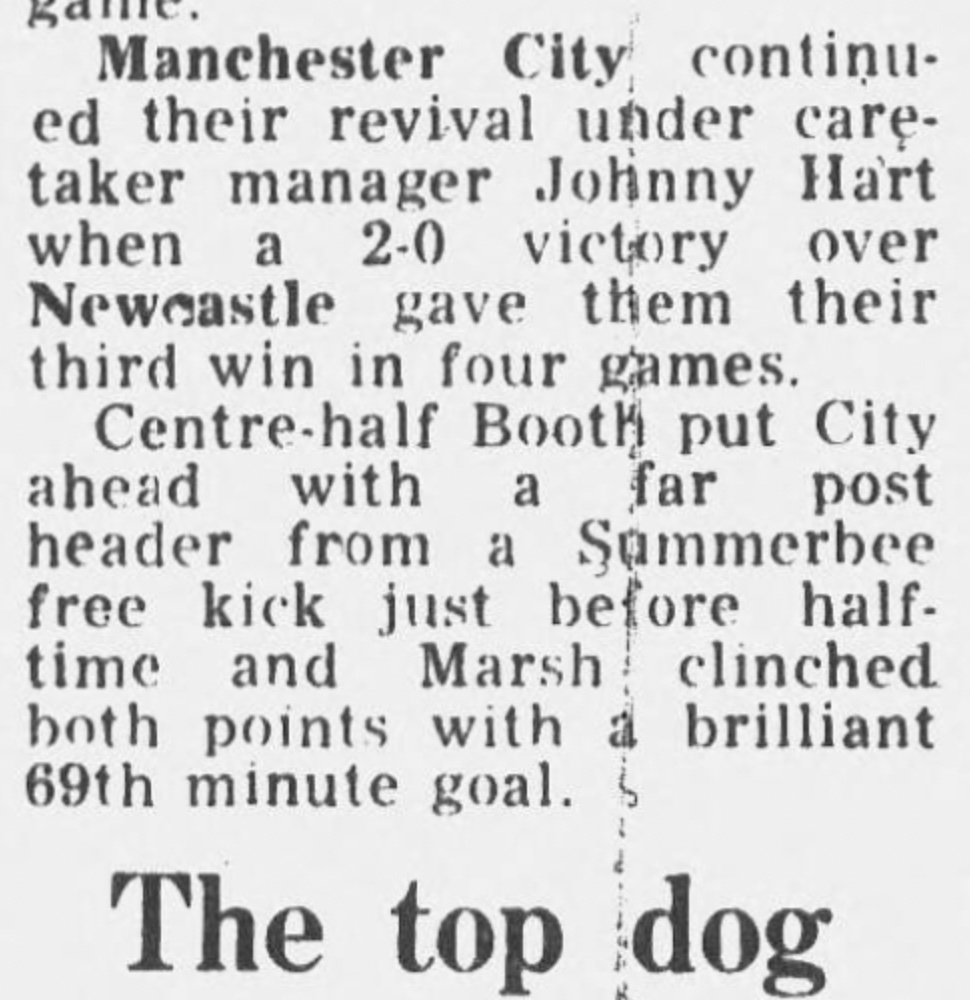
Fifty years ago today (18 April 1973) City defeated Newcastle 2-0 with goals from Tommy Booth (a header) and a brilliant effort from Rodney Marsh (in 69th minute). City’s boss at the time was Johnny Hart. You can read his frank views (from an interview I did with him several years ago) here:
On this day (29 March) in 1924 Manchester City faced Newcastle United in the FA Cup semi-final. Not only that but the game was to be the last competitive game played by City’s legendary winger Billy Meredith. Meredith’s Manchester career began in 1894 when he joined City.
Here for subscribers is the story of that game, plus a contemporary match report and film of Meredith’s last game. Enjoy!
Subscribe to get access – Annual
To read this and all content on this site please subscribe. It works out about £1.67 a month if you take out an annual subscription (£20 per year) or £3 a month if you’d like to sign up for a month at a time (see below). Annual subscribers get full access to everything posted since the site was set up in December 2020 and the hundreds scheduled to be posted during their subscription.
It costs £3 per month (or £20 a year – see above) to subscribe. Monthly subscribers get full access to everything posted since 1 October 2022 and everything posted during their subscription. They can also cancel any time. Why not try it for a month?
The 18th of February 1984 brought a crowd of 41,767 (the division’s second biggest crowd of the season) to the Second Division match between Manchester City and Newcastle United. This crowd was over 15,000 higher than the best in the top flight (Arsenal v Aston Villa attracted 26,640). City were third prior to the match, with Newcastle fourth. and here’s some background and highlights.
With three promotion places available City felt certain they could achieve an immediate return, however they did not account for the role Kevin Keegan would play in Newcastle’s fortunes. Newcastle had been struggling to make an impact since relegation in 1978, but then Keegan returned as a player and the whole place seemed revitalised, indeed he had helped the Geordies achieve a 5-0 thrashing of City in October. McNeill: “There are few players that I have greater respect for than Keegan and this time, I’m referring only to his ability on the pitch, he was the heart and soul of Newcastle. It’s a terrible thing to admit, but every time I read that Kevin had an injury I hoped it would keep him out of the Newcastle side for a game or two. Usually it didn’t and I was glad in the end because I have such a high regard for him. He was certainly the difference between City and Newcastle. They had Keegan’s inspirational qualities and we didn’t.”
By 11 February City and Newcastle were level on points with the Blues in third place, and Newcastle fourth with a game in hand. Above them lay Chelsea and Sheffield Wednesday. The four sides were termed the ‘Big Four’ by the media who regularly chose to feature games from the Second above those in the First. As always Liverpool seemed destined to win the Championship and so much attention turned to the glamour clubs of the Second, especially Newcastle with the charismatic Keegan.
On 18 February came the vital Maine Road clash between the ‘Jocks’ and the Geordies. A win would put City six points ahead of Newcastle, yet defeat would put the two sides level with Keegan’s men also having a game in hand. A crowd of 41,767 – City’s and the division’s second biggest crowd of the season – saw future Blues Peter Beardsley and Kevin Keegan netting fine goals to give the Geordies the initiative with Steve Kinsey scoring for the Blues. Highlights:
City finished the season fourth and missed out on promotion.
On this day (9 January) in 1957 Manchester City and Newcastle United met in a game that was described as the game of the season and also Newcastle’s ‘most thrilling encounter.’ What was the game and why did they say this? Well here for subscribers is the story of that day and film of it too. Enjoy:
Subscribe to get access – Annual
Read this and all other content on this site when you subscribe today. It costs £20 a year (about £1.67 a month) or there’s a monthly option below.
I wasn’t born then so couldn’t be at the game but were you at this match? If you were why not leave your memory as a comment or email it to me for possible future use on this website?