Maine Road & Temperance

This map shows the Maine Road area, where Manchester City’s former ground was, before any of the terraced housing was built. The dark blue shape I’ve placed on the map is approximately where the stadium was built. Maine Road was initially known as Dog Kennel Lane and was renamed in stages as terraced housing was built on it. The lane originally had a bend where the current Maine Road ends and the old lane veered off towards modern day Princess Parkway.

I explain a lot more about this in Farewell To Maine Road and in the Big Book of City. In the MCFC match programme a few years back I explained:

Maine Road itself was a relatively insignificant street in 1923, but in the previous century the road had the name ‘Dog Kennel Lane’ and it had for many decades been a fairly significant but meandering route south of the city. The street was renamed in stages when the area was developed during the late 1800s. For years the reason Maine Road was picked was not clear, but in 2009 I discovered the truth.

The Maine Road name came indirectly from the US State of Maine but this was a compromise. The following newspaper article explains: ‘Dog Kennel Lane took its name from the kennel where hounds were kept. It stood on the right-hand side at the bend about a thousand yards from Moss Lane, opposite to the road which tracked off to the left and led to Demesne Farm. The common name of this lane is so common and unattractive that when the Temperance Company bought the Trafford land they asked the local board to change the name to Demesne Road, and the subject was compromised by calling it Maine Road out of compliment to the Temperance principles of the petitioners.’

The idea of the Temperance movement was to discourage people from drinking alcohol. On 2 June 1851 the State of Maine passed the first recognised prohibition law, and two years later the United Kingdom Alliance was founded in Manchester, pledging to badger Parliament to outlaw liquor in England.

The ‘Temperance Company’ mentioned in the article was actually part of the movement and had bought some land at the top of Dog Kennel Lane – this area is close to the junction with Moss Lane East. They wanted to create a better standard of living and within that area they erected buildings in keeping with their approach to life, such as the Temperance Billiard Hall. However, the ‘Dog Kennel Lane’ name was clearly an issue and so the selection of the name ‘Maine Road’ was made. So the name Maine Road refers to the US State and the part that Maine played in the Temperance movement.

An early 20th century interpretation of an older map, showing modern streets (dotted) with the original roads.

If you’d like to read more on the history of Maine Road, take a look at Farewell To Maine Road, which can be downloaded from this page:

If you enjoy all the free material on my website and would like to support my research and keep this website going (but don’t want to subscribe) then why not make a one-time donation (or buy me a coffee). All support for my research is valued and welcome. It allows me to keep some free material available for all. Thanks.

Choose an amount

£2.50
£5.00
£7.50

Or enter a custom amount

£

Your contribution is appreciated.

Donate
Maine Road Now and Then

It’s worth comparing this image from recent years, showing the housing and school now built on Maine Road, with this 1940s image of the Maine Road site. The boundary lines are visible, demonstrating how the site changed usage.

This 1971 aerial image shows the stadium from another angle, looking west.

Maine Road aerial 1971 from Farewell To Maine Road

If you’d like to read more on the history of Maine Road, take a look at Farewell To Maine Road, which can be downloaded from this page:

If you enjoy all the free material on my website and would like to support my research and keep this website going (but don’t want to subscribe) then why not make a one-time donation (or buy me a coffee). All support for my research is valued and welcome. It allows me to keep some free material available for all. Thanks.

Choose an amount

£2.50
£5.00
£7.50

Or enter a custom amount

£

Your contribution is appreciated.

Donate

Air Raids Around Maine Road

It’s 1941 and there are air raids across Manchester… Have a look at this map. What does it signify? Well, the map shows Manchester City’s Maine Road Stadium as it looked between 1931 and 1934, before the main part of the Platt Lane Stand was built (and after the corner was erected). But that’s not why I’ve posted it. I’ve posted it because of those pen circles that appear on it.

This is actually a Manchester City Council plan of buildings hit by bombs in the area immediately east of the Maine Road stadium. As you can see a house in Thornton Road was hit but none of the Maine Road stadium itself was hit in those January 1941 raids on Manchester. The stadium had a lucky escape but sadly many residents and Mancunians did not.

1941 Bomb damage near Maine Road

Here’s an aerial photo of Maine Road from 1971 to give a feel for the site. The Platt Lane corner is number 3 and Thornton Road is the street that backs on to Maine Road near number 6.

Maine Road aerial 1971 from Farewell To Maine Road

If you’d like to read more on the history of Maine Road, take a look at Farewell To Maine Road, which can be downloaded from this page:

If you enjoy all the free material on my website and would like to support my research and keep this website going (but don’t want to subscribe) then why not make a one-time donation (or buy me a coffee). All support for my research is valued and welcome. It allows me to keep some free material available for all. Thanks.

Choose an amount

£2.50
£5.00
£7.50

Or enter a custom amount

£

Your contribution is appreciated.

Donate

Swales Out 1983

As part if my Maine Rd 100 countdown in 2023 I posted this image of Manchester City fans demonstrating against chairman Peter Swales and his supporting board of directors. It’s always worth remembering those days as a reminder of how things change.

Of course fans still demonstrate and make their feelings known over various issues (as is their right) but these days it tends to be over specific issues. Back then it was about the direction of the full club. This image was from 1983 but protests against Swales and the board began in 1979 and continued until 1993-94. Here’s a photo of John Bond stood in front of the Main Entrance in 1983. The ‘cage’ protecting the entrance would often get locked to prevent fans forcing their way in during demonstrations.

John Bond, 1983

Here’s a 1995 image of Maine Road showing the forecourt in front of the Main Stand where most demonstrations occurred:

The City FC Flag

Anyone remember seeing the CITY F.C. flag that used to proudly fly above the Popular Side/Kippax. It was there for decades. There had been a CITY F.C. flag at Hyde Road and it may well be that this was the same flag. It was often referred to in the media during its life at Maine Road, such as in this 1925 cartoon:

The first derby at Maine Road
The City flag flying at Maine Road’s first Manchester derby

The flag flew proudly over the Popular Side until the stand was roofed in 1957. Then the flag was moved to the Scoreboard End, eventually disappearing in the 1960s when rumour has it that it was taken down by Liverpool fans. I’m not certain if that’s true and I’ve never found any evidence but if you do know more please let me know.

I do know that in the 1930s a disgruntled City fan lowered it during a difficult game and it caused outrage. It was mentioned in the local press and the culprit had to make a formal apology to the club and his fellow City fans.

This 1971 image shows the roofed Kippax Stand. The flag was originally on a flag pole roughly where the number 7 is in the days before the stand had a roof. When the Kippax was roofed it was moved to the back of the Scoreboard End. The North Stand (10) replaced the Scoreboard End in the early 1970s.

Maine Road aerial 1971 from Farewell To Maine Road

If you’d like to read more on the history of Maine Road, take a look at Farewell To Maine Road, which can be downloaded from this page:

If you enjoy all the free material on my website and would like to support my research and keep this website going (but don’t want to subscribe) then why not make a one-time donation (or buy me a coffee). All support for my research is valued and welcome. It allows me to keep some free material available for all. Thanks.

Choose an amount

£2.50
£5.00
£7.50

Or enter a custom amount

£

Your contribution is appreciated.

Donate

Maine Road’s 1994 Redevelopment Plan

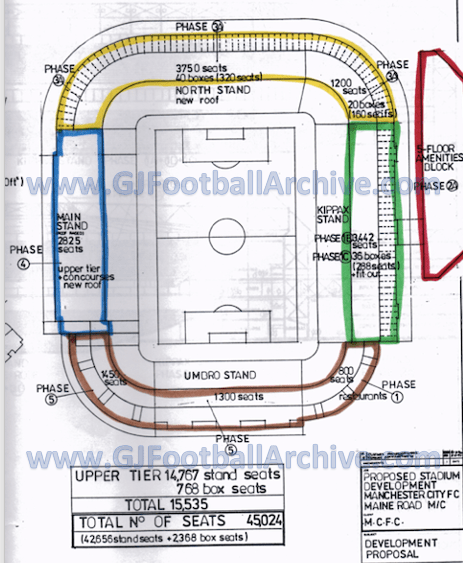
Here’s a 1994 plan of what might have been in terms of Maine Road’s development. This image is of how the entire stadium was supposed to look. To explain the colour image looks towards the stadium from above the Kippax car park. The North Stand is on the right and the Platt Lane on the left. The black and white image is from the other side of the ground, looking towards the Kippax from the Main Stand.

1990s Maine Rd redevelopment plans as seen in Farewell To Maine Road

You can see from the black and white image that the plan was to replicate the general look of the new Kippax (being planned at this stage – this was January 1994 and the old Kippax was still standing) around the ground. The North Stand was to have a second tier added and hospitality boxes between the levels, like the new Kippax. The Platt Lane was to have a second tier added above the two lines of existing hospitality boxes.

The Main Stand would have part of the seating chopped away and a new second tier added.

To facilitate all of this some houses were to be bought and demolished on the streets immediately behind the North Stand and the Kippax/Platt Lane corner.

The new Kippax was the first phase of the development but Manchester’s bids for the Olympics changed thinking. Couple that with relegation in 1996 and the wholesale redevelopment of Maine Road was postponed after the Kippax opened and then dropped completely.

As mentioned previously, Francis Lee’s plans would have seen the new Kippax followed by a phased development of each of the other three stands. These images might give an indication of how it would have progressed.

The following 1971 aerial image shows the proximity of the housing on Thornton Road (bottom left, near number 6) and behind the North Stand (number 10). They were planned to be demolished in Lee’s 1994 plan.

Maine Road aerial 1971 from Farewell To Maine Road

If you’d like to read more on the history of Maine Road, take a look at Farewell To Maine Road, which can be downloaded from this page:

If you enjoy all the free material on my website and would like to support my research and keep this website going (but don’t want to subscribe) then why not make a one-time donation (or buy me a coffee). All support for my research is valued and welcome. It allows me to keep some free material available for all. Thanks.

Choose an amount

£2.50
£5.00
£7.50

Or enter a custom amount

£

Your contribution is appreciated.

Donate

Mr Grimsdale!

I’ve posted this image of entertainer Norman Wisdom doing some prematch stuff at Maine Rd in the 90s before but it’s always worth reminding ourselves of the days when he’d come out on to the pitch, fall over while taking a penalty and similar antics. Often supported by musician Rick Wakeman too! On one of the days many of us stood on the Kippax saw the elderly entertainer take to the field but didn’t recognise him at first. In fact many of us thought it was Peter Reid wearing a flat cap!

There were lots of odd prematch activities over the decades and you can read about them in this 2000 word article on the history of pre-match entertainment at Manchester City. There are mentions of the St Joseph’s Industrial School and Beswick Prize Bands, various DJs, athletic challenges, Norman Wisdom, Frank Sidebottom & more. Enjoy:

Subscribe to get access – Annual

Read more of this content when you subscribe today. It costs £20 a year (less than 6p a day) to access everything posted since the site went live in December 2020 (books, interviews, videos, history talks etc.) and throughout your period of subscription. Or you can subscribe a month at a time for £3 (cancel anytime; see below)

Subscribe to get access – Monthly

Monthly subscribers have access to everything posted since 1 October 2022 (books, interviews, videos, history talks etc.) and throughout your period of subscription. It costs £3 per month (cancel anytime)

Maine Road in 100 Features

A couple of years ago I did a daily series of 100 features on Maine Road as I counted down to the centenary of Manchester City’s old stadium. These articles can still be viewed and here’s the one posted on 21 May 2023:

There are 100 features in total from that series. You can use the Maine Road category/tag to find them all or follow links like this to get a selection:

https://gjfootballarchive.com/category/manchester-city/maine-road/page/6/

Remembering Bobby Kennedy

Sorry to hear the news that Manchester City’s Scottish defender Bobby Kennedy has died. To remember his footballing life, here’s an interview I did with him in 2005 (as it was published at the time):

Defender Bobby Kennedy proved to be a popular player after joining the Blues in 1961.  He went on to make 251 (plus 3 as sub) appearances for City over a seven year period and was a key member of City’s mid sixties side.  In April 2005 Gary James caught up with him at the stadium.

Let’s start with your childhood in Motherwell.  How important was football to you as a boy?

We all played football and I was a Motherwell fan.  I used to go all over Scotland watching them and as I got older my school used to go to Motherwell to train, so all of that was very important and made a big impression of course.  But football in Scotland wasn’t as professional as in England, so I never thought about it as a career.  I wanted to progress, but I didn’t think it would pay my wage.  I ended up working as an engineer, co-incidentally with Ian St. John, and then I joined Kilmarnock and he signed for Motherwell.  I’d also played for a village team and Joe Baker played for the same team.

At Kilmarnock you played in the Scottish Cup Final, that must have been a great experience?

Yes it was, and we also played in the Scottish League Cup Final, but each time we faced Rangers, so there was only ever going to be one winner unfortunately!  I had a great time at Kilmarnock and I never really thought about leaving, and I suppose I never really thought about English football.  It was never at the forefront of our minds, and then we went on a tour to the States and we played Burnley and we beat them.  Now Burnley were one of the top English clubs back then and so this was a real test for us, but that day everything went well and I remember that playing Burnley was regarded by us as a major event.  I’d never played against a strong English side, and so that made me think a little.

Not long after that City made their approach, was that the first time you’d heard of any interest in you from England?

Oh Aye.  I never heard of any interest, but then I never thought in that way.  When City got in touch with Kilmarnock, money was tight and I think they needed to sell someone, so it was good for them.  Plus the maximum wage had just been abolished in English football and so when the offer came I was astounded with the wage they were offering.  I was on £22 and City offered £38 I think.  These figures will seem like peanuts today but believe me this was a major increase.  Having said that I still thought long and hard about the move.  

How did you find Manchester when you arrived in 1961?

I was fortunate that Jackie Plenderleith was at City because he looked after me and helped me settle, but it felt like an entirely different way of life.  At first Jackie would take me and my wife to the pubs and clubs – I guess he wanted to show the different areas and help us get accustomed to the place – but I remember we felt a bit homesick and me and my wife started to talking and, even though she had worked in Glasgow, it felt alien to some extent and we stuck out a little.  We knew that once we’d found a house and made it our home we wouldn’t be going out so much, so that became our priority and we eventually settled.  David Shawcross and a few others also helped us settle.

On the pitch I couldn’t have had a better start.  We beat Leicester 3-1 in my first game and I even scored against the great Gordon Banks.  The fans loved that and I think they supported me from the beginning, although it was a little tough at first.  Denis Law, who was a great hero to the fans, had been sold, and Ken Barnes, another hero, had also moved on, and their replacements were me and Peter Dobing.  For a lot of fans – and I can totally understand this – we were not an improvement.  Usually when you bring players in you try to improve the side, but when we joined I don’t think anyone believed the side had improved.  Nevertheless the fans took to me and I think they recognised that I always gave 100% – City fans rightly demand that and they will often overlook a player’s weaknesses so long as he shows the same commitment to the Club as they do.  

You were an everpresent in your first season, then in November 1962 you were awarded the captaincy.  How did that feel?

I was very happy with that because I suppose my 100% commitment had helped, but I have to say it didn’t change a great deal.  I shook hands with the opposition captain, tossed the coin, selected the end, but apart from that I continued to do what I’d always done.  Every member of the side should act like a captain, so when you do get the captaincy it shouldn’t change too much.  Obviously, I tried to lead by example and tried to help younger players or anyone struggling, but I’d expect every player to do that anyway.

The 1962-3 season ended in relegation, then City seemed to lack direction for the next couple of seasons, how did this period feel to you?

It was worrying of course, and I guess the game we all talk about is that match with Swindon when there were only 8,000 at Maine Road.  That was a miserable day.  My strongest recollection is that our groundsman Stan Gibson would put grass seed out at the start of spring to try and get the pitch going for the next season.  Growing a pitch then was much more difficult.  Anyway, Stand had sown seeds prior to the Swindon game, and during the match the atmosphere was very poor.  Pigeons came on to the turf and sat eating the seed in the middle of the pitch.  We had to play around them!  

After the game there was a bit of a demonstration and one or two bricks were thrown – that was a major disturbance at the time because general disorder was not known – and little Albert Alexander went out to face the fans.  It was a brave thing to do but Albert was an absolute Blue and felt the pain of the day himself.  I think, after listening to Albert, the fans all just packed up and went home, but in the dressing room some of the players were saying they’d had enough.  They wanted to leave…  saw no future etc.  I didn’t feel like that because, even in City’s darkest hour, I still couldn’t see anywhere better to go.  It had been the worst day of my footballing life, but I loved Maine Road, loved the support, and I saw Manchester City as the best club in the world.  Why move?

Talking of Albert Alexander, I must ask you about the story from 1968 of ‘Bobby Kennedy’s shooting’?

This is a pretty famous one.  The story goes that while we were in the States on tour Bobby Kennedy, John F Kennedy’s brother, was shot.  Joe Mercer heard the news from his hotel bed and immediately ‘phoned Albert’s room and said:  “Have you heard, Bobby Kennedy’s been shot?” and Albert replied: “What’s he doing out at this time?”  Some people have tried to make out that Albert was perhaps the type of director who didn’t have his finger on the pulse, but in truth Albert was such an obsessed City man that nothing but Manchester City really mattered.  So as far as he was concerned on that night there was only one Bobby Kennedy worth thinking of.  I know this has since appeared in a book – I won’t say which one – as the author’s own story but the truth is that its Joe and Albert’s story and that Albert was such a passionate Blue that even a member of the famous Kennedy family was not as important as a City man.

It wasn’t long before Joe Mercer came.  How did you view the managerial changes and appointments during this period?

I started under Les McDowall who was very much an old school manager – shirt & tie, office type.  You rarely saw him but when you did it was usual when he was unveiling one of his new tactical plans.  Everyone knows about the Revie Plan, that was before my time, but McDowall was still creating plans during his final seasons.  We had one where we played with 5 at the back and I had a number 7 shirt on.  It’s difficult to explain but he basically mixed everything up.  Anyway, we played a friendly against Burnley in Dublin (12/10/62) and tried it out.  It worked like a dream and McDowall thought it was the Bees Knees.  We came back to England, played it against Birmingham and we were awful.  It was soon scrapped.

Actually McDowall would probably have excelled in today’s game because he was absolutely driven with tactical formations.  After he left pipe smoking George Poyser took over.  That wasn’t a dynamic period at all and I guess that’s when the rot really set in, although we still had some very good players – Alex Harley, Matt Gray and the rest.  Poyser was sacked and for the last part of the 1964-65 season Freddie Tilson took over.  In the close season I returned to Scotland for a few weeks as we always did and by the time I came back Joe and Malcolm were here.

How different was life under Mercer & Allison?

At first it was a bit strange.  I’d ended the 1964-5 season playing at centre-half and I think they were led to believe that was my position.  When the new season started I wasn’t included and they played Dave Bacuzzi at right back instead.  They weren’t really happy with that and then Johnny Hart suggested putting me into the number 2 shirt.  I stayed there for the rest of the season other than one game.

In terms of training, Malcolm allowed us to train with the ball.  That was new – our training under the others had consisted of a few laps of the pitch and a run up Princess Parkway.  Malcolm actually allowed us to practice ball skills.  Ironically, after promotion he then got us running again – much harder than before of course!  

Did you see much of Joe?

Joe was great of course, but we also knew that he’d been ill and so it was clear that he wasn’t going to be on the training pitch with us.  Joe did an awful lot of work at the Club, but it was only really at the end of the week that he’d be talking with you at training.  In fact what usually happened was that Joe would come down, take me for a walk around the pitch with his arm around me, and tell me that I wasn’t playing.  That I’d not been selected.  By the time we returned to the tunnel area, I’d be thanking him for not picking me!  

By the time of the 1967-8 Championship you were more a squad member than first team regular, how did that feel?

The spirit and atmosphere at the Club was so great that I still had no interest in leaving.  This was still the greatest club and I always reasoned that I’d be mad to leave it.  Funnily enough the peak moment as far as the Club was concerned during my spell here has to be the Newcastle title decider in May 1968.  If you look at the records, I’m the unused substitute for that day.  I was desperate to get on, but I knew there was no way they’d disrupt the team.  After we’d won the title I appeared on all the photos, lifting the trophy and the rest, but in truth I knew it wasn’t my success, although I had appeared in half a dozen of the games.  I was still delighted though.  

A couple of years earlier when Mercer first arrived another Scot Ralph Brand was his first signing, his career didn’t really succeed at City, do you have a view on why?

At that time Ralph had been a big star in Scotland and was an international player but, I guess, so much was expected of him that it may have put too much pressure.  It’s difficult to say but he and Mike Summerbee arrived more or less at the same time and Mike succeeded from the start.  It was a dream for me to play behind him because he made my life so easy.  All I had to do was get the ball and give it to Mike.  With Ralph there was a lot of competition for his place – Neil Young and Dave Connor really leaped above him once Malcolm started working with them.  I was fortunate when I arrived that there wasn’t too much competition but, as time progressed, Tony Book was signed and opportunities became limited for me.

In March 1969 you moved to Grimsby as player-manager, had you decided it was time to move into management?

To some extent yes.  I knew I was nearing the end of my playing career and decided to look at other options.  Joe told me there might be a coaching role coming up and that did interest me, but then Grimsby made an approach – Matt Busby had suggested me to them – and the chance came to continue playing as well as move into management.  I took the chance, but I now realise that I might have been better moving into a coaching role first to gain experience.  At Grimsby there were 14 directors who each had to vote on every issue. You couldn’t get anything done and I was unable to move forward.  The fans took to me and the last few months of the season everything clicked on the pitch and we had a terrific record, but the directors and I could never work together in the end and that was that.  I was asked to do some coaching work at Bradford City, and then I became manager when Bryan Edwards left.

It was a good club to be at and the directors worked hard, so that all helped.  We got to the quarter-finals of the FA Cup, losing to Southampton, so it was all good.  We beat John Bond’s Norwich in a tie, and he went mad, saying that we shouldn’t be in the League etc.  We got promoted, I was given a two year contract then three months later I was sacked! 

Jim Iley then gave me a coaching job at Blackburn, but he was sacked shortly afterwards, and I knew it was only a matter of time before a new manager would bring his own staff in.  When I was asked to leave I thought it was time to call it a day.  I gave up on a football career and, through a friend in Manchester, I was asked to get involved with the clothing business and, at the age of 67 it’s something I still do.  A great new career.

Finally, it’s fair to say football still plays a major part in your life.  Your son’s coaching young goalkeepers at Bradford, and your daughter has represented Scotland at Women’s football.  How does this feel?

It’s great to know that they are still finding enjoyment out of the game.  I watch my grandchildren play, and of course I did go and support my daughter when she was playing for Scotland and Bradford.  I think ladies football is great and I’ve seen some very talented players.  It’s a great sport to play.

As well as that I try to come to watch City whenever I can.  There’s still something about this club that is special.   

Season’s Greetings 1982

Here’s a nice Christmassy themed programme cover from today (18 December) in 1982. If you’re wondering City’s sponsor was SAAB and this was the first season of shirt sponsorship at Maine Road.

The day’s opponents were Brighton and the game ended 1-1 (Kevin Bond scoring for the Blues). Bond is the player on the far left of this photo. Notice Joe Corrigan (far right)… I get the impression he’s muttering ‘what is the game coming to? Cars on the pitch… there’ll be referees sat in a room miles away awarding a penalty after a perfectly good save is judged to be a foul, by someone sat watching a telly next!’

If you want to know more about this period then why not subscribe? As well as all the other benefits you could read the following 3,500 word feature on the 1982-83 season. Enjoy (well, if you know the outcome of this season you can enjoy this memory refresh while reflecting on the modern day successes of the Blues!).

Subscribe to get access – Monthly

Read more of this content when you subscribe today. It costs £3 per month (cancel anytime) to access everything posted since 1 October 2022 or there’s a special annual rate below which gives greater access and works out much cheaper.

Subscribe to get access – Annual

Read more of this content when you subscribe today. It costs £3 per month (above) or £20 a year (here) to access everything posted since the site was created in December 2020. This special rate works out about £1.67 a week and gives access to everything posted, including PDFs of 3 of my books.

If you’d like to know more about subscribing then see:

Tomorrow’s feature is on the 1983-84 season. If you missed the earlier features then start here:

The 1980s: 1980-1981 Gow, Hutchison & McDonald