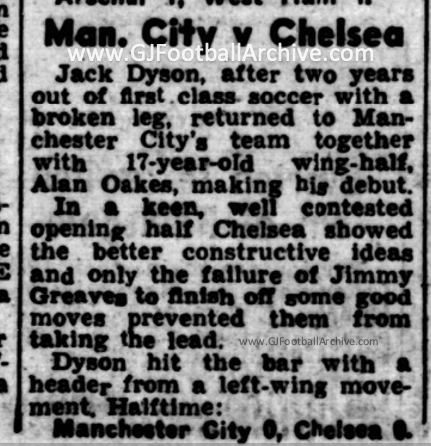
It’s Chelsea v Manchester City today. There are lots of features on this site about the two clubs such as this one talking about Alan Oakes’ debut:
Other features on City & Chelsea games can be read here:
Football writing, thoughts and more by Gary James
It’s Chelsea v Manchester City today. There are lots of features on this site about the two clubs such as this one talking about Alan Oakes’ debut:
Other features on City & Chelsea games can be read here:
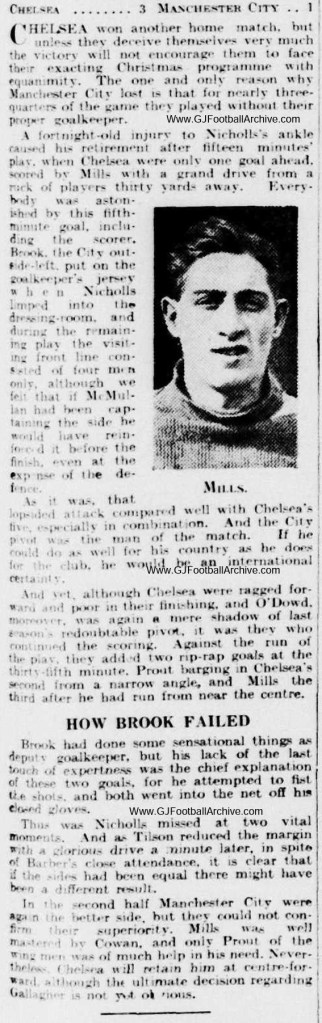
This weekend Manchester City face Chelsea and it’s reminded me of this newspaper cutting from the 1930s. I love this cutting showing Manchester City striker Eric Brook in nets v Chelsea. He was deputising for the Blues’ injured goalkeeper. It looks like Brook had a bandana on his head here too! The photo was taken on December 17 1932. You can read the match report here.
City were losing 1-0 when Nicholls was injured 15 minutes into the match and the scoreline became even more convincing as the game progressed. However this report (from a London edition of a national newspaper) states that City were the better team in both halves.
It’s Manchester City at Chelsea this weekend. Last season that same fixture ended in a 4-4 draw and this was heralded as a great game by the Sky TV pundits. As fans, these sort of games never feel like great games at the time but neutrals obviously love them. For fans of the teams involved they tend to feel like opportunities lost or maybe great comebacks depending on which side you support. Immediately after the game last year I was asked when City’s previous 4-4 draw was and I spent a few minutes thinking ‘I’ve never seen one before involving City, or have I?’ So, I then started to scour the material in my collection and was somewhat surprised to find it was against Grimsby in September 1950! Certainly many, many years before I was born.
My favourite goal in last season’s match at Chelsea was the one Haaland scored with his er… um… er… shorts area. The City scorers were: Haaland (25 minutes pen, 47 minutes), Akanji (45+1 minutes), Rodri (86 minutes) and for Chelsea (including two City old boys): Thiago Silva (29 minutes), Sterling (37 minutes), Jackson (67 minutes), Palmer (90+5minutes pen)
Incredibly last season’s game wasn’t the first time City had drawn 4-4 at Chelsea and, coincidentally I’d tweeted about this before last year’s match. I never expected history to repeat itself. You can read about the earlier match via the link below. Incidentally, the game was in 1936-37 and City won the title that year – as they did in 2023-24!
Choose an amount
Or enter a custom amount
Your contribution is appreciated.
DonateContinuing the series of features on Manchester City in the early 1900s! Today it’s an article on the season after the ban, showing how City coped. Despite everything that had been thrown at Manchester’s Blues they finished third. Read the subscriber article below for the story.
If you’re not a subscriber then why not sign up for a month and see what you think?
Read more of this content when you subscribe today. It costs £3 per month (cancel anytime) or sign up a year at a time for the discounted annual fee of £20. This gives access to everything on the site, including PDFs of 3 of my books and various other articles, interviews and audio material. Each subscriber has access to all content posted during their subscription period too. Why not sign up for a month and see what you think?
More on the 1900s soon. Why not subscribe and read this and all the other subscriber features?
Each year, following the end of the UEFA football season I update the UEFA European Span of Success table. What is this? It’s a list of those clubs who have won two or more major UEFA tournaments showing the span between their first UEFA success and their most recent. The list may surprise some who think that football is all about those perceived as European giants with ‘history’.
The table hasn’t really changed much from last year as Real Madrid were Champions League winners. Atalanta, who won the Europa League, and Olympiacos (Conference winners) have only won one major European trophy and so they do not yet make it on to the list of multiple winners:

The ‘history’ ‘no history’ thing really irritates me. All clubs have history and even when that’s recognised some still go on about history as if it started in 1992, 1999 or 2008 etc. depending on whether your club was successful or your rivals were failing. The two highest placed English teams are West Ham and Manchester City, who both found major European success before some of those clubs recognised today as Europe’s elite.
Obviously, this table does not show the number of major trophies won, but it does give an indication of trophy winning longevity for those who obsess on ‘my cup’s bigger than yours’ and similar debates. Personally, I think we should all be proud of our club’s achievements and not worry about what a rival has won.
West Ham have the second longest span of all Europe’s clubs and City have the fourth equal. Nice work Hammers and Blues!
The above table includes the four major UEFA tournaments: European Cup/Champions League; European Cup Winner’s Cup; UEFA Cup/Europa League & the Europa Conference League. It does not include non-UEFA tournaments such as the Mitropa Cup and Fairs Cup. Nor does it include the Intertoto Cup or similar.
I’m sure some will say but why aren’t the Mitropa or Fairs Cups in there? It’s a good point but these were not UEFA tournaments, though I recognise that the Mitropa Cup had some significant clubs competing in it. It was predominantly an East European competition and participants were not spread over the entire continent.
With the Fairs Cup… It is true that this was later transformed into the UEFA Cup and I have included all UEFA Cup finals in my analysis. But the Fairs Cup had an odd series of entry rules at times. Cities, rather than clubs, often entered with Barcelona beating London in one final for example. It was set up as a friendly type of competition with cities that had staged trade fairs playing each other. As time wore on entry came via the League Cup or League position in England, which added significance to it. But two teams from the same city were not allowed to participate, which meant that teams finishing way down the table could be (and were) included if those above them were multiple clubs from the same city.
In 1970 Manchester City’s Mike Doyle joked that by winning the League Cup he was satisfying his aim of ‘keeping United out of Europe’ (he joked about creating car stickers with that slogan!) because it appeared at that time that United’s only chance of Europe had gone with City’s qualification for the Fairs Cup.

City went on to win the ECWC that season, meaning that Fairs Cup place was opened up to League position, but United had finished lower down the table anyway and qualified for the Watney Cup instead. Actually, the Watney Cup is one worth talking about, but I’ll save that for another day. In 1970 Fourth placed Derby County qualified for the Watney Cup, while 5th to 7th (Liverpool, Coventry and Newcastle) all got a Fairs Cup place, alongside 12th placed Arsenal (Fairs Cup winners). I’ve not investigated this fully but it does seem odd that the Watney Cup took precedence over the Fairs Cup.
Arsenal’s 1970 Fairs Cup success was their first European trophy but is not included in the span, neither are those Fairs Cup wins of Barcelona. However, as quite a few Arsenal fans seemed to get a bit upset when the table was posted last year I’ve decided to include the Fairs Cup in the following version of the table. So this table is the winners of the main UEFA competitions I mentioned earlier plus the Fairs Cup with its odd rules:

Hopefully, those Arsenal fans who were somewhat upset last year will now be happy. Note that West Ham have now been overtaken by Roma and that Barcelona are now above Manchester City, Bayern & Atletico Madrid. Both ‘Rome’ and ‘Barcelona’ won the Fairs Cup when it was city based and not club based.
Arsenal are now 18th in this combined table, behind their fellow English clubs West Ham, City, Chelsea, United and Liverpool.
As an example of the odd qualification rules in place for the Fairs Cup at times it’s worth looking at the 1969 qualification via the English League system.
In 1969 champions Leeds entered the European Cup. The ECWC place went to FA Cup winners Manchester City and the Fairs Cup places went to: Arsenal (4th), Southampton (7th) and Newcastle (9th). Swindon had won the League Cup, beating Arsenal in the final, but the Fairs Cup organisers wouldn’t allow them to participate as they were not a top flight club! This adds to the reason the competition is usually excluded. It is certainly not a UEFA competition in any case.
Similarly, Everton (3rd), Chelsea (5th), Spurs (6th) and West Ham (8th) who all finished above Newcastle were denied because of the rule that only one club from each city be allowed. So Liverpool and Arsenal’s inclusion meant their rivals stood less chance of winning the trophy than Newcastle simply because there were multiple clubs in their cities.
That rule does make me wonder what would have happened if both Manchester clubs had qualified for the competition as City are within the city of Manchester boundaries and United are not. Would the two clubs have challenged any decision not to include one of them based on the age old argument of Manchester’s boundaries?
Maybe I’ll post more on the odd rules of football competitions and tell the story of some of those long forgotten competitions.
If you’re interested in the wider span of success for English clubs (listing those who have the longest span between their first trophy and most recent, not simply European trophies) then take a look at this (Manchester City are second):
Choose an amount
Or enter a custom amount
Your contribution is appreciated.
DonateYou can find out the benefits of subscribing here:
Following on from my piece the other day about League domination where I challenged a few myths that have developed about Premier League domination. It continues to be said that the Premier League is not as competitive as in the past and that teams at the bottom have no chance. This is of course concerning and there are definitely issues between the haves and have nots in football but is this a recent phenomenon? Is this caused by one club in particular?
Each season there are often one or two clubs who have an extremely low points total and, to be frank, I’m not certain whether the champions (whoever they are and whenever they succeed) can be blamed for the results of games not involving them.
Surely, even if City, Liverpool, Arsenal, Chelsea, United etc. win the League every season by a record amount of points the results between all other 19 clubs have zero to do with that club’s dominance? If you’re a supporter of a relegated club can you honestly say that you’d stand a chance of winning the League if City or another team did not exist? You’d need possibly the top ten to disappear before it had a major impact on your chance of League success (I’m not saying that’s acceptable – I’m just stating that it can never be the fault of one club).
Those finishing second may blame the dominant club but surely not anyone outside of those challenging. Blame all the elite maybe. These things never happen over night and because one club wins the League.
So, how do we calculate the gap between the champions and those struggling? Where do we start?
One method is to look at the team that wins the League and see how big a gap is between them and the relegated clubs. There are often one or two teams that gather few points and so I’ve looked at the difference between the champions and the team finishing 17th (safe from relegation). I’ve taken the lowest points accumulated by the 17th placed team and compared that to the Champions.
This makes interesting reading and shows that the lowest points gathered by the 17th placed ‘safe’ team was almost two decades ago! That’s right, it’s not the current era – it’s all those years ago!
Chelsea were the champions when the lowest points total was accrued by the 17th placed club in 2004-05 (in fact the three lowest were all in the 2000s not the last decade). The five lowest points accumulated by a team in 17th place are (note: 5 of these are 2010 or earlier):
1: 2004-05 Champions Chelsea earned 61 points more than 17th placed WBA (34)
2: 2009-10 Chelsea earned 51 points more than 17th placed West Ham (35)
2: 2008-09 United earned 55 points more than 17thplaced Hull (35)
2: 2019-20 Liverpool earned 64 points more than 17th placed Aston Villa (35)
5th: 1999-00 United earned 55 points more than 17th placed Bradford (36)
5th: 2007-08 United earned 51 points more than 17th placed Fulham (36)
5th: 2013-14 City earned 50 points more than 17th placed WBA (36)
5th: 2017-18 City earned 64 points more than 17th placed Southampton (36)
5th: 2018-19 City earned 62 points more than 17th placed Brighton (36)
5th: 2022-23 City earned 53 points more than 17th placed Everton (36)
Ignoring the first few seasons when there were more than 20 clubs in the Premier League, the highest points total ever gathered by the club in 17th place was 44 (Bolton) in 2002-03 – only two seasons before the lowest points total, showing how these things can vary.
Okay but what about teams actually relegated? Here are the five lowest points accumulated by a team finishing 20th and the difference with the champions that season. Again the lowest points gathered was in the 2000s, not 2020s (Only 2 of these are since 2015 and none are from the 2020s!):
1: 2007-08 Champions United gathered 76 points more than 20th Derby (11 points)
2: 2005-06 Chelsea gathered 76 more than Sunderland (15)
3: 2018-19 City gathered 82 more than Huddersfield (16)
4: 2015-16 Leicester gathered 64 more than Aston Villa (17)
5: 2002-03 United gathered 64 more than Sunderland (19)
5: 2009-10 Liverpool gathered 78 more than Portsmouth (19)
Okay, so what about the actual points gap between the champions and the 20th placed club? Again analysis of every Premier League season shows some interesting information. The five biggest points differences between top and bottom are (again two of these are from the 2000s):
1st: 2018-19 City 82 points over Huddersfield
2nd: 2019-20 Liverpool 78 points over Norwich
3rd: 2005-06 Chelsea 76 points over Sunderland
3rd: 2007-08 United 76 points over Derby
5th: 2021-22 City 71 points over Norwich
For the next analysis I’ve calculated the difference between the champions and the club finishing in 18th place (usually a relegated place, but not in the first couple of years of the Premier League). The idea being that the bottom two could be way off the pace.
This shows that City’s record 100 points season was the biggest gap between them and the 18th place relegated club. That’s significant, however that was an incredible record breaking season of wins for City. Interestingly though, for a team that’s supposed to be creating barriers between the top and the bottom City only hold two of the top five biggest gaps (Chelsea also hold 2) and one of those top 5 champions is actually Chelsea in 2004-05 – 19 years ago!
If we look beyond the top five there are 3 clubs in joint 6th place including Manchester United in 1998-99 – 25 years ago! Yet it’s supposed to be only now that the gap between top and relegation is vast.
For those wondering here are the highest 10 or so gaps between top and relegated clubs (18th place):
1st: 2017-18 City (the record 100 points season) 67 points over Swansea
2nd: 2019-20 Liverpool 65 points over Bournemouth
3rd: 2018-19 City 64 points over Cardiff
4th: 2004-05 Chelsea 62 points over Crystal Palace
5th: 2016-17 Chelsea 59 points over Hull
6th: 1999-00 United 58 points over Wimbledon
6th: 2020-21 City 58 points over Fulham
6th: 2021-22 City 58 points over Burnley
9th: 2003-04 Arsenal 57 points over Leicester
9th: 2005-06 Chelsea 57 points over Birmingham
11th: 2008-09 United 56 points over Newcastle
11th: 2009-10 Chelsea 56 points over Burnley
What does all this statistical information prove? Well there doesn’t appear to be much difference between the 2000s and the last decade. Some seasons in each decade there were huge gaps.
We all know that the elite are some way ahead of those that struggle and there is an imbalance. That’s concerning for football and the introduction of Financial Fair Play and similar has, so far, strengthened the position of the elite and limited the opportunity for investment at lower clubs.
You can read my previous post here:
Choose an amount
Or enter a custom amount
Your contribution is appreciated.
DonateOn this day (April 26) in 1969 Manchester City defeated Leicester City in the FA Cup final. It is worth pausing to consider how the Blues compared to football’s other successful sides in the competition at this time in football history. City’s four FA Cup successes placed them 7th in the all-time list of FA Cup winners – can you guess the clubs they were behind? Liverpool? No! MUFC? No! Arsenal? No! Keep going…
They were behind Aston Villa (7), Blackburn Rovers (6), Newcastle United (6), Tottenham Hotspur (5), The Wanderers (5) and West Bromwich Albion (5). Bolton, Sheffield United and Wolves had, like City, each won four FA Cups, while Manchester United and Arsenal had only won three, Liverpool one and Chelsea had not yet won the trophy. In fact Chelsea had only won one major trophy (the League Championship) at this point in their history.
Here for subscribers is a long read on that final and the events surrounding it:
Read more of this content when you subscribe today.
I’m delighted to say that my latest biographical piece for the Oxford Dictionary of National Biography has been published. It’s on the life of Tommy Docherty, the former Preston & Scotland footballer and manager with a whole host of clubs including Manchester United of course. Details of all the people featured by the dictionary this year can be viewed here:
https://www.oxforddnb.com/newsitem/811/whats-new-april-2024
I’ve written several articles for the dictionary in recent years, including biographical pieces on footballers Jimmy Armfield, Ray Wilkins and Frank Swift. It’s a prestigious publication, recording the achievements of the nation’s most important figures. Anyone included within the book has achieved something remarkable, or perceived as an iconic figure in some way.
Hopefully, in the future I’ll be able to contribute biographical pieces on other important figures. Various panels decide who is to be included but I would be interested to know who you think should be covered in future editions. The important aspect to remember is that these figures must now be deceased and have contributed something remarkable or iconic. Those who died in 2021 or the years that have followed will be eligible to be considered for future editions. Sadly, I won’t decide but I have previously been asked my thoughts and have provided names.
The series of features/articles covering Manchester City in the 1970s continues with this brief post about average attendances. We hear so much baloney these days about which clubs are giants and so on but the truth is that in terms of success no team has ALWAYS been at the top and in terms of support most clubs have had highs and lows. There are some clubs that generation after generation have been popular with fans and this cutting from the Manchester City match programme of 1977-78 may interest some.
I’m not going to point to any club or anything but look at the numbers and make your own minds up. Manchester City, incidentally, tended to be the 3rd best supported club (no matter where they finished) behind United and Liverpool throughout the mid to late 70s and early 1980s. They occasionally dropped to 4th depending on whether Everton or Spurs had a good season and even in City’s 1982-83 relegation season Manchester’s Blues were the 4th best supported club. Not bad for a failing club!

This series of articles and features on Manchester City in the 1970s will run throughout January with indepth articles some days and smaller ‘on this day’ style posts on others. There will be flashbacks to great games, players and more. Every day in January will offer something to enjoy.
Subscribers will get access to everything. If you want to know more on this incredible decade for Manchester City Football Club then why not subscribe and read it all? You could even subscribe for a month and see what you think. The following 5,200 word article is on the 1970-71 season and is available to subscribers below. Enjoy!
Read more of this content when you subscribe today. It costs £3 per month (cancel anytime) to access everything posted since 1 October 2022 or there’s a special annual rate below which gives greater access and works out much cheaper.
Read more of this content when you subscribe today. It costs £3 per month (above) or £20 a year (here) to access everything posted since the site was created in December 2020. This special rate works out about £1.67 a week and gives access to everything posted, including PDFs of 3 of my books.
If you’d like to know more about subscribing then see:
Choose an amount
Or enter a custom amount
Your contribution is appreciated.
DonateThe series of features/articles covering Manchester City in the 1970s continues with this video clip of City away at Chelsea in the FA Cup on this day (23 January) in 1971. Watch the footage below to see two nice goals from Colin Bell and another from Ian Bowyer, which owed much to Bell too. Bell was wonderful this day but sadly only these brief black and white highlights remain. Watch it here:
Were you at the game and do you remember it? Feel free to give your story in the comments.
This series of articles and features on Manchester City in the 1970s will run throughout January with indepth articles some days and smaller ‘on this day’ style posts on others. There will be flashbacks to great games, players and more. Every day in January will offer something to enjoy.
Subscribers will get access to everything. If you want to know more on this incredible decade for Manchester City Football Club then why not subscribe and read it all? You could even subscribe for a month and see what you think. The following 5,200 word article is on the 1970-71 season and is available to subscribers below. Enjoy!
Read more of this content when you subscribe today. It costs £3 per month (cancel anytime) to access everything posted since 1 October 2022 or there’s a special annual rate below which gives greater access and works out much cheaper.
Read more of this content when you subscribe today. It costs £3 per month (above) or £20 a year (here) to access everything posted since the site was created in December 2020. This special rate works out about £1.67 a week and gives access to everything posted, including PDFs of 3 of my books.
If you’d like to know more about subscribing then see:
Choose an amount
Or enter a custom amount
Your contribution is appreciated.
Donate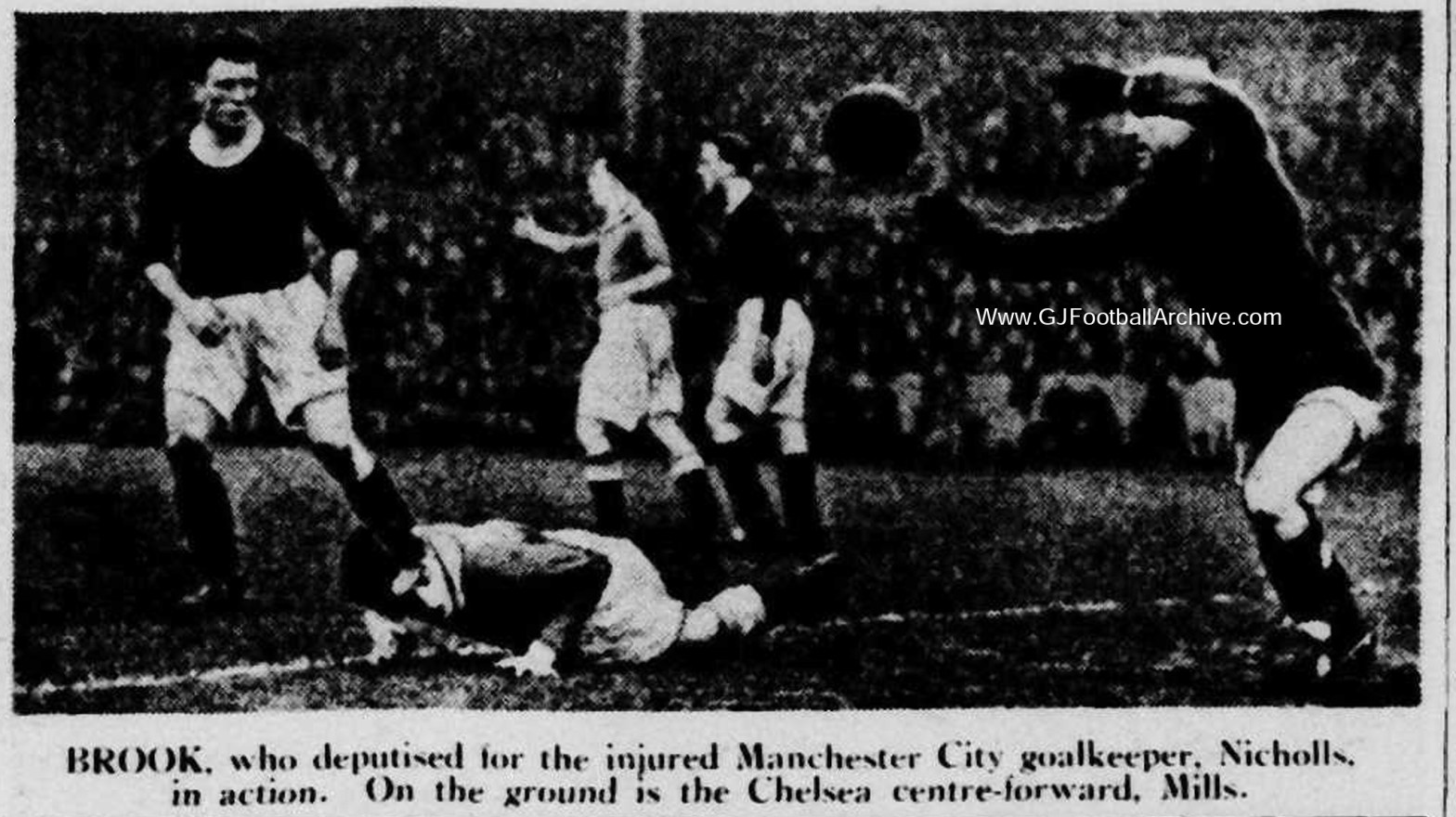


 Gary James' Football Archive