League Dominance – Gap Between Top and Bottom

Following on from my piece the other day about League domination where I challenged a few myths that have developed about Premier League domination. It continues to be said that the Premier League is not as competitive as in the past and that teams at the bottom have no chance. This is of course concerning and there are definitely issues between the haves and have nots in football but is this a recent phenomenon? Is this caused by one club in particular?

Each season there are often one or two clubs who have an extremely low points total and, to be frank, I’m not certain whether the champions (whoever they are and whenever they succeed) can be blamed for the results of games not involving them.

Surely, even if City, Liverpool, Arsenal, Chelsea, United etc. win the League every season by a record amount of points the results between all other 19 clubs have zero to do with that club’s dominance?  If you’re a supporter of a relegated club can you honestly say that you’d stand a chance of winning the League if City or another team did not exist?  You’d need possibly the top ten to disappear before it had a major impact on your chance of League success (I’m not saying that’s acceptable – I’m just stating that it can never be the fault of one club).

Those finishing second may blame the dominant club but surely not anyone outside of those challenging. Blame all the elite maybe. These things never happen over night and because one club wins the League.

So, how do we calculate the gap between the champions and those struggling?  Where do we start?

One method is to look at the team that wins the League and see how big a gap is between them and the relegated clubs. There are often one or two teams that gather few points and so I’ve looked at the difference between the champions and the team finishing 17th (safe from relegation). I’ve taken the lowest points accumulated by the 17th placed team and compared that to the Champions.

This makes interesting reading and shows that the lowest points gathered by the 17th placed ‘safe’ team was almost two decades ago! That’s right, it’s not the current era – it’s all those years ago!

Chelsea were the champions when the lowest points total was accrued by the 17th placed club in 2004-05 (in fact the three lowest were all in the 2000s not the last decade). The five lowest points accumulated by a team in 17th place are (note: 5 of these are 2010 or earlier):

1: 2004-05 Champions Chelsea earned 61 points more than 17th placed WBA (34)

2: 2009-10 Chelsea earned 51 points more than 17th placed West Ham (35)

2: 2008-09 United earned 55 points more than 17thplaced Hull (35)

2: 2019-20 Liverpool earned 64 points more than 17th placed Aston Villa (35)

5th: 1999-00 United earned 55 points more than 17th placed Bradford (36)

5th: 2007-08 United earned 51 points more than 17th placed Fulham (36)

5th: 2013-14 City earned 50 points more than 17th placed WBA (36)

5th: 2017-18 City earned 64 points more than 17th placed Southampton (36)

5th: 2018-19 City earned 62 points more than 17th placed Brighton (36)

5th: 2022-23 City earned 53 points more than 17th placed Everton (36)

Ignoring the first few seasons when there were more than 20 clubs in the Premier League, the highest points total ever gathered by the club in 17th place was 44 (Bolton) in 2002-03 – only two seasons before the lowest points total, showing how these things can vary.

Okay but what about teams actually relegated? Here are the five lowest points accumulated by a team finishing 20th and the difference with the champions that season. Again the lowest points gathered was in the 2000s, not 2020s (Only 2 of these are since 2015 and none are from the 2020s!):

1: 2007-08 Champions United gathered 76 points more than 20th Derby (11 points)

2: 2005-06 Chelsea gathered 76 more than Sunderland (15)

3: 2018-19 City gathered 82 more than Huddersfield (16)

4: 2015-16 Leicester gathered 64 more than Aston Villa (17)

5: 2002-03 United gathered 64 more than Sunderland (19)

5: 2009-10 Liverpool gathered 78 more than Portsmouth (19)

Okay, so what about the actual points gap between the champions and the 20th placed club? Again analysis of every Premier League season shows some interesting information.  The five biggest points differences between top and bottom are (again two of these are from the 2000s):

1st: 2018-19 City 82 points over Huddersfield

2nd: 2019-20 Liverpool 78 points over Norwich

3rd: 2005-06 Chelsea 76 points over Sunderland

3rd: 2007-08 United 76 points over Derby

5th: 2021-22 City 71 points over Norwich

For the next analysis I’ve calculated the difference between the champions and the club finishing in 18th place (usually a relegated place, but not in the first couple of years of the Premier League). The idea being that the bottom two could be way off the pace.

This shows that City’s record 100 points season was the biggest gap between them and the 18th place relegated club. That’s significant, however that was an incredible record breaking season of wins for City. Interestingly though, for a team that’s supposed to be creating barriers between the top and the bottom City only hold two of the top five biggest gaps (Chelsea also hold 2) and one of those top 5 champions is actually Chelsea in 2004-05 – 19 years ago!

If we look beyond the top five there are 3 clubs in joint 6th place including Manchester United in 1998-99 – 25 years ago! Yet it’s supposed to be only now that the gap between top and relegation is vast.

For those wondering here are the highest 10 or so gaps between top and relegated clubs (18th place):

1st: 2017-18 City (the record 100 points season) 67 points over Swansea

2nd: 2019-20 Liverpool 65 points over Bournemouth

3rd: 2018-19 City 64 points over Cardiff

4th: 2004-05 Chelsea 62 points over Crystal Palace

5th: 2016-17 Chelsea 59 points over Hull

6th: 1999-00 United 58 points over Wimbledon

6th: 2020-21 City 58 points over Fulham

6th: 2021-22 City 58 points over Burnley

9th: 2003-04 Arsenal 57 points over Leicester

9th: 2005-06 Chelsea 57 points over Birmingham

11th: 2008-09 United 56 points over Newcastle

11th: 2009-10 Chelsea 56 points over Burnley

What does all this statistical information prove? Well there doesn’t appear to be much difference between the 2000s and the last decade. Some seasons in each decade there were huge gaps.

We all know that the elite are some way ahead of those that struggle and there is an imbalance. That’s concerning for football and the introduction of Financial Fair Play and similar has, so far, strengthened the position of the elite and limited the opportunity for investment at lower clubs. 

You can read my previous post here:

City 1 Leicester 0, the FA Cup Final

On this day (April 26) in 1969 Manchester City defeated Leicester City in the FA Cup final. It is worth pausing to consider how the Blues compared to football’s other successful sides in the competition at this time in football history.  City’s four FA Cup successes placed them 7th in the all-time list of FA Cup winners – can you guess the clubs they were behind? Liverpool? No! MUFC? No! Arsenal? No! Keep going…

They were behind Aston Villa (7), Blackburn Rovers (6), Newcastle United (6), Tottenham Hotspur (5), The Wanderers (5) and West Bromwich Albion (5).  Bolton, Sheffield United and Wolves had, like City, each won four FA Cups, while Manchester United and Arsenal had only won three, Liverpool one and Chelsea had not yet won the trophy.  In fact Chelsea had only won one major trophy (the League Championship) at this point in their history.  

Here for subscribers is a long read on that final and the events surrounding it:

Subscribe to get access

Read more of this content when you subscribe today.

Oxford Dictionary of National Biography

I’m delighted to say that my latest biographical piece for the Oxford Dictionary of National Biography has been published. It’s on the life of Tommy Docherty, the former Preston & Scotland footballer and manager with a whole host of clubs including Manchester United of course. Details of all the people featured by the dictionary this year can be viewed here:

https://www.oxforddnb.com/newsitem/811/whats-new-april-2024

I’ve written several articles for the dictionary in recent years, including biographical pieces on footballers Jimmy Armfield, Ray Wilkins and Frank Swift. It’s a prestigious publication, recording the achievements of the nation’s most important figures. Anyone included within the book has achieved something remarkable, or perceived as an iconic figure in some way.

Hopefully, in the future I’ll be able to contribute biographical pieces on other important figures. Various panels decide who is to be included but I would be interested to know who you think should be covered in future editions. The important aspect to remember is that these figures must now be deceased and have contributed something remarkable or iconic. Those who died in 2021 or the years that have followed will be eligible to be considered for future editions. Sadly, I won’t decide but I have previously been asked my thoughts and have provided names.

The 1970s: Attendance Flashback to 1978

The series of features/articles covering Manchester City in the 1970s continues with this brief post about average attendances. We hear so much baloney these days about which clubs are giants and so on but the truth is that in terms of success no team has ALWAYS been at the top and in terms of support most clubs have had highs and lows. There are some clubs that generation after generation have been popular with fans and this cutting from the Manchester City match programme of 1977-78 may interest some.

I’m not going to point to any club or anything but look at the numbers and make your own minds up. Manchester City, incidentally, tended to be the 3rd best supported club (no matter where they finished) behind United and Liverpool throughout the mid to late 70s and early 1980s. They occasionally dropped to 4th depending on whether Everton or Spurs had a good season and even in City’s 1982-83 relegation season Manchester’s Blues were the 4th best supported club. Not bad for a failing club!

This series of articles and features on Manchester City in the 1970s will run throughout January with indepth articles some days and smaller ‘on this day’ style posts on others. There will be flashbacks to great games, players and more. Every day in January will offer something to enjoy.

Subscribers will get access to everything. If you want to know more on this incredible decade for Manchester City Football Club then why not subscribe and read it all? You could even subscribe for a month and see what you think. The following 5,200 word article is on the 1970-71 season and is available to subscribers below. Enjoy!

Subscribe to get access – Monthly

Read more of this content when you subscribe today. It costs £3 per month (cancel anytime) to access everything posted since 1 October 2022 or there’s a special annual rate below which gives greater access and works out much cheaper.

Subscribe to get access – Annual

Read more of this content when you subscribe today. It costs £3 per month (above) or £20 a year (here) to access everything posted since the site was created in December 2020. This special rate works out about £1.67 a week and gives access to everything posted, including PDFs of 3 of my books.

If you’d like to know more about subscribing then see:

The 1970s: Great Performance by Colin Bell

The series of features/articles covering Manchester City in the 1970s continues with this video clip of City away at Chelsea in the FA Cup on this day (23 January) in 1971. Watch the footage below to see two nice goals from Colin Bell and another from Ian Bowyer, which owed much to Bell too. Bell was wonderful this day but sadly only these brief black and white highlights remain. Watch it here:

Were you at the game and do you remember it? Feel free to give your story in the comments.

This series of articles and features on Manchester City in the 1970s will run throughout January with indepth articles some days and smaller ‘on this day’ style posts on others. There will be flashbacks to great games, players and more. Every day in January will offer something to enjoy.

Subscribers will get access to everything. If you want to know more on this incredible decade for Manchester City Football Club then why not subscribe and read it all? You could even subscribe for a month and see what you think. The following 5,200 word article is on the 1970-71 season and is available to subscribers below. Enjoy!

Subscribe to get access – Monthly

Read more of this content when you subscribe today. It costs £3 per month (cancel anytime) to access everything posted since 1 October 2022 or there’s a special annual rate below which gives greater access and works out much cheaper.

Subscribe to get access – Annual

Read more of this content when you subscribe today. It costs £3 per month (above) or £20 a year (here) to access everything posted since the site was created in December 2020. This special rate works out about £1.67 a week and gives access to everything posted, including PDFs of 3 of my books.

If you’d like to know more about subscribing then see:

Buying Success?

In recent years it has become fashionable to claim that football is all about money these days and that certain clubs have ‘bought success’. Well, that may or may not be true but what is an absolute fact is that this has been the situation throughout football history. Take a look at this article from October 1965 which talks about clubs ‘buying success’. It focuses on Everton & Tottenham – two clubs whose fans often criticise City & Chelsea for ‘buying success’.

What this shows is that there’s nothing new in football. If someone talks of football being ‘ruined’ by your clubs spending then remember that at some point in the past the game may have been ‘ruined’ by their clubs’ spending!

Enjoy the cuttings:

Oh, and if you think it’s a one-off about Everton, here’s an article from the Liverpool Daily Post (13 May 1963) congratulating the Toffees on their policy of spending. It basically says that clubs should be applauded for doing that! Interesting how it’s okay when it’s your local club but not when it’s one from a rival city.

The 1970s: 1970-71 Takeover Madness

The series of features/articles covering Manchester City in the 1970s continues with a 5,200 word article on the entire 1970-71 season. You can read this below. This series of articles and features on Manchester City in the 1970s will run throughout January with indepth articles some days and smaller ‘on this day’ style posts on others. There will be flashbacks to great games, players and more. Every day in January will offer something to enjoy.

Subscribers will get access to everything. If you want to know more on this incredible decade for Manchester City Football Club then why not subscribe and read it all? You could even subscribe for a month and see what you think. The following 5,200 word article is on the 1970-71 season and is available to subscribers below. Enjoy!

Subscribe to get access – Monthly

Read more of this content when you subscribe today. It costs £3 per month (cancel anytime) to access everything posted since 1 October 2022 or there’s a special annual rate below which gives greater access and works out much cheaper.

Subscribe to get access – Annual

Read more of this content when you subscribe today. It costs £3 per month (above) or £20 a year (here) to access everything posted since the site was created in December 2020. This special rate works out about £1.67 a week and gives access to everything posted, including PDFs of 3 of my books.

If you’d like to know more about subscribing then see:

Forward as Goalkeeper for 3/4 of Game v Chelsea

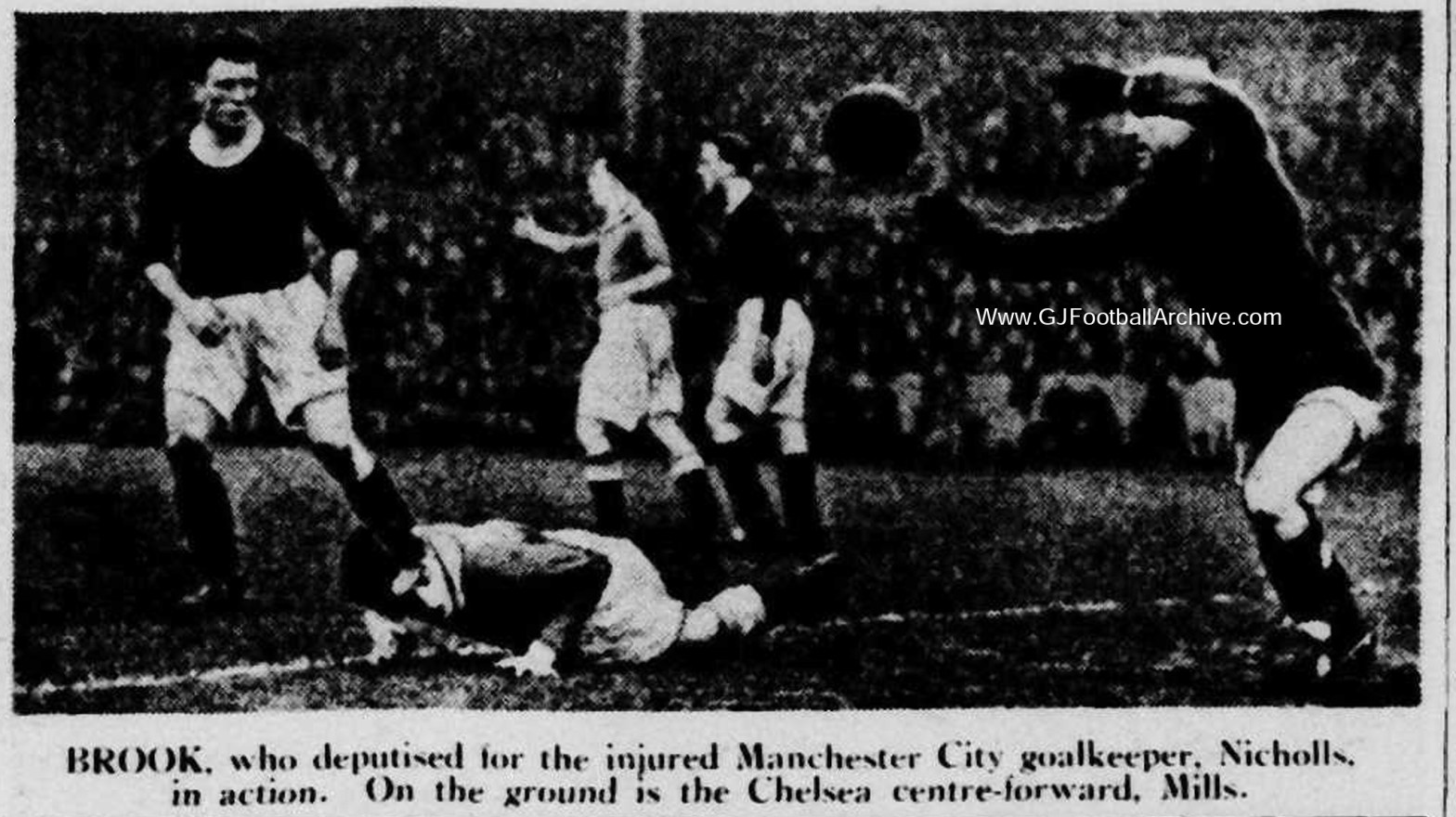
I love this cutting showing Manchester City striker Eric Brook in nets, deputising for the Blues’ injured keeper. It looks like Brook had a bandana on his head here too! The photo was taken on this day (December 17) in 1932 when the Blues faced Chelsea.

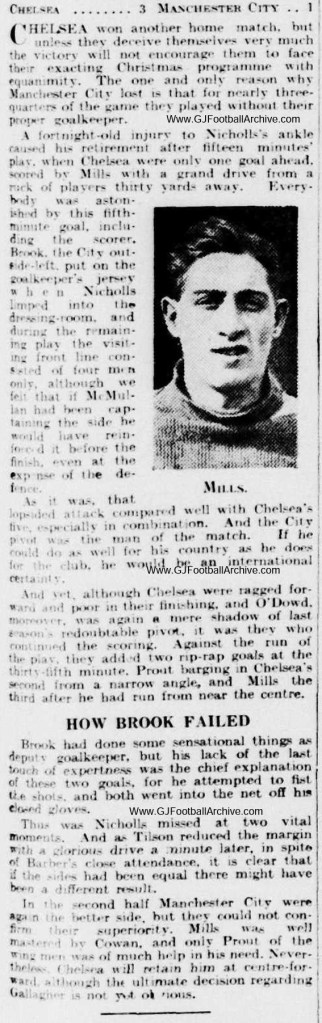
You can read the match report here. City were losing 1-0 when Nicholas was injured 15 minutes into the match and the scoreline became even more convincing as the game progressed. However this report (from a London edition of a national newspaper) states that City were the better team in both halves.

The 1980s: Full Members Final?

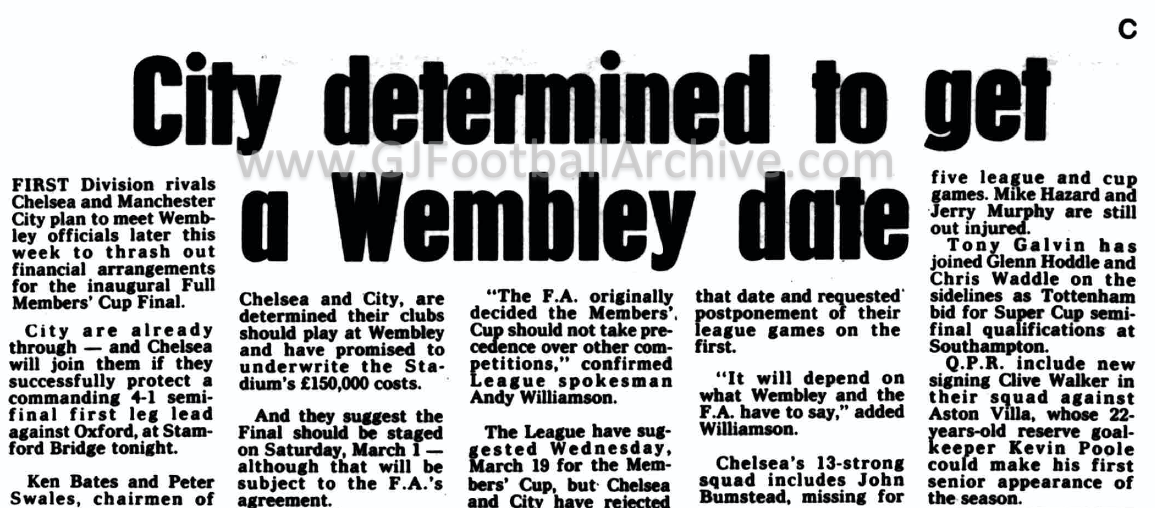
Today’s 1980s flashback is an on this day (17 December) from 1985 when newspapers carried the news that Full Members’ Cup finalists Manchester City and potential finalists Chelsea planned to meet to set a date for the competition’s final. These were strange days and I guess there are many younger fans who have no idea what the Full Members’ Cup was all about. Elsewhere on this site you can find material on it or you can read the article on this season below (see boxes on subscribing below).

The issue was that the competition needed a Wembley final to add some credibility to it and both City and Chelsea were determined this would take place at a weekend. The preferred date was 1 March 1986 but this required clubs to postpone fixtures as the article suggests. What was not realised on 17 December 1985 was that City’s opponents on 1 March would object. Why? Well, City’s opponents were Oxford and they were the team that Chelsea had to beat to reach the national final. Had Oxford won then it seems likely they would have had no objection to rearranging their League game with City, but once Chelsea beat them the chance of City getting their preferred date was never going to happen.

In the end the final was played on Sunday 23 March, the day after an Old Trafford Manchester derby!

The 1980s was a truly important decade in the history of Manchester City Football Club and you can find out more on this season by reading the following 2,500 word feature on 1985-86. Enjoy!

Subscribe to get access – Monthly

Read more of this content when you subscribe today. It costs £3 per month (cancel anytime) to access everything posted since 1 October 2022 or there’s a special annual rate below which gives greater access and works out much cheaper.

Subscribe to get access – Annual

Read more of this content when you subscribe today. It costs £3 per month (above) or £20 a year (here) to access everything posted since the site was created in December 2020. This special rate works out about £1.67 a week and gives access to everything posted, including PDFs of 3 of my books.

If you’d like to know more about subscribing then see:

Tomorrow’s feature is on the 1986-87 season. If you missed the earlier features then start here:

The 1980s: 1980-1981 Gow, Hutchison & McDonald

The 1980s: Corrigan and Daley Move?

Continuing the series of articles covering the 1980s. Today’s is an on this day (8 December) from 1980. It’s a newspaper story about Joe Corrigan and Steve Daley potentially moving from Maine Road to other clubs. Have a read of the piece. Ultimately Corrigan stayed but Daley never did play for Manchester City again. If you want to know more about the trials and tribulations of this period then why not subscribe and read the following ten thousand word long read on the 1980-81 season. Enjoy!

Subscribe to get access – Monthly

Read more of this content when you subscribe today. It costs £3 per month (cancel anytime) to access everything posted since 1 October 2022 or there’s a special annual rate below which gives greater access and works out much cheaper.

Subscribe to get access – Annual

Read more of this content when you subscribe today. It costs £3 per month (above) or £20 a year (here) to access everything posted since the site was created in December 2020. This special rate works out about £1.67 a week and gives access to everything posted, including PDFs of 3 of my books.

If you’d like to know more about subscribing then see:

Tomorrow’s feature is on the 1981-82 season.