Maine Road 100 – Day 94

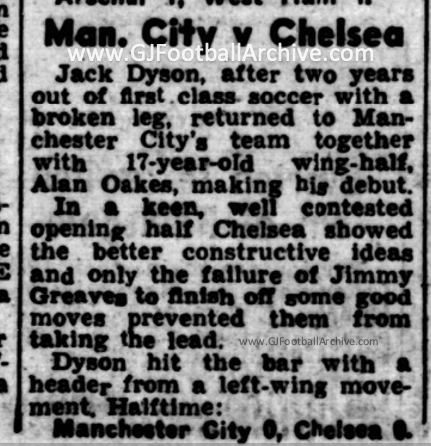
It’s Day 94 of my Maine Road 100 countdown (not long to go now!) to the centenary of Maine Road’s first game. Recently I’ve been asked if I know who played most games at City’s old stadium and the answer is that Alan Oakes made more appearances in City’s first team at Maine Road than any other player. Alan made 340 plus one as sub appearances at Maine Road in a City first team shirt.

Alan is also City’s record appearance holder of course. He’s often overlooked these days when people talk about truly great City players but Alan was a model professional, loved by Blues, teammates and opponents alike. Here’s an interview I did with Alan a few years back.

This interview occurred in February 2005 and we discussed his life and career. This appears here as it was originally published.

Alan Oakes joined the Blues at the age of 15 in 1958 and made his first team debut in November 1959 when he was 17 years and 2 months.  He stayed at Maine Road until July 1976 by which time he had made a staggering 564 League appearances.  In February 2005 he was inducted into City’s Hall of Fame, and author Gary James met up with him to discuss his career.

To begin with let’s talk about your childhood, did you come from a sporting background?

We were all very sporty and my father and others played local football – nothing professional – and as a boy I’d play cricket in the summer and football in the winter.  The usual sort of thing – coats as goalposts – and I loved playing.  I progressed into the Mid-Cheshire Boys side and then one day I got the shock of my life when City’s scout Albert Kavanagh knocked on the door and asked me to join the groundstaff.  He’d watched me play at Broughton, Salford, and seemed to like what he saw.  I was astounded and delighted at the same time.  This was a dream moment.

Coming from a Cheshire village like Winsford in the 50s to a big city like Manchester must have been a bit daunting, how did you and your family feel about the move?

It was an opportunity I couldn’t miss.  Other teams showed interest but City meant so much to me.  I’d been to Maine Road a few times – I stood on the old Kippax before it had a roof – and loved the Club.  I wasn’t blinkered though because I also went to Maine Road to watch some of United’s first games in Europe.  Remember they used City’s ground because they didn’t have floodlights and a lot of Blues went to watch the European sides.

Clearly, you saw a wealth of talent during this period, but who were your heroes?

Ken Barnes was a brilliant player and by far the best in his position, and Bobby Johnstone had an amazing footballing brain.  They were great players to watch and later I was fortunate to play with Ken, but my boyhood hero was always Billy Wright from Wolves.  There was something special about Wolves.  They brought over several top European sides for friendlies – I guess they paved the way for the European Cup – and they won so many fans.  They were a great, entertaining side and Billy Wright was their star.  I was still a City fan, but I recognised the quality of Wright and Wolves.

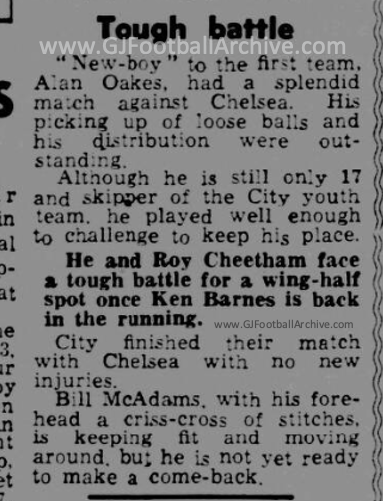
Still only 17 you made your debut in a 1-1 draw with Chelsea, how did you feel about your performance?

I felt okay, but I gave away a penalty!  Fortunately for me Bert Trautmann – the greatest ever keeper – was in nets and he saved the day.  As a member of the groundstaff I’d clean Bert’s boots and even that felt like a great honour, so you can imagine how grateful I felt when he saved the penalty.  The Chelsea game was a one off – I think Ken Barnes was injured – and so it was a few weeks before my chance came again.  I felt a lot of satisfaction that I was in the reckoning though.  When I arrived at City there were 55 professionals and about five teams to progress through to reach the first team.

How did you find the management and coaching staff in those days?

They were all ex-City players and so that was important.  Fred Tilson and Laurie Barnett had played in the 30s finals and coached us, and manager Les McDowall had been a good player in his day.  Clearly the coaching techniques they used were not a patch on Malcolm Allison, but they did what was right for the period.  They also treated me well and looked after me.  I found it difficult adjusting to life in a big city.  I lived in digs for a while, and then moved back home and travelled by train and, eventually, car.  

By 1963 you were a regular but City were entering a difficult period, did that come across to you?

We had a lot of quality in the side but seemed to be conceding too many goals.  We knew we were struggling but we always gave it our best.  After we were relegated in ’63 Derek Kevan and Jimmy Murray arrived.  We were doing really well, then Jimmy did his cartilage in – that was a major blow – and we tailed off.  We missed promotion (6th place) and we couldn’t get it going again until Joe and Malcolm arrived in ’65.  

Although you were still relatively young, you were one of the more experienced players, how did the arrival of Mercer & Allison go down?

It was a great lift of course, but I know we were wary of Malcolm at first.  He had all these ideas and it seemed so different to what we were used to, but within a week or so he’d won everybody over.  The transformation by the two men was so fast – before we’d completed our pre-season games we were convinced we would win promotion.  We couldn’t wait to get started.  The confidence flowed and then Malcolm tackled our fitness.  Of course we won promotion easily, and then held our own in 1966-7.  Don’t forget we had faced a couple of big tests in those first two seasons – We took a strong Everton side to 2 replays in the FA Cup while we were still in Division Two and narrowly lost to Revie’s Leeds the following year.  We lost 1-0 to Leeds with a Jack Charlton goal that should have been disallowed.  So we came away from those games confident we could face any side.  There was nothing for us to fear.

Of course, the Championship followed in ’68 and all the other successes of that great period, which one means most to you?

The Championship and European successes were both very important.  This is a difficult one really, but because I was there during the dark days, I think the most important one had to be the promotion in 1966.  My reason is that without that none of the rest would have followed.  Joe and Malcolm didn’t just get us promoted, they first stopped the rot.  We were going downhill fast and they stopped that, changed gear and pushed us forward quickly, and it wasn’t done with negative play.  A lot of teams pack the defence and try to ensure they don’t lose, we always went out to win and never contemplated holding out for a point.

Throughout your City career people commented that you were a quiet, unassuming, perhaps shy player, was that fair?

I think I was a good professional.  I used to simply get on with it.  I was dedicated and tried to give everything for the Club.  I believe I was a good, honest pro.  If I was asked to do an interview, I’d do it, but I never sought the headlines.  Media coverage was not as it is today, so it was easier in many ways, but I would do it when needed.  More than anything I wanted to make sure my role on the pitch spoke for me.  

By 1973 the Mercer-Allison partnership had ended and some of the other players started to move on, did you contemplate leaving?

Never.  You were worried that you’d be dropped or the next one out, but I never thought about choosing to leave.  Why would anyone want to leave the best club in the country?  I remember thinking that somebody would take my place and that I had to keep performing at the highest level.  In some ways I liked to push myself by thinking of all the people who could take my place, but I never, ever thought about leaving until after the League Cup final of 1976.

The team had changed significantly by 1976, and you were clearly one of the elder statesmen of the team, how did you find that period?

I enjoyed it all, and I remember playing a few games with Peter Barnes in front of me.  I loved that.  He was such a gifted player and it was great for me to play behind someone that exciting at that stage in my career and in his.  I know this came a couple of years after I’d moved on, but it irritated me when Peter Barnes was sold because I believe he could have helped City to real success.  He was the sort of player you built a team around.

While I’m thinking about this, I also believe Mike Summerbee and Francis Lee were sold far too early.  Francis had so much more left in him – he proved that at Derby – and so the break up of the Mercer-Allison team came too rapid.

In July 1976 you moved to Chester, why did you make the move?

I’d had a great season.  I’d played 39 League games and won the League Cup and so there was no pressure to leave, but I did think that I may have blocked some other gifted players coming through.  I was also aware that I’d be 34 when the new season starts and that I may not be up to it in the way I would normally expect.  Chester City were just up the road and for me it was a nice move.  I do remember thinking ‘what have I done?’ because I’d gone from a First Division palace to play at Third Division grounds, but the move was a good one.  Looking back though I was perhaps wrong to leave when I did.  My advice to any player now is to remain playing at the highest level for as long as you physically can.  Those days are precious and should not be cut short.  

I also missed Maine Road a lot when I left and I miss it even more now.  I regret the fact City have left that ground.

At Chester you moved into management, was this something you’d always wanted?

It was part of the attraction of joining Chester that I could become player-manager and I think in the six years I was there we had a great time.  Success is different for a team like Chester, it’s all about survival and so I had to do a lot of work in the transfer market.  I had another ex-City star, Cliff Sear, with me and we worked well together, and I loved every minute at Sealand Road.  Often I’d be trying to negotiate good transfer fees and working hard to sell a couple of players to keep us afloat, and so I got satisfaction from that when it all came right.  I still got a lot of satisfaction from playing as well, so it was a perfect role.

Ian Rush was one of your players.  Is it true he almost came to City?

Yes it is.  Whenever anybody with talent was due to leave Chester I would want them to move to a bigger, better club.  I still love City and so I wanted Rushie to go to Maine Road.  We were having a great cup run and Tony Book and Malcolm Allison came to watch him.  Rush scored twice and I met up with Tony and Malcolm afterwards.  Tony was keen to sign him but Malcolm didn’t rate him for some reason and it all collapsed.  He later went to Liverpool and the rest is history, but I wanted him to go to Maine Road and I wish that deal had occurred.  Of course, you never know how these things would have worked out.

Did you ever consider moving into a higher division as a manager?

Definitely – with City!  It must have been 1983 because I know Billy McNeill was given the job in the end, but I applied for the City job.  I desperately wanted the role because I loved the Club and because I believed I knew exactly what the Club needed.  I’d also served what I thought was a good apprenticeship – six years at Chester taught me a great deal about survival and transfer negotiations.  I knew City had financial problems and that someone with the right experience was needed – the last thing the Club could cope with was someone who needed to spend – and so I felt I was ideal for the role.  Don’t forget what I’d experienced as a player at Maine Road as well.  Most importantly, I understood the Club and all about Manchester football fans and their expectations and needs.   This remains the greatest club in my eyes.

I got an interview at Peter Swales’ house.  A few directors were there and I thought I gave a very good interview.  Unfortunately, I didn’t get the job.  I still wonder what might have happened.

Moving on to today, your son Michael has become a Premier League goalkeeper, is this something you’ve encouraged?

I didn’t push him but I did encourage him.  It’s a great game to be a part of and I love the fact he’s involved.  Joe Corrigan helped him a lot when he was young and so I’m grateful for that, and when he joined Aston Villa I was delighted.  Now he’s at Wolves and I do try to watch him but I find it very difficult.  I’m always in two minds as to whether I want the ball to be at his end of the field or not.  If Wolves are attacking I know he’s safe, but I also know he can’t demonstrate his abilities.  If Wolves are on the defensive I want him to have to make a great save but I’m also worried he’s going to be caught out.  I think he’s doing really well though.  

I once replaced Bert Trautmann in nets – it was against West Ham and he was sent off, so I deputised.  I can’t remember much about it now, but I don’t think Michael would have learnt much if he’d seen it!

Finally, you have made a total of 672 first team appearances for City (including 3 Charity Shield games), how did you feel when you first broke Bert Trautmann’s appearance record?

I was a little bit sad that I took the record off Bert because to me there was no finer ‘keeper and player for the Club, but obviously I felt pleased to have the record.  Personally, I’m looking forward to the day when the record’s beaten.  I know it will take a lot to beat but I hope somebody does it, and if the person who beats it has the same sort of career and enjoyment at City that I have had then he will have had a fantastic career.  This is a great club with terrific fans and I have enjoyed every minute of my time with the Club.
Maine Road 100 – Day 23

It’s day 23 of my posts counting down to the centenary of Maine Road’s opening game and today’s feature is on the building of the North Stand. As Manchester City are about to appear in the 2023 Champions League final I thought I’d post images from a much earlier European game. This image of Neil Young comes from the 1971 ECWC semi-final v Chelsea. Notice Young is wearing City’s away colours. People often assume that City rarely wore away colours at Maine Road, but the truth is somewhat different.

Often when there was a clash of colours in a cup game City would wear their away strip. Games in the 1920s right through to 1970s saw the Blues don maroon, red/black and even scarlet at times at Maine Road.

The main image shows that North Stand being constructed in the background. You can see that the roof is not yet complete but that the terracing is in use for this ECWC semi final. The terracing was new concrete and the stand housed bars underneath. It was a terraced stand until summer 1972 when the decision was taken to make it a seated stand.

City chairman Eric Alexander was the main man responsible for the stand’s development and he was a passionate believer in giving fans the best facilities possible. He also had ambitious plans to redevelop the Kippax, however Peter Swales became the chairman soon after and he put Ian Niven in charge of ground developments. From then on, until 1993, the only major development was the erection of a new Main Stand roof in 1982. In the 1990s the club was forced to build – or condemn – the Platt Lane Stand.

Maine Road was a major ground for most of its existence and, even with little investment during from 1973 onwards, it was still selected as a cup semi-final venue. BUT I often wonder how spectacular the stadium would have been had Eric Alexander been left in charge of stadium developments. Instead of penny-pinching and devaluing the ground maybe it would have eclipsed Old Trafford as it had for the first 40 years of its existence?

People always focus on Swales as the cause of all the problems and it is true that he was the chairman and the man ultimately responsible, but he was not the major shareholder. In fact he often talked of how he only had a small number of shares until 1983 (when he made a major purchase following City’s relegation he often said). He was supported by directors who often held many more shares than he did. They could’ve ousted him, but instead supported him. Each director had responsibilities for different elements of the club – Swales often talked of this and the match programme frequently told us who was responsible and what they did – yet once Swales did stand down and Franny Lee took over some of those who had worked with Swales swapped sides and retained their positions. I know, from my own interviews with Swales, Alexander and others, that Swales felt let down and betrayed. Every issue was suddenly made to be ‘his’ fault. He accepted this, saying that he was the main man, but others needed to hold their hands up for the lack of investment in Maine Road etc.

1971 ECWC v Chelsea. Francis Lee. Photo by Alan Jubb

The above image shows Francis Lee at this same game and to the right you can see more of the North Stand under construction.

For those unfamiliar with Maine Road this photo may help. The North Stand can be seen with a completed roof on this image (number 10). This was later in 1971 and the stand is still a terraced one.

Maine Road aerial 1971 from Farewell To Maine Road

If you’d like to read more on the history of Maine Road, take a look at Farewell To Maine Road, which can be downloaded from this page:

If you enjoy all the free material on my website and would like to support my research and keep this website going (but don’t want to subscribe) then why not make a one-time donation (or buy me a coffee). All support for my research is valued and welcome. It allows me to keep some free material available for all. Thanks.

Choose an amount

£2.50
£5.00
£7.50

Or enter a custom amount

£

Your contribution is appreciated.

Donate

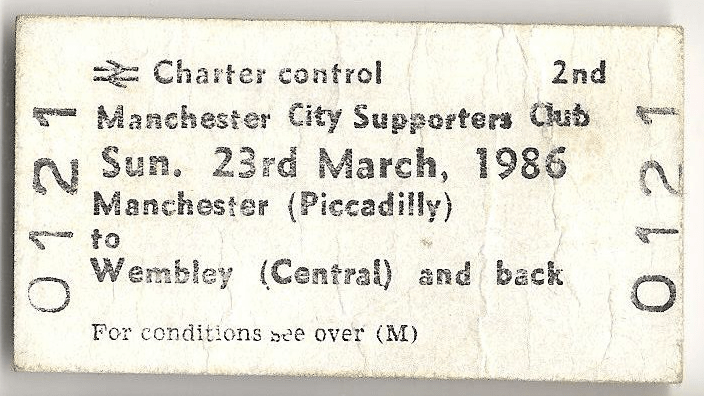
WEMBLEY, WEMBLEY 86 (MCFC V Chelsea)

Back in March 1986 City drew 2-2 with United at Old Trafford one day and then faced Chelsea in the inaugural Full Members’ Cup final the following day.  The competition was one of two competitions created in response to the ban on English clubs playing in Europe following the Heysel European Cup Final of 1985.  Here’s the story of that Wembley final…

Subscribe to get access

Read more of this content and everything else in the archive when you subscribe today.

Subscribe to get access

Read more of this content and everything else in the archive when you subscribe today.

The League Cup: City Women

On this day (March 5) in 2022 Manchester City’s women’s team faced Chelsea in the 11th final of the FA Women’s League Cup at Wimbledon. This was Chelsea’s third appearance in a League Cup final and they had won the previous two editions. City, who had won the competition three times, contested their fifth League Cup final. It was the first time the women’s teams had met in a major cup final. Manchester’s Blues won the final 3-1 with goals from Weir (49 & 69) and White (58).

You can read the BBC material on this final here:

https://www.bbc.co.uk/sport/live/football/60088827

The League Cup is a hugely important trophy to Manchester’s Blues and to commemorate that success here’s a piece looking at the history of the competition from Manchester City’s view point. The League Cup, sponsored by Continental during the seasons Manchester City first won the competition and therefore known as the Continental Cup, was the first national competition won after the relaunch of the women’s team. As such it became highly significant.

City supporter David Sheel explains how the first final was viewed: “The club put on some coaches for us. It was night match – that doesn’t help. It was played at Adams Park, Wycombe Wanderers’ ground. There were two coaches. The first was full of parents and young academy girls and a few supporters with the second just supporters. All free. We went – sadly a lot couldn’t go because it was a week night – and we played against Arsenal. A team full of established top players who had beat us 4-0 at City in the League. But, like semi final win over Chelsea at Hyde, there was just something about that night. Arsenal were all over us at times and did everything but score. Our defence was outstanding but we also had a few chances at the other end. Got to half-time nil-nil and you’re thinking ‘just one chance, please.’ I can remember the goal… Joey Johnston went down the line, whipped the ball in and Izzy Christiansen, the smallest player on the pitch, headed it in. There were four of us sat together – the coaches had arrived just before kick off so we’d had to leg it in and grab the first spaces you could find. The four of us jumped up but we were surrounded by Arsenal fans. They started giving us some abuse. The goal was in the 73rd minute and we hung on. 

“When the final whistle went I was as proud of that achievement as I was in 2011 when the men won the FA Cup. To me personally it was the same. I never ever felt I’d see the men win anything in my life and then the same was true with the women. I was so proud of the club. After that they did the trophy presentation and I picked up some of the tinsel that got fired out of the cannons when they did the presentation. All the players came over to the side afterwards. Jill Scott was showing me her medal. They shared it with the fans. They even let me put my hands on the trophy. We were all there together. A bit like the men and their success in 2011 I think this told the outside world that City were here to do business. Inside the club the ambition was there but until you win a major trophy the other clubs may not take you seriously.”

When I interviewed her in 2018-19 player Abbie McManus remembered: “That feeling of beating Arsenal, who have dominated women’s football for years and years. At the time we were perceived to be a bunch of nobodies that have just thrown a team together and everyone was saying you’re just throwing money at it. I didn’t actually play that game. I got sent off the game before so I missed it! But watching the game and the feeling of that win. Being the underdog. I don’t think that feeling will ever come back.”

Izzy Christiansen scored in the final and told me how she felt: “An amazing feeling to score in that game. There’s no other words to describe it. It was just probably one of the best days of my life, the fact that the ball hit the back of the net. The fact that it meant that we, as a team, and a club, got our first trophy. That kind of set us off on our journey really.  We had a taste of success at the start and that’s where we’ve stayed, wanting success.”

The Blues went on to win the Continental Cup in 2014, 2016, 2019 and then 2022. City’s finals:

2014 City 1 Arsenal 0

Goalscorer: Christiansen (73)

Attendance: 3,697 (Adams Park, High Wycombe).

Referee Nigel Lugg (Surrey)

2016 City 1 Birmingham City 0 (aet)

Goalscorer: Bronze (105)

Attendance: 4,214  (Academy Stadium, Manchester). 

Referee Rebecca Welch (Durham)

2019 Arsenal 0 City 0 (City won 4-2 on penalties)

Attendance: 2,424  (Bramall Lane, Sheffield). 

Referee Lucy Oliver (Newcastle)

2022 City 3 Arsenal 1

Goalscorers: Caroline Weir (49 & 69) and Ellen White (58).

Attendance: 8,004

Referee Lisa Benn

You can find out more about the history of City Women in my book Manchester City Women: An Oral History. Follow the link for details of how to buy:

Chelsea – 4 Points Taken

Today (6 February) in 2005 a Stamford Bridge crowd of 42,093 witnessed a goalless draw between Manchester City and Chelsea.  This meant City were the only side to take 4 points from the eventual Champions.

Chelsea 4 Manchester City 4

On this day (3 February) in 1937 the champions to be Manchester City drew 4-4 at Chelsea. Here are the comments from City about this game and how it was received in London too. Enjoy:

Manchester City versus Chelsea – The story so far…

Tomorrow (5 January 2023) Manchester City play Chelsea at Stamford Bridge in the Premier League and so I thought I’d post a few connections, historical moments and memorable game details here. So here goes…

All-time Record (all first team competitions)

City wins 62, Chelsea wins 71, 39 drawn.

League – 154 played, 53 City wins, 62 Chelsea wins, 39 drawn.

FA Cup – Played 7 (there’ll be another this coming weekend!), 4 City wins, 3 Chelsea wins

League Cup – Played 4, 3 City wins, 1 Chelsea win.

Champions League – Played 1, 1 Chelsea win. You can read about that one here:

ECWC – Played 2, 2 Chelsea wins.

Full Members Cup – Played 2, 2 Chelsea wins.

Community Shield – Played 2, 2 City wins.

Game One

The first match between the sides was on 7 December 1907 in Division One.  Chelsea had been promoted the previous season, and the match ended 2-2 before a 40,000 crowd at Stamford Bridge.

Debuts

City debutants in this fixture include Rodney Marsh, whose first game was the 1-0 victory over Chelsea on 18 March 1972.  Local hero Tommy Booth netted the winner in front of 53,322.

Marsh was a high profile and expensive signing back in 1972. He was signed shortly before the transfer deadline back then. Another major signing who made his league debut v Chelsea was Robinho who joined the Blues on transfer deadline day back in 2008, marking his league debut v Chelsea with a goal that September.

On 14 November 1959 in a 1-1 draw, Alan Oakes made the first of an incredible 665 (plus 3 as substitute) appearances for the Blues – sadly he gave away a last minute penalty, but Bert Trautmann saved it!  You can read more on that game here:

A little over 30 years later Howard Kendall signing Niall Quinn marked his debut with a goal in another 1-1 draw.

Others to have made their debuts include Tosin Adarabioya, Aleix Garcia & David Faupala (scored on his debut). Those players all made their debuts in the FA Cup game on 21 February 2016. 

Television

The first City-Chelsea game to be shown on BBC TV was on 1 October 1955 at Stamford Bridge when Chelsea beat City 2-1. The commentator was Kenneth Wolstenholme. 

The first meeting of the sides to be shown on the BBC’s Match of the Day was 1 October 1966, when Tommy Docherty’s Chelsea beat City 4-1.  Chelsea’s scorers were Tambling, Baldwin, Kirkup and Osgood, while the dependable Neil Young netted for City.

The first live match was on Friday 4 May 1984 with a 7.15pm kick-off, again on BBC.  This Division Two match ended in a 2-0 victory for 2nd placed Chelsea, and the result ended City’s dreams of an immediate return to the top flight.  Chelsea clinched the title that season on goal difference from Sheffield Wednesday and the live game became noteworthy as it was the first Second Division match shown live on television.  Interestingly, the BBC recruited Bobby Charlton as their City ‘expert’ for this game.

Connections

Kevin De Bruyne (made three League appearances for Chelsea), Willy Caballero, Frank Lampard, Scott Sinclair, George Weah, Shaun Wright-Phillips, Nicolas Anelka, Wayne Bridge, Danny Granville, David Rocastle, Gordon Davies, Clive Allen, Clive Wilson, Terry Phelan, and Colin Viljoen are some of the players to have appeared for both clubs.  Further back amateur Max Woosnam had appeared for first Chelsea then City.  He was City’s captain for a while, and was given the honour of captaining the Blues in their first match at Maine Road.  A good all-round sportsman, Woosnam was a Wimbledon doubles champion, and Olympic gold medallist.  He also captained England.

Highest Attendances

The top five attendances for this fixture are:

85,621 – FA Cup semi final, 14 April 2013, City 2 Chelsea 1 

81,775 – 2019 League Cup final, 0-0 City won 4-3 on penalties

72,724 – 2018 Community Shield, City 2 Chelsea 0

68,000 – The highest crowd for this fixture at the old Wembley; the 1986 Full Members’ Cup Final.  

64,396 – 26 March 1948 meeting at Stamford Bridge; a 2-2- draw.

The top five attendances for City V Chelsea at the Etihad are: 54,486 on 23 November 2019; 54,457 on 3 December 2016; 54,452 on 10 February 2019; 54,331 on 16 August 2015 and 54,328 on 4 March 2018. A reduction in capacity at the Etihad means that games from 2021 onwards cannot better these figures.

The highest attendance for City V Chelsea at Maine Road was 53,322 on 18th March 1972. 

Wembley ‘86

The only game between the two sides at the old Wembley Stadium was the inaugural Full Members’ Cup Final in 1986.  Despite taking the lead in the eighth minute, City were losing 5-1 with only five minutes left.  A Mark Lillis inspired fightback followed and he helped City achieve a 5-4 scoreline, before time ran out.  It was a thrilling match and it also helped David Speedie enter the record books.  His hat-trick was the first in a senior domestic final at Wembley since Stan Mortensen in 1953.

You can read about that one here:

Kippax First and Last

City’s first & last games in front of the Kippax Stand were both against Chelsea. The first came on 5 September 1957. City won that game 5-2 (goals from Colin Barlow 2, Fionan ‘Paddy’ Fagan 2 and Billy McAdams), attendance 27,943. The second was on 20 April 1994 – a 2-2 draw (City goals from Uwe Rosler and Paul Walsh), attendance 33,594.

Did You Know?

The two Second Division matches between the sides in 1927-8 were watched by a total of 104,643.  That season City, despite being a Second Division club, had the highest average attendance of all the clubs in the Football League.

Well I Never!

The last match of the 1993-4 season was the last played in front of the old Kippax Stand.  At the time, the Kippax was the largest capacity terraced stand in the country, and Chelsea supporters (dressed as Blues Brothers) laid a wreath in front of the famous old stand.  It was a gesture much appreciated by City fans.  The game ended 2-2 and afterwards supporters hacked off pieces of the old terracing.  Even the old “Colin Bell Bar” Sign was seen being taken towards the city centre after the match!

Feature Match

My feature match is noteworthy as it was played at a time when the Blues were suffering heavy fixture congestion, and squad rotation was still something for the future.

The match is the first leg of the 1970-1 ECWC semi-final.  City were cup holders, while Chelsea had qualified after beating Leeds in the FA Cup Final replay at Old Trafford played on the same night as City’s ECWC final in April 1970.

Malcolm Allison was banned from all football activity by the FA, leaving Joe Mercer in total control.  Joe always believed the strongest team possible should play.  He didn’t hold with the view that players should be saved for the important matches and, although his belief that every team should always field their strongest side was fair and just, in 1971 it was to cost the Blues dearly.  During a relatively meaningless 4 League fixtures over the Easter period injuries piled up.  By the time of the ECWC game Summerbee, Pardoe, Oakes, Heslop, Bell, and Doyle – all crucial players – were on the injury list, causing Joe to play a team of inexperience in the most crucial match of the season.  Shortly before kick off at Stamford Bridge he solemnly told the press his team and then said:  “And may God bless this ship and all who sail in her.”

Despite their naivety, Mercer’s Minors put in a good performance.  Goalkeeper Joe Corrigan, who played the game with his left eye half-closed through injury, was in exceptional form.  Dave Sexton’s Chelsea surged forward in the opening minutes, but Corrigan kept them at bay.  Gradually, the confidence of City’s inexperienced side increased, and at half-time they entered the dressing room still level.

Sadly, a minute into the second half Tony Towers was unable to intercept a cross from Chelsea’s Keith Weller to David Webb, and a mistake by Tommy Booth allowed Derek Smethurst to score for the home side.  It was the only mistake City made all night, and the game ended 1-0.  Joe was proud of his players, and looked forward to the return.

Sadly, others (Booth and Corrigan) were missing for the second match – played only 48 hours after a gruelling 2-2 draw against Liverpool.  Again Chelsea won 1-0, this time the replacement ‘keeper, Ron Healey, turned an inswinging free kick from Weller into his own net.

City’s dream of becoming the first side to retain the trophy ended – a feat no club ever managed to do – while Chelsea went on to beat Real Madrid in the final.

The 1970-1 season had also seen a ferocious boardroom battle tear the club apart, and for the first time had caused friction between Mercer and Allison.  A year later the partnership ended for good.

Stats:  ECWC Semi-Final first leg 14 April 1971

Chelsea 1 City 0

Scorers – Chelsea: Smethurst

City: Corrigan, Book, Connor, Towers, Booth, Donachie, Johnson, Hill, Lee, Young, Mann

Attendance: 45,955 

If you have enjoyed this article then feel free to use the search field or Category selection below to find other articles. Some content is free to read while others are for subscribers only.

Subscribe to get access

If you have enjoyed this free post and would like to support my research and writing then please subscribe. Annual subscribers (£20 per year, sign up here) get access to everything posted on the site including PDFs of 2 of my out of print books and archived content like my exclusive audio interviews with John Bond, Malcolm Allison etc. Not only that but you’ll be helping to support this site’s development.

Subscribe to get access

If you have enjoyed this free post and would like to support my research and writing then please subscribe. Monthly subscribers (£3 per month, sign up here) get access to everything posted on the site since 1 October 2022. Not only that but you’ll be helping to support this site’s development.

City Make History With Foreign Player Rule?

On this day (23 December) in 1995 there was a great deal of speculation that Manchester City would be the first team to field four ‘foreign players’ which wound PFA chief Gordon Taylor up considerably. There had been a rule in place limiting the number of foreign players to three but this had been challenged by English clubs, following the historic Bosman judgement in the European Court of Justice.

Basically, before Bosman challenged the restrictive trade practices UEFA insisted that a maximum of three foreign players could appear for clubs. The Bosman judgement was immediately considered by Premier League clubs who felt it meant they could play as many players from the European Union as they wanted (though the maximum of 3 from outside the EU was still a limit).

The Premier League, supported by the FA, said the ruling meant that City and other clubs could play as many EU players as they wanted. At Maine Road Alan Ball had brought Danish under-21 international Ronnie Ekelund on loan and together with Eike Immel, Uwe Rosler and Georgi Kinkladze it was suggested he would play against Chelsea on 23 December 1995.

In the end Ekelund came on as substitute for Rosler, so 4 ‘foreign players’ had appeared that day but only 3 at any one time (though there’s a whole other discussion to be had about players from other United Kingdom countries and Ireland and whether they should count as that day the Republic of Ireland’s Niall Quinn played, as did Gerry Creaney from Scotland and Welsh international Kit Symons!).

As for the game… City lost 1-0 to Chelsea!

Ekelund had a brief up and down career at City, making only 6 (plus 3 as sub) appearances and he was soon off to Barcelona, while the change to the ‘foreign player’ rule was to have a massive impact on the development of football in England, paving the way for the multitude of talented players at City today.

Subscribe to get access

If you have enjoyed this piece and would like to support my writing while also accessing further great content, then why not subscribe? Those who subscribe on an annual basis get access to everything posted on this site since December 2020 (including PDFs of 2 out of print books, and audio interviews with John Bond, Malcolm Allison etc.). Those subscribing on a monthly basis get access to everything posted since 1 October 2022. It’s £20 a year (subscribe here) or £3 per month (subscribe below). Why not try it for a month?

Subscribe to get access

If you have enjoyed this piece and would like to support my writing while also accessing further great content, then why not subscribe? Those subscribing on a monthly basis get access to everything posted since 1 October 2022. It’s £20 a year (subscribe above) or £3 per month (subscribe here). Why not try it for a month?

Oakes’ First

On this day (14 November) in 1959 Manchester City’s record appearance holder Alan Oakes made the first of 564 League appearances.  The game ended in a 1-1 draw with Chelsea with the away team missing a penalty. Jack Dyson returned to the City team after two years out with a damaged leg. Here’s a contemporary match report from the game:

There are lots of other features on my website about Alan Oakes, why not have a read while you’re here?

https://gjfootballarchive.com/tag/alan-oakes/

Chelsea Vanquished

On this day (16 October) in 2004 eventual champions Chelsea were defeated 1-0 by Manchester City at the City of Manchester Stadium (now Etihad).  City were the only side to beat the champions during 2004-5 and managed to draw the return fixture 0-0. You can read more on the October game below:

By the time Chelsea arrived in Manchester on 16th October the Blues were 12th on 8 points, while the visitors were second, behind Arsenal, on 20 points.  Chelsea were also one of only two sides unbeaten in the League and were, without doubt, favourites to win this match.  Keegan optimistically told fans pre-match:  “It is still 11 against 11 on the day and we are more than capable of beating the top sides.”  

The manager’s views proved correct as City defeated the eventual champions 1-0 with an 11th minute penalty from Nicolas Anelka.  It was the first time Jose Mourinho had suffered a defeat at Chelsea and was only the second time his side had conceded a goal during 2004-05.  It was also City’s first home victory over the London club in the Premier League.  Sadly, Jihai Sun suffered cruciate ligament damage and was to miss the rest of the season.

The Jihai Sun injury was not the only one affecting Keegan’s side during the first half of the season and, as the Blues had one of the smallest squads in the Premier League, the manager found himself with few players to choose from at times.