Continuing here: the story of Manchester City’s origins. Today’s feature is a 3,300+ word feature on the earliest known game, played in November 1880. Have a look elsewhere on the site for other content on this period.
Subscribe to get access
These articles will be available to subscribers to this site. It costs £3 per month (cancel any time) or sign up for a year for the discounted price of £20 per year (works out about £1.67 a month to access every article on this site). To date in excess of 1,500 articles/features have been posted including interviews, talks and more.
If you enjoy all the free material on my website and would like to support my research and keep this website going (but don’t want to subscribe) then why not make a one-time donation (or buy me a coffee). All support for my research is valued and welcome. It allows me to keep some free material available for all. Thanks.
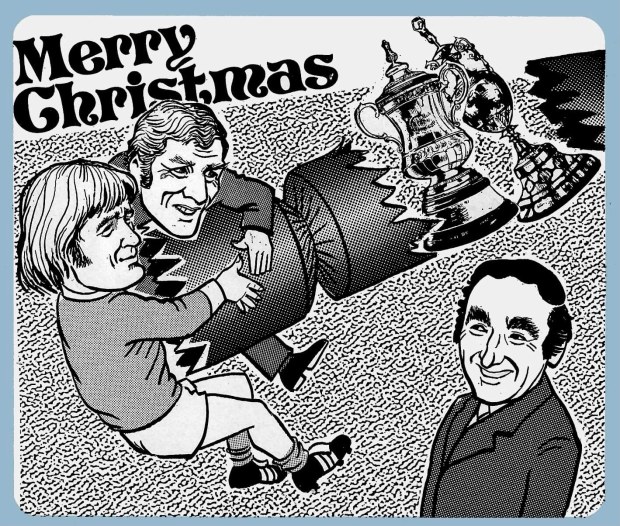
Had your Christmas dinner yet? If not then spare a thought for those days when professional football in England would take place on Christmas Day. In the modern era the thought of playing League football on Christmas Day is totally unacceptable, but in years gone by games were played on consecutive days over Christmas, including Christmas Day, and these were often the best attended matches of the winter.
The last Christmas Day game featuring Manchester City took place in 1957 when the Blues were defeated 2-1 at Burnley. The City team for that landmark game was: Trautmann, Leivers, Little, Barnes, Ewing, Warhurst, Barlow, Kirkman, Johnstone, Hayes, and Fagan. Fionan Fagan was the last City player to score on Christmas Day
The following day City defeated Burnley 4-1 at Maine Road in front of a crowd of 47,285. The only change to the line up was Ron Phoenix, who replaced Bobby Johnstone.
The First Noel
The first League game ever played by City on Christmas Day was at Christmas 1896 against Newton Heath (present day Manchester United). The game was played at Bank Street, Clayton (roughly across the road from the Etihad, the site of the BMX centre behind the present Velodrome) and was attended by 18,000 – a figure described by the Athletic News as being huge for Newton Heath: “The crowd was an enormous one and I never saw so many lads at a football match. They were really the cause of the encroaching in the first half, for they were continually creeping under the rails, and as a natural consequence their elders were bound to follow if they were to get a glimpse of the game.”
Fans streamed on to the pitch on several occasions and the game was almost abandoned at half time: “Mr. J. Parlby, one of the League Management Committee, told the crowd point blank that if they did not keep beyond the touchline, the game could not proceed, and the Newton Heath Club would have to suffer the consequences.”
Parlby, was actually a City director, and his words may have been influenced by the fact Newton Heath were the better side that day! The game ended 2-1 to the Heathens.
The two sides met on two further occasions on Christmas Day, the last (1902) ended 1-1 at Clayton before 40,000 with Billy Meredith scoring for the Blues.
Highest Christmas Crowd
City tended to be away from home on Christmas Day, but the best Maine Road crowd on the 25th was 56,750 in 1930 when City faced Arsenal. The following day a mere 17,624 attended the return game at Highbury.
The previous year a crowd reported as 70,000 watched Aston Villa beat City 2-1 on Boxing Day at Maine Road. This is the highest Christmas crowd at a City League game.
Christmas Thriller
Perhaps the most entertaining – if disappointing – game ever played by the Blues on Christmas Day was the 6-5 defeat by Bury at Gigg Lane in 1925.
Debuts
The following players made their Manchester City League debuts on Christmas Day:
Here’s the Official Programme cover and Manchester City comments (below), published on 27 October 1900 for City’s game with Derby at Hyde Road. Back then the programme was a shared one with Second Division Newton Heath (later United) and a couple of rugby clubs. the comments below on City’s performances and preview of the Derby game are interesting. The 3-0 game it opens with was City’s 3-0 Division One defeat at Sunderland. The Monday game it mentions was a 2-0 victory over Newton Heath in the Lancashire Cup.
The ‘Doctor’ mentioned lower down was City half back William ‘Doc’ Holmes. The preview suggested this would be a tough game for City, though the return of Jimmy Ross was welcomed. Ross, a former Preston Invincible, was a key member of the side and he’d been sidelined for the previous six League games.
The match with Derby ended in a 2-0 victory with both goals scored by Fred Williams. If you’d like to find out more on this season for Manchester City then why not read the following 1200+ word article telling the story of 1900-01? Why not subscribe and read this and all the other content on here? You can even try it for a month at a time if that works best?
Subscribe to get access
Read more of this content when you subscribe today. It costs £3 per month (cancel anytime) or sign up a year at a time for the discounted annual fee of £20. This gives access to everything on the site, including PDFs of 3 of my books and various other articles, interviews and audio material. Each subscriber has access to all content posted during their subscription period too. Why not sign up for a month and see what you think?
Always a controversial question but back in the early 1900s there was only ever one answer and that was Manchester City who were often referred to as simply ‘Manchester’ in official publications for both City and their Manchester rivals. Here’s an image of the title section of the official programme which directly references ‘Manchester’ (meaning City) and Newton Heath.
Obviously, as there was no Manchester United then I guess it was inevitable that City would be known as Manchester to some. It just surprises me that an official publication for both clubs would use ‘Manchester’ so regularly. Presumably both clubs were happy with this. So if anyone asks ‘which club is Manchester? then the one both were happy to call Manchester must be in with a big shout!
On another topic… notice the opportunity to have your flask filled up at City’s headquarters, the Hyde Road Hotel, before the match? Imagine if that option was brought back at the Etihad!
2025 marks the 140th anniversary of the first final of the Manchester Cup (later known as the Manchester Senior cup). The Manchester Cup was the first competition either Manchester United (as Newton Heath) or Manchester City (as Ardwick) won and was a hugely significant competition at the time of their first victories. In many ways it was more important locally than the FA Cup. The final was held on 25 April 1885 and you can read a match report of the game here and then my own words on the final:
The first season of the Manchester Cup proved to be very exciting with games involving Hurst and Newton Heath grabbing much attention in the local newspapers. In fact the two sides competed in the first Manchester Cup final. This was played at Manchester FC’s Whalley Range ground and had an attendance of approximately 3,500. The Ashton club won 3-0 and at the end of the match all the Hurst players were lifted shoulder high by their fans and there was tremendous excitement on the pitch. It was perhaps the first time a Manchester side had experienced success that actually meant something. Hurst could rightly claim to be the best in the area, and after the game finished the President of the Manchester FA, Mr. Colbert, presented the cup to J. Ingham, Hurst’s Captain. The Reporter newspaper then described the fantastic parade that took place all the way back to Ashton: ‘All the way from Whalley Range the victors kept cheering and the band playing, the cup being held up in front of one of the carriages in which the journey to Ashton was made. On arriving in town their cheers were redoubled and they received a great ovation in the streets.
‘The victors crowded into the Pitt & Nelson, and Mr. Joseph Fletcher, holding in his hand the cup which was filled with liquor, and addressing the captain of the club, said he had great pleasure in presenting to Mr. Ingham the cup on behalf of the Hurst Cricket & football Club.’
Joseph Fetcher was the landlord of the Pitt & Nelson and according to the Reporter he made a speech saying that he: ‘had lately been in Blackburn and he could assure them that the fame of the Hurst club was well known in that district and he was certain that the next season they would be called upon to play with teams from that district, the Mother of the Game.’
This was undoubtedly the finest moment for any of the Manchester clubs at this stage in history, and Hurst were worthy recipients of the praise. Hurst had done more than most to encourage the game to develop and, as well as entering the FA Cup, they also tried to arrange fixtures with teams beyond the Manchester boundaries. In March 1885 they had welcomed Welsh side Rhyl to Hurst and the Ashton side won 8-1 before 3,000 fans, then on Good Friday they played their return match and, according to reports from the period over 750 fans travelled from Ashton for the game which Hurst won 4-0. Considering the nature of travel, working conditions, and the state of the game at the time this was a major achievement.
You can find out more about the origins of football in Manchester in my book Manchester A Football History. The book is long out of print but PDFs of the entire 2010 edition is available to subscribers to this site.
This is the Introduction for the 2010 edition of the book Manchester A Football History (Gary James, published by James Ward). As with everything else on this site copyright laws apply. The book is published here for the personal use of subscribers to this site. For any other use please email the publishers at info@manchesterfootball.org
Subscribe to get access
Read more of this content when you subscribe today. You can subscribe for £20 a year (works out about £1.67 per month) or £3 per month (cancel any time). Why not try it for a month?
Here’s an interesting cutting from the Official Programme of both Manchester City and Newton Heath in December 1898. Back then City’s and Newton Heath’s match programme was a joint affair, shared with a couple of rugby clubs too. Reading this gives an impression of how the rivalry was at the time – I’m sure City fans will find the line about referee Jack Lewis’s decision making interesting!
This game was actually played at City’s Hyde Road on Boxing Day 1898 and, as was typical of the period, both sets of fans were vocal and spread around the ground.
The opening paragraph described an infamous passageway that led to the Hyde Road ground and was often muddy. Also, worth noting that Billy Meredith was the biggest name in football and was a popular City player at this time.
With the latest League Manchester Derby occurring this weekend it seems appropriate to remember the first ever Manchester derby played in the Football League. The match between Manchester City and Newton Heath was played at City’s Hyde Road ground today in November 1894. You can read the story of the game (with all the stats, background etc.) here:
The series of features on the 1900s continues today with a simple look at the average attendances of league clubs. I’m publishing the statistics here for season 1900-1901 when Manchester City finished 11th in the First Division (top tier). There were 18 clubs in the division that season. Despite this relatively low position, City were the second best supported club – the highest position either Manchester team had enjoyed up to that point. League champions Liverpool were the 5th best supported club. Newton Heath (MUFC) were still a Second Division club and were 22nd best supported team.
All these figures are estimated based on newspaper reports of the period but are widely accepted as a good indication of support enjoyed at each club.
Match programme for 29 September 1900. Manchester City v Stoke
In the following table every team is in Division One unless (2) appears after their name. This indicates they were a Second Division club that season. Where two teams have the same average then these have been listed in alphabetic order.
1900-1901 Average Attendances
Average
Team
18700
Aston Villa
18300
Manchester City
16225
Everton
15800
Newcastle
15000
Liverpool
13600
Sheff Utd
11525
Sunderland
10575
WBA
10175
Bolton
9950
Sheff Wed
9450
Notts County
9350
Nottm Forest
8375
Middlesbrough (2)
8050
Derby
6950
Bury
6850
Stoke
6575
Blackburn
6325
Preston
5900
Small Heath (2)
5900
Woolwich Arsenal (2)
5850
Wolves
5475
Newton Heath (2)
4975
Leicester Fosse (2)
4625
Grimsby (2)
3725
Stockport (2)
3575
Lincoln (2)
3125
Walsall (2)
3100
Burnley (2)
2850
Barnsley (2)
2825
Chesterfield (2)
2800
Glossop (2)
2675
New Brighton Tower (2)
2375
Burton Swifts (2)
2075
Burslem Port Vale (2)
2050
Gainsborough Trinity (2)
1850
Blackpool (2)
This series of features covers the final years of Ardwick, the birth of Manchester City and the Club’s first national success. Why not subscribe and read every feature?
Continuing the series of features on Manchester City in the early 1900s! Today it’s a 1200+ word article telling the story of 1900-01.
Ever wondered how Manchester found its first major trophy success or what the scandal that rocked City was all about?
Subscribe to get access
Read more of this content when you subscribe today. It costs £3 per month (cancel anytime) or sign up a year at a time for the discounted annual fee of £20. This gives access to everything on the site, including PDFs of 3 of my books and various other articles, interviews and audio material. Each subscriber has access to all content posted during their subscription period too. Why not sign up for a month and see what you think?
The series of features on the 1900s starts today with a simple look at the average attendances of league clubs. I’m publishing the statistics here for season 1899-1900 when Manchester City was a First Division club for the first time. They were the third best supported club – the highest position either Manchester team had enjoyed up to that point. In fact City had been the best supported club for the opening months of the season as the heading photo shows (that’s from 20 January 1900).
All these figures are estimated based on newspaper reports of the period but are widely accepted as a good indication of support enjoyed at each club.
Manchester City with the Second Division Shield, 1899
In the following table every team is in Division One unless (2) appears after their name. This indicates they were a Second Division club that season. Where two teams have the same average then these have been listed in alphabetic order.
1899-1900 Average Attendances
Average
Team
19825
Aston Villa
16725
Newcastle
16000
Manchester City
12925
Everton
11325
Liverpool
11175
Sheff Utd
10475
Sunderland
8950
Notts County
8125
Derby
7875
Nottm Forest
7700
Stoke
7150
Sheff Wed (2)
6575
Wolves
6475
Blackburn
6250
Leicester Fosse (2)
6225
Newton Heath (2)
6175
WBA
5925
Burnley
5925
Middlesbrough (2)
5775
Bury
5050
Small Heath (2)
4825
Preston
4800
Bolton (2)
4125
Woolwich Arsenal (2)
4000
Glossop
3775
Grimsby (2)
3775
Lincoln (2)
2950
Chesterfield (2)
2875
New Brighton Tower (2)
2525
Walsall (2)
2400
Barnsley (2)
1875
Gainsborough Trinity (2)
1675
Burslem Port Vale (2)
1650
Loughborough (2)
1650
Luton (2)
1500
Burton Swifts (2)
This series of features covers Manchester City in the opening years of the twentieth century. Why not subscribe and read every feature?
Tomorrow there’ll be a subscriber article on the 1900-01 season in a similar style to those recently posted on the 1890s. Here’s an 1800 article below on Manchester City in the final months of 1899:
Subscribe to get access
Read more of this content when you subscribe today. It costs £3 per month (cancel anytime) or sign up a year at a time for the discounted annual fee of £20. This gives access to everything on the site, including PDFs of 3 of my books and various other articles, interviews and audio material. Each subscriber has access to all content posted during their subscription period too. Why not sign up for a month and see what you think?



 Gary James' Football Archive