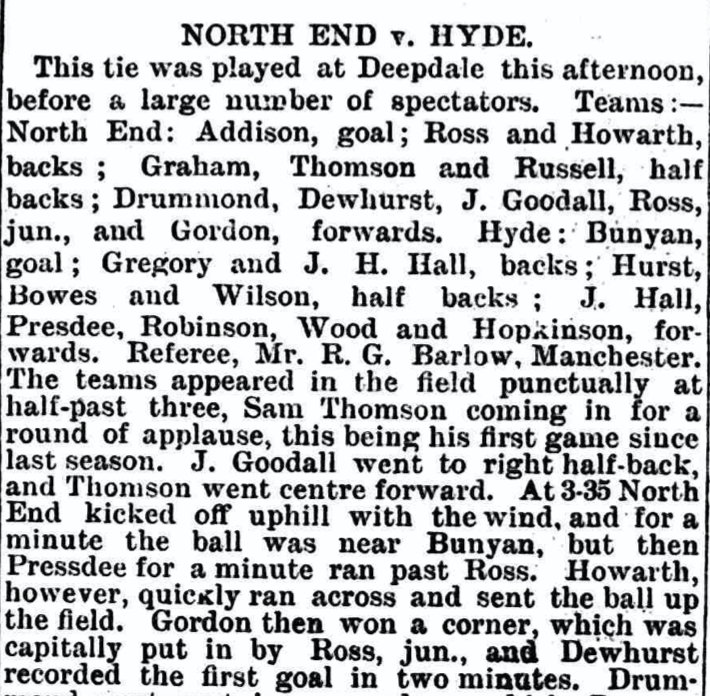
On 15 October 1887 one of the most remarkable FA Cup games of all time occurred at Preston and featured Hyde FC, who were formed in 1885 at a meeting attended by approximately forty men in the White Lion public house.
At the start of the 1886-87 season one of the giants of the period, Blackburn Rovers, were invited to Hyde for a friendly which Hyde lost 8-0 but afterwards members of Blackburn’s side stressed they believed Hyde had potential.
These comments encouraged Hyde to enter the FA Cup the following season and they opened the 1887-88 season with a friendly against significant opposition with Bolton defeating Hyde 8-1.
Preston had arranged a fixture with West Bromwich Albion and wanted to play the FA Cup tie midweek instead. Hyde, because of the complications a midweek game would have caused, rightly refused and, as a result, Preston made it clear that they would do all they could to win the match – in those days friendlies were often perceived as being more lucrative than FA Cup ties (actually we’re back at that point now in 2020s England for some clubs!).
The game commenced on 15 October 1887 at 3.30pm and within five minutes Fred Dewhurst headed Preston’s first goal and the score reached 4-0 after approximately twenty minutes.
According to reports the Preston goalkeeper didn’t touch the ball until the twenty-fifth minute when he took a goal kick, but by this point Hyde was already a struggling side and almost immediately after the goal kick Preston challenged Hyde’s goal again with Hyde conceding three goals in five minutes. By half time they had scored twelve goals.
Hyde commenced the second half determined to demonstrate an attacking spirit and they briefly put Preston under some pressure but Preston soon regained the initiative and the goals flooded in.
Match reports simply list the scorers from this point on as, presumably, the pace was so frenetic that it was impossible for the reporters to record the general action, and the final score was 26-0. There had been significant controversy and confusion as Hyde’s centre-back Bowers had left the pitch with a sprained arm at 3-0 and Preston allowed the Hydonians to bring on another player for the second half even though substitutions were not allowed at this point in football history. Presumably they had felt a half time twelve goal lead was enough of a cushion.
Famous Lancashire cricketer and footballer Richard Barlow played his part in the large victory as he was the referee, emphasising the continuing existence of a local sporting elite that crossed the conurbation.
Barlow had played an additional five minutes during which time Preston’s last goal was scored and the reason this additional time was played remains unclear, although some suggested the referee was simply too involved with the action to check his watch, while others over the years that followed claimed his watch had stopped and that an additional ten or fifteen minutes had actually been played.
Whatever the truth this was a remarkable victory for Preston. Despite the scoreline, Hyde’s goalkeeper Bunyan was regarded as one of the best players on the pitch. The referee, himself a former goalkeeper with Manchester Association, was equal in his praise when reflecting on the game in 1908: ‘I may say that had the Hyde goalkeeper not been in good form, North End would have materially increased their score. I have never seen such splendid passing and shooting in my life. The old Preston team would, in my opinion, be at least two goals better than any team in the field at the present day.’
After the game Hyde and Preston regularly played each other in friendlies, and the two sides also met to raise money for the victims of the Hyde Coal mining disaster of 1889 – that same year Newton Heath LY&R and Ardwick met under floodlights at Belle Vue to raise money for the families. Walter Chew, the Ardwick secretary, was responsible for organising the floodlit match in February 1889, which raised £240 for the families of the twenty-three killed in the disaster. This is believed to be the first floodlit association match played in the area, although there is anecdotal evidence to suggest that Preston played against Ardwick at Hyde Road around the same time under artificial light and there was also a meeting between Everton and Ardwick on 10 March 1890 under artificial light.
In 1987 Preston and Hyde United met to remember the 1887 FA Cup tie. This time Preston defeated Hyde 4-1 on their plastic pitch at Ewen Fields.
In the FA Cup Hyde were drawn away to Preston North End, who had reached the semi-finals the previous season and were recognised as a leading side. For Hyde, the game was expected to be exceptionally tough, however there was some controversy pre-match.


