Continuing the series focusing on Manchester City in the 1980s here’s a list of items available at the City Souvenir Shop in December 1982. It’s an interesting list but what would you want to buy?
For a few minutes I was puzzled by the items marked ‘centenary’ thinking are they talking of the centenary of the earliest known game as St Mark’s in 1880 or have they got things completely wrong? Then I realised these items refer to the 100th FA Cup Final (so not really a centenary of the FA Cup either, but I do know City’s souvenir shop did talk of it as the ‘Centenary Final’, though that is usually regarded as the 1972 final; the 1981 final was known as the ‘100th Final’).
I bet there are a few reading this who bought some of the items on the list.
If you want to know more about this period then why not subscribe? As well as all the other benefits you could read the following 3,500 word feature on the 1982-83 season. Enjoy (well, if you know the outcome of this season you can enjoy this memory refresh while reflecting on the modern day successes of the Blues!).
Subscribe to get access – Monthly
Read more of this content when you subscribe today. It costs £3 per month (cancel anytime) to access everything posted since 1 October 2022 or there’s a special annual rate below which gives greater access and works out much cheaper.
Read more of this content when you subscribe today. It costs £3 per month (above) or £20 a year (here) to access everything posted since the site was created in December 2020. This special rate works out about £1.67 a week and gives access to everything posted, including PDFs of 3 of my books.
Continuing the series focusing on Manchester City in the 1980s here’s a brief reminder of Tommy Caton and a day (4 December) in 1982 when he scored twice to give City a 2-1 victory over his future club.
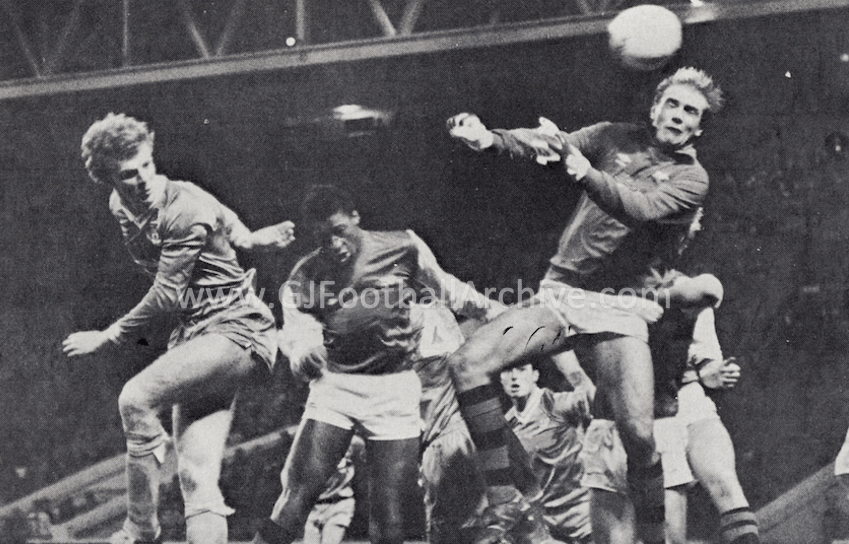
The photo shows central defender Caton sending a 52nd minute header past Arsenal ‘keeper George Wood, following an Asa Hartford corner. This gave City the lead at Maine Road but then five minutes from time the away team equalised. In the last minute another corner (this time from Paul Power) led to Caton leaping to send the ball home and give the Blues a 2-1 victory.
Two days later Caton was called up to the full England squad for a European Championship qualifier. Caton was a gifted defender who should have played regularly for England. Sadly, it was not to be.
If you want to know more about this period then why not subscribe? As well as all the other benefits you could read the following 3,500 word feature on the 1982-83 season. Enjoy (well, if you know the outcome of this season you can enjoy this memory refresh while reflecting on the modern day successes of the Blues!).
Subscribe to get access – Monthly
Read more of this content when you subscribe today. It costs £3 per month (cancel anytime) to access everything posted since 1 October 2022 or there’s a special annual rate below which gives greater access and works out much cheaper.
Read more of this content when you subscribe today. It costs £3 per month (above) or £20 a year (here) to access everything posted since the site was created in December 2020. This special rate works out about £1.67 a week and gives access to everything posted, including PDFs of 3 of my books.
A new daily series of articles for subscribers started a few days ago covering the 1980s. This is a seasonal journey through a truly important decade in the history of Manchester City Football Club. Today’s article is a 3,500 word feature on the 1982-83 season. Enjoy (well, if you know the outcome of this season you can enjoy this memory refresh while reflecting on the modern day successes of the Blues!).
Subscribe to get access – Monthly
Read more of this content when you subscribe today. It costs £3 per month (cancel anytime) to access everything posted since 1 October 2022 or there’s a special annual rate below which gives greater access and works out much cheaper.
Read more of this content when you subscribe today. It costs £3 per month (above) or £20 a year (here) to access everything posted since the site was created in December 2020. This special rate works out about £1.67 a week and gives access to everything posted, including PDFs of 3 of my books.
On this day (17 October) in 1980 John Bond officially became the Manchester City manager. Back in November 1995 I interviewed the former Manchester City manager. At the time I was researching my in-depth history of the club called Manchester The Greatest City (later updated as Manchester The City Years).
I met John at his home and spent a good few hours with him chatting about the Blues and his career. I loved doing this interview and was always grateful for the time he gave me. He was quite frank, open and honest – which delighted me because he was a great talker. He was also happy for me to quote everything he said in the interview. I did end up quoting him extensively in the book (and in others I’ve produced) but none of the interview has ever been heard by the wider public.
You can hear the interview I did that day. In this first section he talks about the steps taken by City to appoint him; the interview (and the directors involved in that notorious filmed job interview for the City documentary in 1980-81); the signing of Tommy Hutchison, Bobby McDonald and Gerry Gow. As I said earlier, he is quite frank in his comments and that may surprise a few.
This audio recording of the first 17 minutes of the interview is available to subscribers of my blog whether annual or monthly. If you want to hear it then please subscribe below.
Of course as this interview was recorded on my old cassette recorder the quality isn’t the best but I’m sure you’ll appreciate the exclusive nature of this.
Subscribe to get access – Annual
If you would like to listen to this frank interview and read the in-depth articles on this site (including the entire Manchester A Football History book) then please subscribe. It works out about £1.67 a month if you take out an annual subscription (£20 per year; here) or £3 a month (see below). Annual subscribers access everything posted since December 2020.
If you would like to listen to this frank interview and read the in-depth articles on this site (including the entire Manchester A Football History book) then please subscribe. A monthly subscription is £3 a month (cancel anytime) if you’d like to sign up for a month at a time (here). Monthly subscribers access everything posted since 1 October 2022. Why not join up for a month and see what you think?
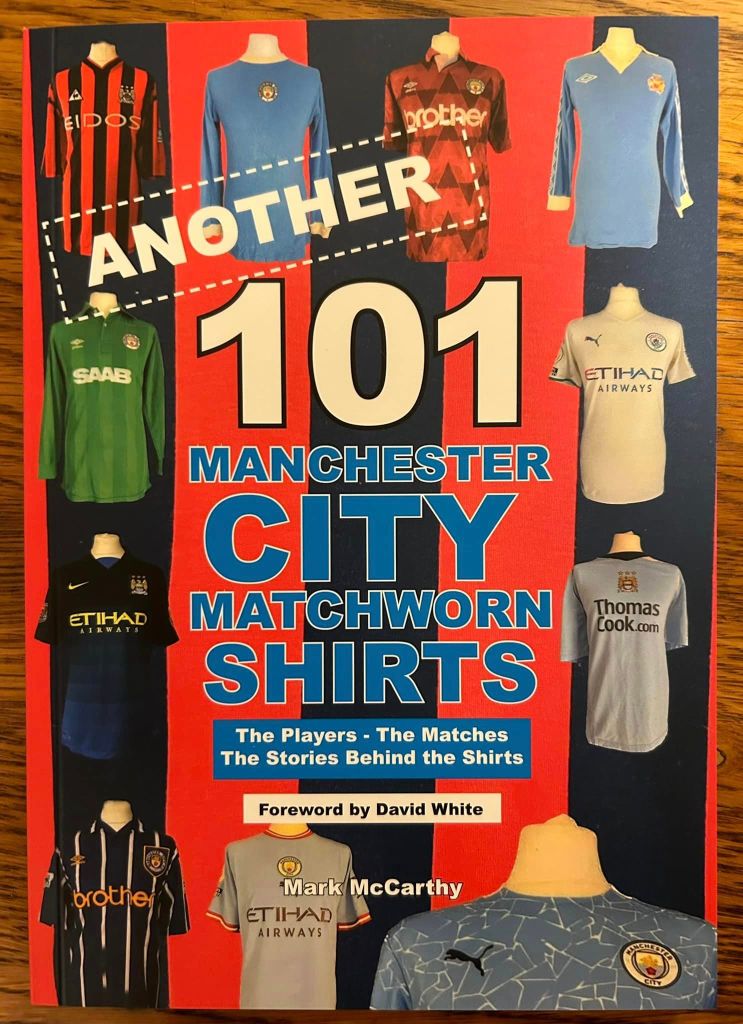
For the second time I’ve asked Mark McCarthy to write a guest blog on his football shirt collection and, specifically, I’ve asked him to tell us about his new book. This book is the second book he has written on his collection. It is packed with lots of great images and stories. Mark tells all below:
It was never my intention to do this follow up book to 101 Manchester City Match Worn Shirts which was released in 2021, but as a passionate City match shirt collector it’s a pleasure to be able to share another part of my collection and some stories regarding the shirts and the seasons’ memories that they may bring.
My collection has grown considerably over the past few years, as has the hobby in general. You only have to scroll through the many social media channels to see the number of accounts now dedicated to collecting not only match worn shirts but football shirts in general. I can’t speak for other collectors, but I can safely say they may well agree with me when I do say the feeling never get’s old of adding a new shirt or unearthing a real holy grail of a shirt into collection. This was the case for me during the first lockdown when after many years of trying to trace the unusual yellow away shirt that was only ever worn once by City at Arsenal on 14 October 1989 (with just one set of shirts produced it has become a real holy grail of City shirts for any collection) I tracked one down. The kit was hastily given away by then City director Freddie Pye, following our 4-0 defeat, with Chairman Peter Swales demanding that the kit was never to been seen again. Well it was actually seen numerous times across Manchester’s Saturday and Sunday leagues when it was used by local team MMS who were managed at the time by Liam Hall.
The kit was used well into the 1990s before the side broke up, a lot of players got to keep the shirts but the majority have long been since sold on. A few have surfaced more recently but were quickly snapped up by a dealer who then sold them for huge profits. After many online requests for the shirt, convinced that there will be one still out there I was put onto a fellow blue called Billy Bell, who had found one just stored in a bag of old City shirts, just waiting to be discovered. A deal was quickly arranged with Billy, who in fairness could have sold the shirt on for much high profits but, as a man of his word, he kept to our deal which I’ll be forever grateful. A courier was quickly arranged to be sent to collect the shirt which I’m thrilled to have in the collection as there certainly aren’t too many, if anymore out there.
Manchester City have played, and still do to this day, a huge part of my life. As many football fans will tell you, our clubs were our first real love, the ones we can forgive no matter what they throw our way. City have certainly tested that unconditional love over the 40 years I have supported the club, although the past 15 years or so have been pretty incredible to say the least.
In February 2023 I was kindly invited by the club to take part in the 2023/24 season kit launch where I spent the day in and around the first team while featuring in the official home fans and players photo shoot along with the likes of Jack Grealish, Erling Haaland, Riyad Mahrez and former City goalkeeper Alex Williams. I also spent time with our current kit manufacturers Puma talking about kit designs and ideas while showing them a collection of match shirts we have worn over the years. The day was topped off when I was introduced to legendary Oasis singer Noal Gallagher who was filming a piece using my shirts, another honour for me and I was delighted to be able to present him with a copy of my first book. For the record Noel’s favourite City shirt is the 86-88 black & red chess board chequered style. A big thank you to Paul Mulholland and City for making a brilliant day of memories to be treasured.
With just over 600 shirts now in the collection I hope the book will spark some memories of days gone by, some you may want to forget and some you will never forget.
You can order a copy direct from Mark which can include a signed dedicated message of choice which will make a perfect birthday or Christmas gift for any blue. EMAIL MARK: mmmac@hotmail.co.uk
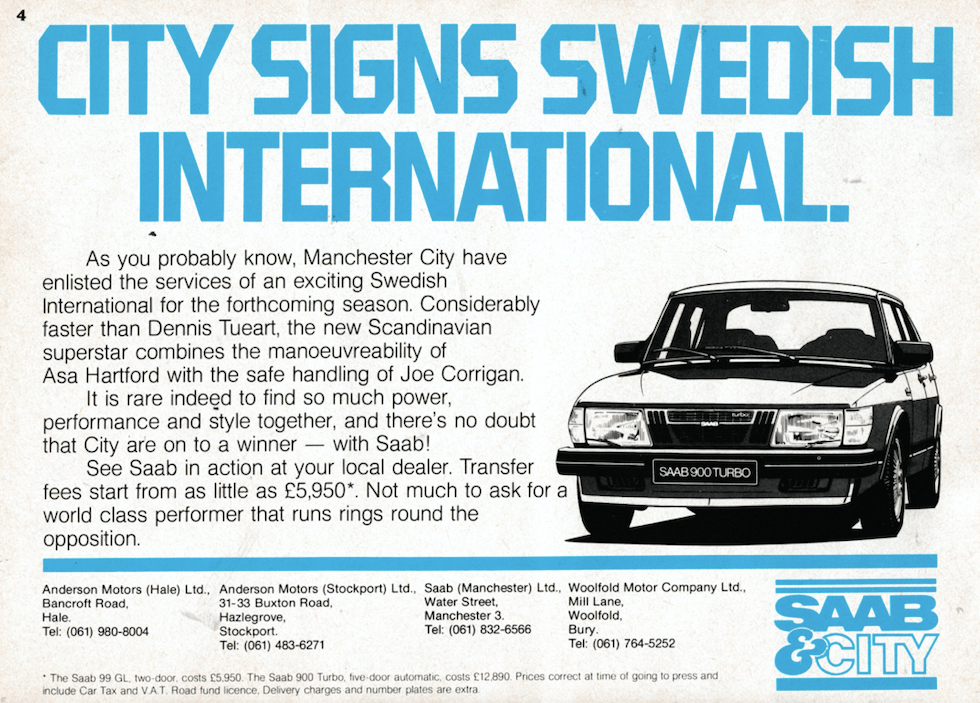
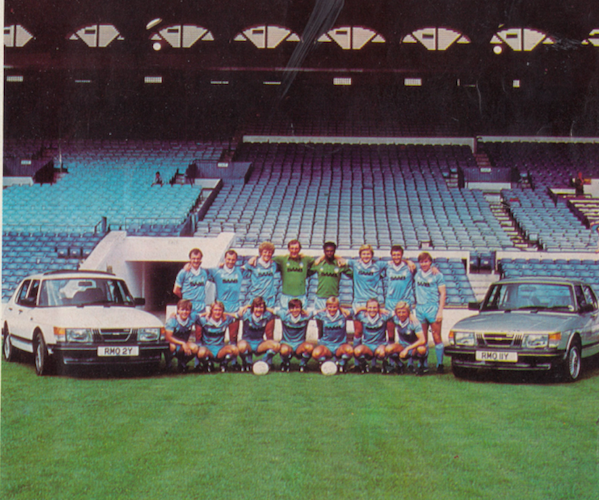
On this day in 1982 Manchester City should have played their first League game with a sponsor’s name on their shirt. However the match was televised and in those days TV did not allow clubs to wear sponsors names in televised games. The match was a 2-1 win away at Norwich and City’s first sponsor was the car company Saab.
New signing David Cross scored the opener after 3 minutes and 5 seconds (below) and we all thought this was going to be a great season. I won’t spoil it by saying what happened the following May!
New signing David Cross scoring after 3 minutes and 5 seconds at Norwich, August 1982
For Day 93 in my series of free articles counting down the 100 days to the centenary of Maine Road’s first game I want to do a bit of an attendance feature. Maybe this will put a few myths to bed!
The Blues have, generation after generation, been one of the English game’s top attractions and Maine Road was an incredible and poweful venue over the years. The Etihad has seen City establish new record average attendances but no English club venue can match what Maine Road achieved in terms of record crowds and it still, all these years on, holds the record for the highest crowd on an English club ground and the record attendance for an English League game – a record City set in 1935 which is currently held by a game featuring United and Arsenal at Maine Road.
The record attendance on a club ground was first set by City in 1924 – 99 years ago! – and was eclipsed by a figure of 84,569 in 1934 – almost 90 years ago. City know how to establish and keep records for decades!
Like all – and I do mean all – English clubs there have been some average attendance lows at Maine Road over the years, but when the entire history of Manchester City at the old stadium is reviewed and the club’s average figures are compared with the national average it is clear that the Blues have consistently been one of football’s most attractive draws. Take a look at the following:
Since the beginning of the Football League in 1888 only nine sides have topped the table for average attendances. In chronological order of their first appearance at the top of the average table they are: Everton (1888-9), Villa (1898-99), Newcastle (1904-05), Chelsea (1907-08), Tottenham (1909-10), City (1910-11), Liverpool (1922-23), Arsenal (1929-30), & Manchester United (1956-57). City were not based at Maine Road back in 1910 (which makes that even more remarkable) and they were the best supported club again before moving to Maine Road. The first time Maine Road attracted the highest national average was in 1925-26 – which means that City are the ONLY team to have topped the attendance charts at two different venues!
Regularly amongst the best supported sides throughout the inter war period, City’s average exceeded 37,000 for the first time in 1927-28 when the club established a record average crowd for the Second Division. This was also the entire League’s highest.
In 1947-48 City’s average crowd exceeded 42,000 for the first time. Prior to that season only Chelsea (1919-20 & 1946-7), Arsenal (1934-5, 1936-7,1937-8, & 1946-7) , Newcastle (1946-7), Liverpool (1946-7), United (1946-7), and Wolves (1946-7) had exceeded that figure.
From 1975 to relegation in 1983 City were always one of the top 4 best supported sides. Yes, even in a relegation season they were better than all but 3 teams and those 3 teams all finished in the top 4 (one won the League, one the FA Cup and the other finished 4th after winning the FA Cup in the previous two seasons).
Since the 1980s whenever City have played outside of the top division, they have tended to be the best supported side in that division.
In general many people believe success increases support, and while that is undoubtedly true to some extent, for City at Maine Road it was often periods of adversity that proved the loyalty of the Club’s fans. For example, in 1925-26 when City were the best supported side in Division One and had established a new record average, the Blues were actually relegated. This coupled with significant poverty and hardship in Manchester at the time should have reduced support but loyalty increased! In my book “Manchester A Football History” I explore the relationship between attendances and Manchester’s major sides and it is fair to say that City fans can feel immensely proud of their loyalty throughout the history of the game. Something that cannot be said by all of the League’s biggest names.
In fact, it is worth highlighting that City have never been the worst supported side in their division at Maine Road (or anywhere else for that matter!) but, of today’s perceived giants, Arsenal (1912-13 – average = 9,100) and Manchester United (1930-31 – average = 11,685) have. City’s worst average at Maine Road came in the desperate 1964-65 season and was 14,753 (half the average of 1960-61 and a 3rd of City’s 1957-8 figure). However it is significant that for every League season the club’s average has always been above the divisional average and, apart from 17 seasons, has always been in the top 11 nationally. Again, few of today’s giants can say that – United’s 20th Century low stands at 4,650 and Chelsea averaged 15,731 as recently as 1988-89.
For fans average attendances are often used as an indicator of size of club and so a number of people over the years have tried to produce a definitive ‘all-time’ attendance table. A few years ago analysis by a member of the Association of Football Statisticians (It wasn’t my research – though I was a life member of this organisation) claimed that if stadium capacity was not an issue for any club City would be the fourth biggest side in terms of attendance. That analysis compared postwar attendance detail with performance on the pitch.
Figures can be manipulated in many different ways, but City fans should feel proud that the Blues have many attendance firsts that can never be matched by today’s perceived biggest clubs.
If you have enjoyed this and the other Maine Road 100 articles/features then why not subscribe? For details see:
Post 79 of my Maine Rd 100 countdown is this image of fans demonstrating against chairman Peter Swales and his supporting board of directors.
Those were the days! This image was from 1983 but protests began in 1979 and continued until 1993-94. Here’s a photo of John Bond stood in front of the Main Entrance in 1983. The ‘cage’ protecting the entrance would often get locked to prevent fans forcing their way in during demonstrations.
John Bond, 1983
Here’s a 1995 image of Maine Road showing the forecourt in front of the Main Stand where most demonstrations occurred:
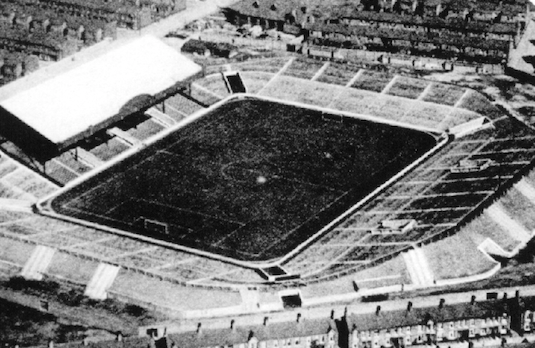
For post 72 in my Maine Road 100 countdown and today I wanted to show this image of the old ground photographed during the summer of 1982 when the Main Stand roof was being replaced. The white barrelled roof was about to be erected but first the old roof, part of which was the original 1923 structure, had to be removed.
This 1971 image shows the roof being removed (number 1) and the new roof would then stretch over the uncovered section (2).
Maine Road aerial 1971 from Farewell To Maine Road
While you’re here why not subscribe to my site and you can then access every article, interview, audio recording etc. already posted and those that will be posted during your subscription. It costs £20 per year (about £1.67 a month) or you can sign up on a monthly basis at £3 per month (you can cancel at any time, so you could sign sign up for a month, access everything you want and then cancel). You can subscribe below:
Subscribe to get access – Annual
Read more of this content when you subscribe today.
It’s day 25 of my posts counting down to the centenary of Maine Road’s opening game. Today – the Maine Road cage!
For years the front of the Main Stand at Maine Road was a simple doorway above a set of stairs. There was nothing particularly remarkable about it, although there was a wonderful mosaic above the entrance. However, by the early 1970s vandalism was taking its toll and the doorway was perceived as being particularly vulnerable. Whether it was or not is open to debate but the decision was taken in the 1970s to solve the problem by erecting a cage around the main entrance. These images of John Bond and John Benson show the cage as it looked in 1983.
John Bond, 1983
The ‘Sponsor a Match’ sign covers the original central mosaic. You can read about that here:
When City fans demonstrated during the 1980s and beyond the cage doors would be closed and locked to prevent fans from getting in to the offices, though they didn’t always manage it in time as this image shows:
Mirrorpix photo
In this image below John Benson and John Bond are stood in front of the players’ entrance which, at this time, was not within the cage (a later development changed that). I find it remarkable that the door for the players to go through was seen as being less important and that the players would not be protected.
John Benson and john Bond, 1983
For those unfamiliar with Maine Road this photo may help. The main entrance was on the Maine Road side of the Main Stand, above number 1.
Maine Road aerial 1971 from Farewell To Maine Road
If you’d like to read more on the history of Maine Road, take a look at Farewell To Maine Road, which can be downloaded from this page:
If you enjoy all the free material on my website and would like to support my research and keep this website going (but don’t want to subscribe) then why not make a one-time donation (or buy me a coffee). All support for my research is valued and welcome. It allows me to keep some free material available for all. Thanks.







 Gary James' Football Archive