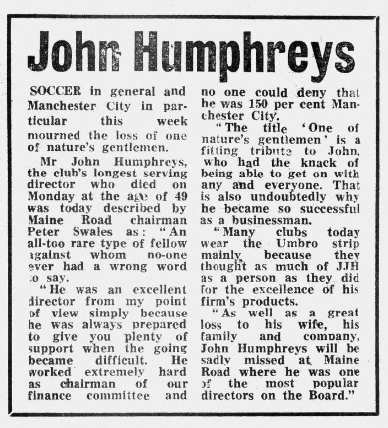
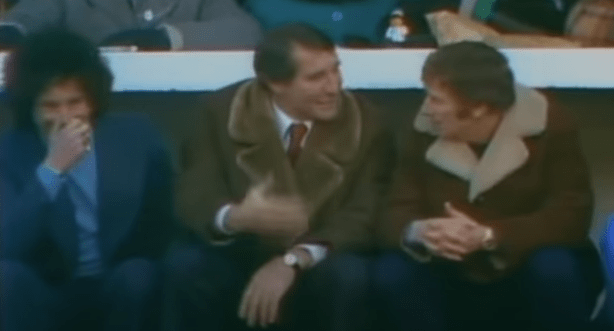
On this day (17 February) in 1979 the Manchester Evening News carried the news that Umbro & Manchester City director John Humphreys had died. His death was a major loss to both organisations. I wrote this about John in my 1997 history of the club Manchester The Greatest City:
This series of articles and features on Manchester City in the 1970s has been running throughout January and now into February with indepth articles some days and smaller ‘on this day’ style posts on others. Every day in January & February offered something to enjoy and I’ll continue this series for a little while yet. Thanks for all the positive comments about it.
Subscribers can access everything. If you want to know more on this incredible decade for Manchester City Football Club then why not subscribe and read it all? You could even subscribe for a month and see what you think. The following 5,700 word article is on the 1978-79 season and is available to subscribers below. Enjoy!
Subscribe to get access – Monthly
Read more of this content when you subscribe today. It costs £3 per month (cancel anytime) to access everything posted since 1 October 2022 or there’s a special annual rate below which gives greater access and works out much cheaper.
Read more of this content when you subscribe today. It costs £3 per month (above) or £20 a year (here) to access everything posted since the site was created in December 2020. This special rate works out about £1.67 a week and gives access to everything posted, including PDFs of 3 of my books.
If you enjoy all the free material on my website and would like to support my research and keep this website going (but don’t want to subscribe) then why not make a one-time donation (or buy me a coffee). All support for my research is valued and welcome. It allows me to keep some free material available for all. Thanks.
The series of features/articles covering Manchester City in the 1970s continues with an article on Tony Book’s time as manager. Tony Book had arrived at Maine Road in 1966 and captained City to phenomenal success. When he arrived at City Book was 32: “I hoped I’d get a couple of years and I would have been very happy with two years at City, of course. Because of what happened and the way the success came in my second year, I felt I could go on again. Winning the League in 1968 was like a spark and I wanted to keep the flame going.”
Book lifted more trophies as captain than any other Blue, until the incredible success experienced during Vincent Kompany’s time. Back in 2015-16 as Kompany was nearing Book’s record, Book told me: “Next time he lifts a major trophy he’ll have matched my record as captain. I hope that success comes soon, and that he then goes on to pass my record this season.”
In 1973-74 Book became manager of City for the final month of the season – a spell that was noteworthy for the infamous Manchester derby when Denis Law netted against United in the Reds’ relegation match. In the years that followed, Book developed a squad of real talent, blending well-regarded internationals with enthusiastic youth to create a flamboyant and entertaining team.
Book’s second full season saw his team of entertainers annihilate United 4-0 in the 4th round of the League Cup – on a night remembered more for the devastating injury to Colin Bell – and progress to the competition’s final where they defeated Newcastle 2-1. The victory meant Book was the first man to win the trophy as a player and as a manager. He said at the time: “Two weeks ago I met Gordon Lee (Newcastle manager) and we agreed that whoever won, it was more important for us to provide a good final. I think we have done that. This was my greatest moment. It was a tremendous final and Tueart’s goal was something special… quite out of this world.”
Looking back on 1976 Book believes the key to the success lay in City’s preparation: “We wanted everything to be low key and travelled down early in the week. We did simple training and tried to build an environment around us that was positive. It worked well and by the day of the final we were ready.”
City were missing Kenny Clements, and Colin Bell was still out of action, causing Book to bring youngster Ged Keegan in. There had been media talk that Keegan and another youngster, Peter Barnes, would feel the pressure but Book felt differently: “I had total faith in my lads. Barnes scored the first – in a move that we’d worked on in training – and Keegan more than justified his place. I never had a doubt.”
Book managed City through one of the club’s most exciting periods: “As a manager I was proud that in five years we won the League Cup; finished runners up by a point to Liverpool; we were in Europe for three consecutive seasons; and we reached the quarter-finals of the UEFA Cup. I had some good players that came in – Dave Watson, Brian Kidd, Joe Royle, Asa Hartford – and did an excellent job for me.”
City fans loved what he had brought the club and at the 1976 League Cup homecoming they chanted ‘Tony, Tony’ repeatedly for some time. At various film shows over the last decade I’ve shown (together with Will McTaggart from the North West Film Archive) a rediscovered film of the homecoming parade which shows exactly what the success meant to the City boss: “I wanted to win the League Cup for them and I remember looking out over the crowd in Albert Square. They were celebrating and singing. Everything we did was for the fans. These fans have been so loyal over the years and they had made me so welcome when I arrived in 1966. Such a special club and wonderful fans. They deserved that success – and so many more for the way they stood by this club during the painful years that came later.”
Almost sixty years after he first arrived at City, Tony Book is still a regular and popular presence around the club: “I love this club and am grateful to all those who brought me here and involved me for so long. Whenever I’ve been given a job to do I’ve always tried to give my best.”
Book certainly represents all that is good about football and he is a powerful reminder of the successes Manchester City achieved during his captaincy and as manager.
This series of articles and features on Manchester City in the 1970s has been running throughout January with indepth articles some days and smaller ‘on this day’ style posts on others. Every day in January & February offered something to enjoy.
Subscribers have access to everything. If you want to know more on this incredible decade for Manchester City Football Club then why not subscribe and read it all? You could even subscribe for a month and see what you think. The following 1,700 word article is on the 1973-74 season and is available to subscribers below. Enjoy!
Subscribe to get access – Monthly
Read more of this content when you subscribe today. It costs £3 per month (cancel anytime) to access everything posted since 1 October 2022 or there’s a special annual rate below which gives greater access and works out much cheaper.
Read more of this content when you subscribe today. It costs £3 per month (above) or £20 a year (here) to access everything posted since the site was created in December 2020. This special rate works out about £1.67 a week and gives access to everything posted, including PDFs of 3 of my books.
If you enjoy all the free material on my website and would like to support my research and keep this website going (but don’t want to subscribe) then why not make a one-time donation (or buy me a coffee). All support for my research is valued and welcome. It allows me to keep some free material available for all. Thanks.
The series of features/articles covering Manchester City in the 1970s continues with this cutting from today (10 February) in 1979 where Junior Blues’ chairman Roger Reade answers critics about the lack of players at a couple of meetings. It’s a bit difficult to read because of the quality of the scan but hopefully you can appreciate the story.
Basically, Roger explains, players were normally available for Junior Blues branch meetings (note: these are district/branches linked to Supporters Club branches, not the main Junior Blues – what an incredible commitment to have players at both the main Junior Blues but also the branches too!). The plans were disrupted because Asa Hartford and Willie Donachie had been selected for Scotland AND on another occasion because Malcolm Allison returned as coach and insisted all the players were in a meeting with him instead.
Here’s the article:
This series of articles and features on Manchester City in the 1970s has been running throughout January and now into February with indepth articles some days and smaller ‘on this day’ style posts on others. Every day offered something to enjoy and I’ll continue this series for a little while yet. Thanks for all the positive comments about it.
Subscribers can access everything. If you want to know more on this incredible decade for Manchester City Football Club then why not subscribe and read it all? You could even subscribe for a month and see what you think. The following 5,700 word article is on the 1978-79 season and is available to subscribers below. Enjoy!
Subscribe to get access – Monthly
Read more of this content when you subscribe today. It costs £3 per month (cancel anytime) to access everything posted since 1 October 2022 or there’s a special annual rate below which gives greater access and works out much cheaper.
Read more of this content when you subscribe today. It costs £3 per month (above) or £20 a year (here) to access everything posted since the site was created in December 2020. This special rate works out about £1.67 a week and gives access to everything posted, including PDFs of 3 of my books.
If you enjoy all the free material on my website and would like to support my research and keep this website going (but don’t want to subscribe) then why not make a one-time donation (or buy me a coffee). All support for my research is valued and welcome. It allows me to keep some free material available for all. Thanks.
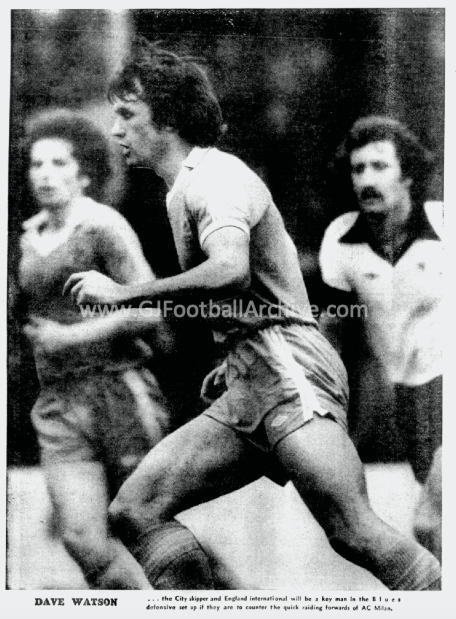
I can’t do a series of features/articles covering Manchester City in the 1970s without mentioning one of my greatest heroes – Dave Watson. Prior to Watson my heroes had been Rodney Marsh (my brother picked Colin Bell and we weren’t allowed to have the same hero!), then Dennis Tueart and then Dave Watson arrived in 1975 and, together with Dennis, he remained the hero forever more. Even a move away from City didn’t change my thoughts and for decades, probably until Vincent Kompany, City didn’t have a defender who could rival Watson for his consistency and determination.
I’ve been fortunate enough to meet Dave a few times over the years (I was lucky enough to sit next to him at the 2008 UEFA Cup final at MCFC – or at least my wife sat next to him; I was next to her) and I also interviewed him a few years back. In his presence he remained very much the hero and was a genuinely nice guy to chat to. Sometimes they say don’t meet your heroes but in Dave’s case he was everything I’d hoped him to be.
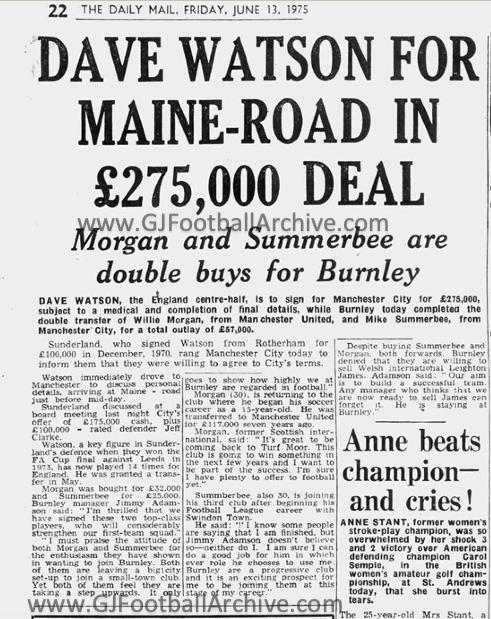
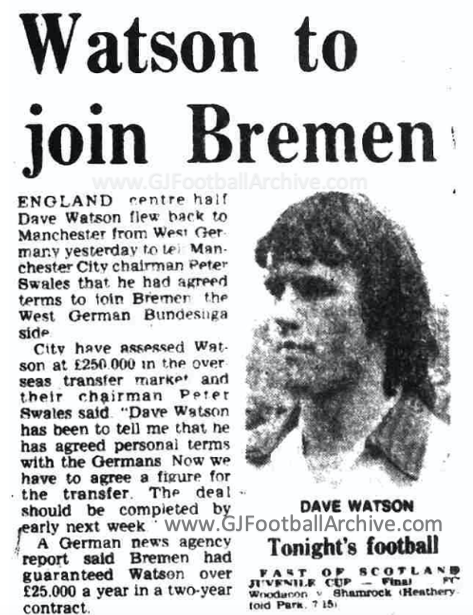
These two cuttings mark the beginning of his MCFC career and his end. Two simple newspaper articles that highlight transfers. That’s all. But as any City fan knows the years, games and moments in between were tremendous as Dave helped City find major success and also challenge in both the League and in Europe too.
You can find out more about Dave’s time at City by searching my website for his name or by following the links. The seasons Dave played for City are covered as part of my 1970s series. Subscribers get access to everything. If you want to know more on this incredible decade for Manchester City Football Club then why not subscribe and read it all? You could even subscribe for a month and see what you think. The following 5,320 word article is on the 1975-76 season and is available to subscribers below. Enjoy!
Subscribe to get access – Monthly
Read more of this content when you subscribe today. It costs £3 per month (cancel anytime) to access everything posted since 1 October 2022 or there’s a special annual rate below which gives greater access and works out much cheaper.
Read more of this content when you subscribe today. It costs £3 per month (above) or £20 a year (here) to access everything posted since the site was created in December 2020. This special rate works out about £1.67 a week and gives access to everything posted, including PDFs of 3 of my books.
If you enjoy all the free material on my website and would like to support my research and keep this website going (but don’t want to subscribe) then why not make a one-time donation (or buy me a coffee). All support for my research is valued and welcome. It allows me to keep some free material available for all. Thanks.
Today’s 1970s flashback includes video of a brilliant goal by Peter Barnes during the 3-0 victory over Spurs by MCFC on this day (3 February) in 1979. You can watch the goal and the others in this game here (these highlights were shown on LWT’s Big Match on 4 February 1979:
This series of articles and features on Manchester City in the 1970s has been running throughout January and into February with indepth articles some days and smaller ‘on this day’ style posts on others.
Subscribers can access everything. If you want to know more on this incredible decade for Manchester City Football Club then why not subscribe and read it all? You could even subscribe for a month and see what you think. The following 5,700 word article is on the 1978-79 season and is available to subscribers below. Enjoy!
Subscribe to get access – Monthly
Read more of this content when you subscribe today. It costs £3 per month (cancel anytime) to access everything posted since 1 October 2022 or there’s a special annual rate below which gives greater access and works out much cheaper.
Read more of this content when you subscribe today. It costs £3 per month (above) or £20 a year (here) to access everything posted since the site was created in December 2020. This special rate works out about £1.67 a week and gives access to everything posted, including PDFs of 3 of my books.
If you enjoy all the free material on my website and would like to support my research and keep this website going (but don’t want to subscribe) then why not make a one-time donation (or buy me a coffee). All support for my research is valued and welcome. It allows me to keep some free material available for all. Thanks.
The series of features/articles covering Manchester City in the 1970s continues with a 5,700 word article on the entire 1978-79 season – a season which saw City mount a UEFA Cup challenge and a former hero return (if only he hadn’t!). My article, like the other indepth pieces, contains material from interviews I have performed with many of the key figures – chairman, managers, players and others. You can read this below.
This series of articles and features on Manchester City in the 1970s has been running throughout January and now into February with indepth articles some days and smaller ‘on this day’ style posts on others. Every day in January offered something to enjoy and I’ll continue this series for a little while yet. Thanks for all the positive comments about it.
Subscribers can access everything. If you want to know more on this incredible decade for Manchester City Football Club then why not subscribe and read it all? You could even subscribe for a month and see what you think. The following 5,700 word article is on the 1978-79 season and is available to subscribers below. Enjoy!
Subscribe to get access – Monthly
Read more of this content when you subscribe today. It costs £3 per month (cancel anytime) to access everything posted since 1 October 2022 or there’s a special annual rate below which gives greater access and works out much cheaper.
Read more of this content when you subscribe today. It costs £3 per month (above) or £20 a year (here) to access everything posted since the site was created in December 2020. This special rate works out about £1.67 a week and gives access to everything posted, including PDFs of 3 of my books.
If you enjoy all the free material on my website and would like to support my research and keep this website going (but don’t want to subscribe) then why not make a one-time donation (or buy me a coffee). All support for my research is valued and welcome. It allows me to keep some free material available for all. Thanks.
It seems that some have a view that the giant clubs remain giant clubs forever and that there are some clubs who have only recently become prominent. Others believe that teams that were giants decades before some of today’s major trophy winners were never actually that prominent. I could spend hours challenging those who hold these views and pointing out that teams such as Everton, Newcastle & City won major trophies before many of these clubs and were perceived as giants years earlier too (decades before in some cases!), but it doesn’t feel like they’d listen. Ah well! Instead as part of my series of features/articles covering Manchester City in the 1970s I’d like to post a few attendance details that may interest some.
The following are a list of the top seven best supported top flight clubs for the ten seasons prior to City’s relegation in 1983. The Manchester clubs are in bold and the numbers in brackets show each club’s league position that season. In addition if any of the clubs won the European Cup, UEFA Cup, ECWC, FA Cup or League Cup that is also listed in brackets.
AVERAGE ATTENDANCES – Top Tier 1973-74
42712 MUFC (21st); 42332 Liverpool (2nd & FA Cup winners); 38666 Leeds (1st); 33048 Birmingham (19th); 32861 Newcastle (15th); 30756 MCFC (14th).
AVERAGE ATTENDANCES – Top Tier 1974-75
45966 LFC (2nd); 40021 Everton (4th); 34822 Leeds (9th); 34614 Newcastle (15th); 32898 MCFC (8th); 30854 Birmingham (17th); 29872 West Ham (13th & FA Cup winners). Both Manchester United (48387) and Sunderland (29931) were in Division Two but had an average higher than some of those in the top seven top tier averages.
AVERAGE ATTENDANCES – Top Tier 1975-76
54750 MUFC (3rd); 41623 Liverpool (1st & UEFA Cup winners); 38874 Aston Villa (16th); 34280 MCFC (8th & LC winners); 33060 Newcastle (15th); 31511 Leeds (5th); 28350 Derby (4th). Sunderland in Division Two had an average of 31250.
AVERAGE ATTENDANCES – Top Tier 1976-77
53710 MUFC (6th & FA Cup winners); 47221 Liverpool (1st & European Cup winners); 40058 MCFC (2nd); 37903 Aston Villa (4th & LC winners); 33599 Newcastle (5th); 32743 Sunderland (20th), 32671 Arsenal (8th).
AVERAGE ATTENDANCES – Top Tier 1977-78
51860 MUFC (10th); 45546 Liverpool (2nd & European Cup winners); 41687 MCFC (4th); 39513 Everton (3rd); 35464 Aston Villa (8th); 35446 Arsenal (5th); 32501 Nottm Forest (1st & LC winners). Tottenham were in Division Two with an average of 33417.
AVERAGE ATTENDANCES – Top Tier 1978-79
46430 MUFC (9th); 46407 Liverpool (1st); 36371 Arsenal (7th & FA Cup winners); 36203 MCFC (15th); 35456 Everton (4th); 34902 Tottenham (11th); 32838 Aston Villa (8th).
AVERAGE ATTENDANCES – Top Tier 1979-80
51608 MUFC (2nd); 44586 Liverpool (1st); 35272 MCFC (17th); 33596 Arsenal (4th); 32018 Tottenham (14th); 29794 Crystal Palace (13th); 28711 Everton (19th).
1979-80 League table and attendance detail up to 26/4/1980
AVERAGE ATTENDANCES – Top Tier 1980-81
45071 MUFC (8th); 37547 Liverpool (5th & LC winners); 34117 Aston Villa (1st); 33587 MCFC (12th); 32480 Arsenal (3rd); 30724 Tottenham (10th & FA Cup winners); 26477 Sunderland (17th). West Ham were in Division Two with an average of 27140.
Kippax Stand c.1980
AVERAGE ATTENDANCES – Top Tier 1981-82
44571 MUFC (3rd); 35100 Tottenham (4th & FA Cup winners); 35061 Liverpool (1st & LC winners); 34063 MCFC (10th); 26780 Aston Villa (11th & European Cup winners); 26585 West Ham (9th); 25589 Arsenal (5th).
1981 City v United Maine Road
AVERAGE ATTENDANCES – Top Tier 1982-83
41552 MUFC (3rd & FA Cup winners); 34758 Liverpool (1st & LC winners); 30581 Tottenham (4th); 26789 MCFC (20th); 24153 Arsenal (10th); 23748 Aston Villa (6th); 22822 West Ham (8th). Second Division Newcastle attracted an average of 24166.
Fans storming the main entrance in 1983. Mirrorpix photo
For those wondering Manchester City did drop a little in terms of position in the attendance chart during their Second Division days but they were still the 6th best supported club (of all clubs) in 1983-84 and 8th best in 1984-85. Back in Division One in 1985-86 the Blues were once again the 4th best supported team in the entire League.
This series of articles and features on Manchester City in the 1970s has been running throughout January with indepth articles some days and smaller ‘on this day’ style posts on others. Every day in January will offer something to enjoy.
Subscribers will get access to everything. If you want to know more on this incredible decade for Manchester City Football Club then why not subscribe and read it all? You could even subscribe for a month and see what you think. The following 1,600 word article is on the 1974-75 season and is available to subscribers below. Enjoy!
Subscribe to get access – Monthly
Read more of this content when you subscribe today. It costs £3 per month (cancel anytime) to access everything posted since 1 October 2022 or there’s a special annual rate below which gives greater access and works out much cheaper.
Read more of this content when you subscribe today. It costs £3 per month (above) or £20 a year (here) to access everything posted since the site was created in December 2020. This special rate works out about £1.67 a week and gives access to everything posted, including PDFs of 3 of my books.
If you enjoy all the free material on my website and would like to support my research and keep this website going (but don’t want to subscribe) then why not make a one-time donation (or buy me a coffee). All support for my research is valued and welcome. It allows me to keep some free material available for all. Thanks.
The 1978-79 season had promised so much with City progressing to the UEFA Cup quarter final before Christmas. However, before that game could be played a series of worrying results and agitation from director Ian Niven caused City to bring back former assistant manager Malcolm Allison in January 1979. Big Mal, as he liked to be termed by this time, was expected to give a bit of a boost but it didn’t quite work out like that.
A league game with Leeds ended 1-1 then a FA Cup tie with Rotherham saw a shock goalless draw at Maine Road. The Blues received significant criticism and two days later the media waited for a shock FA Cup giant killing at Rotherham. It didn’t happen as City won the match 4-2 with Brian Kidd netting twice and goals from Gary Owen and Peter Barnes. It wasn’t a straightforward win though, as this report shows. The game was played on this day (17 January) in 1979.
If you enjoy all the free material on my website and would like to support my research and keep this website going (but don’t want to subscribe) then why not make a one-time donation (or buy me a coffee). All support for my research is valued and welcome. It allows me to keep some free material available for all. Thanks.
On this day (30 December) in 1978 if you just happened to be in New York you could watch Manchester City v Southampton in the All Star Soccer programme (or should that be program?) while you waited for Steve Austin, the six million dollar man later that day.
The game actually took place on 9 December, so there’s a good chance you’d have known the result. I won’t spoil it though as you can see highlights of the game here (5m 33secs in to this review of 1978-79):
Following the unveiling of the Bell, Lee and Summerbee statue earlier this week I’ve decided to re-publish here interviews I did with each player at some point over the last decade or so. These interviews are written in a question and answer style and I hope they help give a flavour of each man. For older fans it’s a chance to remember them in their pomp. Today it’s the turn of Mike Summerbee. I’ve never posted this before on here – It’s an interview I did with him City in April 2005. This was published in the City match programme back then and you can read Mike’s views on his career here as published at the time. Enjoy!
Mike Summerbee was the second player, after Ralph Brand to join Joe Mercer’s City in 1965. Over the following decade he became a major star and played a significant role throughout the Mercer-Allison glory years. Always the entertainer, Mike featured in the classic footballing wartime adventure film “Escape To Victory” and today assists the Club’s commercial activities. Last week author Gary James caught up with him at the Manchester City Experience.
Let’s start with “Escape To Victory”. How did you get involved in the filming of that movie?
It was Bobby Moore who got me involved. We’d known each other since I was 16, and we both had a similar outlook. The makers of the film had got several Ipswich Town players involved, plus Pele and of course Bobby. They needed another familiar British player and Bobby suggested me. He called me and said: “How do you fancy being in a movie with Michael Caine?” And that was it. Within three weeks I was on my way to Budapest for filming. I had no idea at the time that this would become one of those films still being shown and talked about twenty odd years later, but it has become a cult movie with websites dedicated to it. It’s the sort of film that many other people would have wanted to be in. I know for a fact that Rod Stewart wanted to be in it.
Why do you think the film is remembered so affectionately?
I don’t want to give too much away – everyone should come to our special showing and see the movie and hear my reasons then – but the film is like a Boys’ Own adventure. It’s got drama, excitement, and is a traditional film. It doesn’t rely on bad language, sex, or extreme violence, and it really does appeal to everyone. Don’t forget it also contains some great actors – everyone remembers Stallone and Caine but look at the other cast members as well – and then there are some very well known footballers including Pele.
I loved making the film and one of the great aspects for me was that when we came to the football scenes we were told to go out and play the game. John Huston – a great director – wanted it to look as realistic as possible and so we played a real game. Inevitably we had spells concentrating on tackling or shooting but much of the game came from real play. Pele’s wonderful overhead kick goal was natural and was done only once. We didn’t take ages setting up, re-shooting etc. It was done for real and only in one take. John Huston had cameras everywhere and tried to make sure everything that took place on the pitch was filmed from every angle. That makes it so much more real.
You have a speaking part in the film, did you know about that before you accepted?
We were told to let the actors act and they were told to let the footballers play. That way we all did what we were good at. Then when it came to the dressing room scenes Michael Caine said to Huston that it didn’t feel right for only the actors to talk and he said that a couple of us should speak. When it came to half time, I congratulated a couple of players on their play – that was natural not planned – and that stayed in, and then other lines were given to us. It felt strange, but when you watch the film it makes much more sense to have us speaking. I loved making the film and there are so many different aspects to talk about, but we’ll save that for the 5th May event.
Moving back to your playing career, we all know that you came from a footballing family, but did that mean it was something you had to do?
My dad played professionally and so from an early age it seemed natural to play. All boys loved playing back then anyway, so there was nothing strange about that, but I suppose when you are young whatever your father does has a greater importance. My brother was a better player than I, although he stopped playing when my Dad died, and we used to play whenever and wherever we could. I’d get to school as early as possible – not for the lessons, I was a dunce! – but for the kickabout. We’d have a tennis ball and play until we had to go in. I also played cricket, athletics and other sports, but football was my best.
Your progression into professional football seems rapid – you were a key feature of the Swindon team in your teens – were there any setbacks?
I’d had a spell at Bristol City when I was 15, but I was so homesick I had to give up on it. My mother worried about me and suggested I kept out of the game. She knew about the problems and difficulties a footballer could have because of my father’s career, and then the opportunity came with Swindon and everything started going right for me. I joined them at a time when they were ready to give youth a chance and I made my debut at 17.
Was life relatively easy for you then?
The life of a footballer was not as glamorous or financially rewarding as it is today. I loved playing and I loved the camaraderie of it all, but we all had to have other jobs to keep us going outside of the season. I used to end up working for the Corporation cutting grass, painting, oddjobs, and digging graves! It kept you in touch with the fans – both the living and the dead! – and I actually loved all of that time. We didn’t have flash cars or anything then. In fact Ernie Hunt and I had a tandem, and we used to cycle together on our tandem to the ground. It was a great, fun time, and I have very fond memories of it all.
One of the significant angles is that Joe Mercer was interested in signing you from fairly early in your career, were you aware of his interest?
To some extent yes. Joe had played with my father at Aldershot, and then Swindon played Joe’s Aston Villa in a testimonial game. We won and I scored a couple, and Joe even played wing-half for Villa. After that I was told he wanted to sign me for Villa and that he’d made a bid but nothing further happened. I don’t know if it was problems at Villa or what but some time after that Joe moved on, and then in 1965 he got the City job. I was in Torquay and I gave him a call – I thought it was time to make the move and chance my arm a little. Joe said he’d be in touch. Then serious interest came from City and I was off.
Did City mean much to you as a boy?
Because of where I lived I’d travel to Birmingham to watch games and whenever City played Villa I used to enjoy seeing Bobby Johnstone, Ken Barnes, Bert Trautmann and the rest. They were such a great and in many ways glamorous side to watch, and the pale blue shirt – a colour I still don’t believe we’ve managed to recreate properly – was so memorable. No other side could match that colour and City were unique. All of those great memories were in my head and I was desperate to play for City when Joe came here. Although they were in Division Two when I arrived they were a major, major side with a great stadium. I loved Swindon, but City were something else.
Everyone talks about the atmosphere around the place, how did you find it?
Joe lifted the spirits of everybody, that was clear, and Malcolm Allison was so ahead of his time and knew all about psychology. He knew what players needed, and he always knew the best way of getting more out of me was by winding me up. I think I was a consistent player, and at half time in one game we’d had a bit of a bad spell. I’d played well, but one or two players had struggled and we all knew it, but in the dressing room Mal went up to the two players and told them they were doing well and that they just had to keep plugging away. He was boosting their confidence I guess and they certainly were more confident in the second half. When he came to me he said I was playing the worst game ever and that I was letting everybody down! It wound me up so much I had a go back at him, and then when we got on the pitch I pushed and fought for everything to prove how wrong he was and I gave 120% – his trick had worked!
During your first year at City (1965-66) England manager Alf Ramsey came to watch you play, and eventually you became the first City man since Don Revie in 1956 to play for England. Were you aware of the attention?
When Ramsey came to watch me the attention was good and, considering Alf concentrated on his ‘wingless wonders’, it was great for me a winger to be considered. I’d been included in the squad from almost immediately after the World Cup win, then I made my England debut against Scotland at Hampden (February 1968) in front of about 150,000, alongside the likes of Moore & Charlton. I was very nervous but they helped to calm me and at half time both Bobbys told me I was doing well, so that helped. In the end every one of my England appearances came at centre-forward, so I guess the style of play limited my opportunities, but I loved playing for England.
What was Alf Ramsey like as a manager?
He was definitely a ‘player’s manager’. He handled us well, and I believe that he was, in the end, treated appallingly be the FA. He treated us exceptionally well and he was a great man to play for – I don’t believe that England have ever managed to find a permanent manager who can match him. He had the same sort of authority as Joe Mercer, but they were different characters. Joe was wonderful with the media and the public, while Alf was primarily a players’ man. There was one time, we’d lost 2-0 at Katowice (1973) and I’d been on the bench. We were pretty down. Alf knew how low we were but because we were playing in Moscow a couple of days later he told everybody to get to bed early, no drinking or anything.
We all sneaked into Bobby Moore’s room and had a few gins. Sir Alf caught us and we thought he was going to have a go. He said: “I thought I’d told you not to drink! But in the circumstances I’ll have a large gin and tonic please.”
Throughout the Sixties and Seventies, City never seemed to fear any opposition, is that something that came from the players?
Obviously, Joe and Malcolm bred a certain atmosphere which boosted confidence. Whenever we played United we’d get to Trafford at 12.30 simply to soak up the atmosphere and to be ready. Mal would swagger to the Stretford End before the game to tell them how many we’d win by, and we’d go out there and match his score, although we used to encourage him to keep the expectation down a little! For us it didn’t matter whether we played Shankly’s Liverpool, Busby’s United, or any other team because we knew we were more than a match for any of them. Some of these teams possessed better individual players but, particularly at Old Trafford, we were always the better side. We had a great team spirit. People always talk about Lee, Bell and Summerbee like Charlton, Law and Best, but our side wasn’t about three players, it was about the whole team. Oakes, Pardoe, Young…. You know all the players. Unfortunately the 3 player line is a good one for the media to focus on, but for the players it was always about the team. I always think it’s wrong to talk about Lee, Bell, & Summerbee. We were part of a great, strong side and, although the 3 of us were well known, we needed that entire side to bring City success.
Finally, you’ve always been known as an entertainer, and always had a great rapport with fans and the media, presumably this is a very important aspect to your life?
As a player I used to meet the fans as often as possible – we all would. We’d have lunch in the old Social Club all mixed together, we’d attend supporters & Junior Blues meetings; take part in the pantomime every year; and generally be out and about. We also used to get on well with the media. The journalists were always good honest judges back then – people like Frank McGhee and Richard Bott always talked truthfully about your performance. If they said I’d had a bad game, I knew I had. They weren’t out to knock you, or to build you up. They spoke honestly and so I enjoyed talking with them.
Mike Summerbee receiving his OBE from Prince William March 2023
For me football is entertainment and the game itself is sometimes less important than everything that surrounds it. I don’t miss playing, but I do miss the camaraderie we had. I miss the team spirit we had with City, England, and even during the filming of Escape To Victory. It’s the same camaraderie fans feel on the terraces. That’s why I enjoy my involvement with the Club today because it’s all about the fans, the City spirit, and the wonderful life that surrounds the game.
Subscribe to access great content and support Gary’s research
If you’ve enjoyed this piece then why not subscribe and read the rest of the great material on here. At the same time you’ll be supporting my research and writing (I’m not employed by anyone and my research/writing is self-funded). It costs £3 per month (here; access everything posted since 1 October 2022) or £20 per year (below; access everything posted since December 2020). You’ll also get to read all content posted during your subscription. Thanks.
Subscribe to access great content and support Gary’s research
If you’ve enjoyed this piece then why not subscribe and read the rest of the great material on here. At the same time you’ll be supporting my research and writing (I’m not employed by anyone and my research/writing is self-funded). It costs £3 per month (above) or £20 per year (here; access everything posted since December 2020). You’ll also get to read all content posted during your subscription. Thanks.




 Gary James' Football Archive