Scored in Consecutive Games for Manchester City

I’ve received separate queries from two major national media outlets today asking whether a record will be set if Semenyo scores in his third consecutive game. They wondered if any player had scored on his debut and in his next two games. Hopefully he’ll play (and score!) against United on Saturday (17 January 2026) but, incredibly, that won’t in itself be a City record as there’s definitely one City player who scored in his debut and the three games that followed (4 consecutive games). There are also others who have netted on their debut and the two games that followed (three consecutive matches). Here are the facts…

One of the media companies mentioned Adebayor and the fact he scored on his debut and in the two League games that followed, making three consecutive scoring League games. That’s true he did, but there was a League Cup tie in between the 2nd and 3rd Premier League games and he didn’t score (he did play). That makes two consecutive games.

There are many City players who have scored in 2 consecutive games such as David Cross in 1982; Stan Bowles in 1967 etc. but there are a couple of players who scored in 3 successive games (regardless of competition) and there’s even a player who scored in 4 consecutive league games (no other game breaks his sequence).

The players/sequences are:

4 consecutive games – (all ‘old’ Div 2/2nd tier): Jimmy Ross – 4/3/1899 (2 goals v Barnsley) & 18/3/1899 (v Walsall) & 25/3/1899 (2 goals v Burton Swifts) & 31/3/1899 (v Gainsborough)

3 consecutive games – Billy McAdams – 2/1/54 (v Sunderland, top flight) & 9/1/54 (FAC, 3 goals v Bradford Park Avenue) & 16/1/54 (top flight v MUFC, so a potential parallel with Semenyo if he scores)

3 consecutive games (all top flight) – Jack Dyson – 8/10/55 (v Sheffield United) & 22/10/55 (penalty v Birmingham City) & 3/12/55 (v Burnley).

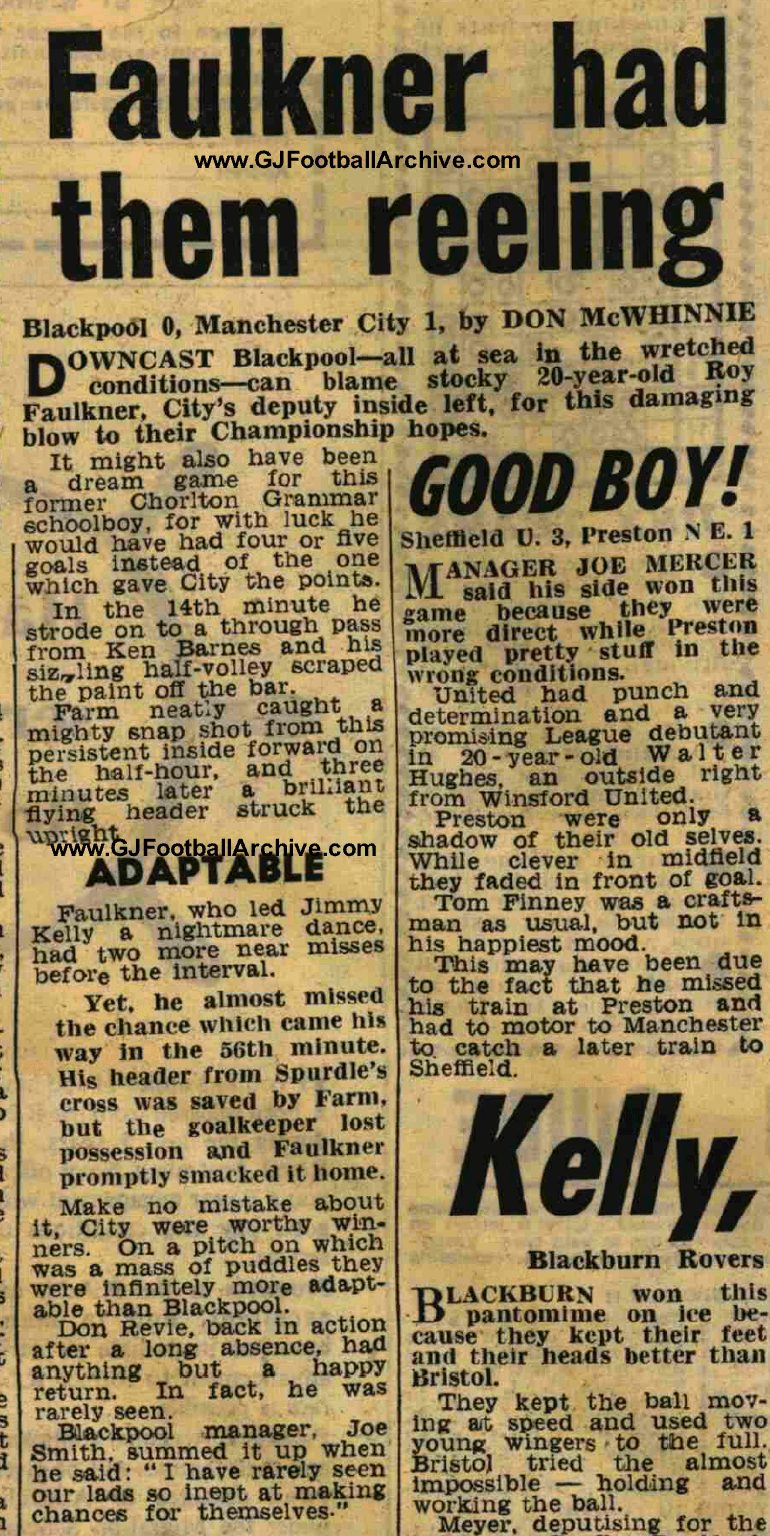
There was a big gap between Dyson’s 2nd and 3rd appearances. He’d got his first chance due to injury to striker Bobby Johnstone, then returned to the reserves. His next chance came when he was selected ahead of the great Don Revie (who was having issues behind the scenes with City’s management). Dyson then kept his place for most of the season.

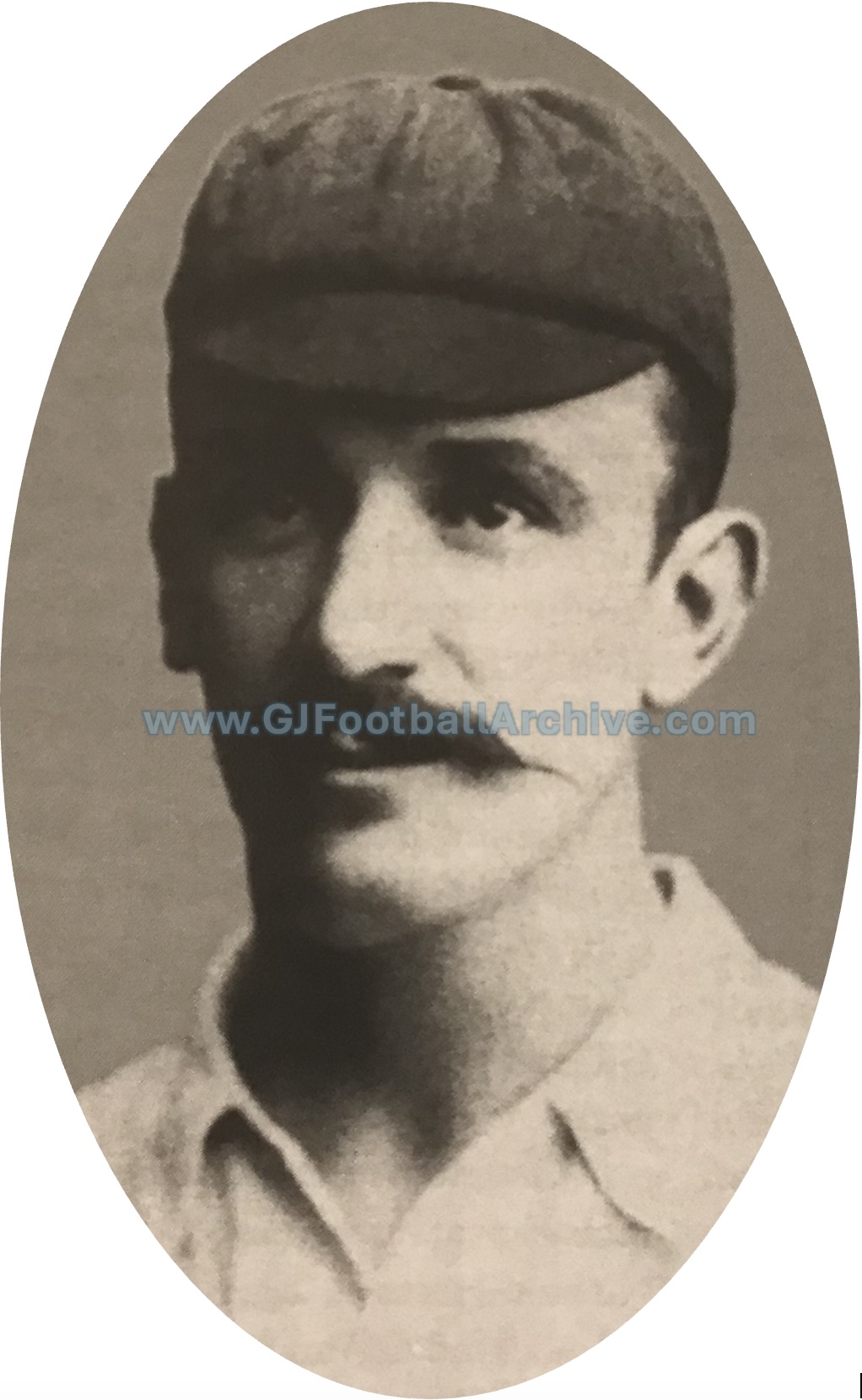
I have to stress I don’t have a comprehensive list of players who scored on their debut and then went on to have a sequence of scoring but I do feel the above are worthy of mention. Jimmy Ross is an interesting figure – he was one of the Preston Invincibles in 1888-89 and scored 7 (occasionally reported as 8) v Hyde in Preston’s 26-0 victory over Hyde in the FA Cup. Ross was a teammate of the brilliant Billy Meredith at City and Meredith often claimed his success back then was down to Ross. Sadly Ross died in 1902 while still a City player.

You can read more on Jimmy Ross here:

A Magazine Advert from 1978

Here’s a magazine advert from November 1978 which gives mention to Manchester City. The brewery involved had no connection to City at the time, so it may seem remarkable to some but back then the fact City had won the FA Cup in the same year as a canned beer was launched in the UK was too good for an ad agency to miss. They could have picked the 1956 League champions (Manchester United) but maybe their spell in the Second Division (promoted in 1975) or the stories of crowd disorder that had dogged United during this era may have given more of a negative angle for the beer.

If you’d like to find out more about Manchester City in the 1970s then take a look at the following 5,700 word article on the entire 1978-79 season – a season which saw City mount a UEFA Cup challenge and a former hero return (if only he hadn’t!). My article, like most of my other indepth pieces, contains material from interviews I have performed with many of the key figures – chairman, managers, players and others. You can read this below.

The article is available to subscribers below. Enjoy!

Subscribe to get access – Monthly

Read more of this content when you subscribe today. It costs £3 per month (cancel anytime) to access everything posted since 1 October 2022 or there’s a special annual rate below which gives greater access and works out much cheaper.

Subscribe to get access – Annual

Read more of this content when you subscribe today. It costs £3 per month (above) or £20 a year (here) to access everything posted since the site was created in December 2020. This special rate works out about £1.67 a week and gives access to everything posted, including PDFs of 3 of my books.

If you’d like to know more about subscribing then see:

If you enjoy all the free material on my website and would like to support my research and keep this website going (but don’t want to subscribe) then why not make a one-time donation (or buy me a coffee). All support for my research is valued and welcome. It allows me to keep some free material available for all. Thanks.

Choose an amount

£2.50
£5.00
£7.50

Or enter a custom amount

£

Your contribution is appreciated.

Donate

Albert Alexander (Junior): MCFC Chairman

Back in the late 1960s there was a popular Manchester City chairman whose family had been involved with the club since the very beginning of the club. That was Albert Alexander. Here’s a profile I wrote in 2012 on him. It’s about 900 words long and is free to read. Enjoy!

Albert Alexander was the second generation of the Alexander family to play a prominent role in the development and history of Manchester City.  His father, also Albert, had been involved with the Club from the 1890s and had held various positions including vice-chairman, and even manager for a spell in 1925-26.

Like his father, the younger Albert dedicated his life to the Blues.  Inevitably, he spent most of his boyhood watching the Club develop and, as he grew, he became more involved with behind the scenes work at the Club’s first home Hyde Road.  He was a member of the Ground Committee which performed crucial activities such as stewarding and ground maintenance.

Alexander also managed the Club’s A team and provided support in whatever way necessary to ensure the Blues succeeded.  He was more than happy to work through the ranks and take on any duty necessary.  His son Eric, who was Chairman in the early 1970s, remembers that his father had suffered during the First World War but that didn’t stop him from putting his energies into the Blues:  “He was a very good footballer and cricketer but he was gassed in the Great War and had to give it up.  It affected him throughout his life, although it’s fair to say he recovered enough to fulfil a happy normal life apart from playing of course. 

“He took up golf, but his love for football was such that he started the ‘A’ team at City.  He started it in 1921 and ran it through until 1963.  He enjoyed working with the youngsters and developing them.  He gained an awful lot of satisfaction from that, particularly when players like Matt Busby developed their skills and style as part of the ‘A’ team.”

Ultimately, after many years of loyal service Alexander became a City director.  This came after the Blues became aware that Manchester United were hoping he would join their board.  It is highly likely Alexander would have turned the Reds down, and it was appropriate that he became a director at Maine Road.  It was an honour he deserved for years of dedication to the City cause.

While director he felt the passion all fans feel for the Blues and he also felt the pain and worries during the Club’s struggles in the early Sixties.  He wanted better and, in 1965 as fans demonstrated following City’s lowest attended League game, he came out to face them and talk with them about his hopes and ambitions for the Club.  He apologised for City’s appalling decline.  It says much about his courage and the respect fans had for him that they dispersed.  It is doubtful whether any other director would have been respected in this manner at such a low point.

Understandably, Alexander who was City’s Chairman by this point wanted to see his side successful and later that summer he appointed Joe Mercer as manager.  It was a brave decision as Mercer had been out of work for a year and had suffered a stroke at Aston Villa.  Other names, such as former City hero Peter Doherty and Liverpool manager Bill Shankly, had been expected to be appointed by the media, so this move could easily have been seen negatively.

Alexander guided City through the successful years of the Mercer-Allison period and was probably the first Chairman to be hugely popular with fans.  Everyone seemed to love ‘Little Albert’ as Mercer dubbed him.

Many of City’s achievements during these years were dedicated to Alexander by Mercer, while journalist Bill Fryer commented in 1970:  “He is highly revered in the game and by the public, and I have no doubt good deals have been done for City out of Albert’s friendships because in reality the whole of football is a ‘club’.”

Sadly, despite the Chairman’s popularity, his final years saw him suffer at the hands of the 1970 takeover battle.  Alexander found out about the takeover when he received a knock on his door at breakfast one day.  It was a complete shock to him.

The takeover destroyed much that was good about City at this point, including the Mercer-Allison partnership.  However, it is rarely mentioned how the takeover affected Alexander, the man who had guided City with distinction through some dark days when no one else wanted to know.  He had taken the Club from the lowest point it had experienced since joining the League, to a position of strength with trophies galore.  Those bidding for control wanted the glory, Alexander’s motives were somewhat different – like all true fans he wanted City no matter what. 

Alexander stood down as Chairman and was made Life President – an honour first given to Lawrence Furniss seven decades earlier, proving the significance of this recognition.  Unfortunately, Alexander’s health was deteriorating by this point and he passed away soon after.

Manchester City owes a great deal to the dedication of Albert Alexander and the other members of his family.  The Alexanders helped guide the Blues from the 1890s through to the reign of Peter Swales, and in some ways on via the continuing involvement of Eric Alexander (still a regular attendee until his death in 2019).  Their contribution should never be forgotten.

If you enjoy all the free material on my website and would like to support my research and keep this website going (but don’t want to subscribe) then why not make a one-time donation (or buy me a coffee). All support for my research is valued and welcome. It allows me to keep some free material available for all. Thanks.

Choose an amount

£2.50
£5.00
£7.50

Or enter a custom amount

£

Your contribution is appreciated.

Donate

Subscribe to get access – Annual

Read more of this content when you subscribe today. It costs £20 a year to subscribe (it works out £1.67 a month) or £3 if you’d like to sign up a month at a time. Annual subscribers get full access for as long as you subscribe (you can always try it for a month). It’s worth bearing in mind that the 2010 Manchester A Football History cost £24.95 and all subscribers will be able to access all of that for as long as they are a subscriber (plus all the other stuff of course).

Subscribe to get access – Monthly

It costs £3 a month to subscribe a month at a time. Why not give it a try! Monthly subscribers get access to everything posted since 1 October 2022 for as long as you subscribe.

The City FC Flag

Anyone remember seeing the CITY F.C. flag that used to proudly fly above the Popular Side/Kippax. It was there for decades. There had been a CITY F.C. flag at Hyde Road and it may well be that this was the same flag. It was often referred to in the media during its life at Maine Road, such as in this 1925 cartoon:

The first derby at Maine Road
The City flag flying at Maine Road’s first Manchester derby

The flag flew proudly over the Popular Side until the stand was roofed in 1957. Then the flag was moved to the Scoreboard End, eventually disappearing in the 1960s when rumour has it that it was taken down by Liverpool fans. I’m not certain if that’s true and I’ve never found any evidence but if you do know more please let me know.

I do know that in the 1930s a disgruntled City fan lowered it during a difficult game and it caused outrage. It was mentioned in the local press and the culprit had to make a formal apology to the club and his fellow City fans.

This 1971 image shows the roofed Kippax Stand. The flag was originally on a flag pole roughly where the number 7 is in the days before the stand had a roof. When the Kippax was roofed it was moved to the back of the Scoreboard End. The North Stand (10) replaced the Scoreboard End in the early 1970s.

Maine Road aerial 1971 from Farewell To Maine Road

If you’d like to read more on the history of Maine Road, take a look at Farewell To Maine Road, which can be downloaded from this page:

If you enjoy all the free material on my website and would like to support my research and keep this website going (but don’t want to subscribe) then why not make a one-time donation (or buy me a coffee). All support for my research is valued and welcome. It allows me to keep some free material available for all. Thanks.

Choose an amount

£2.50
£5.00
£7.50

Or enter a custom amount

£

Your contribution is appreciated.

Donate

The 1950s: Sunderland v Manchester City

On this day (30 March) in 1956 Manchester City defeated Sunderland 3-0 before 40,394 at Roker Park. The City scorers were Joe Hayes and Don Revie (pictured with Ken Barnes and Johnny Williamson) plus an own goal. You can read more on this season below…

Here for subscribers is a 3,900 word article on the 1955-56 season when City won the FA Cup final (nowadays known as the Trautmann Final) and Bert Trautmann was FWA Footballer of the Year (presented in the days before the final). Enjoy!

You can read the article by subscribing below.

Subscribe to get access

Read more of this content when you subscribe today. It costs £3 per month or you can subscriber for the discounted annual rate of £20 per year. Each subscriber gets access to everything posted so far, including PDFs of a couple of my books.

The 1950s: The 1956 FA Cup Semi Final

On this day (17 March) in 1956 Manchester City defeated Tottenham Hotspur 1-0 in the FA Cup semi final with a goal from Bobby Johnstone. The game was watched by 69,788 at Villa Park and you can watch film of it here:

https://www.britishpathe.com/asset/60611/

You can read more on this season below…

Here for subscribers is a 3,900 word article on the 1955-56 season when City won the FA Cup final (nowadays known as the Trautmann Final) and Bert Trautmann was FWA Footballer of the Year (presented in the days before the final). Enjoy!

You can read the article by subscribing below.

Subscribe to get access

Read more of this content when you subscribe today. It costs £3 per month or you can subscriber for the discounted annual rate of £20 per year. Each subscriber gets access to everything posted so far, including PDFs of a couple of my books.

The 1950s: The 1955-56 Season

The new series on Manchester City in the 1950s continues today with this 3,900 word article on the 1955-56 season when City won the FA Cup final (nowadays known as the Trautmann Final) and Bert Trautmann was FWA Footballer of the Year (presented in the days before the final). Enjoy!

This is a subscriber article and you can read it by subscribing below.

Subscribe to get access

Read more of this content when you subscribe today. It costs £3 per month or you can subscriber for the discounted annual rate of £20 per year. Each subscriber gets access to everything posted so far, including PDFs of a couple of my books.

The 1950s: Starting Tomorrow!

Starting tomorrow I’ll be posting a series of articles on Manchester City in the 1950s. It will be similar to the series I’ve posted on the 1960s, 1970s, 1980s etc. The series will start with a subscriber article on the 1949-50 season – a season that saw Bert Trautmann make his City debut.

Bobby Johnstone Double

On this day (25 February) in 1956 Bobby Johnstone scored twice as Manchester City defeated Preston 3-0. Joe Hayes scored the other goal.

I’m contemplating writing a series of features on the 1950s as this decade is beginning to slip from living memory. We’ve lost almost all the players who played during that decade for City and maybe it’s time to post some of the interviews I did with the likes of Fagan, Barnes, Clarke, Little? What do you think? I’m always keen to hear from readers/subscribers to the site.

Les McDowall

Now that Pep Guardiola has managed his 500th Manchester City game (yes, I know he’s been ill and missed games but he’s still the manager when they occurred) here’s a brief look at the only manager ahead of his record at the club, Les McDowall (note: Les missed some games on scouting missions, so similar to Pep’s missed games?). Enjoy!

Les McDowall

June 1950 – May 1963

Previously:  Impressive wing-half for City during 40s.

Took Over From: Jock Thomson, who left in February 1950 as City headed towards relegation, but it is believed Wilf Wild with Fred Tilson filled the void between managers.

Inherited: Bert Trautmann, Roy Clarke, Joe Fagan & Johnny Hart.

Players Brought In Included: City’s talented forward Don Revie & inspirational captain Roy Paul.  Also Alex Harley & Peter Dobing.

Best Buy: For his role in the Revie Plan and long term commitment to the City cause – Ken Barnes.

Youngsters He Gave Debuts To: Joe Hayes, Dave Wagstaffe, John Benson, Neil Young, Alan Oakes & Glyn Pardoe.

First Game: Preston North End 2 City 4 (City scorers George Smith 2, Roy Clarke and Dennis Westcott), 19 August 1950, attendance 36,294.

High Points: Winning promotion during his first season; FA Cup finalists in 1955 & FA Cup winners in 1956 (and finishing fourth that season).

Coaches: Thirties stars Fred Tilson & Laurie Barnett.

Tactics: Became noted for tactical innovations such as the Revie Plan (although people assume this to be Revie’s idea the name came from the fact he was the key player; it had previously operated in the Reserves with Johnny Williamson in the role).  The Plan revolutionised City’s play and led to the mid-fifties success.   

Last Game: West Ham United 6 City 1 (City scorer Alan Oakes), 18 May 1963, attendance 16,602.

Season By Season Record:

League

1950-51 P 42            W 19   D 14    L 9      GF 89 GA 61 Pts 52             

1951-52 P 42            W 13   D 13    L 16    GF 58 GA 61 Pts 39             

1952-53 P 42            W 14   D 7      L 21   GF 72 GA 87 Pts 35             

1953-54 P 42            W 14   D 9      L 19    GF 62 GA 77 Pts 37             

1954-55 P 42            W 18   D 10    L 14    GF 76 GA 69 Pts 46             

1955-56 P 42            W 18   D 10    L 14    GF 82 GA 69 Pts 46             

1956-57 P 42            W 13   D 9      L 20    GF 78 GA 88 Pts 35             

1957-58 P 42            W 22   D 5      L 15    GF 104 GA 100 Pts 49       

1958-59 P 42            W 11   D 9      L 22    GF 64 GA 95 Pts 31            

1959-60 P 42            W 17   D 3      L 22    GF 78 GA 84 Pts 37            

1960-61 P 42            W 13   D 11    L 18    GF 79 GA 90 Pts 37            

1961-62 P 42            W 17   D 7      L 18    GF 78 GA 81 Pts 41            

1962-63 P 42            W 10   D 11    L 21    GF 58 GA 102 Pts 31

 2 points for a win

FA Cup

1950-51 P 1  W 0     D 0      L 1      GF 0   GA 2   Reached 3rd round

1951-52 P 2  W 0     D 1      L 1      GF 3   GA 6   Reached 3rd round

1952-53 P 3  W 1     D 1      L 1      GF 9   GA 6   Reached 4th round

1953-54 P 2  W 1     D 0      L 1      GF 5   GA 3   Reached 4th round

1954-55 P 6  W 5     D 0      L 1      GF 10 GA 4   Reached final

1955-56 P 7  W 6     D 1      L 0      GF 11 GA 4   FA Cup winners

1956-57 P 2  W 0     D 1      L 1      GF 5   GA 6   Reached 3rd round

1957-58 P 1  W 0     D 0      L 1      GF 1   GA 5   Reached 3rd round

1958-59 P 2  W 0     D 1      L 1      GF 3   GA 4   Reached 3rd round

1959-60 P 1  W 0     D 0      L 1      GF 1   GA 5   Reached 3rd round

1960-61 P 4  W 1     D 2      L 1      GF 4   GA 4   Reached 4th round

1961-62 P 2  W 1     D 0      L 1      GF 1   GA 2   Reached 4th round

1962-63 P 3  W 2     D 0      L 1      GF 3   GA 2   Reached 5th round

League Cup

1960-61 P 2  W 1     D 0      L 1      GF 3   GA 2   Reached 3rd round

1961-62 P 1  W 0     D 0      L 1      GF 2   GA 4   Reached 2nd round

1962-63 P 6  W 3     D 2      L 1      GF 10 GA 12 Reached 5th round

TOTAL (League & cup fixtures)

P591   W220  D127  L244   GF 1049        GA 1135

Trophies Won: FA Cup (1956) 

Other Competitive Fixtures: 1 Charity Shield game

They Said:  “Les McDowall was very much an old school manager – shirt & tie, office type.  You rarely saw him but when you did it was usually when he was unveiling one of his new tactical plans.  We had one where we played with 5 at the back and I had a number 7 shirt on.  He would probably have excelled in today’s game because he was absolutely driven with tactical formations.”  Defender Bobby Kennedy talking in 2005.

Followed By: George Poyser

After City: Became Oldham Athletic manager shortly after leaving City.  Died in August 1991 at the age of 78.