Anyone remember seeing the CITY F.C. flag that used to proudly fly above the Popular Side/Kippax. It was there for decades. There had been a CITY F.C. flag at Hyde Road and it may well be that this was the same flag. It was often referred to in the media during its life at Maine Road, such as in this 1925 cartoon:
The first derby at Maine RoadThe City flag flying at Maine Road’s first Manchester derby
The flag flew proudly over the Popular Side until the stand was roofed in 1957. Then the flag was moved to the Scoreboard End, eventually disappearing in the 1960s when rumour has it that it was taken down by Liverpool fans. I’m not certain if that’s true and I’ve never found any evidence but if you do know more please let me know.
I do know that in the 1930s a disgruntled City fan lowered it during a difficult game and it caused outrage. It was mentioned in the local press and the culprit had to make a formal apology to the club and his fellow City fans.
This 1971 image shows the roofed Kippax Stand. The flag was originally on a flag pole roughly where the number 7 is in the days before the stand had a roof. When the Kippax was roofed it was moved to the back of the Scoreboard End. The North Stand (10) replaced the Scoreboard End in the early 1970s.
Maine Road aerial 1971 from Farewell To Maine Road
If you’d like to read more on the history of Maine Road, take a look at Farewell To Maine Road, which can be downloaded from this page:
If you enjoy all the free material on my website and would like to support my research and keep this website going (but don’t want to subscribe) then why not make a one-time donation (or buy me a coffee). All support for my research is valued and welcome. It allows me to keep some free material available for all. Thanks.
On this day (30 March) in 1956 Manchester City defeated Sunderland 3-0 before 40,394 at Roker Park. The City scorers were Joe Hayes and Don Revie (pictured with Ken Barnes and Johnny Williamson) plus an own goal. You can read more on this season below…
Here for subscribers is a 3,900 word article on the 1955-56 season when City won the FA Cup final (nowadays known as the Trautmann Final) and Bert Trautmann was FWA Footballer of the Year (presented in the days before the final). Enjoy!
You can read the article by subscribing below.
Subscribe to get access
Read more of this content when you subscribe today. It costs £3 per month or you can subscriber for the discounted annual rate of £20 per year. Each subscriber gets access to everything posted so far, including PDFs of a couple of my books.
On this day (17 March) in 1956 Manchester City defeated Tottenham Hotspur 1-0 in the FA Cup semi final with a goal from Bobby Johnstone. The game was watched by 69,788 at Villa Park and you can watch film of it here:
Here for subscribers is a 3,900 word article on the 1955-56 season when City won the FA Cup final (nowadays known as the Trautmann Final) and Bert Trautmann was FWA Footballer of the Year (presented in the days before the final). Enjoy!
You can read the article by subscribing below.
Subscribe to get access
Read more of this content when you subscribe today. It costs £3 per month or you can subscriber for the discounted annual rate of £20 per year. Each subscriber gets access to everything posted so far, including PDFs of a couple of my books.
The new series on Manchester City in the 1950s continues today with this 3,900 word article on the 1955-56 season when City won the FA Cup final (nowadays known as the Trautmann Final) and Bert Trautmann was FWA Footballer of the Year (presented in the days before the final). Enjoy!
This is a subscriber article and you can read it by subscribing below.
Subscribe to get access
Read more of this content when you subscribe today. It costs £3 per month or you can subscriber for the discounted annual rate of £20 per year. Each subscriber gets access to everything posted so far, including PDFs of a couple of my books.
Starting tomorrow I’ll be posting a series of articles on Manchester City in the 1950s. It will be similar to the series I’ve posted on the 1960s, 1970s, 1980s etc. The series will start with a subscriber article on the 1949-50 season – a season that saw Bert Trautmann make his City debut.
On this day (25 February) in 1956 Bobby Johnstone scored twice as Manchester City defeated Preston 3-0. Joe Hayes scored the other goal.
I’m contemplating writing a series of features on the 1950s as this decade is beginning to slip from living memory. We’ve lost almost all the players who played during that decade for City and maybe it’s time to post some of the interviews I did with the likes of Fagan, Barnes, Clarke, Little? What do you think? I’m always keen to hear from readers/subscribers to the site.
Now that Pep Guardiola has managed his 500th Manchester City game (yes, I know he’s been ill and missed games but he’s still the manager when they occurred) here’s a brief look at the only manager ahead of his record at the club, Les McDowall (note: Les missed some games on scouting missions, so similar to Pep’s missed games?). Enjoy!
Les McDowall
June 1950 – May 1963
Previously: Impressive wing-half for City during 40s.
Took Over From: Jock Thomson, who left in February 1950 as City headed towards relegation, but it is believed Wilf Wild with Fred Tilson filled the void between managers.
Inherited: Bert Trautmann, Roy Clarke, Joe Fagan & Johnny Hart.
Players Brought In Included: City’s talented forward Don Revie & inspirational captain Roy Paul. Also Alex Harley & Peter Dobing.
Best Buy: For his role in the Revie Plan and long term commitment to the City cause – Ken Barnes.
Youngsters He Gave Debuts To: Joe Hayes, Dave Wagstaffe, John Benson, Neil Young, Alan Oakes & Glyn Pardoe.
First Game: Preston North End 2 City 4 (City scorers George Smith 2, Roy Clarke and Dennis Westcott), 19 August 1950, attendance 36,294.
High Points: Winning promotion during his first season; FA Cup finalists in 1955 & FA Cup winners in 1956 (and finishing fourth that season).
Coaches: Thirties stars Fred Tilson & Laurie Barnett.
Tactics: Became noted for tactical innovations such as the Revie Plan (although people assume this to be Revie’s idea the name came from the fact he was the key player; it had previously operated in the Reserves with Johnny Williamson in the role). The Plan revolutionised City’s play and led to the mid-fifties success.
Last Game: West Ham United 6 City 1 (City scorer Alan Oakes), 18 May 1963, attendance 16,602.
Season By Season Record:
League
1950-51 P 42 W 19 D 14 L 9 GF 89 GA 61 Pts 52
1951-52 P 42 W 13 D 13 L 16 GF 58 GA 61 Pts 39
1952-53 P 42 W 14 D 7 L 21 GF 72 GA 87 Pts 35
1953-54 P 42 W 14 D 9 L 19 GF 62 GA 77 Pts 37
1954-55 P 42 W 18 D 10 L 14 GF 76 GA 69 Pts 46
1955-56 P 42 W 18 D 10 L 14 GF 82 GA 69 Pts 46
1956-57 P 42 W 13 D 9 L 20 GF 78 GA 88 Pts 35
1957-58 P 42 W 22 D 5 L 15 GF 104 GA 100 Pts 49
1958-59 P 42 W 11 D 9 L 22 GF 64 GA 95 Pts 31
1959-60 P 42 W 17 D 3 L 22 GF 78 GA 84 Pts 37
1960-61 P 42 W 13 D 11 L 18 GF 79 GA 90 Pts 37
1961-62 P 42 W 17 D 7 L 18 GF 78 GA 81 Pts 41
1962-63 P 42 W 10 D 11 L 21 GF 58 GA 102 Pts 31
2 points for a win
FA Cup
1950-51 P 1 W 0 D 0 L 1 GF 0 GA 2 Reached 3rd round
1951-52 P 2 W 0 D 1 L 1 GF 3 GA 6 Reached 3rd round
1952-53 P 3 W 1 D 1 L 1 GF 9 GA 6 Reached 4th round
1953-54 P 2 W 1 D 0 L 1 GF 5 GA 3 Reached 4th round
1954-55 P 6 W 5 D 0 L 1 GF 10 GA 4 Reached final
1955-56 P 7 W 6 D 1 L 0 GF 11 GA 4 FA Cup winners
1956-57 P 2 W 0 D 1 L 1 GF 5 GA 6 Reached 3rd round
1957-58 P 1 W 0 D 0 L 1 GF 1 GA 5 Reached 3rd round
1958-59 P 2 W 0 D 1 L 1 GF 3 GA 4 Reached 3rd round
1959-60 P 1 W 0 D 0 L 1 GF 1 GA 5 Reached 3rd round
1960-61 P 4 W 1 D 2 L 1 GF 4 GA 4 Reached 4th round
1961-62 P 2 W 1 D 0 L 1 GF 1 GA 2 Reached 4th round
1962-63 P 3 W 2 D 0 L 1 GF 3 GA 2 Reached 5th round
League Cup
1960-61 P 2 W 1 D 0 L 1 GF 3 GA 2 Reached 3rd round
1961-62 P 1 W 0 D 0 L 1 GF 2 GA 4 Reached 2nd round
1962-63 P 6 W 3 D 2 L 1 GF 10 GA 12 Reached 5th round
TOTAL (League & cup fixtures)
P591 W220 D127 L244 GF 1049 GA 1135
Trophies Won: FA Cup (1956)
Other Competitive Fixtures: 1 Charity Shield game
They Said: “Les McDowall was very much an old school manager – shirt & tie, office type. You rarely saw him but when you did it was usually when he was unveiling one of his new tactical plans. We had one where we played with 5 at the back and I had a number 7 shirt on. He would probably have excelled in today’s game because he was absolutely driven with tactical formations.” Defender Bobby Kennedy talking in 2005.
Followed By: George Poyser
After City: Became Oldham Athletic manager shortly after leaving City. Died in August 1991 at the age of 78.
On this day (10 November) in 1956 the great Don Revie left Manchester City for Sunderland. Revie had been in and out of favour with manager Les McDowall for over a year, but fans recognised his qualities. Here for subscribers is a profile of Don. Enjoy.
Subscribe to get access
Read more of this content when you subscribe today. It costs £3 per month or there’s a special discounted rate of £20 a year. Subscribers have access to everything posted on the site, including PDFs or Manchester A Football History and my 1st book on MCFC (published in 1989).
I’m always conscious that time moves quickly within football and that names of legendary players that your parents were familiar with may not be known by your children. Today, as it was 101 years since his birth yesterday (he was born on 22 October 1923) I’m publishing here a brief folklore piece I did on Manchester City goalkeeper Bert Trautmann. Hopefully, some newer/younger football fans may be familiar with the name. If not this may help…
It is one of City’s greatest stories involving a true Blue legend and a remarkable example of how Manchester has always been a welcoming city. Bernhard Trautmann was born in Germany in 1923 and, as a keen young athlete, he became a member of the Hitler Youth. He had high hopes of representing Germany in the decathlon at the 1940 Olympic Games and went to Berlin for several training camps. Sadly, war was to end all possibility of him becoming an Olympic hero.
Indoctrinated throughout his teenage and early adult life, Trautmann became a paratrooper during World War Two. The simple facts of what followed are astounding:
After being captured and escaping from the Russians and the Americans, Trautmann became a Prisoner of War held by the British.
He began playing as a goalkeeper while a prisoner.
He joined St Helen’s Town.
City’s goalkeeping crisis meant the Blues were desperate for a ‘keeper, any ‘keeper!
Trautmann given chance and joined City.
Protests and season tickets returned in disgust, but some including Rabbi Altmann spoke in support
Known as ‘Bert’, Trautmann soon became a hero to City fans.
In 1955 he became the first German to play in the FAC final.
1956 he helped City win the FA Cup.
In the 1956 final Trautmann was outstanding, diving brilliantly at times and bravely often. With a little over 15 minutes left to play the ‘keeper made a daring save at the feet of Birmingham’s Murphy. The collision left Bert in tremendous pain and film of the final shows that his head and neck were at an odd angle. The ‘keeper bravely played on, despite obvious pain. No one knew the full extent of the dramatic injury and then a second collision occurred a short while later. These were the days before substitutes and City had been down to ten men the previous year. Bert knew that it had cost them the final, but the pain was excruciating.
City won the FA Cup and in the days that followed the full extent of Bert’s injury was revealed. It was claimed he had ‘broken’ his neck and that a slight knock could have killed him.
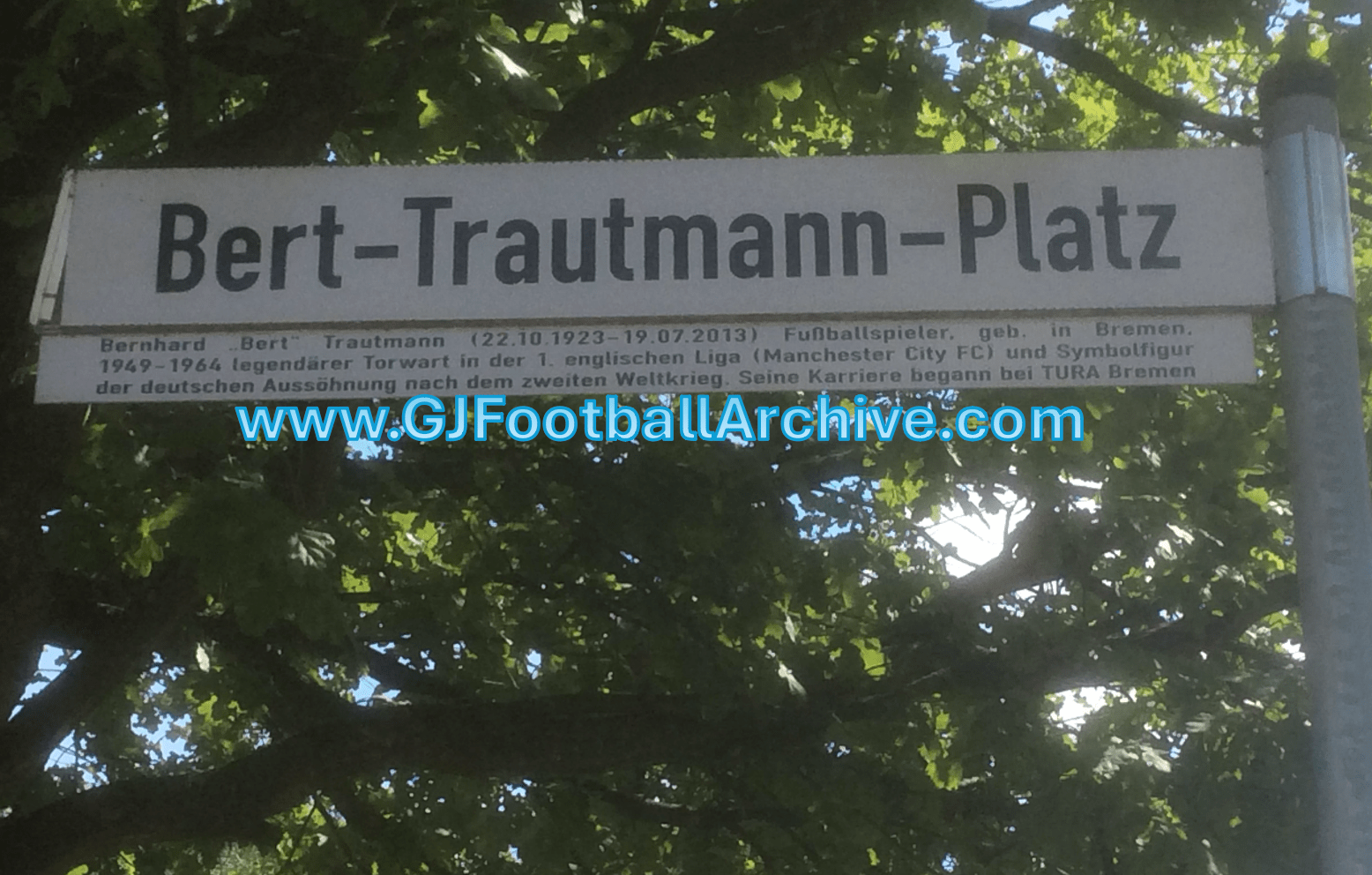
Bert’s home city of Bremen, Germany, is well worth a visit and his boyhood home is still standing. There is also a small square named after him, next to his first football club Tura Bremen – where he played as a midfielder! Significantly, the square uses the English version of his name, adding to the view that Trautmann did so much for Anglo-German relations.
Bert once told me “I was born in Germany but I grew up in Manchester”. Now his birth city recognises his significance to our city.
There’s a lot of furore this week about Manchester City’s decision to wear their new Oasis inspired kit instead of their home kit for their Champions League game with Inter Milan. Lots are talking about tradition, heritage and the like, so I thought I’d add a few words here that might have been overlooked or forgotten. So here goes…
Firstly, my position is clear that I’ve always been keen to see City wear home colours/blue for every fixture possible (whether home, away or at a neutral venue) but I’m a pragmatist and know that’s no longer likely. History and tradition does mean something but of course, when it comes to football, traditions change frequently. People may think City have only ever worn a particular colour at home or that the traditional away colours are red & black but these things are not true. Times change.
When it comes to wearing alternative kits at home it has been done more often than perhaps people realise. In fact the only decade when it hasn’t happened appears to be the 2010s – I say appeared because I haven’t got evidence of every home game in the 1890s and 1900s!
These last few days have caused some to recall the Middlesbrough game when David James went up front and the two Tottenham games at Maine Road in 80s/90s when the referee felt the kits were too close and City ended up changing. But there have been many other occasions. In fact it’s well over 100 years since City first chose to wear away colours/alternative strips at home when they didn’t need to!
The image above of Neil Young comes from the 1971 ECWC semi-final v Chelsea. Notice that Young is wearing City’s away colours.
Often when there was a clash of colours in a cup game City would wear their away strip. Games in the 1920s right through to 1970s saw the Blues don maroon, red/black and even scarlet at times at Maine Road.
Here’s another image from that Chelsea semi final:
1971 ECWC v Chelsea. Francis Lee. Photo by Alan Jubb
To the right you can see the North Stand under construction, as you can in the Young image.
Other games in living memory (not necessarily mine, but living memory for many older blues) include:
January 1971 – City v Wigan in FA Cup (red & black)
September 1970 – City v Bologna in Anglo-Italian Cup (red & black)
January 1968 – City v Reading in FA Cup (all maroon)
March 1966 – City v Everton in FA Cup (all maroon)
March 1966 – City v Leicester in FA Cup (all maroon)
March 1956 – City v Everton in FA Cup (maroon shirts, white shorts)
In earlier decades City often chose to wear an away shirt for cup ties where there was a clash. Prior to 1921 the FA rule was that home teams would have to change if there was a clash.
In March 1924 City chose to wear a kit they described as ‘Lucky scarlet’ for a FA Cup tie with Cardiff at Maine Road. So for well over 100 years City have often chosen to wear alternative kits at home instead of traditional blue when they didn’t need to.
Personally, I’d still prefer City to always wear blue no matter where they play, but that’s never going to happen anyway.
Incidentally, if you’d like to read more on the history of Maine Road, take a look at Farewell To Maine Road, which can be downloaded from this page:
If you enjoy all the free material on my website and would like to support my research and keep this website going (but don’t want to subscribe) then why not make a one-time donation (or buy me a coffee). All support for my research is valued and welcome. It allows me to keep some free material available for all. Thanks.