4-4 at Chelsea

It’s worth reminding ourseleves of this game from 12 November 2023 when Manchester City drew 4-4 at Chelsea. It was heralded as a great game by the media but for fans of the teams involved they tend to feel like opportunities lost or maybe great comebacks depending on which side you support. Immediately after the game in 2023 I was asked when City’s previous 4-4 draw was and I spent a few minutes thinking ‘I’ve never seen one before involving City, or have I?’ So, I then started to scour the material in my collection and was somewhat surprised to find it was against Grimsby in September 1950! Certainly many, many years before I was born.

My favourite goal in that match at Chelsea was the one Haaland scored with his er… um… er… shorts area. The City scorers were: Haaland (25 minutes pen, 47 minutes),  Akanji (45+1 minutes),  Rodri (86 minutes) and for Chelsea (including two City old boys): Thiago Silva (29 minutes),  Sterling (37 minutes),  Jackson (67 minutes),  Palmer (90+5minutes pen).

You can watch City’s highlights here:

https://www.mancity.com/citytv/mens/chelsea-4-4-man-city-extended-premier-league-highlights-63835413

Incredibly that game wasn’t the first time City had drawn 4-4 at Chelsea and, coincidentally I’d tweeted about this before the 2023 match. I never expected history to repeat itself. You can read about the earlier match via the link below. Incidentally, the game was in 1936-37 and City won the title that year – as they did in 2023-24!

If you enjoy all the free material on my website and would like to support my research and keep this website going (but don’t want to subscribe) then why not make a one-time donation (or buy me a coffee). All support for my research is valued and welcome. It allows me to keep some free material available for all. Thanks.

Choose an amount

£2.50
£5.00
£7.50

Or enter a custom amount

£

Your contribution is appreciated.

Donate

Charlton-Arsenal Attendance

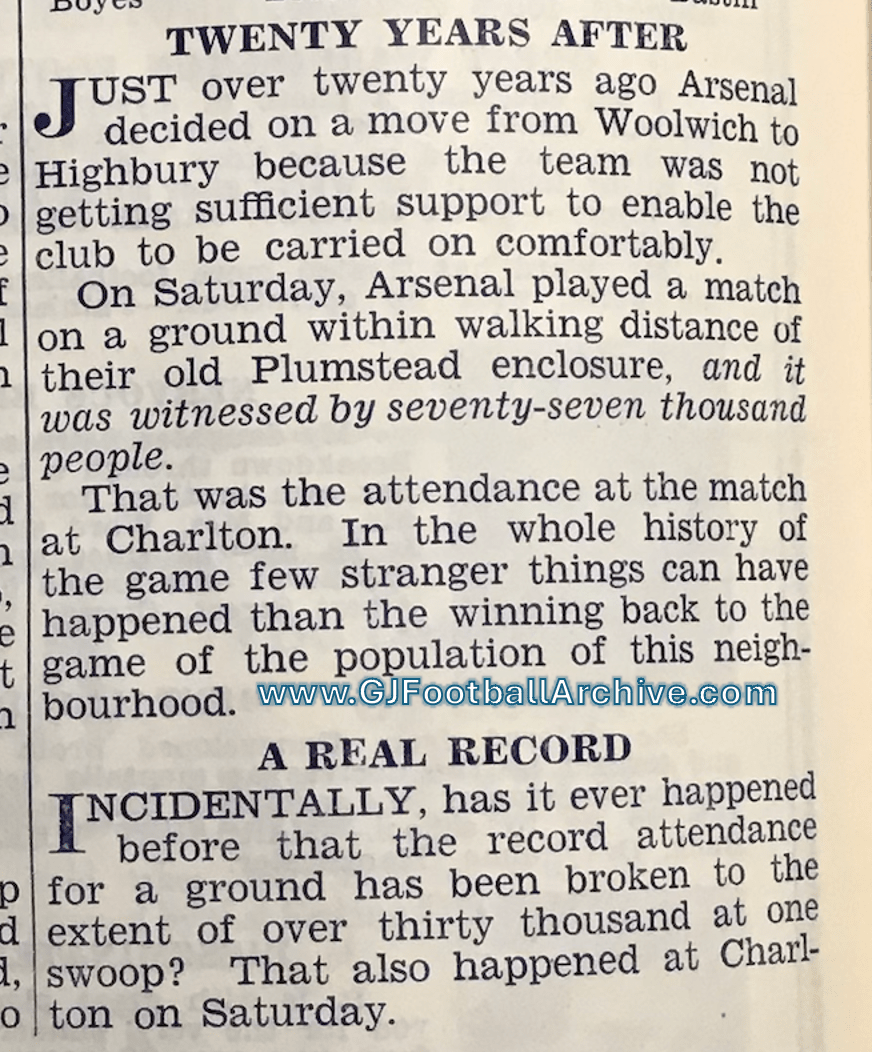
Here’s a cutting from a Manchester City match programme in October 1936 which talks of a game between Charlton and Arsenal, played on 17 October 1936. The official attendance that day was 68,160 for the League game. Note how it talks of Arsenal leaving their original base south of the Thames due to issues attracting crowds and then the mention of Charlton’s popularity in south London.

Incidentally, Manchester City’s record League attendance at this time was 79,491 and record attendance was 84,569.

You can find out all about Manchester City during the 1936-37 season by reading the following 2,500 word subscriber article on that season. If you subscribe (see below) I hope you enjoy it. If you don’t subscribe then why not try it for a month (£3 per month or sign up for a year at a discounted £20 per year)?

Here’s the article:

Subscribe to get access

Read more of this content when you subscribe today. It costs £3 a month (cancel anytime) or sign up for a year at £20 per year. Subscribers have access to the 1000s of articles, features, interviews etc. posted so far and all those posted during your subscription.

Albert Alexander (Junior): MCFC Chairman

Back in the late 1960s there was a popular Manchester City chairman whose family had been involved with the club since the very beginning of the club. That was Albert Alexander. Here’s a profile I wrote in 2012 on him. It’s about 900 words long and is free to read. Enjoy!

Albert Alexander was the second generation of the Alexander family to play a prominent role in the development and history of Manchester City.  His father, also Albert, had been involved with the Club from the 1890s and had held various positions including vice-chairman, and even manager for a spell in 1925-26.

Like his father, the younger Albert dedicated his life to the Blues.  Inevitably, he spent most of his boyhood watching the Club develop and, as he grew, he became more involved with behind the scenes work at the Club’s first home Hyde Road.  He was a member of the Ground Committee which performed crucial activities such as stewarding and ground maintenance.

Alexander also managed the Club’s A team and provided support in whatever way necessary to ensure the Blues succeeded.  He was more than happy to work through the ranks and take on any duty necessary.  His son Eric, who was Chairman in the early 1970s, remembers that his father had suffered during the First World War but that didn’t stop him from putting his energies into the Blues:  “He was a very good footballer and cricketer but he was gassed in the Great War and had to give it up.  It affected him throughout his life, although it’s fair to say he recovered enough to fulfil a happy normal life apart from playing of course. 

“He took up golf, but his love for football was such that he started the ‘A’ team at City.  He started it in 1921 and ran it through until 1963.  He enjoyed working with the youngsters and developing them.  He gained an awful lot of satisfaction from that, particularly when players like Matt Busby developed their skills and style as part of the ‘A’ team.”

Ultimately, after many years of loyal service Alexander became a City director.  This came after the Blues became aware that Manchester United were hoping he would join their board.  It is highly likely Alexander would have turned the Reds down, and it was appropriate that he became a director at Maine Road.  It was an honour he deserved for years of dedication to the City cause.

While director he felt the passion all fans feel for the Blues and he also felt the pain and worries during the Club’s struggles in the early Sixties.  He wanted better and, in 1965 as fans demonstrated following City’s lowest attended League game, he came out to face them and talk with them about his hopes and ambitions for the Club.  He apologised for City’s appalling decline.  It says much about his courage and the respect fans had for him that they dispersed.  It is doubtful whether any other director would have been respected in this manner at such a low point.

Understandably, Alexander who was City’s Chairman by this point wanted to see his side successful and later that summer he appointed Joe Mercer as manager.  It was a brave decision as Mercer had been out of work for a year and had suffered a stroke at Aston Villa.  Other names, such as former City hero Peter Doherty and Liverpool manager Bill Shankly, had been expected to be appointed by the media, so this move could easily have been seen negatively.

Alexander guided City through the successful years of the Mercer-Allison period and was probably the first Chairman to be hugely popular with fans.  Everyone seemed to love ‘Little Albert’ as Mercer dubbed him.

Many of City’s achievements during these years were dedicated to Alexander by Mercer, while journalist Bill Fryer commented in 1970:  “He is highly revered in the game and by the public, and I have no doubt good deals have been done for City out of Albert’s friendships because in reality the whole of football is a ‘club’.”

Sadly, despite the Chairman’s popularity, his final years saw him suffer at the hands of the 1970 takeover battle.  Alexander found out about the takeover when he received a knock on his door at breakfast one day.  It was a complete shock to him.

The takeover destroyed much that was good about City at this point, including the Mercer-Allison partnership.  However, it is rarely mentioned how the takeover affected Alexander, the man who had guided City with distinction through some dark days when no one else wanted to know.  He had taken the Club from the lowest point it had experienced since joining the League, to a position of strength with trophies galore.  Those bidding for control wanted the glory, Alexander’s motives were somewhat different – like all true fans he wanted City no matter what. 

Alexander stood down as Chairman and was made Life President – an honour first given to Lawrence Furniss seven decades earlier, proving the significance of this recognition.  Unfortunately, Alexander’s health was deteriorating by this point and he passed away soon after.

Manchester City owes a great deal to the dedication of Albert Alexander and the other members of his family.  The Alexanders helped guide the Blues from the 1890s through to the reign of Peter Swales, and in some ways on via the continuing involvement of Eric Alexander (still a regular attendee until his death in 2019).  Their contribution should never be forgotten.

If you enjoy all the free material on my website and would like to support my research and keep this website going (but don’t want to subscribe) then why not make a one-time donation (or buy me a coffee). All support for my research is valued and welcome. It allows me to keep some free material available for all. Thanks.

Choose an amount

£2.50
£5.00
£7.50

Or enter a custom amount

£

Your contribution is appreciated.

Donate

Subscribe to get access – Annual

Read more of this content when you subscribe today. It costs £20 a year to subscribe (it works out £1.67 a month) or £3 if you’d like to sign up a month at a time. Annual subscribers get full access for as long as you subscribe (you can always try it for a month). It’s worth bearing in mind that the 2010 Manchester A Football History cost £24.95 and all subscribers will be able to access all of that for as long as they are a subscriber (plus all the other stuff of course).

Subscribe to get access – Monthly

It costs £3 a month to subscribe a month at a time. Why not give it a try! Monthly subscribers get access to everything posted since 1 October 2022 for as long as you subscribe.
The 1930s: 1936-1937 Champions

My series on Manchester City in the 1930s continues today with a 2,500 word subscriber article on the 1936-37 season. If you subscribe (see below) I hope you enjoy it. If you don’t subscribe then why not try it for a month (£3 per month or sign up for a year at a discounted £20 per year)?

Here’s the article:

Subscribe to get access

Read more of this content when you subscribe today. It costs £3 a month (cancel anytime) or sign up for a year at £20 per year. Subscribers have access to the 1000s of articles, features, interviews etc. posted so far and all those posted during your subscription.

Starting Tomorrow: MCFC in the 1930s!

A new series of articles and features starts tomorrow on Manchester City in the 1930s. Some features will be available for all and some will be available only for subscribers. If you’d like to find out more on subscribing see:

Gundogan Record

On 3 June 2023 Ilkay Gundogan City secured his place in national football history with the quickest goal in a FA Cup final. It was a stunning volley after only 12 seconds. That day Gundogan scored two and helped City to 2-1 FA Cup final victory over Manchester United.

As well as the speed of the first goal, Gundogan’s goals gave him another MCFC record. Dave Masey, who has been collecting stats and historical information on Manchester City for years contacted me to tell me about one of his spreadsheets which holds details of City scorers in trophy winning games.

His records capture those who have scored in major cup finals, but besides Cup Finals he also records other trophy-winning games. These include the deciding League games from 1937 onwards against Sheffield Wednesday (1937), Newcastle, QPR, West Ham, Brighton and Villa (2022), but nothing from three recent title successes where the Blues clinched the title when they were not playing. Got that? Good, now….

Dave tells me that the FA Cup success saw Gundogan move to the top of the list with 5 goals, overtaking Neil Young and Sergio Aguero. So he has scored more goals in trophy-winning games than any other Blue.

The list of scorers in trophy winning games reads:

1904Meredith
1934/7Tilson (3), Brook (2), Doherty
1956Hayes, Dyson, Johnstone
1968/70Young (4), Lee (2), Summerbee, Doyle, Pardoe
1976P Barnes, Tueart
2011-(former)Aguero (4), Y Toure (2), Nasri (2), Kompany (2), D Silva (2),Jesus (2), Sterling (2), Dzeko, Zabaleta, Navas, Fernandinho
2016-(current)Gundogan (5),  Laporte (2), Rodri (2), Mahrez, De Bruyne

Dave also tells me that in the three seasons where somebody else’s defeat clinched the title for City, the scorers in the club’s last game before the title confirmation were:

Gundogan (3), Sterling (2), Jesus, Haaland.

As Dave says, Ilkay gets a remarkable number of important goals, particularly for somebody who is ‘just’ a 1 goal in 5/6 games player (63 in 357 for City by June 2025).

Manchester City v Germany in the Berlin Olympic Stadium

On this day (19 May) in 1937 Manchester City became the first English team to play at the Berlin Olympic Stadium. This was a highly political match but it doesn’t get mentioned as often as it should but I’ve talked about it frequently over the decades. The match saw League Champions Manchester City become the first English side to play in the Berlin Olympic stadium when they faced a German national 11 – club v country! 

The German national side beat “England’s greatest players” 3-2 in a propaganda led game.  According to the English players there that day, tHe Blues had a morale victory when they refused to perform the Nazi salute. You can read more on this game below.

I am not going to pretend that English football teams making tours of Continental countries do not have a very pleasant time, but at the same time these tours are not picnics.  You are there to play serious football, and you have to go about it in the ordinary businesslike way.”  Sam Barkas, City Captain, 27th May 1937

As Sam Barkas hinted, sometimes end of season football tours are not the fun experience a lot of fans think. Sometimes the tour takes on a whole different meaning.  This is certainly true for the May 1937 tour to Germany.

The Blues, as Champions of England, were invited to play a series of high profile matches across Germany and its neighbouring States.  Although this was a major honour for City it has to be stressed that the whole concept of the tour, as far as Germany’s Nazi rulers were concerned, was to promote Germany’s sporting prowess against the best England could offer.  

Subscribe to get access

Read more of this content when you subscribe today. It costs £3 per month or £20 per year and you then have full access to all items posted in the archive for as long as you subscribe.

Frank Swift’s Birth

On this day in 1913: Frank Swift was born. Here for subscribers is a detailed article I wrote on Swift a few years back:

Swift, Frank Victor (1913-1958), footballer and journalist was born in Blackpool, Lancashire on 26 December 1913, the second son of five children.  From his earliest memories, he was always obsessed with the game of football, playing at every opportunity with his brothers, one of whom, Fred, became first team goalkeeper for a variety of clubs, most notably Blackpool, Oldham Athletic and Bolton Wanderers.

Subscribe to get access

Read more of this content when you subscribe today. It’s £20 for an annual subscription or £3 per month (cancel anytime, see below).

A City Captain’s Death

On this day (8 December) in 1989 the captain of Manchester City’s 1936-37 League title success died. The captain was defender Sam Barkas, who had been born in December 1909. Here’s a profile of this legendary figure who also played for Bradford City and Workington.

SAMUEL BARKAS (1934-47)

Defender, 5ft 9in, 13st. 7lbs, b. Wardley, 29 December 1909, d. Shipley, W.Yorks, 8 December 1989

Signed from Bradford City, 20 April 1934 (£5,000)

Transferred: Workington player-manager, May 1947

Career: Middle Dock, Thorndale, Barnes Rovers, Bradford City, City, Workington Town

Debut v Liverpool, 2 May1934

Appearances: League: 175 apps. 1 gl; FA Cup: 20 apps. 0 gls; Charity: 1 apps, 0 gls Wartime (League & Cup): 75 apps. 3 gls;  Total:  271 apps, 4 gls.

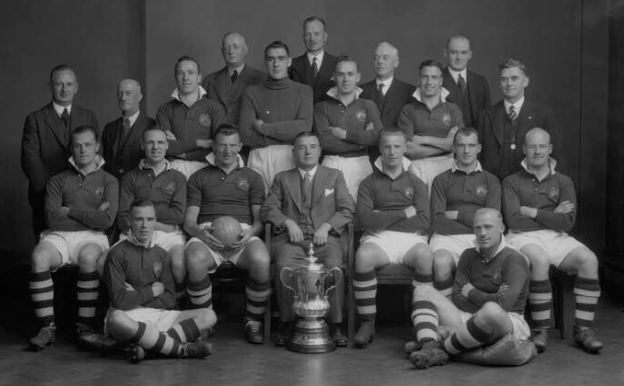
Captain of the great 1936-37 Championship winning side, Barkas was a stylish left back who joined the Blues for £5,000 from Bradford City in April 1934 shortly before the FA Cup final.  Naturally, he was unable to play at Wembley but did manage to play in the final two League games that season.  In fact Barkas was to miss only one of the first 68 League games played after his arrival as he quickly proved his value with many outstanding performances. 

One of the first players to create positive play from defensive positions, Barkas became renowned for always trying to create attacking opportunities and even managed to score a goal himself – to bring a 1-1 draw on the opening day of the 1934-5 season at West Bromwich Albion.  

As the decade progressed Barkas became an England international and a major figure in Manchester.  Sadly, the war interrupted his career as he was in his prime – he was 29 when war broke out – and when football returned on a professional, national basis Barkas was almost 37.  Nevertheless he managed to guide the side to the Second Division title and appeared in 33 League matches during 1946-7.  His last appearance came on 14th June 1947 (City’s latest ever finish) when the Blues defeated Newport County 5-1 with all goes coming from George Smith.

He later became Workington Town manager and also had a spell on City’s scouting staff.

If you enjoy all the free material on my website and would like to support my research and keep this website going (but don’t want to subscribe) then why not make a one-time donation (or buy me a coffee). All support for my research is valued and welcome. It allows me to keep some free material available for all. Thanks.

Choose an amount

£2.50
£5.00
£7.50

Or enter a custom amount

£

Your contribution is appreciated.

Donate

Peter Doherty Leaves Manchester City

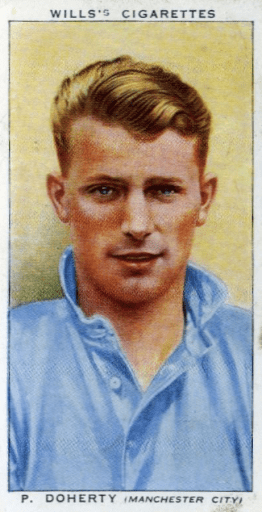
On this day (6 December) in 1945 the legendary Manchester City forward Peter Doherty (described as the greatest Irish footballer of all time into the 1970s) was transferred to Derby County. A few years back I wrote this profile of him.

Subscribers to my site can read the article below:

Subscribe to get access

If you would like to read this and all the in-depth articles on this site (including the entire Manchester A Football History book and my audio interview with John Bond for example) then please subscribe. It works out about £1.67 a month if you take out an annual subscription (£20 per year) or £3 a month if you’d like to sign up for a month at a time.