Manchester City v Crystal Palace: A Record Breaking FAC Tie

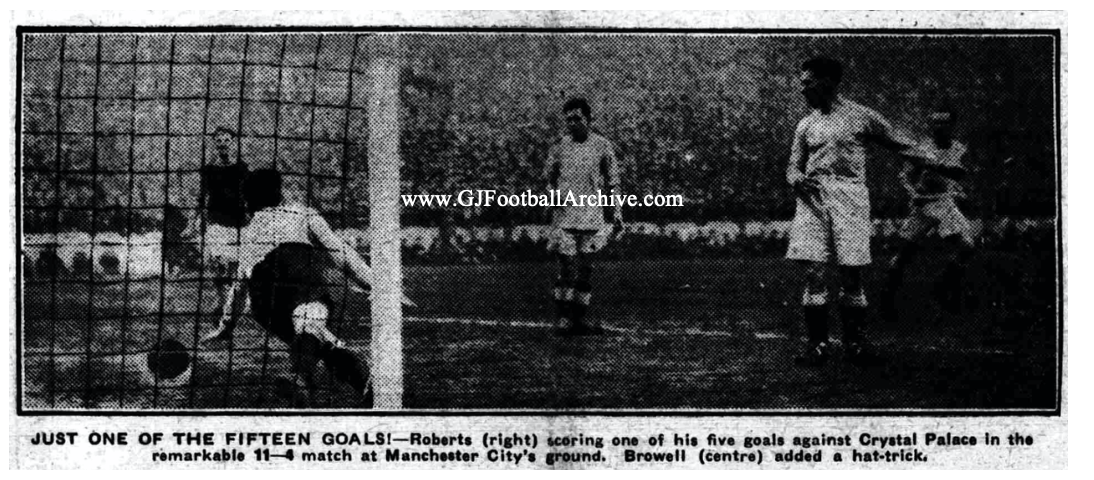
With City and Palace now scheduled to meet in the FA Cup final it’s worth remembering that on 20 February 1926 City recorded an amazing victory over Palace in the competition. It was a fifth round FA Cup tie with Crystal Palace at Maine Road. The Blues, without a manager since November, were being managed by committee with director Albert Alexander senior making the final decisions. It’s an incredible thought that a director without ever being known as a player, could make these decisions but Alexander was a knowledgeable football man and had been with the club since formation in 1894.

By half-time the score was 7-0 to the Blues, but Palace would not give up and quickly pulled back four goals.  City were knocked out of their period of complacency and soon found their goalscoring touch again.  By the end it was 11-4 and, according to a number of spectators present on the day, Manchester fans rushed on at the final whistle and carried off the Palace ‘keeper shoulder high.  Apparently he had played extremely well and, somehow, managed to keep the score down, although one cannot help wondering if he’d have been given such a reception had the scores been reversed.

Frank Roberts was the City star for this particular game, scoring a remarkable five, while Tommy Browell also earned a few plaudits with his hat-trick. The other scorers were: Billy Austin, George Hicks and Tommy Johnson.

With no management and such a miserable time in the League, no one could believe how City had been able to deliver such strong cup performances.  Here’s film of the game:

https://www.britishpathe.com/video/crystal-palace-overwhelmed

The 1920s – The First All-Manchester FAC Semi-Final

On this day (27 March) in 1926 the first all-Manchester FA Cup semi final occurred. You can see film of that game here and subscribers can read about the match below. Here’s the film from Bramall Lane:

https://www.britishpathe.com/asset/51947/

Subscribers can read the article below:

Subscribe to get access

Read everything on the site when you subscribe today. Monthly subscription is £3 per month (cancel anytime). Monthly subscribers access everything posted since 1 October 2022. Alternatively, sign up for a year at a time for the special discounted annual subscription of £20 for access to everything posted since the site’s creation in 2020.

Where Were You?

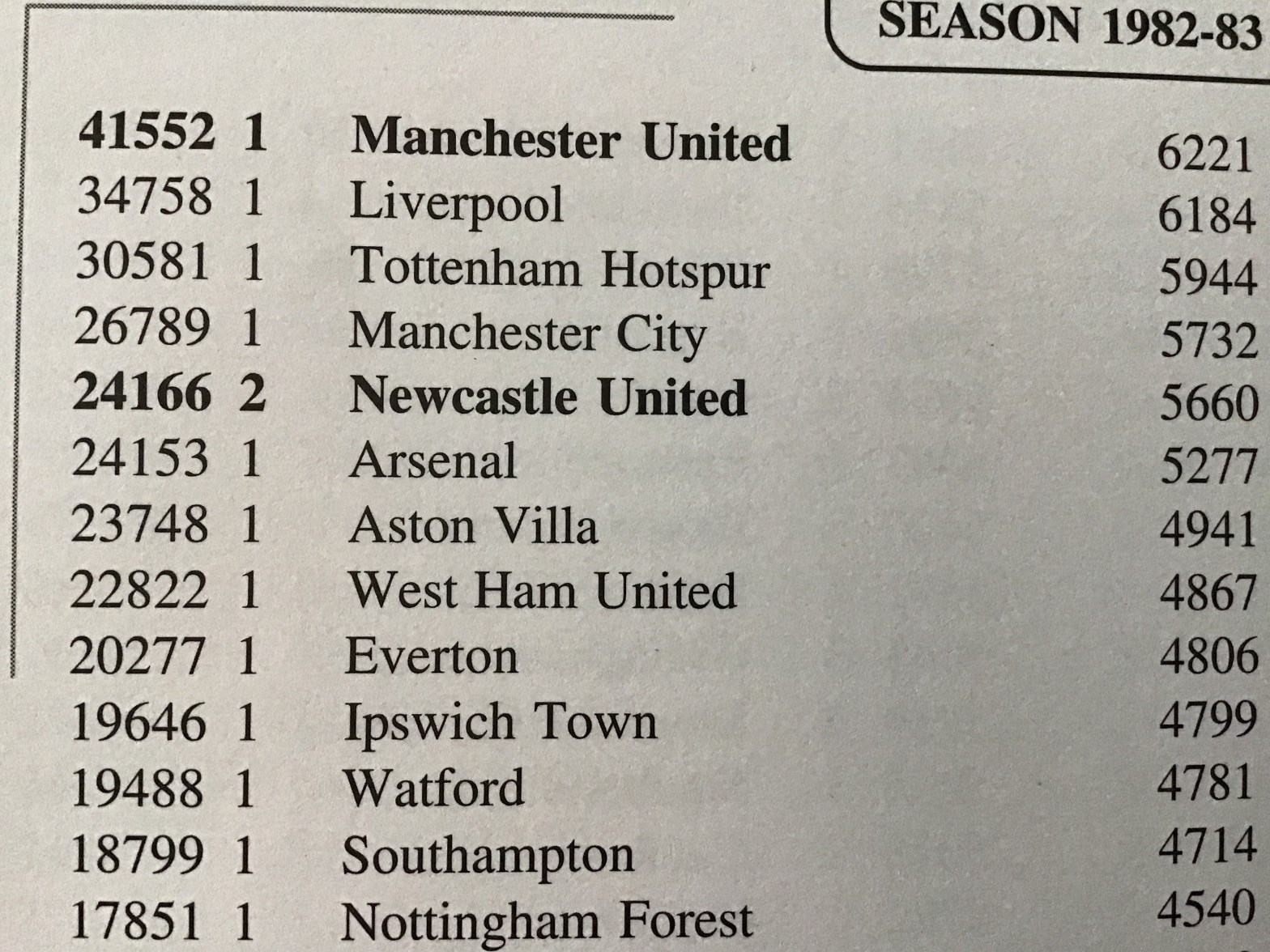
Fairly early on in the game between Manchester City and Arsenal the fans of the London club started to sing the old ‘Where were you when you were…’ chant. You’d think they’d know because often City were attracting better crowds than Arsenal. Let’s look at 1982-83 when I experienced my first relegation as a City fan. Back then City were the 4th best supported club (26,789) and Arsenal were 6th (24,153) – see the average attendance table above. City finished in a relegation position and Arsenal were 10th.

The following season Arsenal did attract a better average than City but they were the 5th best supported club in the entire 4 divisions and City were the 6th. In terms of League position Arsenal were 6th and City were 4th in Division Two.

We could talk about the late 1990s but neither club had a ground that could satisfy the demand to see them, so a sell out Maine Road in 1998-99 for third tier City has to compare with a sell out Highbury for title challenging Arsenal.

Since then stadium size has dictated average support but if we go back to earlier decades and assume that Arsenal’s ‘Where were you when you were sh*t’ refers to City heading towards relegation or being out of the top flight then City’s record is impressive overall. In 1965-66 (the last 2nd division season before the 1980s) City averaged 27,739 (10th best in entire League) while First Division Arsenal were the 9th best supported club on 29,036.

We can jump back even further. In the 1920s Arsenal were perceived as a popular club and in 1925-26 they averaged 31,471 – the 3rd best in the League. Where were City? Oh, City who were relegated that season were the 2nd best supported team with an average of almost 32,000. Not much more than Arsenal but the Gunners were 2nd in the League and City were relegated!

The year after Second Division City were the 3rd best supported club and top flight Arsenal were 4th!

1926-27 Average attendances. Manchester City in Second Division

The year after that (1927-28) Second Division City were the best supported club in the entire League with 37,468. Where were top flight Arsenal? 7th best supported with 27,434.

1927-28 Average attendances. Manchester City were the best supported club despite being in Second Division

It’s all a nonsense but if Arsenal fans, or any other team, want to sing songs like this then it would help if they knew their own history of support.

Five in the FA Cup

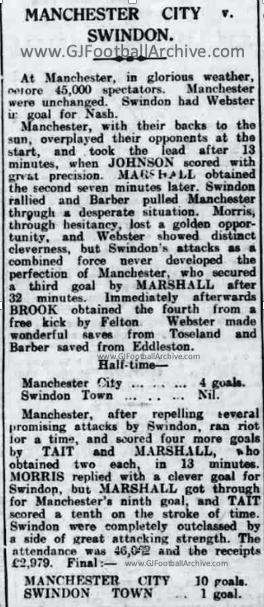
Last night (27 February 2024) Erling Haaland became the third Manchester City player to score five goals in a FA Cup game when he faced Luton. The two previous players to achieve this feat were Frank Roberts (see link below for video of the game he scored 5 in) and Bobby Marshall. Marshall’s five came in a FA Cup replay at Swindon on 29 January 1930 when City won 10-1. The attendance for this Tuesday afternoon match was 46,082 – a remarkable figure for an afternoon game in the days before floodlit competition.

Here are a couple of reports of that game (the second contains the goalscoring times/sequence):

Here’s the story of Frank Roberts’ five:

Of course Denis Law had scored 6 in a FA Cup tie v Luton but these were wiped from the records:

For Haaland there were a few records/points to note:

  • He is regarded as the first player to score five or more in the FA Cup (1st round onwards) since Duane Darby scored 6 for Hull v Whitby in 1996-97.
  • He is the first to score five or more for a top-flight club in the FA Cup since George Best scored 6 for United v Northampton in 1970.
  • He is the first to score five against Luton for City since Denis Law in 1961 when Law scored 6 but all were wiped from the records as the game was abandoned.
  • This is the second time Haaland has scored five goals in a game in his senior career, previously doing so for City against RB Leipzig in the Champions League in March 2023.
  • Since his debut for City in July 2022, Haaland has scored 79 goals in 83 games in all comps, 30 more than any other Premier League player in the that time (Salah 49).

First Maine Road Derby Anniversary

Manchester City’s Maine Road stadium was opened 100 years ago last month and today (12 September) marks the anniversary of the stadium’s first competitive Manchester derby BUT it’s not the centenary of that game as United were a second tier club when City moved to their old stadium. In fact it wasn’t until the stadium’s third season that United and City met competitively at Maine Road.

You can read about that first Maine Road meeting as part of my Maine Road 100 series of free articles. This one was posted on Day 35 here:

Maine Road 100 – Day 98

It’s Day 98 of my Maine Road 100 countdown to the centenary of Maine Road’s first game. I hope you’ve enjoyed these. Today it’s about the players who have scored most goals in individual games at Maine Road. Any ideas who may be heading the list and how many goals they may have scored in a single game at Maine Road?

The following are the players who have scored most in a single game for each of the domestic competitions at Maine Road:

League: 5 goals – scored by Tommy Browell v Burnley 24/10/25 & George Smith v Newport 14/6/47

FA Cup: 5 goals – scored by Frank Roberts v Crystal Palace 20/2/26

League Cup: 4 goals – scored by Dennis Tueart v Notts County 29/10/80. You can see stuff on this here:

You can read about Frank Roberts v Palace here:

If you have enjoyed this series of articles and posts on Maine Road then why not become a subscriber and access all the other great content. To find out more see:

Maine Road 100 – Day 93

For Day 93 in my series of free articles counting down the 100 days to the centenary of Maine Road’s first game I want to do a bit of an attendance feature. Maybe this will put a few myths to bed!  

The Blues have, generation after generation, been one of the English game’s top attractions and Maine Road was an incredible and poweful venue over the years. The Etihad has seen City establish new record average attendances but no English club venue can match what Maine Road achieved in terms of record crowds and it still, all these years on, holds the record for the highest crowd on an English club ground and the record attendance for an English League game – a record City set in 1935 which is currently held by a game featuring United and Arsenal at Maine Road.

The record attendance on a club ground was first set by City in 1924 – 99 years ago! – and was eclipsed by a figure of 84,569 in 1934 – almost 90 years ago. City know how to establish and keep records for decades!

Like all – and I do mean all – English clubs there have been some average attendance lows at Maine Road over the years, but when the entire history of Manchester City at the old stadium is reviewed and the club’s average figures are compared with the national average it is clear that the Blues have consistently been one of football’s most attractive draws.  Take a look at the following:

  • Since the beginning of the Football League in 1888 only nine sides have topped the table for average attendances.  In chronological order of their first appearance at the top of the average table they are: Everton (1888-9), Villa (1898-99), Newcastle (1904-05), Chelsea (1907-08), Tottenham (1909-10), City (1910-11), Liverpool (1922-23), Arsenal (1929-30), & Manchester United (1956-57). City were not based at Maine Road back in 1910 (which makes that even more remarkable) and they were the best supported club again before moving to Maine Road. The first time Maine Road attracted the highest national average was in 1925-26 – which means that City are the ONLY team to have topped the attendance charts at two different venues! 
  • Regularly amongst the best supported sides throughout the inter war period, City’s average exceeded 37,000 for the first time in 1927-28 when the club established a record average crowd for the Second Division.  This was also the entire League’s highest.
  • In 1947-48 City’s average crowd exceeded 42,000 for the first time.  Prior to that season only Chelsea (1919-20 & 1946-7), Arsenal (1934-5, 1936-7,1937-8, & 1946-7) , Newcastle (1946-7), Liverpool (1946-7), United (1946-7), and Wolves (1946-7) had exceeded that figure.
  • From 1975 to relegation in 1983 City were always one of the top 4 best supported sides. Yes, even in a relegation season they were better than all but 3 teams and those 3 teams all finished in the top 4 (one won the League, one the FA Cup and the other finished 4th after winning the FA Cup in the previous two seasons).
  • Since the 1980s whenever City have played outside of the top division, they have tended to be the best supported side in that division.  

In general many people believe success increases support, and while that is undoubtedly true to some extent, for City at Maine Road it was often periods of adversity that proved the loyalty of the Club’s fans.  For example, in 1925-26 when City were the best supported side in Division One and had established a new record average, the Blues were actually relegated.  This coupled with significant poverty and hardship in Manchester at the time should have reduced support but loyalty increased!  In my book “Manchester A Football History” I explore the relationship between attendances and Manchester’s major sides and it is fair to say that City fans can feel immensely proud of their loyalty throughout the history of the game.  Something that cannot be said by all of the League’s biggest names.  

In fact, it is worth highlighting that City have never been the worst supported side in their division at Maine Road (or anywhere else for that matter!) but, of today’s perceived giants, Arsenal (1912-13 – average = 9,100) and Manchester United (1930-31 – average = 11,685) have.  City’s worst average at Maine Road came in the desperate 1964-65 season and was 14,753 (half the average of 1960-61 and a 3rd of City’s 1957-8 figure).  However it is significant that for every League season the club’s average has always been above the divisional average and, apart from 17 seasons, has always been in the top 11 nationally.  Again, few of today’s giants can say that – United’s 20th Century low stands at 4,650 and Chelsea averaged 15,731 as recently as 1988-89. 

For fans average attendances are often used as an indicator of size of club and so a number of people over the years have tried to produce a definitive ‘all-time’ attendance table.  A few years ago analysis by a member of the Association of Football Statisticians (It wasn’t my research – though I was a life member of this organisation) claimed that if stadium capacity was not an issue for any club City would be the fourth biggest side in terms of attendance.  That analysis compared postwar attendance detail with performance on the pitch.   

Figures can be manipulated in many different ways, but City fans should feel proud that the Blues have many attendance firsts that can never be matched by today’s perceived biggest clubs.   

If you have enjoyed this and the other Maine Road 100 articles/features then why not subscribe? For details see:

Maine Road 100 – Day 91

For Day 91 of the 100 day Maine Road countdown until the centenary of City’s old stadium is a flashback to one of the earliest seasons for the old place. In particular I’m talking about a remarkable City victory against Crystal Palace in the FA Cup, way back in 1926. Why is this significant? Well, it was possibly the first season or at the least the prime example of a season when the old phrase ‘Typical City!’ was first established. Fortunately Typical City rarely raises its head these days but back in 1925-26 it was very much to the fore. Read on for more…

City hadn’t had a manager since November 1925 (believing instead that vice chairman Albert Alexander could lead the other directors in selecting the team) and were struggling in the League when the Blues played a FA Cup fifth round tie against Crystal Palace on 20 February 1926. The tie turned out to be a fifteen goal thriller with City in rampant form.  

By half-time the score at Maine Road was 7-0 to the Blues, but Palace would not give up and quickly pulled back four goals.  City were knocked out of their period of complacency and soon found their goalscoring touch again.  

By the end it was 11-4 and, according to a number of spectators present on the day, Manchester fans rushed on at the final whistle and carried off the Palace ‘keeper Callendar shoulder high.  It’s the sort of thing City fans would do back then! Apparently he had played extremely well and, somehow, managed to keep the score down, although one cannot help wondering if he’d have been given such a reception had the scores been reversed.

Frank Roberts was the City star for this particular game, scoring a remarkable five, while Tommy Browell also earned a few plaudits with his hat-trick. Browell had been ill for most of the week and had been unable to train.

With no management and such a miserable time in the League, no one could believe how City had been able to deliver such strong cup performances. 

Remarkably, film of the game has survived and can be viewed here:

https://www.britishpathe.com/video/crystal-palace-overwhelmed

Maine Road 100 – Day 76

For post 76 of my Maine Rd 100 countdown a reminder of a day when over 74,000 watched managerless Manchester City at Maine Road. The image is of Frank Roberts, a City star that day. That day (30 January 1926) City faced Huddersfield Town in a FA Cup tie at Maine Road, watched by 74,799.

The following article, for subscribers to GJFootballArchive.com, provides the background story to the tie and film of the game.

Subscribe to get access – Annual

If you would like to view this article then please subscribe below. It works out about £1.67 a month if you take out an annual subscription (£20 per year) or £3 a month if you’d like to sign up for a month at a time (below). Annual subscribers get full access to the 1000+ articles posted so far and the hundreds scheduled to be posted in the coming weeks.

Subscribe to get access – Monthly

If you would like to view this article then please subscribe below. It works out about £1.67 a month if you take out an annual subscription (£20 per year, above) or £3 a month if you’d like to sign up for a month at a time (here). Monthly subscribers get full access to everything posted since 1 October 2022 and the hundreds scheduled to be posted in the coming weeks.

Maine Road 100 – Day 48

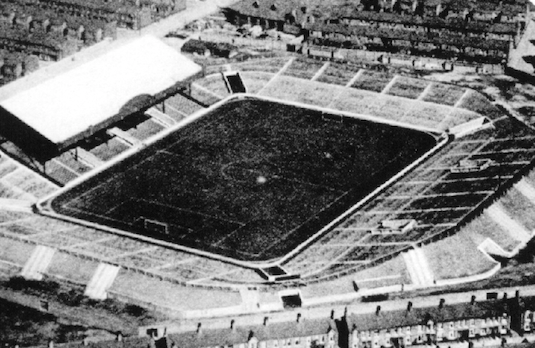
For day 48 of my posts counting down to the centenary of Maine Road’s opening game I’ve posted this aerial photo from 1925. People often talk about Maine Road being surrounded by tightly packed housing and it was but there was also quite a bit of green too, as this image shows.

Additional housing was erected in the area towards the top in the years that followed. In fact I think the entire estate was being built at the time this photo was being taken.

Maine Road is of course in the top right of this image. Notice also the sports ground at the top right corner of Platt Fields Park. This had a number of uses over the years and I think it was a police ground at this time. It later became City’s Platt Lane training ground of course.

1925 Aerial photo of Maine Road and Platt Fields Park

If you’d like to read more on the history of Maine Road, take a look at Farewell To Maine Road, which can be downloaded from this page:

If you enjoy all the free material on my website and would like to support my research and keep this website going (but don’t want to subscribe) then why not make a one-time donation (or buy me a coffee). All support for my research is valued and welcome. It allows me to keep some free material available for all. Thanks.

Choose an amount

£2.50
£5.00
£7.50

Or enter a custom amount

£

Your contribution is appreciated.

Donate