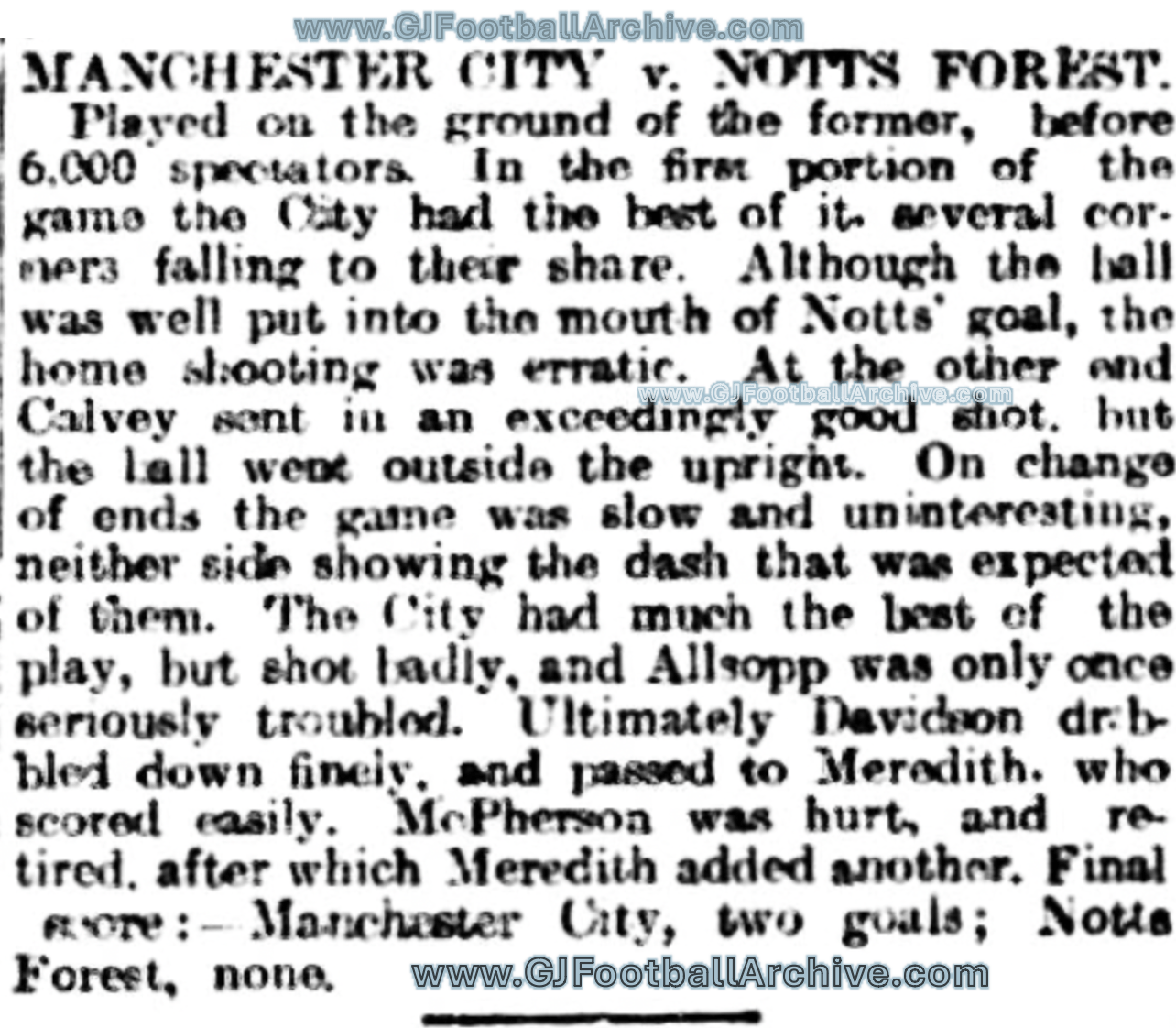
It’s City v Forest tonight (4 March 2026), so here’s a few snippets/features on the two clubs. The first game between them in Manchester was played on 9 April 1900 and ended in a 2-0 City win (see report). This was a First Division game (City became the first Manchester side to earn promotion when they won the Second Division title the previous season). Billy Meredith scored both goals.
Manchester City with the Second Division Shield, 1899
There are quite a few articles on Forest and City on here. Here are all the ones tagged Nottingham Forest:
Also, if you’d like to find out more on the early 1900s for Manchester City then why not start with this subscriber feature on the second half of the 1899-1900 season? It’s a 1300 word article:
Subscribe to get access
Read more of this content when you subscribe today. It costs £3 per month (cancel anytime) or sign up a year at a time for the discounted annual fee of £20. This gives access to everything on the site, including PDFs of 3 of my books and various other articles, interviews and audio material. Each subscriber has access to all content posted during their subscription period too. Why not sign up for a month and see what you think?
It’s now almost 40 years since I first started detailed research into the history of Manchester City and its origins, and it’s an area that is still fascinating. I still keep being asked about the origins of Manchester City, particularly the period prior to 1894 and I love the fact so many are interested in the steps that led to the establishment of what has become a major, global footballing power. I’ve posted much about those early years on this site but I know it’s often in a scattered style making it difficult to find, so here for those interested, are links to past articles on key figures and moments in the St Mark’s, West Gorton, Gorton AFC, Ardwick & associated clubs’ history. Tomorrow from noon for 24 hours I’ll be giving free access to a video I did a while back on the origins (details of the video lower down this page).
Firstly, the earliest known game (note: not necessarily the first game!):
Walter Chew, a man occasionally described as ‘The Father of Manchester City’ (though he himself tells a different story and in a 1920s interview told his eye witness story of who the actual founder was):
A man every Blue should know about, Lawrence Furniss. A player with Gorton, Ardwick secretary-manager, MCFC director, chairman responsible for move to Maine Road, Life President when City won the title in 1937. He saw it all and was involved from the 1880s through to 1940s when he died:
The facts not the fiction…. There are so many myths, assumptions, exaggerations etc. doing the rounds so hopefully this piece I wrote a few years back helps to explain:
On 1 February 2023 I performed an online talk on the latest research into the origins of City, focusing on the period prior to 1887 when the club was based in the West Gorton and Gorton areas. Tomorrow from noon I’ll post this for all to see for free for 24 hours, but if you can’t wait or miss it then it is already available here for subscribers to the site:
There are still many gaps in our knowledge even though material has been rediscovered in recent years. There are some things we won’t know but over the coming weeks I’ll post more on the early years. Some will be available to all, some to subscribers but I’m sure there’ll be lots out there to enjoy.
In the meantime why not search the website or use the tags to see articles on the period prior to 1894. Every season of the 1890s for example has a detailed article written about it while individual games, players and related stories are also included within the thousands of posts on this site. Here’s a link to the 1890-91 season for example:
The origins of Manchester City, like many other clubs, have been misunderstood or incorrectly reported over the years and there are many areas of ongoing research that will fill the gaps over the coming years. It takes time and effort to research at the level needed. When I first started researching there were some stories that had been passed down for years that have since been challenged and corrected but there are many other areas to reflect on. There are, of course, many other areas where further research is still needed.
For years I’ve worked with a variety of people on the origins of City (one of the key elements of my PhD research was on the origins of men’s and women’s football in Manchester and my research into this continues). In the 2010s MCFC set up a research group called Project Blue which I willingly helped and explained the myths that exist and what we still don’t know. The following slide was part of a lengthy presentation I performed on 14 December 2011 on that where I explained how we got where we were at the time and those who had worked together on uncovering the club’s early history.
One of my slides presented to the history research group Project Blue on research into Manchester City’s origins on 14 December 2011
I was always grateful to Dennis Chapman, John Maddocks and Ray Goble who welcomed me into their ‘club’ of research and others, such as Dave Masey who, like me, was a member of the Association of Football Statisticians. Dave continues to help my research. Thanks to these guys and others when I was starting out I have tried to ensure I help and support others researching. The more we research and share, the greater our collective knowledge.
There is still much to be done and sadly lots we will never know.
Whatever research is uncovered over the coming years one thing is clear and that is the history and origins of Manchester City are wrapped up in community initiatives and a desire by some to use football as a positive, community building enterprise. People like William Sumner, Walter & William Chew, Lawrence Furniss and Joshua Parlby should always be remembered for their part in the formative years of football in our city.
There is much research still to be done. If you’d like to support this research then please subscribe to the site and you’ll have access to hundreds of articles, interviews, talks etc. You could join for a month and see what you think.
Subscribe to get access – Annual
To support the site and have access to everything posted costs £20 a year (about £1.67 a month) or £3 to subscribe a month at a time (see below).
Monthly subscribers access everything posted since 1 October 2022 and can cancel anytime. All subscribers access everything posted during their subscription too.
If you enjoy all the free material on my website and would like to support my research and keep this website going (but don’t want to subscribe) then why not make a one-time donation (or buy me a coffee). All support for my research is valued and welcome. It allows me to keep some free material available for all. Thanks.
The entertainer Norman Wisdom was born on this day (4 feb) in 1915 so a good excuse to remember the day when he larked around on the Maine Rd pitch (and some claimed they thought it was Peter Reid). It’s always worth reminding ourselves of the days when he’d come out on to the pitch, fall over while taking a penalty and similar antics. Often supported by musician Rick Wakeman too! On one of the days in the 90many of us stood on the Kippax saw the elderly entertainer take to the field but didn’t recognise him at first. In fact many of us thought it was Peter Reid wearing a flat cap!
There were lots of odd prematch activities over the decades and you can read about them in this 2000 word article on the history of pre-match entertainment at Manchester City. There are mentions of the St Joseph’s Industrial School and Beswick Prize Bands, various DJs, athletic challenges, Norman Wisdom, Frank Sidebottom & more. Enjoy:
Subscribe to get access – Annual
Read more of this content when you subscribe today. It costs £20 a year (less than 6p a day) to access everything posted since the site went live in December 2020 (books, interviews, videos, history talks etc.) and throughout your period of subscription. Or you can subscribe a month at a time for £3 (cancel anytime; see below)
Monthly subscribers have access to everything posted since 1 October 2022 (books, interviews, videos, history talks etc.) and throughout your period of subscription. It costs £3 per month (cancel anytime)
Here’s an advert from the official Manchester City and Newton Heath match programme, published in September 1899. It demonstrates a period when football clubs looked to raise money however they could. Here ‘business men’ could advertise on almost any part of City’s Hyde Road ground or United’s Bank Street ground. I always find it funny when people try to claim that football has only become a ‘business’ in recent decades… Ever since the game became professional it has been a business and those owning clubs have looked at ways to increase income or profitability.
More on the 1899-1900 season elsewhere on the site. Why not search for features?
I’ve posted this image of entertainer Norman Wisdom doing some prematch stuff at Maine Rd in the 90s before but it’s always worth reminding ourselves of the days when he’d come out on to the pitch, fall over while taking a penalty and similar antics. Often supported by musician Rick Wakeman too! On one of the days many of us stood on the Kippax saw the elderly entertainer take to the field but didn’t recognise him at first. In fact many of us thought it was Peter Reid wearing a flat cap!
There were lots of odd prematch activities over the decades and you can read about them in this 2000 word article on the history of pre-match entertainment at Manchester City. There are mentions of the St Joseph’s Industrial School and Beswick Prize Bands, various DJs, athletic challenges, Norman Wisdom, Frank Sidebottom & more. Enjoy:
Subscribe to get access – Annual
Read more of this content when you subscribe today. It costs £20 a year (less than 6p a day) to access everything posted since the site went live in December 2020 (books, interviews, videos, history talks etc.) and throughout your period of subscription. Or you can subscribe a month at a time for £3 (cancel anytime; see below)
Monthly subscribers have access to everything posted since 1 October 2022 (books, interviews, videos, history talks etc.) and throughout your period of subscription. It costs £3 per month (cancel anytime)
Starting today: A new series of features on Manchester City in the early 1900s! Ever wondered how Manchester found its first major trophy success or what the scandal that rocked City was all about? Well, now’s your chance to find out. This series covers the period 1900-1910 It starts with the second half of the 1899-1900 season in this 1300 word article:
Subscribe to get access
Read more of this content when you subscribe today. It costs £3 per month (cancel anytime) or sign up a year at a time for the discounted annual fee of £20. This gives access to everything on the site, including PDFs of 3 of my books and various other articles, interviews and audio material. Each subscriber has access to all content posted during their subscription period too. Why not sign up for a month and see what you think?
The series of features on the 1900s starts today with a simple look at the average attendances of league clubs. I’m publishing the statistics here for season 1899-1900 when Manchester City was a First Division club for the first time. They were the third best supported club – the highest position either Manchester team had enjoyed up to that point. In fact City had been the best supported club for the opening months of the season as the heading photo shows (that’s from 20 January 1900).
All these figures are estimated based on newspaper reports of the period but are widely accepted as a good indication of support enjoyed at each club.
Manchester City with the Second Division Shield, 1899
In the following table every team is in Division One unless (2) appears after their name. This indicates they were a Second Division club that season. Where two teams have the same average then these have been listed in alphabetic order.
1899-1900 Average Attendances
Average
Team
19825
Aston Villa
16725
Newcastle
16000
Manchester City
12925
Everton
11325
Liverpool
11175
Sheff Utd
10475
Sunderland
8950
Notts County
8125
Derby
7875
Nottm Forest
7700
Stoke
7150
Sheff Wed (2)
6575
Wolves
6475
Blackburn
6250
Leicester Fosse (2)
6225
Newton Heath (2)
6175
WBA
5925
Burnley
5925
Middlesbrough (2)
5775
Bury
5050
Small Heath (2)
4825
Preston
4800
Bolton (2)
4125
Woolwich Arsenal (2)
4000
Glossop
3775
Grimsby (2)
3775
Lincoln (2)
2950
Chesterfield (2)
2875
New Brighton Tower (2)
2525
Walsall (2)
2400
Barnsley (2)
1875
Gainsborough Trinity (2)
1675
Burslem Port Vale (2)
1650
Loughborough (2)
1650
Luton (2)
1500
Burton Swifts (2)
This series of features covers Manchester City in the opening years of the twentieth century. Why not subscribe and read every feature?
Tomorrow there’ll be a subscriber article on the 1900-01 season in a similar style to those recently posted on the 1890s. Here’s an 1800 article below on Manchester City in the final months of 1899:
Subscribe to get access
Read more of this content when you subscribe today. It costs £3 per month (cancel anytime) or sign up a year at a time for the discounted annual fee of £20. This gives access to everything on the site, including PDFs of 3 of my books and various other articles, interviews and audio material. Each subscriber has access to all content posted during their subscription period too. Why not sign up for a month and see what you think?
A new series of features starts tomorrow. This series provides a season by season account of Manchester City FC in the early 1900s. Some are 2000+ word articles, others are a bit less, but each adds to the story of how the club evolved. So, if you’ve ever wondered how Manchester found its first major success or wondered about the scandal that rocked the club, here’s your chance to find out. This series covers 1900-1910.
Watch this space tomorrow for details.
Match programme for 29 September 1900. Manchester City v Stoke
The series of features on the 1890s continues today with a simple look at the last League tables for the 1800s. These were published after the final games of December 1899 and cover the Football League First Division and the Second Division. See if you can spot your club.
Notice the Division One table includes Bury and Manchester City from present day Greater Manchester, with near neighbours Glossop also in there (at the time the smallest town ever to have had a top flight team). Glossop were funded by Samuel Hill-Wood who eventually turned his attentions to Arsenal (they’re in the Second Division in these tables).
The last Division One table for the 1800s. This was published after the final games of December 1899.
The Second Division included Bolton and Newton Heath (MUFC) from present day Greater Manchester. Arsenal appear below New Brighton Tower.
The last Division Two table for the 1800s. This was published after the final games of December 1899.
This series of features covers the final years of Ardwick, the birth of Manchester City and the Club’s first national success. Why not subscribe and read every feature like this 1800 article below on Manchester City in the final months of 1899?
Subscribe to get access
Read more of this content when you subscribe today. It costs £3 per month (cancel anytime) or sign up a year at a time for the discounted annual fee of £20. This gives access to everything on the site, including PDFs of 3 of my books and various other articles, interviews and audio material. Each subscriber has access to all content posted during their subscription period too. Why not sign up for a month and see what you think?
The series of features on Manchester City in the 1890s continues today with this match report from the last first team competitive game of the 19th century for the Blues. City drew the match with Blackburn Rovers 1-1 with Billy Gillespie netting City’s equaliser.
Another report I have highlights that the match also say Billy Meredith appeal that Howarth, a Blackburn player, had handled in the penalty area which led to a lengthy conversation between the referee and linesman as to whether a penalty should be awarded. After much consideration they decided not to away a penalty – much to Meredith’s annoyance (if only they’d had VAR in operation… all problems like this would be easily resolved. Hmm!).
This series covers the final years of Ardwick, the birth of Manchester City and the Club’s first national success. Why not subscribe and read every feature like this 1800 article below on Manchester City in the final months of 1899?
Subscribe to get access
Read more of this content when you subscribe today. It costs £3 per month (cancel anytime) or sign up a year at a time for the discounted annual fee of £20. This gives access to everything on the site, including PDFs of 3 of my books and various other articles, interviews and audio material. Each subscriber has access to all content posted during their subscription period too. Why not sign up for a month and see what you think?


 Gary James' Football Archive