Every Monday I’m posting a section from my book ‘The Emergence of Footballing Cultures: Manchester 1840-1919’. It tells the story of the origins of men’s football in Manchester and discusses the birth of both City and United plus the clubs that predated them such as Hulme Athenaeum, Manchester AFC, Birch etc. Today’s section is the seventh chapter of the book (a 10,500 word section). This focuses on football as a business (yes, it was a business even then!), the move into league football for Manchester’s clubs and the relaunch of them as Manchester City and Manchester United.
Subscribing costs £3 per month (cancel anytime) or you could sign up for a year at the discounted price of £20 per year. Every subscriber gets access to everything posted on the site.
Subscribe to get access
Read more of this content when you subscribe today.
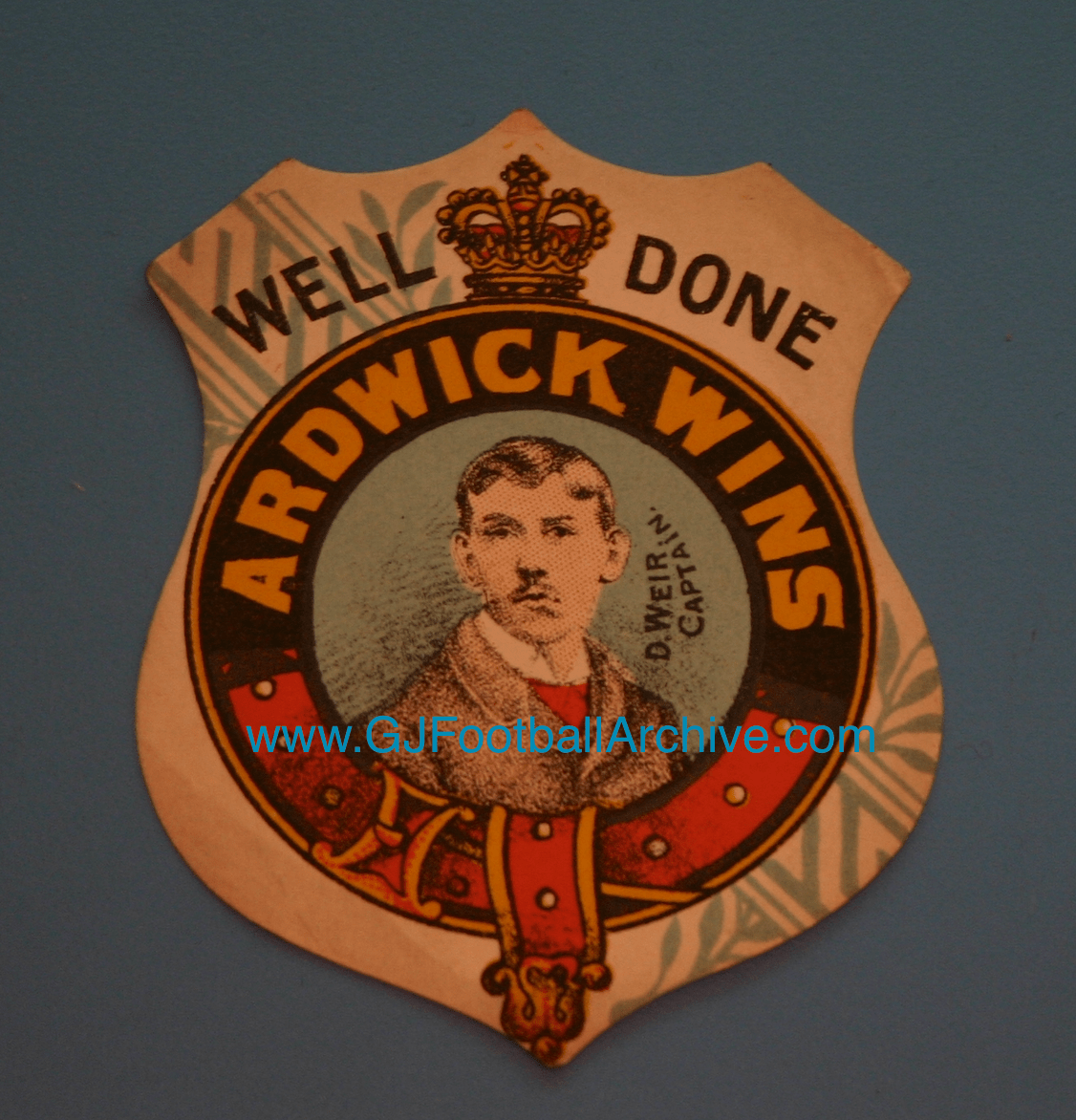
The other week I posted this card from John Baines (he used to produce these cards in Bradford, West Yorkshire) featuring Ardwick AFC’s captain Davie Weir. It made me realise that perhaps I should post more on the Ardwick years of City and so here’s a small piece on the birth of Ardwick in 1887. That year was to prove perhaps the most important year of the decade as far as the club was concerned. Gorton AFC’s leaders decided in which direction the Club should go after spending a couple of seasons playing at the Bull’s Head in Reddish Lane, on the very edge of Gorton. This was really as far away from the Club’s Clowes Street origins as the side could go while remaining in Gorton. The Club’s identity was in danger of disappearing.
Association Football was becoming more popular in the area and sides, such as Newton Heath, were beginning to progress, winning trophies such as the Manchester Cup. Professionalism was beginning to develop and Gorton had to decide on whether their future was to be as a good local side, such as a modern day pub team, or as a professional outfit.
The decision was taken to become a progressive and professional outfit. The committee also wanted Gorton to return to their Clowes Street roots. They recognised that this was not entirely possible – Clowes Street remained one of Manchester’s most densely populated areas – but they did manage to find an area of wasteland not too far away. Legend tells us that Club Captain Kenneth McKenzie lived in Bennett Street, Ardwick, and every lunchtime he would take a short cut from Bennett’s Timber Yard, off Hyde Road, through the L&NWR railway arches, and across the wasteland to Bennett St. He believed that with a little effort this land could become Gorton’s home.
After a great deal of effort and negotiation with the railway company which owned the land the pitch was ready for its first match by the end of August 1887. In addition, steps were taken to relaunch the Club. The name of Ardwick AFC was chosen as the new ground was just within the boundaries of Ardwick and not Gorton, although it has to be stressed that this ground was closer to Clowes Street than any other Gorton venue used by the Club after its first season.
The nearby Hyde Road Hotel became Ardwick’s headquarters. Stones from this building, demolished in 2002, formed part of the Club’s Memorial Garden at the City Of Manchester Stadium when it was opened.
Gradually Ardwick increased their support and it’s fair to say that by the summer of 1888 Ardwick were Manchester’s most popular club, or at least on a par with Newton Heath. In 1889 Ardwick built a grandstand capable of holding 1,000 spectators, and for the sum of £5 15s the club’s first pay box – turnstile was not an appropriate name – was erected.
From that point on the side grew at a rapid rate and managed to recruit several good quality and well known players. Perhaps the best known at the time was Davie Weir (seen on the card at the top of this page) who joined Ardwick in May 1890. Often described as individualistic, Weir was an England international when he arrived at Hyde Road after playing in the 6-1 victory over Ireland in March 1889 and a 3-2 defeat by Scotland the following April. Against Scotland he was credited with scoring England’s second goal, although there remains some dispute as to who got the final touch.
At City Weir played as a forward, but he had previously been known for fulfilling a variety of roles most notably centre-half. Football was still developing of course, but the key point concerning Weir’s pre-Ardwick days is that he was known as a great goalscorer whatever position he played at Bolton. He’d only missed one match during Bolton’s first two seasons of League football, and had netted a 21 goals in 43 League games. During 1889-90 season he scored an incredible 10 goals in only 4 FA Cup ties. Clearly for Weir – a player only in his late twenties – to leave League side Bolton to join a side that had yet to compete in any formal league says a great deal about the ambition of Ardwick.
At Hyde Road Weir was immediately popular and he netted two hat-tricks in his first four games. He also scored the first Ardwick goal in the FA Cup, and was a key member of the side that competed in the Alliance League in 1891-2. His career also saw him feature in the Club’s first season in the Football League where he became Ardwick’s top goalscorer, despite returning to Bolton midway through the season in January 1893.
In later life he became the Glossop manager in 1909 and remained with the Division Two side until April 1911 when he was approached by Stuttgart to become their coach. He passed away in November 1933 at the age of 70.
It’s now almost 40 years since I first started detailed research into the history of Manchester City and its origins, and it’s an area that is still fascinating. I still keep being asked about the origins of Manchester City, particularly the period prior to 1894 and I love the fact so many are interested in the steps that led to the establishment of what has become a major, global footballing power. I’ve posted much about those early years on this site but I know it’s often in a scattered style making it difficult to find, so here for those interested, are links to past articles on key figures and moments in the St Mark’s, West Gorton, Gorton AFC, Ardwick & associated clubs’ history. Tomorrow from noon for 24 hours I’ll be giving free access to a video I did a while back on the origins (details of the video lower down this page).
Firstly, the earliest known game (note: not necessarily the first game!):
Walter Chew, a man occasionally described as ‘The Father of Manchester City’ (though he himself tells a different story and in a 1920s interview told his eye witness story of who the actual founder was):
A man every Blue should know about, Lawrence Furniss. A player with Gorton, Ardwick secretary-manager, MCFC director, chairman responsible for move to Maine Road, Life President when City won the title in 1937. He saw it all and was involved from the 1880s through to 1940s when he died:
The facts not the fiction…. There are so many myths, assumptions, exaggerations etc. doing the rounds so hopefully this piece I wrote a few years back helps to explain:
On 1 February 2023 I performed an online talk on the latest research into the origins of City, focusing on the period prior to 1887 when the club was based in the West Gorton and Gorton areas. Tomorrow from noon I’ll post this for all to see for free for 24 hours, but if you can’t wait or miss it then it is already available here for subscribers to the site:
There are still many gaps in our knowledge even though material has been rediscovered in recent years. There are some things we won’t know but over the coming weeks I’ll post more on the early years. Some will be available to all, some to subscribers but I’m sure there’ll be lots out there to enjoy.
In the meantime why not search the website or use the tags to see articles on the period prior to 1894. Every season of the 1890s for example has a detailed article written about it while individual games, players and related stories are also included within the thousands of posts on this site. Here’s a link to the 1890-91 season for example:
The origins of Manchester City, like many other clubs, have been misunderstood or incorrectly reported over the years and there are many areas of ongoing research that will fill the gaps over the coming years. It takes time and effort to research at the level needed. When I first started researching there were some stories that had been passed down for years that have since been challenged and corrected but there are many other areas to reflect on. There are, of course, many other areas where further research is still needed.
For years I’ve worked with a variety of people on the origins of City (one of the key elements of my PhD research was on the origins of men’s and women’s football in Manchester and my research into this continues). In the 2010s MCFC set up a research group called Project Blue which I willingly helped and explained the myths that exist and what we still don’t know. The following slide was part of a lengthy presentation I performed on 14 December 2011 on that where I explained how we got where we were at the time and those who had worked together on uncovering the club’s early history.
One of my slides presented to the history research group Project Blue on research into Manchester City’s origins on 14 December 2011
I was always grateful to Dennis Chapman, John Maddocks and Ray Goble who welcomed me into their ‘club’ of research and others, such as Dave Masey who, like me, was a member of the Association of Football Statisticians. Dave continues to help my research. Thanks to these guys and others when I was starting out I have tried to ensure I help and support others researching. The more we research and share, the greater our collective knowledge.
There is still much to be done and sadly lots we will never know.
Whatever research is uncovered over the coming years one thing is clear and that is the history and origins of Manchester City are wrapped up in community initiatives and a desire by some to use football as a positive, community building enterprise. People like William Sumner, Walter & William Chew, Lawrence Furniss and Joshua Parlby should always be remembered for their part in the formative years of football in our city.
There is much research still to be done. If you’d like to support this research then please subscribe to the site and you’ll have access to hundreds of articles, interviews, talks etc. You could join for a month and see what you think.
Subscribe to get access – Annual
To support the site and have access to everything posted costs £20 a year (about £1.67 a month) or £3 to subscribe a month at a time (see below).
Monthly subscribers access everything posted since 1 October 2022 and can cancel anytime. All subscribers access everything posted during their subscription too.
If you enjoy all the free material on my website and would like to support my research and keep this website going (but don’t want to subscribe) then why not make a one-time donation (or buy me a coffee). All support for my research is valued and welcome. It allows me to keep some free material available for all. Thanks.
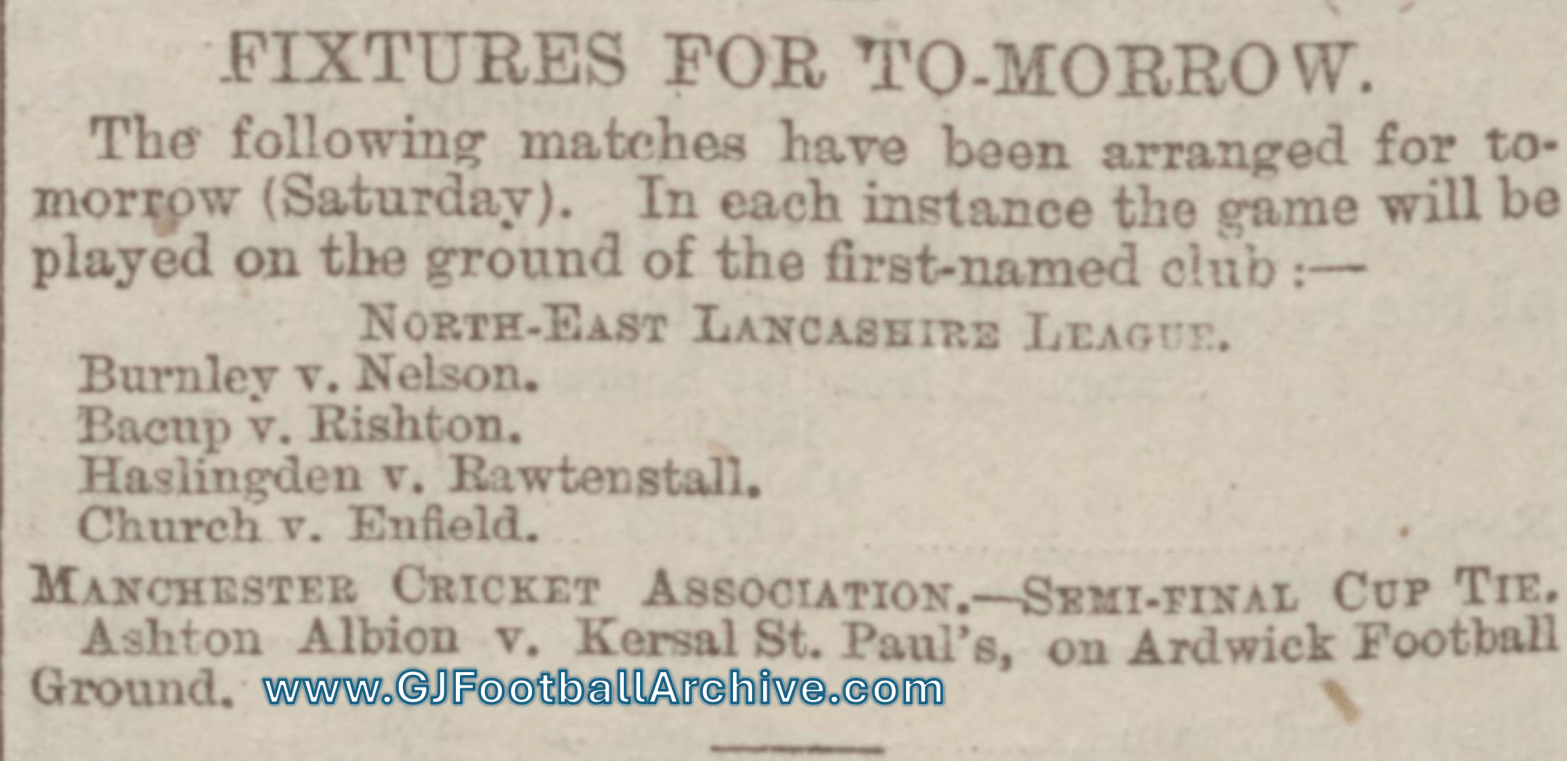
There have been games of cricket played by Manchester City over the years and there have been occasions when other sports, such as rugby and tennis, have been played at City’s grounds but it may surprise some to know that cricket has also been played at the club’s venues. Back on 24 July 1891 a Manchester newspaper listed this cricket fixture to be played at Hyde Road (at the time the ground of Ardwick AFC – City’s predecessor). It won’t have been the only cricket match there and the site had been known to stage bare knuckle boxing bouts years before the football ground was built there.
The series of features on Manchester City in the 1890s continues today with a 1100 word article on Ardwick’s exploits in the 1891-92 season. The last season before the club joined the Football League.
Ever wondered how MCFC came into being and what happened to Ardwick AFC? Well, now’s your chance to find out. This series covers the final years of Ardwick and the birth of Manchester City.
Subscribe to get access
Read more of this content when you subscribe today. It costs £3 per month (cancel anytime) or sign up a year at a time for the discounted annual fee of £20. This gives access to everything on the site, including PDFs of 3 of my books and various other articles, interviews and audio material. Each subscriber has access to all content posted during their subscription period too. Why not sign up for a month and see what you think?
A new series of features starts tomorrow. This series provides a season by season account of Ardwick AFC and Manchester City FC in the 1890s. Some are 2000+ word articles, others are a bit less, but each adds to the story of how the club evolved. So, if you’ve ever wondered how MCFC came into being and what happened to Ardwick AFC, here’s your chance to find out. This series covers the final years of Ardwick, the birth of Manchester City and Manchester’s first national title.
We hear so much about the Premier League era and how the game has changed, so for today’s feature I’ve decided to take a look at the early 1990s and the birth of the Premier League. It’s almost thirty years since the structure of league football changed forever and during that time some clubs have benefitted from the new structure and others have found life difficult. City have experienced both extremes of course.
The narrative that we often hear about the Blues’ journey over the last thirty years is that they’ve gone from a struggling club to a hugely successful one and, while it is true City are highly successful today and that the Blues entered their lowest ever point in the late 1990s, it is wrong to assume that the position the club found itself in by 1999 was typical of the club’s full history.
So, here for subscribers, I’m taking a look back at the early 1990s and remind ourselves where the Blues were; who their rivals were; and the state of football at that time:
Subscribe to get access
Read more of this content when you subscribe today. It costs £3 per month (cancel anytime) or £20 a year. Throughout your subscription you can access ALL content on this site. Have a search to see what’s included.
Read more of this content when you subscribe today. If you’d like to support my research then why not subscribe? Every subscription directly helps support my research and provides annual subscribers with access to everything posted on this site, including the entire Manchester A Football History and From Maine Men To Banana Citizens books, plus interviews, articles and more. I am not employed by anyone and all my research is self funded or comes from subscriptions to this site.
Read more of this content when you subscribe today. You can subscribe at either £20 per year (above) or at £3 per month here (cancel any time). For those subscribing £3 per month you will be able to access all content from October 2022 onwards for as long as you are a subscriber. Those subscribing £20 a year have access to everything posted since December 2020.