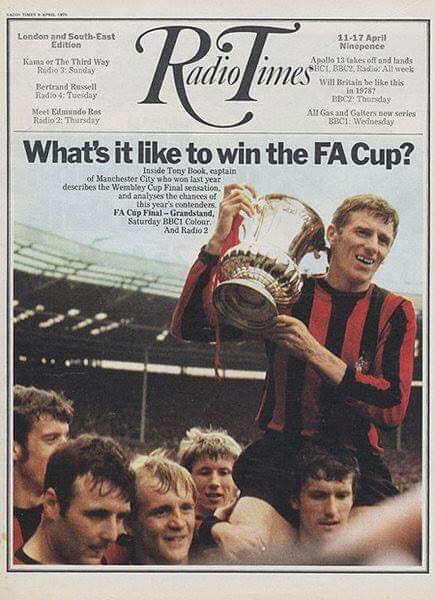
Here’s a nice cover from the Radio Times featuring Manchester City’s 1969 FA Cup winners. They defeated Leicester 1-0 thanks to a goal from prolific City scorer Neil Young.
Category Archives: Manchester City
The 1950s: Film of a Snowy Maine Road

Here’s film of Manchester City v Preston from this day (16 December in 1950) in 1950: https://www.youtube.com/watch?v=ywhEPT5R3LU&list=PLIBBFkx37GSdU3VcxT_41AAV-0gUpxl5j&index=12 It’s a snowy day and I won’t mention the score!
If you’d like to read more on this season, then here’s a 1,500 word article on the 1950-51 season. Enjoy!
This is a subscriber article and you can read it by subscribing below.
Subscribe to get access
Read more of this content when you subscribe today. It costs £3 per month or you can subscriber for the discounted annual rate of £20 per year. Each subscriber gets access to everything posted so far, including PDFs of a couple of my books.
From My Collection: MCFC Wear Sammy Scarves

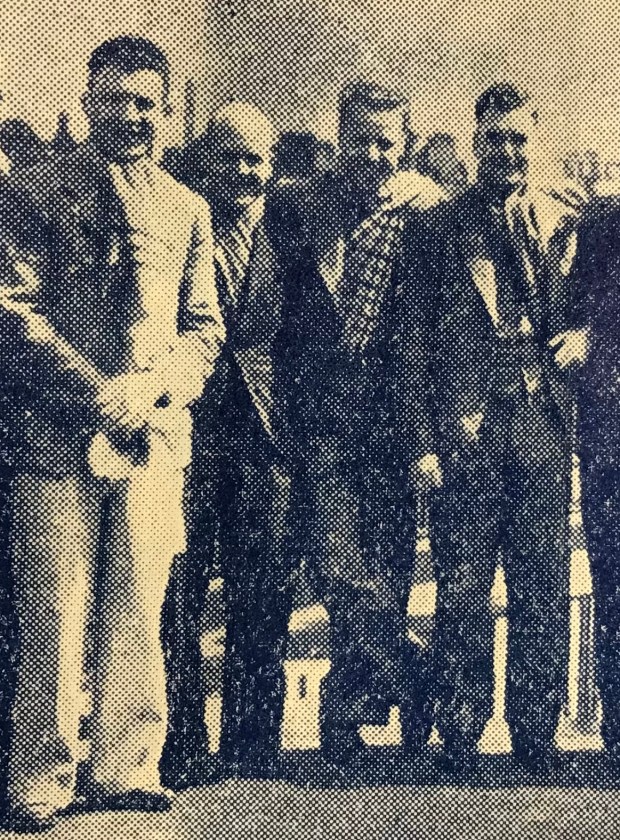
An advert which appeared on the cover of the Manchester City match programme from today (15 December) in 1934. Back then ‘all’ the City players wore Sammy Scarves! Presumably not in games, though Sammy Scarves could have made a fortune in Sammy Snoods when Tevez was playing!
8
Bunny Shaw: Record Scorer

Congratulations to Khadija ‘Bunny’ Shaw on becoming the first Manchester City Women player to score 100 goals since the relaunch of the club. It’s a wonderful feat and she deserves immense praise. Here’s City’s report of today’s (14 December 2025) 6-1 victory over Aston Villa which saw Shaw score 4 goals:
https://www.mancity.com/news/womens/man-city-aston-villa-wsl-match-report-december-2025-63901308
60 Years Ago Today: City and United Youth

Here’s the front of a match programme for the FA Youth Cup tie between Manchester City and Manchester United on this day (13 December) in 1965. How many names do you recognise? The match ended in a 5-0 United win.
You can find out more on Manchester City during the 1965-66 season by reading the following 4100 word article. As with most of the other features in this series it includes words from interviews I have performed with those who were there. This is a subscriber article (see below).
Subscribe to get access
Read more of this content when you subscribe today. It costs £3 per month (cancel anytime) or sign up for a year at the discounted price of £20 per year (works out £1.67 per month). Subscribers access the 1000+ articles posted so far and the others scheduled during the life of your subscription.
The Last City Derby Hat-trick Until Haaland & Foden

On this day (12 December) in 1970 a hat-trick from Francis Lee was City’s last hat-trick in a Manchester derby until Haaland and Foden in October 2022! The 1970 game also saw a goal from Mike Doyle to gave City a comfortable 4-1 victory over Manchester United before an Old Trafford crowd of 52,636. That victory meant City had won 5 and only dropped 4 points in 8 consecutive League derby meetings with the Reds. There was also a devastating injury to Glyn Pardoe (more on that in another post!). Here is the background, report and verdict of that game…
Subscribe to get access – Annual
Read more of this content when you subscribe today. Annual subscribers pay £20 per year to access all material posted since December 2020 and all articles throughout the life of their subscription. Monthly subscribers pay £3 per month (see below).
Subscribe to get access – Monthly
Read more of this content when you subscribe today. Monthly subscribers pay £3 per month to access all material posted since 1st October 2022 and all articles throughout the life of their subscription. Annual subscribers pay £20 per year (see above).
40 Years Ago Today: MCFC Wembley Bound

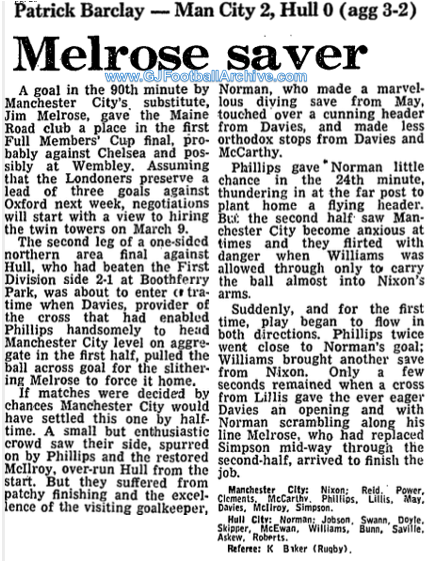
Forty years ago today (11 December 1985) a 2-0 victory (3-2 on aggregate) by Billy McNeill’s Manchester City over Brian Horton’s Hull sent the Blues to Wembley for the inaugural Full Members’ Cup Final. City’s scorers at Maine Road were David Phillips and Jim Melrose before the largest crowd (by any club) of the entire tournament, excluding the final, of 10,180. Here’s a contemporary report by Patrick Barclay of the game:
You can read more on the Full Members Cup and what it was all about here:
From My Collection… Topical Times Sporting Annual 1934 1935

During my tidy-up of my writing space I’ve rediscovered items I’ve used in my research over the years and thought I’d post some on here. Today here are some images and information from the Topical Times Sporting Annual 1934-35. There’s some interesting aspects and information that I’m sure some of you will find interesting. let’s start with the cover…
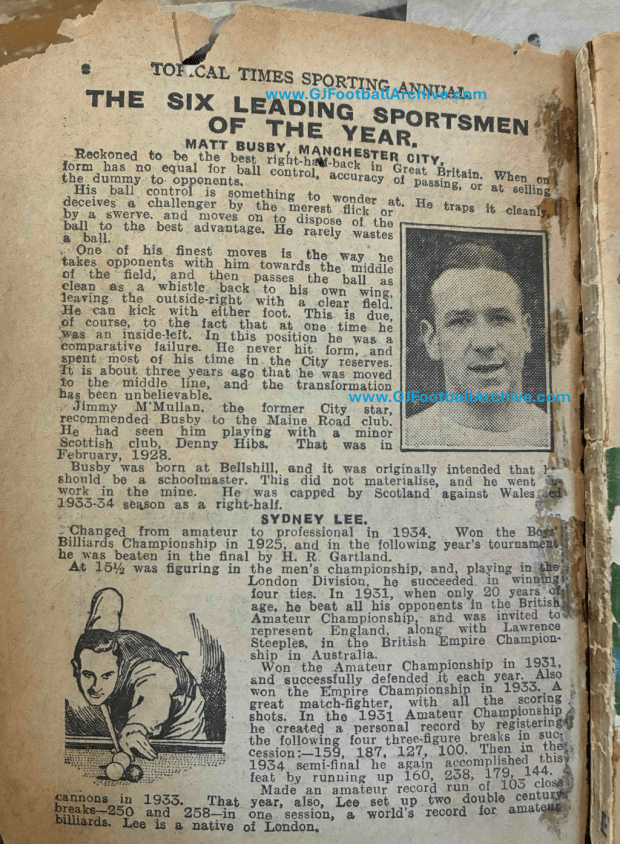
The player in the blue shirt is Manchester City’s Matt Busby who the yearbook regarded as one of the 6 sporting stars of 1934. Here’s what they said about him:
The book included a small section on each team. City’s looked like this (notice the record attendance has a typo; it should be 84,569. Also, look at Middlesbrough’s record crowd. It has since been passed though!):

For those wondering why this alphabetical list of clubs went from City to Middlesbrough and not Manchester United, the list was by division. At that time City were in the top tier and United were in the second. Here’s their profile:

At that time United’s record crowd was for a game staged at Old Trafford but not featuring United. That has since been surpassed but Old Trafford’s record is still for a game not featuring United (Wolves v Grimsby FAC tie). Note also the official colours of United.
If you enjoy all the free material on my website and would like to support my research and keep this website going (but don’t want to subscribe) then why not make a one-time donation (or buy me a coffee). All support for my research is valued and welcome. It allows me to keep some free material available for all. Thanks.
Choose an amount
£2.50
£5.00
£7.50
Or enter a custom amount
£
Your contribution is appreciated.
DonateThe First Time: Manchester City V Real Madrid

Almost 46 years since their first ever meeting Manchester City and Real Madrid meet tomorrow (10 December 2025) in the Champions League. I doubt anyone in the media covering the game will mention the first meeting but if there is anyone interested it took place on 19 December in 1979. Back in 1979 the game was considered a prestigious friendly, or at least that’s what it was supposed to be, but it turned out to be a controversial game with implications for the Blues for some time. Here for subscribers is an 1800 word article with images of that game and the controversy surrounding it.
Subscribe to get access – Monthly
This article is available to subscribers to the website. It costs £3 per month (cancel anytime) or £20 a year (see below).
Subscribe to get access – Annual
This article is available to subscribers to the website. Annual subscribers access everything on the site (books, articles, videos, history talks, interviews etc.) posted since it was created in December 2020. Monthly subscribers access everything since 1 October 2022. Both Monthly & Annual subscribers access all new content too throughout their subscription.
Coleman Goal in the Blue Ballet

Here’s a photo from this day (9 December) in 1967 and it shows Tony Coleman scoring City’s third goal in a remarkable game that took place at Maine Road. It became known as the Ballet On Ice. Manchester United supporter Bobby Greenroyd watched the game on Match of the Day and wrote to City afterwards: ‘I am a regular Manchester United fan, but after Saturday’s game your next home gate will be increased by one.’ High praise, particularly as United themselves were on the verge of European Cup glory.
Why and how did this happen and which leading MCFC figure sneaked out to buy a bag of chips while the club celebrated its 1968 League title success? Here for subscribers is an article that explains all….
Subscribe to get access – Annual
Read this and everything else on the site when you subscribe today. It costs £20 a year or £3 per month (see below). Annual subscribers get access to everything posted since December 2020 plus all material during the subscription.
Subscribe to get access – Monthly
Read this and everything else on the site when you subscribe today. It costs £20 a year (see above) or £3 per month. Monthly subscribers get access to everything posted since 1st October 2022 plus all material during the subscription. Why not give it a go for a month?
 Gary James' Football Archive