England’s 1st World Cup Qualifier: Maine Rd Selected Above Wembley

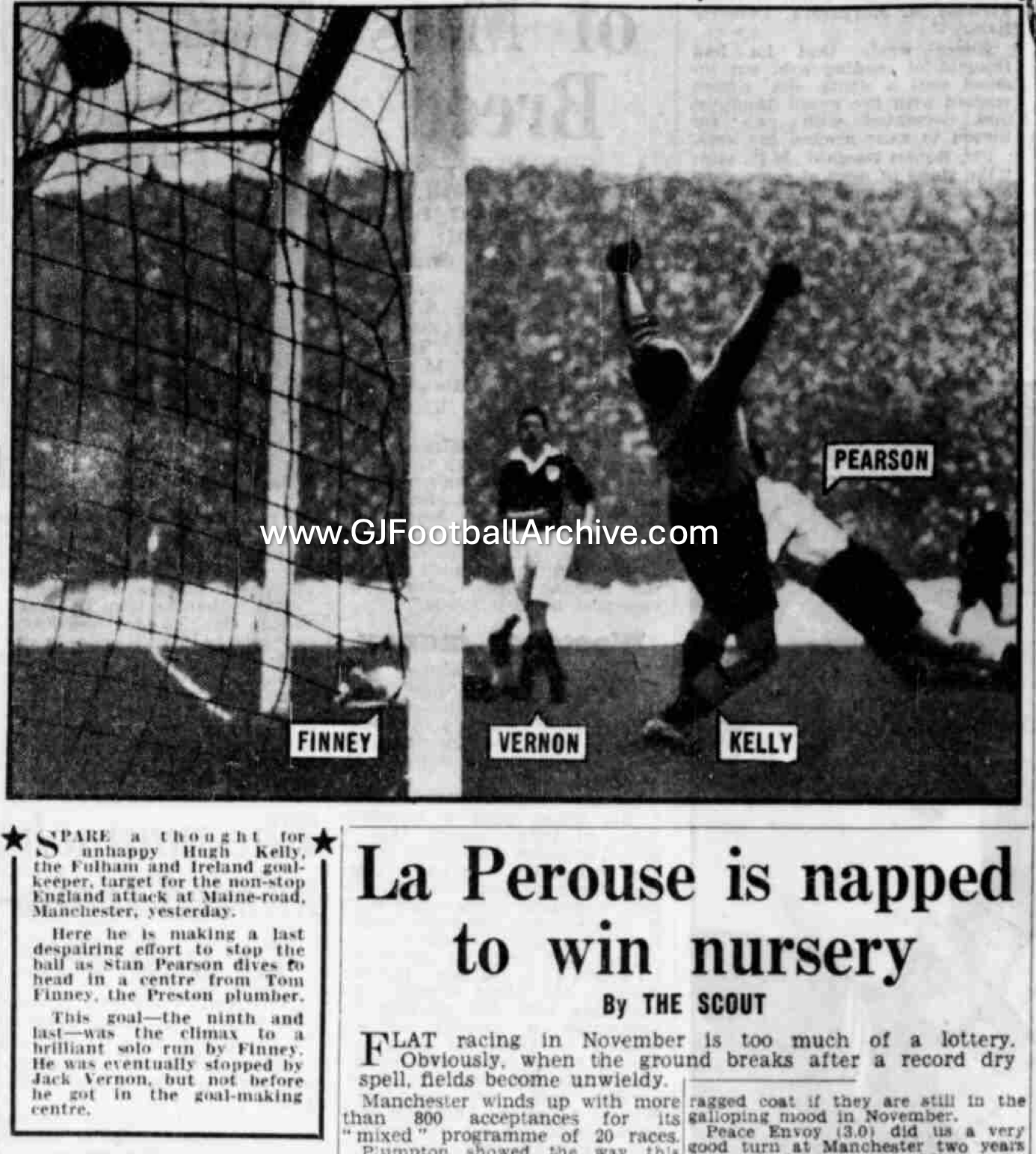
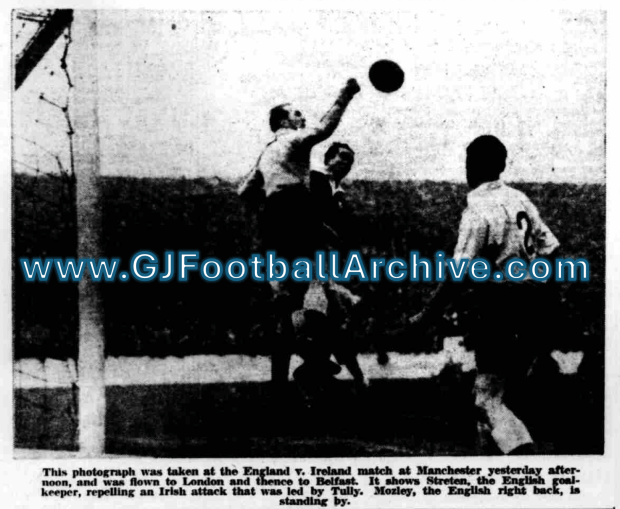
Here’s a report, image and film from the first World Cup qualifying match played in England (from this date, 16 November, in 1949). It saw England thrash Ireland 9-2 at Maine Road. This was a historic game for obvious reasons and the match programme explained how the World Cup operated as this was the first time England had participated in the tournament.

Here’s film: https://www.youtube.com/watch?v=ktdSk-o6YNA

Here’s a newspaper report:

Manchester City’s Three Royal Boxes!

Last Saturday (25 October 2025) I was fortunate to be invited to the England v Brazil women’s international as a guest of the FA. My seat was in the Royal Box at the Etihad (City of Manchester Stadium as it was named on the night due to sponsorship reasons). On social media someone commented that the Royal Box was a bit of a stretch in terms of its name but the truth is that the Directors Box (as it’s more commonly known) has housed members of the British royal family, including the late Queen Elizabeth II. In fact it was originally named the Royal Box for the Commonwealth Games in 2002. Back then I remember suggesting it should retain the name and now, maybe, the original name should return?

Other royals, including the former King of Spain, have sat there for Manchester City games and other events, so the name would be quite apt. Funnily enough, the Etihad’s ‘Royal Box’ isn’t the first part of a City ground to be given that name. It’s not even the second but the third! Both Maine Road and before that Hyde Road, had visits from senior members of the British Royal Family and on each occasion the Directors Box was spruced up and renamed the Royal Box for the game. Here’s the current King’s great grandad at Hyde Road’s Royal Box in 1920:

The King with the Mayor in Hyde Road’s ‘Royal Box’. Notice Lawrence Furniss stood, behind the King. Furniss was a major figure from the 1880s to the 1940s at City.

So, City, how about renaming the Directors Box the Royal Box again?

The following subscriber article talks about all of that, but in essence the current King’s dad, grandad and great grandad have all attended City matches at one of City’s home grounds. You can read about those visits here:

Subscribe to get access – Monthly

Read this 1,600 word article when you subscribe today. It costs £3 per month (cancel any time) or £20 a year. As well as this article you get to access books, videos, history talks, interviews and other articles.

Subscribe to get access – Annual

Annual subscribers access everything since the site went live in December 2020. Monthly subscribers get everything since 1 October 2022. All subscribers access new posts throughout their subscription.

“Stanley’s Match” – England 8 Scotland 0 16th October 1943

“When I heard the team I said two prayers.  One of thanks to the Scots for leaving me out, and one on behalf of Adam Little who had taken my place.  I knew then we’d do well to get away with less than five goals against.”  So said Bill Shankly referring to the selection of the England team to face Scotland at Maine Road in October 1943. You can read the story of this incredible game here:

Subscribe to get access

Read more of this content when you subscribe today.

Subscribe to get access

Read more of this content when you subscribe today. You can subscribe at either £20 per year (above) or at £3 per month here (cancel any time). For those subscribing £3 per month you will be able to access all content from October 2022 onwards for as long as you are a subscriber. Those subscribing £20 a year have access to everything posted since December 2020.

Maine Road & Temperance

This map shows the Maine Road area, where Manchester City’s former ground was, before any of the terraced housing was built. The dark blue shape I’ve placed on the map is approximately where the stadium was built. Maine Road was initially known as Dog Kennel Lane and was renamed in stages as terraced housing was built on it. The lane originally had a bend where the current Maine Road ends and the old lane veered off towards modern day Princess Parkway.

I explain a lot more about this in Farewell To Maine Road and in the Big Book of City. In the MCFC match programme a few years back I explained:

Maine Road itself was a relatively insignificant street in 1923, but in the previous century the road had the name ‘Dog Kennel Lane’ and it had for many decades been a fairly significant but meandering route south of the city. The street was renamed in stages when the area was developed during the late 1800s. For years the reason Maine Road was picked was not clear, but in 2009 I discovered the truth.

The Maine Road name came indirectly from the US State of Maine but this was a compromise. The following newspaper article explains: ‘Dog Kennel Lane took its name from the kennel where hounds were kept. It stood on the right-hand side at the bend about a thousand yards from Moss Lane, opposite to the road which tracked off to the left and led to Demesne Farm. The common name of this lane is so common and unattractive that when the Temperance Company bought the Trafford land they asked the local board to change the name to Demesne Road, and the subject was compromised by calling it Maine Road out of compliment to the Temperance principles of the petitioners.’

The idea of the Temperance movement was to discourage people from drinking alcohol. On 2 June 1851 the State of Maine passed the first recognised prohibition law, and two years later the United Kingdom Alliance was founded in Manchester, pledging to badger Parliament to outlaw liquor in England.

The ‘Temperance Company’ mentioned in the article was actually part of the movement and had bought some land at the top of Dog Kennel Lane – this area is close to the junction with Moss Lane East. They wanted to create a better standard of living and within that area they erected buildings in keeping with their approach to life, such as the Temperance Billiard Hall. However, the ‘Dog Kennel Lane’ name was clearly an issue and so the selection of the name ‘Maine Road’ was made. So the name Maine Road refers to the US State and the part that Maine played in the Temperance movement.

An early 20th century interpretation of an older map, showing modern streets (dotted) with the original roads.

If you’d like to read more on the history of Maine Road, take a look at Farewell To Maine Road, which can be downloaded from this page:

If you enjoy all the free material on my website and would like to support my research and keep this website going (but don’t want to subscribe) then why not make a one-time donation (or buy me a coffee). All support for my research is valued and welcome. It allows me to keep some free material available for all. Thanks.

Choose an amount

£2.50
£5.00
£7.50

Or enter a custom amount

£

Your contribution is appreciated.

Donate

The 1920s: First Maine Road Derby

100 years ago today (12 September) Manchester City and Manchester United met in the first Manchester Derby to be played at Maine Road (United had been in the second tier for the first couple of seasons of Maine Road’s existence). Here’s the background, report and stats from that game (this is all from the book I wrote with Steve Cawley called The Pride of Manchester – the history of the Manchester Derby). Enjoy!

MANCHESTER CITY 1 (Cowan)

MANCHESTER UNITED 1 (Rennox)

Manchester City: Jim MITCHELL, Sam COOKSON, Philip McCLOY, Sammy SHARP, Sam COWAN, Charlie PRINGLE, Billy AUSTIN, John (known as Jack) WARNER, Frank ROBERTS, Tom JOHNSON, George HICKS. Manager: David Ashworth

Manchester United: Alf STEWARD, Charlie MOORE, Jack SILCOCK, Ray BENNION, Frank BARSON, Frank MANN, Joe SPENCE, Thomas SMITH, Jimmy HANSON, Clatworthy ’Clat’ RENNOX, Frank MCPHERSON. Manager: John Chapman

BACKGROUND

United had spent three seasons in the Second Division and returned as runners-up to Leicester City. Some of the old faithfuls remained, notably Silcock and Spence, but inevitably team strengthening and transitions had occurred, in particular, with the acquisition of club captain Frank Barson. Signed in 1922 for the huge sum of £5,000, United promised Barson a pub if they were promoted within three years – and he just made it! A former blacksmith, Barson was an attacking centre-half of international standard but also carried a notorious reputation as a traditional ‘hard man’ who was quick to exact retribution if a team-mate was fouled. Another useful signing was Frank McPherson, a man with reputedly the hardest shot in football. The Reds made a quite promising start to the new campaign and had looked impressive in a 3-0 home victory against Aston Villa.

City’s playing squad had changed considerably since the last derby, while manager Ernest Mangnall who had joined the Blues from United in September 1912 and played such a major role in the development of both clubs had left City in May 1924, and was replaced by David Ashworth. Meredith had also finally retired in 1924, bowing out in an FA Cup semi-final against Newcastle, although he retained a connection through his son-in-law Charlie Pringle who now played for the Blues. A number of fresh signings had been made; Frank Roberts for £3,400, Billy Austin for£2,000 and Philip McCloy for £3,000. City also had great hopes that Sam Cowan, a centre-half signed from Doncaster Rovers in December 1924 would develop into a quality player. City had moved to their magnificent purpose-built stadium at Maine Road in August 1923 and had established a provincial record crowd of 76,166 in the stadium’s first season. Now, with the derby imminent, its capacity was viewed at a possible 85,000!

BEFORE THE GAME

            P          W         D          L           F          A          Pts

UNITED 4          1          1          2          5          4          3

CITY      3          1          0          2          3          4          2

MATCH VERDICT

The derby rivalry resumed in front of what was, at the time, City’s record League gate. City were deemed the better side in what was a rousing contest. Local born ‘keeper Alf Steward had an outstanding game keeping the lively City forwards at bay with a string of fine saves, before ’Clat’ Rennox then went down to the other end and gave the Reds the lead with a smart shot.

Sam Cowan capped a wonderful display by scoring the equaliser with a powerful far post header from a left wing corner (see photo). It was a fitting reward for Cowan, who besides being the man of the match, looked to be a player the Blues could build a future around.

“The Athletic News” reported on the resumption of the derby match after a four year break: ”The first meeting of the Manchester rivals after a lapse of four years brought the City club the largest League gate they have ever enjoyed. It was not so great as that recorded at the Cup-tie with Cardiff City in March 1924, when 76,166 spectators paid for admission, but over 62,000 people passed through the turnstiles, and, with ticket-holders, the attendance was officially returned at nearly 66,000. It was a magnificent spectacle and a game fought in a splendid spirit. That the City did not defeat their rivals was due primarily to the brilliant goal-keeping of Steward, a Manchester-born player, to whose rich promise the Athletic News referred last Monday.

It was fitting that on the only occasion he was beaten the success fell to Samuel Cowan, for these players were the outstanding figures in the contest. Cowan’s headwork was a feature of the match. More, he tackled with grim determination and effectiveness, and distributed the ball with discrimination and accuracy.

Cowan promises to be all that the City club expected when they brought him from Doncaster Rovers last season. He has all the physical requirements for a centre half-back, and, judging by his display in this match, he has the temperament for the big event. His equalising goal was a masterpiece in headwork and judgement”.

If you’d like to know more about this season for Manchester City why not read the following 4,900 word subscriber article on the 1925-26 season. If you subscribe (see below) I hope you enjoy it. If you are not currently a subscriber then why not try it for a month (£3 per month or sign up for a year at a discounted £20 per year)?

Here’s the article:

Subscribe to get access

Read more of this content when you subscribe today. It costs £3 a month (cancel anytime) or sign up for a year at £20 per year. Subscribers have access to the 1000s of articles, features, interviews etc. posted so far and all those posted during your subscription.

Stan Gibson 100th Anniversary

Born on this day (10th September) in 1925, Stan Gibson would have been 100 today. For those wondering who Stan was then read on… He was Manchester City’s groundsman for forty years and created a playing surface worthy of the club’s stature, particularly during the sixties and seventies when the pitch was possibly in its best ever state (though you can see from film of those days that the pitches were not a patch on today due to technological advances in the years that have followed). 

Stan worked as a stoker during the war for the Navy.  Always a keen sportsman – he was a Naval boxing champion and had football trials with Burnley – but by his 30s was becoming well known as a groundsman.  He arrived at Maine Road from Chorlton Cricket Club in 1959 after a recommendation by City ‘keeper Steve Fleet, and in the years that followed he worked hard to create a perfect pitch.  

By the time of City’s promotion in 1966 Stan had made the surface one the club could be proud of.  Both Joe Mercer and Malcolm Allison were keen to use Stan’s expertise to develop the pitch further, and thereby increase City’s chance of success.  Working with Allison, Stan made the pitch the biggest  – and many would say the best – in the League.  

Both Mercer and Allison recognised his contribution to City’s success.  It’s a little known fact that Stan was trusted with the job of looking after the FA Cup following City’s homecoming in 1969.  He chose to put the prized possession in the safest place he could think of, and the trophy spent its first night in Manchester locked in his toilet!

Stan loved City – he was even on the club’s books for a while in his youth – and felt the pitch was his own.  He could never relax during a match though:  “I watch the pitch rather than the game!  I shouldn’t really, because I get very upset if I see a divot, especially if it is the opposing side who have churned it up.”

Inevitably, the pop concerts in the 80s and 90s brought him a few headaches, but he welcomed other innovations, such as the undersoil heating implemented in 1979.

Stan was always an important influence and others often sought his views.  At one stage Rod Stewart tried to lure him away to tend his own turf, while Ken Bates was desperate for him to join Chelsea.  Stan would have none of it:  “I know I’m biased, but to me there’s nowhere better than Maine Road, and there’s nothing nicer than someone coming up to me on a Saturday and saying how great the pitch looks.  Makes all the toil worthwhile.”

His love for the club and Maine Road was never in doubt, and was perfectly summed up in 1994:  “City is my life.  That pitch out there is my baby.  I can’t keep away from it, and I couldn’t imagine my life without it.”

He leaves his Australian-based son Stuart and his daughter Janice – another popular face around Maine Road.

Stan passed away on Christmas Eve 2001 and this written by me as an obituary for him at the time. It was first published shortly after his death.

While you’re here I’d like to thank you for taking the time and trouble to visit my website. I have been researching and writing about Manchester football for a long time (no wonder I’m going grey!) with my first book published in 1989. I am not employed by anyone and I do not have sponsorship either and so I’ve set up this website to help share my 32 years plus writing and research. The intention is to develop the archive and to provide access to as much of my material as possible over the coming weeks, months & years. Subscribers can already access hundreds of articles/posts including the entire Manchester A Football History book and audio interviews with several people, including former City bosses John Bond and Malcolm Allison.  

It costs £3 per month or you can sign up for a year at the special price of £20 (it works out £1.67 a month) to get full access for as long as you subscribe. Why not subscribe for a month and see what you think? If you don’t want to subscribe then how about supporting the site with a donations (see below). Thanks for the support, Gary.

Subscribe to get access to the full site

£20 per year or £3 per month

If you enjoy all the free material on my website and would like to support my research and keep this website going (but don’t want to subscribe) then why not make a one-time donation (or buy me a coffee). All support for my research is valued and welcome. It allows me to keep some free material available for all. Thanks.

Choose an amount

£2.50
£5.00
£7.50

Or enter a custom amount

£

Your contribution is appreciated.

Donate

The 1920s: The English Hampden

The new series on Manchester City in the 1920s continues today with a 3,000 word subscriber article on the 1923-24 season. If you subscribe (see below) I hope you enjoy it. If you are not currently a subscriber then why not try it for a month (£3 per month or sign up for a year at a discounted £20 per year)?

Here’s the article:

Subscribe to get access

Read more of this content when you subscribe today. It costs £3 a month (cancel anytime) or sign up for a year at £20 per year. Subscribers have access to the 1000s of articles, features, interviews etc. posted so far and all those posted during your subscription.

As well as subscriber pieces this series on the 1920s includes some free articles. Watch out for a daily post.

The 1920s: Building A New Stadium

The new series on Manchester City in the 1920s continues today with a 1,500 word subscriber article on the 1922-23 season. If you subscribe (see below) I hope you enjoy it. If you are not currently a subscriber then why not try it for a month (£3 per month or sign up for a year at a discounted £20 per year)?

Here’s the article:

Subscribe to get access

Read more of this content when you subscribe today. It costs £3 a month (cancel anytime) or sign up for a year at £20 per year. Subscribers have access to the 1000s of articles, features, interviews etc. posted so far and all those posted during your subscription.

As well as subscriber pieces this series on the 1920s includes some free articles. Watch out for a daily post.

130,000 Capacity Stadium for Manchester City

This is an interesting cutting from 1935 talking about the possibility of increasing Maine Road to cope with the huge crowds that wanted to watch Manchester City play. It may seem crazy today but wasn’t such an odd idea in the 1930s. You can find out more on the story here:

Home in Barnsley

On this day (31 July) in 2008 Manchester City played a home game at Barnsley. This game made history as it was the first occasion the Blues had played a home European tie outside of Manchester.  Previously City had played home European games at Maine Road and at the City Of Manchester Stadium, but work at Eastlands following a concert by Bon Jovi prevented the Club from staging the game at home.  The decision was taken to stage the match at Barnsley.  Subscribers can read about both legs of the European tie here: