Continuing the series of features on the 1960s, here’s a story involving Colin Bell and Harry Dowd it’s always worth telling… On this day (8th February) in 1964 Manchester City and Bury drew 1-1. It hardly sounds a remarkable game but it was for two reasons – this was Colin Bell’s Bury debut (and he scored!) AND City’s goalkeeper Harry Dowd scored the Blues equaliser.
This was City’s first point of 1964. The Blues were losing 1-0 to a debut goal from Bury youngster and future Blue Colin Bell at Maine Road when Dowd suffered a broken finger in the 54th minute. He was unable to continue in nets but stayed on the field and reverted to centre-forward – a role he’d often played as a youngster.
Scottish forward Matt Gray replaced Dowd in nets and the game continued with the regular ‘keeper keen to impress in attack: “I was restless enough to give it all I’d got. I felt just like a colt on its feet for the first time, pushing and shoving my way through and going for the every ball – many of which I hadn’t a hope of getting. But the moment of glory wasn’t far away, and it seemed the fans were loving every minute of the action.”
“I got the chance to slip the ball to Derek Kevan, his shot hit the bar, and as it bounced down I went lunging in to turn home the equaliser. The newspapers said some very kind things the next day.”
With Dowd’s efforts up front and a fine performance in goal from Gray the Blues secured the point. Gray had managed to keep a clean sheet, although Dowd’s amazing exploits prevented him from receiving the kind of credit that other emergency City ‘keepers Doyle, McDonald, Gleghorn, Quinn and Walker would over the decades that followed.
This game was probably Dowd’s highlight of the season as later on, he found himself dropped with Bert Trautmann returning to the side for three games before even he gave way to Alan Ogley for the final five matches of the season.. At one point Dowd asked for a transfer, but he remained at Maine Road, playing a significant part in the successes that followed under manager Joe Mercer.
If you’re a subscriber you can read the following article on Manchester City during the 1963-64 season. If you’d like to read this 1700 word article, plus all other articles on the site, then please subscribe (see below). As with most of the other features in this series it includes words from interviews I have performed with those who were there.
Subscribe to get access
Read more of this content when you subscribe today. It costs £3 per month (cancel anytime) or sign up for a year at the discounted price of £20 per year (works out £1.67 per month). Subscribers access the 1000+ articles posted so far and the others scheduled during the life of your subscription.
On this day (29 January) in 1966 Mike Summerbee scored twice as Manchester City defeated Middlesbrough 3-1. The other goal came from Neil Young (the photo is of course Neil Young in 1971 at Maine Road). 1965-66 was an important season in MCFC history and you can read more on it in the following 4100 word article. This (plus all other articles on the site) is available to subscribers (see below). As with most of the other features in this series it includes words from interviews I have performed with those who were there.
Subscribe to get access
Read more of this content when you subscribe today. It costs £3 per month (cancel anytime) or sign up for a year at the discounted price of £20 per year (works out £1.67 per month). Subscribers access the 1000+ articles posted so far and the others scheduled during the life of your subscription.
On this day (24 January) in 1966 52,661 watched at Maine Road as Manchester City defeated Blackpool 3-1 in the FA Cup with goals from Mike Doyle, Mike Summerbee and Johnny Crossan (the photo is of course of Mike Summerbee with Colin Bell and Francis Lee in October 1967). 1965-66 was an important season in MCFC history and you can read more on it in the following 4100 word article. This (plus all other articles on the site) is available to subscribers (see below). As with most of the other features in this series it includes words from interviews I have performed with those who were there.
Subscribe to get access
Read more of this content when you subscribe today. It costs £3 per month (cancel anytime) or sign up for a year at the discounted price of £20 per year (works out £1.67 per month). Subscribers access the 1000+ articles posted so far and the others scheduled during the life of your subscription.
On this day (12 January) in 1966 Manchester City defeated Rotherham 3-1 with goals from Mike Doyle (2) and Johnny Crossan (the photo is of course of Mike Doyle in the following decade at Maine Road). 1965-66 was an important season in MCFC history and you can read more on it in the following 4100 word article. This (plus all other articles on the site) is available to subscribers (see below). As with most of the other features in this series it includes words from interviews I have performed with those who were there.
Subscribe to get access
Read more of this content when you subscribe today. It costs £3 per month (cancel anytime) or sign up for a year at the discounted price of £20 per year (works out £1.67 per month). Subscribers access the 1000+ articles posted so far and the others scheduled during the life of your subscription.
Continuing the series of features on the 1960s, here’s a subscriber article on Manchester City during the 1965-66 season. This was an important season in City’s development. If you’d like to read this 4100 word article, plus all other articles on the site, then please subscribe (see below). As with most of the other features in this series it includes words from interviews I have performed with those who were there.
Subscribe to get access
Read more of this content when you subscribe today. It costs £3 per month (cancel anytime) or sign up for a year at the discounted price of £20 per year (works out £1.67 per month). Subscribers access the 1000+ articles posted so far and the others scheduled during the life of your subscription.
Four years ago today (5 January 2021) the great Colin Bell MBE died. I did an interview for the Blue Moon Podcast the day after Colin passed away. It was an emotional morning of course. The guys at the podcast have made the entire interview free to listen to here:
On this day (24 December) in 1948 the great maverick Mancunian footballer Stan Bowles was born. Here’s a profile of him…
Bowles joined City as an amateur on 27 July 1965, becoming an apprentice on 1 October 1965 and then professional on 29 December 1966.
Then in 1967 things really began to happen and Bowles’ first game was as a substitute in a League Cup tie at home to Leicester City. He scored two goals in the second half and the following Saturday he made his League debut another memorable one. He scored two again!
Lots of stories have circulated over the years about his time at City. Like Mario Balotelli many years later some are truthful; others are exaggerations and some are completely make up.
The stories go that Bowles once missed a flight to Amsterdam where City were to play against Ajax, and that Bowles’ interest in the horses led to Joe Mercer saying: ‘If Stan could pass a betting shop like he can pass a ball, he’d be a world beater.’ Suspensions and other issues led to Stan refusing to sign a new contract and he asked to leave. That in itself led to him being suspended for 14 days on the advice of the Football League.
Inevitably Bowles moved on, first to Bury (July 1970) and then to Crewe (September 1970).
A spell at Carlisle followed and then in September 1972 a bid of £110,000 took him to Loftus Road where he won five England caps as a QPR player.
Seven years later Nottingham Forest’s Brian Clough bought him for £210,000 but sold him again less than a year later after further issues. Further spells were reported at Orient, Brentford, Hounslow and Epping.
In 2015 it was announced he was suffering with Alzheimer’s Disease, like his former boss Joe Mercer. Bowles died on 24 February 2024.
At City Bowles made a total of 20 first team appearances, scoring 4 goals, but he remains recognised as a hugely talented player.
There are articles on this site mentioning Bowles. Here’s a selection:
If you enjoy all the free material on my website and would like to support my research and keep this website going (but don’t want to subscribe) then why not make a one-time donation (or buy me a coffee). All support for my research is valued and welcome. It allows me to keep some free material available for all. Thanks.
This day (21 November) in 1970 saw England international Francis Lee score twice as Manchester City defeated West Ham United 2-0 at Maine Road. Franny was a wonderful, attacking player and a statue of him alongside Colin Bell and Mike Summerbee has been erected at the Etihad Stadium. I met Francis a lot over the years and interviewed him frequently. So, if you’ve not seen this before, here’s an interview I did with him at his home in February 2010. This was published in the City match programme back then and you can read Franny’s views on his career here as published at the time. Enjoy!
In a glittering career Francis won two League Championships, the ECWC, League Cup and the FA Cup.
Francis, let’s begin with your early career at Bolton. Is it true you started on the groundstaff?
That’s right. I set myself a target that I had to get into the first team by the time I was 17 or 18. If I didn’t I was going to go back to college and train as a draughtsman. That was my plan, but I managed to get into the first team at 16 and I made my debut against City (5/11/60). We won 3-1 and I scored a header at 3.15 against Bert Trautmann – I think Bert must have thought he was getting over the hill for me to score a header past him!
I had about a dozen games over two seasons, then in 1962-63 I was top scorer with 12 goals from 23 League games.
You topped the goalscoring charts each season at Bolton from 1962 until you left. You were playing on the wing. Was that your preferred position?
I think my best position was as support striker to a big fella. I only played in that role twice really – at Bolton with Wyn Davies when I scored 23 League goals one season and then at City with Wyn again when I scored 33 League goals in 1971-72. A lot of my career was spent at centre-forward which is a bit of a difficult position to play if you’re only 5ft 7. When I played for England I was support to Geoff Hurst and that suited me. At centre-forward I had my back to the ball but when I was support striker – the free player – that suited me fine. I could pick up the ball going forward and that was great.
At Bolton you scored 106 goals in 210 appearances. A great record, but when you left the club the stories were that you were in dispute. Is that true?
Well, what happened is that we were relegated in 1964 and, despite a near-miss in 1965 when we finished third, it didn’t feel as if we were going forward. My ambition was still to see how far I could develop in the game and in the back of my mind I had the ambition to play for England, but I wasn’t even selected for the under 23s. The story was going around that I was difficult to handle – which is funny because Joe Mercer said that I was the easiest player to handle at one point.
Were you difficult to handle at Bolton?
I was opinionated and ambitious, but not difficult. I think that message was going around because I was on a weekly contract at that time. The club knew that it would be difficult for them to stop me moving on if another club came in. So any player with a reputation for being difficult would not be on anyone else’s shopping list, would they? Bolton offered me a new contract worth something like £150 a week but my wage was only £35. That actually upset me and I said: “if you now think I’m worth £150 a week what about all those years you’ve been underpaying me?” It wasn’t the money that was an issue it was the way they handled it. What they were doing was trying to get me on that contract and then my value would increase if someone came in to buy me. Once they saw how dissatisfied I was with the way they were handling it, they said that it’d be best if we made a clean break, and so I said I’d pack the game in. I had my business by then and so I said: “give me my employment cards and I’ll pack it in.” They thought I was bluffing.
It’d been a decent season – I’d scored 9 goals in 11 games including when we beat the great Liverpool side in the League Cup – but then it ended in September 1967. They gave me my cards and that was it.
Were you absolutely certain you’d pack it all in at that point?
I kept myself fit but I was working on my business. I was driving my lorry around, collecting the waste paper and so on. The business was growing and I felt that if I wasn’t wanted then I’d concentrate on that. It was always my fallback.
I know how stories can get exaggerated over the years, but is it true that in between games you were going around collecting the waste paper?
I used to drive my lorry during the week and even on the Thursday or Friday before a game I’d be collecting waste paper. I used to put on a flat cap and muffler so that nobody would recognise me! In the end I was driving articulated lorries and it was getting to be a very good business. My last pick up was the day before I signed for City! I roped and sheeted about 15 ton of paper and cardboard from a spinning mill in Bolton. Took it to the Sun Paper Mill in Blackburn and when I got back about 5pm I got a call from Joe Mercer. He didn’t give his name at first but I recognised him. “Who is that?” He said: “Tom Jones.” I said: “It doesn’t sound like Tom Jones, sounds more like a man called Mercer!” and he asked: “Where’ve you been?” I told him I’d been playing golf – I couldn’t play the game at all then but I couldn’t tell him what I had been doing!
This is Your Life Joe Mercer 1970 MCFC squad
Did you immediately want to sign for City?
Other teams had shown interest in signing me. Liverpool offered £100,000 I understand but then when I wasn’t playing it affected my price. In later years Shanks often used to grab me and say in that strong Scottish accent: “Son, I should’ve signed ya the night I saw ya!”
City was just right of course. It meant the business could carry on. I don’t know if Bolton had told Joe about my contract or the £150 offer but the first thing he said to me before we talked it through was: “I’ll be honest with you son. We’ve no money. We’re skint!” I said: “It doesn’t matter. I’ll just be delighted to start playing again.” I meant it as well.
I signed for City for £60 a week – remember I’d turned down £150 at Bolton! But it was well worth it. The way the team developed and, of course, when I realised my ambition and played for England.
I left a lot of friends of mine at Bolton – Freddie Hill, Tommy Banks, Roy Hartle, Gordon Taylor – and we had some great times. Those of us who had come through the ranks were poorly paid for the job we were doing at the time, but we enjoyed ourselves. I never had any argument with the players, fans or people at Bolton, it was just those that ran it. I loved my time at Bolton.
When you joined City the Blues were ninth in Division One after losing 5 of the 11 games played. But the side was transformed from the moment you came. Unbeaten in your first 11 League games. Were you the difference?
The team just clicked and I was only part of a good group of players. We had that great run up to Christmas, then a bit of a blip, but in the New Year we just rattled on. It was a terrific period. Mike Summerbee was playing at centre-forward and our culture at the time was to play with five forwards. It was very unusual for the time. The only system we played was that we all played – we had ten players who went up together, and ten who defended together. When we won the League at Newcastle at the end of the season it was wonderful and particularly special because none of us had ever won anything significant. This was our first major success and that’s why the following season the ordeal of playing a European Cup tie was so tough.
Francis Lee after scoring at Newcastle
Was it just inexperience that caused City to lose the Fenerbahce European Cup tie 2-1 on aggregate?
None of us had played in Europe before. Mike Summerbee had only made his England debut against Scotland in February 1968. Colin Bell had played in two England friendlies, but apart from that none of us had any concept of what it could be like in Turkey. Had we played the first leg in Istanbul and the second at Maine Road I think we’d have gone through, but the goalless 1st leg at Maine Road killed us really. We worked hard in Istanbul and it was a creditable result over there but we were out and it was because we were inexperienced. It was a culture shock.
Confidence was at a real low after that game. We’d had a bad run and only had a small squad so we struggled. But that was the way it was. Back then the motivation for all of us was to be in the team and to keep your place.
I think younger readers may be surprised to read that City tried to keep the same eleven players game after game, competition after competition. Would you have enjoyed a squad rotation policy when you played?
The aim of a footballer is to play. Why would anyone want to be rested? If a manager had said to me ten minutes before full time that he wanted to bring me off even though I was playing well, I’d have told him “no way! I’m enjoying myself. This is what you bought me for, now let me do it!” It wouldn’t matter what the manager says I’d want to stay on. That’s what the game is about – enjoyment! Every player wanted to play. None of us wanted to be on the bench.
People talk about the number of games played today but in 1969-70, ignoring friendlies, you played 72 competitive games for England and City. Would squad rotation have helped?
No. Playing is always better than being on the training pitch and I used to love playing, so I tried not to miss a game. It didn’t matter whether it was an England friendly, Anglo-Italian cup or whatever, I wanted to play and represent my club and my country. I think it’s best for all players. Look at Tevez. He’s improved his fitness and form by playing, and I think a lot of players are like that. He needs to play, and that’s what I always wanted.
Francis Lee v Schalke 15 April 1970
Some of the other players from the 1969-70 season have talked about Franny’s Grand Slam. Your aim to win four trophies in one season inspired them. What do you remember of that?
Well, we wanted to win every game so it seemed natural to me that we should go for all four. We won the League Cup and Cup Winners’ Cup, so that wasn’t bad. In the FA Cup we ended up suffering a rare defeat at United. We were doing okay in the League then we had a few injuries – Mike, Colin Bell and Neil Young were injured at key times – otherwise I think we would have won three trophies. But the thing about the ‘Grand Slam’ was that it was the ambition of the place. I remember we were going to London on the train and could see Wembley, and I shouted to the lads to take a look because two of our ‘Grand Slam’ games would be played there!
1970 ECWC
Moving forward a couple of years, we missed the title by a point in 1972. Why?
Rodney Marsh has told you himself that his signing affected the 1971-72 season. Malcolm played Rodney and disrupted a team that I’m convinced would have won the League that year. I don’t blame Rodney. There was one game near the end where we should have had a couple of penalties for hand ball but, because this was the season when we got that record number of penalties, they weren’t given. That season our luck changed and everything went against us.
A lot has been made about you ‘diving’ but the factual evidence is that the majority of those penalties were given for things like handball or fouls on other players. Nevertheless, the myths survive. So, big question, did you ever dive?
I couldn’t say that I always stayed on my feet unless I was absolutely knocked down. In those days you used to get some horrendous treatment by the defenders, but I will tell you that the season before those penalties we only had a couple, and before that I think it was one. The reason we got so many in 1971-72 is that they had changed the law, plus we were going for the title so we were putting sides under a lot of pressure and they reacted. I was fouled only 5 times out of the 13 league penalties we got.
When I was attacking I used to play the odds. If a defender was coming towards me I’d carry on, or I’d run towards the defender because there were only three things that could happen – he pulls me down, he gets the ball off me – well done, or I get a cracking shot at goal. So the odds were in my favour. You have to play them.
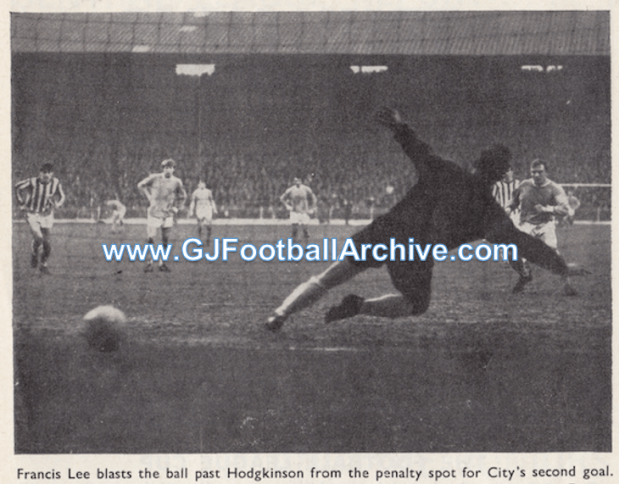
I think the reason people go on about penalties with me is because I was the one taking them. It didn’t seem to matter what they were given for, the headlines were that I had scored from a penalty. The season after I think we only got one penalty. I would say that for every dubious penalty that was awarded there were another twenty that we should have had.
Francis Lee’s first penalty for City January 1968 v Sheffield United
Was the move to Derby something you really wanted?
By that time my business was substantial so going to Derby was going to cause problems. Derby offered City more than anyone else and that was that. We won the title in my first season – I’d only signed a contract for a year – and they were a very good side, so I stayed with them for another season. The pitch was awful – even Maine Road’s pitch was better – but I felt we could have won the European Cup that second season. We beat Real Madrid 4-1 but I missed the return game because I’d been sent off in the Hunter incident against Leeds. We lost 5-1.
They actually changed the rule after that saying it was unfair to automatically ban a player from a European game after a domestic match when the player had yet to be proved to be guilty. There wasn’t much chance of me being ‘not guilty’ – the footage was there for everyone to see!
People often suggest that City sold you too soon and that had you stayed a couple of seasons longer we might have won the title again. Do you hold this view?
I think if I’d have stayed and Mike Summerbee – remember he was sold a year after me – then I do think we’d have mounted a serious challenge for the title. Mike had plenty to offer and should not have been sold.
You came back to Maine Road and scored for Derby (28/12/74). I was in Platt Lane that day and I remember a surreal moment when City fans cheered your goal. Did that actually happen?
Yes, it did. Then I think they thought: “What have we done, he’s playing for them!”
I enjoyed my football and I loved scoring. I loved that goal. I picked it up with my back to the line, went through two people and on to score the goal. The film shows me smiling because I’d scored what I thought was a good goal. It had nothing to do with City or revenge or anything like that. I think I enjoyed about 95% of every game I ever played. It was fun. A great way to earn a living, so on that day I was happy.
Why did you retire in 1976 only a few weeks after your 32nd birthday?
My business was taking over. I had about 110 people working for me and was travelling all over the country. Had I been playing closer to Bolton then I may have carried on. Derby wanted me to stay on, and I made a promise to Dave Mackay that if I was to play again then I’d do it for him. Tommy Docherty tried to persuade me to join United but I wouldn’t break my promise to Derby.
Your business and horse racing interests grew, but then in 1993 you were back, mounting a takeover of City. Why?
I wasn’t looking to get back into the game at all during those years. I had a successful career and was happy. But City were in a desperate state and I genuinely felt that I could not let a club I cared passionately for struggle like that.
When we finally gained control there were so many issues. So many skeletons coming out of the cupboards. The financial state of the club was appalling. I should have known then that it wouldn’t work!
The biggest problem at the start was having to build the new Kippax Stand –there really wasn’t a workable plan in place before we arrived and yet the stand had to be replaced within months of us arriving. We ended up spending about £16m in the end – even removing the waste from underneath the old terracing cost £1.8m because it was contaminated. I thought then that my luck had changed. Everything we tried to do became an issue and the Kippax was a millstone.
1994-95 the new Kippax takes shape
It’s extraordinary when you think that prior to us, Blackburn and Everton, no one ever put money into a football club. People bought shares but never invested, we did invest.
Off the pitch things did improve significantly, but on the pitch we struggled. What’s your view?
People like John Dunkerley worked very hard during that spell and the training facilities were improved and so on. Then, just when we finished the Kippax, Manchester Council started to talk to me about becoming tenants of the new stadium – now that turned out to be the best thing that happened to City during the decade that followed. We spent a lot of time working with them and talking with various people to make it happen. Full marks must go to the Council for having the foresight and it became very important for City to become anchor tenants. I think I had a lot of bad luck as Chairman and things certainly didn’t work on the pitch, but I do think that was one thing that the club got right.
Finally, thinking of your time as a player, many people claim the 1970 League Cup Final was your greatest City game, do you feel that?
I don’t think of individual games in that way. You have to look at the club during your time there and see what that club won and what you contributed to the overall success of the club, not necessarily individual games.
1970 League Cup final. Francis Lee facing ball and Glyn Pardoe
My role was to make things happen, and if I was making things happen, especially if it was causing some aggravation for the opposition, then I was happy. When you hear the opposition players shouting things like: “don’t let him turn!” that’s a real pat on the back. You know you’re getting to them.
In terms of individual games or goals… I think one of the goals I scored at West Ham (18/11/67) was the best goal I’ve ever scored. I was playing against Bobby Moore and I think I had a fantastic game.
I always think that a top class player should go on to the pitch and have enough confidence in his own ability to know that it is very rare for him to have a bad game. It’s not arrogance or anything, but it is the mark of a top class player. If you go onto the pitch feeling that then more often than not you will have a good game. The next step is to take it up the levels until you walk on to the pitch believing you’ll have a great game and score a couple of goals.
At City most of us developed that confidence and on some days, when the entire team was at that level, we had some tremendous games. There are signs that the current side are heading in that same direction.
You can read more on Francis throughout the website. Use the Francis Lee tab lower down on this page or search using his name. As an example, here’s a detailed profile of him I wrote a few years back:
Subscribe to access great content and support Gary’s research
If you’ve enjoyed this piece then why not subscribe and read the rest of the great material on here. At the same time you’ll be supporting my research and writing (I’m not employed by anyone and my research/writing is self-funded). It costs £3 per month (here; access everything posted since 1 October 2022) or £20 per year (below; access everything posted since December 2020). You’ll also get to read all content posted during your subscription. Thanks.
Subscribe to access great content and support Gary’s research
If you’ve enjoyed this piece then why not subscribe and read the rest of the great material on here. At the same time you’ll be supporting my research and writing (I’m not employed by anyone and my research/writing is self-funded). It costs £3 per month (above) or £20 per year (here; access everything posted since December 2020). You’ll also get to read all content posted during your subscription. Thanks.
Continuing the series of features on Manchester City in the early 1900s! Today it’s an article on the 1908-09 season. If you’re a subscriber you can read this below.
If you’re not a subscriber then why not sign up for a month and see what you think?
Subscribe to get access
Read more of this content when you subscribe today. It costs £3 per month (cancel anytime) or sign up a year at a time for the discounted annual fee of £20. This gives access to everything on the site, including PDFs of 3 of my books and various other articles, interviews and audio material. Each subscriber has access to all content posted during their subscription period too. Why not sign up for a month and see what you think?
Continuing the series of features on Manchester City in the early 1900s! Today it’s a 9400 (yes that’s right!) word article telling the story of 1903-04 when Manchester won its first major trophy. If you’re a subscriber you’ll need to get a brew before reading this celebration of that season. If you’re not a subscriber then why not?
Ever wondered how Manchester found its first major trophy success or what the scandal that rocked City was all about? Then subscribe and read this series of articles.
Subscribe to get access
Read more of this content when you subscribe today. It costs £3 per month (cancel anytime) or sign up a year at a time for the discounted annual fee of £20. This gives access to everything on the site, including PDFs of 3 of my books and various other articles, interviews and audio material. Each subscriber has access to all content posted during their subscription period too. Why not sign up for a month and see what you think?






 Gary James' Football Archive