A new daily series of articles for subscribers started a few days ago covering the 1980s. This is a seasonal journey through a truly important decade in the history of Manchester City Football Club. Today’s article is a 3,500 word feature on the 1982-83 season. Enjoy (well, if you know the outcome of this season you can enjoy this memory refresh while reflecting on the modern day successes of the Blues!).
Subscribe to get access – Monthly
Read more of this content when you subscribe today. It costs £3 per month (cancel anytime) to access everything posted since 1 October 2022 or there’s a special annual rate below which gives greater access and works out much cheaper.
Read more of this content when you subscribe today. It costs £3 per month (above) or £20 a year (here) to access everything posted since the site was created in December 2020. This special rate works out about £1.67 a week and gives access to everything posted, including PDFs of 3 of my books.
A new daily series of articles for subscribers started yesterday covering the 1980s. This is a seasonal journey through a truly important decade in the history of Manchester City Football Club. Today’s article is a 2,500 word feature on the 1981-82 season. Enjoy!
Subscribe to get access – Monthly
Read more of this content when you subscribe today. It costs £3 per month (cancel anytime) to access everything posted since 1 October 2022 or there’s a special annual rate below which gives greater access and works out much cheaper.
Read more of this content when you subscribe today. It costs £3 per month (above) or £20 a year (here) to access everything posted since the site was created in December 2020. This special rate works out about £1.67 a week and gives access to everything posted, including PDFs of 3 of my books.
On this day (10 November) in 1978 it was reported that Polish international Kaziu Deyna signed for Manchester City. It was some time before it was all sorted out however! Back in 2003 I wrote this profile of former Manchester City player and Polish World Cup star Kazimierz Deyna. Deyna was such an important and unusual signing at the time he joined City that I feel this article is still appropriate and of interest to subscribers to my blog today.
Subscribe to get access – Monthly
If you would like to read this in-depth article then why not subscribe? It costs £3 a month if you’d like to sign up for a month at a time. Monthly subscribers get full access to everything posted since 1 October 2022. You can also sign up for a year at a discounted rate and get even more access (see below).
If you would like to read everything on this site (including the entire Manchester A Football History book, my first book & Farewell To Maine Road) then please take out an annual subscription (£20 per year; equivalent to £1.67 per month).
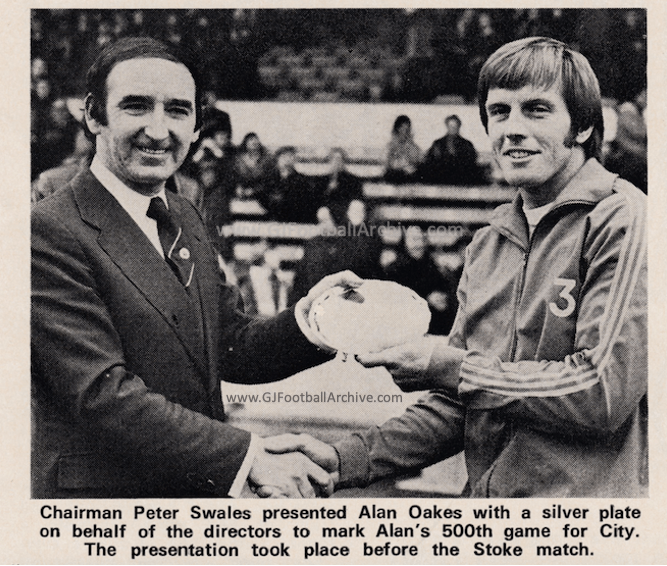
Today (9 November) in 1974 Manchester City presented longserving player Alan Oakes with a silver plate to commemorate his 500th League appearance. He’d actually made his 500th League appearance the previous week when City faced Everton at Goodison.
At Maine Road on 9 November City chairman Peter Swales presented him with the award before the game with Stoke (Oakes made his 501st League appearance that day). City won that match 1-0 with a goal from Rodney Marsh. You can see Marsh’s goal here:
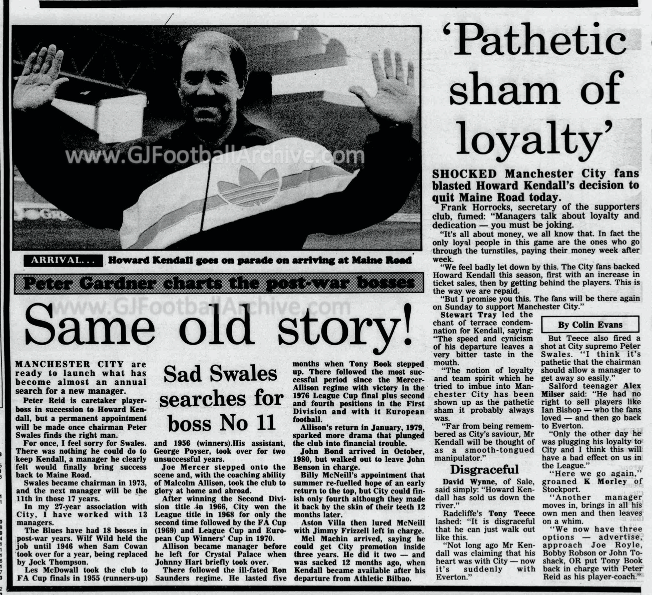
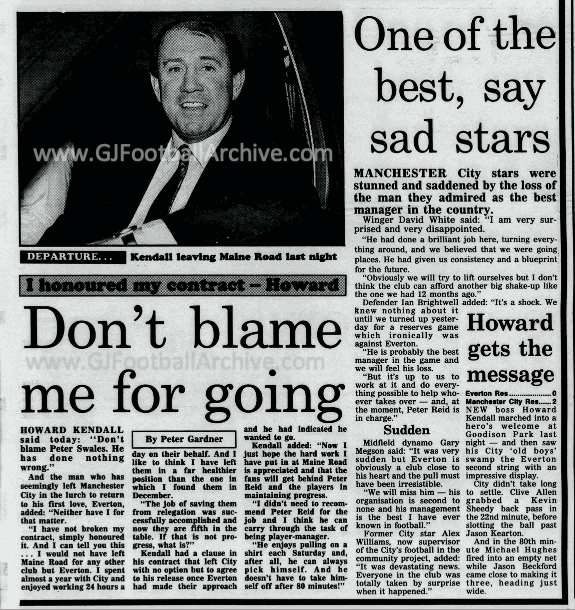
On this day (7 November) newspapers were full of the previous day’s news that had stunned Manchester City and that was the resignation of manager Howard Kendall. Kendall had decided to return to his former club Everton.
The move absolutely stunned City fans (though we did get the blame in some newspapers who claimed we’d never actually taken to him – absolute rubbish and demonstrates the typical attitude of the period which was if anything went wrong blame the fans!). Fans had voiced concern over Kendall’s signing of many, many former Evertonians but overall they were satisfied (more than satisfied) with the manager’s approach at City.
The bottom line with Kendall leaving is that chairman Peter Swales and his supporting directors had given him a contract that allowed him to walk out on the job whenever he chose. It was a strange situation and the belief at the time was that the City board had believed the ONLY job Kendall would be tempted to leave City for was the England job and, with Peter Swales in charge of the international selection committee, the chance of that happening was extremely slim.
Ah well! Here are some newspaper articles from this day back in 1990.
On this day (13 October) in 1979 Kaziu Deyna scored the only goal of the City-Nottingham Forest League game at Maine Road. A crowd of 41,683 witnessed the City win with future Spanish TV presenter Michael Robinson wearing the number 9 shirt for the Blues that day.
Back in 2003 I wrote this profile of former Manchester City player and Polish World Cup star Kazimierz Deyna. Deyna was such an important and unusual signing at the time he joined City in November 1978 that I feel this article is still appropriate and of interest to subscribers to my blog today.
Subscribe to get access – Annual
If you would like to read this in-depth article and all the others on this site (including the entire Manchester A Football History book) then please subscribe. It works out about £1.67 a month if you take out an annual subscription (£20 per year) or £3 a month (see below) if you’d like to sign up for a month at a time. Each subscriber gets full access to the 1000+ articles posted so far and the hundreds scheduled to be posted in the coming weeks.
If you would like to read this in-depth article and all the others on this site (including the entire Manchester A Football History book) then please subscribe. It costs £3 a month (cancel anytime) of take out a special annual subscription for £20 (above).
Here’s a nice little quote from 1973. It’s a reminder of the days just before Peter Swales became Manchester City chairman but he was already the main mouthpiece for the board (something that riled chairman Eric Alexander significantly!). It shows how Swales was already trying to grab the headlines with comments that he knew would get media attention.
The background is that there had been some discussion on whether Rodney Marsh would be sold as, according to the media, he wasn’t exactly fitting in with City’s perceived direction and had, according to some, cost the Blues the League title in 1972. You can read about that elsewhere on my site (see below).
I wonder if Swales ever did get any offers for the Main Stand as a result of this? I do know that Punch magazine did a humorous piece outlining that it had been bought by Tottenham for £500,000 and their forward.
One Manchester club seems to be getting everything right, winning League titles, European trophies and so on while the other appears to be in self-destruct mode with demonstrations against the owner and all sorts of worrying stories appearing in the media. Sound familiar? This was actually the situation on this day (11 September) in 1993 when Manchester City (not United) were the team in crisis and United (not City) were the team winning Leagues and European trophies.
This cutting is from 11 September 1993 and highlights the proposed takeover by Francis Lee of the Blues. Peter Swales had been City’s chairman for twenty years during which he’d taken the club from being a major, profitable power to one that was heavily in debt – debt that was hampering the club’s development – with a stadium that was being downgraded almost every day via a lack of serious investment. Across at United the club appeared relatively stable with a stadium that was being invested in. They also had one of the game’s most talented and successful managers while City had gone through a series of managers in the previous few years. City were a relatively stable top flight team though by 1993. Brian Horton was now City’s boss and he seemed to offer a positive style of football but the wider problems of the club were never far away. All sound familiar still?
I do find it amazing that City and United seem to have swapped roles so emphatically since 1993 in terms of how the clubs are managed, invested in, stadium developments and so on.
For those unaware of what happened to City or those who perhaps support United and are looking to see what happened and whether history will repeat here’s a brief overview: United dominated football for most of the 1990s & 2000s while City’s Lee takeover was successful. Lee, however, was unable to revive City’s fortunes and build on the fifth place finished that had occurred in 1991 and 1992. Although much of the financial infrastructure of City was improved following the takeover, the dismissal of Horton as manager and a poor appointment in Alan Ball led to relegation. Further issues followed as star players left, managers were sacked or left and the Blues ended up in the 3rd tier (for one season – too many believe City were a 3rd tier club who eventually got lucky but they were a top 6 team who fell apart!).
Could history repeat itself with the roles reversed? Unlikely United will ever fall as low as City but it is worth noting that City never expected to fall that low. Also, removing Swales from power was something that fans had been wanting for decades. It only became a possibility when a former hero announced he could take over the club BUT even then the hopes and ambition of all Blues could not be met.
Yesterday (6 September 2023) I posted a story highlighting the transfer of Steve Daley to Manchester City in 1979. Today I’d like to expand on that by posting here an interview I did with Steve where we discuss that transfer, City fans and the spending City were doing at the time we did the interview. It was a great time to interview Steve and I enjoyed it immensely, helping fill in some gaps.
This interview is available to subscribers below.
Subscribe to get access – Monthly
Read more of this content when you subscribe today. It costs £3 per month to subscribe or sign up for a year at the special price of £20 (works out about £1.67 a month). Monthly subscribers can cancel anytime, so why not give it a try for a month? Monthly subscribers access everything posted since 1 October 2022 whereas annual subscribers get everything posted since the site started in December 2020 (see below).
It costs £20 to subscribe for a year (here). Books, interviews (audio and written), images, features and more have been posted to this site so far. More to come.
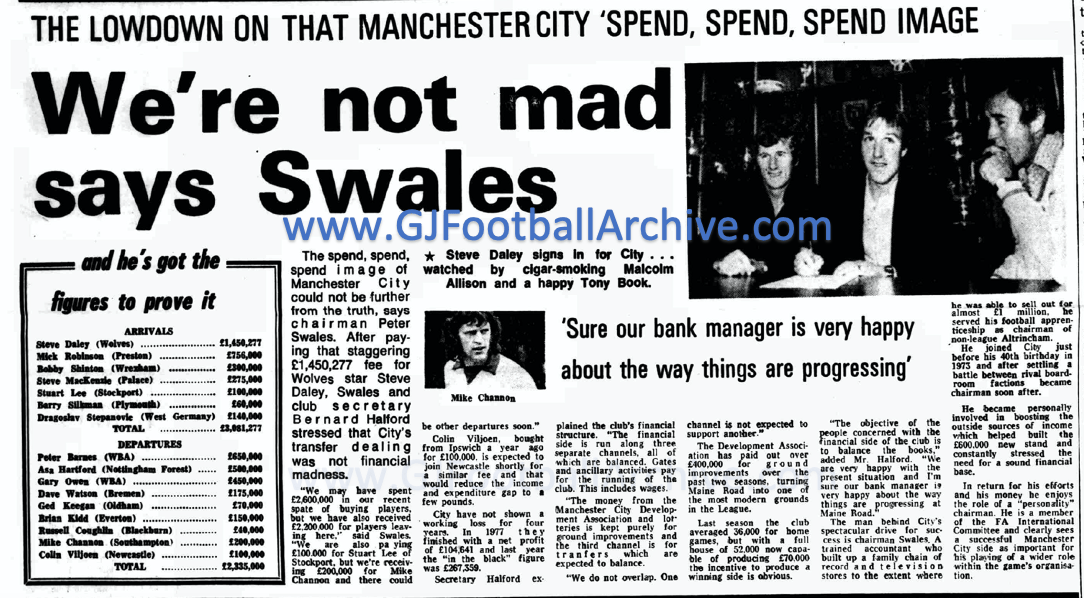
Well, it seems the norm today to talk about the cost of Manchester City’s squad with TV commentators frequently talking about the price of City’s bench. It gets tiring. However, this is not the first time the media talked of City as a ‘spend, spend, spend’ club. Today marks the anniversary of one day in particular when City’s spending caught the media’s attention. That day was on 6 September 1979 when Steve Daley signed for the Blues at a cost of £1,450,277.
City had to defend this spending which – and I know it’s difficult to understand in the modern world of £100m+ footballers – absolutely stunned football. This transfer was the British record but it was perceived as huge.
Chairman Peter Swales’ defence for the spending was that City was a profitable club (see the article) and this is true. City were a hugely profitable club in the 1970s but that all changed over the coming years with Swales, his supporting directors and managers getting giddy trying to buy success. As we all know it takes more than money to generate success and this period of City’s history is the one that actually created the club’s fall from grace, leading to some to believe in the 2010s & 2020s that the club had ‘no history’ and was not a ‘giant’. All that is balderdash. City were a giant who fell unlucky through poor management by a board of directors who did not plan for long term development.
Anyway, lots to say on this but read the article here from 1979 and hopefully that will show the position of strength the club was in (but soon messed up!).
While you’re here why not listen to one of my interviews with Malcolm Allison. You can hear a taster here: