Today’s 1980s flashback is to a game that ends 2-2 after Manchester City had twice gone behind to Coventry. It’s from this day (21 December) in 1986 and the goalscorer who twice saved City from possible defeat is defender Steve Redmond. Watch the highlights here on a video clip that contains no commentary (MCFC in red and black). I was at the game that day as this was my first trip to Coventry City and I am stood in the away section to the right of the screen in the open end (far right). Sadly, the away section is not visible but I remember this as a good away following.
My series on the 1980s highlights a truly important decade in the history of Manchester City Football Club. You can read about this period in the following article – it is a 2,500 word feature on the 1986-87 season. Enjoy!
Subscribe to get access – Monthly
Read more of this content when you subscribe today. It costs £3 per month (cancel anytime) to access everything posted since 1 October 2022 or there’s a special annual rate below which gives greater access and works out much cheaper.
Read more of this content when you subscribe today. It costs £3 per month (above) or £20 a year (here) to access everything posted since the site was created in December 2020. This special rate works out about £1.67 a week and gives access to everything posted, including PDFs of 3 of my books.
Continuing the series focusing on Manchester City in the 1980s here’s a list of items available at the City Souvenir Shop in December 1982. It’s an interesting list but what would you want to buy?
For a few minutes I was puzzled by the items marked ‘centenary’ thinking are they talking of the centenary of the earliest known game as St Mark’s in 1880 or have they got things completely wrong? Then I realised these items refer to the 100th FA Cup Final (so not really a centenary of the FA Cup either, but I do know City’s souvenir shop did talk of it as the ‘Centenary Final’, though that is usually regarded as the 1972 final; the 1981 final was known as the ‘100th Final’).
I bet there are a few reading this who bought some of the items on the list.
If you want to know more about this period then why not subscribe? As well as all the other benefits you could read the following 3,500 word feature on the 1982-83 season. Enjoy (well, if you know the outcome of this season you can enjoy this memory refresh while reflecting on the modern day successes of the Blues!).
Subscribe to get access – Monthly
Read more of this content when you subscribe today. It costs £3 per month (cancel anytime) to access everything posted since 1 October 2022 or there’s a special annual rate below which gives greater access and works out much cheaper.
Read more of this content when you subscribe today. It costs £3 per month (above) or £20 a year (here) to access everything posted since the site was created in December 2020. This special rate works out about £1.67 a week and gives access to everything posted, including PDFs of 3 of my books.
A new daily series of articles for subscribers started last week covering the 1980s. This is a seasonal journey through a truly important decade in the history of Manchester City Football Club. Today’s article is a 4,000 word feature on the 1987-88 season. Enjoy!
Subscribe to get access – Monthly
Read more of this content when you subscribe today. It costs £3 per month (cancel anytime) to access everything posted since 1 October 2022 or there’s a special annual rate below which gives greater access and works out much cheaper.
Read more of this content when you subscribe today. It costs £3 per month (above) or £20 a year (here) to access everything posted since the site was created in December 2020. This special rate works out about £1.67 a week and gives access to everything posted, including PDFs of 3 of my books.
A new daily series of articles for subscribers started last week covering the 1980s. This is a seasonal journey through a truly important decade in the history of Manchester City Football Club. Today’s article is a 2,500 word feature on the 1986-87 season. Enjoy!
Subscribe to get access – Monthly
Read more of this content when you subscribe today. It costs £3 per month (cancel anytime) to access everything posted since 1 October 2022 or there’s a special annual rate below which gives greater access and works out much cheaper.
Read more of this content when you subscribe today. It costs £3 per month (above) or £20 a year (here) to access everything posted since the site was created in December 2020. This special rate works out about £1.67 a week and gives access to everything posted, including PDFs of 3 of my books.
The deadline for the last ever King of the Kippax fanzine has passed and I missed it. I meant to get something sent to Dave and Sue Wallace but circumstances meant I couldn’t and I really regret that. So instead I’m posting here a piece I wrote ten years ago in 2013 when there were a series of footballing anniversaries. It’s not quite what I intended but I hope it says enough of how I feel about fanzines and the role of King of the Kippax over the decades.
It’s a season of footballing anniversaries this year (2013). The FA celebrates 150 years, the Football League 125 and King of the Kippax an amazing 25 years. Of these three anniversaries KK is inevitably getting the least focus but in many ways its significance to football, or at least our team, has been greater during its first 25 years than the FA’s first 25.
The FA did little to support football in Manchester for decades and it wasn’t until Manchester’s clubs started to take the FA Cup seriously that the organisation began to matter. But even then the FA did its upmost to prevent our professional clubs from challenging properly. In 1904 when City became Manchester’s first FA Cup winners how did the FA react? They decided we must be doing something illegal and sent auditors to the club to determine if we had ‘bought’ success. Okay, so they found a few irregularities with a transfer from Glossop, but for the following year or so they relentlessly pursued our club (and to be fair did something similar with Newton Heath, who became United, and with Glossop). Ultimately, we received a devastating punishment and the club could have died. I won’t go on about how unjust all of this was – City were no worse than most sides the difference being that the FA was determined to catch us out! – but if you do want to read an account of it dig out my latest book “Manchester The City Years”.
Despite all of this the FA Cup actually gave City our first success and we should ensure we celebrate 23 April 1904 (the date of the final) every year – make St George’s Day City’s day!
The Football League was more supportive of City during those early years, but prior to 1892 the League had no involvement from either Manchester side despite the League holding its first meeting in Manchester. Our celebrations of the League should really come in 4 years’ time when it’ll be 125 years since City (as Ardwick) joined the League. Although it’s worth pointing out that Ardwick and Manchester City were two separate organisations – and stressed as such at the time – and even existed alongside each other for a short while (personally though, I see MCFC as a continuation of Ardwick in spirit if not in legal terms). From 1892 to 2002 (when City last competed in the Football League) the Football League was central to City’s life. The competition became City’s lifeblood as far as competition was concerned.
What about KK? Well, unlike the other two KK was significant to City and City fans from the start. It was born in an era when fans had much to say but little opportunity to be heard. Alongside the other fanzines born in the late 1980s KK gave us a voice and a shared understanding of what the issues at City and in football were. Before the fanzines our only real outlet was the Piccadilly Radio phone-in on Saturdays which came in to its own during the time James H Reeve was at the helm. We had no forums, blogs, tweets etc. We didn’t have phone-in shows on national radio or fan columns in newspapers. We didn’t have interaction with the club, other than via supporters clubs meetings which some fans saw as being too weak to challenge the club on key issues (I won’t get into all of that here, but it’s worth noting that some fans did feel the Supporters Club was too close to Peter Swales and, as he was often the cause of fan concerns, that caused some issues).
We did also have the Pink postbag in the Saturday sports paper, sadly no longer with us. Unfortunately, journalists on the paper in the late 80s would contact the club to get their views before publishing a controversial or critical letter (this happened with one from me in 1987 which presented evidence about an issue that mattered to fans but was ultimately swept under the carpet). Censorship and club propaganda was an issue at a time when the game was dying and fans were being treated appallingly.
King of the Kippax helped to give us a voice and helped highlight the issues. Staff at City would be sent out to buy the fanzine in its early days, while others would do all they could to limit the fanzine’s opportunity to question what was going on – proving the significance of the fanzine. I don’t want to get too giddy about what KK and the other fanzines achieved but it is important that we all understand what has been achieved. It’s a bit like the electoral system – people fought hard to get the vote in the face of adversity but today we take it all for granted. We think it’s always been like this. Now with social media it would be easy to forget what KK and the other fanzines have achieved. Many fanzines have stopped being produced, which makes it all the more important to celebrate KK’s 25th anniversary and to congratulate Dave, Sue and all the contributors over the years for what they’ve achieved. I still read KK from cover to cover and find all the regular contributors interesting. I don’t always agree with everything I read but, I guess, that’s always been the point. KK has promoted debate and encouraged fans to think about issues, and that’s how it should be.
I hope King Of The Kippax continues to provide a powerful outlet for fans for years to come. It’s important that we remember that before the fanzines we didn’t have a voice. Thanks Dave & Sue, and the others, for all you’ve done and continue to do for us.
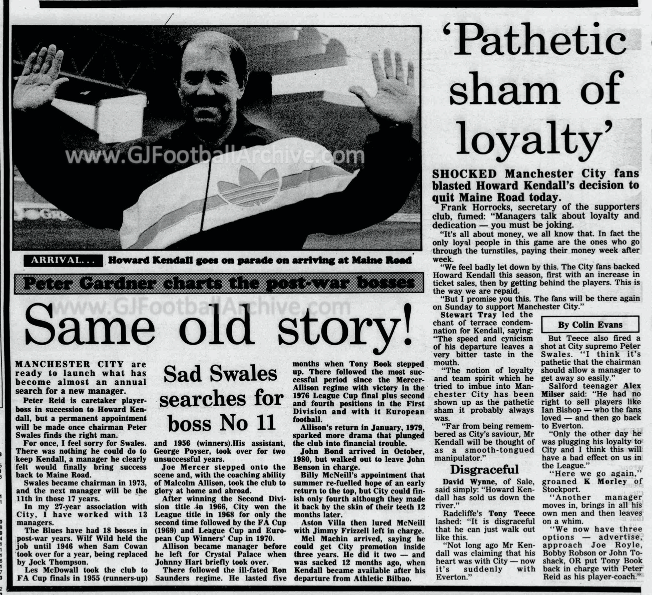
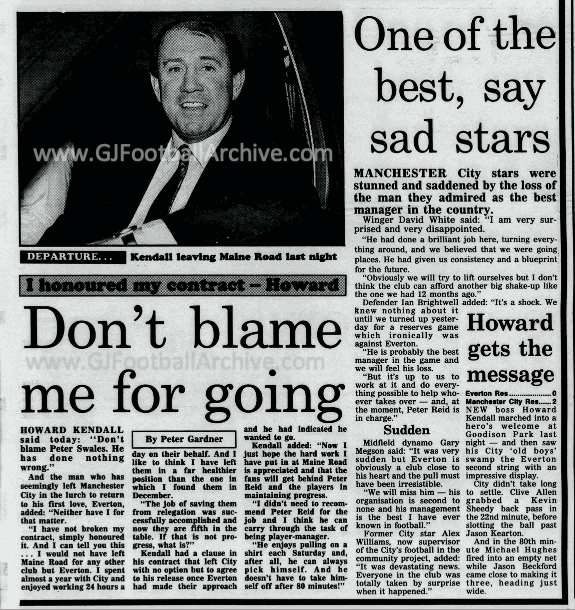
On this day (7 November) newspapers were full of the previous day’s news that had stunned Manchester City and that was the resignation of manager Howard Kendall. Kendall had decided to return to his former club Everton.
The move absolutely stunned City fans (though we did get the blame in some newspapers who claimed we’d never actually taken to him – absolute rubbish and demonstrates the typical attitude of the period which was if anything went wrong blame the fans!). Fans had voiced concern over Kendall’s signing of many, many former Evertonians but overall they were satisfied (more than satisfied) with the manager’s approach at City.
The bottom line with Kendall leaving is that chairman Peter Swales and his supporting directors had given him a contract that allowed him to walk out on the job whenever he chose. It was a strange situation and the belief at the time was that the City board had believed the ONLY job Kendall would be tempted to leave City for was the England job and, with Peter Swales in charge of the international selection committee, the chance of that happening was extremely slim.
Ah well! Here are some newspaper articles from this day back in 1990.
I’m sure some will believe this didn’t happen but on this day (31 October) in 1930 the previous night’s meeting of the so-called Boycotting Committee of the Manchester United Supporters Club met to discuss their next boycott of a first team game. There was widespread dissatisfaction of the plight of the Reds that season and the season would end with United’s Old Trafford average being 11,685 (the lowest average for either United/Newton Heath or City since Newton Heath averaged 4,650 in 1902). Neither side has attracted a lower average since.
What’s significant about this brief article is the mention of the planned boycott v Arsenal – that game attracted the highest crowd of the season to date! This demonstrates how difficult it is to plan a protest and for all fans to join in.
I explored the boycott and fan related issues in Manchester A Football History (my 2008/2010 update) book. This has been out of print for over a decade but PDFs of every chapter are free to download for all who subscribe. See the following for details of how to subscribe:
If you enjoy all the free material on my website and would like to support my research and keep this website going (but don’t want to subscribe) then why not make a one-time donation (or buy me a coffee). All support for my research is valued and welcome. It allows me to keep some free material available for all. Thanks.
A year ago today (22 October) lifelong City fan Bobby Ward was in touch with a video he’d caught during City’s home game v Brighton of fans chanting a new Erling Haaland chant. Here’s the video (look out for the actions):
What shall we do with a big Norwegian, What shall we do with a big Norwegian, Can’t stop him from scoring, Erling, Erling Haaland, Erling, Erling Haaland…
The game v Brighton on 22 October 2022 ended in a 3-1 City win with Haaland scoring twice.
I’m always keen on the development of football chants, so if you’re one of the guys who started this please get in touch with your story of the chant, the actions and so on. I’d be happy to say more about it here. You guys were certainly persistent.
2023 marks the 100th anniversary of Maine Road’s first game and to commemorate this landmark moment I have been posting a different image or feature on the old stadium each day for the last 100 days. Today is day 100 and is the actual centenary of that historic first game. So guess what I’m covering today? On this day (25 August) in 1923 Manchester City’s Maine Road Stadium staged its first game. Here is film of that landmark day in Manchester’s sporting history…
You can also read a 1100 word article about the opening of the stadium and on why the ground was considered to be the ‘English Hampden’ and not the ‘Wembley of the North’ that some have tried to claim in more recent times.
Subscribe to get access – Annual
Read this and all other content when you subscribe. It costs £20 a year to access all the articles, interviews, talks and books on the site plus everything posted during your subscription. There’s also a monthly option (see below)
Monthly subscriptions (cancel any time) costs £3 per month to access all the articles, interviews, talks and books posted on the site since 1 October 2022 plus everything posted during your subscription. Why not try it for a month?
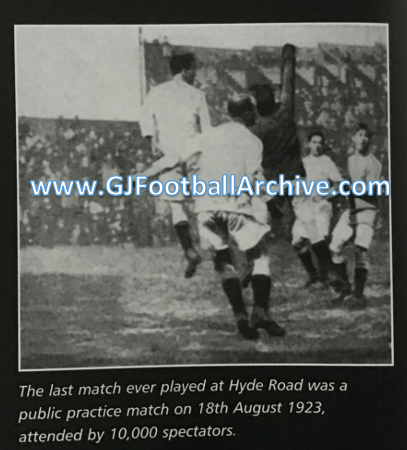
On 18 August 1923 the last ever game, a practice match, was staged at Manchester City’s Hyde Road ground with a crowd of about 10,000. Afterwards the goal posts and a few turnstiles were taken from the old ground and erected at Maine Road – about 6 were still at Maine Road in 2003 when it was demolished. Attempts were made to keep one of the oldest (from 1896) and re-erect it in a public area at the new stadium. Sadly, the day before it was to be removed the external wall was smashed and the turnstile was stolen.




 Gary James' Football Archive